

My daughter-in-law threw a nearly $3,000 dinner bill in front of me and said, “Consider it your fee to sit with us. If you can’t afford it, you don’t belong here.” I reached toward my purse, but before I could open my wallet, a young waiter leaned toward my ear and whispered, “Ma’am, please don’t pay. You need to see this first.” What he showed me that evening exposed a plan my daughter-in-law and her mother had been preparing for months. And by the time they discovered what I actually owned, the most expensive thing they had lost was not their money.
My name is Martha Bennett. I’m sixty-three years old, a widow, a mother, and the owner of a commercial cleaning company in Charlotte, North Carolina.
For most of my life, I have worn comfortable shoes, driven practical cars, and avoided conversations about money.
Those choices apparently convinced my daughter-in-law, Sloane, that I had very little of it.
I never bothered correcting her.
When my husband, Samuel, died nine years earlier, he left me a small house, a garage full of tools, and memories I still couldn’t revisit without crying.
Everything else I had built myself.
My company started with one vacuum cleaner, three residential customers, and a borrowed van that needed a new transmission every other winter.
By the time Sloane entered our lives, Bennett Facilities employed more than two hundred people.
We cleaned medical offices, restaurants, distribution centers, office buildings, and several large commercial properties throughout the Carolinas.
We also owned real estate.
Quite a bit of it.
But Sloane knew only that I ran a cleaning service.
In her world, cleaning was something wealthy people paid other people to do. Therefore, the woman running a cleaning business must belong to the second category.
I could have told her otherwise.
I chose not to.
My son, Caleb, married Sloane two years earlier.
He was thirty-six, thoughtful, hardworking, and, until recently, the kind of man who would stop whatever he was doing to help a stranger change a tire.
His father had taught him that.
I had raised him to believe that kindness mattered more than appearances.
For a long time, I thought those lessons had stayed with him.
Then he met Sloane Whitmore.
She was beautiful, educated, polished, and extraordinarily skilled at making cruelty sound like good manners.
Her mother, Vivian, was even better.
Vivian treated people as though everyone in the world had been assigned a particular seat, and her greatest responsibility was ensuring nobody sat above their station.
The first time we met, she asked whether I cleaned houses personally.
“Sometimes,” I answered.
She smiled.
“How wonderfully humble.”
I remember thinking there was nothing humble about honest work.
But I kept the thought to myself.
At the wedding, I sat near the back because Vivian’s friends needed the front tables.
When the photographer arranged family portraits, I was asked to step aside for one picture and forgotten when the next photograph was taken.
When I offered to contribute toward the wedding flowers, Sloane told me everything was already covered.
Later, I learned Vivian had described my offer as “sweet but unnecessary.”
I did not complain.
Caleb seemed happy.
That was enough.
Or at least I convinced myself it was.
Three days before Vivian’s sixty-fifth birthday, Caleb called me.
“Mom, are you doing anything Saturday evening?”
“Probably catching up on paperwork. Why?”
“Vivian’s having a birthday dinner. Sloane wants you there.”
I paused.
Sloane had never particularly wanted me anywhere.
“That’s nice of her.”
He didn’t answer immediately.
Then he said, “I’d really like you to come.”
Something about his voice bothered me.
He sounded tired, almost careful, as though somebody might be listening.
“Caleb, is everything all right?”
“Yeah, Mom. Everything’s fine.”
I had heard that answer too many times recently.
I asked about my granddaughter, Emma.
“She misses you,” he said.
Emma was five years old, with brown curls, enormous questions, and a habit of calling me Grandma Marty.
I hadn’t seen her in almost six weeks.
Every planned visit had been canceled.
One weekend she was sick.
Another weekend Sloane had scheduled family photographs.
The following Sunday, Vivian supposedly needed help organizing an event.
“Bring Emma by soon,” I told him.
“I’ll try.”
Not “I will.”
“I’ll try.”
That should have told me more than it did.
Saturday evening, I opened my bedroom closet and pulled out a navy dress I hadn’t worn in eleven years.
Samuel had bought it for our twenty-fifth wedding anniversary.
He’d saved for months, then pretended he’d discovered it on clearance.
When I came downstairs wearing it, he had stopped in the hallway and smiled.
“You look like the woman I fell in love with,” he said.
I had laughed and told him I was exactly the same woman.
He shook his head.
“No. You’re stronger now.”
Standing before my mirror that Saturday, I remembered those words.
I fastened a pair of small pearl earrings, brushed my silver hair into place, and picked up the brown leather wallet Caleb had bought me with his first paycheck.
The wallet was worn at the corners.
Sloane had once suggested I replace it.
But Caleb had been nineteen when he handed it to me, proud as a king because he’d finally earned enough money to buy his mother something.
I wasn’t going to throw it away simply because someone else thought it looked cheap.
The restaurant was called The Hawthorne Room.
It occupied the ground floor of a renovated historic building in uptown Charlotte.
Tall windows overlooked the street. Brass fixtures gleamed beneath warm lights. Fresh flowers stood in enormous ceramic vases.
A valet approached my car.
I thanked him, tipped him, and walked inside.
Near the entrance, the general manager, Elena Ruiz, looked up from the reservation desk.
Her face brightened.
“Mrs. Bennett. Good evening.”
“Hello, Elena.”
“It’s lovely to see you again. How was the inspection this morning?”
“Excellent. Your kitchen passed every item on our service checklist.”
“Your team was wonderful last night.”
“I’m glad.”
We exchanged a quiet smile.
My company had held the restaurant’s overnight cleaning contract for almost four years.
When their previous contractor abruptly closed, Bennett Facilities had arranged emergency crews before a major holiday weekend.
Elena remembered.
She had repeatedly told me that our workers were the reason the restaurant could maintain its standards.
I had come directly from inspecting their work several times.
But Vivian’s family knew none of that.
Elena glanced toward the private dining room.
“Are you joining the Whitmore celebration?”
“I am.”
For one brief moment, something crossed her face.
Concern.
Then professionalism returned.
“Of course. Right this way.”
I noticed it.
I didn’t understand it until much later.
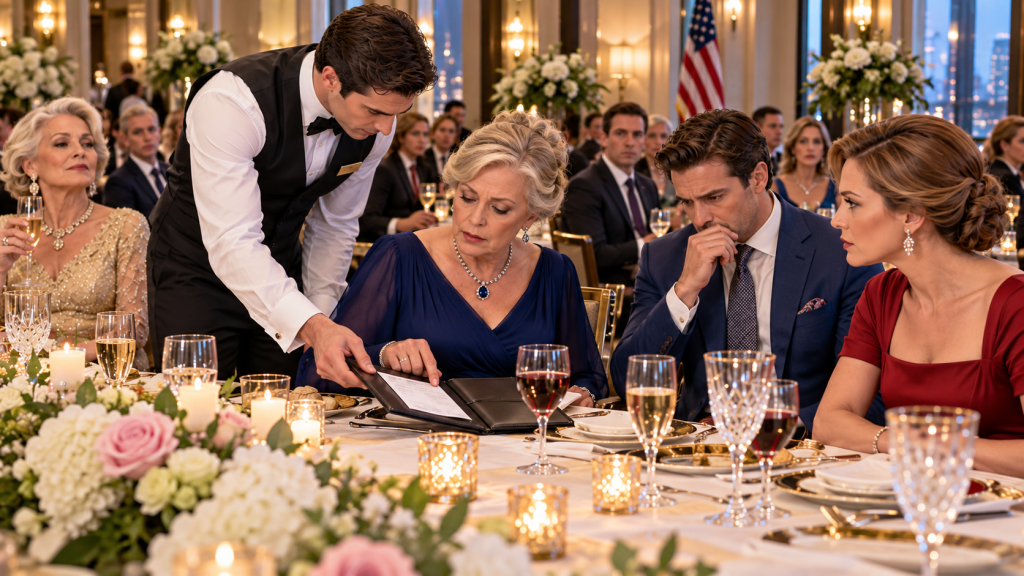
Twenty-seven people were gathered around a long dining table covered in white linen.
Crystal glasses reflected the candlelight.
There were champagne bottles chilling in silver buckets and flower arrangements so large that guests had to lean around them to talk.
Vivian sat at the head of the table in a silver beaded gown.
Sloane stood beside her wearing emerald green.
Caleb sat three seats away, staring at his phone.
When I entered, Vivian lifted her chin.
“Martha! You made it.”
Several guests turned.
I smiled.
“Happy birthday, Vivian.”
I handed her a small wrapped package.
Inside was a hand-painted porcelain trinket dish I had purchased from a local artist.
Vivian glanced at the wrapping.
“How thoughtful.”
She passed it to a woman standing behind her without opening it.
“Could you put this with the other things?”
Then she looked at me more closely.
“Is that an old dress?”
“It is.”
“How charming. Vintage is coming back, I suppose.”
A woman nearby gave a polite laugh.
I smiled and said nothing.
Sloane guided me toward the far end of the table.
“We managed to squeeze you in.”
My place card was positioned between two strangers near the service doorway.
Caleb noticed.
“Mom, you can sit beside me.”
Sloane rested her hand on his shoulder.
“Caleb, we already arranged the seating.”
He looked at her.
Then at me.
And slowly sat back down.
That was the first moment I realized something was deeply wrong.
My son had never been afraid to ask someone to move a chair.
Yet that evening he looked as though even the smallest disagreement might cause an explosion.
Dinner began.
For the next hour, Vivian described her travels, properties, expensive renovations, and acquaintances whose names apparently carried tremendous importance.
She mentioned Monaco three times.
She discussed a school that charged more in annual tuition than many people earned.
She told a long story about refusing to stay at a hotel because the staff had placed her luggage in the wrong suite.
Everyone laughed.
I listened quietly.
Then one of Vivian’s friends turned toward me.
“And what do you do, Martha?”
“I run a facilities services business.”
Vivian waved one manicured hand.
“She’s being modest. It’s a cleaning service.”
“Commercial cleaning,” I clarified gently.
“Oh, of course,” Vivian replied. “Offices and things.”
The woman smiled uncertainly.
“That sounds like hard work.”
“It is. I’m very proud of our employees.”
Vivian leaned forward.
“Surely you’re thinking about retirement.”
“Not yet.”
“At your age?”
I took a sip of water.
“I still enjoy what I do.”
“How wonderful to have something to occupy your time.”
I could have mentioned that my company had just secured a multiyear contract worth several million dollars.
I could have explained that my managers handled daily operations while I focused on acquisitions, finances, and employee development.
But why?
People determined to misunderstand you rarely change their minds because you recite your résumé.
So I asked Vivian whether she was enjoying her birthday.
She began another story about Switzerland.
Across the table, Caleb barely touched his dinner.
Whenever his phone lit up, Sloane glanced toward it.
When he tried to speak, she interrupted him.
When he declined a second glass of wine, Vivian called him tense.
He smiled without showing his teeth.
I knew that smile.
He had worn it as a child whenever he was trying not to cry.
After the main course, Sloane excused herself.
I watched her walk toward the reservation desk.
She spoke briefly with someone near the front.
Then she disappeared around the corner.
Several minutes later, she returned carrying a slim leather folder.
She exchanged a glance with Vivian.
Vivian placed her champagne glass down.
The movement was small.
But deliberate.
Then Sloane approached me.
“Martha, there’s one little thing we should take care of.”
She placed the folder directly in front of my plate.
I looked up.
“What is it?”
“The bill.”
I opened the folder.
The amount was $2,948.65.
For a moment, I assumed she was showing me the cost of the celebration for some ordinary reason.
Then Sloane smiled.
“Consider it your fee to sit with us.”
The conversation around the table faded.
I looked at her.
“Excuse me?”
“If you can’t afford this dinner, you don’t belong here.”
Nobody moved.
Twenty-seven adults sat in a room full of expensive food and watched a woman publicly humiliate her husband’s mother.
Vivian lifted her champagne glass.
“Sloane does have a point. Family occasions require everyone to contribute.”
I looked toward Caleb.
His gaze was fixed on his wineglass.
His fingers tightened around the stem.
“Caleb?”
He swallowed.
“Mom…”
Sloane touched his shoulder.
“Let your mother handle this herself.”
He fell silent.
That hurt more than the bill.
I had worked through twelve-hour shifts, illness, loneliness, and years of financial uncertainty to give my son a secure childhood.
I had never wanted repayment.
I had only wanted him to grow into someone who wouldn’t watch another person be treated cruelly.
Yet there he sat.
Silent.
For several seconds, I felt something fragile inside me begin to crack.
Then I reached for my purse.
Not because I believed I owed the money.
I simply wanted to end the spectacle without giving them the angry reaction they seemed to be waiting for.
Sloane’s smile widened.
Vivian leaned back.
A man farther down the table raised his phone.
I noticed the camera pointed toward me.
I opened my purse and touched the old brown wallet.
That was when someone stepped behind my chair.
“Ma’am.”
I looked up.
A young waiter stood beside me.
His name tag read NOAH.
He leaned closer.
“Please don’t pay.”
His voice was almost inaudible.
I studied him.
He couldn’t have been older than twenty-three.
His expression was strained, and he glanced toward Sloane before continuing.
“There’s something you need to see.”
I slowly removed my hand from my purse.
Sloane noticed immediately.
“Is there a problem?”
“No,” I said calmly. “I’m just checking something.”
Noah carefully turned the folder toward me.
Near the bottom of the paperwork was a notation I had overlooked.
It identified Sloane Whitmore as the person who had requested the charge be assigned to me.
But another line was even more interesting.
The dining event had already been covered by a corporate deposit.
The balance due to the restaurant was zero.
I looked at Noah.
“This is already paid?”
He nodded.
“Yes, ma’am. It was settled before dinner.”
My eyes returned to the paperwork.
“Then why was it presented to me?”
He hesitated.
Then he slipped a folded sheet beneath my napkin.
“Because this wasn’t about the money.”
I unfolded the paper under the table.
It was a printed email addressed to the restaurant’s events department.
Sloane had sent it the previous afternoon.
The message instructed staff to prepare an itemized statement for me, even though Vivian’s company had already covered the meal.
It requested that the statement be delivered while the family was gathered.
It also specified that the reaction should be allowed to continue without interruption.
Then came the sentence that made my skin go cold.
“Once Martha refuses payment, proceed with the attached financial incapacity documentation.”
I read it twice.
Financial incapacity?
What did that have to do with a birthday dinner?
Before I could speak, Noah leaned closer.
“Your son came here yesterday asking questions about those papers.”
I looked at Caleb.
He finally raised his eyes.
The expression on his face was not embarrassment.
It was fear.
Noah continued.
“He asked the manager to preserve everything.”
Then Elena appeared beside our table carrying a large envelope.
“Mrs. Bennett,” she said quietly, “before anyone pays, there’s something your son asked us to keep safe.”
The room had become so silent that I could hear the restaurant’s kitchen doors swinging in the distance.
Sloane stood.
“Elena, this is a private family matter.”
Elena remained composed.
“I understand. But our restaurant will not participate in misleading a guest about an account.”
Vivian set down her glass.
“Excuse me?”
“The dinner has already been paid for,” Elena explained. “There is no outstanding restaurant charge.”
A woman near the middle of the table frowned.
“Then why are we asking Martha to pay?”
Nobody answered.
Sloane’s cheeks reddened.
“That’s not what this is about.”
“Then explain what it is about,” I said.
She crossed her arms.
“We were trying to see whether you could handle a simple financial responsibility.”
“A responsibility I never agreed to?”
“You’re missing the point.”
“No,” I replied. “I’m beginning to understand it.”
I looked at Elena.
“May I see the envelope?”
She handed it to me.
Inside were copies of the event instructions and correspondence Sloane had sent the restaurant.
There was also a note confirming that management had declined her request to involve restaurant employees in any staged confrontation.
Sloane had proceeded anyway.
She had collected a paid receipt herself and presented it to me as though I owed the money.
But the most disturbing document was a page headed FAMILY FINANCIAL CAPACITY REVIEW.
It contained my name.
My age.
My home address.
And a list of statements describing supposed problems with my memory, decision-making, and ability to manage money.
One statement claimed I had repeatedly forgotten important bills.
Another claimed I was vulnerable to manipulation because I lived alone.
A third claimed my refusal to cooperate with reasonable family requests showed impaired judgment.
At the bottom was a blank section labeled OBSERVED INCIDENT.
Beside it, someone had typed the date of Vivian’s birthday dinner.
I stared at the page.
They had prepared to record my refusal before the dinner even began.
The elaborate humiliation wasn’t spontaneous.
It was an assignment.
I slowly lifted my head.
“Caleb.”
My son closed his eyes.
“Tell me you didn’t help prepare this.”
He shook his head.
“No, Mom.”
“Then tell me why your wife has a document describing me as financially incapable.”
Sloane stepped between us.
“Because someone has to think about your future.”
I looked directly at her.
“My future?”
“You’re getting older, Martha. And you have assets you don’t necessarily know how to manage.”
For the first time that evening, she seemed to realize she’d said too much.
I watched her expression change.
Vivian interrupted.
“This conversation is becoming inappropriate.”
I almost smiled.
“Inappropriate? You’ve just handed me a three-thousand-dollar bill for a dinner you already paid for, hoping I’d embarrass myself so you could document it as evidence that I can’t manage money.”
Several guests turned toward Vivian.
One woman quietly pushed back her chair.
A man who had been filming lowered his phone.
I looked at him.
“Please don’t delete that recording. I may need it.”
He froze.
Then nodded.
Sloane pointed toward the envelope.
“You’re making assumptions.”
“Perhaps. So let’s clear them up.”
I held up the financial review.
“Who prepared this?”
She said nothing.
“Who decided I needed to be evaluated?”
Vivian stood abruptly.
“Martha, we have tried to be patient with you.”
“Patient about what?”
“Your unwillingness to plan responsibly.”
I studied her.
My finances were private.
My retirement plans were private.
My business arrangements were private.
I had never asked Vivian for money, advice, or help.
Yet she was speaking as though she’d been supervising my life for years.
“Vivian,” I asked softly, “what exactly do you know about my assets?”
She lifted her chin.
“Enough.”
That single word changed everything.
I looked at Caleb.
“Come outside with me.”
He stood immediately.
Sloane grabbed his wrist.
“We’re not finished.”
He looked down at her hand.
Then, slowly, removed it.
“Yes,” he said. “We are.”
I followed him toward the hallway.
Elena quietly directed us to an empty private room.
Noah brought water and closed the door.
For several moments, my son stood by the window, unable to look at me.
Then he began to cry.
Not loudly.
Not dramatically.
His shoulders simply collapsed.
“Mom, I’m sorry.”
I remained seated.
“Tell me what happened.”
He rubbed his face.
“It’s complicated.”
“Then start at the beginning.”
He took a breath.
“Vivian’s development company is in trouble.”
I waited.
“They’ve been carrying loans on two commercial projects. One of the projects stalled, and their lender wants additional security before renewing the debt.”
“What does that have to do with me?”
He finally looked at me.
“They want your industrial property.”
I felt my heartbeat slow.
“The Rowan Industrial Yard?”
He nodded.
My husband and I had purchased that land almost nineteen years earlier.
At the time, it was an aging industrial property on the edge of Charlotte.
Samuel had thought the warehouses would make a good base for my expanding cleaning operation.
We had purchased the site through a holding company and gradually renovated the buildings.
As the surrounding area developed, the property’s value increased dramatically.
The most recent independent appraisal had placed it above nine million dollars.
Very few people outside my legal and financial team knew that.
Apparently, Vivian did.
“How did they find out about Rowan?” I asked.
“Public property records. Then they hired someone to research the companies connected to it.”
I leaned back.
For two years, the Whitmores had treated me as a woman barely capable of buying a decent dress.
But someone had been quietly investigating my holdings.
“Go on.”
Caleb swallowed.
“Vivian wanted me to ask you to sell the property to one of her companies. She said it would be a family investment.”
“At what price?”
He stared at the floor.
“Two million dollars.”
I didn’t speak.
A property worth more than nine million.
For two million.
“They thought you’d accept because you wouldn’t know what it was worth,” he whispered.
I looked away.
Outside the window, headlights moved along the street.
I remembered Samuel standing beside me in that old warehouse years earlier.
The roof leaked.
The walls smelled of dust and engine oil.
We had eaten sandwiches on overturned paint buckets while discussing whether we’d made a terrible financial mistake.
He’d squeezed my hand.
“One day,” he said, “this place will take care of you.”
The memory hurt.
Then Caleb spoke again.
“When I refused to ask you, Sloane said there were other ways.”
My attention snapped back.
“Other ways?”
“She started talking about financial protection. Medical assessments. Family guardianship.”
I stared at him.
“She wanted to have me declared incapable of managing my own affairs?”
He nodded miserably.
“She said a court could appoint someone to protect your interests.”
“Someone like you?”
He said nothing.
I understood.
They wanted my son placed in a position where he might gain control over my property.
They had apparently convinced themselves that an adult woman who cleaned buildings for a living couldn’t possibly understand the assets registered in her own name.
They were wrong about the business.
And they were dangerously wrong about the law.
One staged dinner would never establish incapacity.
But they intended to create a paper trail of misleading incidents, statements, and observations until someone took their story seriously.
“How long have you known?”
Caleb’s face crumpled.
“About six weeks.”
Six weeks.
I thought about all the canceled visits.
All the hurried telephone calls.
All the times he’d told me everything was fine.
“Why didn’t you tell me?”
He took a shaky breath.
“Because I was ashamed.”
“Of what?”
He sat opposite me.
“Last year, Vivian helped me get a job with her development company. She paid me well. I thought I was finally doing something impressive.”
Caleb had studied construction management.
He had worked his way through several modest positions before accepting Vivian’s offer.
I’d been proud of his success.
“She started asking me to sign internal documents,” he continued. “Loan guarantees. Project authorizations. Things she said were routine.”
My stomach tightened.
“How much?”
“Eighty-five thousand dollars in personal exposure on one agreement. Maybe more, depending on how the lender interprets another.”
I closed my eyes briefly.
“Caleb.”
“I know.”
“No, sweetheart. You don’t.”
He began crying again.
“Sloane said if I told you, she’d leave me. She said she’d make sure Emma knew I was the reason our family fell apart.”
There it was.
Not simply greed.
Fear.
Shame.
And a marriage that had taught my son to confuse obedience with peace.
“I thought I could fix it,” he whispered.
I looked at him for a long time.
“By letting your mother be humiliated?”
He flinched.
“I didn’t know they were going to do this tonight.”
“But you knew something was planned.”
“Yes.”
“And you let me come.”
He lowered his head.
“Yes.”
That answer wounded me more than any excuse could have.
I loved Caleb.
I always would.
But love did not make his silence harmless.
“Why did you come to the restaurant yesterday?”
He pulled his phone from his pocket.
“Because I found the document they were making.”
He showed me screenshots of emails, property diagrams, financial summaries, and notes describing my supposed decline.
Some material had been obtained from public filings.
Other information appeared to come from documents I’d once given Caleb for his own estate planning.
He’d shared them with Sloane without asking me.
One screenshot contained an especially troubling phrase.
“Obtain execution of protective authority before lender deadline.”
I read it twice.
“What does that mean?”
“I don’t know exactly. I was afraid they were going to try to get you to sign something.”
“Or pretend I already had.”
He looked at me.
And in that moment, I understood why he was frightened.
“Caleb,” I said carefully, “is there a document with my signature on it?”
He nodded.
“I saw one.”
The room seemed to tilt.
“What document?”
“A power of attorney.”
I gripped the arms of my chair.
“I have never given Sloane or Vivian power of attorney.”
“I know.”
“Where is it?”
“Vivian’s office. I photographed part of it.”
He showed me another image.
There was my name.
My address.
A statement granting broad financial authority.
And at the bottom, a signature intended to resemble mine.
I stared at it.
Whoever had created it had copied the general shape of my handwriting.
But they had made one mistake.
They used the wrong middle initial.
I had signed my legal name the same way for forty years.
The forged document used the initial from an outdated online biography that contained a typographical error.
My anger settled into something colder.
“Caleb, listen carefully. Do not confront them about this document. Do not take anything from Vivian’s office. Do not alter or delete a single message.”
He nodded.
“I’m calling my attorney tonight.”
“Mom, I’m so sorry.”
I reached across the table and took his hand.
For a few seconds, he looked like the little boy who used to come into my kitchen after nightmares.
But he wasn’t little anymore.
He was a grown man who had choices to make.
“I love you,” I said. “But being frightened doesn’t excuse allowing someone to hurt another person.”
Tears rolled down his face.
“I know.”
“And if you’re serious about protecting Emma, you need to stop helping people who use her as a threat.”
He nodded again.
I released his hand.
Then I called my attorney.
Her name was Priya Shah.
She had worked with my company for almost fifteen years and handled my estate planning.
When she answered, I told her exactly what had happened.
She listened without interrupting.
Then she asked one question.
“Are you somewhere safe?”
“Yes.”
“Good. Have the manager preserve every original communication and transaction record. I’ll arrange to collect copies properly. Don’t sign anything tonight.”
“I wasn’t planning to.”
“And Martha?”
“Yes?”
“This sounds much more serious than a family argument.”
“I know.”
When I ended the call, Caleb remained silent.
I stood.
“I’m going back to the dining room.”
He looked alarmed.
“Mom, why?”
“Because I came here to wish someone a happy birthday.”
I paused.
“And because I’m not leaving with everyone thinking I agreed to pay a bill I never owed.”
When we returned, the atmosphere had changed.
Several guests had left.
The remaining people sat in awkward clusters.
Vivian was standing near the fireplace, speaking sharply to Sloane.
Both women turned when they saw me.
Sloane approached.
“Did Caleb explain our concerns?”
“He explained quite a lot.”
Vivian folded her arms.
“Then perhaps you understand why we’re worried about you.”
I studied her face.
Her expression contained no guilt.
Only calculation.
“Vivian, your birthday dinner was paid for before I arrived.”
“Yes.”
“You asked me to pay nearly three thousand dollars anyway.”
“It was a test.”
“A test I never agreed to.”
“Families sometimes have to make difficult decisions.”
I glanced toward the guests.
“Then I suppose we should be very careful about the decisions we make.”
Sloane stepped forward.
“You’re turning this into a scandal.”
“No. I’m declining to participate in one.”
Vivian gave a dismissive laugh.
“Really, Martha. You’re making yourself sound very important.”
I looked at Elena, who was standing near the doorway.
“Elena, did our overnight team finish the floor restoration in the west dining room?”
“Yes, Mrs. Bennett. It looks beautiful.”
“And the kitchen ventilation cleaning?”
“Completed ahead of schedule. Your supervisor sent the report this morning.”
I nodded.
“Excellent.”
Vivian stared at us.
“What are you talking about?”
Elena answered before I could.
“Bennett Facilities has been one of our commercial service partners for years. Mrs. Bennett’s company handles several major aspects of our building maintenance.”
A man at the table looked up.
“Bennett Facilities? The company with the contracts in three states?”
“Yes,” Elena replied.
I noticed Vivian’s expression change.
Sloane frowned.
“You mean Martha personally runs that company?”
“I own it,” I said.
The room fell silent again.
This time, the silence felt different.
Vivian stared at me.
“But Caleb said you had a cleaning business.”
“I do.”
“You never mentioned how large it was.”
“You never asked.”
A woman near the window covered a small smile.
I turned back to Vivian.
“You spent this entire evening discussing the importance of class, wealth, and belonging. You never once asked about the people who make your comfortable life possible.”
Vivian opened her mouth.
I continued.
“The servers carrying your plates. The cooks preparing your food. The cleaners who make sure this room is spotless before you arrive. Their work has dignity whether you recognize it or not.”
No one interrupted.
“And for the record, I could afford this dinner.”
Sloane gave a faint, triumphant smile.
“Then why make such a fuss?”
“Because I shouldn’t have to buy a place at my own family’s table.”
Her smile disappeared.
I picked up my purse.
“I won’t be paying a bill that has already been settled. And I won’t discuss my finances with either of you again without legal counsel.”
Vivian’s voice sharpened.
“Are you threatening us?”
“No.”
I looked directly at her.
“I’m informing you that I understand what you’re trying to do.”
Then I turned toward Elena.
“Thank you for looking after your guests.”
She nodded.
“Good night, Mrs. Bennett.”
Before leaving, I found Noah near the service station.
I thanked him.
He looked embarrassed.
“I just didn’t think it was right.”
“You made a difficult choice.”
“My mom used to work for your company,” he said.
I looked at him more closely.
“What’s her name?”
“Rosa Alvarez.”
I remembered immediately.
Rosa had worked on our medical facilities team for twelve years before retiring after a knee injury.
“She was a wonderful supervisor.”
Noah smiled.
“She always said you treated people fairly.”
I felt my throat tighten.
“Tell her Martha sends her love.”
“I will.”
He hesitated.
“I hope everything works out.”
“So do I.”
Then I walked outside.
I sat in my car for several minutes before starting the engine.
My hands were trembling.
Not from fear of Vivian.
From grief.
Because no amount of money could erase the sight of my son watching someone humiliate me while saying nothing.
When I finally drove home, Charlotte’s streets were nearly empty.
The house was dark.
I made tea I didn’t drink and sat at the kitchen table where Samuel used to read the newspaper.
For the first time in years, I spoke aloud to him.
“I don’t know how our boy got here.”
There was no answer.
Only the refrigerator humming and the clock ticking above the stove.
I cried then.
Not because Sloane had called me poor.
Not because Vivian had tried to embarrass me.
I cried because my son had become someone I scarcely recognized.
The next morning, I was awake before sunrise.
By eight o’clock, Priya was sitting at my kitchen table with her laptop open.
Beside her sat June McCall, my company’s chief financial officer.
June had worked with me for eleven years.
She knew every significant financial commitment connected to Bennett Facilities and its real estate holdings.
I gave them the documents from the restaurant.
Then I showed them Caleb’s photographs.
Priya studied the supposed power of attorney.
“Have you ever signed anything resembling this?”
“No.”
“Have you authorized anyone to act for you financially?”
“Only under the limited arrangements you prepared, and none involve Sloane or Vivian.”
Priya nodded.
“We’ll verify the current records and contact the relevant institutions.”
June leaned closer to the screen.
“Look at this parcel number.”
It belonged to Rowan Industrial Yard.
“And this address,” she continued. “It’s the registered office for Whitmore Development.”
My stomach tightened.
The forged power of attorney wasn’t merely an attempt to control my personal checking account.
It appeared connected to a proposed transaction involving Rowan.
June opened our property records.
The industrial yard was held by a company I wholly controlled.
It was neither jointly owned with Caleb nor part of any marital asset belonging to him.
No one could legitimately pledge it as collateral simply because they were related to me.
But someone had apparently been trying.
Priya made several calls.
By midday, we learned that a commercial lender had received preliminary documents suggesting my company was considering guaranteeing financing for a Whitmore project.
The documents had not resulted in a completed loan.
That was important.
But the information they contained was disturbing.
The proposed financing involved millions of dollars.
And Rowan Industrial Yard appeared repeatedly as potential security.
I stared at the screen.
“They were going to use my property to rescue Vivian’s development business.”
“That appears to be one objective,” Priya said carefully. “We need to establish exactly who prepared and submitted each document.”
June looked furious.
“Vivian couldn’t even be bothered to learn what our business does, but she found time to research our land.”
Priya closed one file.
“We’re going to handle this methodically. Preserve the evidence, correct the lender’s records, verify the disputed signatures, and make the appropriate reports.”
I nodded.
I wanted to storm into Vivian’s office.
I wanted to demand answers.
But Samuel had taught me something when we first started our business.
“Anger can tell you there’s a problem,” he used to say. “It can’t do your bookkeeping.”
So I let Priya work.
That afternoon, Caleb came to my house.
He looked as though he hadn’t slept.
He had a small overnight bag and a bruise-colored exhaustion beneath his eyes.
“Sloane told me not to come,” he said.
“Did she?”
“She says you’re trying to destroy the family.”
I stepped aside.
“Come in.”
He sat at the kitchen table.
I poured coffee.
For several minutes, neither of us spoke.
Then he said, “She’s taken Emma to Vivian’s house.”
My heart sank.
“Is Emma safe?”
“Yes. She’s with her mother.”
“Have you spoken to her?”
“On the phone. Sloane says I can see her when I apologize.”
“For what?”
“For embarrassing her family.”
I placed my cup down.
“Caleb, you need an attorney of your own.”
He stared at me.
“Are you going to help me?”
The question hurt.
“I’ll help you find competent legal advice. But I won’t pay off Vivian’s debts or pretend your decisions didn’t happen.”
He nodded.
“I understand.”
“Do you?”
He lifted his eyes.
“I spent two years trying to be the husband Sloane wanted. Then I spent another year trying to keep Vivian happy because she controlled my job.”
He rubbed his forehead.
“Somewhere along the way, I stopped saying no to anything.”
I listened.
“Every time I disagreed with Sloane, she said I was making her feel unsafe or unsupported. Every time I disagreed with Vivian, she reminded me how much money she’d invested in my career.”
He looked at the old photographs along my kitchen wall.
“I thought keeping peace meant keeping my family together.”
I sat opposite him.
“Peace built on fear isn’t peace, Caleb.”
He nodded slowly.
Then he opened his bag and removed a folder.
“I brought everything I have.”
There were employment agreements, loan documents, printed messages, and meeting notes.
He had obtained them from his own records and accounts.
Priya later advised him how to preserve the material without taking anything he wasn’t entitled to access.
One email changed the direction of the investigation.
It was from Vivian to Sloane.
The subject read: MARTHA STRATEGY.
Vivian had written that Caleb was proving unreliable.
She suggested approaching me directly through a proposed family investment.
If I refused, they would present my refusal as evidence that I was incapable of making reasonable financial decisions.
Another message described the birthday dinner as “a useful opportunity to demonstrate emotional instability.”
Sloane had replied with something that made me feel physically sick.
“She always gets upset when Caleb doesn’t defend her. I can make that happen.”
I read it several times.
They had deliberately used my love for my son against me.
They knew his silence would hurt.
They wanted my reaction.
And they had planned to turn that pain into evidence.
I pushed the paper away.
Caleb started to speak.
I raised my hand.
“Not yet.”
He stopped.
For a long while, I watched sunlight move across the kitchen floor.
Then I asked him the question that mattered most.
“Did you know they intended to use your silence to upset me?”
He shook his head.
“Not until I saw that message.”
“But you knew they planned to pressure me.”
“Yes.”
“And you still didn’t warn me before the dinner.”
He swallowed.
“Yes.”
I stood and walked to the sink.
I needed a moment.
Behind me, Caleb whispered, “I don’t expect you to forgive me.”
I turned around.
“Good. Because forgiveness isn’t something you can demand by apologizing.”
He nodded.
“But I do believe people can change,” I continued. “And I believe you’re still capable of becoming a man your daughter can be proud of.”
His face crumpled.
“Then show her,” I said. “Don’t just tell me.”
Over the next several days, the situation became more serious.
Priya confirmed that the supposed power of attorney had not been prepared through my legal office.
The notarial details were questionable.
A letter describing my alleged memory problems had also appeared in the collection of documents being circulated.
It purported to summarize a medical assessment.
But I had never attended such an assessment.
With my authorization, Priya contacted the medical practice named on the letter.
The practice confirmed that it had not prepared the document.
That discovery changed the tone of every conversation.
What Vivian and Sloane had described as family concern now appeared connected to false records and attempts to influence financial decisions.
Priya sent formal preservation notices and helped coordinate reports to the institutions and authorities responsible for reviewing the suspected misconduct.
I did not post about the situation online.
I did not call Vivian’s friends.
I did not ask employees to spread rumors.
I simply protected my business, my property, and my name.
But Vivian apparently expected something different.
On Wednesday afternoon, she called me.
I let the first call go unanswered.
She called again.
Then a third time.
Finally, I answered with Priya listening beside me.
“Martha,” Vivian began, “this has gone much too far.”
“Has it?”
“You’ve involved attorneys in a private disagreement.”
“This isn’t about a birthday dinner anymore.”
“It’s about a family trying to help an elderly woman make responsible choices.”
I glanced at Priya.
“I’m sixty-three, Vivian. I run a profitable company, supervise a management team, and manage my own affairs. You’ve never had evidence that I can’t.”
“Age can affect judgment.”
“So can desperation.”
Silence.
Then Vivian’s voice changed.
“You have no idea how difficult commercial development can be.”
“I know enough to avoid signing away nine million dollars in property for two million.”
She inhaled sharply.
“Who told you that?”
“You did, apparently. In writing.”
Another silence.
Then she said something I never forgot.
“That land is sitting there doing nothing for you.”
I looked out at my garden.
The property housed employees, equipment, vehicles, warehouses, and several tenants.
It had helped build everything I owned.
Yet to Vivian, it was merely something she believed I should surrender.
“It’s doing exactly what I need it to do,” I replied.
“You could save our entire project.”
“Your project is not my responsibility.”
“We’re family.”
I almost laughed.
“Last Saturday, your daughter told me I didn’t belong at your table unless I paid for the privilege.”
Vivian’s voice tightened.
“She was emotional.”
“No. She was following instructions.”
The call ended moments later.
That evening, Sloane sent me fourteen messages.
The first few were angry.
She accused me of humiliating Vivian.
Then she claimed I had misunderstood an innocent attempt to plan for my future.
When that failed, she tried a different approach.
She wrote that Emma was confused and upset.
She suggested that if I wanted a relationship with my granddaughter, I needed to stop making trouble.
I stared at that message for a long time.
There are few things more painful than knowing someone is willing to use a child as leverage.
I could have replied with anger.
Instead, following Priya’s advice, I preserved the messages and sent one brief response.
“I love Emma. I will not involve her in adult disputes. Please direct any further discussion concerning my finances or the documents to my attorney.”
Then I put the phone down.
For the first time in weeks, I slept through the night.
Two weeks later, a meeting was arranged at Priya’s office.
Vivian attended with an attorney.
Sloane came with her.
Caleb attended separately with his own lawyer.
I sat at the end of the conference table beside Priya and June.
There were no crystal glasses.
No champagne.
No carefully arranged seating hierarchy.
Just water, legal pads, and a folder of documents.
Vivian looked different.
Her hair was perfectly styled, but the confidence she’d displayed at dinner had hardened into something brittle.
She avoided looking at me.
Her attorney began by explaining that everyone hoped to resolve the matter without unnecessary conflict.
Priya listened.
Then she asked for confirmation that no further documents would be submitted or represented as having my authorization without independent verification.
Vivian’s lawyer agreed to address that issue.
There was a long discussion about disputed records, the attempted transaction, and the damage caused by the false information.
No one was arrested in that room.
No judge appeared to deliver an instant verdict.
Real consequences rarely arrive with theatrical timing.
Instead, there were investigations, document reviews, lender decisions, and difficult legal questions.
But one thing was clear.
Vivian could no longer proceed as though my property belonged to her family.
At one point, Sloane leaned forward.
“All of this could have been avoided if Martha had been willing to discuss selling the land.”
I looked at her.
“Did you ever ask me whether I wanted to sell?”
She hesitated.
“You would have said no.”
“Then you already knew my answer.”
“That property could solve a lot of problems.”
“Your problems.”
Sloane’s face flushed.
“We’re supposed to be family.”
I remembered her words at dinner.
“If you can’t afford it, you don’t belong here.”
I repeated them quietly.
She looked away.
“Those were said in anger.”
“You planned the event the day before.”
She stared at the documents.
I continued.
“You didn’t lose my trust because you misunderstood me. You lost it because you understood exactly how much my son’s love mattered to me, and you tried to turn that love into a weakness.”
Nobody spoke.
Then Caleb did something I had been waiting years to see.
He sat forward.
“Sloane, stop.”
She turned sharply.
“Excuse me?”
“Stop blaming my mother.”
Her eyes widened.
“You’re choosing her over your wife?”
“No,” he said, his voice trembling. “I’m choosing to tell the truth.”
He looked toward the attorneys.
“I knew my mother did not need financial protection. I knew she understood her business. I also knew my wife and Vivian wanted her property for their development financing.”
Sloane stared at him.
“Caleb.”
He continued.
“I didn’t do enough to stop it. That’s my responsibility. But I’m not going to support a false story about her anymore.”
His hands were shaking.
I knew how much courage those words had cost him.
And I also knew they should have been spoken much sooner.
Both things could be true.
Vivian’s attorney requested a break.
The meeting ended without the sweeping agreement Vivian had apparently expected.
There was no miraculous reconciliation.
There was simply a new reality.
Their plan had been exposed.
Their documents were under scrutiny.
And I was no longer willing to let them define me.
Over the following months, the Whitmore development business faced increasing pressure from its lenders.
Some of its proposed financing could not move forward.
The disputed documents became part of a formal investigation.
I won’t pretend every question was resolved overnight.
Several matters remained in the hands of attorneys and investigators long after that dinner.
But Rowan Industrial Yard stayed exactly where it belonged.
Under the control of the business I had spent decades building.
My employees kept their jobs.
Our contracts continued.
And the people who depended on Bennett Facilities never had to pay for Vivian’s ambition.
Sloane and Caleb separated.
It was painful.
There were arguments about finances, parenting schedules, and what their marriage had become.
Caleb found another job.
The salary was lower than the one Vivian had paid him.
He told me he slept better.
He also began counseling.
I was glad.
Not because counseling could erase what happened.
But because he finally seemed willing to understand how fear, shame, and the need for approval had shaped his decisions.
One afternoon, he came to visit.
He stood on my porch holding a grocery bag.
“What’s that?” I asked.
“Ingredients.”
“For what?”
“Dinner.”
I raised an eyebrow.
“Are you cooking?”
“Trying to.”
I stepped aside.
He entered the kitchen where he’d spent most of his childhood.
For years, he’d watched me cook while doing homework at the table.
Samuel used to wash dishes and sing badly to whatever was playing on the radio.
Now Caleb stood at the counter chopping vegetables with the concentration of someone defusing a bomb.
I watched him for a while.
Then he said, “Mom, I know I can’t fix what I did.”
“No.”
“I know I hurt you.”
“Yes.”
He put down the knife.
“But I want to earn back your trust.”
I took a seat.
“Then keep making better decisions. Especially when they’re difficult.”
He nodded.
“I will.”
After a moment, he added, “I should have stood up when Sloane put that bill in front of you.”
I looked at him.
“Yes. You should have.”
His eyes filled.
I continued.
“But you can’t change that dinner. You can change the next time someone needs you to do what’s right.”
He wiped his eyes and returned to the vegetables.
It wasn’t a perfect moment.
There was no dramatic embrace.
No declaration that everything was forgiven.
But something between us shifted.
For the first time in a long while, my son was no longer asking me to protect him from the consequences of his choices.
He was accepting them.
That mattered.
My relationship with Emma took longer to repair.
I refused to speak badly about her mother.
Whatever Sloane had done, Emma was an innocent child who deserved to love both parents without feeling guilty.
As Caleb’s parenting arrangements became more stable, I began seeing Emma regularly again.
The first afternoon she returned to my house, she ran through the front door and threw her arms around my waist.
“Grandma Marty!”
I knelt carefully.
“Oh, sweetheart.”
She hugged me so tightly that I nearly lost my balance.
“I missed you.”
“I missed you too.”
She pulled back and looked at me seriously.
“Daddy says you have a big cleaning company.”
I smiled.
“I do.”
“Does that mean you clean lots of houses?”
“Some houses. Mostly buildings where people work.”
She considered this.
“Like schools?”
“Sometimes.”
“And hospitals?”
“Yes.”
Her eyes widened.
“That’s important.”
I laughed softly.
“It is.”
Then she whispered something that made my chest ache.
“Mommy said you didn’t have enough money.”
I took her small hands.
“Sweetheart, money isn’t what makes someone important.”
She frowned thoughtfully.
“Then what does?”
I brushed a curl away from her forehead.
“How they treat people.”
She nodded as though I’d revealed a great mystery.
Then she asked whether we could make chocolate-chip cookies.
So we did.
And for an entire afternoon, there were no attorneys, no forged documents, no wealthy people arguing about land.
There was only flour on my kitchen counter, chocolate on Emma’s fingers, and a little girl giggling because she’d cracked an egg directly onto the floor.
It was the happiest I’d felt in months.
Around that time, I returned to The Hawthorne Room for a routine meeting about our service contract.
Elena greeted me warmly.
After we discussed scheduling, I asked whether Noah was working.
“He is,” she said. “He’s finishing his shift.”
“Would you ask him to come by?”
A few minutes later, Noah appeared.
He looked nervous.
“Mrs. Bennett?”
“Hello, Noah.”
He smiled.
“How are you doing?”
“Much better, thanks to your courage that night.”
He glanced down.
“I just told you what was happening.”
“Sometimes that’s exactly what courage looks like.”
I handed him a small envelope.
His expression changed.
“Ma’am, I can’t accept anything for doing my job.”
“It’s not a payment for what happened.”
Inside was a letter telling him about a scholarship program my company funded for employees and their families pursuing vocational or college education.
His mother, Rosa, had worked for us long enough to qualify him under the program’s existing rules.
He had once mentioned to Elena that he wanted to finish a degree in hospitality management.
I explained the program and how he could apply.
No promises.
No special treatment.
Just an opportunity he might not have known existed.
Noah read the letter.
His eyes filled.
“My mom used to talk about the employee education program.”
“She should have told you to apply.”
He laughed.
“She probably did. I wasn’t listening.”
I smiled.
“That sounds familiar.”
Before leaving, I asked Elena to make sure our service team had everything they needed for the upcoming holiday season.
She assured me they did.
Then she said something that stayed with me.
“Mrs. Bennett, I’ve worked in hospitality for almost twenty years. People reveal a great deal about themselves by how they treat workers they believe have no power.”
I thought about Vivian.
About Sloane.
About the twenty-seven people who had watched their little performance.
“And sometimes,” I replied, “they reveal even more by how they treat family.”
That winter, I attended a small employee celebration at our main warehouse.
There were folding tables, paper decorations, homemade desserts, and children racing between chairs.
June had arranged for everyone to bring a favorite dish.
I made my mother’s macaroni and cheese.
One of our younger supervisors introduced me to his wife.
“This is Mrs. Bennett,” he said proudly. “She started the whole company.”
His wife shook my hand.
“It’s an honor to meet you.”
I laughed.
“I’m just Martha.”
And I meant it.
I had spent years building a company, but I had never wanted my title to enter a room before I did.
I wanted people to see me.
Not my balance sheet.
Not my property records.
Not the value of what I might leave behind.
Just me.
Late that evening, after the celebration ended, I walked through the warehouse.
The floor had been freshly polished.
Our trucks stood in orderly rows.
The lights shone across shelves filled with equipment and supplies.
I stopped beside the first van I had purchased when Bennett Facilities became profitable.
We kept it in one corner as a reminder of where we’d started.
The paint was faded.
The seats were worn.
Samuel had once spent an entire weekend repairing its brakes.
I rested my hand on the hood.
And for a moment, I could almost hear him laughing.
“You did good, Martha.”
I whispered, “We did.”
The following spring, Vivian sent me a letter.
Not a text.
Not an email.
An actual handwritten letter on expensive stationery.
She said the previous months had been difficult.
She said she regretted how the birthday dinner had unfolded.
She wrote that she hoped, someday, we could remember that we were connected through family.
There was no direct acknowledgment of the false documents.
No real explanation of the scheme.
Only regret that things had become unpleasant.
I read it once.
Then I placed it in a folder with the rest of the correspondence.
I did not respond.
Forgiveness is personal.
Trust is earned.
And access to my life is not something anyone receives automatically because of marriage or blood.
I wished Vivian no harm.
But I no longer wished to know her.
Sloane occasionally appeared at events involving Emma.
We remained civil.
I greeted her.
I thanked her when appropriate.
I never used those moments to revisit the dispute.
But I did not invite her into my home.
I did not discuss my finances.
And I did not confuse politeness with reconciliation.
Some boundaries are quiet.
That doesn’t make them weak.
One Sunday, almost a year after Vivian’s birthday, Caleb brought Emma over for dinner.
He arrived carrying a bag of groceries and a bouquet of yellow tulips.
“What’s the occasion?” I asked.
“Sunday.”
I smiled.
“That’s a good occasion.”
He cooked chicken, potatoes, and green beans.
Emma arranged three mismatched plates on the table.
Then she made place cards using construction paper.
Mine read GRANDMA MARTY in enormous purple letters.
Caleb’s said DADDY.
Hers said EMMA THE BOSS.
We laughed until she insisted that being the boss meant she got the biggest potato.
While we ate, she asked about my old navy dress.
She had seen it hanging in the guest bedroom closet.
“Why don’t you wear that pretty dress anymore?”
I looked toward the hallway.
For a moment, I remembered the candles, the champagne, Sloane’s smile, and the leather folder sliding across the table.
I remembered my son’s silence.
Then I looked at him now.
He was listening to Emma with genuine attention, smiling as she explained an elaborate story about her kindergarten classmates.
He had changed.
Not perfectly.
Not completely.
But meaningfully.
“I wore it to a dinner once,” I told her.
“Was it fancy?”
“Very.”
“Was it fun?”
I considered the question.
“Not particularly.”
Emma wrinkled her nose.
“Then why did you go?”
I looked across the table at Caleb.
“Because someone I loved asked me to.”
He lowered his eyes.
Then Emma reached for my hand.
“Well, you can wear it here next time. We won’t charge you.”
Caleb burst out laughing.
I laughed too.
So hard that tears ran down my face.
Emma looked delighted with herself.
She had no idea how much her innocent words meant.
Later, after Caleb washed the dishes and Emma fell asleep on the couch, I stood in the doorway of my living room.
The house was peaceful.
Not lonely.
Not tense.
Just peaceful.
Caleb approached quietly.
“Mom?”
“Yes?”
“Thank you for letting me come back.”
I turned toward him.
“Caleb, being my son was never something you had to purchase.”
His eyes filled.
“But being trusted by you is something I have to earn.”
I nodded.
“Yes.”
He hugged me.
And this time, I hugged him back without feeling that either of us was pretending the past had disappeared.
That was enough.
The next morning, I opened my closet and took out the navy dress.
I held it against myself before the mirror.
The fabric had softened with age.
One seam needed repairing.
I decided to have it altered.
Not because I expected another elegant dinner.
Not because I wanted anyone to admire it.
But because the dress had belonged to a happy memory long before Vivian and Sloane tried to attach a painful one to it.
They did not deserve to own that memory.
I thought of Samuel buying it for me.
I thought of how proudly he’d looked at me.
I remembered the words he’d said.
“You’re stronger now.”
He had been right.
I was stronger.
But not because I owned valuable land.
Not because my business employed hundreds of people.
Not because I could afford a dinner that cost nearly three thousand dollars.
I was stronger because I had learned the difference between generosity and surrender.
Between forgiveness and pretending.
Between loving someone and allowing them to mistreat me.
I had spent too many years believing that keeping family together meant absorbing every insult, overlooking every slight, and quietly carrying the burden whenever someone else behaved badly.
I no longer believed that.
Family is not a table where one person gets to decide who belongs based on money.
Family is supposed to be the place where you don’t have to prove your worth before someone offers you a chair.
That Saturday night, Sloane tried to charge me $2,948.65 for the privilege of sitting with twenty-six other people who thought I was beneath them.
She expected me to become angry.
She expected me to refuse.
She expected my reaction to become another document in a scheme designed to take control of something I had spent decades building.
Instead, a young waiter chose honesty.
A manager chose integrity.
An attorney helped protect the truth.
And my son finally began learning that silence in the face of cruelty is a choice, too.
Vivian never got my property.
Sloane never gained authority over my affairs.
And I never paid that dinner bill.
But I did gain something I hadn’t expected.
A clearer understanding of who deserved a place in my life.
These days, my Sunday dinners are much smaller.
Usually, there are three people.
Sometimes four or five.
We use ordinary plates.
Nobody wears diamonds.
The flowers come from my garden.
And if someone arrives tired, worried, poorly dressed, or unable to contribute a single dollar, I pull out another chair.
Because I know something Vivian never understood.
The value of a person cannot be measured by the cost of the meal in front of them.
And the people who truly love you will never send you a bill for belonging.
💬THE END! THANK YOU FOR READING!