

“Daniel, tell her what happened to the other letter.”
Margaret Reynolds spoke so quietly that I almost didn’t hear her.
But her son heard every word.
Colonel Daniel Reynolds stood beneath the enormous crystal chandelier, surrounded by more than sixty Christmas guests, with an engagement ring still trembling between his fingers.
For the first time since I had known him, he looked genuinely afraid.
Not angry.
Not embarrassed.
Afraid.
His mother took one careful step toward him.
“Daniel,” she repeated, “where is the letter your father left for Kesha?”
Daniel’s expression hardened.
“Mother, this is neither the time nor the place.”
“Then perhaps you should have thought about that before inviting her here to humiliate her.”
The words sent an uneasy murmur through the gathering.
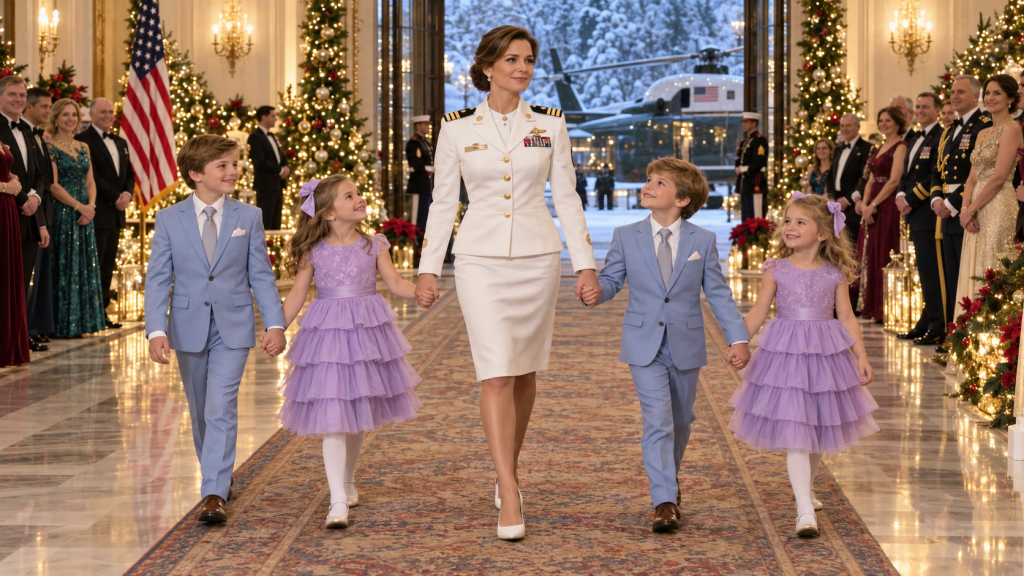
I stood beside my four eight-year-old children, watching a family that had once made me feel invisible begin to unravel in front of its closest friends.
Noah still held my hand.
Ethan stood protectively beside his sisters.
Sophia was staring at the glittering Christmas tree.
And Olivia, my youngest by eleven minutes, was looking directly at the man whose gray eyes she had inherited.
“Mommy,” she whispered, “why is everybody upset?”
I knelt beside her.
“Because grown-ups sometimes keep secrets they should have told the truth about.”
Daniel heard me.
His jaw tightened.
“That’s enough, Kesha.”
I rose slowly.
“No, Daniel. Eight years ago, you decided when our conversation was finished. You don’t get to make that decision today.”
The blonde woman beside him stepped away.
Her name, I would soon learn, was Vanessa Whitmore.
She looked approximately thirty, with carefully arranged golden hair, a diamond necklace, and the expression of someone watching her future collapse without understanding why.
“Daniel,” she said, “are those children yours?”
He said nothing.
Vanessa looked at Noah, then Ethan.
Their resemblance to Daniel was impossible to ignore.
The same gray eyes.
The same strong eyebrows.
The same small dimple on the left cheek.
She turned back toward him.
“You told me Kesha couldn’t have children.”
I felt something twist inside my chest.
Of all the lies Daniel could have told about our marriage, that one was especially cruel.
He hadn’t simply abandoned me during pregnancy.
He had rewritten the entire story so that he could appear blameless.
I took a steady breath.
“I was eleven weeks pregnant when Daniel filed for divorce,” I said. “He knew about the pregnancy before he left.”
Vanessa stared at him.
“You said she made that up.”
Daniel finally found his voice.
“I said there were circumstances you didn’t understand.”
“What circumstances?” Vanessa demanded.
He glanced around the room.
“Can we discuss this privately?”
“No,” Margaret answered.
The force in her voice surprised everyone.
Margaret Reynolds had always been a woman who believed appearances mattered.
When I was married to Daniel, she inspected dinner arrangements, corrected people’s posture, and considered the family reputation something sacred.
Now she stood in front of her guests with tears gathering in her eyes.
“For eight years,” she said, “I believed my son when he told me there had never been a pregnancy.”
She looked at the children.
“And all this time, I had four grandchildren.”
Daniel’s fingers closed around the velvet ring box.
“You don’t know that.”
The words struck the room like a slap.
Ethan stiffened beside me.
“You think we’re lying?” he asked.
I gently touched his shoulder.
“Sweetheart, you don’t have to answer him.”
But Ethan continued looking at Daniel.
“We have birth certificates,” he said. “And pictures. And Mom says you can find out who your parents are from DNA.”
Several guests lowered their eyes.
Daniel seemed to realize that his denial had made everything worse.
“I’m not discussing paternity with children,” he snapped.
“No,” I replied. “You’re discussing it in front of children. There’s a difference.”
A deep voice interrupted us.
“Colonel Reynolds.”
Major General Thomas Mercer stepped forward from near the fireplace.
He was a tall, silver-haired man whom I recognized from a joint federal and state emergency-management conference two years earlier.
His expression was grave.
“I suggest you remember who is standing in front of you.”
Daniel frowned.
“With respect, General, this is a private family matter.”
Mercer looked toward me.
“Commander Reynolds, I apologize for the circumstances of our meeting.”
I inclined my head.
“Thank you, General.”
Daniel’s eyes narrowed.
“You know her?”
“Yes,” Mercer replied. “And before you make another foolish accusation, you should know that Commander Kesha Reynolds has earned considerable respect in the public-safety community.”
The room grew quieter.
Mercer continued.
“Her investigative division helped coordinate the recovery of missing children during last year’s interstate trafficking investigation. Her team also assisted federal partners in identifying a sophisticated financial fraud network.”
I hadn’t come to Christmas dinner to discuss my career.
But Daniel had spent years assuming I would never become anything without him.
Hearing someone of Mercer’s standing acknowledge my work seemed to unsettle him almost as much as seeing our children.
Vanessa studied my uniform.
“You’re a commander?”
“Yes.”
“With the Texas Department of Public Safety?”
“Yes.”
Daniel looked as though each answer was another unpleasant surprise.
His mother wiped her eyes with a handkerchief.
Then she spoke again.
“The letter, Daniel.”
This time, nobody interrupted her.
Daniel looked toward the grand staircase.
“I don’t know what you’re talking about.”
Margaret’s face changed.
It was a subtle expression.
But I recognized it immediately.
It was the look she used when someone had made the mistake of lying directly to her face.
“Your father wrote to Kesha before he died,” she said. “I found a copy in his private papers last month.”
My breath caught.
General Richard Reynolds had died three years earlier.
Whatever disagreements existed between his son and me, Richard had once treated me with genuine kindness.
He had been a decorated Army officer, but he never believed military rank excused cruelty.
When I married Daniel, Richard had welcomed me into the family.
He encouraged my career.
He asked thoughtful questions about my work.
And unlike his son, he never suggested that a wife’s ambitions should disappear after marriage.
I had not known he left me anything.
“What letter?” I asked.
Margaret turned toward me.
“A letter he wrote shortly before his final hospitalization.”
Daniel interrupted.
“Mother, stop.”
But Margaret seemed beyond stopping.
“He wanted you to know something about the last conversation he had with Daniel.”
My eyes moved toward my ex-husband.
Daniel looked at the floor.
And suddenly I remembered a telephone call from eight years earlier.
A call I had tried not to think about for a long time.
It had happened the afternoon before our divorce was finalized.
I was sitting in a parking lot outside an obstetric clinic in Colorado Springs, crying so hard that I could barely see the dashboard.
My pregnancy was already considered high-risk.
The ultrasound had revealed four heartbeats.
Four.
The doctor had explained that carrying quadruplets would require extraordinary care.
I was frightened, exhausted, and desperate to speak with my husband.
Daniel had refused my calls all morning.
But when my telephone finally rang, it wasn’t him.
It was General Richard Reynolds.
“Kesha,” he said gently, “I understand there’s something important we need to discuss.”
Before I could answer, I heard Daniel shouting in the background.
Then the call disconnected.
That was the last time Richard and I spoke.
Until this Christmas, I had believed Daniel had convinced his father that the pregnancy was a lie.
Now I wasn’t so certain.
Margaret looked toward the family attorney, who stood near the staircase.
“Mr. Hollis, please bring me the blue folder from my study.”
Daniel moved quickly.
“Mother, you are not doing this.”
She looked at him with a firmness I had never seen before.
“Richard spent his entire life believing honor was something a person demonstrated through actions. I will not allow you to use his name to protect your lies.”
The lawyer disappeared upstairs.
Daniel turned toward me.
“You planned this.”
I stared at him.
“You invited me.”
“You brought a helicopter and four children to make a spectacle.”
“No, Daniel. I brought my children because your mother asked to see me, and they deserved the chance to meet their father’s family.”
His laugh was bitter.
“And the aircraft?”
“It was an approved departmental transport flight associated with scheduled official travel. The Colorado stop and passenger arrangements were reviewed in advance, and I paid the personal travel costs assigned to us. There was no secret mission to impress your relatives.”
Daniel looked disappointed that he couldn’t turn the conversation into an accusation of misuse of government resources.
Then he pointed toward the children.
“You should have warned me.”
I felt a wave of disbelief.
“Warned you that the children you refused to acknowledge were alive?”
His face reddened.
“That’s not what I meant.”
“What did you mean?”
He didn’t answer.
I had spent eight years imagining what I might say if I ever stood in front of him again.
I had imagined anger.
I had imagined shouting.
I had imagined demanding explanations until he was forced to admit what he had done.
But looking at him now, I felt something unexpected.
Distance.
The frightened young woman he had abandoned no longer existed.
And the man I once loved seemed smaller than I remembered.
Not physically.
Morally.
Eight years earlier, I had believed Daniel Reynolds was one of the finest men I had ever met.
We met during a military charity reception in San Antonio.
I was a young state investigator attending on behalf of a public-safety outreach program.
He was a recently promoted Army major with an easy smile and an impressive family name.
He approached me while I was standing beside a display of historical military photographs.
“You look like you’d rather be investigating a crime than listening to another speech,” he said.
I laughed.
“Is it that obvious?”
“Only to someone who feels exactly the same way.”
For the next hour, he made me feel as though I was the most interesting person in the room.
He asked about my work.
He remembered my answers.
He spoke about service, loyalty, and building a meaningful life.
When he asked for my number, I gave it to him.
Six months later, he proposed.
At the time, I thought I was marrying my best friend.
The first year was beautiful.
We traveled whenever his military schedule allowed.
We cooked together.
We talked about the children we hoped to have someday.
Daniel once told me he wanted a noisy house filled with laughter.
“Three kids,” he said one evening.
I smiled.
“Maybe two.”
“Four,” he joked.
“Absolutely not.”
We laughed until we could hardly breathe.
It was a memory that haunted me during my pregnancy.
Because when I discovered I was carrying four babies, Daniel didn’t laugh.
He accused me of trying to trap him.
Our marriage had already begun to deteriorate.
My career was advancing.
I had been offered specialized investigative training that could eventually lead to a leadership position.
Daniel resented the hours.
He resented my independence.
He especially resented that I refused to leave law enforcement and become the constantly available military wife he wanted.
His criticisms began quietly.
“You’re always working.”
“You care more about your cases than our marriage.”
“My mother never needed a career to feel important.”
Eventually, he started criticizing the smallest things.
My clothes.
My friends.
The way I spoke to senior officers.
Even how I arranged our kitchen cabinets.
If I disagreed, he called me difficult.
If I cried, he accused me of being dramatic.
And when I became pregnant, instead of celebrating, he demanded proof.
I showed him the medical reports.
He claimed they could be altered.
I invited him to the ultrasound.
He refused.
Then came the divorce papers.
I remember standing outside the military courthouse as Daniel walked toward his vehicle.
“Please,” I said. “Whatever happens between us, these babies are still yours.”
He didn’t look back.
“That’s your problem now.”
Those six words changed my life.
I spent the next several months learning how to survive without expecting anything from him.
My mother came to Texas to help.
My closest friend, Dr. Angela Morris, became my greatest source of emotional support.
I attended every medical appointment.
I followed every instruction.
I worked as long as my physicians considered it safe.
And each evening, I sat in my small apartment, resting my hands against my growing stomach.
“You have me,” I whispered.
“I don’t know how I’m going to do everything yet, but you have me.”
The babies arrived early.
There were complications.
There were frightening days in the neonatal intensive care unit.
Noah was tiny.
Ethan needed respiratory support.
Sophia struggled with feeding.
And Olivia, the smallest, spent longer in the hospital than the others.
I remember standing beside four incubators, listening to the steady electronic sounds of the monitors.
I had never felt so helpless.
Or so determined.
My mother stood beside me.
“You don’t have to be strong every minute,” she whispered.
I shook my head.
“I just need them to come home.”
Eventually, they did.
One by one.
Four car seats.
Four tiny blankets.
Four sets of bottles.
Four beautiful reasons to keep going.
Those first two years nearly broke me.
There were nights when all four babies cried.
Nights when I was so tired that I sat on the kitchen floor and wept.
Mornings when I went to work with hardly any sleep.
My mother helped.
Angela helped.
A trusted childcare provider named Rosa helped.
And slowly, we built a routine.
I finished my advanced training.
I accepted difficult assignments.
I learned how to delegate without feeling guilty.
I saved money.
I bought our first family home.
And eventually, the children grew from fragile newborns into energetic, curious, wonderfully different individuals.
Noah became fascinated by aircraft.
Ethan loved puzzles and engineering.
Sophia adored animals and announced that she intended to become a veterinarian.
Olivia was our storyteller.
She could turn a trip to the grocery store into a dramatic adventure.
Together, they filled our home with noise and joy.
Daniel missed all of it.
Their first steps.
Their first words.
Their first day of school.
Their birthdays.
Their Christmas mornings.
He missed the day Noah learned to ride a bicycle.
He missed Ethan winning his first science competition.
He missed Sophia rescuing an injured bird.
He missed Olivia singing confidently in the school talent show.
And until that Christmas at the Reynolds estate, he had never even met them.
The sound of approaching footsteps brought me back to the present.
Mr. Hollis returned carrying a blue leather folder.
He was a thin man in his late sixties, with silver spectacles and the careful manner of someone accustomed to handling sensitive family matters.
Margaret gestured toward the library.
“Kesha, may we speak privately?”
I looked down at the children.
They were beginning to appear overwhelmed.
The grand room was full of staring adults.
Whatever happened next, I didn’t want them forced to witness every painful detail.
“Yes,” I replied. “But the children need somewhere comfortable to sit.”
Margaret immediately turned toward a housekeeper.
“Mrs. Delgado, would you please prepare the morning room? Hot chocolate, sandwiches, and something from the dessert table.”
The housekeeper nodded warmly.
“Of course, Mrs. Reynolds.”
Sophia’s eyes brightened.
“Is there chocolate cake?”
Mrs. Delgado smiled.
“There’s an entire chocolate fountain.”
Olivia gasped.
“An entire fountain?”
For the first time since our arrival, I laughed.
I knelt before the children.
“I’m going to speak with Grandma for a little while. Officer Brooks will stay with you.”
Lena had accompanied us as part of our travel arrangements, and she stepped forward with a reassuring smile.
“I think I can supervise four very important chocolate inspectors.”
Ethan glanced toward Daniel.
“Do we have to talk to him?”
“No,” I answered immediately.
“You never have to speak to anyone you’re uncomfortable with.”
He nodded.
Then Noah asked quietly, “Is he mad because we’re here?”
I felt my throat tighten.
I took his face gently between my hands.
“No, sweetheart. Whatever he’s feeling, it isn’t because you did something wrong. You and your brother and sisters have every right to exist, to be loved, and to ask questions.”
Noah hugged me.
The others joined him.
For a moment, the five of us stood in a tight circle beneath the Christmas lights.
Then Lena led them toward the morning room.
I watched until they disappeared through the doorway.
Only then did I turn back toward Daniel.
“Now,” I said, “we can talk.”
The library was exactly as I remembered.
Tall bookcases lined the walls.
A marble fireplace glowed beneath a portrait of General Richard Reynolds.
Heavy curtains framed windows overlooking snow-covered gardens.
There was a large mahogany desk near the far wall.
Richard used to sit there and read military history.
During my marriage, he had once invited me into this room to ask about my career plans.
He listened for almost an hour.
At the end, he said something I never forgot.
“Don’t let anyone convince you that ambition is unbecoming in a woman, Kesha. Character is what matters.”
Standing there eight years later, I felt the weight of his absence.
Margaret placed the blue folder on the desk.
Daniel remained near the door.
Vanessa had insisted on joining us.
General Mercer and Mr. Hollis were also present.
Margaret opened the folder.
Inside lay several letters, copies of documents, and an old photograph.
The photograph showed Richard and me at a family dinner shortly after my wedding.
We were smiling.
I hadn’t seen that picture in years.
Margaret touched it gently.
“Richard kept this on his desk.”
I swallowed.
“He was always kind to me.”
“Yes,” she whispered. “He was.”
Then she removed a sealed envelope.
My name was written across the front.
Kesha Reynolds.
The handwriting was unmistakably Richard’s.
I reached for it, but Margaret held it a moment longer.
“There is something you should understand before you read this.”
Daniel turned sharply.
“Mother.”
She ignored him.
“Three years ago, when Richard was hospitalized, he asked Daniel to contact you.”
I looked toward my ex-husband.
“He told me that he’d recently learned you had children.”
My heart began pounding.
“How?”
Margaret took a breath.
“An old family friend showed him a newspaper article about a public-safety award ceremony in Texas. You were pictured with four small children.”
I remembered the photograph.
The children had been five.
They stood beside me holding miniature American flags.
The article mentioned that I was a mother of quadruplets.
I had assumed nobody in Daniel’s family would ever see it.
Apparently, Richard had.
“He recognized the resemblance immediately,” Margaret continued.
“He asked Daniel whether the children were his.”
Daniel looked away.
“And what did he say?” I asked.
Margaret’s voice broke.
“He denied it.”
The room went silent.
“Richard didn’t believe him,” she continued. “He wanted to contact you himself. But he was already very ill, and Daniel convinced him that approaching you would create unnecessary distress.”
I turned toward Daniel.
“You told your dying father his grandchildren weren’t yours?”
He folded his arms.
“I told him the situation was complicated.”
“There was nothing complicated about four birth certificates.”
He glared at me.
“You never sent them.”
I almost laughed.
“You blocked every way I had of reaching you.”
Daniel shrugged.
“You could have found me.”
The words were so absurd that even Vanessa stared at him.
“Daniel,” she said slowly, “did you seriously expect her to chase you around the world after you divorced her?”
He said nothing.
Margaret continued.
“Richard wrote this letter because he was afraid he wouldn’t have another opportunity to speak with you.”
She finally placed the envelope in my hands.
My fingers trembled as I opened it.
Inside were three pages.
The first began:
Dear Kesha,
If this letter reaches you, I hope it finds you safe, healthy, and surrounded by people who appreciate the extraordinary woman you are.
I stopped reading.
Tears blurred the words.
It had been years since anyone from the Reynolds family had spoken to me with such warmth.
I wiped my eyes and continued.
Richard wrote that he regretted not doing more when our marriage collapsed.
He said he had been told conflicting stories.
He admitted that he had wanted to believe his son.
But he also said he remembered the distress in my voice during our final telephone conversation.
He had never forgotten it.
Then came the paragraph that made my knees feel weak.
I recently learned that you may have four children. If those children are Daniel’s, then I have been denied the joy of knowing my own grandchildren. I cannot change the years that have passed, but I can make certain they know their grandfather wanted to meet them.
I pressed the paper against my chest.
Margaret began crying openly.
Even General Mercer looked away.
Richard’s letter continued.
He explained that he had instructed his attorney to establish a family trust for any biological grandchildren whose identities could be legally verified.
The money was intended for education, healthcare, and long-term support.
It was not dependent on Daniel’s approval.
Nor was it meant to purchase affection.
Richard wanted the children to have choices.
He also wanted them to know that their existence had never been something shameful.
I read the final paragraph twice.
Please tell them that their grandfather was proud of them before he ever knew their names. And tell them that the measure of a family is not how impressive its history appears, but how faithfully it cares for its youngest members.
My hands shook.
For years, I had told myself that Daniel’s rejection was something I had completely overcome.
But reading those words opened a quiet place inside me that still hurt.
Not because I wanted Daniel back.
I never had.
I hurt because four children had grown up without a grandfather who would have loved them.
I placed the letter carefully on the desk.
“Why didn’t I receive this?”
Nobody spoke.
Then Margaret looked at Daniel.
“Because I gave the original to my son to deliver.”
I stared at him.
Daniel shifted his weight.
“It was a difficult time.”
“Three years ago,” I said. “Your father died three years ago. You had his letter for three years?”
“I didn’t think it would help anyone.”
“You didn’t think it would help four children to know their grandfather cared about them?”
He looked away.
Vanessa took another step back.
“What kind of man hides something like that?”
Daniel rounded on her.
“Stay out of this.”
“No,” she replied. “You’ve lied to me about an entire family.”
He raised his voice.
“I said stay out of it!”
General Mercer moved slightly forward.
“Colonel, lower your voice.”
Daniel looked around the room.
For the first time, he seemed to understand that nobody was automatically taking his side.
Margaret removed another document from the folder.
“There is more.”
I looked at her.
“What more?”
She glanced at Mr. Hollis.
The attorney cleared his throat.
“General Reynolds amended his estate plan shortly before his death. Under the amended trust, the existence of qualifying grandchildren triggers certain financial provisions.”
Daniel’s face tightened.
I suddenly understood.
This wasn’t only about a letter.
There was money involved.
A great deal of money.
Mr. Hollis continued.
“The trust contains significant holdings, including investment accounts and interests in several family properties.”
Daniel spoke sharply.
“Those assets were already allocated.”
“Some were,” Hollis replied. “Others were held conditionally pending verification of descendants.”
Margaret closed her eyes.
“I discovered the provision while reviewing estate documents last month.”
I looked from her to Daniel.
“Is that why you invited me?”
Margaret opened her eyes.
“Partly.”
She took a careful breath.
“I believed you might have children. I didn’t know there were four. I wanted you here so I could speak to you face-to-face.”
“Then why didn’t you call and explain?”
“Because Daniel told me you were unstable and might refuse contact.”
The room seemed to tilt.
I stared at him.
“Unstable?”
Daniel said nothing.
Margaret continued.
“He told me that the divorce had left you bitter. He said you fabricated stories about children whenever you wanted attention.”
I felt something cold settle inside me.
Daniel hadn’t merely abandoned us.
He had spent eight years carefully discrediting me to anyone who might ask questions.
I looked at Margaret.
“And you believed him.”
She lowered her eyes.
“Yes.”
The simple admission hurt more than an excuse would have.
For several seconds, I said nothing.
Then I spoke quietly.
“You could have contacted me directly. My name appeared in public professional directories for years. My address was available through ordinary legal channels. You could have asked questions.”
Margaret nodded.
“I know.”
“You could have found out the truth before Richard died.”
Tears slid down her cheeks.
“I know.”
I wanted to be angry with her.
Part of me was.
But I also saw an older woman confronting the consequences of trusting the wrong person.
She couldn’t recover those lost years.
Neither could I.
Neither could my children.
Mr. Hollis adjusted his glasses.
“There is another document you need to see, Commander.”
He opened the folder to a set of correspondence records.
“These show that a formal notice regarding the trust was prepared for you after General Reynolds’s death.”
I stared at him.
“Prepared?”
“Yes. We later discovered that the mailing instructions had been altered.”
Daniel’s head snapped up.
“That’s not relevant.”
Hollis looked directly at him.
“It is extremely relevant.”
The attorney slid a page across the desk.
The notice had been addressed to an apartment in Colorado.
An apartment I hadn’t occupied since before the divorce.
Someone had provided that address as my current residence.
And beneath the address was a handwritten notation.
Contact information confirmed by D. Reynolds.
My stomach tightened.
Daniel had known exactly where to reach me.
My professional location had never been a secret.
Yet he had directed important legal correspondence to an address he knew was obsolete.
I looked at him.
“Did you do this deliberately?”
He didn’t answer.
“Daniel.”
His expression turned defiant.
“I didn’t want you interfering with the estate.”
There it was.
The truth.
Not a misunderstanding.
Not confusion.
Not an unfortunate coincidence.
He simply didn’t want his children to receive anything that might reduce the wealth he expected to control.
Vanessa covered her mouth.
Margaret seemed to age ten years in a moment.
And Mr. Hollis calmly said, “For the record, Colonel, that statement may be relevant to the review already underway.”
Daniel looked at him sharply.
“What review?”
The attorney folded his hands.
“The trustees retained independent counsel after the discrepancies were discovered. The matter is being examined.”
Daniel’s face drained.
“You went behind my back?”
Margaret’s voice was steady.
“No, Daniel. I stopped allowing you to speak for everyone.”
He turned toward me.
“You came here to take my inheritance.”
I looked at him for a long moment.
Then I shook my head.
“I came because your children deserved answers.”
I touched Richard’s letter.
“And because someone in this family apparently remembered what fatherhood was supposed to mean.”
Daniel’s mouth opened.
Before he could respond, the library door swung inward.
Olivia stood in the doorway.
Lena appeared behind her, looking apologetic.
“Commander, I’m sorry. She said she needed you.”
Olivia’s eyes were wet.
My heart immediately tightened.
I crossed the room and knelt.
“What’s wrong, sweetheart?”
She held out her small hand.
Inside was a broken silver charm.
It was shaped like a snowflake.
Her favorite bracelet had snapped.
“I’m sorry,” she whispered.
I took the charm.
“Oh, honey. We can fix this.”
She glanced past me toward Daniel.
Then she lowered her voice.
“Mommy, did Grandpa really want us?”
The question broke something inside me.
I looked over my shoulder.
Margaret stood motionless beside the desk.
Even Daniel appeared startled.
I turned back to Olivia.
“Yes, sweetheart.”
“How do you know?”
I gently took Richard’s letter.
“Because he wrote us something very special.”
She looked at the pages.
“Can you read it to me?”
I swallowed.
“Yes. But I think your brother and sisters should hear it too.”
Margaret stepped forward.
“May I come?”
I looked at her.
For eight years, this woman had been a distant figure from my former life.
Now she stood before me asking permission to meet her grandchildren.
I could have refused.
A part of me wanted to.
But then Olivia looked up at her with those familiar gray eyes.
And I remembered that my children shouldn’t have to inherit every wound their parents carried.
“You may,” I said. “But we take things slowly.”
Margaret nodded immediately.
“Of course.”
“And no promises you can’t keep.”
“I understand.”
We walked together toward the morning room.
Daniel remained in the library.
Vanessa followed us, but she kept a respectful distance.
The children were sitting around a polished oval table covered with holiday treats.
Noah had hot chocolate on his upper lip.
Ethan was examining a mechanical nutcracker.
Sophia was asking Mrs. Delgado whether the estate had horses.
Olivia hurried toward her siblings.
“Guys! Grandpa wrote us a letter!”
All three looked up.
I sat beside them.
Margaret pulled a chair close, but not too close.
I unfolded the pages.
Then I read selected portions of Richard’s letter aloud.
I explained that their grandfather had learned about them when they were younger.
That he had wanted to meet them.
That he had been very sick.
And that he had left words for them because he hoped they would someday understand how much they mattered.
Noah listened without moving.
Ethan leaned forward.
Sophia held Olivia’s hand.
When I finished, silence filled the room.
Then Sophia asked, “Was Grandpa a good man?”
I looked at Margaret.
Her eyes filled again.
“He tried very hard to be,” she whispered.
“Did he like Christmas?”
Margaret smiled through her tears.
“He loved Christmas.”
“Did he like cookies?”
“He used to steal them from the kitchen before dinner.”
Sophia giggled.
“That sounds like Ethan.”
“Hey!” Ethan protested.
Everyone laughed.
It was a small moment.
But after everything that had happened, it felt enormous.
Margaret reached into her pocket and withdrew a small photograph.
It showed Richard standing beside a golden retriever in a snowy garden.
“This was your grandfather with his dog, Ranger.”
Noah studied it.
“Was he in the Army?”
“Yes.”
“Like the man in the big picture?”
Margaret nodded.
“That is him too.”
Ethan looked toward me.
“Mom, can we keep a picture?”
I smiled.
“If Grandma is willing.”
Margaret pressed the photograph into his hand.
“You can have this one.”
Ethan examined it carefully.
Then he said something that made Margaret begin crying again.
“Thank you, Grandma.”
She covered her mouth.
For a few seconds, she couldn’t speak.
Finally, she whispered, “You’re welcome, sweetheart.”
I knew that one tender afternoon couldn’t repair eight lost years.
But watching my children discover that someone from their father’s family had wanted them gave me a quiet sense of relief.
There had been love waiting for them.
It had simply been hidden.
The afternoon continued with an uneasy mixture of celebration and reckoning.
The other guests gradually returned to their conversations.
Some approached me to offer congratulations on my career.
Others awkwardly apologized for assumptions they had made.
A retired colonel admitted that Daniel had told several friends I had left public service years earlier.
A family acquaintance said she remembered hearing that I had moved overseas after the divorce.
The stories were inconsistent.
But they all had one thing in common.
Daniel had always portrayed himself as the reasonable party.
I discovered that he had been telling different versions of our marriage depending on his audience.
To his military friends, I was supposedly too ambitious to be a wife.
To his relatives, I was unstable and resentful.
To Vanessa, I was a childless woman who couldn’t accept that he had moved on.
And to his mother, I was someone whose words couldn’t be trusted.
The realization was disturbing.
But it was also clarifying.
For years, I had occasionally wondered whether I should have tried harder to explain myself.
Now I understood that Daniel hadn’t misunderstood me.
He had needed other people to misunderstand me.
His reputation depended on it.
Later that afternoon, I stepped onto the covered terrace for a moment of quiet.
Snowflakes drifted beyond the railing.
The mountains rose dark and beautiful against the winter sky.
I wrapped my coat around myself and breathed in the cold air.
Behind me, the glass door opened.
Vanessa stepped outside.
She held the diamond ring box.
It was closed now.
“May I speak with you?” she asked.
I nodded.
She stood beside me, leaving a comfortable distance between us.
For a while, neither of us spoke.
Then she said, “I owe you an apology.”
I glanced toward her.
“For what?”
“For believing him.”
I looked back at the snow.
“You didn’t know me.”
“No. But I repeated things he said about you.”
I turned toward her.
Vanessa’s eyes were red.
“He told me you were obsessed with his family. That you tried to ruin his career. That you couldn’t accept the divorce.”
I let out a slow breath.
“That sounds familiar.”
She looked at the ring box.
“He proposed to me ten minutes before your helicopter arrived.”
I raised my eyebrows.
“He actually asked?”
She nodded.
“I said yes.”
The words hung between us.
Then she gave a short, sad laugh.
“And now I don’t know who the man I agreed to marry really is.”
I studied her.
“Vanessa, that’s something you have to decide for yourself.”
She nodded.
“I know.”
Then she asked the question I hadn’t expected.
“Did you ever miss him?”
I thought carefully before answering.
“I missed the person I believed he was.”
She looked at me.
“For a long time, I missed our plans. The future I thought we were building. The idea that my children would have a father who wanted them.”
I paused.
“But eventually I realized I wasn’t mourning the man who left. I was mourning the man I thought I’d married.”
Vanessa wiped her cheeks.
“That makes sense.”
She opened the ring box.
The diamond glittered beneath the gray winter light.
“He told me this ring belonged to his grandmother.”
I looked at it.
I recognized the setting.
Margaret had once shown me the same ring in an old family jewelry collection.
“Yes,” I said. “I believe it did.”
Vanessa closed the box.
“He was going to give me a life full of beautiful things.”
I looked toward the mansion.
“Beautiful things don’t always make a beautiful life.”
She nodded slowly.
Then she straightened her shoulders.
“Thank you for talking to me.”
Before returning inside, she turned.
“One more thing.”
“Yes?”
“He told me you wanted money from him.”
I almost smiled.
“I haven’t received a dollar of support from Daniel in eight years.”
Her face tightened.
“Not even child support?”
“No voluntary support. For years, I chose not to spend our lives chasing a man who wouldn’t acknowledge his children. My attorneys preserved the records and explored the available legal options. His responsibilities didn’t disappear just because I built a life without his help.”
Vanessa stared at me.
Then she whispered, “He really did lie about everything.”
After she left, I stood alone for another minute.
The cold wind brushed against my face.
I remembered countless nights from the children’s infancy when I wished someone would arrive and make things easier.
Someone who would share the exhaustion.
Someone who would say, “I’ve got this. Go rest.”
Daniel had never been that person.
But others had.
My mother.
Angela.
Rosa.
Lena.
The teachers who cared about my children.
The colleagues who supported my work.
The neighbors who brought meals during illnesses.
The friends who celebrated birthdays and graduations.
Family, I had learned, was not always defined by the people whose names appeared on a birth certificate.
Sometimes it was defined by the people who consistently showed up.
When I returned inside, the situation had changed again.
Daniel stood near the staircase speaking urgently into his phone.
General Mercer watched from a distance.
Mr. Hollis was reviewing documents with Margaret.
And my children were in the drawing room helping Mrs. Delgado decorate gingerbread houses.
For one hopeful moment, I thought the remaining afternoon might pass peacefully.
Then Daniel ended his call and approached me.
“We need to talk.”
I glanced toward the drawing room.
“Not in front of the children.”
“Fine.”
We moved into a smaller sitting room.
He closed the door.
I remained standing.
Daniel paced twice before turning toward me.
“What do you want?”
I stared at him.
“Excuse me?”
“How much?”
I felt an almost unbelievable sense of exhaustion.
“Daniel, you still don’t understand.”
He ignored me.
“The trust is worth a considerable amount. I know that’s why you’re here.”
“You invited me.”
“Stop saying that.”
“Then stop pretending I orchestrated this.”
His hands curled into fists at his sides.
“You think you can arrive with four children, embarrass me in front of everyone, and walk away with millions?”
I crossed my arms.
“Your father made his own estate arrangements.”
“And now you intend to exploit them.”
“No. I intend to ensure that any rights belonging to my children are protected.”
He stopped pacing.
“There are ways we can settle this privately.”
I looked at him.
“What kind of ways?”
He lowered his voice.
“You don’t need to pursue any formal paternity proceedings. I could arrange a reasonable payment.”
I stared at him.
Then I understood.
He was offering money in exchange for avoiding public acknowledgment of his children.
“How reasonable?” I asked quietly.
Daniel looked relieved.
He mistook my question for interest.
“Enough to cover their education.”
“And what would you want in return?”
“A confidentiality agreement. No public statements. No claims against my military benefits. No interference with the trust.”
I felt my anger rise.
Not because he offered money.
Because he believed he could turn eight years of abandonment into a financial transaction that benefited him.
“You want me to accept money so you can keep pretending your children don’t exist?”
He frowned.
“Don’t make it emotional.”
I took one step toward him.
“Daniel, they’re not a business problem.”
He looked away.
“They’re children,” I continued. “Real children. Noah loves aircraft. Ethan builds complicated machines out of cardboard. Sophia wants to save every injured animal she sees. Olivia writes stories about princesses who rescue themselves.”
He remained silent.
“They get sick. They have nightmares. They laugh at terrible jokes. They need help with homework. They ask difficult questions.”
I paused.
“And for eight years, you never once asked whether they were alive.”
Daniel’s expression flickered.
For a moment, I thought he might say something sincere.
Instead, he replied, “I wasn’t ready to be a father.”
The honesty of that statement was almost startling.
“You could have said that,” I answered. “You could have admitted you were afraid. You could have asked for time. You could have sought help.”
I shook my head.
“But you chose to accuse me of lying.”
He looked toward the window.
“I had my career.”
“So did I.”
“You don’t understand the pressure I was under.”
I almost laughed.
“Daniel, I gave birth to four premature babies, watched them fight to grow strong enough to leave the hospital, and raised them while building a career in law enforcement. I understand pressure.”
He said nothing.
I continued.
“You had choices. You made them. And now you have to live with what those choices cost.”
He sat heavily in an armchair.
For several seconds, he stared at the carpet.
Then he asked, “Do they hate me?”
The question surprised me.
“No.”
He looked up.
“They don’t?”
“They don’t know you well enough to hate you.”
The words seemed to hurt him.
“They’ve asked about you,” I said. “I told them you were their father, but that you weren’t part of our lives. I never told them they were unwanted.”
He swallowed.
“Then why did Noah ask that question?”
“Because children hear things. They notice silence. They ask why other children have fathers at school events when theirs never comes.”
Daniel lowered his eyes.
“Last year,” I continued, “Noah found an old court document while helping me organize a storage cabinet. It contained language from the divorce proceedings in which you disputed the pregnancy.”
I paused.
“He read enough to understand.”
Daniel looked horrified.
“He read that?”
“Yes.”
“What did you tell him?”
“The truth, in a way an eight-year-old could understand. I told him that his father made choices before he was born that were unfair and hurtful, but those choices never determined his worth.”
Daniel covered his face.
I watched him for a moment.
Then I said, “If you ever want a relationship with these children, it won’t begin with money. It will begin with honesty, accountability, and respect for their emotional safety.”
He looked up.
“Would you allow it?”
“I would consider a carefully structured introduction if they want one and if appropriate professionals believe it’s healthy. But you don’t get to walk into their lives as a hero after eight years of absence.”
Daniel nodded slowly.
For the first time that day, he didn’t argue.
Then a knock sounded at the door.
Mr. Hollis entered.
“Commander Reynolds, I apologize for interrupting, but there has been a development.”
Daniel immediately stood.
“What development?”
The attorney looked at him.
“We’ve received confirmation regarding the trust records.”
Daniel’s face tightened.
“What confirmation?”
Hollis turned to me.
“The trustees found correspondence suggesting an earlier effort to verify the children’s identities was deliberately obstructed.”
I stared at him.
“Earlier?”
“Yes. Approximately two years after General Reynolds died.”
Daniel’s expression became unreadable.
Hollis continued.
“A private investigator retained by the trustees attempted to contact you through a representative. The investigator’s report states that someone claiming to act with your authority declined further communication.”
My heart began pounding.
“I never authorized anyone to decline communication.”
“We suspected as much.”
Daniel moved toward the door.
“I have nothing to say about this.”
Hollis stepped aside rather than blocking him.
“You are free to leave this conversation, Colonel. But the records will be reviewed whether you participate or not.”
Daniel stopped.
For several seconds, he seemed to be weighing his options.
Then he turned.
“You people are making an enormous mistake.”
He walked out.
I looked at Hollis.
“What happens now?”
“That depends on what the evidence establishes. We are preserving the communications, confirming the chain of custody, and consulting independent counsel. We won’t make accusations without sufficient proof.”
I appreciated the careful answer.
I had spent too many years conducting investigations to mistake suspicion for evidence.
“Keep my children’s information confidential,” I said.
“Of course.”
“And please communicate through my attorney from this point forward.”
Hollis nodded.
“That would be appropriate.”
I gave him the name of a trusted family-law attorney in Texas who had assisted me with matters involving the children.
Then I returned to the drawing room.
Sophia was decorating a gingerbread house with so much candy that the roof was beginning to collapse.
Noah had constructed an elaborate landing pad from chocolate wafers.
Ethan was trying to make his miniature house structurally sound.
Olivia had created a pink frosting castle.
They were laughing.
They were happy.
And suddenly all I wanted was to protect that happiness.
“Who wants to see the Christmas lights outside?” I asked.
Four hands shot into the air.
Margaret offered to show us the gardens.
I agreed.
We bundled ourselves into coats and scarves.
The estate’s walking paths had been cleared of snow, and thousands of warm white lights illuminated the trees.
The children hurried ahead with Lena.
Margaret walked beside me.
For a while, we said nothing.
Then she stopped near a small stone fountain.
“Kesha, I owe you more than an apology.”
I looked at her.
She continued.
“When Daniel told us the marriage was ending, I sided with him without asking what had happened.”
I said nothing.
“I thought supporting my son meant defending him.”
She looked toward the children.
“But supporting someone should never mean protecting them from the truth.”
I watched Noah and Ethan race toward an illuminated reindeer.
“You were his mother,” I said. “I understand that you wanted to believe him.”
“Wanting to believe him wasn’t the mistake,” she replied. “Refusing to question him was.”
I was surprised by the honesty.
Margaret removed her gloves.
“I remember the day you left Colorado. You called the house.”
I turned toward her.
“You remember?”
“Yes.”
I remembered that call too.
I had asked whether Richard might be available.
Margaret told me Daniel didn’t want contact.
She said I needed to accept that the marriage was over.
“I was frightened,” I admitted. “I didn’t know whether the babies would survive.”
Margaret’s eyes filled.
“I wish you had told me.”
“I tried.”
She closed her eyes.
“Yes. You did.”
The admission settled between us.
Then she asked, “Would you ever consider letting me know them?”
I looked toward my children.
Olivia was laughing as Sophia tried to catch a snowflake on her tongue.
“I won’t promise you immediate closeness,” I answered. “They’ve had a full life without this family. You can’t expect them to feel attached just because you share blood.”
Margaret nodded.
“I understand.”
“But if you genuinely want to build a relationship, you can start slowly.”
“How?”
“Write them letters. Remember their birthdays. Learn what they enjoy. Be consistent. Don’t make promises you can’t keep.”
She listened carefully.
“And most importantly,” I continued, “don’t ask them to pretend the past didn’t happen.”
Margaret wiped her eyes.
“I won’t.”
For the first time, I believed she meant it.
We continued walking.
Near the garden entrance stood a bronze statue of General Richard Reynolds.
The children gathered around it.
Noah read the inscription aloud.
“Service. Integrity. Honor.”
He looked at Margaret.
“Grandma, was Grandpa famous?”
She smiled.
“Some people knew him, yes.”
Ethan studied the statue.
“Did he ever make mistakes?”
Margaret paused.
Then she nodded.
“Of course.”
“Even generals?”
“Especially generals need to remember they can make mistakes.”
Ethan considered this.
Then he said, “Mom says being important doesn’t mean you’re always right.”
Margaret looked toward me.
“Your mother is very wise.”
Sophia grinned.
“We know.”
I laughed.
It was the kind of ordinary exchange I had once hoped my children might enjoy with extended family.
I never imagined it would take eight years and a Christmas confrontation to make it possible.
When we returned to the mansion, the sun was beginning to set.
The dining room had been prepared for the evening feast.
Long tables glittered with candles, silverware, and elaborate floral arrangements.
But the atmosphere was no longer the polished celebration Daniel had planned.
News of the confrontation had spread among the guests.
Several relatives had quietly left.
Others remained, uncertain whether to approach us.
Daniel was nowhere to be seen.
Vanessa stood near the front entrance speaking with a driver.
Her luggage had been brought downstairs.
I approached her.
“Leaving?”
She nodded.
“I called my sister. I’m going to stay with her.”
She looked toward the staircase.
“Daniel wants me to wait until things calm down.”
I said nothing.
Vanessa gave a sad smile.
“I think I’ve spent enough time waiting for him to tell me the truth.”
She held up the velvet box.
“I returned the ring.”
I nodded.
“I hope things get easier for you.”
“Thank you.”
She hesitated.
“May I say goodbye to the children?”
I considered her request.
Vanessa had been kind to them during the afternoon.
She had not tried to involve them in the adult conflict.
“Yes,” I replied.
We found the children near the Christmas tree.
Vanessa knelt.
“It was very nice meeting you.”
Olivia smiled.
“Are you a princess?”
Vanessa laughed softly.
“No, sweetheart.”
“You look like one.”
“That’s very kind of you.”
Sophia handed her a small gingerbread cookie wrapped in a napkin.
“For your trip.”
Vanessa accepted it with trembling fingers.
“Thank you.”
Then she stood and looked at me.
“You’ve raised wonderful children.”
I smiled.
“They’ve taught me quite a lot.”
She left a few minutes later.
Daniel watched from an upstairs landing.
He did not follow her.
Instead, he disappeared into the corridor.
At six o’clock, Margaret made an announcement.
Dinner would proceed as planned.
She invited me and the children to sit beside her.
I almost declined.
The day had been exhausting.
But Noah whispered that he wanted to stay for the Christmas turkey.
And Sophia wanted another chance to see the chocolate fountain.
So I agreed.
The dining room filled gradually.
General Mercer sat nearby.
Mr. Hollis joined another table.
Lena remained close to the children.
Daniel eventually entered.
He had changed out of his formal military uniform into a dark suit.
His face was pale.
He took a seat at the far end of the table.
Margaret stood.
The conversations faded.
She looked around the room.
“For many years,” she began, “this family has celebrated Christmas by speaking about tradition, service, and honor.”
She paused.
“Today, I have been reminded that those words mean very little unless we live by them.”
Daniel stared down at his plate.
Margaret continued.
“I learned that I have four grandchildren whose lives I have missed because I accepted false information without questioning it.”
A few guests shifted uncomfortably.
“I cannot undo those years. I can only acknowledge my mistake and try to become someone worthy of knowing them.”
She turned toward my children.
“Noah, Ethan, Sophia, Olivia, thank you for coming today.”
Sophia smiled shyly.
Margaret’s voice trembled.
“And Kesha, thank you for raising them with such love.”
I felt my eyes sting.
She lifted her glass.
“To truth, to family, and to the courage to make things right.”
The room responded quietly.
Then dinner began.
For almost twenty minutes, the evening was surprisingly peaceful.
The children enjoyed their food.
Noah asked General Mercer about helicopters.
Ethan discussed engineering.
Sophia wanted to know whether military working dogs received Christmas presents.
Olivia entertained everyone at our end of the table with a story about a snowman who became mayor of a town.
Even Margaret laughed.
Then Daniel spoke.
“I think everyone has forgotten that none of this has been legally established.”
The table fell silent.
I slowly set down my fork.
Daniel looked toward his mother.
“You’re calling these children your grandchildren without a paternity test.”
Margaret stared at him.
“Daniel.”
“I’m simply stating a fact.”
Noah lowered his eyes.
Ethan’s face reddened.
I felt anger rise in my chest.
But before I could speak, General Mercer placed his napkin beside his plate.
“Colonel Reynolds,” he said, “you have made your point. This is not an appropriate conversation for dinner.”
Daniel leaned forward.
“With respect, General, I have a right to defend myself.”
“You have a right to seek proper legal verification,” Mercer replied. “You do not have a right to repeatedly humiliate children over a matter you refused to address when their mother was pregnant.”
Daniel stared at him.
The general’s expression remained calm.
“Leadership begins with accountability. Rank does not change that.”
The words seemed to strike Daniel harder than shouting would have.
Margaret looked toward me.
“Kesha, I am so sorry.”
I stood.
“Children, we’re going to take a short break.”
All four rose immediately.
We moved into the hallway.
I knelt beside them.
Noah looked distressed.
“Mom, what if he really doesn’t believe we’re his?”
I brushed his hair back.
“Then that’s something the adults can resolve with evidence.”
Ethan spoke quietly.
“I don’t want to belong to him.”
I looked into his eyes.
“Being biologically related to someone doesn’t mean they own you.”
He nodded.
Sophia asked, “Do we still have to call him Daddy?”
“No. You may call him Daniel if you ever speak to him. You don’t owe anyone a title they haven’t earned in your life.”
Olivia wrapped her arms around my neck.
“Can we go home?”
I held her close.
“Of course.”
At that moment, I knew our visit was over.
Whatever needed to happen next could happen through attorneys, professional evaluations, and conversations that respected my children’s well-being.
They had received the most important thing I hoped they might find.
Proof that their grandfather had cared.
They did not need to spend another minute defending their right to exist.
I informed Margaret that we were leaving.
She looked disappointed.
But when she saw the children’s faces, she understood.
“I wish the day had been different,” she whispered.
“So do I.”
She walked us toward the foyer.
Mrs. Delgado brought the children’s coats.
Lena confirmed our transport arrangements.
The approved helicopter flight was no longer available for our return, so we would use the commercial travel plan already arranged as our alternative.
Noah looked a little disappointed.
“Are we not flying in the helicopter again?”
“Not today,” I said. “But we still get to fly home.”
He brightened.
“Can I have the window seat?”
“We’ll work something out.”
Margaret knelt carefully before the children.
“I know today has been confusing.”
They watched her.
“I am grateful that I met you.”
Sophia stepped forward.
“Will you send us pictures of Grandpa?”
Margaret smiled through tears.
“Yes.”
“Of his dog too?”
“Especially his dog.”
Ethan held up the photograph she had given him.
“Thank you for this.”
Margaret nodded.
Then Olivia surprised everyone.
She threw her arms around Margaret’s shoulders.
“Don’t be sad, Grandma.”
Margaret held her carefully.
“I’ll try, sweetheart.”
One by one, the others offered hugs.
I stood quietly watching.
It was a tender moment.
But I reminded myself not to mistake emotion for lasting change.
Trust would require time.
Consistency.
Actions.
We said goodbye.
As the front doors opened, cold air swept through the foyer.
Snow glittered beneath the estate lights.
Then Daniel appeared behind us.
“Kesha.”
I stopped.
The children moved closer to me.
He looked at them.
For a moment, I thought he might finally apologize.
Instead, he said, “I want a paternity test.”
I nodded.
“Have your attorney contact mine.”
His expression shifted.
“You’re agreeing?”
“I have never been afraid of the truth, Daniel.”
He looked toward Noah.
Then Ethan.
Sophia.
Olivia.
The resemblance was even more striking beneath the bright foyer lights.
Daniel swallowed.
“And if they’re mine?”
I held his gaze.
“Then you’ll have to decide what kind of person you want to be going forward.”
He looked down.
“What if they don’t want to know me?”
I glanced at my children.
“Then you’ll have to respect that, too.”
He nodded faintly.
For once, he had no argument.
We stepped outside.
As we walked toward the waiting vehicles, Noah took my hand.
“Mom?”
“Yes, sweetheart?”
“Was Christmas ruined?”
I stopped.
I looked at my four beautiful children standing beneath the falling snow.
Then I smiled.
“No.”
“But everybody was upset.”
“Some people were.”
“Then why wasn’t it ruined?”
I knelt.
“Because Christmas isn’t about making every moment perfect. It’s about remembering who loves you and choosing how to treat one another.”
Sophia smiled.
“And cookies?”
I laughed.
“Yes. Cookies are very important.”
The children giggled.
We climbed into the vehicle.
As the estate disappeared behind us, I felt a strange sense of peace.
Daniel had wanted me to arrive ashamed.
Instead, I was leaving with the truth.
And this time, it belonged to my children.
Three weeks later, the legal process began.
Daniel submitted to a court-recognized paternity test through the appropriate procedures.
My children participated with professional support and careful explanations suited to their ages.
I didn’t present it as a contest.
I told them that medical testing could help answer a question adults should have resolved years earlier.
The results came back.
The evidence established Daniel as their biological father.
There was no ambiguity.
No room for another invented story.
When my attorney called with the confirmation, I was sitting at the kitchen table helping Sophia finish a school project.
I thanked the attorney.
Then I continued cutting construction paper.
My life didn’t suddenly change.
The children still needed breakfast.
Homework still had to be completed.
Laundry still waited in baskets.
And the world kept turning.
But for Daniel, the result apparently changed everything.
He called my attorney repeatedly.
He wanted copies of the reports.
He wanted to speak with the children.
He wanted to understand why nobody had told him they were quadruplets.
That final question almost made me laugh.
He had refused every opportunity to find out.
Now he wanted someone else to explain what he had chosen not to know.
My attorney handled the communications.
We discussed appropriate financial support obligations.
We consulted a child psychologist about whether and how future contact might be introduced.
And we worked to ensure that no one used the children as leverage in disputes over money or reputation.
Meanwhile, the trustees continued reviewing Richard’s estate.
Their investigation established that notices had been misdirected and that representations about my willingness to communicate were unreliable.
The trustees referred their findings to counsel for further action.
Because the trust’s provisions were complex, its administration required additional legal proceedings.
I made one condition clear.
Any funds belonging to the children would be managed for their benefit.
They would not become a reward for me.
Nor would they become a bargaining tool for Daniel.
My children already had a home, financial security, education, and love.
Richard’s gift could provide opportunities.
But it would never replace the grandfather they had lost.
The greatest surprise came in February.
Margaret called me one Saturday morning.
It was the first time she had contacted me directly since Christmas.
“Good morning, Kesha.”
“Good morning, Margaret.”
“I hope I’m not disturbing you.”
“Not at all.”
I could hear children’s voices in the background.
Sophia and Olivia were arguing about whose turn it was to choose a movie.
Noah and Ethan were building something in the living room.
Margaret chuckled.
“It sounds lively.”
“That’s one word for it.”
She hesitated.
“I wanted to ask whether the children received my letters.”
I smiled.
“They did.”
“Did they like them?”
“Sophia was delighted by the photographs of Ranger.”
Margaret laughed softly.
“And Ethan?”
“He appreciated the picture of Richard’s old workshop.”
“What about Noah?”
“He wants to know if the general ever flew helicopters.”
“And Olivia?”
I smiled again.
“She says your handwriting looks like a queen’s.”
Margaret began laughing.
Then her voice broke.
“Thank you for telling me.”
I waited.
She continued.
“I don’t want to rush them. But I’d like to visit Texas someday, if you believe that’s appropriate.”
I thought for a moment.
“Maybe in the spring.”
“Whatever works best for them.”
I was pleased by the answer.
She wasn’t demanding.
She wasn’t invoking family authority.
She was asking.
That mattered.
Over the following months, Margaret kept every promise she made.
She wrote individual letters to each child.
She remembered their interests.
She sent birthday cards on time.
When Sophia became interested in horses, Margaret mailed her photographs from the estate’s old stables.
When Ethan asked about Richard’s military career, she sent a child-friendly collection of stories about his grandfather’s service.
For Noah, she found pictures of helicopters Richard had flown in during his career.
For Olivia, she sent a small notebook with a note encouraging her to write stories.
There were no extravagant gifts.
No attempts to purchase affection.
Just patient, consistent attention.
The children began looking forward to her letters.
And slowly, I found myself doing something I never expected.
I began trusting Margaret Reynolds.
Not completely.
Not immediately.
But enough to believe that people could change when they were willing to face uncomfortable truths.
Daniel’s situation was different.
The fallout from Christmas followed him into the new year.
His engagement ended.
Vanessa returned the ring and moved out of the home they had shared.
A review of the estate matter raised questions about his conduct.
I did not receive every detail of what happened inside his military command, nor did I pretend to know outcomes that were not public or formally disclosed.
But I knew his professional reputation was no longer protected by the unquestioning admiration that had surrounded him for years.
Several senior colleagues had witnessed his behavior at Christmas.
His family had learned he repeatedly misrepresented the circumstances of our divorce.
And the documentation surrounding the trust made his earlier explanations difficult to sustain.
For the first time, Daniel had to answer questions he could not simply dismiss.
But the most significant consequence had nothing to do with money, rank, or public embarrassment.
It was that his four children knew who he was.
And they were not particularly interested in impressing him.
In March, Daniel sent each child a letter.
My attorney forwarded them to the child psychologist, who reviewed the contents with me.
The letters were awkward.
Daniel wrote about his military career.
He described places he had traveled.
He mentioned awards and assignments.
He said he hoped the children would be proud of him.
But he didn’t clearly apologize.
He didn’t acknowledge the pain of his absence.
He wrote as though introducing himself were a formal ceremony.
I asked the psychologist for guidance.
She suggested that Daniel be encouraged to write again, this time focusing on what he was responsible for rather than what he had accomplished.
He resisted.
Then, eventually, he sent a second set of letters.
They were different.
Shorter.
Less polished.
He acknowledged that he had been wrong to leave.
He admitted that he had refused to listen when I told him about the pregnancy.
And he wrote that the children were not responsible for any of his choices.
When I read those letters, I felt a complicated mixture of emotions.
Relief.
Sadness.
Skepticism.
A little anger.
And something that might eventually become forgiveness.
Not because Daniel deserved to be excused.
But because I didn’t want to spend the rest of my life carrying his failures like a weight.
The children responded in their own ways.
Sophia wrote a polite note thanking him for the letter.
Olivia drew a picture of herself with her siblings and me.
Noah asked whether Daniel really knew how to fly a helicopter.
Ethan declined to respond.
I respected each decision.
I told them that their feelings might change over time.
And that whatever they chose, I would support them.
In April, Margaret visited Texas.
She stayed at a nearby hotel rather than assuming she would be invited into our home.
That small decision told me she was taking our boundaries seriously.
We began with lunch at a quiet restaurant.
The children were excited.
Margaret arrived carrying a photo album.
Inside were pictures of Richard from childhood through retirement.
She told stories.
Funny stories.
Embarrassing stories.
Stories about a man who loved dogs, disliked burned toast, and secretly sang off-key while decorating the Christmas tree.
The children adored them.
Ethan asked a hundred questions.
Noah studied every photograph involving aircraft.
Sophia loved the pictures of Ranger.
Olivia announced that she intended to write a book about Grandpa Richard.
Margaret laughed until tears ran down her cheeks.
Later that afternoon, we visited a park.
The children played while Margaret and I sat on a bench.
She looked older than she had at Christmas.
But also softer.
Less concerned with appearances.
More willing to sit quietly and appreciate ordinary moments.
“I spent so many years worrying about what people thought of this family,” she said.
I watched Olivia chase Sophia across the grass.
“And now?”
Margaret smiled sadly.
“Now I wish I’d spent more time asking whether everyone in it was happy.”
I nodded.
She looked toward me.
“Richard would have loved them.”
“I know.”
She was silent for a moment.
Then she said, “He would have been proud of you too.”
I swallowed.
“Thank you.”
It was a simple conversation.
But it mattered.
For years, the Reynolds name had represented rejection.
Now, slowly, it was becoming associated with something else.
Honesty.
Regret.
And the possibility of building a healthier relationship.
In May, the children celebrated their ninth birthday.
We hosted a party in our backyard.
There were balloons, games, a giant cake divided into four decorated sections, and enough excited children to make our normally orderly home feel like a carnival.
Margaret attended.
So did my mother, Angela, Rosa, Lena, and several friends.
Margaret met the people who had helped me raise the children.
At first, she seemed nervous.
Then my mother took her aside.
I watched them speaking beneath the shade of an oak tree.
Later, Margaret approached me with tears in her eyes.
“Your mother told me about the neonatal intensive care unit.”
I nodded.
“She said you hardly left the hospital.”
“I was afraid.”
Margaret took my hand.
“I should have been there.”
I looked at her.
“Yes,” I said gently. “You should have.”
She accepted the answer.
No excuses.
No defensiveness.
Just quiet acknowledgment.
Then she said, “I’m grateful the children had so many people who loved them.”
I smiled.
“So am I.”
That afternoon, as the children blew out their candles, I looked around the backyard.
The people gathered there came from different backgrounds and different parts of my life.
Some were related by blood.
Others were not.
But all had shown up.
That was what mattered.
After the party, I found a small envelope tucked beneath the gift table.
It was addressed to me.
Inside was a handwritten note from Daniel.
He hadn’t attended.
The children weren’t ready for that, and we had agreed that any future meeting would be arranged separately.
The note read:
Kesha,
I understand now that I cannot make up for the years I missed.
I have spent most of my adult life believing that success meant advancing, winning, and never appearing weak.
I used those beliefs to justify things that were indefensible.
I hurt you.
I abandoned our children.
And I lied because admitting the truth would have forced me to confront what kind of man I had become.
I do not expect forgiveness.
I only want you to know that I recognize what I did.
I hope someday the children will allow me to meet them properly.
Daniel.
I read it twice.
Then I folded it and placed it in my desk.
I didn’t call him.
I didn’t rush to reassure him.
An apology was a beginning.
Not a conclusion.
Over the summer, the trust proceedings moved forward.
The trustees confirmed that the children qualified under Richard’s estate provisions.
Accounts were established under appropriate legal protections.
Their future educational and financial interests would be managed independently and responsibly.
When my attorney explained the arrangements, I felt grateful.
But not triumphant.
I didn’t need to win a contest against Daniel.
My children had already given me more purpose and happiness than I had ever imagined.
The trust was a gift from a grandfather they never met.
I wanted them to understand its meaning, not merely its monetary value.
So one evening, I gathered them in the living room.
They sat around me in pajamas.
I held Richard’s letter.
“Grandpa left something for you,” I explained.
Noah’s eyes widened.
“Like treasure?”
I smiled.
“In a way.”
Ethan leaned forward.
“Money?”
“Yes. Money that’s being protected for your future.”
Sophia looked thoughtful.
“Can we use some to help animals?”
I laughed softly.
“When you’re older, you’ll have choices about how to use what belongs to you. Helping others can certainly be one of them.”
Olivia tilted her head.
“Did Grandpa think we were going to be famous?”
“No, sweetheart.”
“Then why did he leave it?”
I looked at the four faces I loved more than anything.
“Because he wanted you to have opportunities. But the money isn’t the most important thing he left.”
Ethan frowned.
“What is?”
I unfolded the letter.
“This.”
I read the final paragraph again.
When I finished, Noah sat quietly for a moment.
Then he said, “So Grandpa loved us even before he met us?”
I nodded.
“Yes.”
Sophia leaned against my shoulder.
“That’s nice.”
It was.
And somehow, those few words meant more to me than any inheritance.
By autumn, Daniel had completed several months of individual counseling and participated in a family-focused assessment recommended by the professionals involved.
The children had also received age-appropriate support.
After careful discussion, the psychologist recommended that any initial meeting be brief, supervised, and entirely voluntary.
I spoke to each child separately.
Noah wanted to go.
He was curious.
Sophia agreed, but only if I stayed nearby.
Olivia said she would try.
Ethan refused.
I respected his decision.
“You don’t have to come,” I told him.
He looked relieved.
“Will Daniel be mad?”
“That isn’t your responsibility.”
Ethan nodded.
“Can I stay with Grandma Margaret?”
I smiled.
“Of course.”
And so, nearly nine years after Daniel abandoned me outside the courthouse, three of our children prepared to meet him for the first time in a quiet counseling office.
Not at a mansion.
Not beneath chandeliers.
Not in front of distinguished guests.
Just in a simple room with comfortable chairs, a box of tissues, and a trained professional who understood that children deserved to feel safe.
Daniel arrived early.
He wore ordinary clothes.
No uniform.
No medals.
No visible signs of rank.
When I entered with Noah, Sophia, and Olivia, he stood.
For a moment, nobody spoke.
Then he knelt.
“Hello,” he said quietly.
Noah studied him.
“Hi.”
Sophia stayed beside me.
Olivia held my hand.
Daniel looked toward them.
“My name is Daniel.”
Noah frowned.
“We know.”
Daniel gave a nervous smile.
“Yes. Of course.”
The therapist gently guided the conversation.
Daniel apologized for his absence.
He didn’t blame me.
He didn’t offer excuses.
He said that he had made choices that hurt people who deserved better.
Noah listened carefully.
Then he asked, “Why didn’t you want us?”
Daniel’s eyes filled with tears.
I felt my own chest tighten.
This was the question he had avoided for nearly nine years.
He took a breath.
“Because I was selfish and frightened,” he answered. “I thought about what I wanted instead of what you needed.”
Noah looked at him.
“That’s not a very good reason.”
Daniel nodded.
“No. It isn’t.”
Sophia spoke next.
“Mom says being scared doesn’t mean you can be mean.”
Daniel swallowed.
“Your mom is right.”
Olivia looked toward me.
Then back at him.
“Do you know our birthdays?”
He answered correctly.
She asked about their favorite colors.
He knew some.
Not all.
Noah asked whether Daniel had ever read the letters they sent.
He said he had.
Then Sophia asked a question nobody expected.
“Do you still think we shouldn’t exist?”
Daniel’s face crumpled.
“No,” he whispered. “I am very glad you’re here.”
She studied him carefully.
“Okay.”
It wasn’t forgiveness.
It wasn’t reconciliation.
But it was an honest answer.
And for that first meeting, it was enough.
The children stayed twenty-five minutes.
Then Olivia announced that she was tired.
The therapist ended the session.
Daniel thanked them for coming.
He didn’t ask for hugs.
He didn’t demand another meeting.
He simply said he would respect whatever they decided.
As we left, Noah turned.
“Daniel?”
“Yes?”
“Grandpa Richard would have liked us.”
Daniel’s eyes filled again.
“I know,” he whispered.
Noah nodded.
“That’s good.”
Then he walked out with his sisters.
In the hallway, Sophia looked up at me.
“Mom, was that okay?”
I knelt.
“How do you feel?”
She considered.
“A little weird.”
I smiled.
“That makes sense.”
Olivia hugged me.
“Can we get ice cream?”
I laughed.
“Yes.”
And with that, my children moved forward.
Not because everything was fixed.
But because they had learned something important.
Adults could make terrible mistakes.
Those mistakes had consequences.
And children were allowed to decide how much space those adults would occupy in their lives.
Ethan eventually agreed to meet Daniel several months later.
His meeting was shorter.
He asked difficult questions.
He didn’t smile much.
But when Daniel accepted his boundaries without arguing, Ethan seemed relieved.
Their relationships developed slowly.
Some weeks the children wanted contact.
Other weeks they didn’t.
There were setbacks.
Disappointments.
Awkward conversations.
There were moments when Daniel slipped into old habits and tried to control the pace of things.
Each time, we returned to the same principle.
The children’s well-being came first.
No title, rank, family name, or inheritance could change that.
As the next Christmas approached, Margaret invited us back to the estate.
This time, the invitation arrived in a handwritten letter.
There was no command.
No demand.
No assumption that we would attend.
She simply wrote that she would be delighted to welcome us if we wished to come.
I read it over breakfast.
Then I asked the children what they thought.
Sophia immediately wanted to visit Ranger’s old favorite walking paths.
Noah wanted to see the helicopter photographs again.
Olivia wanted to help decorate the enormous Christmas tree.
Ethan was less certain.
“Will Daniel be there?”
I nodded.
“Possibly.”
He considered that.
“Will he make a big speech?”
I smiled.
“I can ask Grandma to make sure nobody turns dinner into a courtroom.”
Ethan laughed.
After several family conversations, we decided to go.
But this time, we traveled like an ordinary family.
We flew commercially.
We rented a comfortable SUV.
We packed far too many snacks.
And we arrived at the Reynolds estate on Christmas Eve with Christmas music playing through the car speakers.
No helicopter.
No dramatic entrance.
No audience waiting to judge us.
Just a mother and four children arriving for a holiday visit.
Margaret met us at the door.
She hugged the children.
She hugged me too, after waiting for me to step forward.
Mrs. Delgado had prepared hot chocolate.
The house smelled of cinnamon and pine.
The Christmas tree sparkled in the grand hall.
But something about the estate felt different.
Perhaps it was the absence of so many formal decorations.
Perhaps it was that Margaret had invited fewer guests.
Or perhaps it was the sight of children’s drawings taped proudly to the refrigerator in the family kitchen.
Our drawings.
Pictures sent by Noah, Ethan, Sophia, and Olivia over the previous year.
The mansion no longer felt like a museum dedicated to the Reynolds family reputation.
It felt, at last, like a home.
That evening, Margaret invited us into Richard’s old library.
A fire burned in the hearth.
On the desk stood a framed photograph of the four children from their ninth birthday.
Beside it was a photograph of Richard.
Margaret placed a small wooden box in front of them.
“Your grandfather left something else,” she said.
The children gathered closer.
Inside were four small keepsakes.
A brass compass.
A silver bookmark.
A pocket magnifying glass.
And a tiny wooden airplane Richard had carved himself years earlier.
Margaret explained that Richard had collected objects that reminded him of curiosity, service, imagination, and courage.
She had chosen one for each child based on their interests.
Noah received the airplane.
Ethan received the compass.
Sophia received the magnifying glass.
Olivia received the bookmark.
They were not expensive gifts.
But the children handled them as carefully as if they were made of gold.
“Grandpa made this?” Noah asked.
Margaret nodded.
“With his own hands.”
He turned the wooden airplane over.
Then he held it against his chest.
“I’m keeping it forever.”
Margaret smiled.
“I think he’d like that.”
Later, while the children watched a Christmas movie, I walked alone into the library.
I stood before Richard’s portrait.
For a long time, I said nothing.
Then I whispered, “They know you now.”
My voice broke.
“Not the way we wanted. But they know you.”
I thought of the years I had spent struggling to build a safe life.
The nights in the hospital.
The endless bottles.
The school mornings.
The birthdays.
The questions about their father.
The moments when I wondered whether I was doing enough.
Then I thought of the confident, compassionate children laughing down the hallway.
I smiled through my tears.
“They’re doing wonderfully, Richard.”
Behind me, a floorboard creaked.
I turned.
Daniel stood in the doorway.
He wore a simple gray sweater.
His expression was quiet.
“I’m sorry,” he said. “I didn’t mean to interrupt.”
I wiped my cheeks.
“It’s fine.”
He glanced toward his father’s portrait.
For several seconds, neither of us spoke.
Then Daniel said, “He would have been proud of them.”
“Yes.”
“And of you.”
I looked at him.
He swallowed.
“I know I’ve said it before. But I am sorry.”
I nodded.
“I heard you.”
He looked toward the floor.
“I spent years trying to convince myself I hadn’t done anything wrong.”
I waited.
“When you showed up last Christmas, I thought you were trying to destroy me.”
I gave a small, sad smile.
“You invited me, Daniel.”
He nodded.
“I know.”
Then he looked at me.
“I understand now that you weren’t trying to destroy anything. You were just refusing to hide the truth anymore.”
I said nothing.
He continued.
“I lost Vanessa. I lost my mother’s trust. My career didn’t follow the path I expected. And I spent months angry at everyone else.”
He looked toward his father’s portrait.
“Then one day, I realized that every problem I was blaming on other people began with something I chose.”
I watched him carefully.
There was a time when those words would have made me rush to comfort him.
A time when I would have wanted to believe that an apology could restore what we lost.
But that time had passed.
“I’m glad you’re taking responsibility,” I said.
He nodded.
“I don’t expect anything from you.”
“That’s good.”
He almost smiled.
Then he asked, “Are you happy?”
The question surprised me.
I thought of my home.
My work.
My friends.
My mother.
The four children who filled my days with laughter, chaos, and purpose.
“Yes,” I answered.
“I really am.”
Daniel looked at me for a long moment.
Then he nodded.
“I’m glad.”
And for the first time, I believed he meant it.
We stood in silence.
Not as husband and wife.
Not as enemies.
But as two people whose lives had once been joined and whose choices had carried them in very different directions.
There would always be consequences.
There would always be memories.
But I no longer needed Daniel to validate the life I had built.
I had lived it.
I had earned it.
And I was proud of it.
Christmas morning arrived with fresh snow.
The children raced downstairs before sunrise.
Margaret was already waiting in her robe, laughing as four excited voices filled the hall.
There were presents beneath the tree.
Stockings hung beside the fireplace.
Mrs. Delgado brought warm cinnamon rolls.
Daniel joined us later.
He kept his distance at first, then helped Noah assemble a model helicopter.
Ethan showed him a complicated puzzle.
Sophia asked whether he knew anything about caring for horses.
Olivia invited him to listen to a story she had written.
Nothing was suddenly perfect.
Ethan still watched him cautiously.
Sophia sometimes returned to my side.
Olivia grew tired of adult conversation.
Noah asked difficult questions.
But Daniel listened.
And when the children needed space, he gave it to them.
That was progress.
Not the dramatic kind that made a room fall silent.
The quiet kind.
The kind built through ordinary choices repeated over time.
Later that morning, Margaret gathered us for a photograph beside the Christmas tree.
There was a moment of awkwardness when Daniel approached.
He stopped several feet away.
“Would it be all right if I stood in the picture?” he asked.
I looked at the children.
Noah nodded.
Sophia shrugged.
Olivia smiled.
Ethan considered for several seconds.
Then he said, “You can stand on the end.”
Daniel nodded.
“That’s fair.”
We arranged ourselves beneath the glowing lights.
Margaret sat in the center.
The children gathered around her.
I stood behind Olivia and Sophia.
Daniel took his place at the far end, exactly where Ethan had requested.
Mrs. Delgado raised the camera.
“Everybody smile!”
The flash went off.
It wasn’t a photograph of a perfect family.
It was a photograph of a family learning that love could not be demanded, truth could not be buried forever, and trust had to be earned.
Afterward, I stepped outside with a cup of coffee.
Snow covered the grounds.
The sky was pale blue.
A small American flag fluttered near the garden path.
For a moment, I remembered my arrival the previous Christmas.
The sound of helicopter rotors.
The shocked faces.
The broken champagne glass.
Daniel’s disbelief.
And Noah’s innocent question.
“Are you the daddy who told everyone we didn’t exist?”
That question had opened a door nobody in the Reynolds family could close again.
But the most important thing that happened afterward wasn’t Daniel’s humiliation.
It wasn’t the inheritance.
It wasn’t the failed engagement.
It wasn’t even the confirmation that he had lied.
It was that my children finally received something they had always deserved.
Acknowledgment.
The knowledge that their grandfather had loved them.
The chance to decide what relationship, if any, they wanted with their biological father.
And the assurance that their mother’s love had never depended on anyone else’s acceptance.
I heard footsteps behind me.
Noah came outside wearing his new winter coat.
He stood beside me.
“Mom?”
“Yes?”
“Do you think Grandpa Richard can see us?”
I looked toward the mountains.
“I don’t know, sweetheart.”
Noah nodded thoughtfully.
Then he smiled.
“I hope he can.”
“Me too.”
He slipped his hand into mine.
“Are you glad we came last Christmas?”
I thought about the pain of that day.
The revelations.
The tears.
The difficult conversations that followed.
Then I looked at my son.
“Yes,” I answered.
“Why?”
“Because sometimes facing something painful is the beginning of making something better.”
Noah considered that.
Then he grinned.
“And because we got to meet Grandma?”
I laughed.
“Yes. Especially because we got to meet Grandma.”
He leaned against me.
Inside, his siblings were laughing.
Margaret was calling everyone to breakfast.
The house glowed with warm Christmas lights.
And for the first time in many years, I felt no heaviness when I looked toward the Reynolds family home.
I had once walked away from this family frightened, pregnant, and uncertain whether I could survive what came next.
Eight years later, I returned with four extraordinary children, a career I had earned, and a life filled with people who loved us.
Daniel had expected me to arrive defeated.
Instead, I arrived as the woman I had become.
And the greatest victory wasn’t watching him lose his arrogance.
It was realizing that I no longer needed to prove anything to him.
I didn’t need his approval.
I didn’t need his wealth.
I didn’t need his surname to give my children value.
We had survived.
We had grown.
We had found happiness.
And when the truth finally came into the light, it didn’t create our worth.
It simply revealed what had been there all along.
That afternoon, Olivia asked whether we could take one more family photograph.
This time, she wanted everyone standing outside beneath the snow-covered trees.
Margaret agreed immediately.
Noah carried his little wooden airplane.
Ethan held his compass.
Sophia brought her magnifying glass.
Olivia tucked her silver bookmark into her coat pocket.
Daniel stood quietly near the edge of the group.
Then Olivia looked at him.
“You can come closer,” she said.
He hesitated.
“Are you sure?”
She nodded.
“But don’t step on my boots.”
Everyone laughed.
Daniel moved a little closer.
Not all the way.
Just enough.
And for that moment, it was exactly the distance the children wanted.
The camera clicked.
Snowflakes drifted through the air.
Margaret smiled.
My children laughed.
And I stood among them feeling something I once believed I would never feel in this place.
Peace.
I knew the years ahead would still require patience.
Daniel would have to continue proving that he could be trustworthy.
Margaret would have to remain consistent.
My children would grow, ask new questions, and make their own decisions about their relationships.
Nothing about our future was guaranteed.
But I wasn’t afraid of that uncertainty anymore.
I had learned that strength wasn’t the absence of fear.
It was continuing to love, protect, and build a good life even when the future was unknown.
That evening, as we prepared to leave, Margaret embraced me.
“Thank you for giving this family another chance,” she whispered.
I looked toward the children, who were already arguing cheerfully about which Christmas movie to watch during the drive.
“I didn’t come back to save the Reynolds family,” I told her gently.
“I came because my children deserved the truth.”
Margaret nodded.
“And they deserved to be loved.”
“Yes,” I said.
“They always did.”
She held my hand for another moment.
Then she let go.
As our vehicle rolled away from the estate, I looked back at the glowing windows.
Once, that mansion had represented everything I had lost.
Now it represented something entirely different.
A reminder that wealth cannot purchase integrity.
That military decorations cannot replace personal honor.
That family traditions mean nothing without compassion.
And that a woman abandoned at her most vulnerable can still build a life far greater than the one someone tried to deny her.
Daniel Reynolds had invited his former wife to Christmas because he wanted the satisfaction of seeing her fail.
Instead, he encountered four children who carried his face but had inherited their mother’s determination.
Four children who were growing into thoughtful, courageous people.
Four children who did not need his permission to belong in the world.
And as they fell asleep one by one in the back seat, surrounded by blankets, gifts, and the quiet warmth of family, I understood what this journey had truly taught me.
The finest inheritance I could leave my children would never be money.
It would be the knowledge that they mattered.
That they deserved honesty.
That love should be demonstrated through actions.
That forgiveness could be offered without surrendering boundaries.
And that no matter how powerful or important someone appeared, their character was revealed by how they treated the people who depended on them.
I glanced in the rearview mirror.
Noah was asleep with his wooden airplane resting in his lap.
Ethan held his compass.
Sophia had tucked her head against Olivia’s shoulder.
Olivia still wore a faint smile.
My four miracles.
My greatest responsibility.
My greatest joy.
I smiled.
Then I turned toward the road ahead.
For so long, Daniel had believed he was the author of our story.
He thought he could decide what happened to me.
What people believed about me.
What future I deserved.
But he was wrong.
He had written one painful chapter.
I had written everything that came after.
And the best pages were still ahead of us.
💬THE END! THANK YOU FOR READING!