

I came home three hours early and found my sixty-eight-year-old mother on her knees scrubbing my mother-in-law’s bathroom. When I helped her stand, her sleeve slipped back. There were several dark marks around her wrist.
My husband immediately said, “Daniela, don’t make a scene.”
And that was when I remembered the last warning my father ever gave me.
“If you ever see your mother hurt, don’t argue with anyone. Open the hidden compartment in her sewing machine.”
I had no idea that following those instructions would expose a secret buried for twenty-six years, destroy my marriage, and reveal why my father had secretly purchased the house next door.
My name is Daniela Vargas.
I was thirty-seven years old, the mother of three-year-old twins, and the owner of a growing logistics consulting business in Querétaro, Mexico.
Until that Christmas, I believed the biggest problem in my marriage was that my husband resented how much I worked.
I was wrong.
The real problem was that my husband and his mother had been hiding something so terrible that they were willing to hurt my mother to keep it buried.
And the day I discovered the truth, my husband made one mistake that changed everything.
He underestimated how carefully my father had prepared me.
My flight from Monterrey landed three hours ahead of schedule, just two days before Christmas.
A client had unexpectedly signed the final documents for a transportation contract worth more than anything my company had handled before.
Instead of staying for another meeting, I took the earliest available flight home.
I was exhausted.
My hair was tied back, my blouse was wrinkled, and I had barely slept during the previous forty-eight hours.
But I was smiling as the taxi turned onto our street.
I had spent eight days away from my twins.
Eight nights of video calls, bedtime kisses through a phone screen, and promises that Mommy would be home before Santa Claus arrived.
Mateo had asked me every evening whether I could bring him a toy airplane.
Sofia wanted a pink rabbit.
Both presents were already wrapped inside my suitcase.
I imagined walking through the door, dropping my bags, and hearing their little feet running toward me.
Instead, the moment I stepped inside, I heard Sofia crying.
Not the impatient cry of a toddler who had dropped a toy.
It was a frightened, exhausted cry.
Then came my mother-in-law’s voice.
“Elena, the guest bathroom still needs to be finished.”
I froze beside the entrance.
My mother had arrived twelve days earlier to help with the children while I completed the Monterrey contract.
She was sixty-eight.
Arthritis had already damaged several joints in her hands.
Some mornings, she could barely close her fingers around a coffee cup.
She had come because she loved her grandchildren, not because anyone needed another housekeeper.
Before leaving, I had arranged a cleaning service.
Mauricio, my husband, insisted he could manage the household.
“Stop worrying about everything,” he had said. “Your mother can enjoy the twins. I’ll handle the rest.”
Apparently, his definition of handling things was very different from mine.
I followed the sound down the hallway.
What I saw inside the bathroom made my stomach drop.
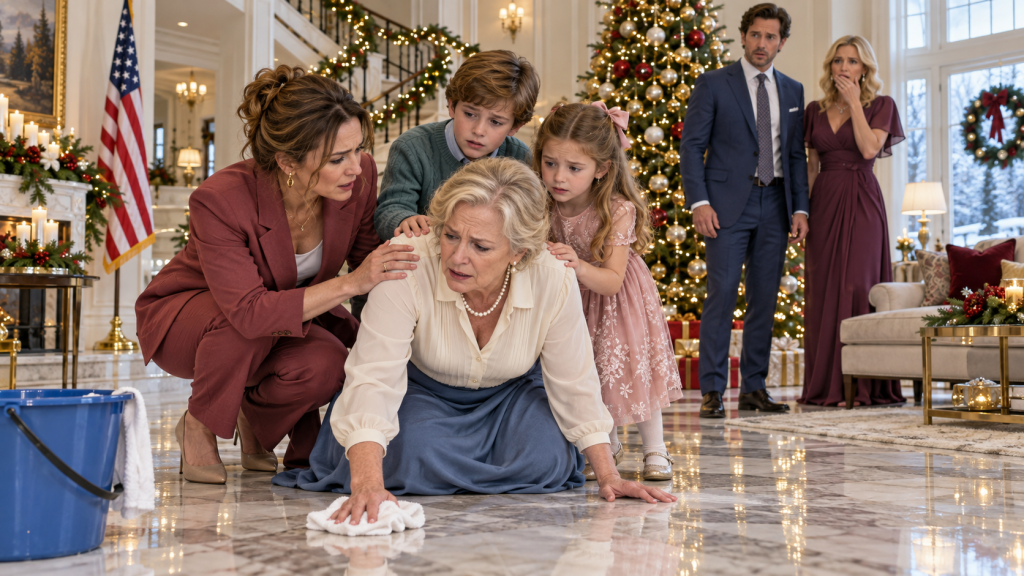
My mother was kneeling beside the toilet.
She wore an old gray sweater and a faded skirt.
Her hands were covered with cleaning solution.
A bucket stood beside her knees.
Mateo clung to her left leg.
Sofia sat against the wall, crying quietly.
My mother looked up.
The instant she saw me, fear crossed her face.
Not relief.
Fear.
“Daniela.”
I hurried toward her.
“Mom, what are you doing?”
She tried to smile.
“Patricia wanted everything ready before Christmas.”
I looked at the brush trembling in her hand.
“Why are you cleaning the bathroom?”
“It’s nothing, sweetheart.”
“Mom.”
She lowered her eyes.
Then I noticed the discoloration beneath her cheekbone.
A dark purple mark, partly concealed beneath powder.
I felt something cold settle in my chest.
“What happened to your face?”
“I slipped.”
“Where?”
“In the kitchen.”
“Doing what?”
She said nothing.
I reached down to help her stand.
As I lifted her, her sleeve slid toward her elbow.
Several dark marks circled her wrist.
They were unmistakable.
Someone had grabbed her hard enough to leave bruises.
For a moment, I couldn’t speak.
Then I whispered, “Who did this?”
She quickly pulled her sleeve down.
“Daniela, please.”
That word frightened me more than anything else.
Please.
Not because she wanted me to stop worrying.
Because she wanted me to stop asking.
From the living room came laughter.
I turned around.
Mauricio sat in his favorite chair watching television, a beer resting against his stomach.
His mother, Patricia, occupied the couch.
Her feet were stretched across the coffee table I had purchased four months earlier.
Dirty plates, glasses, and food wrappers covered the surface.
Neither of them looked remotely concerned about the crying children or my mother kneeling on the bathroom floor.
Mauricio glanced toward me.
“You’re back early.”
That was all.
No embrace.
No question about the flight.
Not even a smile.
Patricia looked me up and down.
“Well, since you’re home, tell Elena to hurry. Mauricio still has shirts that need ironing.”
I stared at her.
“My mother does not work for you.”
Patricia laughed.
“She’s living here without paying anything. Surely she can contribute.”
My voice became very quiet.
“She came here to help with my children.”
“And she has been helping,” Patricia replied. “But there’s no reason she can’t keep things tidy.”
I looked at Mauricio.
“Did you cancel the cleaning service?”
He shrugged.
“Mom thought it was unnecessary.”
“You told me you would handle it.”
“And I have.”
I looked back toward the hallway.
My mother was standing in the bathroom doorway, holding Sofia.
Mateo remained pressed against her skirt.
Their faces told me more than Mauricio’s words.
I returned to Mom.
“Get your things. We’re leaving.”
She shook her head.
“Daniela, it’s almost Christmas.”
“I know.”
“The children—”
“Are coming with us.”
That was when Mauricio appeared in the doorway.
“Daniela, don’t make a scene.”
I turned toward him.
“Move.”
He folded his arms.
“Where exactly do you think you’re going?”
“Somewhere my mother won’t be treated like a servant.”
He stepped forward.
“The children are staying here.”
“No, they aren’t.”
His expression hardened.
“If you take them, I’ll call a lawyer tomorrow.”
I stared at him.
He smiled.
“My mother can explain how often you disappear on business trips.”
Patricia appeared behind him.
“And how Elena can barely manage her own health.”
Mauricio continued.
“You’re never around, Daniela. I’m the parent who stays home.”
It was such a ridiculous statement that under different circumstances, I might have laughed.
Mauricio had not held a steady job in nearly eighteen months.
I paid the mortgage.
I paid the utilities.
I paid the children’s preschool tuition.
I paid for the groceries, insurance, vehicles, and nearly every expense in our household.
Yet somehow, he had convinced himself that my working made me an absent mother.
And Patricia was standing beside him, ready to support whatever story he invented.
I looked at them both.
Then I remembered my father.
Seven months earlier, he had been lying in a hospital bed, barely able to speak.
Three days before his death, he asked me to sit beside him.
His name was Gabriel Vargas.
He had worked as an accountant for more than forty years.
He was quiet, methodical, and deeply protective of the people he loved.
My father had never been dramatic.
He rarely raised his voice.
But that afternoon, he gripped my hand with surprising strength.
“Daniela, listen carefully.”
“I’m listening, Dad.”
“If you ever see your mother hurt, don’t argue with anyone.”
I thought his medication was confusing him.
“Dad, Mom is safe.”
His eyes filled with tears.
“Promise me.”
“Of course.”
“Open the hidden compartment in her sewing machine.”
I leaned closer.
“What compartment?”
“The old Singer. Beneath the wooden base.”
I stared at him.
“Why?”
His breathing became difficult.
“Everything you need is there.”
A nurse entered before he could explain.
The following morning, he was too weak to speak.
Two days later, he died.
I had never opened the compartment.
Until that afternoon, I had barely thought about his instructions.
But standing in my hallway with my mother hiding bruises, I suddenly understood that my father had been afraid of something.
And whatever frightened him was connected to my husband’s family.
I turned toward Mauricio.
“I’m not arguing.”
He looked satisfied.
Then I picked up Sofia.
“Mateo, take Grandma’s hand.”
Mauricio blocked the doorway.
“I told you, the children stay.”
I took out my phone.
Opened an app he had never seen.
Then pressed three buttons.
The television went black.
The downstairs lights switched off.
The heating system stopped.
Mauricio stared at the screen.
“What did you do?”
“I disabled the smart-home settings connected to my account.”
His phone vibrated.
Then again.
Then again.
I continued.
“And I canceled the supplementary bank cards I’ve been paying for.”
Patricia shot to her feet.
“You can’t do that two days before Christmas!”
I looked at her.
“You just discovered that I can.”
Mauricio reached for my phone.
I stepped back.
“Don’t.”
His jaw tightened.
“You think money gives you control over everything?”
“No,” I replied. “But it gives me the ability to stop paying for people who mistreat my mother.”
I gathered the children.
My mother picked up her small suitcase.
And we walked outside.
Mauricio followed.
He expected me to head toward my SUV.
Instead, I turned toward the property directly beside ours.
The other half of the duplex.
For three years, Mauricio had believed it was tied up in a bank dispute.
Its curtains were always closed.
The garden was neglected.
Patricia had even placed a PRIVATE PROPERTY sign beside the entrance.
But I knew something neither of them expected.
My father had purchased the house through a family trust.
He had told me about the arrangement shortly before he became seriously ill.
At the time, he explained that it was a precaution.
“For your mother and the children,” he said.
He had given me access to the security system and digital locks.
But he had never explained why he wanted the property kept so quiet.
Now, as I approached the front door, I began to suspect there was much more to the story.
I placed my thumb against the digital lock.
The indicator changed from red to green.
The door clicked open.
Warm air greeted us.
Interior lights illuminated a spotless living room.
Mauricio stopped on the walkway.
“How do you have access?”
I looked at him.
“Because this house belongs to my father’s trust.”
Patricia came outside.
The moment she saw the open door, her face changed.
“Daniela.”
Her voice sounded strange.
Almost pleading.
“Who gave you that property?”
“My father bought it three years ago.”
She swallowed.
Her eyes moved toward the narrow basement windows.
Then she whispered something I would never forget.
“Your father promised nobody would ever open that basement again.”
I felt my heart begin to pound.
“What happened in that basement?”
Patricia grabbed Mauricio’s arm.
“We need to leave.”
But my mother stepped forward.
For the first time that day, her voice was firm.
“No, Patricia.”
Patricia stared at her.
“Elena, don’t.”
“You’ve hidden the truth long enough.”
Mauricio looked between them.
“What truth?”
Mom turned toward me.
“Your father didn’t buy this house as an investment, Daniela.”
“Then why did he buy it?”
Her eyes filled with tears.
“Because he discovered what Patricia did twenty-six years ago.”
Before I could ask another question, Patricia rushed toward the basement door inside the house.
I stepped in front of her.
“Don’t touch it.”
Her expression twisted.
“You don’t understand.”
“Then explain.”
She said nothing.
My phone rang.
The caller was Ricardo Salazar, my father’s longtime attorney.
I answered immediately.
“Ricardo?”
“Daniela, the security system notified me that someone entered the property.”
“I’m here with my mother.”
He hesitated.
“Is Patricia there?”
I looked at my mother-in-law.
“Yes.”
Ricardo’s voice became urgent.
“Do not let her enter the basement.”
“Why?”
“Your father left a sealed recording. It contains evidence concerning something that happened many years ago.”
Patricia suddenly covered her mouth.
Ricardo continued.
“And Daniela, there is something else.”
“What?”
“Your husband knows exactly what happened down there.”
I slowly turned toward Mauricio.
He was reaching into his jacket.
For one terrible second, I thought he might be taking out a weapon.
Instead, he pulled out a small brass key.
An old-fashioned key with a faded red ribbon attached.
My mother gasped.
“Gabriel’s key.”
Mauricio closed his fist around it.
“Everyone needs to calm down.”
I stared at him.
“Where did you get that?”
He looked away.
Patricia stepped toward him.
“Give it to me.”
He refused.
“Mom, you told me there wasn’t anything left.”
Ricardo spoke sharply through my phone.
“Daniela, can you hear me?”
“Yes.”
“Please put some distance between yourself and them. Take the children somewhere secure. I can meet you at the property with the documents your father entrusted to me.”
I looked at my twins.
Sofia had begun rubbing her eyes.
Mateo was clinging to my mother’s hand.
Whatever secret was buried beneath that house, I would not uncover it while my children stood beside two people I no longer trusted.
I turned to the little ones.
“Sweethearts, we’re going upstairs to see your Christmas presents.”
Mateo looked up.
“Santa already came?”
“Not yet,” I said gently. “But Grandma has a surprise for you.”
I guided them into the house.
Mauricio moved toward me.
“Daniela, we need to talk.”
“No,” I said. “We needed to talk when you decided my mother should scrub toilets.”
He reached for my arm.
I stepped away.
“Don’t touch me.”
Something in my expression must have convinced him.
He stopped.
I locked the door behind us.
Through the glass, I watched Patricia begin shouting at him.
He looked down at the key in his hand.
Then toward the basement windows.
Neither of them noticed the small camera mounted beneath the porch roof.
But I did.
And for the first time, I was grateful that my father had been so careful.
Inside, the house was surprisingly comfortable.
There were clean blankets in the bedrooms.
Fresh towels.
A fully equipped kitchen.
A small basket of children’s toys stood beside the living room couch.
My father had planned for us to use this home one day.
That realization nearly brought me to tears.
Mom sat carefully in an armchair while I helped the twins remove their jackets.
I gave them crackers and juice.
Then I carried the portable baby monitor from a cabinet upstairs and settled them in the room my father had prepared.
The walls were painted a soft yellow.
Two small beds stood beneath the window.
Above them hung wooden letters spelling MATEO and SOFIA.
My father had died before the children turned three.
Yet he had thought to prepare a refuge where they could feel safe.
I stood in the doorway longer than necessary.
Then I returned downstairs.
Mom was staring at the basement door.
“Mom,” I said, sitting beside her. “Tell me what happened.”
She shook her head.
“Your father wanted to explain it himself.”
“He can’t.”
A tear rolled down her cheek.
“I know.”
I reached for her hand.
She winced.
The bruises around her wrist were worse than I had realized.
“Before anything else, we’re getting you examined.”
“Daniela—”
“Please don’t tell me you slipped.”
She closed her eyes.
For several seconds, the only sound was the humming refrigerator.
Then she whispered, “Mauricio grabbed me.”
My stomach tightened.
“When?”
“Yesterday morning.”
“Why?”
“I told him I wouldn’t sign something.”
“What did he want you to sign?”
“A paper saying I wasn’t fit to care for the children.”
I stared at her.
“He wanted you to declare yourself incapable?”
She nodded.
“Patricia said they needed it for a lawyer.”
My hands went cold.
“Did you sign?”
“No.”
“Then what happened?”
“Patricia started shouting. Mauricio grabbed my wrist. He tried to take the pen and put it in my hand.”
She looked down.
“I pulled away. I fell against the kitchen counter.”
I thought about the bruise beneath her cheekbone.
“And nobody helped you?”
She shook her head.
“Mateo started crying. Sofia screamed. Mauricio told me to stop frightening the children.”
I could barely breathe.
For twelve days, my mother had been trapped inside my own home, threatened by people I had trusted to protect her.
“Why didn’t you call me?”
Her answer broke something inside me.
“Because Patricia said Mauricio would take the children away if I made trouble.”
I stared at her.
“You believed her?”
“She showed me papers.”
“What papers?”
“Documents from a lawyer. They said you were neglecting your family.”
My mother began crying.
“I knew they weren’t true, Daniela. But I didn’t know what they could do with them.”
I embraced her carefully.
“You should have told me.”
“I know.”
She wiped her face.
“But I was afraid.”
Those words made me understand something important.
Fear had not made my mother weak.
It had made her cautious.
And Patricia and Mauricio had used that caution against her.
I called a medical service and arranged for Mom to be examined.
Then I called my attorney, Lucía Mendoza.
I explained everything.
Lucía listened without interrupting.
When I finished, she said, “Do not sign anything. Preserve the messages, photographs, and security recordings. We need to establish exactly what happened and address custody arrangements immediately.”
“Can they take my children?”
“Threatening you doesn’t give them that right, Daniela. But we need to proceed carefully.”
I looked at the bedroom ceiling.
The twins were laughing quietly upstairs.
“I won’t let them scare my mother again.”
“Then we’ll document this properly.”
After ending the call, I opened the security app.
The cameras covering the neighboring property’s entrances showed Mauricio and Patricia still outside.
They were arguing.
Patricia pointed repeatedly toward the basement windows.
Mauricio was shaking his head.
Then she slapped him.
I stared at the screen.
He didn’t strike her back.
He simply stood there, looking stunned.
For years, I had seen Mauricio become strangely quiet whenever Patricia was angry.
I had always assumed he was avoiding conflict.
Now I wondered whether he had spent his entire life being controlled by her.
It didn’t excuse what he had done to my mother.
But it explained something.
Twenty minutes later, Ricardo arrived.
He was seventy-one, with silver hair, a neatly trimmed mustache, and the same leather briefcase he had carried to my father’s funeral.
He took one look at my mother’s wrist.
His expression darkened.
“Elena.”
She lowered her head.
“I’m sorry, Ricardo.”
He knelt beside her chair.
“You have nothing to apologize for.”
Then he stood and faced me.
“Daniela, we need the sewing machine.”
I felt a strange sense of recognition.
My father had made the same request seven months earlier.
“It’s at my mother’s house,” I said.
Mom shook her head.
“No. I brought it here.”
I turned toward her.
“What?”
“Patricia told me to bring things I could use while I was staying. She wanted me to repair curtains and shirts.”
“Where is it?”
“In the utility room at your house.”
I stared toward the wall separating the two properties.
The old Singer sewing machine was less than twenty meters away.
And Mauricio and Patricia were standing between me and it.
Ricardo opened his briefcase.
“Your father anticipated that possibility.”
He handed me a sealed envelope.
Across the front, in my father’s handwriting, were four words.
For Daniela, when necessary.
My eyes blurred.
I carefully opened it.
Inside was a single handwritten page.
My darling daughter,
If you’re reading this, then something I feared has probably happened.
I am sorry I couldn’t explain everything while I was alive.
I wanted to protect your mother from reliving the worst night of her life.
I also wanted to give Mauricio the chance to become a better man than the family that raised him.
Perhaps I was wrong about that.
The old sewing machine contains records that must be compared with the evidence in the basement.
Do not confront Patricia alone.
Trust Ricardo.
And remember something I have told you since you were little.
A person who loves you does not need to frighten you to keep you close.
Dad.
I pressed the letter against my chest.
My father had known.
He had known there was something dangerous about Patricia.
And somehow, he had known Mauricio might one day turn against me.
“Why didn’t he tell me?” I whispered.
Ricardo pulled out a chair.
“Because he was trying to prevent a tragedy from becoming another tragedy.”
I looked at him.
“What happened twenty-six years ago?”
He glanced at my mother.
“Would you like me to explain?”
She nodded slowly.
“Yes.”
Ricardo took a deep breath.
“In December 2000, a young woman named Isabel Torres disappeared.”
The name meant nothing to me.
I frowned.
“Who was she?”
My mother’s lips trembled.
“My best friend.”
I turned toward her.
“Mom?”
“She was like a sister to me,” Mom whispered.
Ricardo continued.
“Isabel worked as a bookkeeper for a property management company owned by Patricia’s late husband, Arturo Rivas.”
I recognized the name immediately.
Mauricio’s father had died when Mauricio was a teenager.
According to the family story, Arturo had been a successful businessman who lost most of his fortune after a dispute with investors.
Patricia rarely spoke about him.
And whenever she did, her voice became bitter.
Ricardo opened another folder.
“Isabel discovered irregularities in company accounts. Money was being transferred from client escrow accounts into private investments.”
“How much money?”
“At the time, several million pesos.”
I stared at him.
“Was Arturo stealing?”
“Arturo was involved. But Isabel discovered that Patricia was authorizing many of the transactions herself.”
I looked toward the window.
Outside, Patricia was pacing.
My mother began to cry.
“She came to our house three nights before Christmas,” she said. “She was terrified.”
I took her hand.
“She told your father she had found documents proving what Patricia and Arturo were doing.”
“Why didn’t she go to the police?”
“She planned to.”
Mom’s voice became barely audible.
“But she wanted to protect her little boy first.”
I frowned.
“What little boy?”
Ricardo looked at me.
“Isabel had a six-year-old son.”
I felt a strange tightening in my chest.
Six years old.
Twenty-six years ago.
Mauricio was thirty-two.
I slowly turned toward Ricardo.
“His name?”
He hesitated.
Then answered.
“Mauricio.”
For a moment, the room seemed to tilt.
I stared at him.
“No.”
My mother closed her eyes.
“Daniela—”
“No,” I repeated. “Mauricio’s mother is Patricia.”
Ricardo nodded.
“Legally, that is what his records eventually showed.”
I looked between them.
“What are you saying?”
Mom began sobbing.
“Patricia isn’t Mauricio’s biological mother.”
The words struck like a physical blow.
I sat completely still.
My husband.
The man I had married.
The father of my children.
Had been raised by a woman who was not his mother.
And the woman who had given birth to him had disappeared twenty-six years earlier.
I whispered, “What happened to Isabel?”
Neither answered immediately.
Then Ricardo said, “That’s what your father spent years trying to prove.”
I thought about Patricia staring at the basement windows.
About Mauricio holding the brass key.
About my father’s warning.
And suddenly, I was no longer certain I wanted to know what waited beneath the house.
But I also knew I could not walk away.
Not anymore.
I called Lucía again and explained what Ricardo had revealed.
She advised us to contact the authorities before entering any area potentially connected to an old crime.
Ricardo agreed.
He had already arranged for an investigator familiar with the original disappearance to meet us.
While we waited, I asked my mother to tell me everything she remembered.
She looked at her swollen hands.
“Isabel wasn’t married when Mauricio was born,” she began. “His father left before she delivered. She worked two jobs to support him.”
“Was Patricia related to her?”
“No. They worked together.”
Mom took a trembling breath.
“Patricia was charming in those days. She gave Isabel extra shifts and offered to watch Mauricio when she had appointments. At first, Isabel thought she was being kind.”
“But she wasn’t.”
“Not entirely.”
Mom wiped her cheeks.
“Patricia and Arturo couldn’t have children. Patricia became very attached to the little boy.”
I thought about my own twins.
About the way Patricia frequently insisted that Mateo looked like her family.
About how she corrected Sofia whenever my daughter called my mother Grandma Elena.
I had assumed it was ordinary jealousy.
Now the memories felt different.
“Isabel told us Patricia had started making strange comments,” Mom continued. “She talked about how much better Mauricio’s life could be if he lived in a wealthy home.”
“What did Isabel say?”
“She told Patricia that money didn’t make someone a mother.”
I swallowed.
“That must have made Patricia furious.”
“Yes.”
Mom looked toward the basement door.
“After Isabel discovered the missing money, she became frightened that Patricia would use the company against her.”
Ricardo added, “There were forged documents indicating Isabel had taken funds herself. Those records could have destroyed her credibility.”
“Did Patricia threaten her?”
“We believe so.”
My mother nodded.
“The last time Isabel visited our house, she said, ‘If anything happens to me, don’t let Patricia keep my son.’”
I felt tears rising.
“What happened next?”
Mom’s voice broke.
“Isabel went to meet Patricia and Arturo at the property next door.”
I looked toward the floor.
“This property?”
“Yes.”
“At the time, it belonged to the Rivas company.”
My mother’s hands began shaking.
“She never came home.”
The room became silent.
Outside, a vehicle stopped beside the curb.
Ricardo looked through the curtains.
“The investigator is here.”
A middle-aged woman stepped out of the car, accompanied by a uniformed officer.
Her name was Inspector Valeria Cruz.
She was calm, observant, and immediately understood that the situation involved both an allegation of recent domestic abuse and possible evidence from a historical missing-person investigation.
She listened to my mother.
She examined the documents Ricardo had brought.
Then she asked one question.
“Has anyone entered the basement recently?”
I thought about the brass key.
“My husband has access.”
Her expression changed.
“Do you know whether he has been inside?”
“No.”
She nodded.
“We’ll need to preserve the area and arrange the proper legal authorization for any forensic search.”
I was grateful for her calmness.
Part of me wanted to break down the basement door immediately.
Another part wanted to gather my children and disappear.
But my father’s letter had been clear.
Don’t argue.
Don’t confront Patricia alone.
Trust Ricardo.
So I waited.
Meanwhile, a medical professional examined my mother and documented the injuries on her face and wrist.
When asked how they occurred, Mom finally told the truth.
Mauricio had grabbed her.
She had fallen.
And Patricia had ordered her to keep working afterward.
The account was formally recorded.
I watched my mother speak, her voice trembling at first and then becoming stronger.
When she finished, she looked at me.
“I’m sorry I was afraid.”
I shook my head.
“I’m proud of you for telling them.”
A little after six that evening, Mauricio called.
I let the phone ring.
He called again.
Then a message appeared.
Daniela, stop being childish. Bring the kids back. We need to discuss this like adults.
A second message followed.
My mother says your father was obsessed with destroying our family. Don’t believe everything Ricardo tells you.
Then a third.
If you go into that basement, you’ll regret it.
I showed the messages to Lucía.
She told me to save them.
I did.
Five minutes later, another message arrived.
You don’t know who your father really was.
For the first time, I felt genuine fear.
Not because I doubted my father.
Because Mauricio sounded as though he knew something he had never told me.
That evening, the twins fell asleep early.
I sat beside their beds, watching the soft rise and fall of their chests.
Mateo had one arm wrapped around his toy airplane.
Sofia held her pink rabbit against her cheek.
I had planned to give them those presents on Christmas morning.
Instead, they were sleeping in a house I had never expected to need, while my marriage disintegrated a few meters away.
I wondered how many times I had ignored warning signs.
Mauricio hadn’t always behaved this way.
When we met, he was attentive and funny.
He worked for a marketing company.
He brought flowers to my office.
He listened when I talked about growing my business.
After our wedding, things slowly changed.
He quit one job.
Then another.
He began criticizing my travel schedule.
He told me my success made him feel unnecessary.
Patricia moved closer.
She had an opinion about everything.
What I cooked.
How I dressed the children.
Whether I should accept another contract.
Whenever I disagreed, Mauricio accused me of disrespecting his mother.
I had mistaken exhaustion for marital difficulty.
And silence for peace.
Now I understood that a marriage can become unsafe long before anyone raises a hand.
The next morning, Ricardo returned with news.
“We located the original file concerning Isabel’s disappearance.”
I stood.
“What did it say?”
“Almost nothing useful. The investigation was closed after several years without a resolution.”
“Why?”
“Witness statements conflicted. Financial records disappeared. Arturo’s company collapsed.”
“And Patricia?”
“She claimed Isabel had fled after stealing money.”
I felt sick.
“She stole her child and blamed her for theft?”
Ricardo met my eyes.
“That is one possibility. We still need proof.”
Then he placed another document on the table.
A copy of a guardianship record.
I stared at it.
Patricia’s name appeared in the section identifying the child’s guardian.
But the signature supposedly belonging to Isabel looked unusually shaky.
Ricardo pointed to the date.
“Signed three days after Isabel was last seen.”
My breath caught.
“How could she sign it if she was missing?”
“That is one of the questions investigators will need to answer.”
I looked closer.
A second signature appeared beside it.
Gabriel Vargas.
My father’s name.
I felt as though someone had punched me.
“Dad witnessed this?”
Ricardo nodded.
“Yes.”
I stepped away from the table.
“No.”
“Daniela—”
“He knew?”
My mother began crying.
“Sweetheart, please listen.”
I looked at her.
“My father helped Patricia take Isabel’s child?”
Ricardo spoke carefully.
“Your father believed he was signing temporary guardianship papers to protect Mauricio while authorities searched for Isabel.”
I stared at him.
“Then why didn’t he challenge it?”
“He did, eventually.”
“Eventually?”
Mom’s voice trembled.
“Patricia threatened us.”
I turned toward her.
“With what?”
She closed her eyes.
“She said your father would be accused of helping Isabel steal company money. She had paperwork with his name on it.”
I looked back at Ricardo.
“Was it true?”
“No evidence supports that accusation. Your father had reviewed company accounts as an outside consultant, and Patricia used his professional connection to make her threats credible.”
My mother continued.
“We had very little money then. You were eleven. Your father was terrified we would lose everything.”
I remembered that period of my childhood.
Dad working late.
Mom crying quietly in the kitchen.
The way they stopped inviting certain friends over.
I had assumed money was tight.
I had no idea my family was carrying someone else’s disappearance.
“Why didn’t you tell me when I grew up?” I asked.
Mom looked devastated.
“Because every time your father tried to reopen the matter, something happened.”
“What kind of things?”
“Threatening letters. A broken window. Someone followed him home from work.”
Ricardo nodded.
“Eventually, Gabriel decided he needed evidence strong enough that Patricia could not intimidate everyone involved.”
“And the house?”
“He acquired it when the property was sold as part of a later estate liquidation.”
I looked at the basement door.
“He bought the scene of Isabel’s disappearance.”
“Yes.”
“Why?”
“Because he believed something had been hidden there.”
I thought of my father’s final letter.
The sewing machine contains records that must be compared with the evidence in the basement.
Suddenly, I understood the importance of getting that machine.
I looked at Ricardo.
“We need to retrieve it.”
Lucía arranged for the necessary assistance.
Later that morning, with the situation documented and officers present to prevent confrontation, I returned briefly to the home I had shared with Mauricio.
Walking through the front door felt surreal.
The Christmas tree still stood beside the staircase.
Stockings hung above the fireplace.
A family photograph from the previous summer rested on the mantel.
In it, Mauricio stood behind me with his hands on my shoulders.
I was smiling.
So were the children.
I stared at the photograph for a moment.
Then I kept walking.
Patricia was in the kitchen.
The moment she saw me, she stood.
“Daniela.”
I ignored her.
“Where’s the sewing machine?”
Her eyes narrowed.
“What sewing machine?”
“My mother’s.”
She crossed her arms.
“I don’t know.”
I walked toward the utility room.
Patricia followed.
“You have no right to come in here and accuse people.”
I stopped.
“This is my home too, Patricia.”
She looked toward the officer standing near the entrance.
Her expression softened instantly.
“I’ve always treated Daniela like my daughter.”
I didn’t respond.
Inside the utility room, the old Singer sat beneath a sheet.
But something was wrong.
The wooden base was scratched.
The side drawer hung open.
I lifted the sheet.
The machine had been moved.
Someone had tried to force open the compartment.
My heart began pounding.
Patricia appeared in the doorway.
“Oh, that old thing? Mauricio was going to throw it away.”
I looked at her.
“Why?”
“It doesn’t work properly.”
I bent down.
There were fresh tool marks along the wooden edge.
Someone had attempted to pry it apart.
I photographed the damage.
Then I asked for help carrying the machine outside.
Patricia’s face tightened.
“You can’t just take things.”
I turned toward her.
“It belongs to my mother.”
She said nothing.
As I passed through the hallway, Mauricio appeared at the front door.
He looked exhausted.
Dark circles surrounded his eyes.
“Daniela, please.”
I stopped.
He looked at the sewing machine.
Then at me.
“Don’t open it.”
I stared at him.
“Why?”
He swallowed.
“Because whatever is inside will destroy everything.”
I felt a terrible sadness.
“No, Mauricio.”
He looked up.
“Whatever you’ve been doing is what destroyed everything.”
For one moment, he appeared ready to say something.
Then Patricia called from behind him.
“Mauricio!”
His face changed.
He stepped aside.
And I left.
Back at the neighboring house, Ricardo placed the sewing machine on the dining table.
My mother stood beside him.
I carefully removed the wooden base.
It was heavier than expected.
Beneath the machine was a narrow panel held in place by two small brass screws.
Ricardo handed me a screwdriver.
My hands trembled as I loosened them.
The panel lifted.
Inside was a shallow compartment wrapped in dark blue cloth.
I unfolded it.
There were three envelopes.
A small flash drive.
Several photographs.
And an old cassette tape.
Across the first envelope, my father had written:
ISABEL TORRES — ORIGINAL RECORDS.
The second read:
PATRICIA RIVAS — PROPERTY TRANSACTIONS.
The third contained only one word.
MAURICIO.
I stared at it.
Ricardo touched my shoulder.
“Start with the photographs.”
I picked up the first picture.
It showed a young woman with dark hair and a bright smile, holding a little boy in a red sweater.
The boy had thick eyebrows, large brown eyes, and a tiny dimple beside his mouth.
I knew that face.
I had seen it in Mauricio’s childhood photographs.
But in those pictures, Patricia always stood beside him.
This woman was different.
I turned the photograph over.
In faded ink, someone had written:
Isabel and my beautiful Mauricio. Christmas 1999.
I began crying.
Not for my husband.
Not yet.
For the woman whose child had grown up believing someone else was his mother.
The next photograph showed Isabel standing beside my mother in our old kitchen.
Both women were laughing.
The third showed Isabel with my father outside an office building.
And the fourth made Ricardo draw a sharp breath.
It showed Patricia standing beside Arturo at the entrance to the duplex.
Behind them, almost concealed by an open garage door, was a man carrying a large rectangular wooden crate.
The photograph was dated December 22, 2000.
The day Isabel disappeared.
I looked at Ricardo.
“What is that?”
He studied the image.
“I don’t know.”
My mother pressed her hand against her mouth.
“Gabriel took that picture.”
I turned toward her.
“Why?”
“Because he’d gone there looking for Isabel.”
I stared.
“He saw Patricia?”
“Yes. But Patricia told him Isabel had already left.”
Ricardo placed the photograph aside.
“Let’s examine the documents.”
The first envelope contained copies of bank transfers, company ledgers, and correspondence.
Most of the paperwork was too complicated for me to understand immediately.
But several numbers stood out.
Transfers to accounts connected to Patricia.
Invoices for services that appeared never to have been performed.
And a handwritten note from Isabel.
If I disappear, look at account 417. Patricia moved everything through the construction company. Arturo knows, but he is afraid of her.
I read the sentence twice.
Then I noticed another line.
The original ledger is in the red metal box.
I looked up.
“What red metal box?”
Ricardo shook his head.
“We’ll have to find out.”
The second envelope contained property documents.
There were records of sales, transfers, and corporate ownership changes stretching across more than two decades.
I recognized the duplex address.
But another name appeared repeatedly.
A company called Horizonte Desarrollo.
I frowned.
“I’ve heard that name.”
Ricardo nodded.
“It was one of the businesses associated with Arturo.”
Then I saw something extraordinary.
A recent contract.
Signed less than six months earlier.
Horizonte Desarrollo.
Mauricio Rivas.
The signature was unmistakable.
I felt my stomach sink.
“My husband is involved in this company?”
Ricardo looked grim.
“Apparently.”
I scanned the document.
It concerned the sale of redevelopment rights connected to several properties, including the original duplex.
But the annex listed both halves of the building as assets available for development.
I looked up.
“How could he include my father’s house?”
“He couldn’t legally transfer something he didn’t own,” Ricardo said. “But he may have represented that he could obtain control of it.”
I remembered Mauricio complaining repeatedly about the empty house.
About how it made our street look neglected.
About why the bank hadn’t sold it.
He had asked whether my father had ever discussed purchasing property nearby.
I had told him no.
I hadn’t trusted the question enough to explain the trust.
Now I was grateful.
I opened the third envelope.
Inside was a handwritten letter addressed to Mauricio.
It was from my father.
Mauricio,
I know more about your childhood than you realize.
You were an innocent boy when terrible choices were made around you.
None of what happened to Isabel was your fault.
But you are an adult now.
You have a family of your own.
And the choices you make from this point forward belong to you.
I hope you will choose truth over fear.
Gabriel.
I stared at the letter.
“Did Dad ever give him a copy?”
Ricardo nodded.
“Your father met with Mauricio privately shortly before his illness became serious.”
My stomach tightened.
“What did Mauricio say?”
“He denied knowing anything.”
“Did Dad believe him?”
Ricardo was silent.
Then he answered.
“No.”
I looked down at the letter again.
My husband had been warned.
He had been offered a chance to tell the truth.
Instead, he had continued lying.
Worse, he had allowed his mother to hurt mine.
The cassette tape came next.
Ricardo had brought a small player.
He inserted the tape and pressed play.
Static filled the room.
Then my father’s voice emerged.
“This is Gabriel Vargas. The date is March 14, 2023.”
I covered my mouth.
Hearing his voice again felt almost unbearable.
He sounded healthy.
Steady.
Careful.
“I am recording this statement because certain evidence may be destroyed after my death.”
There was a pause.
“Twenty-three years ago, my friend Isabel Torres disappeared after discovering financial misconduct involving Patricia and Arturo Rivas.”
I sat down.
My father’s voice continued.
“I witnessed documents I should never have signed. I believed I was protecting a frightened child. Instead, I helped Patricia obtain legal control over him.”
A faint sound came through the recording.
He was crying.
“I have lived with that mistake every day.”
My mother began sobbing beside me.
Then Dad continued.
“In 2022, I acquired access to archived records connected to the original property. I discovered evidence suggesting that Isabel did not leave the premises voluntarily.”
My skin prickled.
“Beneath the basement stairs, behind a false wall, is a storage chamber that was sealed shortly after her disappearance.”
I looked toward the basement door.
“During a renovation inspection, I found signs that the wall had been constructed after the rest of the foundation.”
His voice became quieter.
“I did not disturb it. I sought legal advice and arranged for the appropriate investigation, but threats against my family made me proceed cautiously.”
The tape crackled.
Then came the sentence that changed everything.
“I believe Patricia knows exactly what is behind that wall.”
My mother closed her eyes.
The recording continued.
“And I have reason to believe Mauricio discovered the chamber several years ago.”
I stared at the player.
The next words were almost a whisper.
“If my daughter hears this, I want her to understand that I never intended to leave her with this burden. I only wanted to make certain she and Elena would be safe.”
The tape clicked.
Silence filled the room.
I sat motionless.
All my life, I had believed my father was simply a cautious man.
Now I understood that he had carried a terrible secret while quietly collecting evidence.
And my husband had been given opportunities to make things right.
He had chosen not to.
I looked at Ricardo.
“We need to find that chamber.”
He nodded.
“The authorities now have information that can help them seek the necessary authorization.”
By the following afternoon, investigators had secured the basement.
Patricia had been formally questioned about the historical case.
Mauricio had retained an attorney.
I watched from the neighboring living room as officers arrived with equipment.
Their movements were controlled and methodical.
No one treated the discovery like a television mystery.
They photographed the entrances.
Documented the locks.
Reviewed property records.
And prepared to examine the concealed area.
The basement itself was larger than I expected.
Concrete stairs led into a cool room lined with old storage shelves.
The air smelled of dust and damp wood.
I had never been down there before.
My father had kept the entrance locked, and I had respected his privacy.
Now I stood at the top of the stairs while investigators worked below.
An officer located the altered section beneath the staircase.
The false wall was constructed from newer materials than the surrounding foundation.
There were signs it had been repaired more than once.
The investigation continued for hours.
I remained upstairs with Ricardo.
My mother stayed with the twins in a bedroom, away from the activity.
Late that afternoon, Inspector Cruz approached me.
“Daniela, we found a concealed storage space.”
My mouth went dry.
“What was inside?”
“Several items. We will need time to examine them properly.”
“Was there a red metal box?”
She looked surprised.
“Yes.”
I grabbed the back of a chair.
Inspector Cruz continued.
“We also found documents, personal belongings, and materials that may be connected to the disappearance.”
I whispered, “Isabel?”
“We cannot draw conclusions yet.”
I nodded.
She was right.
I didn’t want assumptions.
I wanted proof.
That evening, I received a call from an unfamiliar number.
I answered cautiously.
“Hello?”
A woman’s voice said, “Is this Daniela Vargas?”
“Yes.”
“My name is Camila Torres.”
I waited.
“I’m Isabel’s younger sister.”
I closed my eyes.
She continued.
“Inspector Cruz contacted our family today. She said new evidence may have been found.”
“Yes.”
Camila began crying.
“We’ve been waiting twenty-six years.”
I didn’t know what to say.
She took a shaky breath.
“Can I ask you something?”
“Of course.”
“Did Isabel’s little boy grow up happy?”
The question broke my heart.
I thought about Mauricio.
About the man who had once danced with me in our kitchen.
About the father who had held our newborn twins with tears in his eyes.
About the husband who had stood in a doorway and threatened to take those same children away.
“I don’t know,” I whispered.
Camila was silent.
Then she said, “I used to wonder whether he remembered her.”
I sat down.
“He may not.”
“He was only six. But Isabel loved him more than anything.”
I looked at the photograph lying on the table.
The young woman holding her little boy.
“She looks so happy in the pictures.”
Camila began crying again.
“She was.”
We spoke for nearly an hour.
Camila told me about Isabel’s childhood.
Her love of singing while she cooked.
Her terrible jokes.
The way she saved money to buy Mauricio school shoes.
She told me Isabel had planned to move away from Querétaro after exposing the financial fraud.
She wanted a fresh start.
“She told me she had finally found a way to protect him,” Camila said.
Then her voice changed.
“Patricia took everything.”
I couldn’t disagree.
But as I ended the call, I realized something painful.
Patricia had not only stolen a child from his family.
She had raised that child to believe love meant obedience.
And Mauricio had brought that same understanding into our marriage.
That night, I made a decision.
Whatever happened next, I would not raise Mateo and Sofia inside that pattern.
On Christmas Eve, Mauricio appeared outside the neighboring house.
He stood beneath the porch light holding a bag of wrapped presents.
My phone rang.
I answered through the security system.
“What do you want?”
“I brought gifts for the kids.”
I looked at the screen.
He seemed smaller than usual.
His shoulders were slumped.
His face was pale.
“They’re sleeping,” I said.
“Daniela, please.”
“We can arrange an appropriate time for you to see them through our attorneys.”
He looked directly into the camera.
“Are you really going to destroy our family over this?”
I stared at him.
“Over what?”
He hesitated.
“Everything that’s happening.”
I felt my voice become steady.
“You hurt my mother.”
His eyes shifted away.
“She wouldn’t cooperate.”
The words stunned me.
“Cooperate with what?”
He rubbed his forehead.
“Mom said Elena was hiding documents.”
“So you grabbed her?”
“I didn’t mean to hurt her.”
“But you did.”
He looked at the ground.
“I know.”
I waited.
For once, I wanted to hear him take responsibility without an excuse.
Instead, he said, “You don’t understand the pressure I’ve been under.”
I almost laughed.
“What pressure?”
He looked toward the basement windows.
“Mom said if the property wasn’t sold, everything would come out.”
I went still.
“What would come out?”
He stared at the camera for a long moment.
Then whispered, “I know Patricia isn’t my real mother.”
My heart pounded.
“How long have you known?”
“Since I was twenty-eight.”
Four years.
For four years, my husband had known.
And for four years, he had allowed me to call Patricia his mother without understanding the truth.
“Did she tell you about Isabel?”
He nodded.
“She said Isabel abandoned me.”
I felt tears sting my eyes.
“And you believed her?”
“I wanted to.”
His honesty hurt more than another lie.
“Did my father tell you otherwise?”
He closed his eyes.
“Yes.”
I pressed my hand against the counter.
“What did he say?”
“That Isabel disappeared here. That Patricia forged documents. That I needed to help him investigate.”
“And what did you do?”
Mauricio began crying.
“I told Mom.”
I closed my eyes.
Of course he had.
The woman who controlled him had remained the person he trusted most.
“She said Gabriel was trying to take me away from her,” he continued.
“You were almost thirty.”
“I know.”
“Did you believe she could take you away from someone?”
He said nothing.
I thought about the way Patricia commanded everyone around her.
Then I asked the question I feared most.
“Have you been inside the hidden room?”
He looked toward the street.
“Yes.”
My knees weakened.
“When?”
“Three years ago.”
“What did you find?”
He covered his face.
“A red box. Old papers. A woman’s necklace.”
I could barely breathe.
“What did you do with them?”
“I put everything back.”
“Why?”
“Mom told me it was evidence that Isabel had stolen money and escaped.”
“Then why hide it?”
He didn’t answer.
The silence stretched.
Finally, he whispered, “Because I knew it wasn’t true.”
I stared at him through the camera.
There it was.
The truth.
He had known.
Maybe not everything.
Maybe not exactly what happened.
But enough.
Enough to recognize that his mother was lying.
Enough to understand that a missing woman deserved answers.
And he had chosen silence.
“Daniela,” he said, “I was afraid.”
I looked toward the stairs.
Upstairs, my children were sleeping.
My mother was resting beside them.
I thought of Isabel, who never got to see her son grow up.
Then I looked back at the screen.
“You had choices, Mauricio.”
He began crying harder.
“I love you.”
For years, those three words had been enough to make me forgive almost anything.
That night, they sounded painfully empty.
“Love doesn’t erase what you did,” I answered.
Then I ended the call.
Christmas morning arrived quietly.
I made pancakes in the unfamiliar kitchen.
My mother sat at the table wearing a clean blue cardigan.
The swelling around her wrist had begun to fade.
Mateo opened his toy airplane.
Sofia hugged her pink rabbit.
They laughed.
They spilled orange juice.
They argued about which Christmas song to play.
And for a few minutes, the world felt almost normal.
Then Sofia climbed onto my lap.
“Mommy?”
“Yes, sweetheart?”
“Is Daddy angry?”
I swallowed.
“Daddy is having some grown-up problems.”
“Is Grandma Patricia angry?”
I looked toward my mother.
She kept her expression gentle.
I kissed Sofia’s hair.
“You don’t have to worry about grown-up arguments.”
Mateo climbed beside us.
“Can Grandma Elena stay forever?”
Mom began crying.
I smiled through my own tears.
“Grandma can stay as long as she wants.”
Mateo nodded seriously.
“Because she makes the good soup.”
We all laughed.
It was the first genuine laughter I had heard from my mother in nearly two weeks.
Later that afternoon, she handed me a small wrapped package.
“I was going to give you this at your house,” she said.
Inside was a tiny embroidered pillow.
Across the front, in careful stitching, were the words:
HOME IS WHERE WE ARE SAFE.
I stared at it.
“Mom.”
She smiled sadly.
“I started making it before everything happened.”
I hugged her.
For a long time, neither of us spoke.
The following week brought the first major breakthrough.
Investigators completed an initial examination of the documents recovered from the basement.
The red metal box contained original financial ledgers.
There were correspondence records connecting Patricia to unauthorized transfers.
There were also personal letters written by Isabel.
One letter described increasing threats.
Another recorded her fear that Patricia intended to gain permanent control of Mauricio.
But the most important discovery was a small digital recording device hidden inside a protective case.
It contained an audio file created on the night Isabel disappeared.
An investigator later explained that the recording appeared to have been transferred from an older medium.
The voices were not immediately identified in the official report.
But a forensic examination and witness comparisons gave investigators reason to treat it as significant evidence.
I was not allowed to listen to the entire recording.
The investigation was ongoing.
But Inspector Cruz told me enough to understand what had happened.
Isabel had confronted Patricia and Arturo about the missing money.
She had refused to sign documents surrendering custody of her son.
An argument followed.
There were sounds of a struggle.
Then a crash.
The recording did not establish every detail of what happened afterward.
But it contradicted Patricia’s claim that Isabel had calmly left the property.
Investigators also discovered records suggesting Arturo and Patricia had arranged the removal of materials from the house shortly after that night.
The wooden crate in my father’s photograph became important.
The inquiry expanded.
Old witnesses were contacted.
Former employees were interviewed.
And for the first time in twenty-six years, Isabel Torres’s disappearance was being treated with renewed seriousness.
Patricia stopped calling me.
Mauricio sent a few messages through his attorney.
Then he disappeared from my life except where the children’s legal arrangements required contact.
I filed for divorce.
It was the most difficult decision I had ever made.
Not because I believed the marriage could be saved.
But because ending it meant accepting that the family I thought I had built was never quite what I believed.
Lucía helped me seek appropriate temporary arrangements for the children.
We presented documented evidence of my mother’s injuries, Mauricio’s threatening messages, and the circumstances surrounding the household.
The court considered the children’s welfare and established temporary measures while proceedings continued.
I didn’t celebrate.
There was no joy in asking a court to protect my children from a situation involving their father.
But I felt relief.
For the first time in years, my decisions were not being shaped by fear of Mauricio’s reaction.
A month after Christmas, Camila Torres visited us.
She arrived carrying a small wooden box.
Inside were photographs, letters, and a child’s blue sweater.
She placed it on the table.
“Isabel kept this after Mauricio outgrew it.”
I touched the faded fabric.
It was the same sweater from the Christmas photograph.
Camila wiped her eyes.
“I thought perhaps his children should have something of hers someday.”
I looked at her.
“You want Mateo and Sofia to know about Isabel?”
“Of course.”
I swallowed.
“They’re her grandchildren.”
Camila began crying.
“Yes.”
The words hung between us.
For twenty-six years, her family had believed they had lost Isabel and Mauricio.
Now, through a strange and painful chain of events, two little children represented a connection they never knew they would have.
I reached across the table.
“Whatever happens between Mauricio and me, they deserve to know their family.”
Camila squeezed my hand.
“Thank you.”
We spent the afternoon looking through photographs.
There was Isabel on a bicycle.
Isabel graduating from school.
Isabel holding a birthday cake.
Isabel laughing beneath a Christmas tree.
The more I learned about her, the harder it became to understand what Patricia had done.
But I also began to see why my father had refused to let the matter disappear.
He hadn’t been chasing revenge.
He had been trying to restore a woman’s name.
And to give her family answers.
As the investigation continued, another disturbing truth emerged.
Mauricio had been involved in a plan to gain control of the neighboring property.
Documents connected to Horizonte Desarrollo showed that he and Patricia had been negotiating a redevelopment arrangement.
The agreement depended on acquiring both halves of the duplex.
But my father’s trust owned the neighboring house.
And the trust had no intention of selling.
Patricia had apparently spent months trying to identify the beneficiaries and find a way to pressure them.
Then my father died.
Mauricio began asking questions about the estate.
When I refused to discuss private trust documents, he became increasingly hostile.
Patricia’s treatment of my mother worsened after Elena arrived to help with the children.
Now I understood why.
They believed my mother knew where my father kept important records.
They were right.
But they never imagined the evidence was hidden inside an old sewing machine.
Mauricio’s plan concerning the children was equally troubling.
Lucía uncovered drafts of a proposed custody filing that portrayed me as frequently absent and my mother as medically incapable of helping.
The documents were incomplete and had not established anything in court.
But they showed how Mauricio had intended to pressure me.
He believed that if he threatened my relationship with the children, I might surrender control of assets or agree to financial terms beneficial to him.
I thought back to the afternoon I returned from Monterrey.
His smug smile.
Patricia’s crossed arms.
Their confidence that I would be frightened into obedience.
They had mistaken my patience for helplessness.
And my love for my children for something they could exploit.
But my father had taught me something important.
When someone threatens what you love, you don’t have to become cruel.
You have to become clear.
Clear about the truth.
Clear about your boundaries.
And clear about what you will no longer allow.
In February, Mauricio requested a meeting.
My attorney arranged it in her office.
He arrived wearing a wrinkled gray jacket.
He had lost weight.
His eyes looked tired.
For a moment, seeing him like that hurt.
I remembered the young man who had proposed to me beside a fountain.
The way he had cried when the twins were born.
The nights we had spent planning a future together.
Then I remembered my mother’s bruises.
I sat down.
Mauricio looked at me.
“Thank you for coming.”
I nodded.
He stared at his hands.
“I’ve started therapy.”
“That’s good.”
“I’ve been talking about my mother.”
I waited.
He gave a bitter laugh.
“I don’t even know what to call her anymore.”
“You can decide that for yourself.”
He looked up.
“Did Camila contact you?”
“Yes.”
“She contacted me too.”
I sat very still.
“What did you say?”
“I told her I wasn’t ready.”
I nodded.
He wiped his face.
“Then I looked at the photographs.”
His voice broke.
“I have her eyes, Daniela.”
I felt tears rising.
“Yes.”
“I’ve spent my whole life believing my mother abandoned me.”
He took a shaky breath.
“And now I find out she may have been trying to save me.”
I said nothing.
There was nothing I could say to make that grief smaller.
Mauricio looked at me.
“I helped Patricia hide things.”
“I know.”
“I knew she was lying.”
“Yes.”
“I told myself I was protecting the only mother I’d ever known.”
I leaned forward.
“And what were you protecting when you hurt mine?”
He closed his eyes.
For a long time, he couldn’t answer.
Finally, he whispered, “Nothing.”
I felt something loosen inside me.
Not forgiveness.
Not yet.
But relief that he had finally stopped inventing excuses.
He looked at me.
“I am sorry.”
I studied his face.
For the first time, I believed he understood the meaning of those words.
But understanding did not undo the damage.
“I hope you become a better man,” I told him.
He began crying.
“Does that mean there’s a chance for us?”
I shook my head.
“No, Mauricio.”
His face crumpled.
“We have children.”
“Yes. And they deserve two parents who are safe and responsible, even if those parents don’t live together.”
He looked away.
“I still love you.”
I took a slow breath.
“Then show that love by becoming someone they can trust.”
The meeting ended without an embrace.
Without a promise.
Without the reconciliation he had hoped for.
And as I walked outside, I realized I had finally stopped confusing compassion with surrender.
Several weeks later, investigators uncovered additional evidence concerning Isabel’s disappearance.
An old transportation record led them to a former employee of Arturo’s company.
The man was elderly and in poor health.
He had refused to discuss the case for decades.
But when confronted with the newly recovered documents, he agreed to provide a statement.
His account described being instructed to move a sealed wooden crate from the duplex to a warehouse outside the city.
He said Arturo had told him the crate contained damaged construction equipment.
Years later, he learned Isabel had disappeared that same night.
He had suspected something was wrong.
But he had remained silent.
The warehouse had long since been demolished.
Investigators examined the former location and associated records.
Eventually, evidence was recovered that allowed them to establish important facts about Isabel’s fate.
I won’t describe every detail.
Some things belong to her family.
Some details are still too painful.
But the investigation determined that Isabel had died around the time she disappeared and that her death had been concealed.
The evidence implicated Patricia and Arturo in the events surrounding her disappearance and the subsequent cover-up.
Arturo had died years earlier.
Patricia was still alive.
And the legal consequences she had avoided for more than two decades were finally beginning.
When Inspector Cruz informed my mother, she collapsed into a chair.
I knelt beside her.
“Mom?”
She covered her face.
“Twenty-six years.”
I held her.
“She’s finally been found.”
Mom cried for a long time.
Then she whispered, “Your father kept his promise.”
I looked toward the photograph of Dad on the mantel.
For the first time since his death, I understood how much of his life had been shaped by the need to make something right.
He had made mistakes.
He had been afraid.
He had waited too long to tell some truths.
But he had never stopped trying.
And in the end, he had left enough evidence for others to continue.
Patricia was taken into custody as the investigation progressed.
Her attorney challenged several allegations.
The case required extensive review of old records, witness accounts, and forensic findings.
I understood that criminal proceedings could take a long time.
But the woman who had spent decades controlling people through fear could no longer control the story.
That mattered.
When the news became public, reporters called my office.
Some wanted photographs.
Others wanted interviews.
A few asked whether I felt satisfaction seeing my mother-in-law accused in connection with a historical crime.
I declined every interview.
This was not entertainment to me.
A woman had lost her life.
A family had lost twenty-six years.
My mother had lived under a shadow of fear.
My husband had grown up inside a lie.
And my children had nearly become pawns in another generation of manipulation.
There was nothing satisfying about that.
There was only the possibility of justice.
And the responsibility to protect the people still living.
By spring, my mother had begun physical therapy to improve her mobility.
She moved into the neighboring house permanently.
We changed the garden.
Removed Patricia’s PRIVATE PROPERTY sign.
Repainted the front gate.
And planted flowers along the walkway.
Mom chose yellow roses.
“Your father always liked these,” she said.
Every Saturday, Mateo and Sofia helped her water them.
Sometimes they made enormous puddles.
Sometimes they soaked their shoes.
Mom laughed more than she had in years.
Watching her kneel beside the flowers—not because someone demanded it, but because she wanted to—felt like a small miracle.
The first time she reached for a gardening tool without wincing, she smiled.
“Look, Daniela.”
I looked.
Her hands were still stiff.
The arthritis had not vanished.
But the bruises were gone.
And so was the fear that once made her lower her eyes whenever someone entered a room.
My divorce proceeded.
It was not quick.
There were financial disclosures, property questions, and difficult conversations about the children.
But I had experienced enough to understand that rebuilding a life is rarely simple.
I hired additional staff at my company.
I stopped accepting every contract that required travel.
Not because Mauricio had been right to criticize my work.
But because I wanted more time with my children.
I learned to distinguish choices made from love from choices made under pressure.
That difference changed everything.
Mauricio continued therapy and eventually began supervised visits under the temporary arrangements established for the twins.
His relationship with Patricia remained complicated.
He struggled with guilt, grief, anger, and the realization that many of his childhood memories had been shaped by deception.
I did not attempt to solve those feelings for him.
That was his responsibility.
He also began communicating with Camila.
Their first meeting was private.
Afterward, he sent me a message.
She showed me pictures of Isabel. I wish I’d known her.
I read it several times.
Then replied.
So do I.
I meant it.
I wished my children could have known their biological grandmother.
I wished my husband had grown up hearing the truth.
I wished my father had not carried so much guilt.
But wishing could not change what had happened.
Only our choices could change what happened next.
In June, Camila invited my mother and me to a small memorial gathering for Isabel.
The ceremony took place in a peaceful garden.
There were no reporters.
No dramatic speeches.
Just people who had loved a woman and waited more than two decades to bring her home.
My mother carried yellow roses.
I carried the photograph of Isabel holding little Mauricio.
Camila spoke about her sister’s kindness.
Her laughter.
Her stubborn determination to give her son a better life.
Then she looked toward Mauricio, who stood quietly near the back.
“Isabel wanted her son to grow into a good man,” Camila said. “I hope that one day he can build a life that honors her love.”
Mauricio lowered his head.
My mother stepped forward.
Her hands trembled as she placed the roses beneath Isabel’s photograph.
“I’m sorry it took us so long,” she whispered.
I stood beside her.
For years, she had believed she failed her best friend.
But when she finally looked up, I saw something change.
The guilt was still there.
The grief remained.
Yet the silence had ended.
And sometimes, ending a silence is the first step toward healing.
After the ceremony, Mauricio approached me.
He looked at the photograph in my hands.
“May I keep a copy?”
“Of course.”
He swallowed.
“Thank you.”
We stood quietly for a moment.
Then he said, “I told the twins I was sorry for making Grandma Elena sad.”
I looked at him.
“Good.”
“They asked whether I could come to the park with them next week.”
“We’ll discuss it through the arrangements.”
He nodded.
There was no argument.
No accusation.
No demand.
Just a small acknowledgment that our children’s needs mattered more than his pride.
It was not enough to restore our marriage.
But it was a beginning for him.
And I hoped he would continue.
That summer, I finally explored every room of the neighboring house.
The basement had been cleared and inspected.
The concealed chamber was no longer hidden.
All evidence relevant to the investigation had been properly collected.
The space itself was empty.
For weeks, I avoided going downstairs.
Then one afternoon, my mother asked to accompany me.
We stood at the foot of the stairs.
The concrete floor was clean.
Sunlight entered through the narrow windows.
The walls that had once concealed the storage space had been opened.
Mom stared at the room.
“Your father hated this place,” she whispered.
I looked at her.
“Then why did he buy it?”
She thought for a moment.
“Because he couldn’t bear the idea of leaving Isabel forgotten here.”
We stood together in silence.
Then I said, “We should change it.”
Mom looked at me.
“How?”
I glanced around.
“A sewing room.”
She blinked.
I smiled.
“A proper one. With good lighting. Shelves for fabric. A big table.”
Her eyes filled with tears.
“Down here?”
“Why not?”
She looked around again.
For the first time, her expression softened.
“Isabel loved sewing.”
“I know.”
Mom stared at me.
“She made clothes for Mauricio when he was little.”
I reached for her hand.
“Then let’s make something beautiful out of this room.”
Over the following months, we renovated the basement.
The concrete walls were painted cream.
We added large mirrors to reflect the daylight.
A long wooden worktable stood in the center.
Shelves held fabric, thread, buttons, and patterns.
My mother’s old Singer sat beside a modern sewing machine.
We preserved the hidden compartment beneath its base.
Not to conceal anything.
But as a reminder of the truth it had protected.
On the wall, we hung a photograph of my father.
Beside it, a photograph of Isabel.
And beneath them, a small plaque.
IN HONOR OF THOSE WHO REFUSED TO LET THE TRUTH DISAPPEAR.
Mom stood in the doorway on the day we finished.
Her eyes filled with tears.
“Your father would have loved this.”
I hugged her.
“I hope so.”
She looked toward the old sewing machine.
“He always said it was worth more than it looked.”
I laughed through my tears.
“He wasn’t wrong.”
By September, Mom had begun teaching sewing classes to women from our neighborhood.
Some were retired.
Some were young mothers.
Others simply wanted to learn a skill.
She charged little or nothing, depending on what each person could afford.
The room filled with laughter, fabric scraps, and the steady sound of sewing machines.
On Saturday afternoons, Mateo and Sofia helped choose buttons.
They called it Grandma’s Magic Room.
I loved hearing that name.
A space once associated with secrecy and fear had become a place where people learned, created, and helped one another.
And my mother, who had once been forced to scrub a bathroom floor while hiding bruises, now sat at the head of a table sharing a skill she loved.
She was not somebody’s servant.
She was not a burden.
She was not too old to matter.
She was Elena Vargas.
A mother.
A grandmother.
A teacher.
And a woman who had finally reclaimed her voice.
One afternoon, as the first anniversary of my father’s death approached, Ricardo visited us.
He brought one final envelope.
“I found this among Gabriel’s personal papers,” he said.
My heart tightened.
“Another letter?”
He nodded.
“This one was meant for you after the trust arrangements were fully settled.”
I opened it carefully.
Inside was a short note.
Daniela,
If you are reading this, then perhaps the house has finally become what I hoped it would be.
Not a place of secrets.
A place of safety.
I know I made mistakes.
I should have spoken sooner.
I should have trusted that you were strong enough to face the truth.
But I hope you understand one thing.
I did not buy that house because I wanted to hold on to the past.
I bought it because I wanted you and your mother to have a future no one could threaten.
You have always been braver than you know.
Never allow another person’s fear to decide how small your life must become.
Love,
Dad.
I couldn’t finish reading without crying.
For years, I had thought courage meant confronting people immediately.
Raising your voice.
Demanding answers.
Refusing to back down.
But my father had shown me another kind of courage.
The quiet kind.
The kind that collects evidence.
Prepares a safe place.
Protects the vulnerable.
And refuses to let fear have the final word.
I folded the letter and placed it beside the photographs.
Then I went upstairs.
The twins were running through the living room.
My mother was laughing as she tried to catch them.
Sunlight poured through the windows.
For the first time in a long time, I felt completely at home.
That December, exactly one year after the day I came home early, we celebrated Christmas in the neighboring house.
The one Patricia had tried so desperately to keep closed.
The one Mauricio had believed was worthless.
The one my father had purchased quietly through a trust.
The Christmas tree stood beside the living room window.
Yellow lights reflected against the glass.
Mom baked cinnamon cookies.
Mateo insisted on placing the star on top of the tree.
Sofia wore a red dress and announced that she would be in charge of distributing presents.
Camila joined us for dinner.
So did Ricardo and his wife.
There were no expensive decorations.
No elaborate parties.
No attempts to impress anyone.
Just people who cared about one another.
Halfway through dinner, Mateo looked toward the photograph of my father.
“Mommy, is Grandpa Gabriel watching Christmas from heaven?”
I smiled gently.
“I like to think so.”
Sofia looked at the photograph.
“Do you think he likes our house?”
My mother covered her mouth.
I felt tears rising.
“Yes, sweetheart.”
I looked around the room.
“At least, I think he would be very happy with what we’ve made of it.”
Later, after the twins fell asleep, Mom and I sat beside the Christmas tree.
She held a cup of tea.
I held my father’s final letter.
Outside, the neighborhood was quiet.
The same street.
The same two houses.
But almost everything else had changed.
Mom looked at me.
“Do you ever regret coming home early that day?”
I considered the question.
I thought about my marriage.
The painful divorce.
The investigation.
The terrible history we had uncovered.
The grief that followed.
Then I thought about finding my mother kneeling beside the toilet.
Her trembling hands.
The bruises beneath her sleeve.
The fear in her eyes.
And the way Mauricio told me not to make a scene.
I shook my head.
“Not for a second.”
Mom looked down.
“I should have stood up for myself sooner.”
I reached for her hand.
“You stood up when you were ready.”
She smiled faintly.
“Your father would have said something wiser.”
I laughed.
“He probably would have told us to check the paperwork first.”
She laughed too.
Then her expression softened.
“He loved us so much.”
“I know.”
For a while, we sat quietly.
Then Mom leaned her head against my shoulder.
“I think I’m finally happy again.”
Those words meant more than anything else that year.
More than winning the legal disputes over my property.
More than the growth of my business.
More than watching Patricia’s carefully constructed story collapse under the weight of evidence.
My mother was happy.
My children were safe.
And I was no longer afraid of disappointing people who had never cared about my well-being.
Before going to bed, I walked downstairs to the sewing room.
The old Singer stood beneath its lamp.
I ran my fingers over the polished wood.
For most of my life, I had seen it as nothing more than my mother’s old sewing machine.
A heavy piece of furniture that followed her from house to house.
Something she loved because it reminded her of simpler times.
I never imagined it would carry evidence of a vanished woman, financial crimes, a stolen childhood, and my father’s final attempt to protect his family.
I opened the hidden compartment one last time.
It was empty now.
The original documents had been preserved properly.
The photographs had been copied.
The recording had helped investigators find the truth.
There was nothing left to hide.
I closed the panel.
Then I noticed something carved into the underside of the wooden base.
Tiny letters.
Almost invisible unless you knew where to look.
My father’s handwriting had always been distinctive.
Careful.
Even.
The carving read:
THE TRUTH IS WORTH PROTECTING.
I stood there for a long time.
Then I switched off the lamp and walked upstairs.
A year earlier, I had returned home expecting to surprise my children.
Instead, I discovered that the people I trusted had been hurting my mother and planning to use my children against me.
I could have screamed.
I could have argued.
I could have allowed Mauricio’s threats to frighten me into silence.
But I remembered my father’s warning.
And I opened the door he had prepared.
That single decision changed our lives.
I learned that family is not defined by who shares your last name.
It is defined by who stands beside you when telling the truth becomes difficult.
I learned that a person can claim to love you while still making choices that harm you.
And I learned that forgiveness, when it comes, does not require giving someone permission to hurt you again.
Most importantly, I learned something about strength.
Strength isn’t always loud.
Sometimes it looks like a sixty-eight-year-old woman finally telling the truth after years of fear.
Sometimes it looks like a little girl hugging her grandmother because she knows Grandma makes her feel safe.
Sometimes it looks like a father quietly buying the house next door because he wants his family to have somewhere to go if everything falls apart.
And sometimes it looks like a daughter walking away from a marriage she once believed would last forever.
Not because she stopped believing in love.
But because she finally understood that real love never demands silence in exchange for safety.
On Christmas morning, Mateo and Sofia woke me before sunrise.
They climbed into my bed, laughing and shouting that Santa had arrived.
Mom called from downstairs.
“Daniela! The pancakes are ready!”
I smiled.
For a moment, I remembered another Christmas.
Another hallway.
Another voice calling my mother’s name and ordering her to finish cleaning.
Then Sofia kissed my cheek.
“Mommy, are you happy?”
I pulled both children close.
“Yes, sweetheart.”
I meant every word.
“I really am.”
And somewhere in the quiet of that beautiful morning, I felt as though my father had finally kept his last promise.
He hadn’t left us a perfect life.
He had left us the means to find the truth.
The courage to protect one another.
And a home where nobody ever had to be afraid again.
💬THE END! THANK YOU FOR READING!