

The moment Noah Whitman looked at the handwriting on the envelope, I knew something was terribly wrong.
His face lost all its color.
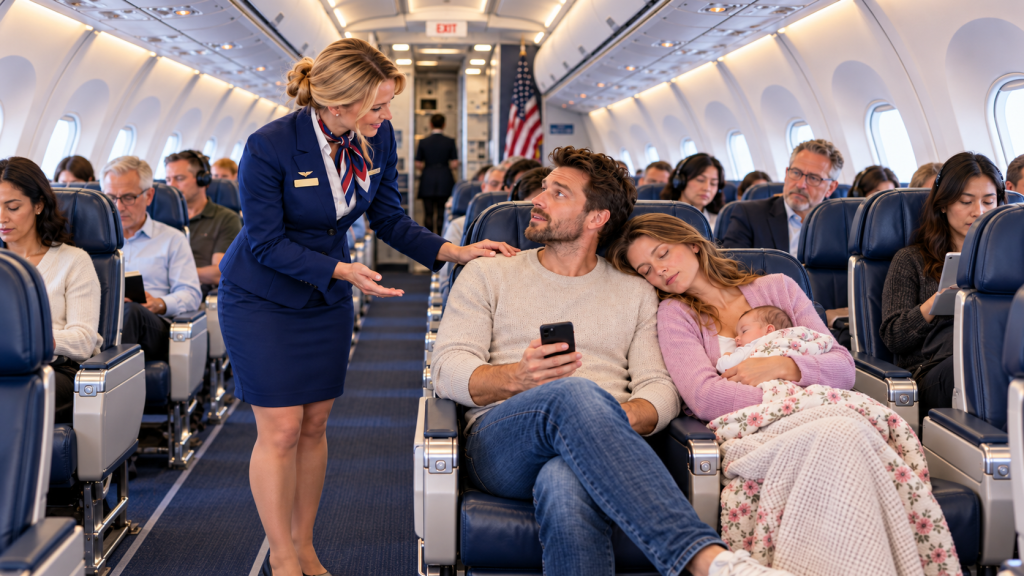
The man who had calmly defended my crying daughter on an airplane, who had allowed a complete stranger to sleep on his shoulder for two hours, suddenly looked as though he had seen a ghost.
“Emily,” he whispered, “where did you get this?”
I stared at the envelope in his hand.
“I don’t know.”
His eyes lifted toward mine.
“What do you mean, you don’t know?”
“I mean I’ve never seen it before. It wasn’t in Lily’s diaper bag when we left Austin.”
Noah turned the envelope over.
There was no return address.
No postage.
Only my daughter’s full name, written in black ink.
Lily Grace Collins.
Beneath it were three words.
For her mother.
I felt an uncomfortable tightness in my chest.
“Who wrote that?”
Noah swallowed.
“My brother.”
I blinked.
“Your brother?”
He nodded slowly.
“Daniel Whitman.”
“Then why do you look like that?”
His eyes met mine.
“Because Daniel disappeared eleven months ago.”
For several seconds, neither of us spoke.
Somewhere beyond the private airport corridor, I could hear the distant announcement of another arriving flight.
Lily stirred against my shoulder.
I adjusted her blanket automatically, although my hands had begun to shake.
“Disappeared how?”
Noah stared at the envelope.
“He left his office one evening. His car was found near Lake Michigan two days later. His wallet was inside. His phone was destroyed.”
“Was there an accident?”
“We never found evidence of one.”
I looked down at the handwriting again.
“And you’re sure that’s his?”
“I’ve spent eleven months looking at every note, document, and letter he ever wrote. I would recognize his handwriting anywhere.”
A security officer approached us.
He was tall, broad-shouldered, and wore a dark suit with a small earpiece.
“Mr. Whitman, we’ve secured the private exit.”
Noah barely acknowledged him.
“Marcus, I need you to find out who handled Ms. Collins’s belongings between Austin and Chicago.”
The officer glanced at the envelope.
“Is there a problem?”
“Possibly a very serious one.”
Marcus nodded.
“I’ll contact airport security.”
“No,” Noah said sharply.
The officer stopped.
“Not through the usual channels. Use our independent investigator. And I want the surveillance footage preserved before anyone has an opportunity to erase it.”
Marcus’s expression changed.
“Understood.”
I looked between them.
“What exactly is happening?”
Noah turned toward me.
“I don’t know yet.”
“That isn’t very reassuring.”
“I know.”
He took a breath.
“But I promise you one thing. Whatever this is, I’m not going to let anyone use you or your daughter to get to me.”
I almost laughed.
Not because it was funny.
Because less than six hours earlier, my biggest concern had been whether Lily would cry through the entire flight.
Now I was standing in an unfamiliar airport beside a billionaire whose missing brother had apparently left a mysterious message in my baby’s diaper bag.
And somewhere downstairs, a private investigator was asking strangers how to find me.
I had already escaped one nightmare.
I wasn’t ready to walk into another.
“Noah, I appreciate what you’ve done. But I need to get to my friend’s apartment.”
He studied me.
“Does your friend know you’re coming?”
“Yes.”
“Does anyone else know her address?”
I hesitated.
“My husband might.”
Noah’s expression tightened.
“Then I don’t think going there immediately is a good idea.”
“Ryan isn’t dangerous.”
The words came out automatically.
And the moment I said them, I realized I wasn’t certain they were true.
Noah noticed.
“What happened between you?”
I looked away.
It was a question people had been asking me for months.
Friends.
Relatives.
My attorney.
Even the woman at the bank who had watched me discover that our joint account had been emptied.
But I was tired of explaining how a marriage could fall apart so completely that the person who once promised to protect you became someone you feared answering the phone.
“He cheated,” I said finally.
Noah remained silent.
“He changed the locks. Took the money. Told people I was unstable. And when I said I was leaving Texas, he threatened to make sure I regretted it.”
Noah’s jaw tightened.
“Did he threaten Lily?”
“Not directly.”
“Emily.”
I swallowed.
“He said I wasn’t taking his daughter anywhere he couldn’t reach her.”
Noah glanced toward Marcus.
“Find out whether Ryan Collins has any connection to the investigator downstairs.”
Marcus nodded and walked away.
I stared after him.
“You don’t even know me.”
Noah turned back.
“That’s true.”
“So why are you doing all this?”
He looked down at Lily, who was sleeping peacefully against my chest.
For a moment, something almost unbearably sad passed across his face.
“Because someone once helped my family when they had absolutely no reason to.”
I waited for him to continue.
But he didn’t.
Instead, he held out the envelope.
“It’s addressed to your daughter. You should open it.”
My fingers trembled as I broke the seal.
Inside was a folded piece of paper.
And a photograph.
I unfolded the letter first.
There were only four sentences.
Emily, if this reaches you, please understand that Lily is in danger.
Do not trust Ryan.
Ask Noah about the blue house.
And whatever happens, do not give anyone the photograph.
I read the words three times.
Then I looked at the picture.
It showed a little girl standing on the porch of a blue wooden house.
She appeared to be about six years old.
Dark curls framed her face.
She wore a yellow dress.
Behind her stood a younger woman with brown hair and a gentle smile.
My breath caught.
Because I recognized the little girl.
It was me.
And the woman standing behind me was my mother.
My mother, who had died when I was fourteen.
My mother, who had never once mentioned anyone named Daniel Whitman.
I stared at the photograph until the edges blurred.
“Noah.”
He looked at me.
“That’s my mother.”
His eyes moved to the picture.
Then he went completely still.
“What’s wrong?” I whispered.
He reached toward the image but stopped before touching it.
“The house.”
“What about it?”
He looked at me with an expression I couldn’t understand.
“Daniel and I spent summers there when we were children.”
My knees suddenly felt weak.
“That isn’t possible.”
Noah shook his head slowly.
“I know that house, Emily.”
I looked at the photograph again.
I remembered almost nothing about it.
A porch swing.
A white fence.
The smell of wet grass after summer rain.
My mother singing while she washed dishes.
A small bedroom with pale yellow curtains.
And a boy.
There had been a boy.
Older than me.
He used to build towers from wooden blocks and let me knock them down.
I hadn’t thought about him in twenty years.
“Noah,” I whispered, “did your brother have a nickname?”
He frowned.
“What?”
“When he was little. Did anyone call him Danny?”
His eyes widened.
“Yes.”
A memory struck me so sharply I nearly dropped the photograph.
A boy with dark hair.
A bicycle with a broken bell.
A scraped knee.
And a voice calling from the backyard.
Come on, Emmy. I’ll show you where the fireflies live.
I stared at Noah.
“I think I knew your brother.”
The silence that followed felt endless.
Noah took one slow step backward.
“From when?”
“When I was little. We lived in a blue house for one summer. Or maybe longer. I don’t know. My mother never talked about those years.”
He pressed his fingers against his mouth.
“Daniel used to talk about a little girl called Emmy.”
My heart began racing.
“He did?”
“He said she was his best friend when they were kids.”
I could barely breathe.
“What happened to her?”
Noah looked away.
“He said she disappeared.”
A cold sensation moved down my spine.
“Disappeared?”
“He was nine. She was around six. One day she was there, and the next day she was gone. His parents told him not to ask questions.”
I looked at the photograph.
My mother had always told me we moved because she found a better job.
She never mentioned disappearing.
She never mentioned the Whitmans.
She never mentioned a little boy named Danny.
And now, decades later, a man who had vanished without explanation was somehow warning me about my husband.
I suddenly wanted nothing more than to take Lily somewhere safe and shut the door.
But another part of me knew that I had already spent too many years accepting answers that didn’t make sense.
“Noah,” I said, “I need to know what happened in that house.”
He nodded.
“So do I.”
Marcus returned several minutes later.
His expression was grim.
“We have a problem.”
Noah immediately straightened.
“What is it?”
“The investigator downstairs isn’t working for Ryan Collins.”
I felt a small wave of relief.
Then Marcus continued.
“He’s working for someone named Victoria Whitman.”
Noah’s face hardened.
“My aunt.”
I looked at him.
“Your aunt hired someone to find me?”
Marcus nodded.
“And there’s something else.”
He held out his phone.
On the screen was a surveillance image from the Austin airport.
It showed a man in a gray baseball cap standing near the boarding area.
He was holding a small black bag.
My stomach dropped.
I recognized him.
He had approached me while I struggled with the stroller.
He had offered to help.
He had picked up Lily’s diaper bag when it fell from the bench.
And he had disappeared before boarding began.
“That man,” I whispered. “He touched our things.”
Marcus looked at me.
“Are you certain?”
“Yes.”
Noah studied the photograph.
Then he said something that made the air seem to vanish from the hallway.
“I know him.”
I turned toward him.
“Who is he?”
“His name is Peter Shaw.”
“And?”
Noah looked directly at Marcus.
“Peter was Daniel’s personal driver.”
The security officer’s expression shifted.
“But he’s been missing since Daniel disappeared.”
Noah nodded.
“Exactly.”
I stared at the screen.
The man who had slipped a warning into my baby’s belongings had been standing less than three feet away from us in Austin.
He could have spoken to me.
He could have explained.
Instead, he had hidden a photograph and disappeared.
“Why didn’t he tell me anything?”
Noah’s answer was quiet.
“Because he probably thought someone was watching.”
We left the airport through a private exit.
I didn’t like the idea of getting into a stranger’s car.
I liked it even less when I saw the two black SUVs waiting outside.
But Marcus showed me his identification, Noah let me send his name and license plate information to my friend, and I called her before agreeing to leave.
She answered on the first ring.
“Emily? Where are you? I’ve been worried sick.”
“I’m okay, Rachel.”
“Are you at the airport?”
“Yes. Something strange happened.”
“What kind of strange?”
I glanced at Noah.
“I’m with someone who helped me on the flight.”
There was a pause.
“Someone?”
“His name is Noah Whitman.”
Silence.
Then Rachel nearly shouted.
“THE Noah Whitman?”
I closed my eyes.
“Please don’t start.”
“Emily, that’s the billionaire from the business magazines.”
“I know that now.”
“Why are you with him?”
“It’s complicated.”
“Are you safe?”
I looked at Noah.
He had stepped away to give me privacy.
“Yes,” I said. “I think so.”
Rachel sighed.
“Send me your location. And don’t disappear on me.”
“I won’t.”
I ended the call and looked down at Lily.
She was awake now, chewing contentedly on her stuffed rabbit.
Children have a remarkable ability to remain unconcerned by catastrophes they don’t understand.
I envied her.
Noah approached.
“There’s a hotel nearby where I can arrange a room for you and Lily. Separate from mine. You’ll have your own key, and you can leave whenever you want.”
“I can’t afford a hotel.”
“I’m not asking you to.”
I shook my head.
“I don’t want to owe you anything.”
His expression softened.
“Then don’t consider it a debt.”
“That’s easy for you to say.”
He nodded.
“Fair point.”
For a moment, we simply looked at each other.
Then he said, “Emily, I know what it feels like when someone with more money than you tries to control your choices. I’m not going to do that.”
Something in his voice made me believe him.
Not completely.
Trust didn’t return that quickly.
But enough.
“Just one night,” I said.
“One night.”
The hotel was nothing like anywhere I had ever stayed.
Its lobby was decorated with pale marble, fresh orchids, and enormous windows overlooking the river.
A woman at reception immediately recognized Noah.
Her expression changed from professional warmth to startled attention.
“Mr. Whitman.”
“Good evening, Caroline.”
She glanced at me, then at Lily.
Noah noticed.
“Ms. Collins is my guest. Please make sure she has everything she needs.”
Caroline nodded.
“Of course.”
Within minutes, I had a suite larger than my former apartment.
There was a bedroom with a king-sized bed.
A sitting room.
A kitchenette.
A crib that hotel staff brought upstairs.
And windows overlooking the glittering Chicago skyline.
I stood in the doorway feeling strangely embarrassed.
“This is ridiculous.”
Noah smiled faintly.
“It’s a room.”
“It’s a room with its own dining table.”
“Technically, yes.”
“And two bathrooms.”
“I didn’t design it.”
Despite everything, I laughed.
It surprised both of us.
Then Lily squealed from her stroller, apparently determined to join the conversation.
Noah crouched beside her.
“Hello, Miss Lily.”
She reached for his beard.
He allowed her to grab it.
I winced.
“She’s going to pull.”
“I’ve survived worse.”
She tugged.
His expression changed.
“Possibly not much worse.”
I laughed again.
And for one brief moment, I forgot that someone had followed us across state lines.
Then Noah stood.
“I’ll have Marcus stationed nearby. Not outside your door unless you want him there. You’ll have the hotel security number too.”
I nodded.
“Thank you.”
He hesitated.
“There’s something I need to tell you before I go.”
My stomach tightened.
“What?”
“My aunt Victoria is the acting chair of Whitman Group.”
I frowned.
“Acting?”
“My father stepped away from the company after Daniel disappeared. He hasn’t been well.”
“And Victoria took over?”
“Yes.”
“Why would she be looking for me?”
Noah glanced at the photograph still tucked inside the envelope.
“I think that photograph may explain it.”
“How?”
He looked troubled.
“Because my family didn’t own that blue house.”
I stared at him.
“Then who did?”
“A woman named Margaret Bennett.”
My heart stopped.
Bennett.
My mother’s maiden name.
I sank onto the edge of the sofa.
“Margaret was my grandmother.”
Noah nodded slowly.
“I was afraid you might say that.”
I looked up at him.
“Tell me everything.”
He sat across from me.
And for the next hour, the world I thought I understood began to unravel.
The blue house had stood outside a small town near Lake Geneva, Wisconsin.
My grandmother Margaret had worked as a housekeeper and personal assistant for Noah’s grandfather, Arthur Whitman.
Arthur had been the founder of the original family investment company.
He had made his fortune developing commercial properties across the Midwest.
But according to Noah, his grandfather had been a complicated man.
Generous in public.
Secretive in private.
And deeply suspicious of his own relatives.
Margaret Bennett had worked for Arthur for almost thirty years.
During that time, she became one of the few people he trusted.
The blue house belonged to her.
But Arthur frequently visited.
So did his grandchildren.
That explained Danny.
That explained the summer afternoons.
But it didn’t explain why my mother had suddenly taken me away.
Or why nobody had ever spoken about those years.
“Arthur died twenty-four years ago,” Noah said.
I frowned.
“That’s around when we moved.”
“Yes.”
“Was there something unusual about his death?”
Noah hesitated.
“He had a stroke. But Daniel always believed something happened before it.”
“What kind of something?”
“He never told me exactly. He said our grandfather had been preparing to expose financial misconduct inside the family company.”
I stared at him.
“And your brother disappeared while investigating it?”
“That’s what I believe.”
“Did he tell the police?”
“He tried. But the documents he collected disappeared from his office.”
I looked at the photograph.
“What does any of this have to do with me?”
Noah leaned forward.
“Arthur left a trust.”
I waited.
“A very large one. Part of it was intended for my grandmother’s charitable foundation. Another part was placed under private administration.”
“And?”
“Daniel believed that money had been diverted for decades.”
My throat tightened.
“By Victoria?”
“I don’t know.”
But his expression suggested he suspected exactly that.
“Daniel spent two years trying to reconstruct the financial records. Then he started looking for Margaret Bennett’s descendants.”
I felt cold.
“Me.”
Noah nodded.
“Apparently.”
I stared at him.
“Why?”
“Because Margaret was one of the witnesses to Arthur’s final instructions.”
I looked down at the envelope.
The photograph showed my mother smiling outside a house I barely remembered.
I wondered how much she had known.
And how much she had hidden to protect me.
That night, after Noah left, I couldn’t sleep.
Lily finally settled into the crib shortly after ten.
I sat beside the window watching the city lights shimmer against the river.
I should have been relieved.
We had a safe place to sleep.
Food.
A locked door.
A friend nearby.
And yet I felt as though the floor beneath my life had opened.
At eleven thirty, my phone rang.
Ryan.
I stared at his name.
Then rejected the call.
He called again.
And again.
Finally, a text appeared.
I KNOW YOU LANDED.
My pulse quickened.
A second message followed.
YOU CAN’T KEEP MY DAUGHTER FROM ME.
Then another.
AND YOU HAVE NO IDEA WHAT YOU’VE TAKEN.
I read the last sentence twice.
What I’d taken?
I hadn’t taken anything.
Except my child, her clothes, and what little remained of my dignity.
I took screenshots and sent them to my attorney in Austin.
Then I forwarded them to Marcus.
Within seconds, he replied.
Do not respond. We’re reviewing the situation.
I put the phone facedown.
Five minutes later, it buzzed again.
This time the message came from an unknown number.
Emily, please don’t trust anyone who tells you Daniel is dead.
My blood turned cold.
Then another message arrived.
He left something with your mother.
Ask about the music box.
I sat perfectly still.
The music box.
I hadn’t thought about it in years.
It had belonged to my mother.
A small wooden box with a brass flower on the lid.
When opened, it played a delicate melody.
She used to keep it on her bedside table.
After she died, I packed it away with her letters and photographs.
It was one of the few things I had refused to leave behind when Ryan changed the locks.
It was inside my second suitcase.
In the hotel bedroom.
Less than twenty feet away.
I stood slowly.
The suitcase lay open beside the dresser.
I crossed the room and knelt.
Beneath a folded sweater and Lily’s spare blankets was a small cloth pouch.
I opened it.
The music box rested inside.
Its wood was worn smooth.
The brass flower had darkened with age.
I turned the little key.
The melody filled the silent room.
And suddenly I was eight years old again.
Sitting on my mother’s lap.
Listening to her hum.
Feeling safe.
I blinked away tears.
Then I examined the box.
There was nothing unusual about it.
At least, nothing I remembered.
I turned it over.
Four tiny screws held the bottom panel in place.
One screw looked different.
Newer.
My breath caught.
I searched through my toiletry bag until I found the tiny screwdriver from Lily’s eyeglass repair kit, which I had inexplicably packed during our frantic move.
Carefully, I removed the screws.
The bottom panel loosened.
Beneath it was a narrow compartment.
Inside lay a folded piece of paper.
And a tiny brass key.
My hands shook so badly I nearly tore the paper opening it.
The handwriting was my mother’s.
Emily, if you’re reading this, it means the past has finally found you.
I’m sorry I couldn’t tell you everything while I was alive.
Some people are willing to destroy entire families to protect a fortune.
Margaret knew the truth.
Arthur tried to make it right.
But Victoria discovered what he intended.
If anyone asks you about the blue house, do not give them the key.
Find Daniel.
He will know where it belongs.
My vision blurred.
My mother had known.
All those years.
She had known that something dangerous was buried inside our family history.
And she had left me a warning I had never discovered.
I picked up the brass key.
A small number was engraved into the side.
317.
I reached for my phone.
Then stopped.
The unknown sender had told me to find the music box.
How did that person know what was inside?
I typed a reply.
Who are you?
The answer came almost immediately.
Someone who promised your mother I would find you if the truth came out.
My heart hammered.
Tell me your name.
A long pause.
Then three words appeared.
It’s me, Danny.
I stared at the screen.
Noah’s missing brother.
Alive.
I wanted to call Noah immediately.
But before I could, another message appeared.
Please don’t tell Noah yet. I need to explain why.
I looked toward Lily’s crib.
She slept with one tiny fist curled beside her cheek.
Everything in me wanted to protect her from whatever was unfolding.
And for the first time since boarding that flight, I understood something frightening.
Running from Ryan might have brought me directly into the center of a much older danger.
I didn’t answer the message.
Instead, I photographed the note, the key, and the hidden compartment.
Then I called Noah.
He answered after one ring.
“Emily?”
“Your brother just contacted me.”
Silence.
Then I heard movement.
“What?”
“He sent messages. He says he’s alive.”
Noah inhaled sharply.
“Are you sure it’s him?”
“No. But he knew about my mother’s music box.”
“What music box?”
I explained.
When I reached the part about the brass key, he interrupted.
“What number?”
“Three seventeen.”
I heard him swear quietly.
“Noah?”
“That number was on a note Daniel left in his office before he disappeared.”
My skin prickled.
“What did the note say?”
“Locker 317. Do not open without Emmy.”
I couldn’t speak.
Noah continued.
“We never found the locker. We searched banks, storage facilities, even old train stations.”
I looked at the key.
“Maybe you’ve been looking in the wrong place.”
He was silent for a moment.
Then he asked, “Emily, can I come upstairs?”
“Yes.”
He arrived ten minutes later with Marcus.
I handed him my phone.
He read the messages in complete silence.
Then he sat down.
For a moment, he looked less like a wealthy businessman and more like a frightened younger brother.
“I’ve spent eleven months wondering whether Daniel was dead,” he said.
His voice cracked.
“And now he’s texting you.”
I sat beside him.
“Maybe it’s someone pretending.”
“I know.”
He rubbed his eyes.
“But I want it to be him.”
The admission was so raw that I didn’t know what to say.
So I simply sat there.
Sometimes silence is kinder than reassurance.
Marcus examined the message details.
“The number is routed through an encrypted service. We won’t be able to identify the sender immediately.”
Noah nodded.
“Can we arrange a safe way to communicate?”
“Possibly.”
I looked at them.
“He asked me not to tell you.”
Noah’s expression darkened.
“That worries me.”
“Me too.”
Then my phone buzzed again.
You told Noah.
I stared at the screen.
Marcus immediately moved toward the windows.
Noah stood.
“How does he know?”
Another message arrived.
I’m sorry, Emmy. I had to be certain you would choose him.
I swallowed.
Then the final message appeared.
Tomorrow. Ten in the morning. The blue house. Come with Noah. No police.
For a long time, no one spoke.
Finally, Noah looked at me.
“I’m not letting you walk into a trap.”
I stared at the message.
Somewhere inside me, a memory was stirring.
A boy leading me through tall grass.
A hidden wooden bridge.
A little blue house.
And a promise.
If you ever get scared, Emmy, come find me.
“I think,” I whispered, “I’ve been trying to find Danny for most of my life without realizing it.”
The following morning, I woke before sunrise.
For a few seconds, I forgot where I was.
Then I saw the Chicago skyline.
The crib beside the bed.
The music box on the nightstand.
And the envelope lying open beside my phone.
Everything came rushing back.
Noah had insisted on arranging professional security before anyone went near the blue house.
Marcus contacted a private investigator named Elena Ruiz, a former financial crimes detective who had been quietly assisting Daniel before his disappearance.
She arrived shortly after seven.
Elena was in her forties, with dark hair pulled into a practical bun and the kind of watchful expression that suggested she noticed details other people missed.
She listened without interrupting as I explained the photograph, the messages, and the key.
Then she asked one question.
“Did your husband know about the music box?”
I frowned.
“Ryan?”
“Yes.”
“He saw it plenty of times.”
“Did he ever ask about it?”
I opened my mouth to say no.
Then stopped.
A memory surfaced.
Three months earlier, Ryan had been searching through the hallway closet.
I had asked what he wanted.
He said he was looking for old tax documents.
But later that evening, I found my mother’s keepsake box sitting open on the bedroom floor.
When I confronted him, he laughed.
“It’s junk, Emily. Why are you so protective of it?”
At the time, I thought he was simply being cruel.
Now I wasn’t so sure.
“He went through my mother’s belongings,” I admitted.
Elena exchanged a glance with Noah.
“When?”
“About three months ago.”
“Did anything go missing?”
“I don’t know.”
She leaned forward.
“Emily, how did you meet Ryan?”
The question startled me.
“At work.”
“What kind of work?”
“I was an administrative coordinator at a medical equipment company in Austin. Ryan was consulting on a software project.”
“Did he pursue you?”
I frowned.
“Yes.”
“How quickly?”
I thought back.
Ryan had been charming.
Persistent.
He brought me coffee every morning.
Remembered my favorite flowers.
Called when he said he would.
After years of dating men who barely seemed interested, his attention had felt wonderful.
“He asked me out after about two weeks.”
Elena nodded slowly.
“Did he know your mother’s maiden name?”
“Yes. I told him about my family.”
Noah looked increasingly troubled.
“Why are you asking?”
Elena folded her hands.
“Because Daniel believed someone had been searching for Margaret Bennett’s descendants for years.”
My stomach tightened.
“Are you suggesting Ryan married me because of my grandmother?”
“I’m saying we shouldn’t dismiss the possibility without checking.”
I shook my head.
“No. That would mean our entire marriage was—”
I stopped.
I looked toward Lily.
Our daughter.
The child we had celebrated bringing into the world.
The child Ryan had held in the delivery room with tears in his eyes.
Surely that part had been real.
Surely some of it had been real.
Elena’s expression softened.
“We don’t know enough yet.”
I nodded.
But the damage was done.
A question had been planted.
And I couldn’t make it disappear.
By eight thirty, Rachel arrived at the hotel.
She burst through the door, hugged me tightly, and immediately demanded to see Lily.
Rachel had been my college roommate.
We had remained close even after life carried us to different states.
She was practical, outspoken, and fiercely loyal.
When I told her what had happened, she listened with growing disbelief.
“So,” she said finally, “you met a billionaire on a plane, his missing brother knows your dead mother’s secrets, your husband might be involved, and now you’re going to an abandoned house in Wisconsin?”
I sighed.
“When you say it like that—”
“There’s no better way to say it.”
Noah, standing near the doorway, almost smiled.
Rachel turned toward him.
“And you.”
He straightened.
“Yes?”
“If anything happens to her, your bank account won’t save you from me.”
Noah nodded solemnly.
“Understood.”
I laughed despite my nerves.
Rachel agreed to stay with Lily in the hotel.
Marcus arranged for a female security officer to remain nearby, and Rachel received direct contact information for the hotel manager and Elena.
I kissed Lily’s forehead.
She reached toward my hair.
“Ma,” she babbled.
It was one of the few sounds she made that resembled a word.
My throat tightened.
“I’ll be back, sweetheart.”
She smiled.
And I silently promised her I would do everything possible to keep that promise.
The drive to Wisconsin took nearly two hours.
Noah sat beside me in the back seat.
Elena rode in front.
A second security vehicle followed at a discreet distance.
Outside, the city slowly gave way to quieter roads, autumn trees, and rolling fields.
For most of the journey, Noah remained silent.
Finally, I asked, “What was Daniel like?”
He looked over.
“What do you remember?”
“A boy who was always trying to make me laugh.”
Noah smiled sadly.
“That sounds right.”
“Was he kind?”
“He was the kindest person in our family.”
I glanced at him.
“That’s a pretty serious accusation against yourself.”
A brief laugh escaped him.
“I suppose it is.”
Then his expression softened.
“Daniel always cared more about people than money. He could walk into a room full of executives and end up talking to the person cleaning the tables.”
I smiled.
“He sounds wonderful.”
“He was infuriating.”
“Why?”
“Because he never knew when to stop trying to fix things.”
Noah looked out the window.
“He couldn’t ignore injustice. If someone was being cheated or mistreated, he made it his problem.”
I thought about the little boy who had let me destroy his block towers.
“Maybe that’s why he remembered me.”
Noah looked back.
“He never forgot you.”
I felt tears gathering.
For so much of my childhood, I had believed that the people who disappeared from my life simply stopped thinking about me.
My father had left before I was born.
My grandmother died when I was young.
My mother followed years later.
Now I was discovering that somewhere, a boy from my childhood had spent decades remembering a little girl called Emmy.
When we turned onto the narrow road leading toward the house, my heart began pounding.
The property stood beyond a line of maple trees.
Its paint had faded.
The white fence was broken in several places.
Weeds pushed through the stone path.
But I recognized it immediately.
The porch.
The front steps.
The upstairs window.
The little swing hanging from an old oak tree.
I pressed my hand against the glass.
“Oh my God.”
Noah watched me.
“You remember?”
I nodded.
“I remember everything.”
Not everything, of course.
But enough.
I remembered chasing butterflies through the backyard.
My grandmother calling us in for lemonade.
My mother folding laundry on the porch.
Danny teaching me how to ride a bicycle.
And one particular afternoon.
A storm.
Raised voices inside the house.
My mother crying.
A black car in the driveway.
I hadn’t thought about that day in years.
But standing outside the blue house, I could almost hear the thunder.
We got out slowly.
Elena surveyed the property.
“No visible movement.”
Noah approached the porch.
“Daniel?”
Nothing.
The wind moved through the trees.
A loose shutter tapped against the wall.
Then a voice came from behind the house.
“You always were impatient, Noah.”
Noah froze.
I turned.
A man stood near the old oak tree.
He was thinner than the photographs I had seen.
His beard was longer.
His hair had grown past his collar.
A faint scar crossed his forehead.
But his eyes were unmistakably like Noah’s.
Noah took a step forward.
“Daniel?”
The man smiled faintly.
“Hey, little brother.”
Noah crossed the yard so quickly I barely saw him move.
The brothers collided in an embrace.
For several seconds, neither spoke.
Noah gripped Daniel’s shoulders as if he needed physical proof that he was real.
“You idiot,” he whispered.
Daniel laughed shakily.
“I know.”
“Eleven months.”
“I know.”
“We thought you were dead.”
Daniel’s smile disappeared.
“I’m sorry.”
Noah stepped back, his eyes wet.
“You have no idea what you’ve done to us.”
Daniel nodded.
“I know exactly what I’ve done. And I hated every minute.”
Then his gaze shifted toward me.
He went very still.
“Emmy?”
The sound of that childhood nickname broke something open inside me.
“Danny?”
He smiled.
“You still have the same eyes.”
I crossed the yard.
For a moment, we simply stared at each other.
Then he opened his arms.
I hugged him.
And suddenly the years between us seemed impossibly small.
“I thought I’d never see you again,” he whispered.
“I didn’t even remember you until yesterday.”
He nodded.
“Your mother wanted it that way.”
I pulled back.
“Why?”
His expression grew serious.
“Because she knew what happened to my grandfather.”
We went inside.
The house smelled of dust, old wood, and damp wallpaper.
Sunlight fell through dirty windows.
The kitchen was smaller than I remembered.
The living room fireplace was still there.
So was the mark on the doorframe where my grandmother used to record our heights.
Emily — age six.
Danny — age nine.
I traced the faded pencil lines with my fingertips.
Daniel watched quietly.
“Margaret loved this place.”
I nodded.
“She loved us too.”
He smiled sadly.
Then Elena stepped forward.
“Daniel, we need answers.”
“I know.”
He led us into the dining room.
The furniture had been covered with sheets.
On the table sat a small metal case.
Daniel opened it.
Inside were photographs, bank records, handwritten notes, and several small encrypted drives.
“My grandfather discovered that Victoria and two executives had been diverting money from the family trust.”
Noah frowned.
“How much?”
“Originally, about twelve million dollars.”
Noah stared.
“That was twenty-four years ago.”
Daniel nodded.
“Today, with the investments and money generated from those assets, we’re talking about a far larger amount.”
I glanced at the documents.
“What does my grandmother have to do with it?”
Daniel looked at me.
“Margaret caught them.”
I swallowed.
“She worked with Arthur for decades. She knew his accounts better than most of his accountants. When money began disappearing, she noticed.”
“And told him?”
“Yes.”
Daniel pulled out an old photograph of Arthur Whitman.
“He planned to remove Victoria from the company and turn the evidence over to authorities.”
“What stopped him?” Noah asked.
Daniel hesitated.
“Arthur suffered a stroke the evening before the meeting.”
The room became quiet.
I stared at him.
“Are you saying Victoria caused it?”
“I can’t prove that.”
“But you suspect it.”
He nodded.
“My grandfather had a serious medical condition. His death was officially attributed to natural causes. I haven’t found reliable evidence that anyone physically harmed him.”
That distinction mattered.
I could see it in Daniel’s face.
He had spent years pursuing the truth, but he didn’t want suspicion mistaken for proof.
“What happened afterward?” I asked.
“Margaret tried to preserve the records Arthur had collected. Your mother helped her.”
I looked up sharply.
“My mother?”
“Yes. She was working part-time for one of Arthur’s legal advisers.”
Suddenly, so many things made sense.
The unexplained move.
The secrecy.
The fear I remembered from that stormy afternoon.
“Victoria discovered they had copies of the records,” Daniel continued. “Someone broke into this house. Your mother took you away that night.”
I felt sick.
“And nobody helped her?”
“My father tried, but he was young and terrified of losing his position in the company. He convinced himself that keeping quiet was protecting everyone.”
Noah closed his eyes.
Daniel continued.
“Margaret signed a confidential agreement under pressure. Your mother refused.”
“What agreement?”
“One that required them to deny knowledge of the diverted funds.”
I stared at the case.
“And my mother kept the evidence?”
“Some of it.”
He looked toward the little brass key in my hand.
“She kept the part that mattered most.”
I placed the key on the table.
“Then tell me what it opens.”
Daniel picked it up carefully.
“There’s a locked cabinet beneath the old staircase.”
I frowned.
“I don’t remember a cabinet.”
“You weren’t supposed to.”
He led us into the hallway.
Beneath the staircase was a narrow wooden panel.
Daniel pressed against a small section of molding.
A hidden latch released.
Behind it was a metal door.
He inserted the key.
It turned.
The door opened.
Inside stood a compact fireproof safe.
Daniel looked at me.
“Your grandmother insisted that only you should have the key.”
“Why me?”
“Because she didn’t trust any of the Whitmans to hold it.”
Even Noah couldn’t argue with that.
Daniel entered a combination he had found in Margaret’s old papers.
The safe opened.
Inside were three sealed folders.
An old ledger.
A cassette tape.
And a handwritten letter.
My name appeared across the envelope.
Emily.
I reached for it.
The paper was yellowed with age.
I recognized my grandmother’s handwriting.
My darling Emily,
If the day comes when you open this letter, I hope you are safe, loved, and surrounded by people who treat you with kindness.
There are things I should have told you when you were old enough to understand, but fear made cowards of many people, including me.
Arthur Whitman was a good friend to our family.
When he discovered what his daughter had done, he tried to correct it.
He signed a trust amendment that would transfer the misappropriated assets, once recovered, into an independent charitable trust and provide compensation to those harmed by the scheme.
Your mother helped preserve the original documents.
Those documents belong to the truth, not to the people who tried to bury it.
Never allow anyone to convince you that you must surrender your peace to prove your worth.
Money can be replaced.
A life cannot.
All my love,
Grandma Margaret.
By the time I finished reading, tears were sliding down my cheeks.
For years, I had thought my grandmother simply disappeared into the fog of childhood memory.
Now I understood that she had tried to protect me in ways I never knew.
Noah stood beside me.
“Are you okay?”
I nodded.
Then shook my head.
“I don’t know.”
He didn’t push.
He simply handed me a tissue.
Daniel carefully removed the ledger from the safe.
“This is what Victoria has been trying to find.”
Elena examined the documents.
“Original signatures?”
Daniel nodded.
“Along with transaction records, correspondence, and the trust amendment.”
Noah stared at the papers.
“If these are authentic, Victoria could face serious consequences.”
“Exactly.”
I looked at Daniel.
“Then why did you disappear?”
His face changed.
He sat slowly.
“Because someone tried to kill me.”
The room went silent.
Eleven months earlier, Daniel had been preparing to meet a retired accountant who claimed to have additional evidence.
He received a call instructing him to come alone to a parking garage.
He arrived expecting documents.
Instead, two men confronted him.
They demanded everything he had collected.
Daniel refused.
One man struck him.
The other tried to force him into a vehicle.
Daniel escaped through a maintenance stairwell, but suffered a severe head injury during the struggle.
Peter Shaw, his driver, found him hiding near a loading dock.
Peter had once worked in military protective services.
He recognized that Daniel was in immediate danger.
Together, they fled.
“Why didn’t you call Noah?” I asked.
Daniel looked at his brother.
“Because the men knew information only someone inside the company could have given them.”
Noah stiffened.
“You thought I was involved?”
“No.”
“Then why?”
Daniel looked ashamed.
“I thought someone close to you was.”
Noah stared at him.
Daniel continued.
“Victoria had access to your schedule. Your office. Your private communications. I didn’t know who she had compromised.”
Noah turned away.
For the first time, I saw anger flash across his face.
Not the controlled irritation of a businessman.
Something much deeper.
“You should have trusted me.”
“I know.”
“You let me bury you in my head every single day.”
Daniel’s eyes filled.
“I know.”
Noah walked to the window.
I watched him struggle to regain his composure.
Finally, he turned back.
“I’m angry with you.”
Daniel nodded.
“I deserve that.”
“But you’re alive.”
His voice broke.
“And that’s what matters.”
The brothers embraced again.
This time, neither tried to hide their tears.
I looked away.
They deserved that moment without an audience.
Then Elena’s phone buzzed.
She glanced at the screen.
Her expression sharpened.
“We have to leave.”
Noah looked over.
“What happened?”
“Someone just entered the property road.”
Daniel stood.
“How many?”
“Two vehicles.”
Elena looked at us.
“And one belongs to Victoria Whitman’s security company.”
My stomach dropped.
Noah reached for his phone.
“Marcus?”
A voice answered immediately.
“We see them. We’re positioned near the entrance.”
“Don’t let them approach the house.”
“We’ll try to keep everyone separated. Police have been notified.”
Daniel closed the safe.
“We need to take the documents.”
Elena shook her head.
“Photograph and inventory everything first. We need a proper evidence trail.”
She worked quickly, documenting the contents before placing them into protective evidence bags.
I stood near the window, watching a dark vehicle stop beyond the broken fence.
A woman stepped out.
Tall.
Elegant.
Silver hair arranged perfectly.
A cream-colored coat.
She looked as though she were arriving at a charity luncheon rather than a confrontation at an abandoned house.
Noah moved beside me.
“Victoria.”
The woman looked toward the porch.
Then smiled.
“Hello, Noah.”
Her voice carried through the open window.
“I believe it’s time we had a family conversation.”
Noah stepped outside, leaving us with Elena and the security officers.
I could hear every word through the doorway.
“You hired someone to follow Emily Collins,” he said.
Victoria tilted her head.
“Emily Bennett, technically.”
My stomach tightened.
She knew my mother’s name.
She knew everything.
“Where is Daniel?” Victoria asked.
Noah didn’t answer.
Her smile faded.
“I know he’s here.”
“What do you want?”
“What belongs to our family.”
Noah’s expression turned cold.
“You mean the documents you tried to destroy?”
Victoria laughed softly.
“You have no idea what you’re talking about.”
“Then why are you here?”
She glanced toward the house.
“Because your brother has been making reckless accusations for years. I wanted to prevent him from ruining the family.”
Noah stepped closer.
“You mean exposing you.”
Victoria’s face hardened.
“Careful.”
“No,” he said. “I think I’ve been careful for too long.”
She stared at him.
Then her eyes moved toward me.
“Emily, darling, why don’t you come outside?”
I froze.
Daniel shook his head.
“Don’t.”
But I was tired of people deciding what I could handle.
I handed the photograph to Elena.
Then stepped onto the porch.
Victoria studied me.
For a brief moment, genuine recognition crossed her face.
“My goodness,” she whispered. “You look exactly like your mother.”
I gripped the porch railing.
“You knew her?”
“Of course.”
“Were you the reason she was afraid?”
Victoria’s expression changed.
“Your mother had an unfortunate tendency to misunderstand complicated business matters.”
Something in me snapped.
“My mother was many things,” I said. “But she wasn’t stupid.”
Victoria’s eyes narrowed.
“I didn’t say she was.”
“You didn’t have to.”
Noah glanced toward me.
I kept my gaze on Victoria.
“She raised me alone. Worked two jobs. Took care of her dying mother. And somehow managed to make me feel loved even when we had almost nothing.”
Victoria said nothing.
“So don’t stand there in your expensive coat and talk about her like she was an inconvenience.”
For a second, even Noah looked surprised.
Then Victoria’s smile returned.
Cold.
Controlled.
“Emotional speeches won’t change the facts, Emily.”
“Neither will threats.”
Her expression hardened.
“Do you know what your husband told me about you?”
I felt the ground shift beneath my feet.
“Ryan?”
Victoria smiled.
“He said you were impulsive. Easily frightened. Very attached to sentimental objects.”
Noah moved closer.
“What does Ryan have to do with this?”
Victoria looked almost amused.
“Oh, Noah. Surely Daniel explained.”
My pulse thundered.
“Explained what?”
She turned toward me.
“Your husband was hired to locate Margaret Bennett’s surviving family.”
The world seemed to tilt.
I gripped the railing harder.
“No.”
Victoria continued calmly.
“He was supposed to establish contact, identify anything your mother might have preserved, and report back.”
I stared at her.
“He married me.”
“Yes.”
“We had a child.”
For the first time, Victoria’s confidence faltered.
“That was never part of the arrangement.”
My knees weakened.
Noah reached for my arm.
I barely felt it.
All I could see was Ryan standing at the end of the aisle on our wedding day.
Ryan promising to love me.
Ryan holding Lily for the first time.
Ryan whispering that we were a family.
Had any of it been real?
Victoria watched me carefully.
“Your husband became emotionally involved. It complicated everything.”
I looked at her.
“Emotionally involved?”
“He was supposed to complete a task. Instead, he created a marriage.”
I felt something inside me turn cold.
“Where is he now?”
Victoria hesitated.
“That’s not relevant.”
“It is to me.”
“Emily—”
“Where is my husband?”
Before she could respond, another vehicle approached the property.
Marcus emerged from behind the security SUV.
“Mr. Whitman, police are arriving.”
Victoria glanced toward the road.
For the first time, she looked genuinely worried.
Then she turned to Noah.
“You’re making a mistake.”
Noah met her gaze.
“Maybe.”
She took a step toward him.
“You could destroy everything your grandfather built.”
Noah looked back at the house.
At Daniel.
At me.
Then he answered.
“No. I’m finally going to find out what he tried to save.”
The police separated everyone while Elena explained the situation.
Victoria’s security personnel were instructed to remain away from the house.
The officers documented the scene and obtained contact information from every person present.
Nobody was arrested that afternoon.
As Elena reminded us, accusations were not convictions.
But the original records were secured through counsel, and investigators began arranging formal interviews.
Victoria left in silence.
Before getting into her vehicle, she looked at me one last time.
“You should ask Ryan what he found in your mother’s belongings.”
Then she disappeared behind the tinted glass.
I stood motionless.
Noah approached.
“Emily?”
I couldn’t answer.
He waited.
Finally, I whispered, “My entire marriage was a lie.”
He didn’t correct me.
He didn’t offer false comfort.
He simply said, “You don’t know everything yet.”
I looked at him.
“That’s what scares me.”
We returned to Chicago that afternoon.
I had never been so desperate to see Lily.
The moment I entered the hotel suite, she reached both arms toward me.
I lifted her from Rachel’s lap and held her tightly.
Her familiar warmth nearly broke me.
I buried my face in her hair.
“Mommy’s here.”
She patted my cheek.
I started crying.
Not quietly.
Not gracefully.
I cried with the kind of exhaustion that comes when you’ve been holding yourself together for far too long.
Rachel wrapped an arm around my shoulders.
“Whatever happened, we’ll figure it out.”
I shook my head.
“You don’t understand.”
“Then tell me.”
So I did.
I told her about Victoria.
About Ryan.
About the investigation.
About the possibility that my husband had approached me as part of a plan to find documents hidden by my mother.
Rachel listened in horrified silence.
Then she said something I desperately needed to hear.
“Emily, even if he entered your life for a dishonest reason, that doesn’t make Lily’s existence anything less than beautiful.”
I looked down at my daughter.
She was pulling at my necklace.
Rachel continued.
“Whatever Ryan did, Lily is yours to love. He doesn’t get to rewrite that.”
I pressed my lips against Lily’s forehead.
And for the first time that day, I could breathe.
That evening, Daniel came to the hotel.
He brought a small wooden box.
It was wrapped in faded blue paper.
“This was meant for you,” he said.
I frowned.
“What is it?”
“Something Margaret gave me before she died.”
I stared at him.
“You saw my grandmother?”
He nodded.
“About six months before she passed.”
“Why didn’t she tell me?”
“She asked me to wait until I understood why she’d kept everything hidden.”
I slowly removed the paper.
Inside was a photograph album.
On the first page was a picture of two children sitting beneath an oak tree.
A dark-haired boy.
A little girl with pigtails.
Danny and Emmy.
On the next page, we were standing beside a bicycle.
Then building a snowman.
Then eating watermelon on the porch.
Page after page showed a childhood I had almost completely forgotten.
I touched the photographs.
“My mother never showed me these.”
“She was trying to keep you away from anything connected to our family.”
I nodded.
Daniel sat beside me.
“There’s something else.”
He opened the back cover.
Inside was a small envelope.
It contained a letter from my mother.
Her handwriting immediately brought tears to my eyes.
My sweet Emily,
If you ever feel that the world has become too hard, remember the blue house.
Remember the people who loved you there.
I never wanted fear to be your inheritance.
I wanted you to grow into a woman who understood that kindness is not weakness, and that being brave doesn’t mean you never feel afraid.
It means you choose what is right even when fear follows you.
If Danny ever finds you, tell him I never forgot his friendship.
And tell him that leaving was the hardest decision I ever made.
I love you beyond every distance.
Mom.
I pressed the letter against my chest.
For years, I had wished for one more conversation with my mother.
One more chance to ask her questions.
One more opportunity to hear her voice.
Now I had discovered words she had written for a future she never lived to see.
Daniel sat quietly beside me.
Finally, I asked, “Why did you keep searching for me?”
He smiled sadly.
“Because your mother made me promise something.”
“What?”
“She said if trouble ever followed the documents, I should find you before anyone else did.”
I frowned.
“Then why did it take so long?”
“Because your name changed. You moved several times. And I didn’t know whether you were alive.”
He paused.
“Three years ago, I finally found a possible match in Austin.”
I looked at him.
“Three years?”
“Yes.”
“Before I married Ryan?”
Daniel nodded.
“I tried to reach out, but someone intercepted my attempts. Then your address changed, and the records became harder to trace.”
I felt sick.
“Ryan.”
“Possibly.”
I closed the album.
“And what happens now?”
Daniel looked toward Noah, who stood near the window.
“We finish what Arthur started.”
The following week passed in a blur of interviews, legal meetings, and difficult conversations.
Noah’s attorneys assembled a team to review the trust documents.
Elena worked with investigators examining the transactions.
Daniel provided a detailed statement about his disappearance and the attack in the parking garage.
Peter Shaw came forward voluntarily and corroborated much of Daniel’s account.
And I hired a family-law attorney in Chicago to coordinate with my lawyer in Texas.
I wanted one thing made absolutely clear.
Lily would not become a bargaining chip in a dispute over money.
Ryan had parental rights that the courts would consider.
I understood that.
But I also had evidence of threatening messages, financial manipulation, and his connection to Victoria.
My attorneys advised me to preserve every record and seek appropriate protective measures.
For the first time in months, I stopped responding to Ryan emotionally.
Every communication went through counsel.
Every threat was documented.
Every financial record was saved.
Then, nine days after we arrived in Chicago, Ryan asked to speak with me.
Through his attorney.
He claimed he wanted to explain everything.
I initially refused.
But Elena believed the conversation might clarify his role in Victoria’s scheme.
So we arranged a meeting at my lawyer’s office.
Noah offered to accompany me.
I declined.
Not because I didn’t trust him.
But because I needed Ryan to see me standing on my own feet.
When I entered the conference room, my husband was already seated.
He looked terrible.
His hair was unkempt.
Dark circles shadowed his eyes.
His expensive watch was gone.
For a moment, I remembered the man who used to bring me soup when I was sick.
The man who cried at our wedding.
The man who held my hand during labor.
Then I remembered him changing the locks.
And my sympathy hardened into something quieter.
“Emily.”
His voice cracked.
I sat across from him.
“Ryan.”
He looked toward my attorney.
“Can we have privacy?”
“No,” I said.
He swallowed.
“Okay.”
Silence stretched between us.
Finally, he whispered, “I never meant for any of this to happen.”
I stared at him.
“Which part?”
He looked confused.
“The part where you lied about meeting me? The part where you searched my mother’s belongings? Or the part where you locked your wife and baby out of our apartment?”
He flinched.
“Emily—”
“Pick one.”
His eyes filled.
“I made mistakes.”
I laughed once.
A short, bitter sound.
“Mistakes?”
He lowered his head.
I leaned forward.
“You didn’t forget our anniversary. You didn’t accidentally spend too much money. You built a relationship with me while hiding the fact that someone was paying you to find information about my dead grandmother.”
He looked up sharply.
“Victoria told you.”
“Yes.”
He closed his eyes.
“Of course she did.”
“Was it true?”
He didn’t answer.
“Ryan.”
Finally, he nodded.
“Yes.”
The word landed harder than I expected.
Even after everything, some small part of me had hoped he would deny it.
Not because I believed him.
Because I wanted there to be something left of the life I remembered.
“How much did she pay you?”
He swallowed.
“Thirty thousand initially.”
I stared.
“Thirty thousand dollars.”
“And a bonus if I found the records.”
“How much?”
He looked away.
“Two hundred thousand.”
I felt physically ill.
“You married me for two hundred thousand dollars?”
“No.”
“Then explain it.”
He rubbed his forehead.
“I was hired to locate you. That’s true. But the relationship wasn’t supposed to happen.”
“And yet it did.”
“Yes.”
“Did you love me?”
His eyes filled.
“I did.”
I looked at him for a long moment.
“Then why did you hurt me?”
He started crying.
And once upon a time, that would have broken my heart.
Now I simply waited.
“Victoria became impatient,” he said. “She thought the records were in your mother’s belongings. I searched, but I couldn’t find them.”
“The music box.”
He nodded.
“I knew it meant something to you, but I didn’t know there was a compartment.”
I felt a small wave of relief.
At least he hadn’t found the key.
“Then why did you empty our account?”
His face twisted.
“Victoria said she could expose what I’d done. I owed money. She threatened legal action and said she would make sure you found out everything.”
“So you stole from your own family.”
“I thought I could replace it.”
“But you didn’t.”
“No.”
I folded my hands.
“And the woman in your photographs?”
He looked down.
“She was someone I met while everything was falling apart.”
I stared at him.
“Another mistake?”
He said nothing.
I stood.
Ryan immediately looked up.
“Emily, please.”
I paused.
“What?”
“I still love Lily.”
I felt my throat tighten.
“Then you should have thought about what your choices would do to her.”
He wiped his eyes.
“Can you ever forgive me?”
I looked at him.
And realized that forgiveness was not the question I needed to answer.
Not yet.
Maybe not for years.
“I don’t know,” I said.
He nodded miserably.
“But I do know this. I’m not returning to a marriage where I have to wonder which words were real.”
His expression crumpled.
“Emily—”
“And whatever happens with Lily, it will happen through the proper legal process. You don’t get to threaten your way back into our lives.”
I turned toward the door.
Then stopped.
“One more thing.”
He looked up.
“When I first met you, I thought being loved meant having someone choose me.”
My voice trembled, but I continued.
“Now I know that being loved also means being safe.”
And I walked away.
Outside the building, Noah was waiting beside his car.
He hadn’t come upstairs.
He had respected my decision.
When he saw me, he straightened.
“How did it go?”
I looked at him.
“It’s over.”
He nodded.
“Do you want to talk?”
“Not yet.”
“Okay.”
We stood beneath the gray Chicago sky.
Then he asked, “Coffee?”
I almost smiled.
“Is that your solution to everything?”
“Not everything.”
“What else?”
He thought for a moment.
“Terrible napkin animals.”
I laughed.
And for the first time in weeks, the laughter didn’t hurt.
Over the next several months, the investigation expanded.
The documents recovered from the blue house supported allegations of longstanding financial misconduct.
Independent forensic accountants traced a complicated network of transfers, shell companies, and concealed assets.
Several former executives agreed to cooperate.
Victoria was removed from her leadership position by the Whitman Group board while formal proceedings continued.
Authorities brought financial crime charges against her and two former company officers.
The criminal case would take time.
Noah warned me not to expect every question to be answered quickly.
He was right.
The legal system didn’t move at the speed of dramatic revelations.
There were hearings.
Challenges.
Document requests.
Disputes over authenticity.
And months when it seemed nothing was happening at all.
But gradually, the truth emerged.
Arthur Whitman had indeed signed an amendment creating an independent trust for specified charitable purposes and compensation connected to the diverted assets.
The original paperwork had been concealed.
My grandmother and mother had helped preserve copies.
And the financial records showed that money had continued moving through entities Victoria controlled long after Arthur’s death.
Not every accusation was proven.
The suspected connection between Arthur’s stroke and the financial confrontation remained speculation.
Daniel’s attackers were investigated separately.
But the documentary evidence was powerful enough to unravel a scheme that had survived for decades.
One afternoon, Noah invited me to his office.
It occupied the upper floors of a glass tower overlooking the river.
I arrived carrying Lily, who had recently learned to walk and was determined to demonstrate the skill everywhere.
Noah greeted us at the elevator.
“There’s my favorite passenger.”
Lily squealed.
He crouched.
She immediately marched into his arms.
I shook my head.
“She likes you more than me.”
“Understandable.”
“Don’t push it.”
He grinned.
Then he led me into a conference room.
Daniel was there.
So was Elena.
And an attorney named Katherine Brooks.
A neat stack of documents sat on the table.
I looked around.
“What’s happening?”
Katherine smiled.
“We have an update regarding your grandmother’s role in the trust.”
I sat.
Noah took the chair beside me.
Katherine opened a folder.
“After reviewing the original amendment and subsequent recovery documents, the independent trustees have determined that Margaret Bennett’s estate is entitled to a specifically documented compensation payment.”
I blinked.
“Compensation?”
“Yes.”
“For what?”
“For losses and expenses incurred while preserving evidence and assisting Arthur Whitman.”
I frowned.
“How much?”
Katherine turned a page.
“The approved amount, including the agreed adjustments calculated under the trust terms, is just over four million dollars.”
I stared at her.
Then laughed.
Because the number was so absurd that laughter was the only possible response.
“I’m sorry?”
“Approximately four million dollars.”
I looked at Noah.
He was watching me carefully.
“Is this a joke?”
“No.”
I looked back at Katherine.
“There must be a mistake.”
She shook her head.
“We’ve had the calculation independently reviewed. The distribution remains subject to the final administrative process, but your entitlement has been confirmed.”
I stared at the documents.
Four million dollars.
I thought of the empty bank account.
The locked apartment.
The nights I had counted diapers and wondered how I would buy groceries.
The humiliating calls asking friends for help.
The plane ticket I had purchased with the last available limit on my credit card.
And now someone was telling me my grandmother had left behind a claim worth more money than I had ever imagined.
I started crying.
Noah moved closer.
“Emily?”
I shook my head.
“It’s not the money.”
He waited.
I looked at Daniel.
“She spent her whole life working.”
Daniel nodded.
“She did.”
“My mother worked until she was exhausted. She never complained. She never asked anyone for anything.”
My voice broke.
“They should have had easier lives.”
Nobody spoke.
I pressed my hands over my face.
“I would give every dollar back if it meant I could tell them they didn’t have to struggle anymore.”
Noah placed a hand gently over mine.
“I know.”
And somehow, I believed he did.
I didn’t become a different person overnight.
There was no dramatic shopping spree.
No expensive sports car.
No mansion purchased out of revenge.
My first major decision was to establish a secure home for Lily.
A modest house outside Chicago with a little garden, a sunny kitchen, and enough space for her toys.
The second was to hire a financial adviser who wasn’t connected to the Whitmans.
The third was to place a significant portion of the money into protected investments for Lily’s future.
And the fourth was something I had been thinking about since reading my mother’s letter.
I created the Margaret and Claire Bennett Foundation.
Named for my grandmother and mother.
Its purpose was simple.
To provide emergency housing, childcare assistance, and legal support grants for parents suddenly left without financial stability during separation or divorce.
I knew firsthand how quickly an ordinary life could collapse when someone controlled the money.
I knew how frightening it was to ask for help.
And I knew what a difference one open door could make.
Rachel became involved in the foundation’s operations.
Elena helped us develop safeguards.
Daniel offered guidance on governance.
And Noah contributed a substantial donation after confirming that the foundation would remain completely independent.
He never asked for naming rights.
Never requested publicity.
He simply wrote the check.
When I asked why, he shrugged.
“Your mother sounds like someone I would have liked.”
I smiled.
“She would have liked you too.”
He looked at me.
“Even with the terrible napkin animals?”
“Especially those.”
Over time, Noah became a regular part of our lives.
Not as a rescuer.
Not as a billionaire appearing with solutions.
As a friend.
He came over for dinner and helped wash dishes.
He learned how to assemble Lily’s toys.
He accompanied us to the park.
He called after difficult meetings, but never insisted I explain more than I wanted.
Sometimes we talked about the investigation.
Sometimes about our childhoods.
Sometimes about absolutely nothing important.
I discovered that Noah disliked crowded restaurants.
That he loved old bookstores.
That he cooked surprisingly good pasta.
And that he became embarrassingly competitive when playing board games.
He discovered that I hated olives.
That I sang terribly while cleaning.
That I cried during sentimental commercials.
And that I was perfectly capable of telling him when he was being impossible.
One evening, after Lily had gone to sleep, we sat on the back porch of my new house.
The air smelled of freshly cut grass.
Fireflies flickered near the fence.
Noah had brought dinner.
We had spent most of the evening laughing about Lily’s latest habit of hiding shoes inside kitchen cabinets.
Then the conversation became quiet.
He looked toward the garden.
“You seem happy here.”
I smiled.
“I am.”
“Good.”
I studied him.
“You sound surprised.”
He shook his head.
“Not surprised.”
“Then what?”
He hesitated.
“Relieved.”
“Why?”
He looked at me.
“Because when I met you, you looked like someone who was barely holding herself together.”
I laughed softly.
“I was.”
“I know.”
He paused.
“And I kept wondering whether you’d ever get a chance to rest.”
I looked toward the house.
Through the kitchen window, I could see Lily’s little pink cup sitting beside the sink.
Her stuffed rabbit lay on the sofa.
My mother’s music box rested on a shelf near the fireplace.
For the first time in years, those ordinary details didn’t make me anxious.
They made me feel safe.
“I think I’m finally learning how,” I said.
Noah nodded.
Then he looked at me with an expression I had begun to recognize.
Something hopeful.
Something careful.
“Emily, can I ask you something?”
I raised an eyebrow.
“That depends.”
He smiled.
“It’s going to sound weird.”
I started laughing.
“Oh, no.”
“I know.”
“Last time you said that, I ended up sleeping on a billionaire’s shoulder.”
He laughed.
“Fair.”
I waited.
He grew serious.
“I’d like to take you to dinner.”
I blinked.
“We have dinner all the time.”
“I mean an actual date.”
The words settled between us.
I felt my heart quicken.
Noah immediately continued.
“You don’t have to answer tonight. And if you’re not ready, nothing changes.”
I studied him.
For months, I had been carefully rebuilding myself.
Learning to trust my decisions.
Learning not to confuse attention with love.
Learning that kindness didn’t automatically create an obligation.
And somewhere along the way, Noah had become one of the few people around whom I never felt the need to pretend.
I smiled.
“Are you going to ask me to fall asleep on your shoulder again?”
He grinned.
“Only if you’re tired.”
I looked at him for a long moment.
Then answered.
“Yes.”
His smile widened.
“To the shoulder?”
“To dinner.”
He laughed.
And I realized something beautiful.
For the first time in a very long time, the thought of a future with someone didn’t frighten me.
It made me curious.
We took things slowly.
Very slowly.
There were boundaries.
Conversations.
Occasional misunderstandings.
And moments when old fears returned without warning.
Noah never acted as though his money entitled him to anything.
When I insisted on paying for dinner, he let me.
When I wanted an evening alone with Lily, he respected it.
When I became overwhelmed by media attention surrounding the Whitman investigation, he helped me find practical ways to protect our privacy without trying to control my choices.
And when I told him that Lily would always come first, he answered without hesitation.
“She should.”
That was when I began to understand the difference between someone wanting to possess your life and someone wanting to share it.
A year after the flight, we returned to the blue house.
The property had been restored.
Its faded paint was replaced with the same soft blue I remembered.
The porch swing had been repaired.
Flowers grew along the fence.
And the oak tree still stood in the backyard.
Daniel had helped establish a small historical and community retreat there, with part of the property dedicated to preserving the documents and stories of the people who had resisted the financial scheme.
He wanted the house to represent something better than fear.
That afternoon, a small group gathered beneath the tree.
Rachel.
Elena.
Daniel.
Noah’s father, whose health had improved enough for him to attend.
And several people who had helped us through the investigation.
Lily ran across the grass, laughing as she chased bubbles Daniel blew into the afternoon breeze.
She was nearly two years old now.
Strong-willed.
Curious.
Fearless.
I watched her with a happiness so overwhelming it almost hurt.
Noah stood beside me.
“Thinking about something?”
I nodded.
“My mother.”
He looked toward the house.
“What about her?”
“I think she’d be happy to see this place again.”
He slipped his hand into mine.
“I think so too.”
Daniel approached carrying the old photograph album.
He opened it to the picture of two children beneath the oak tree.
“Look familiar?”
I laughed.
“Danny, you had terrible hair.”
He grinned.
“You had terrible shoes.”
“They were pink.”
“They were fluorescent.”
We laughed.
Then Daniel grew quiet.
“I wish Margaret could see us.”
I looked at the house.
“She can, in a way.”
He nodded.
We stood together for a moment, remembering people who had loved us enough to preserve the truth when it would have been easier to walk away.
Later that evening, after the guests had gone and Lily had fallen asleep in her stroller, Noah and I sat on the porch swing.
The sky was turning gold.
A gentle breeze moved through the trees.
He looked toward me.
“Do you ever think about that flight?”
I smiled.
“All the time.”
“What part?”
“The napkin rabbit.”
He groaned.
“It was a rabbit.”
“It had three wings.”
“Those were ears.”
“Of course they were.”
He shook his head, laughing.
Then his expression softened.
“I was having one of the worst days of my life.”
I turned toward him.
“Really?”
He nodded.
“Victoria had just threatened to remove me from the company if I continued asking questions about Daniel.”
I remembered the exhaustion in his eyes.
“The flight was supposed to give me a few hours to think.”
“And instead you sat beside a crying baby.”
“And her very tired mother.”
I smiled.
He continued.
“Then you leaned against me.”
I looked down.
“Because you asked me to.”
“Yes.”
“And I slept for two hours.”
“Yes.”
“Which was incredibly embarrassing.”
He laughed softly.
“Emily, I hadn’t felt peaceful in months.”
I looked at him.
He took my hand.
“For two hours, nobody wanted anything from me. Nobody was arguing about money or contracts. Nobody was asking where Daniel was.”
His voice softened.
“There was just you, Lily, and the sound of an airplane.”
I felt tears gathering.
He smiled.
“I think that was the first time I remembered what ordinary happiness felt like.”
I leaned against his shoulder.
This time, nobody was taking pictures.
Nobody was whispering.
Nobody was watching us with suspicion.
It was simply a quiet evening at the house where our stories had first crossed decades earlier.
And I finally understood something.
Sometimes the most extraordinary things begin with the smallest acts of kindness.
A stranger defending a crying baby.
Someone lifting a stroller.
A ridiculous napkin rabbit.
A tired mother being allowed to sleep.
None of those moments seemed important at the time.
But they had changed everything.
My divorce was eventually finalized.
Ryan’s involvement in Victoria’s scheme became part of the broader investigation, and he cooperated with authorities after obtaining legal counsel.
The financial and custody matters were resolved separately through the courts.
I never tried to erase him from Lily’s history.
When she became old enough to ask questions, I intended to tell her the truth in a way she could understand.
Not a story designed to make her hate her father.
Not a fairy tale that excused his choices.
Just the truth.
Because children deserve honesty without being forced to carry the bitterness of adults.
Victoria’s criminal proceedings concluded after a lengthy legal process, with convictions on several financial offenses.
The recovered assets were placed under independent supervision.
The charitable trust began funding its intended beneficiaries.
And the Whitman Group underwent a sweeping governance overhaul.
Noah stepped away from several executive responsibilities.
He said he wanted to spend more time building a life instead of merely managing a company.
Daniel returned gradually to public life.
The scars from his disappearance didn’t vanish.
Neither did the complicated feelings between the brothers.
But they worked through them.
They argued.
They apologized.
They learned to trust each other again.
And every year, on the anniversary of the day Daniel returned to the blue house, they met there for dinner.
No speeches.
No reporters.
Just family.
A family that had finally stopped hiding from its own history.
As for me, I kept the music box.
It sits on a shelf in our living room.
Sometimes I open it when Lily asks about my mother.
The melody is still delicate.
A little uneven.
But beautiful.
I tell Lily about the grandmother she never met.
About a woman who worked hard.
Who loved fiercely.
Who chose courage when fear would have been easier.
I tell her about Margaret too.
About the blue house.
The oak tree.
And the little boy named Danny who once promised to protect his best friend.
And sometimes, when Lily asks how Noah came into our lives, I smile.
Because that story is my favorite.
I tell her about the airplane.
About the crying baby.
About the man in the navy blazer.
And about how he leaned toward her exhausted mother and made the strangest request she’d ever heard.
“Would you mind pretending to sleep on my shoulder?”
Lily always laughs when I reach that part.
Then she asks the same question.
“Did you really fall asleep, Mommy?”
And I answer the same way.
“For two whole hours.”
She giggles.
Then looks at Noah.
“And you didn’t move?”
He smiles.
“Not even once.”
One evening, years after that flight, Lily asked a different question.
“Daddy Noah, why didn’t you wake Mommy up?”
He looked at me.
Then at her.
And answered with a tenderness that brought tears to my eyes.
“Because sometimes, sweetheart, the kindest thing you can give someone is a little peace.”
I had spent so long believing that my life had been destroyed when Ryan betrayed me.
I thought losing my marriage meant losing my future.
I thought arriving in Chicago with two suitcases and a baby was proof that I had failed.
But I know better now.
I wasn’t a failure.
I was a woman beginning again.
I had survived betrayal.
I had uncovered truths that generations before me had struggled to protect.
I had learned that wealth couldn’t replace integrity.
That apologies couldn’t erase consequences.
That love without respect was not enough.
And that a person’s character was revealed not by what they owned, but by how they treated someone who had nothing to offer them.
Noah didn’t know who I was when we met.
He didn’t know about my grandmother.
He didn’t know about the key.
He didn’t know that our childhoods had crossed long before that flight.
He simply saw a tired mother struggling with her baby.
And he chose kindness.
Perhaps that was the most remarkable part of all.
Not the money.
Not the mystery.
Not the hidden documents or the family fortune.
But the fact that, at the exact moment I had stopped believing strangers could be trusted, one stranger reminded me that goodness still existed.
A year and a half after that first flight, Noah asked me to marry him.
He didn’t do it at a glamorous party.
There were no photographers.
No elaborate display.
We were in the backyard of the little house I had bought for Lily.
She was sitting on a blanket, playing with building blocks.
Noah had been helping me plant roses along the fence.
His sleeves were rolled up.
There was dirt on his hands.
And when he knelt beside me, I thought he was reaching for another gardening tool.
Instead, he opened a small velvet box.
Inside was a simple, beautiful ring.
He looked nervous.
More nervous than I had ever seen him.
“Emily,” he said, “I’ve spent much of my life surrounded by people who wanted something from me.”
I felt my heart begin to race.
“But you never did.”
I shook my head, tears already gathering.
“You gave me something I didn’t know I was missing.”
“What?” I whispered.
He smiled.
“A place where I could just be Noah.”
I started crying.
He took my hand.
“I don’t want to rescue you. You already rescued yourself.”
His voice trembled.
“I just want to be beside you for whatever comes next.”
He paused.
“Will you marry me?”
I couldn’t speak.
So I nodded.
Then I laughed through my tears.
“Yes.”
He slipped the ring onto my finger.
Lily looked up from her blocks.
“Why Mommy crying?”
Noah smiled.
“Happy tears.”
She considered that.
Then stood, toddled toward us, and wrapped her little arms around our knees.
“Group hug!”
We laughed and pulled her between us.
And in that ordinary backyard, surrounded by half-planted roses and scattered toys, I felt richer than any amount of money could have made me.
Our wedding took place at the blue house the following spring.
It was small.
Family and close friends.
Lily wore a pale yellow dress like the one in the old photograph of my mother and me.
Daniel stood beside Noah.
Rachel stood beside me.
And on a little table near the ceremony were framed photographs of Margaret and Claire Bennett.
Two women whose courage had made the day possible.
Before walking down the aisle, I opened my mother’s music box.
The familiar melody filled the room.
I closed my eyes.
And for one brief moment, I could almost feel her beside me.
Then Rachel touched my shoulder.
“Ready?”
I looked toward the garden.
Noah stood beneath the oak tree.
Waiting.
Smiling.
And Lily was already waving both arms at me.
I took a breath.
“Yes.”
I was finally ready.
Because I no longer believed that happiness meant life would never hurt again.
I knew better than that.
Life could be unfair.
People could betray you.
Plans could collapse without warning.
But the ending of one chapter didn’t have to be the ending of everything.
Sometimes the road away from the life you thought you wanted leads directly toward the life you were meant to build.
And sometimes, all it takes to begin is a plane ticket.
A sleeping baby.
A stranger’s shoulder.
And the courage to trust that tomorrow might still hold something beautiful.
When I reached Noah beneath the oak tree, he took my hands.
His eyes were shining.
“You look beautiful,” he whispered.
I smiled.
“So do you.”
He laughed softly.
“That’s generous.”
“Very.”
Then he leaned closer.
“Can I ask you something?”
I raised an eyebrow.
“It’s going to sound weird?”
He grinned.
“Possibly.”
I laughed.
“What is it?”
He glanced at Lily, then back at me.
“If you get tired during the reception, you can still sleep on my shoulder.”
I squeezed his hands.
“Noah?”
“Yes?”
“I think I’ll stay awake for this part.”
And together, surrounded by the people who loved us, we began the rest of our lives.
I arrived in Chicago believing I had lost everything.
But what I had really lost was a life built on lies.
What I found was something no fortune could purchase.
Truth.
Freedom.
Family.
And a love that never required me to become smaller in order to keep it.
Years later, I still remember the moment that stranger leaned toward me on the airplane.
I remember thinking his request was completely absurd.
I remember hesitating.
Wondering whether I could trust him.
Then gently placing my head against his shoulder.
I thought I was pretending to sleep for thirty seconds.
I had no idea I was finally waking up to the life I deserved.
And if my mother could see me now, I think she would understand.
I didn’t find happiness because a wealthy man saved me.
I found happiness because, when the truth came knocking, I finally stopped running from it.
And the man who stood beside me never asked me to surrender my strength.
He simply made room for it.
That was the greatest gift of all.
💬THE END! THANK YOU FOR READING!