

My fiancée walked down the aisle wearing an oversized old man’s suit, and for a few terrible seconds, I thought she had turned our wedding into some kind of joke.
I was standing beneath a flower-covered arch in front of eighty-seven guests when I first saw her.
The music was playing. Everyone had risen from their chairs. Our photographer was positioned beside the aisle, ready to capture the moment I had imagined for months.
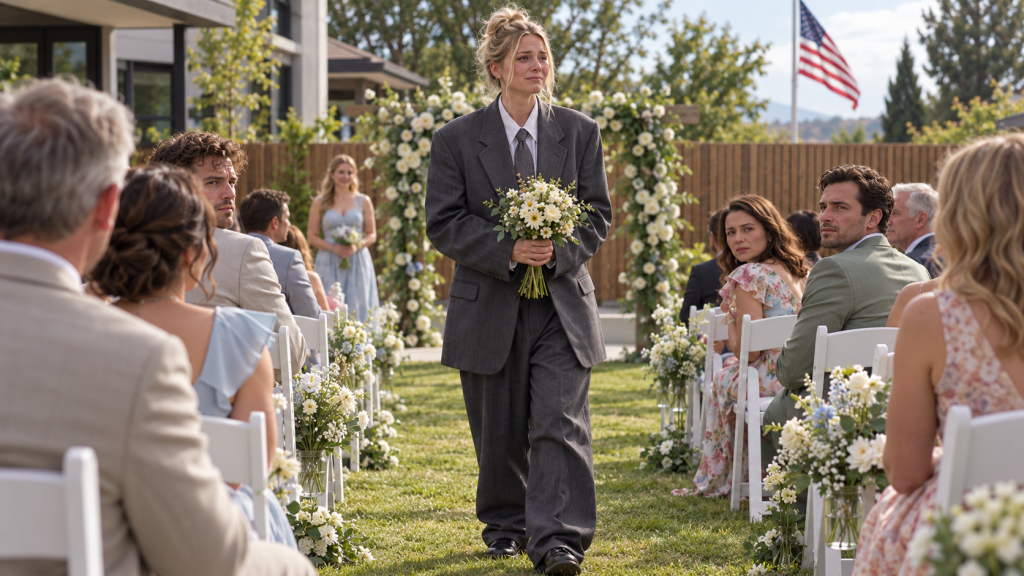
But instead of the beautiful white dress I had expected, Claire appeared wearing a black suit that looked at least three sizes too large.
The shoulders hung awkwardly. The sleeves almost covered her hands. The trousers gathered around her ankles, and a dark tie rested against the white shirt beneath the jacket.
She was carrying a bouquet of white roses.
And she was smiling.
At first, I couldn’t move.
Then I heard someone whisper behind me.
“What on earth is she wearing?”
Another guest gave a nervous laugh.
I looked toward my mother, who was sitting in the second row.
Her expression had gone completely blank.
My father, Robert, was sitting beside her.
He wasn’t smiling either.
But there was something different about his expression.
He looked frightened.
I didn’t understand that at the time.
I thought he was simply embarrassed, the same way I was.
I had no idea that the suit Claire was wearing had once belonged to a man who had saved my life.
And I certainly didn’t know that my father had spent more than twenty years hiding what happened that day.
My name is Nathan Reed. I’m thirty-four years old, and until my wedding day, I believed I knew my family better than anyone.
I was wrong.
Claire and I met five years earlier at a friend’s birthday dinner in Richmond, Virginia.
She arrived nearly forty minutes late, carrying a grocery-store cake because the bakery had mixed up the original order.
Everyone else complained about the delay.
Claire just set the cake on the table, borrowed a knife, and announced that we were lucky because the replacement had twice as much frosting.
That was the first thing I loved about her.
She could walk into an uncomfortable situation and somehow make everyone feel better without pretending the situation wasn’t uncomfortable.
She worked as an elementary school librarian.
I was a civil engineer.
Our personalities were different in almost every possible way.
I made lists.
Claire lost lists.
I arrived fifteen minutes early.
Claire believed that arriving exactly on time was a respectable accomplishment.
I read instructions before assembling furniture.
Claire considered instructions a personal insult.
Somehow, we worked.
She made my life less rigid.
I made hers a little more organized.
When I proposed after five years together, she cried before I even finished asking.
Then she laughed because I had accidentally opened the ring box backward.
We told our families that evening.
My mother screamed so loudly over the phone that I had to hold it away from my ear.
My father congratulated us and immediately asked whether we’d chosen a date.
Claire’s mother, Mary, cried quietly.
Her father had died twelve years earlier, and I knew weddings brought up complicated feelings for her.
I had never met Patrick Sullivan.
But I had heard plenty about him.
Claire described him as a man who could repair almost anything, except the toaster he repeatedly insisted wasn’t broken.
He worked with his hands.
He built bookshelves, repaired boats, fixed neighbors’ porch steps, and once spent an entire weekend making Claire a wooden dollhouse because she had seen one in a store that cost too much.
She still had that dollhouse.
It sat in the guest bedroom of our apartment, carefully wrapped in a faded quilt.
Whenever I suggested finding a better place to display it, Claire said she was waiting until we had a house with enough room.
I thought that was sweet.
I didn’t understand how many pieces of her father she was still trying to keep close.
Patrick had died from cancer when Claire was nineteen.
She had been in college.
He had gotten sick during her first semester, and by the time she returned home for the summer, the doctors were already discussing treatments that might give him more time rather than cure him.
Claire rarely spoke about the final months.
But she sometimes mentioned things he had said when she was little.
He called her Cricket.
He taught her how to change a tire.
He told her never to marry someone who made her feel foolish for asking questions.
And apparently, when she was seven, he made a promise.
“One day,” he’d told her, “I’m going to put on my best suit, and I’m going to walk you down the aisle.”
Claire remembered that conversation perfectly.
I wouldn’t learn about it until our wedding.
We chose a small garden venue outside Richmond.
There was an old renovated farmhouse, a white stone patio, and a lawn bordered by flowering trees.
It wasn’t extravagant, but it was beautiful.
We saved for almost a year.
My parents offered to help with the catering, while Mary insisted on paying for the flowers.
Claire handled most of the decorations.
I handled contracts, schedules, and the terrifying spreadsheet that tracked our expenses.
We argued about chocolate cake versus lemon cake.
We compromised on alternating layers.
We argued about the seating chart.
We compromised by putting my uncle, who loved political debates, at the opposite end of the room from her aunt, who loved winning them.
Everything felt normal.
Except for the dress.
Claire refused to show it to me.
I assumed she wanted the traditional surprise.
She had gone shopping with Mary and her best friend, Hannah, who was also her maid of honor.
At one point, I walked into our apartment and found three garment bags hanging outside the bedroom.
Claire immediately pushed me back into the hallway.
“No looking.”
I raised my hands.
“Wouldn’t dream of it.”
She grinned and kissed my cheek.
Looking back, I remember that her smile faded almost immediately afterward.
I asked if something was wrong.
She said she was tired.
I believed her.
Weddings are exhausting to plan.
A month before the ceremony, Claire asked me a strange question while we were folding laundry.
“Do you think people have to look a certain way to get married?”
I laughed.
“Well, I hope not. I’m planning to look like a nervous accountant.”
She smiled faintly.
“I’m serious.”
I set down a towel.
“What do you mean?”
“Would it bother you if I didn’t look exactly how you imagined?”
I thought she was worried about her hair or her weight or some tiny detail that wouldn’t matter.
“Claire, you could wear a potato sack and I’d still marry you.”
She looked relieved.
Then I added, “Although I’d probably have questions about the potato sack.”
She laughed.
And the conversation ended.
I would replay it in my head at least a hundred times after the wedding.
Because I had meant what I said.
But standing in front of eighty-seven guests while she walked toward me in an enormous black suit, I discovered that meaning something in theory and feeling it in real life were not always the same.
On our wedding morning, I woke before my alarm.
My best man, my younger brother Ethan, was already downstairs making coffee.
He was twenty-nine, recently married, and enjoying every opportunity to remind me that he was technically more experienced.
“Don’t faint,” he said when I entered the kitchen.
“I’m not going to faint.”
“That’s what people say before they faint.”
My friends arrived an hour later.
We got dressed, checked our ties, took photographs, and laughed about how strange it was that we were finally adults doing things we’d watched older relatives do when we were children.
My father stopped by shortly before we left.
He adjusted my cufflinks even though they didn’t need adjusting.
“You ready?” he asked.
“More than ready.”
He smiled.
“Marriage isn’t always easy.”
“I know.”
“No, you don’t. But you will.”
Then he put one hand on my shoulder.
“Just remember, whatever happens, protect your family.”
I thought it was ordinary fatherly advice.
Later, those words would feel different.
About thirty minutes before the ceremony, Hannah hurried past the room where we were waiting.
Her face was flushed.
She was holding a small sewing kit.
“Everything okay?” I asked.
She stopped.
“Yeah. Claire’s fine.”
“That’s not exactly what I asked.”
Hannah hesitated.
Then she said, “She’s just emotional.”
That made sense.
I knew Claire would be thinking about Patrick.
I assumed Hannah had been comforting her.
I had no reason to imagine anything else.
The ceremony began at four.
My brother walked beside me to the arch.
The guests settled into their seats.
The bridesmaids entered.
Hannah was the last.
She glanced at me as she passed.
There was something almost apologetic in her expression.
Then the music changed.
Everyone stood.
And Claire appeared.
For several seconds, I genuinely thought something had gone wrong backstage.
Maybe her dress had torn.
Maybe she’d spilled something on it.
Maybe this was some temporary outfit before she changed.
But she was walking down the aisle as though everything was exactly how she wanted it.
The suit was clearly old.
Not fashionable-old.
Actually old.
The black fabric had softened to charcoal in places. The trousers were loose, and the jacket’s oversized shoulders made Claire look smaller than she was.
Yet she had arranged everything carefully.
Her white shirt was pressed.
A small silver pin was fastened near the jacket’s lapel.
Her hair was swept into a neat bun.
And her bouquet was tied with a pale blue ribbon.
I stared.
Behind me, a few guests started whispering.
Someone laughed before another person shushed them.
I felt heat crawl up my neck.
We had spent months planning this wedding.
There were photographers.
There were relatives who had traveled from three states.
My coworkers were there.
My grandparents were watching.
And Claire had somehow decided to do something this unusual without telling me.
When she reached me, I leaned toward her.
“Claire, what is this?”
Her smile trembled.
She didn’t answer immediately.
Instead, she handed her bouquet to Hannah.
Then she reached across her body and folded back the enormous cuff of her left sleeve.
Inside was a faded fabric label.
The stitching was worn but still readable.
MADE FOR PATRICK SULLIVAN.
Beneath it was the name of a tailor and a date from the summer of 1994.
I looked up.
“Your dad?”
Claire nodded.
“This was his wedding suit.”
My embarrassment faltered.
She touched the lapel.
“He wore it when he married Mom.”
I didn’t know what to say.
Claire swallowed.
“I wanted him to walk me down the aisle. This was the closest way I knew.”
My chest tightened.
I glanced toward Mary.
She was crying.
Not a little.
Tears were running down her face, and she wasn’t trying to hide them.
For the first time, I understood why the suit mattered.
But before I could respond, Claire reached into the inside pocket.
“There’s something else,” she whispered.
She unfolded a photograph.
It was old and slightly yellowed around the edges.
Two young men were standing outside a small church.
One was Patrick Sullivan.
He was wearing the same black suit.
The other man wore a navy dress uniform.
I recognized him instantly.
My father.
Robert Reed.
I looked toward the second row.
Dad’s face had turned pale.
My heart began beating harder.
“What is this?” I whispered.
Claire turned the photograph over.
On the back, in faded blue ink, someone had written:
“You said you could never repay me for bringing Nathan home. Don’t repay me. Just be there for Claire if the day comes when I can’t. —Patrick, August 2000.”
I read the sentence twice.
Then a third time.
My name was on it.
Not a different Nathan.
Not a coincidence.
Me.
I looked at my father again.
He was staring at the photograph.
And suddenly, a memory I hadn’t thought about in years came back to me.
Dark water.
A rushing current.
Someone shouting my name.
And a pair of hands dragging me toward the shore.
All my life, my father had told me he was the one who saved me.
But the photograph in Claire’s hand suggested another story entirely.
“Nathan?” she whispered.
I realized our officiant had stopped speaking.
Everyone was watching us.
I had no idea how long we had been standing there.
Claire’s eyes filled with tears.
“I’m sorry,” she whispered. “I didn’t know what it meant until three days ago.”
“What happened three days ago?”
She glanced toward the guests.
“Please. Not here.”
I looked at her.
Then at the suit.
Then at my father, who had lowered his eyes.
For one terrifying moment, I felt as though I was standing between two entirely different versions of my life.
The one I had lived.
And the one someone had kept hidden from me.
The officiant leaned slightly closer.
“Would you like a moment?”
My first instinct was to say yes.
I wanted to pull my father aside.
I wanted to ask why his photograph had been hidden in Patrick Sullivan’s wedding suit.
I wanted to know what “bringing Nathan home” meant.
But Claire was standing in front of me, trembling.
And suddenly, beneath everything else, I remembered why we were there.
We were getting married.
I gently took the photograph from her hand.
“Can Hannah hold this for now?”
Claire nodded.
I passed it to her maid of honor.
Then I took both of Claire’s hands.
“We’re going to talk about this,” I whispered.
“I know.”
“And I wish you’d told me about the suit.”
A tear slipped down her cheek.
“I know that too.”
I took a breath.
“But I still want to marry you.”
Her face changed.
“Really?”
“Claire, I’ve wanted to marry you for five years.”
She gave a shaky laugh.
I smiled despite everything.
“Your outfit has definitely made the day more interesting.”
Several people near the front chuckled softly.
The tension eased.
Claire squeezed my hands.
And we turned toward the officiant.
The ceremony continued.
I barely remember the first reading.
My mind kept returning to that photograph.
But when Claire began her vows, every other thought faded.
“Nathan,” she said, “you make ordinary things feel safe. You remember the details I forget. You listen when I talk too much. You always ask if I’ve eaten when you know I’m worried.”
People laughed softly.
She looked down at her enormous sleeves.
“And sometimes I make decisions that surprise you more than I should.”
Another gentle laugh moved through the guests.
Claire looked directly at me.
“I promise not to hide the difficult parts of myself because I’m afraid they won’t fit into the life we’re building. And I promise to make room for the difficult parts of you too.”
Something about those words nearly broke me.
Because I was beginning to suspect that my family had been hiding difficult things for a very long time.
When it was my turn, I unfolded the vows I’d written.
I had spent weeks perfecting them.
Now they seemed almost too polished.
I looked at Claire, standing there in her father’s suit.
“Claire, I thought I knew exactly what today would look like.”
A few guests laughed again.
I smiled.
“Apparently, I was wrong.”
She laughed through her tears.
“But I know what I want the rest of my life to look like. I want you there when things go right. I want you there when things fall apart. And I promise that when something surprises me, I’ll try to understand before I decide what it means.”
She squeezed my hands.
We exchanged rings.
The officiant pronounced us husband and wife.
And when I kissed her, the entire garden erupted in applause.
For a few seconds, I forgot about the photograph.
I forgot about my father’s expression.
I forgot about the whispers.
I just held my wife.
Then I turned toward the guests.
And saw my father’s empty chair.
He had left before the ceremony ended.
I didn’t know whether to feel angry or afraid.
My mother was still sitting in the second row.
She looked devastated.
Ethan leaned toward her, saying something I couldn’t hear.
Mary sat beside the aisle, holding a handkerchief.
Her eyes were on Claire.
The reception began almost immediately afterward.
People surrounded us with congratulations.
Some guests praised the suit.
Others seemed unsure whether they were supposed to mention it.
Claire handled every comment with grace.
When one of my older relatives asked whether she’d misplaced her wedding gown, Claire simply answered, “No. I found something I needed more.”
I watched her say it.
And for the first time that afternoon, I saw the outfit the way she did.
It wasn’t a costume.
It wasn’t a joke.
It was a daughter trying to bring her father to her wedding.
But I still had questions.
And now those questions were bigger than the suit.
During the photographs, our photographer suggested that Claire remove the jacket for a few poses.
She shook her head.
“Not yet.”
I understood.
We took pictures beneath the trees.
One of Claire holding the sleeves up so they wouldn’t cover her hands.
One of us laughing when the wind blew her tie sideways.
One with Mary standing between us, touching the lapel with the tips of her fingers.
And one that became my favorite months later.
Claire was looking up at me.
I was looking down at her.
Neither of us noticed the camera.
My expression was serious.
Hers was gentle.
It looked exactly like what our marriage would become.
Two people learning that love did not always arrive in the form they expected.
After the photographs, I found my mother near the farmhouse entrance.
She was alone.
“Where’s Dad?”
She looked away.
“Nathan, not now.”
“Mom.”
She pressed her lips together.
“He went to his car.”
“Why?”
“I don’t know.”
“That’s not true.”
Her eyes filled.
“Nathan, please.”
I lowered my voice.
“Did you know Claire’s father?”
She took a long breath.
“Yes.”
The word hit me harder than I expected.
“How long?”
“Since before you were born.”
I stared at her.
“Both of you lied?”
My mother flinched.
“We didn’t know how to explain.”
“Explain what?”
She glanced toward the reception hall.
“Your father needs to tell you.”
That was when I realized the secret wasn’t simply a forgotten friendship.
Whatever had happened between our families was serious enough that my parents had deliberately concealed it for years.
Even after I brought Claire home.
Even after we got engaged.
Even after they sat across from Mary at our rehearsal dinner the night before.
I stepped outside.
My father was standing beside his car at the far end of the parking lot.
He had taken off his suit jacket.
His tie hung loose around his neck.
For the first time in my life, he looked old.
Not physically old.
Defeated.
When he saw me, his shoulders dropped.
“Nathan.”
“How did you know Patrick Sullivan?”
He looked toward the trees.
“We served together.”
“In the Navy?”
He nodded.
“For almost four years.”
“Then why did you tell me you’d never met Claire’s family?”
He didn’t answer.
I stepped closer.
“Dad, you were at her parents’ wedding.”
His eyes closed.
“I know.”
“And there’s a photograph of you in Patrick’s suit pocket with a message about me.”
He rubbed his forehead.
“I hoped that picture was gone.”
That sentence made my stomach drop.
“You knew about it?”
“Patrick kept it.”
“Why?”
My father looked at me.
And for the first time, I saw something in his expression that I’d never associated with him.
Shame.
“Because he wanted me to remember a promise.”
“What promise?”
Dad’s mouth tightened.
He looked past me toward the garden where music was beginning to play.
Then he said something I would never forget.
“Nathan, when you were eight years old, you nearly drowned.”
“I know. You saved me.”
He stared at the pavement.
“No, son.”
My chest went cold.
“I wasn’t the one who pulled you out of the water.”
I couldn’t speak.
All my life, that story had belonged to my father.
He had told it at family dinners.
He had told it when I was learning to swim.
He had told it when I became a father-to-be in his imagination, joking that one day I’d understand what it meant to be terrified for a child.
There was even an old photograph in our family album of Dad standing beside a hospital bed, holding my hand.
Underneath, my mother had written, “Our hero brought Nathan home.”
I had believed every word.
“What are you saying?” I asked.
My father swallowed.
“Patrick saved you.”
The sounds of the wedding reception seemed to drift farther away.
I remembered the water.
Not clearly.
Just pieces.
We had been visiting friends near a small waterfront property outside Norfolk.
I had been playing with a wooden toy boat.
The toy slipped out of my hands and floated toward the deeper water.
I reached for it.
My foot slid off the edge of the dock.
After that, my memories became fragments.
The shock of cold water.
The terrible feeling of not knowing which direction was up.
My father’s voice shouting my name.
And someone lifting me.
For twenty-six years, I’d attached my father’s face to those hands.
Now he was telling me I had remembered the wrong man.
“Patrick was there that afternoon,” Dad continued. “He’d come over to help me repair the dock. Your mother was inside with Mary and little Claire.”
“Claire was there?”
He nodded.
“She was five. You were eight.”
I stared at him.
“We knew each other?”
“You played together a few times when you were children.”
I felt the ground shift beneath me.
Claire and I had spent five years laughing about how unlikely it was that our lives had crossed.
We had met through mutual friends as adults.
We had discovered we liked the same restaurants, the same terrible television shows, and the same hiking trails.
We used to joke that we’d probably passed each other somewhere long before we met.
Apparently, we had done more than pass each other.
We had played together as children.
Our fathers had been friends.
Our mothers had shared meals.
And nobody had told us.
“When you fell,” Dad said, “I jumped from the dock after you. But the current was stronger than I expected.”
He paused.
“I couldn’t reach you.”
“What happened?”
“Patrick was farther down the shoreline. He saw you being pulled toward the channel. He went into the water before anyone could stop him.”
My father stared toward the parking lot.
“He got hold of you. He pushed you toward the rocks where I could reach you, but he got caught against a submerged piece of timber.”
I remembered being told that Dad had suffered cuts on his hands.
I had never heard about anyone else being injured.
“Patrick got hurt?”
Dad nodded.
“He damaged his knee badly. Tore several ligaments. Needed surgery.”
My chest tightened.
Claire had told me that her father walked with a limp for most of her childhood.
She said he always blamed an old sports injury.
He never explained much beyond that.
“Why didn’t you tell me?”
Dad looked at me helplessly.
“At first, you were too young.”
“And after that?”
He said nothing.
“Dad.”
He finally met my eyes.
“Because people started calling me a hero.”
I stared.
“Who did?”
“Your mother. The neighbors. Everyone who heard about the accident.”
“But Patrick was the one who saved me.”
“I helped get you out. I performed CPR until the paramedics arrived. I was there, Nathan. I did help.”
“Then why didn’t you explain what Patrick did?”
Dad’s face crumpled.
“Because I was ashamed that I couldn’t reach you first.”
For a moment, neither of us spoke.
Then he continued.
“Patrick never corrected anyone. He said it didn’t matter who got the credit as long as you were alive.”
My father’s voice broke.
“He was that kind of man.”
I thought of Claire describing her father repairing neighbors’ houses without asking for money.
The wooden dollhouse.
The tire-changing lessons.
The old suit she had worn because she couldn’t bear the thought of walking down the aisle without him.
And suddenly, I understood that the man I’d never met had been part of my life long before I knew his name.
“But that doesn’t explain why you pretended not to know his family,” I said.
My father looked away.
“No.”
“Then tell me the rest.”
He rubbed his palms together.
“Nathan, there are things I did that I’m not proud of.”
“You’ve already established that.”
He winced.
I didn’t apologize.
After a long silence, he said, “Patrick and I stayed friends for years after the accident. We visited each other. Our families took vacations together. When you were twelve, we moved to Raleigh because I got a better job. We saw them less often, but we kept in touch.”
I remembered moving.
I remembered saying goodbye to friends.
I did not remember the Sullivans.
“You lost touch?”
“Not exactly.”
Dad pressed his thumb against his wedding ring.
“In 2008, I started a contracting business. You remember.”
I nodded.
He had opened a small residential construction company.
For a while, he seemed happy.
Then the recession hit.
The business struggled.
I remembered arguments about money, late nights at the office, and my mother taking additional shifts at the hospital.
Eventually, Dad closed the business and returned to working for another company.
What I hadn’t known was how much the failure had cost other people.
“Patrick helped me get started,” Dad said.
“How?”
“He guaranteed part of a business loan.”
My stomach tightened.
“How much?”
“Sixty thousand dollars.”
I stared at him.
“He personally guaranteed sixty thousand dollars of your business debt?”
“Yes.”
“Did Mom know?”
“She knew he was helping. She didn’t understand the full amount.”
“And when your company failed?”
Dad closed his eyes.
“The bank came after him for the unpaid balance.”
“How much?”
“Just over twenty-eight thousand.”
The number hung between us.
Twenty-eight thousand dollars.
I thought about Claire’s stories of growing up without expensive vacations.
Her father working weekends.
Her mother sewing clothes instead of buying new ones.
Claire taking out student loans.
I had never considered that some of those hardships might have been connected to my own family.
“Did you repay him?”
Dad’s silence answered before his words did.
“Not all of it.”
My anger rose so quickly that I had to step back.
“You let him cover your debt?”
“I was broke, Nathan.”
“So was he!”
“I know.”
“Did he sue you?”
“No.”
“Why not?”
Dad looked toward the reception hall.
“Because he said I’d been his friend longer than I’d been his debtor.”
I stared at him.
“And you let him say that?”
My father wiped his face.
“I kept promising I’d make it right.”
“Did you?”
“I made some payments. Then Patrick got sick.”
I felt sick myself.
“What happened when he got cancer?”
“He stopped asking about the money.”
“That wasn’t my question.”
Dad swallowed.
“I couldn’t face him.”
I stared.
“He was dying, and you couldn’t face him?”
“I was ashamed.”
“Of what? Owing him money?”
“Of everything.”
His voice rose slightly.
“Of the business. Of the promises. Of needing him to save me over and over again. I didn’t know how to stand in front of him and admit how badly I’d failed.”
I shook my head.
“So you just disappeared?”
Dad’s eyes filled with tears.
“Yes.”
The honesty surprised me.
But it didn’t make the answer hurt less.
“Did you go to his funeral?”
He looked away.
“No.”
I took another step back.
I’d been twenty-two when Patrick died.
I was finishing college.
My father had told me he was traveling for work that week.
I remembered because he’d missed my birthday dinner.
Now I wondered whether he had really been traveling.
Or whether he’d simply been hiding from a grieving family.
“Mary called me after Patrick died,” he said quietly. “She wanted to talk about settling what was owed. I told her I’d call back.”
“Did you?”
“No.”
I couldn’t believe the person standing in front of me was the father I’d admired my entire life.
Not because he had made a financial mistake.
People made mistakes.
Businesses failed.
Money disappeared.
But he’d allowed someone who saved his son to shoulder part of that failure, and then he’d abandoned that man’s family when they needed him.
“How did you recognize Claire at our engagement?” I asked.
“I recognized Mary first.”
“At the dinner?”
He nodded.
“I knew immediately.”
“And you said nothing?”
“I hoped she wouldn’t bring it up.”
“She didn’t.”
“No.”
I remembered that dinner.
Mary had been unusually quiet.
Dad had spent most of the evening talking about the weather and the food.
I’d thought they were simply awkward around each other.
Now I understood.
“What did you think would happen?” I asked. “That Claire and I would get married and nobody would ever find out?”
Dad wiped his eyes.
“I don’t know.”
“That’s not an answer.”
“It’s the only one I have.”
I looked at him for a long time.
Then I said, “You need to tell Mom everything.”
He nodded.
“And you need to talk to Mary.”
His shoulders sank.
“I know.”
“But not today.”
He looked surprised.
“Today belongs to Claire. You don’t get to turn her wedding into another story about your guilt.”
For a moment, he looked as though he wanted to argue.
Then he lowered his head.
“You’re right.”
I turned toward the farmhouse.
“Nathan.”
I stopped.
Dad’s voice was barely audible.
“Patrick really was a good man.”
I looked back.
“He sounds like he was.”
Then I walked away.
I found Claire in a small room near the reception hall.
She had removed the tie but was still wearing the suit.
Hannah was helping her adjust the trousers.
When Claire saw my face, she immediately asked Hannah to give us a minute.
The door closed.
For several seconds, neither of us spoke.
Then Claire said, “He told you.”
I nodded.
“How much do you know?”
She sat down carefully.
“Some of it.”
I leaned against the wall.
“Start from the beginning.”
She folded her hands in her lap.
“About six months ago, when Mom and I were talking about wedding dresses, I told her I wished Dad could be here.”
Her voice trembled.
“She said his wedding suit was still in the attic.”
Claire looked down at the jacket.
“I hadn’t seen it since I was a teenager. I asked if I could try it on.”
She smiled faintly.
“It was enormous.”
I almost laughed.
“That’s one word for it.”
“Mom cried when she saw me wearing it.”
Claire brushed at her eyes.
“She told me Dad used to joke that when I got married, he’d have to buy a bigger suit because he’d probably spend the entire ceremony crying.”
I pictured a younger Patrick Sullivan laughing with his daughter.
“Mom suggested sewing a little piece of the jacket into my wedding dress,” Claire continued. “But I couldn’t bring myself to cut it.”
“So you decided to wear the whole thing.”
She nodded.
“I know it sounds strange.”
“It does.”
Her face fell.
I crossed the room and sat beside her.
“But I’m starting to understand.”
She looked at me.
“I wanted to feel like he was walking with me. I wanted something he had touched. Something he had worn on one of the happiest days of his life.”
She swallowed.
“And I thought if I told you, you’d try to talk me out of it.”
“Would I have?”
“I don’t know.”
I considered that.
If she’d told me months earlier, I probably would have been confused.
I might have suggested carrying his photograph or sewing a piece of fabric into her dress.
I might have worried about what people would think.
But I would have listened.
And we could have made the decision together.
“Claire, I wish you’d trusted me.”
She nodded.
“I know.”
“Not because I wanted to control what you wore. Because I was standing there trying to figure out whether something had gone wrong, and you were smiling like everything was normal.”
Tears filled her eyes.
“I’m sorry.”
I took her hand.
“Tell me about the photograph.”
Claire looked toward the window.
“Three days ago, I took the suit to a seamstress. She was shortening the trousers and securing one of the pockets. She found the picture tucked deep inside.”
I nodded.
“Mom saw it and went completely still.”
“What did she say?”
“She told me the man beside Dad was an old friend named Robert Reed.”
My jaw tightened.
“She knew.”
“She knew he was your father. She recognized him when we got engaged.”
“Why didn’t she say anything?”
Claire’s expression hardened.
“Because she didn’t want your father’s mistakes to become our problems.”
I looked at her.
“Your mother knew about the money?”
“Some of it. She didn’t tell me the exact amount until yesterday.”
I exhaled slowly.
Claire’s eyes filled again.
“She also told me about the accident. About you falling into the water when you were little.”
I looked at her sharply.
“And you didn’t tell me?”
“I wanted to. I almost called you that night.”
“Why didn’t you?”
“Because Mom asked me to let your father explain.”
I stood and walked toward the window.
Claire continued.
“She said your dad had been running from this for years, and she didn’t want me to make our wedding about something that happened before we were old enough to remember.”
I turned.
“But you showed me the photograph during the ceremony.”
She covered her face.
“I know.”
Her voice cracked.
“I hadn’t planned to.”
I waited.
“When I reached the front, you looked so shocked by the suit. I saw you glance toward your father, and he looked terrified.”
She lowered her hands.
“All I could think was that you were looking at me like I had made a fool of you. I panicked. I wanted you to understand there was more to it.”
She started crying.
“I wanted you to see that this wasn’t some random old suit.”
I sat beside her again.
“Claire.”
She shook her head.
“I should have told you before the wedding. I should never have put you in that position.”
I reached for her hand.
“You’re right.”
She looked surprised.
I continued gently.
“But I should have asked you what it meant before assuming you were trying to embarrass me.”
She wiped her cheeks.
“We both handled it badly.”
“Yeah.”
For a moment, we sat quietly.
Then I asked something that had been bothering me since my conversation with Dad.
“Did you know we played together as kids?”
Claire nodded.
“Mom told me.”
“Do you remember?”
She smiled through her tears.
“Not really. But Mom has a picture.”
“Of us?”
“Apparently you were wearing a yellow raincoat, and I was trying to steal your toy boat.”
I stared at her.
“Was it wooden?”
“Yes.”
A strange feeling moved through me.
The toy boat.
The one I’d dropped into the water.
I remembered it perfectly.
It had been painted blue and white.
There was a tiny red stripe along the bottom.
I hadn’t thought about it in years.
“Patrick made that boat,” I whispered.
Claire looked startled.
“What?”
“I remember Dad telling me a friend made it.”
She smiled sadly.
“That sounds like something my dad would do.”
I looked at her for a long time.
Then I said, “Your father saved my life.”
Claire’s eyes filled again.
“He did.”
I took her hand.
“And I never got to thank him.”
She leaned against my shoulder.
“Maybe you can thank him by being a good husband.”
That broke something inside me.
I wrapped my arms around her.
We sat there for several minutes, holding each other while the reception continued outside.
Eventually, Claire laughed softly.
“We’re missing our own wedding.”
I kissed her forehead.
“Apparently.”
She looked down at the jacket.
“Do you hate it?”
“The suit?”
She nodded.
I examined the oversized shoulders, the loose sleeves, the old silver pin.
“No.”
“Really?”
“I think your dad had terrible fashion sense.”
She laughed so suddenly that she almost choked.
“He did.”
“And I think we should have discussed it.”
“Absolutely.”
“But I don’t hate it.”
Claire rested her head against me.
“Thank you.”
I smiled.
“Although I’m going to need an explanation for the tie.”
“It was his favorite.”
“Of course it was.”
She laughed again.
And that was the first moment all afternoon when I felt like we were really married.
Not because we had exchanged rings.
But because we’d just had our first difficult conversation as husband and wife and managed to find our way back to each other.
When we returned to the reception, most of the guests were already eating.
Our coordinator looked relieved.
My brother approached with two glasses of water.
“Are we still doing the first dance?” he asked.
“Yes,” Claire said.
Ethan looked at the suit.
“Just checking. I wasn’t sure if Nathan was supposed to borrow a dress.”
Claire burst out laughing.
I punched his shoulder lightly.
“Don’t give her ideas.”
The atmosphere relaxed.
But I noticed my father still hadn’t returned.
My mother came to our table a few minutes later.
She kissed Claire on the cheek.
“You look beautiful, sweetheart.”
Claire squeezed her hand.
“Thank you.”
Then Mom turned toward me.
“Your father went home.”
I nodded.
“We talked.”
Her expression changed.
“About everything?”
“Enough.”
She sat down beside me.
For a while, she said nothing.
Then she whispered, “I should have told you years ago.”
I looked at her.
“Why didn’t you?”
She twisted her napkin.
“Your father always said he’d explain when you were older. Then you became a teenager, and he said you were too busy with school. Then you went to college.”
“And suddenly I was thirty-four.”
She nodded.
“I let him keep postponing it.”
“Did you know Patrick was the one who pulled me out?”
“Yes.”
“Then why did you write that Dad was our hero?”
Her face crumpled.
“Because I was grateful to both of them. Robert helped revive you, Nathan. He was the one holding you when the ambulance came.”
She took a trembling breath.
“But I should have told the whole story. Patrick was the reason there was a child for Robert to help.”
I looked away.
Mom touched my arm.
“Being terrified of losing you doesn’t excuse what we did.”
I turned back.
“No. It doesn’t.”
She nodded.
“I know.”
We sat quietly until the servers began bringing out dessert.
Then Mom asked, “Are you okay?”
I looked across the room.
Claire was laughing with Hannah.
Her oversized jacket was hanging over the back of her chair.
She looked happier than she had all afternoon.
“I will be,” I said.
Dinner passed more peacefully than I’d expected.
People gave speeches.
Ethan told embarrassing stories about my teenage years.
Hannah described Claire as the only person she’d ever known who could lose her car keys while holding them.
Everyone laughed.
Then Mary stood.
She was a small woman with silver-streaked brown hair and gentle eyes.
She held a folded paper in her hands.
“I wasn’t going to give a speech,” she began.
“But I think Patrick would be disappointed if I let today pass without embarrassing our daughter at least a little.”
Claire laughed.
Mary looked toward her.
“When Claire was seven years old, she found a picture from our wedding. She studied it for a long time, then asked her father why he was wearing such an ugly suit.”
The room erupted in laughter.
Claire covered her face.
“Patrick told her it was the finest suit he’d ever owned. And Claire said, ‘Well, I hope it looked better when it was new.'”
More laughter.
Mary smiled.
“But that evening, Patrick put the suit on again.”
Her voice softened.
“He took our little girl into the kitchen, turned on an old love song, and let her stand on his shoes while they danced.”
Claire stopped smiling.
Her eyes filled.
“She told him that when she grew up, she wanted him to wear the same suit when he walked her down the aisle.”
Mary glanced toward the jacket hanging on Claire’s chair.
“He promised he would.”
A quiet settled over the room.
Mary took a breath.
“Patrick isn’t here to keep that promise in the way he wanted. But somehow, our daughter found a way for him to keep it anyway.”
I reached for Claire’s hand.
Mary looked at me.
“Nathan, I know today has held more surprises than you expected.”
A few guests smiled.
“But I want you to know that Patrick would have liked you.”
Her voice trembled.
“He believed a good man wasn’t someone who never made mistakes. He believed a good man was someone who cared enough to admit them and try to make things right.”
I felt those words settle deeply.
Mary raised her glass.
“To Nathan and Claire. May you always find your way back to each other.”
Everyone stood.
The applause was warm and genuine.
Claire was crying.
I was close.
After the toast, Mary hugged me.
“I’m sorry about today,” she whispered.
“You don’t have to apologize for the suit.”
“I’m not apologizing for the suit.”
She pulled back.
“I’m apologizing for the secrets.”
I looked into her eyes.
She seemed exhausted.
“I should have told you what I knew,” she continued. “But I was afraid that reopening everything would hurt Claire.”
I nodded slowly.
“Did my father ever try to repay you?”
Mary’s expression changed.
“Twice. Years ago.”
“What happened?”
“He sent checks with no explanation, no letter, no apology. I returned them.”
“Why?”
“Because I wanted him to look me in the eye and acknowledge what had happened. I didn’t want money arriving like he was paying to make a memory disappear.”
I understood that.
But I also understood that refusing payment hadn’t made her life easier.
“Would you accept it now?”
Mary hesitated.
“I don’t know.”
Then she looked toward Claire.
“But I don’t want my daughter beginning her marriage with someone else’s debt hanging over her.”
I nodded.
“Neither do I.”
That evening, something unexpected happened.
After our first dance, Claire disappeared for twenty minutes.
When she returned, she was wearing a wedding dress.
A simple ivory gown with delicate sleeves and a flowing skirt.
Her hair was down.
She had changed her shoes.
For a moment, I was just as surprised as I’d been when she first appeared in the suit.
She walked toward me, smiling nervously.
“What do you think?”
I stared.
“You had a dress?”
She nodded.
“I always had a dress.”
“Where was it?”
“In the bridal suite.”
I laughed.
“Claire!”
She took my hands.
“I wanted to wear Dad’s suit for the ceremony. But I also wanted to wear the dress for our first evening as husband and wife.”
I shook my head.
“You really enjoy surprises.”
“Apparently.”
She looked worried.
“Do you like it?”
I pulled her closer.
“I love it.”
Her face brightened.
I kissed her.
Then I whispered, “For the record, I’d have married you wearing either one.”
She smiled.
“I know that now.”
We danced.
And for the first time that day, I stopped watching the doors, wondering whether my father would return.
He didn’t.
But the wedding was still beautiful.
We danced badly.
We ate too much cake.
My brother attempted a speech after three glasses of champagne and had to be gently redirected by his wife.
Claire’s grandmother insisted on taking photographs with every guest.
Our photographer stayed later than planned because the sunset turned the garden gold.
And near the end of the night, Claire and I stood alone beside the flower-covered arch.
The chairs had been cleared away.
A few petals were scattered across the grass.
The air smelled like roses and damp earth.
Claire leaned against me.
“Are you disappointed?” she asked.
I looked at her.
“About what?”
“The wedding.”
I thought carefully before answering.
“It wasn’t what I imagined.”
She looked down.
I lifted her chin.
“But that doesn’t mean I’m disappointed.”
She smiled faintly.
“I wanted it to be perfect.”
“Claire, perfection was never going to happen. Ethan was here.”
She laughed.
I kissed her forehead.
Then I said, “I wish we hadn’t been surprised by so much. But I’m glad your dad was part of the day.”
She rested her head on my chest.
“So am I.”
A few minutes later, she whispered something that stayed with me.
“I think Dad would have liked that we finished the ceremony.”
“Why?”
“Because he hated leaving things unfinished.”
I smiled.
“Then he’d be pleased.”
The next morning, we woke at the hotel with our wedding clothes hanging in the closet.
Claire’s dress was neatly covered.
Her father’s suit was draped over a chair because the garment bag had torn.
I was sitting on the edge of the bed when she emerged from the bathroom.
She looked at the suit.
Then at me.
“Can I ask you something?”
“Of course.”
“Are you angry with your dad?”
I considered the question.
“Yes.”
She nodded.
“Do you hate him?”
“No.”
Claire sat beside me.
“Those can both be true, you know.”
I looked at her.
“I know.”
She slipped her hand into mine.
“I spent years being angry that Dad died. Not at him exactly. Just at everything. I missed him when I graduated. I missed him when I got my first job. I missed him when you proposed.”
Her eyes filled.
“And sometimes I was angry with other people just because they still had their fathers.”
I held her hand.
“I never knew that.”
“I didn’t want you to feel guilty.”
“You can tell me those things.”
She leaned against me.
“I know.”
We spent the next two days at a small cabin in the Blue Ridge Mountains.
Our original honeymoon plans had been modest because we’d spent most of our savings on the wedding.
We hiked.
We cooked dinner together.
We sat on the porch watching the trees.
Neither of us wanted to spend our first days as newlyweds talking endlessly about my father’s secrets.
But sometimes the conversation returned on its own.
One evening, Claire asked whether I remembered anything else about the accident.
I told her about the cold water.
The toy boat.
The hands pulling me toward the shore.
Then I remembered something I’d never understood before.
“Someone was singing,” I said.
Claire looked at me.
“What?”
“When I was in the hospital. I remember someone sitting beside me, singing.”
“What song?”
I hesitated.
“It was something about a little blue boat.”
Claire stared.
Then her eyes filled.
“My dad made up songs,” she whispered.
I looked at her.
“He used to invent silly songs about whatever he was doing. Washing dishes, fixing the car, painting the fence.”
She smiled through her tears.
“When I was little, he sang one about a blue boat that wouldn’t sink.”
For a long time, we sat without speaking.
Then I began to cry.
Not loudly.
Not dramatically.
Just tears I couldn’t stop.
Because suddenly, I remembered a man’s rough voice beside my hospital bed.
A hand resting on my shoulder.
Someone telling me I was going to be okay.
And I realized Patrick Sullivan hadn’t simply pulled me out of the water.
He had stayed.
He had comforted a frightened little boy who wasn’t his own.
He had given me kindness I had carried for twenty-six years without knowing where it came from.
Claire wrapped her arms around me.
And for the first time, I grieved a man I’d never truly known.
When we returned home, there was a letter waiting in our mailbox.
It was from my father.
Four handwritten pages.
I almost threw it away.
Instead, I sat at the kitchen table and opened it.
Dad began by saying he didn’t expect forgiveness.
He apologized for leaving the wedding.
He apologized for lying about Patrick.
He apologized for letting me grow up believing a story that wasn’t complete.
Then he wrote about the years after the accident.
He described Patrick visiting the hospital every evening after work.
He described the two of them sitting in plastic chairs outside my room, arguing about baseball and pretending they weren’t terrified.
He remembered Patrick refusing to accept money for the medical expenses he had incurred after injuring his knee.
And he admitted something else.
He had always resented how easily Patrick seemed to do the right thing.
I read that sentence several times.
Dad wrote that Patrick wasn’t perfect.
He was stubborn.
He could be impatient.
He argued over small things.
But when someone needed help, he never seemed to calculate what it might cost him.
Dad said he’d spent years comparing himself to Patrick.
And when the business failed, he couldn’t bear becoming indebted to him again.
So he did something worse.
He avoided the man who had helped him.
Then he avoided Patrick’s widow.
And eventually, he avoided telling the truth altogether.
Near the end, Dad wrote:
“I thought if I admitted what Patrick had done, you would stop seeing me as the father who protected you. I was wrong. Every year I kept quiet, I became less worthy of the respect I was trying to preserve.”
I sat there for a long time.
Claire found me with the letter in my hands.
“Are you okay?”
I nodded.
Then shook my head.
“I don’t know.”
She sat beside me.
“Do you want to tell me?”
I handed her the letter.
She read it slowly.
When she finished, she placed it carefully on the table.
“At least he’s finally telling the truth.”
“Yes.”
“But that doesn’t fix everything.”
“No.”
She touched my hand.
“Then he has more work to do.”
She was right.
And to my father’s credit, he eventually did it.
Two weeks after the wedding, Dad contacted Mary.
He asked if she’d be willing to meet him with an attorney to review the old business records.
Mary initially refused.
I didn’t blame her.
But several days later, she called him back.
They met in a small conference room.
Claire and I were there.
My mother came too.
Dad brought old loan statements, canceled checks, bank records, and a folder containing documents from the failed business.
He had spent days gathering everything.
The original unpaid amount had been a little more than twenty-eight thousand dollars.
After reviewing the records, the attorney confirmed that Dad had repaid part of the balance years earlier.
But a substantial amount remained.
Dad proposed repaying the rest, with additional money to account for the years Mary had carried the burden.
Mary looked at the paperwork for a long time.
Then she asked him one question.
“Why now?”
Dad’s eyes filled.
“Because I should have done it years ago.”
Mary said nothing.
He continued.
“Patrick trusted me. You trusted me. And when things fell apart, I acted like being ashamed was the same thing as making amends.”
His voice trembled.
“It wasn’t.”
Mary folded her hands.
“Your money won’t bring him back.”
“I know.”
“It won’t give Claire back the years she spent worrying about college expenses.”
“I know.”
“And it won’t make me forget that you disappeared when my husband was dying.”
Dad lowered his head.
“I know.”
For several seconds, nobody spoke.
Then Mary said, “But you still owe the money.”
Dad nodded.
“Yes.”
She looked at the attorney.
“Then let’s settle the debt properly.”
That was Mary.
Gentle, but not weak.
Kind, but not easily manipulated.
She accepted the restitution through a written agreement.
She did not offer forgiveness in exchange.
And Dad didn’t ask for it.
Afterward, as everyone was gathering their things, Mary stopped beside him.
“Robert.”
He looked up.
“Patrick never hated you.”
My father froze.
Mary’s voice softened.
“He was disappointed. He was hurt. But he never hated you.”
Dad’s eyes filled.
“He should have.”
“Maybe.”
She picked up her purse.
“But he didn’t.”
Then she walked out.
I watched my father sit alone at the conference table.
For the first time, he didn’t try to explain himself.
He just sat with what he’d heard.
A month later, my mother called.
She wanted to know whether I’d come to dinner.
I hesitated.
Dad and I had spoken twice since the attorney’s meeting.
Both conversations were awkward.
Neither lasted more than ten minutes.
I still loved him.
But I couldn’t pretend everything was back to normal.
Mom seemed to understand.
“You don’t have to come if you’re not ready,” she said.
I looked across the kitchen at Claire.
She was arranging books on a shelf.
I thought about the promises we’d made at our wedding.
About honesty.
About making room for difficult things.
“I’ll come,” I said.
“But just me.”
Mom agreed.
When I arrived, Dad was standing in the kitchen.
He looked nervous.
We ate dinner with Mom.
We talked about work, traffic, and Ethan’s new dog.
Nobody mentioned the wedding.
Afterward, Mom excused herself to call a friend.
Dad and I were alone.
He cleared his throat.
“I found something.”
He walked to a drawer and took out an old wooden box.
Inside was a small blue-and-white toy boat.
The paint was chipped.
The tiny red stripe along the bottom had faded.
One corner of the wooden sail was missing.
I stared.
I hadn’t seen it since childhood.
“How do you still have that?”
Dad looked down.
“Patrick pulled it out of the water the next day.”
My throat tightened.
“He saved the boat too?”
Dad smiled sadly.
“He said you might want it.”
I picked it up.
There was a small mark carved into the underside.
Two initials.
P.S.
Patrick Sullivan.
I ran my thumb over them.
“He made this?”
Dad nodded.
“For your eighth birthday.”
I looked at him.
“You told me a coworker gave it to me.”
“I know.”
I shook my head.
“Why couldn’t you just tell me his name?”
Dad’s face tightened.
“Because by the time you were old enough to ask, I’d already told the story so many times that I didn’t know how to change it.”
I stared at the boat.
Then I looked at my father.
“You know what hurts the most?”
He shook his head.
“I would have loved you either way.”
His eyes filled.
“I know that now.”
“You didn’t need to be the only hero.”
He nodded.
“I know.”
I set the boat down.
“You were my dad. That was enough.”
My father covered his face.
For several seconds, his shoulders shook.
I had seen him cry only twice in my life.
Once when his mother died.
And once when my brother graduated from college.
This was different.
He wasn’t grieving someone he’d lost.
He was grieving the person he’d pretended to be.
Eventually, he lowered his hands.
“I’m sorry, Nathan.”
I believed him.
For the first time, I truly believed that he understood what he’d done.
But belief wasn’t the same as forgiveness.
And forgiveness wasn’t the same as forgetting.
I told him that.
He nodded.
“I understand.”
Then I picked up the toy boat.
“Can I take this?”
Dad looked at it.
“Of course.”
I carried it home.
Claire was sitting on the sofa when I walked in.
She saw the boat.
Her mouth fell open.
“Nathan.”
I handed it to her.
She turned it over.
When she saw the initials, her eyes filled.
“Dad always carved his initials into things he made.”
She traced the letters gently.
Then she laughed through her tears.
“I remember him making little boats.”
I sat beside her.
“He made that one for me.”
Claire looked at me.
“Then I guess he was trying to bring us together long before we knew it.”
I smiled.
“Maybe.”
We put the boat on a shelf beside her childhood dollhouse.
Two wooden objects.
Made by the same man.
One for his daughter.
One for a little boy whose life he would eventually save.
For a long time, I found myself looking at them whenever I walked through the room.
They reminded me that people could leave traces of themselves in places they never expected.
A few months after the wedding, Mary invited us to her house.
She had been sorting through Patrick’s belongings.
There were tools in the garage, old photographs, fishing equipment, and notebooks filled with measurements and sketches.
Claire had asked for some of his things.
Mary wanted us to help choose what to keep.
We spent the afternoon opening boxes.
Claire found an old toolbox with her initials painted on the handle.
Inside were tiny screwdrivers and a measuring tape.
She laughed.
“Dad gave me this when I was nine. He said every girl should know how to fix a loose cabinet hinge.”
I smiled.
“Sounds like him.”
We found photographs of Claire as a child.
One showed Patrick teaching her to ride a bicycle.
Another showed her sitting on his shoulders at the beach.
Then Mary brought out a small album.
“I think you should see these.”
She opened it to a picture of two young couples sitting around a picnic table.
My parents.
Claire’s parents.
And two children playing on a blanket.
One was me.
The other was Claire.
I leaned closer.
I was wearing a yellow raincoat.
Claire had a pink bow in her hair.
She was holding the wooden boat.
I stared.
“I remember this.”
Claire laughed.
“You look furious.”
“I probably wanted my boat back.”
She pointed to her younger self.
“I apparently had excellent taste.”
We turned the page.
There were more photographs.
Our families at a beach.
My father holding Claire when she was a baby.
Patrick helping me climb a tree.
Our mothers smiling together outside a grocery store.
I felt an odd ache.
There was an entire chapter of my childhood I’d never known existed.
Not because I’d forgotten.
But because nobody had helped me remember.
Mary watched us quietly.
Then she said, “Your father and Patrick weren’t always unhappy with each other.”
I looked at her.
“I know.”
“They were like brothers once.”
She turned another page.
There was a photograph of Dad and Patrick laughing beside a barbecue grill.
“They had a lot of good years,” Mary continued. “I don’t want you to think everything was ruined from the beginning.”
I nodded.
That mattered more than I expected.
Because once I learned the truth, I had started seeing every memory through the worst thing my father had done.
Mary seemed to understand.
“People can disappoint you terribly and still have loved you,” she said.
I looked at her.
“How did you manage not to hate him?”
She thought for a moment.
“Some days, I did.”
The honesty surprised me.
She smiled sadly.
“But hatred would have taken more from me than I wanted to give.”
Claire reached for her mother’s hand.
Mary squeezed it.
“That doesn’t mean people get to escape responsibility. It just means I don’t want my life organized around what someone else did wrong.”
I would remember that sentence for a long time.
Before we left, Mary handed me a small notebook.
“Patrick kept this in his workshop.”
I opened it.
Most of the pages contained measurements, material lists, and rough sketches.
Near the back was a short entry dated several days after the accident.
It wasn’t a formal letter.
Just a few lines.
Patrick had written that Nathan was home from the hospital.
He mentioned that Robert had been terrified.
Then he wrote:
“That boy has his whole life ahead of him. Hope he grows up brave enough to help somebody else when the time comes.”
I read the words twice.
Claire leaned over my shoulder.
We looked at each other.
Neither of us spoke.
Patrick hadn’t written about being a hero.
He hadn’t written about being owed anything.
He had simply hoped the little boy he saved would grow up to help someone else.
I closed the notebook carefully.
That night, after we returned home, I sat at our dining room table thinking about those words.
I had spent months wondering how to honor Patrick.
How to repay something that could never truly be repaid.
Eventually, I realized I was asking the wrong question.
Patrick hadn’t wanted repayment.
He had wanted goodness to continue.
So Claire and I made a decision.
We started a small annual scholarship at the local technical college for students entering construction, carpentry, or skilled trades programs.
It wasn’t a huge amount.
We couldn’t afford anything extravagant.
But we committed to contributing every year.
We named it the Patrick Sullivan Memorial Scholarship.
When we told Mary, she cried.
Then she asked whether the scholarship could include students who had struggled financially after losing a parent.
We agreed immediately.
My father later asked whether he could contribute.
I told him he could, as long as he understood the scholarship wasn’t a shortcut to repairing our relationship.
He nodded.
“I know.”
His contribution was made without putting his name on anything.
For once, he seemed content to help without being recognized.
That mattered to me.
It didn’t erase the past.
But it was a beginning.
Our relationship improved slowly.
Not through one dramatic conversation.
Not through a single apology.
But through ordinary, sometimes uncomfortable effort.
Dad stopped changing the subject when Patrick’s name came up.
He answered questions honestly.
He listened when I told him something still hurt.
And when Claire spoke about her father, he didn’t retreat into guilt.
He listened to her stories.
Sometimes he added memories she hadn’t known.
He told her about Patrick singing badly in the truck.
About the time he accidentally painted a customer’s porch railing the wrong color.
About how he used to carry extra sandwiches because he always expected someone else to forget lunch.
Claire treasured those stories.
She wasn’t ready to consider my father part of her family in the same way she once might have.
But she appreciated having another person who remembered Patrick.
One Sunday afternoon, almost six months after our wedding, Dad came over for dinner.
Claire had made roast chicken.
I had burned the rolls.
Everything felt pleasantly ordinary.
After dinner, Dad stood beside the shelf in our living room.
He looked at the wooden boat and the dollhouse.
Then he turned toward Claire.
“Your father made beautiful things.”
Claire smiled.
“He did.”
Dad nodded.
“He was a better friend to me than I deserved.”
Claire looked at him for a long moment.
Then she said, “You can still honor him by being a better friend to the people who are here.”
Dad’s eyes filled.
“You’re right.”
He didn’t ask for a hug.
He didn’t ask her to forgive him.
He simply thanked her.
And when he left that evening, Claire walked him to the door.
That small gesture meant more than any dramatic declaration could have.
The following spring, our wedding photographer contacted us.
She was updating her portfolio and wanted permission to use one particular photograph.
It was the image of Claire walking down the aisle in her father’s oversized suit.
I opened the file on my computer.
The photograph was beautiful.
The afternoon sunlight caught the edge of Claire’s face.
Her bouquet was bright against the dark fabric.
The jacket hung awkwardly around her shoulders.
But her expression was peaceful.
Determined.
Almost radiant.
Behind her, Mary was crying.
And near the front, just visible in the background, I was standing beneath the flower-covered arch.
I looked stunned.
Not exactly the expression I’d imagined in our wedding album.
Claire walked into the room.
“What are you looking at?”
I turned the screen toward her.
She laughed.
“Oh, your face.”
I groaned.
“Don’t remind me.”
She leaned closer.
“You look like someone just told you the wedding cake was made of broccoli.”
I laughed.
“That’s pretty close to how I felt.”
She slipped her arms around my shoulders.
“Do you regret anything?”
I thought about the question.
There were things I wished we’d done differently.
I wished Claire had told me her plans.
I wished my parents had been honest years earlier.
I wished Patrick had lived long enough for me to know him.
I wished the photograph hadn’t forced so many painful truths into the middle of our wedding.
But I didn’t regret marrying Claire.
And I didn’t regret learning the truth.
“No,” I said.
Then I corrected myself.
“I regret that I wasted the first few seconds of seeing you worrying about what everyone else thought.”
Claire smiled.
“That’s understandable.”
“Maybe. But I wish I’d seen what you were trying to do sooner.”
She leaned her forehead against mine.
“You figured it out.”
I looked back at the photograph.
The photographer had captured something I hadn’t noticed on the day itself.
Claire was holding one oversized sleeve against her chest.
Almost like someone was holding her hand.
I stared at it for a long time.
Then I realized why the picture affected me so deeply.
For twelve years, Claire had carried the grief of losing her father.
She’d graduated without him.
Started her career without him.
Fallen in love without him.
Planned our wedding without him.
And on the one day she’d dreamed of having him beside her, she’d found a way to carry a piece of him down the aisle.
It wasn’t conventional.
It wasn’t perfectly planned.
But it was love.
A daughter’s love for her father.
And a father’s love that had somehow survived in an old jacket, a faded photograph, a wooden toy boat, and the life of a boy he had once saved.
We gave the photographer permission to use the picture.
A few weeks later, she sent us a printed copy as a gift.
We framed it.
Not in the hallway.
Not in a guest room.
We hung it above the shelf holding the dollhouse and the wooden boat.
Visitors sometimes asked why the bride in our wedding photograph was wearing an oversized men’s suit.
And whenever they did, Claire and I exchanged a look.
Because the answer was no longer a secret.
We told them about Patrick.
About the suit he’d worn when he married Mary.
About the promise he’d made to his little girl.
About a wooden boat that floated too far from a dock.
About a man who jumped into dangerous water to save a child.
And about the complicated, painful, beautiful way two families found their history again.
I didn’t always tell every detail.
Some parts belonged to the people who had lived them.
But I never allowed anyone to make the suit into a joke.
Because I understood something I hadn’t understood on my wedding morning.
Sometimes the most important person at a wedding is someone who isn’t physically there.
Sometimes love doesn’t look the way we expect.
Sometimes it arrives in clothing that’s too large, with sleeves that cover the hands and trousers that bunch around the ankles.
And sometimes the truth we need most comes from a person who can no longer speak.
On our first wedding anniversary, Claire and I returned to the garden venue.
We didn’t arrange anything elaborate.
We simply walked through the grounds together.
The flowers were blooming again.
The same old farmhouse stood beside the patio.
The stone path looked exactly as it had on our wedding day.
Claire wore a simple blue dress.
I wore jeans and a button-down shirt.
We stopped beneath the arch where we’d exchanged our vows.
It had been decorated with fresh flowers for another wedding later that afternoon.
Claire looked down the empty aisle.
“Do you remember what you said when you first saw me?”
I laughed.
“Unfortunately.”
She smiled.
“‘Claire, what is this?'”
I shook my head.
“I could have handled that better.”
She took my hand.
“I could have warned you.”
“True.”
We laughed.
Then she grew quiet.
“I miss him.”
I knew who she meant.
I slipped my arm around her.
“I know.”
She looked toward the end of the aisle.
“I used to imagine Dad standing beside me here. I thought the hardest part of getting married would be walking without him.”
I kissed her temple.
“But you didn’t walk without him.”
She smiled through her tears.
“No.”
Then she looked up at me.
“And neither did you.”
I didn’t understand at first.
She squeezed my hand.
“My dad was there for you too, Nathan. Long before our wedding.”
I thought about the cold water.
The hospital room.
The rough voice singing about a little blue boat.
The twenty-six years I’d lived because someone had chosen to help.
Claire was right.
Patrick had walked beside both of us in ways neither of us understood until that day.
I pulled her into my arms.
We stood beneath the arch for a long time.
And I made a quiet promise.
I would never hide the truth from the people I loved just because I was afraid of how they might see me.
I would never confuse pride with strength.
And I would never forget that the measure of a good person wasn’t how loudly the world praised them.
It was what they chose to do when someone needed help.
My father had spent years protecting an image of himself.
Patrick Sullivan had spent his life protecting people.
One man wanted to be remembered as a hero.
The other never asked to be remembered at all.
Yet twenty-six years after he pulled a frightened little boy from the water, Patrick was still teaching that boy what it meant to become a good man.
And every time I looked at our wedding photograph, I remembered the moment my wife walked toward me in an oversized old suit.
At first, I thought she’d ruined the picture-perfect wedding I’d imagined.
Instead, she had brought something into our marriage that no expensive dress or flawless ceremony could have provided.
The truth.
Her father’s memory.
And the chance to build our lives on something stronger than appearances.
Because in the end, the suit was never really about what Claire was wearing.
It was about who was walking beside her.
And once I understood that, I never looked at our wedding photographs the same way again.
💬THE END! THANK YOU FOR READING!