

My daughter told me I had two choices: serve her husband or leave her home. So I smiled, packed my suitcase, and walked out without raising my voice. Seven days later, I woke up to twenty-two missed calls and one message I never thought I would receive. When Tiffany said I could either wait on her husband or get out, I did not shout. I did not argue. I did not slam anything against the counter. And I did not remind her, at least not then, of every bill I had paid in silence, every bag of groceries I had carried into that house, and every piece of my retirement I had sacrificed because I thought that was what a father did.
I only smiled. Then I picked up my suitcase and left the house I had spent my whole life paying for. She thought I would give in like I always had. She expected me to calm down, apologize, step into the kitchen, and do whatever her husband demanded just to keep the peace. But that Saturday afternoon in Kalispell, Montana, something inside me finally became quiet. My keys were still warm in my hand when I came through the front door. Grocery bags dug into my wrists. Soft spring sunlight slipped through the living room curtains and stretched across the hardwood floors Martha and I had refinished together two decades earlier. Outside, a neighbor’s flag stirred in the mountain breeze. A lawn mower buzzed somewhere down the street, steady and ordinary, as if my life was not about to change. Inside my house, Harry was sprawled in my leather recliner.
Not just any chair.
Martha had given me that recliner before cancer took her. It was the last birthday present she ever bought me. I used to sit there at night with coffee in my hands, listening to the quiet house and imagining she was still moving around in the kitchen.
Now my son-in-law had his feet propped up in it like the place belonged to him. A half-empty beer bottle hung from his fingers. The basketball game blasted through the room, and the remote sat on his stomach like he was king of the house.
He did not even turn his head.
“Old man,” he said, still watching the screen, “bring me another beer from the fridge while you’re standing.”
I lowered the grocery bags to the floor.
The milk and bread landed with dull thuds. The plastic handles had already carved red lines into my palms.
“Excuse me?” I asked.
“You heard me,” Harry said. “Corona. Not that cheap stuff you drink.”
A chill settled deep in my chest.
I had bought those Coronas for him. I had spent part of my Social Security check on beer I would never touch because Tiffany had once said Harry liked a decent drink after work.
I had called it kindness.
Another small payment toward peace.
“Harry,” I said evenly, “I just walked in. I need to put these groceries away.”
Only then did he look at me.
His expression was familiar: irritated, superior, as if I were causing trouble by having a limit.
“What’s the big deal?” he said. “You’re already up. I’m comfortable.”
“The big deal,” I answered, “is that this is my house.”
Harry’s feet dropped to the floor.
He stood slowly, using his size like a threat. He was thirty, broad-shouldered, and full of the careless confidence of a man who had never built anything but still expected to command it.
But I had spent thirty years in banking, sitting across from men who believed loud voices could change facts.
Harry did not scare me.
He only saddened me.
“Your house?” he said with a laugh. “That’s funny, considering your daughter and I live here.”
“You live here because I allowed it.”
“We pay the bills.”
“With my money.”
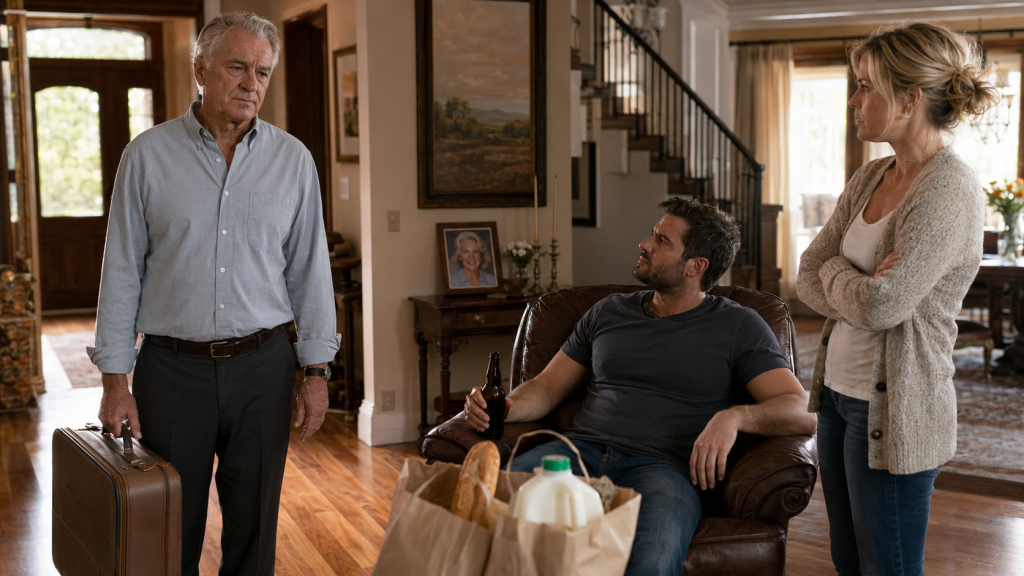
“Details.” He stepped closer, beer still in his hand. “Listen, Clark. We can do this the easy way or the hard way. You want to keep living here peacefully? Then you cooperate. That’s all.”
The kitchen door opened.
Tiffany stepped in, holding a dish towel. Her blonde hair was tied back loosely. She glanced at Harry, then at me, then at the bags near the door.
“What’s happening?” she asked.
“Your father is making a scene,” Harry said. “I asked him for one beer, and now he’s acting like I insulted the president.”
Tiffany looked at me with disappointment.
Not worry.
“Dad,” she said, “just get him the beer. This isn’t worth a fight.”
I stared at her.
For one brief second, I searched her face for the child who used to climb into my lap during storms and whisper, “Don’t let the sky break, Daddy.”
But that little girl was gone.
Now she stood beside her husband.
And Harry kept going.
“See, Clark, this is how things work now,” he said. “You live in our house. You contribute. So when I ask you to do something, you do it. No questions. No attitude.”
“Our house?” I repeated.
“That’s right,” Tiffany said.
Then she stepped beside him as if they had practiced the moment.
“Dad, you need to choose right now,” she said. “Either you help Harry and do what he asks, or you pack your things and leave.”
Her words stayed in the room like smoke.
Harry smirked, certain he had already won.
I looked at my daughter one final time.
“All right,” I said softly.
Harry leaned back, satisfied.
“Good. Now, about that beer.”
I picked up the grocery bags, placed them neatly on the kitchen counter, and turned toward the hallway.
“I’ll pack.”
Tiffany blinked.
“Dad, stop.”
But I did not stop.
I walked into my bedroom slowly, not because I was weak, but because I wanted to remember every step. That house carried my whole life in its walls. Martha’s laugh in the kitchen. Tiffany’s first birthday cake smashed across her face. Christmas mornings. Hospital calls. Quiet dinners after grief had taken all our words.
On my dresser sat Martha’s photograph.
I touched the frame.
“I’m sorry,” I whispered.
Then I opened the closet and pulled down my old brown suitcase.
I packed simply.
Three shirts. Two pairs of pants. My shaving kit. Medication. My wallet. Martha’s photograph. Her wedding ring in the little wooden box.
Then I opened the bottom drawer.
Under a stack of old tax records was the blue folder Tiffany never cared enough to ask about.
Inside were the deed, the mortgage payoff letter, the property tax records, insurance documents, and copies of every transfer I had made to cover utilities, repairs, groceries, and Harry’s truck payment when Tiffany cried that they were “just one month behind.”
I placed the folder in my suitcase.
When I returned to the living room, Harry was sitting again in my recliner.
“Changed your mind?” he asked.
“No.”
Tiffany’s face tightened.
“Dad, you’re being dramatic.”
I smiled at her gently.
“No, sweetheart. This is the first calm thing I’ve done in years.”
Then I walked out.
I did not know where I was going until I reached the end of the driveway.
Across the street, Mrs. Lindell stood trimming her roses. She was seventy-eight, widowed twice, and sharper than most lawyers I had known. She watched me with my suitcase and said nothing for a moment.
Then she lowered her garden shears.
“Clark,” she called, “you need a place?”
Pride tried to rise in me.
But grief was heavier.
“For a night,” I said.
She nodded.
“Guest room is made.”
I slept that night under a blue quilt that smelled faintly of lavender and cedar. For the first time in months, nobody shouted from the living room. Nobody opened my bedroom door without knocking. Nobody asked me to pay a bill, fix a problem, or disappear into my own house.
The silence should have felt lonely.
Instead, it felt clean.
The next morning, I called my attorney, Samuel Price.
He had handled Martha’s estate. He was old-fashioned, careful, and had once told me, “Sentiment is not a legal strategy, Clark.”
When I explained what happened, he was quiet for a long time.
Then he said, “Bring me the folder.”
By noon, I was sitting across from him.
He read everything carefully, his glasses low on his nose.
“The property is solely in your name,” he said.
“Yes.”
“They have no lease?”
“No.”
“No written agreement?”
“No.”
“They contribute nothing meaningful?”
I laughed once, bitterly.
“They contribute noise.”
Samuel closed the folder.
“Then we proceed formally.”
I looked down at my hands.
“They’re still my daughter and son-in-law.”
“I understand,” he said. “But being your daughter does not give her the right to take your home.”
The first letter went out that afternoon.
Notice to vacate.
Thirty days.
No threats. No insults. Just law.
For the first two days, Tiffany did not call.
I imagined her waiting for me to break. I imagined Harry telling her I would come crawling back, apologizing with groceries and cash.
On the third day, she sent one text.
Dad, this is embarrassing. Come home and stop this.
I did not answer.
On the fourth day, Harry called. I let it go to voicemail.
His message was short.
“You made your point. Now quit acting stupid.”
I saved it.
On the fifth day, Samuel called me.
“There’s something else,” he said.
My stomach tightened.
“What?”
“Harry tried to contact your insurance company claiming he was an authorized household manager.”
I closed my eyes.
“He what?”
“He also asked about adding his name to the policy. They refused.”
I sat there in Mrs. Lindell’s sunroom, looking out at the mountains beyond the glass.
For years, I had mistaken Tiffany’s stress for helplessness. I had mistaken Harry’s arrogance for immaturity. I had told myself they were young, struggling, overwhelmed.
But this was not struggle.
This was strategy.
On the sixth day, I went to the bank.
Not the branch where I had worked before retirement. A different one, across town. I sat with a manager named Elise, showed my identification, and removed Tiffany as emergency contact from my accounts.
Then I froze my credit.
Then I changed every password.
Then I checked every automatic payment.
Harry’s truck.
Their phone bill.
A streaming service.
A gym membership.
A credit card payment Tiffany had sworn was “just temporary.”
I stopped them all.
Each cancellation felt like pulling a thread from around my throat.
That night, I slept better than I had in years.
On the seventh morning, I woke to my phone vibrating off the nightstand.
Twenty-two missed calls.
Fourteen from Tiffany.
Six from Harry.
Two from unknown numbers.
Then I saw the message.
Dad, please call me. Harry is gone. He emptied our account. The sheriff came. I don’t know what to do. I’m sorry.
I read it three times.
I did not feel victory.
That surprised me.
I thought there would be satisfaction, maybe even some bitter joy. But there was only a deep ache, the kind that comes when a wound proves it was worse than you wanted to admit.
Mrs. Lindell knocked softly on the guest room door.
“You all right?”
I opened the door and handed her the phone.
She read the message and looked up.
“Well,” she said, “that took less time than I expected.”
I almost laughed.
Instead, I called Samuel.
He told me to meet him at the house and not to go inside alone.
By the time we arrived, Tiffany was sitting on the front porch steps in yesterday’s clothes. Her eyes were swollen. Her hair hung loose around her face. For one painful second, she looked sixteen again, heartbroken after her first boyfriend dumped her.
Then she saw me.
“Dad.”
I stopped at the bottom of the steps.
Samuel stood beside me.
Tiffany looked at him, then back at me.
“Why is he here?”
“Because this is still a legal matter,” I said.
Her face crumpled.
“Harry left.”
“I know.”
“He took the money from our joint account. He took my jewelry. He took the laptop. He said this was all my fault because I didn’t control you.”
The word control passed through me like cold water.
I looked past her into the house. The front door hung open. Inside, my living room looked ransacked. Empty beer bottles on the side table. Cushions on the floor. One of Martha’s framed paintings leaned crookedly against the wall.
Then I saw my recliner.
A dark stain covered one arm.
My hands curled.
Tiffany noticed.
“I’m sorry,” she whispered. “I should have stopped him.”
“Yes,” I said. “You should have.”
She flinched.
“I didn’t mean what I said.”
“You meant it when saying it benefited you.”
Tears spilled down her cheeks.
“I was scared of him.”
I looked at my daughter, and for the first time, I heard something honest beneath her excuses.
But honesty did not erase damage.
“Then you should have told me,” I said.
“I was ashamed.”
“So you made me the servant instead.”
She covered her mouth.
Samuel cleared his throat gently.
“Ms. Harris, your father is willing to allow you access to collect personal belongings. But the notice to vacate remains in effect.”
Tiffany looked at me like I had slapped her.
“You’re kicking me out too?”
“I am taking back my home.”
“I have nowhere to go.”
The old me would have broken at that sentence.
The old me would have handed her keys, money, forgiveness, and another chance to hurt me.
But something had changed during those seven quiet days.
“You have thirty days,” I said. “I will help you find a safe place. I will not live with you. I will not pay Harry’s debts. I will not be spoken to like hired help in my own house ever again.”
She lowered her head.
“I’m sorry, Daddy.”
That word nearly undid me.
Daddy.
Not Dad.
Not Clark.
Daddy.
I looked toward the mountains, breathing through the pain in my chest.
“I love you,” I said. “But love without boundaries nearly destroyed me.”
For the next month, everything changed.
Harry tried calling twice. I did not answer. Samuel documented every message. Tiffany filed a police report for the stolen items. She cried often, apologized more than once, and for the first time in years, did not ask me for money.
I helped her find a small apartment near her work.
Not by paying the rent.
By driving her to appointments. By helping her read the lease. By reminding her to ask questions. By standing beside her without standing in front of her.
When move-out day came, she placed her boxes in a borrowed truck and stood in the driveway.
The house behind her looked tired, but still standing.
So did we.
She walked over and handed me a small envelope.
“What’s this?” I asked.
“The first hundred dollars,” she said. “For what I owe you.”
I looked at the envelope.
“Tiffany, you owe me more than money.”
“I know,” she whispered. “But I need to start somewhere.”
I took it.
Not because I needed the hundred dollars.
Because she needed to give it.
After she left, I walked back inside my house alone.
The air smelled of dust, old beer, and lemon cleaner. The silence was different now. Not empty. Not lonely.
Mine.
I cleaned for hours.
I scrubbed the counters. Bagged the trash. Opened every window. Threw out the stained recliner after sitting beside it for a long time, saying goodbye to the memory of Martha attached to it.
Then, in the corner of the living room, I placed her photograph on the mantel.
“I did it,” I told her.
The evening sun spilled across the hardwood floors we had refinished together.
For the first time in years, I made coffee the way Martha liked it, too strong and too hot. I sat at the kitchen table instead of the living room.
The house creaked softly around me.
No television blasting.
No demands.
No one calling me old man.
Just the wind moving through Montana pines and the quiet sound of a life returning to its rightful owner.
Seven days earlier, my daughter gave me two choices.
Serve her husband.
Or leave her home.
She never understood the truth.
It had never been her home to give.
And walking out was not surrender.
It was the first time I finally chose myself.
THE END! THANKS FOR READING!