

My parents threw me out for refusing to abort my baby when I was nineteen. For ten years, they never knew why I said we would all regret it. Then I came back with my son. And one sentence changed everything. I was nineteen years old, terrified, and barely three weeks pregnant when I finally told my parents. The moment the words left my mouth, I knew my life was about to change.
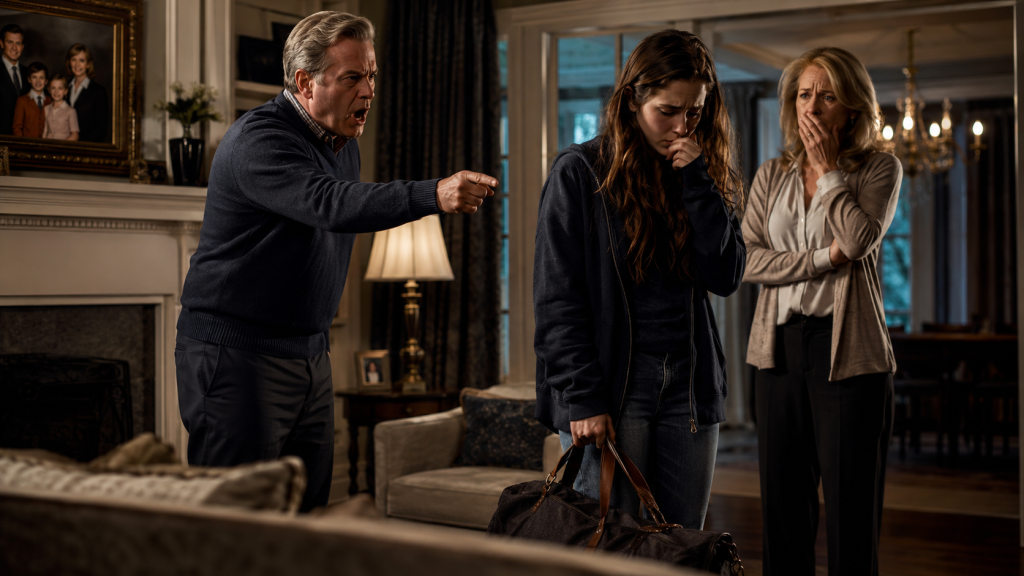
We were sitting in the living room of our modest Ohio home, the same room where I had opened Christmas gifts, watched cartoons, cried over school dances, and listened to my father say that family was the only thing a person could count on. My hands shook as I held the positive pregnancy test between my fingers. My mother stared at it as if it were something poisonous. My father slowly leaned forward in his recliner. His face did not look angry at first. It looked blank. That frightened me more.
“Who’s the father?” he asked.
I swallowed.
“I can’t tell you.”
The silence that followed was the kind that makes your ears ring.
My mother’s eyes narrowed. “What do you mean you can’t tell us?”
“It’s complicated,” I whispered.
“Complicated?” she snapped. “Emma, you are nineteen. Pregnant. Living under our roof. Nothing about this gets to be complicated.”
My father stood up.
“Is he married?”
“No.”
“Is he older?”
“No.”
“Did he force you?”
“No,” I said quickly. “No. It wasn’t like that.”
“Then say his name.”
I looked down at the test in my hand.
I wanted to tell them.
God help me, I wanted to tell them everything.
I wanted to say his name out loud and let the truth finally breathe in that room.
But I had promised.
Not because he was ashamed of me.
Not because I was ashamed of him.
Because the truth was tied to something much bigger than my fear.
And once it came out, there would be no taking it back.
“I can’t,” I said again. “But I can’t end this pregnancy. I can’t. And if I do, it won’t just affect me. It’ll affect all of us.”
The second those words came out, everything exploded.
My father’s recliner slammed against the wall when he jumped to his feet.
“Don’t you dare play games with us!”
“I’m not playing games.”
“You walk in here pregnant, refuse to tell us who did it, and then act like this baby is some gift we’re supposed to protect?”
My mother started crying.
Not soft crying.
Angry crying.
The kind that made me feel guilty before I even understood what I had done wrong.
“Emma,” she said, “you have your whole life ahead of you. College. A career. A future. You can’t throw it all away.”
“I’m not throwing anything away.”
“You are,” my father said. “And you’re doing it under my roof.”
“Dad, please. I can’t explain right now, but one day you’ll understand.”
His face turned cold.
“As long as you live in this house, you follow my rules. Either you get rid of that baby, or you get out.”
My breath caught.
“Dad.”
“Choose.”
My mother whispered his name, but she did not stop him.
That was the moment I understood something I had been too young to see before.
Sometimes one parent throws you out.
And the other opens the door by staying silent.
“I’m keeping my baby,” I said.
My father pointed toward the hallway.
“Then pack.”
Within an hour, I was standing on the front porch with one duffel bag, forty-three dollars in my wallet, and nowhere to go.
My mother stood behind the screen door crying.
I looked at her, waiting.
Waiting for her to say, “Come back inside.”
Waiting for her to say, “We’ll figure it out.”
Waiting for her to choose me.
She only pressed her hand against her mouth.
The porch light buzzed above me.
My father shut the door.
Just like that, I was nineteen, pregnant, homeless, and completely alone.
I left Ohio three days later.
A girl from community college let me sleep on her couch for a week.
Then an older woman from the diner where I worked gave me the number of a cousin in Kentucky who rented a room cheap.
I changed my phone number.
Not because I wanted to hurt my parents.
Because I knew if my mother called crying, I might crawl back.
And I could not crawl back.
Not after what I knew.
Not after the promise I had made beside a hospital bed.
His name was Caleb.
That was the name I could not say.
Caleb Morgan.
He was twenty-one, quiet, gentle, and the first person who ever made me feel seen instead of managed.
We had met at the library where I worked part-time.
He came in every Tuesday with medical textbooks and black coffee.
At first, I thought he was a student.
Later, I learned he was studying because he had been sick most of his life, and when doctors talked to him, he liked to understand every word.
Caleb had a heart condition.
A serious one.
He joked about it because he hated pity.
He said things like, “My heart is dramatic, not broken.”
But I knew better.
Some days, he had to stop halfway up the library stairs and pretend to check his phone while he caught his breath.
Some nights, he called me from the hospital and said, “Tell me something normal.”
So I told him about customers at the diner.
About my mother burning biscuits.
About my father yelling at baseball games.
About how I wanted to become a teacher.
He told me about his childhood.
About foster homes.
About never knowing who his biological family was.
About the adoption records he was trying to open.
Then, one night, everything changed.
Caleb called me from the hospital and asked me to come.
When I arrived, he was pale, but his eyes were bright.
“I found them,” he whispered.
“Found who?”
“My biological parents.”
He handed me a folded paper.
I opened it.
At first, the names meant nothing.
Then I saw the address.
My address.
My parents’ address.
I thought I had read it wrong.
“Caleb,” I whispered, “what is this?”
His voice shook.
“Emma, I think your parents had a son before you.”
The room spun.
I sat down hard in the chair beside his bed.
I knew my parents had married young.
I knew there were years they didn’t talk about.
I knew my mother sometimes cried on my birthday for reasons she never explained.
But a son?
A baby?
Caleb looked terrified.
“I didn’t know,” he said. “I swear I didn’t know until today.”
I believed him.
Of course I believed him.
But the truth felt impossible.
We had fallen in love before either of us knew.
And now the paper between us had turned our love into something the world would never understand.
The next morning, more testing proved the first file was wrong.
Caleb was not my brother.
Not biologically.
He had been placed under my parents’ names by mistake because another couple with a similar last name had surrendered him through the same agency.
But the confusion uncovered something else.
Something my parents had buried for twenty years.
They had lost a baby boy before I was born.
A baby named Samuel.
My mother had never recovered from it.
My father had blamed himself.
And somewhere in that mess of sealed records, Caleb’s search had brushed against their grief.
He made me promise not to tell them yet.
“Not like this,” he said. “Not while I’m in a hospital bed. Not while there are still missing pages. Let me get the full file. Then we’ll go together. I’ll explain everything.”
But we never got that chance.
Three weeks later, Caleb died during surgery.
I found out I was pregnant six days after his funeral.
I was still carrying the photo he had given me.
A photo of him as a little boy, standing outside a foster home with a crooked smile and serious eyes.
The same eyes my son would later have.
When my father demanded the name, I could not say Caleb.
Not because he was dangerous.
Not because I was ashamed.
Because if I said his name, the entire buried story would come with it.
The adoption records.
The mistaken file.
The dead son my parents never told me about.
The possibility that Caleb had almost become part of their grief before he became mine.
And I was nineteen.
Alone.
Pregnant.
Standing in front of two people already full of rage.
I thought I was protecting everyone from a truth too heavy to survive.
So I left.
And I kept my baby.
His name was Leo Caleb Morgan.
The next ten years were the hardest years of my life.
I worked breakfast shifts at a diner, evening shifts at a grocery store, and took classes whenever I could afford them.
I learned how to stretch soup for three days.
I learned which bills could wait one week and which could not.
I learned to study with a sleeping baby on my chest and a textbook propped against a laundry basket.
There were days I cried in the shower because Leo had a fever and rent was due and I had twelve dollars left until Friday.
But every time I looked at him, I remembered Caleb’s hand in mine.
I remembered him whispering, “If I ever get a family, I’ll never waste them.”
So I did not waste mine.
Leo grew into a bright, kind, watchful boy.
He noticed everything.
When I was tired, he brought me water.
When I cried, he pretended not to see, then quietly sat closer.
By the time he was ten, he had Caleb’s eyes, Caleb’s thoughtful silence, and my stubborn chin.
He also had questions.
“Why don’t we visit Grandma and Grandpa?”
I always said, “It’s complicated.”
I hated myself every time.
Then, on his tenth birthday, after cake and a small pile of gifts, Leo sat beside me on the couch.
“Mom,” he said, “can I meet them just once?”
I looked at him.
There was no anger in his face.
Only curiosity.
Only longing.
And I realized my parents had already taken ten years from him.
I would not give them another one by letting fear decide for me.
So we packed an overnight bag.
I put Caleb’s photo in my purse.
Then we drove eight hours back to Ohio.
The house looked smaller than I remembered.
The porch had been repainted.
The maple tree in the yard was taller.
But the front steps were the same.
Those were the steps where my old life had ended.
Leo reached for my hand.
“You okay, Mom?”
I squeezed his fingers.
“I’m trying to be.”
Then I knocked.
A few seconds later, the door opened.
My father stood there.
Older.
Thinner.
His hair almost completely gray.
For one long second, he stared at me as if he was seeing a ghost.
“Emma?”
My mother appeared behind him.
Then her eyes landed on Leo.
She gasped.
Nobody spoke.
Ten years of silence stood between us.
Finally, I took a deep breath.
“I need to tell you the truth,” I said.
My father’s expression tightened.
“The truth about Leo.”
My mother’s hand flew to her mouth.
“And the real reason I couldn’t get rid of him.”
Their eyes locked on my son.
Then, for the first time since I had arrived, their hands started shaking.
My father stepped back from the door, but he did not invite us in.
His eyes stayed fixed on Leo like he was trying to solve a puzzle his heart already feared.
“Emma,” my mother whispered, “what are you talking about?”
Leo moved closer to me and held my hand.
I looked down at him, then back at the two people who had thrown me out with nothing but a duffel bag and shame.
“Before I tell you,” I said, “you need to promise me you won’t interrupt.”
My father’s jaw tightened.
“After ten years, you don’t get to give orders in my house.”
I almost laughed because that was exactly the same voice that had sent me into the cold.
But Leo looked up and said softly, “Grandpa, please.”
The word hit my father like a slap.
His face changed.
My mother started crying before I had said another word.
I reached into my purse and pulled out Caleb’s old photo, folded and worn from years of hiding.
“This,” I said, placing it in my father’s shaking hand, “is why I couldn’t tell you who Leo’s father was.”
My mother looked at the photo.
Then she screamed.
Not because she recognized Caleb.
Because she recognized the background.
The blue porch.
The white railing.
The little swing.
“That’s Saint Agnes,” she whispered. “The children’s home.”
My father’s lips parted.
My mother backed into the wall, shaking her head.
“No. No, Emma, where did you get this?”
“From Caleb,” I said. “Leo’s father.”
My father gripped the photo so tightly it bent.
“Caleb Morgan?”
The way he said the name told me something I had not known.
He knew it.
My mother covered her face.
“Oh God.”
I stared at them.
“You knew him?”
My father sank into the nearest chair.
His voice was barely sound.
“Samuel.”
The name landed between us like a stone.
My mother sobbed.
“I wanted to tell you,” she cried. “I wanted to tell you so many times.”
My father looked at the photo, then at Leo.
“When your mother and I were very young,” he said slowly, “we had a baby boy before you. Samuel. He was born sick. We were poor. Scared. The doctors said he might not survive. My parents pressured us. Hers too. They said adoption would give him a better chance.”
My mother whispered, “I signed the papers while I was still bleeding.”
My chest tightened.
My father continued, voice breaking.
“We regretted it every day. We tried to find him later. The agency said the records were sealed. Then they told us he had died as an infant.”
I looked at Caleb’s photo.
“That wasn’t true.”
“No,” my father said. “It wasn’t. Years later, a man called us. Said there had been a records mistake. Said Samuel may have lived under another name.”
My mother sobbed harder.
“We were afraid,” she said. “Your father was afraid to open that door. Afraid to find out we had abandoned a child who survived.”
My father closed his eyes.
“So we did nothing.”
The room went silent.
I could barely breathe.
“Caleb found those records,” I said. “He found your names. Then he found the correction. He wasn’t my brother. He was connected to Samuel’s file because of a mistake. But he knew there was a lost child in our family. He wanted to help find him. He wanted to come here with me.”
My mother looked at Leo again.
“And then?”
“He died,” I said.
Her hand flew to her mouth.
“And six days later, I found out I was pregnant.”
My father’s eyes filled.
I stepped closer.
“When I told you we would all regret it, I meant this. Caleb was the only person who knew the truth about Samuel’s records. He left me copies. And Leo is the only child he ever had.”
My father looked at my son as if seeing him for the first time.
Leo stood quietly beside me, too young to understand every piece, but old enough to feel the room breaking open.
Then I said the sentence I had carried for ten years.
“Leo is not the mistake you thought he was. He is the reason I found the son you lost.”
My mother collapsed into a chair.
My father began to cry.
Not proud tears.
Not quiet tears.
The kind that shake a person from the inside out.
I had never seen him cry like that.
Not once in my whole life.
Two weeks later, a private investigator confirmed what Caleb had started.
Samuel had lived.
He had grown up under another name.
He had died at thirty-eight from heart failure, the same condition Caleb had, leaving behind a daughter in Michigan.
My parents had a granddaughter they had never met.
And if I had ended my pregnancy, if I had thrown away Caleb’s papers, if I had believed my father’s anger more than my own heart, that truth might have stayed buried forever.
My parents asked for forgiveness.
Not once.
Many times.
My mother held my hands and sobbed into them.
My father stood on the porch where he had once banished me and said, “I was wrong. I was cruel. I chose pride over my daughter.”
I wanted those words to fix everything.
They did not.
Ten years cannot be undone by one apology.
A child cannot grow up without grandparents and suddenly get those birthdays back.
A nineteen-year-old girl cannot be made un-homeless.
But truth does something strange.
It does not erase the wound.
It cleans it enough for healing to begin.
Leo met them slowly.
One dinner.
Then one weekend.
Then phone calls.
My father taught him how to fish.
My mother cried the first time Leo called her Grandma without thinking.
As for me, I learned that forgiveness is not a door you kick open.
It is a path you walk carefully, one honest step at a time.
Sometimes I still remember that porch.
The duffel bag.
The sound of the door closing.
But now I also remember another day.
The same porch.
My son’s hand in mine.
My father whispering, “Come inside.”
And my mother touching Leo’s face like she was afraid he might disappear.
For ten years, they thought I had ruined my life.
But I had not ruined it.
I had protected the one life that led all of us back to the truth.
My son did not just change everything.
He brought home the family secret everyone else had been too afraid to face.
THE END! THANKS FOR WATCHING!