

When my fifteen-year-old daughter, Lucy, came home with red, puffy eyes, I knew something was wrong. She had spent the week babysitting for our neighbor, Mrs. Carpenter, who had promised her eleven dollars an hour. Lucy had been excited about it. It was her first real job, or at least the first one that felt real to her. She had written the hours in her little blue notebook. Monday through Friday.
Four hours a day.
Sometimes five, if Mrs. Carpenter came home late.
She was saving for a used laptop because the one she had for school froze every time she opened more than two tabs.
All week, she had walked across the street with a backpack full of homework, snacks, and the CPR card she was proud of earning at the community center.
And all week, I had watched her come home tired but happy.
Until Friday.
That evening, she opened the front door, stepped inside, and stood in the hallway like she did not know where to go.
Her eyes were swollen.
Her cheeks were blotchy.
The straps of her backpack hung loose from one shoulder.
“What happened, Lucy?” I asked.
She tried to shake her head, but her chin trembled.
“Mrs. Carpenter… she didn’t pay me.”
For one second, I thought I had misheard.
“What do you mean she didn’t pay you?”
Lucy wiped her face with the sleeve of her hoodie.
“She said it was a life lesson.”
My heart changed shape in my chest.
“A life lesson?”
Lucy nodded, staring at the floor.
“She said I should get things in writing and never trust someone’s word. Then she slammed the door in my face.”
I stood very still.
“What exactly did she say?”
Lucy swallowed hard.
“She said hard work was payment enough. She said I was lucky she trusted me with her kids, and that I should be grateful for the experience.”
My fury boiled so fast I had to turn away from my daughter, because I did not want her to think anger was aimed at her.
Lucy was a gentle girl.
Too gentle sometimes.
She apologized to chairs when she bumped into them.
She thanked cashiers twice.
She carried extra pencils because someone in class might forget one.
And Mrs. Carpenter, a grown woman with a perfect lawn and a white SUV, had looked at that child and decided kindness made her easy to cheat.
“How much does she owe you?” I asked.
Lucy opened the blue notebook with shaking hands.
“Two hundred and twenty dollars.”
I went to my desk drawer, took out my emergency cash envelope, and counted the money into her palm.
Her eyes filled again.
“Mom, no. You don’t have to.”
“Yes,” I said. “I do.”
“But she owes it.”
“And she will pay it.”
Lucy looked up at me.
I placed the bills in her hand and closed her fingers around them.
“This is not because she got away with it,” I told her. “This is because you did the work, and you deserve to be paid for it today.”
She started crying then.
Not loud.
Just tired, hurt tears.
I pulled her into my arms and held her in the hallway while her backpack slid to the floor.
Over her shoulder, through the front window, I could see Mrs. Carpenter’s house.
White porch.
Black shutters.
Hanging baskets.
The kind of house that made people assume decency lived inside.
But I had learned long ago that cruelty often keeps a beautiful lawn.
That night, after Lucy went to bed, I sat at the kitchen table with her blue notebook.
She had written everything.
Monday, 3:30 to 8:00.
Tuesday, 3:30 to 7:30.
Wednesday, 3:30 to 8:30.
Thursday, 3:30 to 7:30.
Friday, 3:30 to 6:30.
Beside each day, she had written little details.
Made dinner.
Helped Ben with spelling words.
Gave Sophie bath.
Cleaned juice spill.
Mrs. C late again.
My daughter had not just watched children.
She had fed them, comforted them, helped them with homework, cleaned up after them, and kept them safe.
I opened Lucy’s phone with her permission and found the messages.
Mrs. Carpenter had texted the rate.
Eleven an hour.
She had texted the schedule.
She had texted, “I’ll pay you Friday when I get home.”
There it was.
In writing.
The life lesson had already been written.
Just not the one Mrs. Carpenter expected.
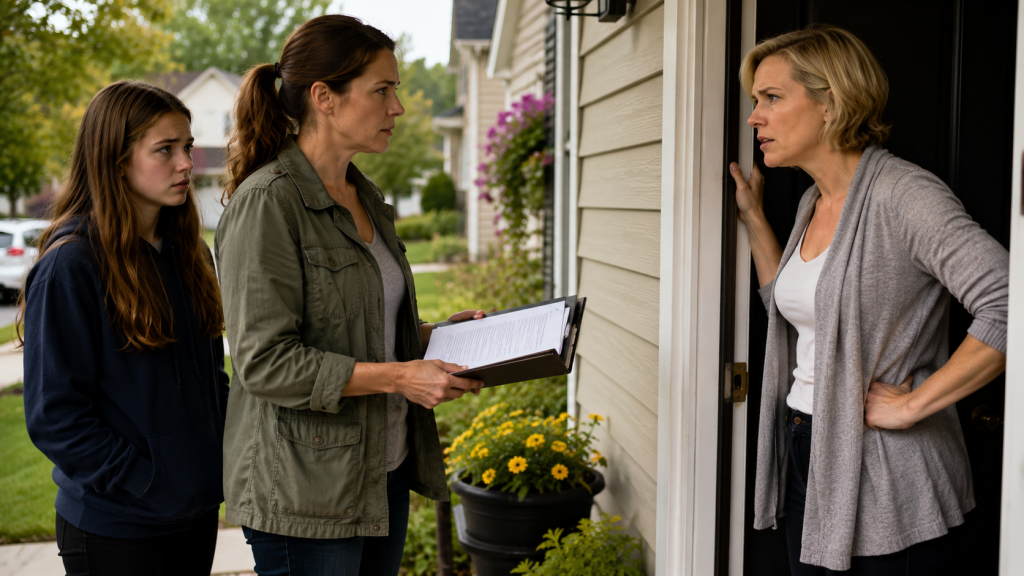
The next morning, I did not knock on Mrs. Carpenter’s door angry.
I went calm.
That was worse.
I carried a small folder in one hand and my phone in the other.
Lucy stood behind me on the sidewalk, nervous, but I told her, “Today you’re going to learn a different lesson.”
Mrs. Carpenter opened the door wearing a silk robe and that smug little smile people use when they think money makes them untouchable.
“Oh,” she said. “Are you here about the babysitting money?”
“Yes,” I said. “Two hundred and twenty dollars.”
She leaned against the doorframe.
“I already explained this to Lucy. She needs to learn how the world works.”
I looked at my daughter.
Her face was pale, but she stood straight.
Then I turned back to Mrs. Carpenter.
“You’re right,” I said. “She does.”
Mrs. Carpenter’s smile widened.
That was when I opened the folder.
“Here are the text messages where you offered eleven dollars an hour. Here are the dates and times you confirmed. Here is your message saying, ‘I’ll pay you Friday.’ And here is Lucy’s written record of every hour she worked.”
Mrs. Carpenter’s smile disappeared slowly, like a light being dimmed.
I held up my phone.
“And because Lucy is fifteen, refusing to pay her after she worked all week is not a life lesson. It is wage theft.”
Her eyes narrowed.
“You’re being dramatic.”
“No,” I said. “I’m being organized.”
She crossed her arms.
“You wouldn’t really make this ugly over two hundred dollars.”
I smiled.
“You made it ugly when you stole from a child.”
Her face hardened.
“I did not steal. I taught her not to be naïve.”
Behind me, Lucy whispered, “Mom…”
I did not look away from Mrs. Carpenter.
“Lucy, listen carefully. When someone hurts you and then calls it education, they are not teaching you. They are testing whether you will stay quiet.”
Mrs. Carpenter laughed under her breath.
“You people are unbelievable.”
That phrase.
You people.
Quiet.
Sharp.
Ugly.
I felt Lucy stiffen behind me.
I took one breath.
Then another.
Because now I understood Mrs. Carpenter had not only cheated my daughter.
She had enjoyed making her feel small.
I looked past her into the spotless hallway.
“Are your children home?”
Her face flickered.
“That is none of your business.”
“It is, actually. Because while you were gone this week, Lucy was responsible for them. And since you refuse to pay her, I thought the other parents should know how you treat minors who work in your home.”
Her eyes shifted.
“What other parents?”
I stepped aside.
Three cars pulled up along the curb.
First came Marsha Reynolds from the end of the street.
Then Mr. Ortiz, whose daughter Sophie was in the same dance class as Mrs. Carpenter’s little girl.
Then Elaine Brooks, who chaired half the PTA and somehow knew everyone’s business before lunch.
Mrs. Carpenter’s mouth opened.
“What did you do?”
“I told them the truth,” I said. “That you hired my daughter, promised payment, let her care for your children all week, then refused to pay her.”
Marsha walked up first.
Her face was tight.
“My son was here Tuesday evening,” she said. “You told me your niece was helping.”
Mrs. Carpenter flushed.
“Lucy is practically family.”
“No,” Lucy said suddenly.
Everyone turned to her.
Her voice shook, but she kept going.
“I’m not family. I was working.”
For the first time since we arrived, Mrs. Carpenter looked uncertain.
Elaine stepped forward.
“Janet, did you or did you not promise this girl eleven dollars an hour?”
Mrs. Carpenter’s lips pressed together.
“It was informal.”
I held up the printed messages.
“It was written.”
Mr. Ortiz looked at me.
“How much?”
“Two hundred and twenty dollars.”
He stared at Mrs. Carpenter.
“You refused to pay a child two hundred and twenty dollars?”
“She’s not a child,” Mrs. Carpenter snapped. “She’s old enough to babysit.”
“But too young to be paid?” he asked.
The silence after that was beautiful.
Not peaceful.
Beautiful.
Because for once, Mrs. Carpenter was standing in the exact discomfort she had tried to hand my daughter.
Her porch had become the classroom.
And everyone was watching the lesson.
She lowered her voice.
“Can we discuss this privately?”
“No,” I said.
She glared at me.
“You are humiliating me.”
I tilted my head.
“Interesting. When you made my daughter cry on your porch, you called it a life lesson. But when people see what you did, suddenly it is humiliation.”
Marsha crossed her arms.
“I want to know who watched my son.”
“Lucy did,” Mrs. Carpenter muttered.
“And did she do a good job?”
Mrs. Carpenter looked trapped.
“Yes.”
“Was anything damaged?”
“No.”
“Were the children safe?”
“Yes.”
“Then pay her.”
Mrs. Carpenter looked around at the neighbors, then into the street, where two more curtains had moved in nearby windows.
The whole neighborhood was starting to notice.
That was the thing about people like Mrs. Carpenter.
They do not fear doing wrong.
They fear being seen doing wrong.
She disappeared inside and came back with a check.
I looked at it and almost laughed.
Two hundred and twenty dollars exactly.
I did not take it.
“Cash,” I said.
Her eyes widened.
“Excuse me?”
“Cash. You had no problem slamming the door in her face. I don’t trust your check.”
Mr. Ortiz made a sound that might have been a cough, but looked a lot like a smile.
Mrs. Carpenter’s hand trembled.
She went back inside.
This time she returned with an envelope.
She shoved it toward me.
I stepped back.
“Not to me.”
Lucy looked at me, startled.
I nodded toward Mrs. Carpenter.
“She earned it. You pay her.”
Mrs. Carpenter held the envelope out.
Lucy did not move at first.
Then she stepped forward.
Mrs. Carpenter said nothing.
I cleared my throat.
Her eyes snapped to mine.
“What?”
“You forgot the words.”
Her face turned red.
Elaine raised her eyebrows.
Mrs. Carpenter looked at Lucy.
“I’m sorry,” she said through tight lips.
“For what?” I asked.
She looked like she could have bitten glass.
“I’m sorry I didn’t pay you.”
Lucy held the envelope against her chest.
“And?” I said.
Mrs. Carpenter’s eyes burned.
“I’m sorry I slammed the door in your face.”
Lucy nodded once.
Not because it was enough.
Because she did not owe that woman another second of her peace.
We turned to leave, but Mrs. Carpenter called after me.
“You’ve ruined my reputation over a misunderstanding.”
I stopped.
Slowly, I turned around.
“No, Janet. Your reputation was never mine to ruin. I only introduced it to your behavior.”
For a long second, nobody spoke.
Then Marsha said quietly, “Well, I’ll be finding another sitter.”
“So will I,” Mr. Ortiz said.
Elaine gave Mrs. Carpenter one last disappointed look.
“I’ll be mentioning this at the PTA meeting. Parents should know who they trust.”
Mrs. Carpenter’s face went white.
That afternoon, Lucy sat at our kitchen table and counted the money twice.
Her hands were steady now.
I made tea.
She looked up at me after a while.
“Mom?”
“Yes?”
“Was that wrong? Telling everyone?”
I sat across from her.
“No.”
“But she looked embarrassed.”
“She should be embarrassed.”
Lucy stared at the envelope.
“I hated how it felt when she said I should have known better.”
I reached across the table and touched her hand.
“You did nothing wrong by trusting someone. She did something wrong by abusing that trust.”
Lucy’s eyes filled again, but this time she did not cry.
“She said the world works like that.”
“Sometimes it does,” I said. “But that does not mean we help it stay that way.”
A week later, Mrs. Carpenter posted a long message in the neighborhood group about forgiveness, private matters, and how society had lost kindness.
Nobody responded for an hour.
Then Marsha commented:
“Paying teenagers for work is kindness.”
Mr. Ortiz added:
“So is honesty.”
Elaine simply wrote:
“Accountability is not cruelty.”
The post disappeared ten minutes later.
By then, the damage was done.
Not to Mrs. Carpenter’s life.
To her illusion.
People still waved at her sometimes, but the easy trust was gone.
No one sent their children to her house.
No one asked her to collect mail during vacations.
At the next block party, she stood near the lemonade table pretending not to notice when conversations moved away from her.
Lucy saw it too.
She was quiet for a moment, then said, “I almost feel bad.”
“That means your heart works,” I told her. “But feeling bad does not mean she was right.”
Over the next few months, Lucy started babysitting for other families.
Real agreements.
Written hours.
Payment before parents left or immediately when they returned.
She made a simple form and kept copies in a folder.
Parents smiled when she handed it to them.
Some even looked impressed.
Lucy became known as the responsible sitter.
The organized one.
The one who arrived early, knew allergies, wrote down emergency numbers, and expected to be paid fairly.
By spring, she had enough money for her laptop.
She bought it herself.
When the box arrived, she carried it into the kitchen like it was made of gold.
I watched her open it, and I thought about that first night.
The red eyes.
The trembling hands.
The way she had whispered, “She didn’t pay me,” like she was ashamed.
Mrs. Carpenter had wanted to teach my daughter a lesson.
She did.
Just not the one she intended.
Lucy learned that kindness does not mean silence.
She learned that trust should be honored, not mocked.
She learned that when someone tries to make you feel foolish for believing them, the shame belongs to the liar.
And I learned something too.
As mothers, we cannot protect our children from every cruel person waiting behind a pretty front door.
But when someone tries to break them, we can stand beside them so they see exactly what strength looks like.
Not screaming.
Not begging.
Not revenge for the sake of revenge.
Truth.
Evidence.
A steady voice.
And the courage to say, “No. You do not get to treat my child that way.”
Years later, Lucy still keeps that blue notebook in her desk drawer.
The pages are bent now.
The ink has faded.
But on the last page, under that awful Friday, she wrote one sentence in purple pen.
“Hard work is not payment. Payment is payment.”
I smiled the first time I saw it.
Because Mrs. Carpenter had been right about one thing.
My daughter did learn how the world works.
But more importantly, she learned how to make it answer when it works wrong.
THE END! THANKS FOR WATCHING!