

I gave birth to my daughter alone on a gray Thursday afternoon inside Oak Ridge Military Medical Center while fluorescent lights hummed endlessly overhead. My husband Caleb was stationed nearly a thousand miles away on a mandatory training assignment he had no permission to leave. So there was no dramatic family moment waiting for me in the delivery room.
No comforting hand to hold. No relatives gathered nearby. Just exhausted nurses rotating through shifts and fourteen brutal hours of labor before they finally placed my baby girl against my chest. I named her Hazel. For a few fragile minutes, everything felt peaceful.
I lay there staring at her tiny face while the noise of the hospital faded into the background, and for the first time in months, my mind finally felt quiet.
Then I reached for my phone.
There were messages from people in my unit, a brief congratulations from my commanding officer, and a shaky video from Caleb apologizing for not being there and telling me he loved me.
Then I opened the text from my mother.
“Penny’s kids want new phones for their birthdays. Send me $2,000 tonight before the sale ends.”
That was the entire message.
No congratulations.
No questions about the delivery or my recovery.
No acknowledgment that I had just brought a child into the world.
Just another demand wrapped in urgency.
I read the message twice, not because I misunderstood it, but because some part of me still hoped I had.
Unfortunately, it sounded exactly like every message my mother, Martha, had sent for years whenever my older sister Penny found herself drowning in another crisis.
There was always something.
Rent.
Car repairs.
School expenses.
Holiday gifts.
Broken appliances.
Overdue bills.
Penny had three children and endless emergencies, and somehow my bank account was always expected to absorb the damage.
I had been doing it since my first deployment bonus years earlier.
At the time, I convinced myself I was helping family survive difficult situations, but eventually I realized I was simply feeding a pattern everyone else had quietly accepted as normal.
Lying there in that hospital bed with stitches, trembling legs, and a newborn sleeping beside me, I felt something inside me change.
It was cold, sharp, and painfully clear.
For the first time, I didn’t answer.
I turned my phone facedown beside the bed and focused instead on Hazel’s tiny hand opening and closing against the blanket.
She had been alive less than a single day, and already I understood something with absolute certainty.
If I didn’t stop this cycle now, it would eventually become part of her life too.
I went home two days later and still said nothing.
The messages started escalating almost immediately.
First my mother asked whether I saw her text.
Then Penny messaged saying the kids were “counting on me.”
After that came the guilt layered carefully into the same phrases I had heard my entire adult life.
Don’t punish children because you’re stressed.
Family shows up for each other.
After everything we’ve been through, this is who you’ve become?
I ignored every single message.
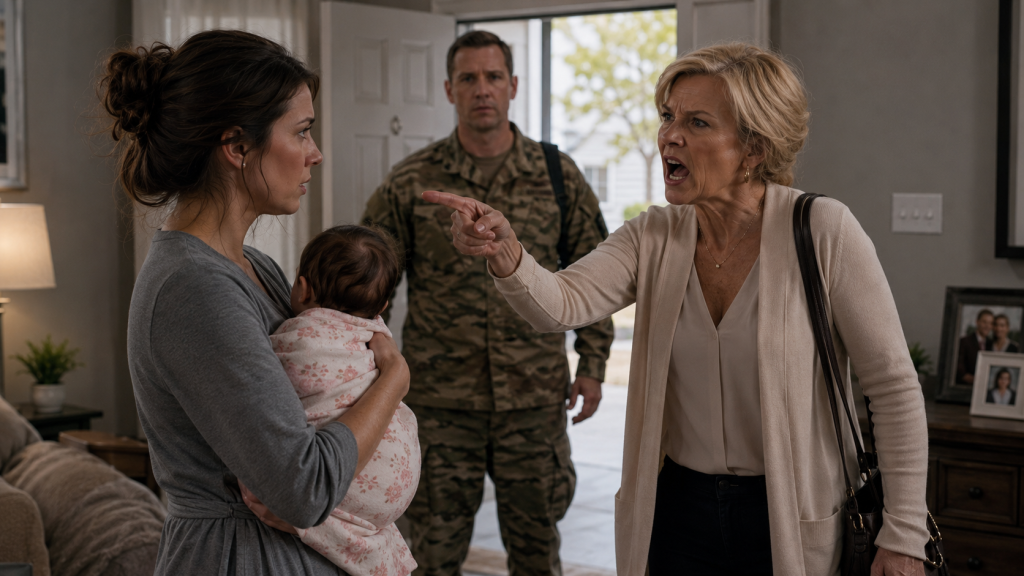
One week after Hazel was born, I was standing in the living room exhausted, sore, and surviving on almost no sleep when my front door suddenly burst open without warning.
My mother still had the spare key.
She stormed inside without knocking, her purse hanging from one shoulder like she had just walked out of a courtroom argument halfway through.
She never asked about Hazel.
She never asked how I was healing.
Instead, she pointed directly at me and demanded, “What is wrong with you?”
Hazel startled awake in her bassinet and immediately began crying.
And in that moment, something inside me finally snapped.
I didn’t scream back.
That seemed to surprise both of us.
Before my mother could move closer, I picked Hazel up and held her protectively against my chest.
Then I calmly told Martha she needed to lower her voice or leave my house immediately.
She stared at me as though I had crossed a line she genuinely believed did not exist.
Then she launched into the same speech she had repeated throughout my entire adult life.
Penny was overwhelmed.
The children were disappointed.
I had stability, a career, and reliable income, which meant I had a responsibility to help everyone else survive.
She said all of that while I was still physically recovering from childbirth, still bleeding, and still learning how to function while caring for a newborn.
When I told her I would not be sending the money, not now and not later, her expression hardened instantly.
She called me cold.
She said the military had changed me.
She accused me of abandoning “real family” in favor of discipline, structure, and pride.
Then she stepped closer, lowered her voice, and looked directly at me.
“You really think your husband is going to protect you from us?”
I looked at my mother for a long moment before answering.
Hazel was still crying softly against my shoulder, and suddenly I realized something that should have been obvious years ago.
My mother wasn’t talking to me like a daughter who had just given birth.
She was talking to me like an ATM that had stopped working.
“No,” I said quietly. “I think I’m going to protect myself.”
She laughed.
Actually laughed.
Then she said the one thing that changed everything.
“After everything we sacrificed for you, you owe this family.”
The room went silent.
Because for the first time in my life, I wasn’t willing to pretend anymore.
“Sacrificed?” I asked. “You mean when Dad used my college fund to pay Penny’s credit cards? Or when my deployment bonus paid her rent? Or when my reenlistment bonus bought her SUV?”
My mother’s face went white.
She never expected me to say those things out loud.
Then I walked to the hallway closet, pulled out a thick binder, and dropped it onto the kitchen table.
Every transfer.
Every loan.
Every payment.
Twelve years of receipts.
Nearly $187,000.
Penny had paid back exactly zero dollars.
My mother stared at the pages.
Then the front door opened.
Caleb stood there unexpectedly, still in uniform.
His training had ended early.
He took one look at my face, one look at Hazel, and one look at the binder.
Then he calmly asked, “Martha, would you like to explain why my wife has financed your other daughter’s entire adult life?”
My mother turned toward him, stunned.
“Caleb, this is family business.”
“No,” he said, stepping inside and closing the door behind him. “This is my wife’s recovery. This is my daughter’s home. And you just barged into both.”
Martha’s mouth tightened.
“You don’t understand our family.”
Caleb’s eyes moved to me.
“I understand enough.”
For years, I had been the strong one.
The dependable one.
The one who didn’t need help.
The one who never broke down because everyone else was already falling apart.
But in that moment, with Hazel warm against my chest and Caleb standing between me and the woman who had trained me to feel guilty for breathing, I almost collapsed from relief.
My mother pointed at the binder.
“You kept records?”
“Yes,” I said.
Her face twisted.
“As if we were criminals?”
“No,” I replied. “As if one day I might need to remember the truth.”
That landed harder than shouting.
Martha looked away first.
Then my phone began ringing.
Penny.
Of course.
My mother reached toward it.
“Answer her.”
I didn’t move.
“Answer her,” she repeated. “She deserves to know why you’re doing this.”
I looked down at Hazel, whose crying had softened into tiny hiccups.
“No,” I said. “I’m done explaining why I’m allowed to keep my own money.”
Martha’s face flushed red.
“You selfish little—”
Caleb’s voice cut through the room.
“Careful.”
It was not loud.
It did not need to be.
My mother stared at him, then at me, as if realizing for the first time that the old rules were gone.
“You’re choosing him over us,” she said.
I almost laughed.
Because that was how she always framed it.
Choice.
Loyalty.
Betrayal.
Never boundaries.
Never respect.
Never accountability.
“I’m choosing Hazel,” I said.
My mother’s expression flickered.
For one second, I thought maybe the sight of her newborn granddaughter might soften her.
But Martha barely looked at the baby.
“You’re being dramatic.”
There it was again.
The family word for pain they didn’t want to respect.
Dramatic.
I walked to the door and opened it.
“Leave.”
Her eyebrows lifted.
“You don’t mean that.”
“I do.”
“This is my daughter’s house.”
“No,” Caleb said. “It’s our house.”
Martha stood frozen, gripping her purse.
Then she lowered her voice.
“You’ll regret this when you need family.”
I looked at her.
“I needed family last week when I gave birth alone.”
She said nothing.
“I needed family when Caleb was gone and I was scared. I needed family when I could barely walk from the hospital bed to the bathroom. I needed family when I was crying at three in the morning because Hazel wouldn’t latch and I thought I was failing her.”
My voice shook, but I kept going.
“And you know what you sent me? A bill.”
For the first time, something like shame crossed her face.
But it disappeared quickly.
Martha was too practiced at turning shame into anger.
She walked toward the door.
“This isn’t over.”
“Yes,” I said. “It is.”
Caleb reached into the drawer by the entryway, removed the spare key she had used, and held it out.
My mother stared at it.
“You’re taking my key?”
“I’m taking back access,” I said.
Her face hardened again.
She placed the key in Caleb’s hand like she was doing us a favor.
Then she left.
The door closed behind her.
And for a moment, the house was silent except for Hazel’s soft breathing.
I turned the deadbolt.
Then I leaned against the door and cried.
Not loudly.
Not dramatically.
Just silently, with Hazel held safely against me while Caleb wrapped his arms around both of us.
“I’m sorry I wasn’t here,” he whispered.
“You’re here now.”
That night, Caleb changed the locks.
The next morning, I changed my banking passwords, canceled every automatic transfer connected to Penny or my mother, and moved my savings into a new account.
Then I sent one message to the family group chat.
I will not be sending money anymore. Not for phones, rent, emergencies, holidays, repairs, birthdays, or bills. Do not come to my home without permission. Do not contact me with demands. I am recovering and taking care of my daughter.
Penny replied within two minutes.
Wow. Motherhood made you cruel fast.
I stared at the message for a long time.
Then I blocked her.
Not because I hated her.
Because I finally loved myself enough to stop arguing with people committed to misunderstanding me.
The fallout was immediate.
Aunts called.
Cousins texted.
My mother told everyone I had “changed” and that Caleb was controlling me.
Penny posted vague things online about family betrayal and people who forget where they came from.
I did not respond.
For once, silence belonged to me.
Not the scared silence of swallowing my feelings.
The peaceful silence of refusing to perform.
A month later, my father came to visit alone.
He and my mother had divorced when I was fourteen, but he had always stayed on the edges of family conflict.
Sending birthday cards.
Calling sometimes.
Pretending he didn’t know how much I carried.
He stood on my porch holding a small pink blanket and looking ashamed.
“I should have stepped in years ago,” he said before I could speak.
I didn’t rush to comfort him.
The old me would have.
The new me waited.
He swallowed.
“I knew your mother leaned on you too much. I told myself you were strong. I told myself you could handle it.”
“I could handle it,” I said. “That was the problem.”
His eyes filled.
“Can I meet my granddaughter?”
I studied him for a moment.
Then I stepped aside.
He washed his hands twice before holding Hazel.
When I placed her in his arms, his face softened in a way I had not seen since I was a child.
“She looks like you,” he whispered.
I sat across from him, exhausted but steady.
“Dad, if you want to be in her life, it has to be different. No guilt. No using her. No pretending bad behavior is family tradition.”
He nodded immediately.
“I understand.”
“I mean it.”
“So do I.”
Maybe he did.
Maybe he didn’t.
But he kept showing up.
Quietly.
Respectfully.
With groceries.
With diapers.
With no demands attached.
Two months passed.
Then Penny showed up.
Unlike my mother, she knocked.
I watched her through the window for nearly a minute before opening the door.
She looked tired.
Not angry-tired.
Defeated-tired.
Her hair was pulled back messily, and she had no makeup on.
“Can we talk?” she asked.
“No money,” I said.
She looked down.
“I know.”
I almost closed the door.
Then she said, “Mom told me you had plenty. She said you liked helping because it made you feel important.”
That sentence hit me like a slap.
Of course Martha had said that.
Of course she had turned my sacrifice into ego.
Penny’s eyes filled.
“I believed her because it was easier than admitting I was using you.”
I didn’t say anything.
She took a breath.
“I’m not here to ask for anything. I’m here to say I’m sorry.”
I looked at my sister.
For years, I had imagined her apology.
I thought it would make me feel lighter.
Instead, it made me feel tired.
Because apologies do not return time.
They do not rebuild savings.
They do not undo nights spent choosing overtime because someone else had chosen irresponsibility.
“Thank you,” I said.
Her face crumpled a little, like she had expected more.
But I didn’t owe her more.
Not yet.
Maybe not ever.
She glanced toward the house.
“Can I see Hazel?”
“No.”
The word hurt her.
It hurt me too.
But I did not take it back.
“Not now,” I added. “Maybe one day, if things actually change.”
Penny nodded, crying quietly.
Then she left.
I closed the door and felt something unfamiliar.
Not victory.
Peace.
Small, fragile, but real.
Hazel grew fast.
The newborn nights turned into sleepy mornings.
Her tiny fists became curious hands.
Caleb learned to make ridiculous faces that always made her smile.
My body healed slowly.
My heart did too.
Some days, guilt still knocked.
But I no longer opened the door every time.
My mother tried once more.
She sent a long email about forgiveness, respect, and how I had humiliated her.
I deleted it after the first paragraph.
Then I changed my email filters.
Six months after Hazel was born, I sat on the living room floor watching her try to crawl toward a soft yellow toy.
Caleb was beside me, recording on his phone.
Hazel rocked forward, wobbled, and collapsed onto her belly with an offended little grunt.
We both laughed.
My phone buzzed with a message from my father.
Proud of you. Not for being strong. For finally letting yourself be loved properly.
I read it twice.
Then I looked around the room.
At Caleb.
At Hazel.
At the changed locks.
At the quiet.
At the binder still sitting on the shelf, not as a weapon, but as proof that I had survived a version of family that only knew how to take.
For so many years, I thought love meant giving until I disappeared.
But Hazel taught me the truth the moment she was placed in my arms.
Love is not supposed to empty you.
Love is supposed to make room for you to breathe.
That night, I stood beside Hazel’s crib after Caleb had gone to bed.
She slept with one hand curled near her cheek.
I whispered the promise I wished someone had made to me.
“You will never have to earn love by sacrificing yourself.”
Then I turned off the lamp.
For the first time in my life, I did not feel guilty for choosing peace.
I felt free.
THE END THANKS FOR READING!