

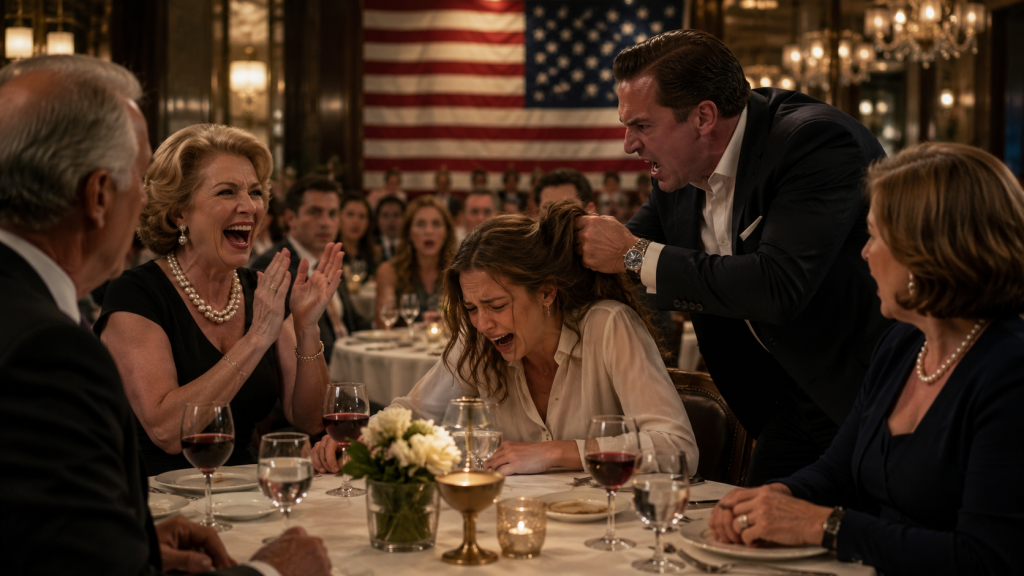
At a crowded restaurant, my son-in-law grabbed my daughter by the hair and humiliated her in front of everyone. Then his mother smiled and cheered, “That’s how it’s done! She needs to learn her place.” My daughter broke down in tears. And I stood up shaking with rage. The restaurant was called Marigold & Ash, the kind of place in Boston where the lights were soft, the wineglasses thin, and everyone spoke as if manners were printed on the menu.
My daughter, Emily Whitaker, sat across from me with her hands folded around a glass of untouched water.
She was twenty-eight, pretty in a tired way, with brown hair falling over one shoulder and a smile she had been forcing all night.
Beside her sat her husband, Brent Callahan, a broad-shouldered man with an expensive watch and a cruel little smirk that appeared whenever someone else spoke too long.
His mother, Diane Callahan, occupied the seat next to him like a queen on a throne.
Pearls at her throat.
Red lipstick sharp as a blade.
Eyes always measuring my daughter.
I had come to dinner because Emily asked me to.
“Please, Mom,” she had whispered over the phone. “Just be calm tonight. Brent wants both families to try again.”
Try again.
That phrase tasted bitter as I watched Brent interrupt her for the sixth time.
“She forgets things,” he told the table, laughing. “Bills, appointments, basic instructions. I swear, living with Emily is like managing a teenager.”
Emily’s face burned.
“That’s not true,” she said softly.
Brent turned his head slowly.
“Excuse me?”
The silence at the table tightened.
Emily swallowed.
“I said that’s not true. I handle the rent, the groceries, your dry cleaning, the insurance—”
Before she could finish, Brent’s hand shot out.
He grabbed her hair near the back of her head and yanked.
Emily cried out.
Her chair scraped the floor.
Several people turned.
A waiter froze beside a nearby table with a tray of plates balanced in both hands.
Brent leaned close to her ear, still holding her hair.
“Don’t embarrass me in public.”
For one second, the world became perfectly still.
Then Diane clapped.
She actually clapped.
“That’s how it’s done!” she said, smiling proudly. “She needs to learn her place.”
Emily’s eyes filled with tears.
She looked at me, not like a grown woman asking for help, but like the little girl who used to run into my arms after nightmares.
Something inside me went cold.
I stood up slowly.
Brent looked at me with lazy amusement.
“Sit down, Linda.”
I reached into my purse, took out my phone, and placed it on the table.
Then I said, loud enough for every person in that restaurant to hear, “Let go of my daughter, or the next voice you hear will be the police dispatcher listening to me report an assault in progress.”
Brent laughed.
“You wouldn’t dare.”
I tapped the screen.
“911, what is your emergency?”
The color drained from his face.
I looked him dead in the eye and said, “My son-in-law has just assaulted my daughter in a public restaurant. He is still touching her. We need police at Marigold & Ash on Hanover Street.”
The dispatcher stayed on the line as Brent instantly released Emily’s hair.
The entire restaurant had gone silent.
Forks stopped moving.
Conversations died mid-sentence.
Every eye in Marigold & Ash was fixed on our table.
Emily pulled away from him, trembling, one hand covering her mouth.
Brent tried to laugh, but the sound came out strained.
“This is ridiculous,” he said. “I barely touched her.”
“Several dozen witnesses just watched you grab her,” I replied.
Diane shot to her feet.
“You’re destroying this family over nothing!”
A woman at the next table stood up.
“Nothing? I saw him yank her hard enough to pull her out of her chair.”
Another voice joined in.
Then another.
Suddenly Brent was no longer the powerful man controlling the room.
He was a man surrounded by witnesses.
Emily stared at the strangers defending her and began to cry harder.
The years of fear were cracking.
Then the restaurant manager appeared beside us and calmly said, “Sir, security footage covers this entire dining room.”
Brent’s face went white.
Diane stopped talking.
And when flashing blue lights appeared through the front windows minutes later, Emily reached for my hand and whispered something I had waited years to hear.
“Mom… I’m ready to leave him.”
I squeezed her hand.
“Then we leave tonight.”
Brent heard her.
His face twisted.
“You’re not going anywhere.”
The officer who had just entered the restaurant turned toward him.
“Sir, step away from her.”
Brent opened his mouth, probably to argue.
Men like Brent always think their voice is a weapon.
But something about the uniform, the witnesses, and the security cameras made him swallow whatever insult had been waiting on his tongue.
Diane stepped forward instead.
“My son is an attorney,” she snapped. “You people need to be very careful.”
The officer looked at her calmly.
“Ma’am, please sit down.”
“I will not.”
“Then step aside.”
Diane stared at him as if no one had ever spoken to her that way before.
I guided Emily away from the table.
Her whole body was shaking.
When we reached the hallway near the restrooms, she nearly collapsed against the wall.
“I’m sorry,” she sobbed. “I’m so sorry.”
I put both hands on her face.
“Emily, listen to me. You did nothing wrong.”
Her breath came in short, broken pulls.
“I should have left before.”
“No,” I said firmly. “He should never have hurt you.”
She closed her eyes.
“I thought if I tried harder, he’d go back to how he was when we first met.”
That sentence broke my heart because I knew it was not only about Brent.
It was about every little piece of herself she had sacrificed trying to earn kindness from a man who used love like bait.
Behind us, one officer was speaking with the manager.
Another was taking statements from diners.
The woman from the next table came over and placed a business card in my hand.
“I’m a nurse,” she said softly. “I saw what happened. I’ll give a statement.”
A waiter stepped forward too.
“So will I.”
Then a younger man near the bar lifted his phone.
“I recorded part of it.”
Brent’s perfect public image was unraveling in real time.
For years, Emily had told me little things.
Brent didn’t like her going out with friends.
Brent checked her phone.
Brent said her clothes were embarrassing.
Brent handled their money because she was “bad with details.”
Every time, I asked if she was safe.
Every time, she smiled too quickly and said, “I’m fine, Mom.”
But mothers hear the words underneath the words.
That night, the truth finally had witnesses.
The police asked Emily if she wanted medical attention.
She hesitated.
I could see the old fear working in her mind.
Brent had trained her to minimize everything.
To apologize for pain.
To make excuses before anyone even accused her.
Then the woman from the next table stepped closer.
“Sweetheart,” she said gently, “let them check you.”
Emily looked at me.
I nodded.
“Okay,” she whispered.
Brent was not arrested that night, but the officer filed a report.
The manager saved the security footage.
The witnesses gave their names.
And I drove Emily home to pack a bag while two officers followed us to keep the peace.
Brent rode with Diane.
He kept calling Emily’s phone.
Over and over.
At first the messages were angry.
Then sweet.
Then threatening.
Then sorry.
Then angry again.
I watched Emily stare at the screen as if each message had a hook in it.
I took the phone gently from her hand.
“Not tonight.”
At the apartment, she moved like a ghost.
She packed clothes, medication, documents, and a small jewelry box from her grandmother.
In the bedroom, she opened a drawer and froze.
I looked inside.
There were old journals.
Receipts.
Printed emails.
A flash drive taped beneath the drawer organizer.
Emily whispered, “I started saving things last year.”
My throat tightened.
“You were planning to leave.”
She nodded.
“But every time I almost did, he knew exactly what to say.”
In the living room, Brent arrived with Diane.
The officers stopped them at the door.
“This is my home,” Brent snapped.
“And she has the right to collect her belongings,” one officer replied.
Diane looked past him at Emily.
“You are humiliating my son.”
Emily stood in the hallway with a suitcase in one hand.
For a moment, I thought she might shrink again.
Then she lifted her chin.
“No,” she said. “He humiliated himself.”
Diane’s eyes widened.
Brent’s face darkened.
But there were officers between them now.
That made all the difference.
Emily walked out of that apartment with two suitcases, a folder of documents, and tears running down her face.
When we reached my car, she looked back once.
Then she got in.
I drove her to my house.
The same house where she had learned to ride a bike.
The same house where she had once baked terrible birthday cakes with too much frosting.
The same house she had slowly stopped visiting because Brent always found a reason she needed to leave early.
That night, I made tea she barely drank.
She showered.
I changed the sheets in her old room.
Before bed, she stood in the doorway and whispered, “Can I lock the door?”
“Of course.”
Her eyes filled.
“He never let me.”
I wanted to scream.
Instead, I said, “You can lock every door in this house if it helps you sleep.”
She nodded.
At three in the morning, I heard her crying.
I sat on the floor outside her room until she opened the door.
Then she curled beside me like she was sixteen again.
“I feel stupid,” she whispered.
“You are not stupid.”
“I defended him.”
“You were surviving.”
“I lied to you.”
“You were afraid.”
“He made me think no one would believe me.”
I brushed her hair back from her face.
“Tonight, a whole restaurant believed you.”
She cried harder then.
Not because she was weak.
Because the cage had finally opened, and stepping out hurt too.
The next morning, Brent sent flowers.
Then an apology email.
Then a message saying Emily had misunderstood him.
Then a message saying she had forced him to react.
Then a message threatening to freeze their accounts.
I printed every one.
By noon, I had called a divorce attorney.
By three, Emily had spoken with a counselor.
By evening, the security footage from Marigold & Ash had been preserved.
Brent’s firm heard about the incident before the week ended.
At first, he tried to control the story.
He told people Emily had an emotional episode.
He said I exaggerated.
He said Diane was being attacked because she was “traditional.”
Then the video surfaced during the protective order hearing.
Not online.
Not publicly.
In court.
Quietly.
Legally.
The judge watched Brent grab my daughter.
Watched Diane clap.
Watched Emily cry.
The courtroom went completely still.
Brent’s attorney stopped smiling.
Diane looked at the floor.
Emily sat beside me with her hands folded tightly in her lap.
When the judge granted the order, Emily exhaled like she had been holding her breath for years.
Outside the courthouse, Brent tried to look wounded.
“Emily,” he called. “You’re making a mistake.”
She stopped.
For one terrifying second, I thought his voice would pull her back.
Then she turned around.
“No,” she said. “I made the mistake when I believed hurting me was love.”
And then she walked away.
The divorce was ugly.
Men like Brent do not lose control gracefully.
He fought over furniture he never liked.
He argued about bank accounts.
He accused Emily of being unstable.
He called my daughter spoiled, ungrateful, dramatic, and vindictive.
But every insult sounded weaker than the evidence.
The journals.
The messages.
The witness statements.
The video.
The report.
The testimony of people who had no reason to lie.
Diane tried to protect him until the end.
She arrived at one hearing wearing pearls and outrage.
She told anyone who would listen that Emily had ruined her son.
But when asked under oath whether she had cheered after Brent grabbed Emily, Diane hesitated.
Then the restaurant video answered for her.
After that, she stopped speaking in court.
Six months later, Emily signed the final papers.
She did not celebrate.
We went for coffee.
She sat by the window, stirring a cup she didn’t drink.
“I thought I’d feel free,” she said.
“You will.”
“When?”
I reached across the table.
“In pieces.”
And that was true.
Freedom came in pieces.
The first time she bought a dress without wondering if Brent would hate it.
The first time she slept through the night.
The first time she laughed loudly in a restaurant.
The first time she let her phone die and didn’t panic.
The first time she said, “No,” without explaining herself.
A year after that night at Marigold & Ash, Emily invited me to dinner.
Same restaurant.
Same soft lights.
Same thin wineglasses.
For a moment, when we stepped inside, her hand tightened around mine.
“Are you sure?” I asked.
She nodded.
“I want to remember it differently.”
The manager recognized us.
He led us to a quiet table by the window.
The woman who had given a statement happened to be there too, dining with her husband.
When she saw Emily, she smiled warmly.
Emily walked over and hugged her.
“Thank you,” my daughter whispered.
The woman hugged her back.
“I’m glad you’re safe.”
We ordered dessert first because Emily said she was done following rules that made no sense.
Halfway through dinner, she looked around the room.
No fear.
No forced smile.
No husband waiting to punish her for speaking.
Just my daughter, alive and whole and slowly returning to herself.
She lifted her glass of water.
“To public places,” she said.
I smiled.
“To witnesses.”
She laughed.
A real laugh this time.
And for the first time in a long time, her smile reached her eyes.
THE END! THANKS FOR READING!