

I gave up my career for twelve years to care for my husband’s mother. Then, at her funeral, her lawyer handed me an envelope just moments after my husband served me divorce papers. When I married Dean Whitmore, I thought I was getting the kind of family people dream about. His parents treated me like one of their own.
His mother, Eleanor, especially.
She never called me her daughter-in-law.
Only her daughter.
For years, everything felt steady.
Dean and I had a good marriage.
Good jobs.
Plans. A life we were proud of. I worked as an interior designer then. Not famous. Not rich.
But good.
Good enough that clients requested me by name.
Good enough that I had my own little office with fabric samples, floor plans, and a brass nameplate Dean bought me after my first big project.
“Someday,” he said, kissing my forehead, “you’ll have your own firm.”
I believed him.
I believed in us.
Then Eleanor got sick.
At first, Dean and I handled it together.
Appointments.
Medication.
Hospital visits.
Grocery runs.
Late-night calls when she fell or forgot where she put the phone.
His siblings lived too far away to help.
Nathan was in Seattle.
Claire was in Atlanta.
Both had families, careers, and endless excuses.
So most of it fell on us.
Then Eleanor’s condition got worse.
At the same time, Dean got promoted.
Longer hours.
More travel.
More pressure.
After weeks of difficult conversations, we made a decision.
I would leave the career I loved and stay home to care for his mother.
Just for a while.
That was what we told ourselves.
Just until Eleanor recovered.
Just until we found full-time care.
Just until things settled.
But a while turned into years.
Twelve years.
I cooked for Eleanor.
Helped her walk.
Managed her medication.
Sat beside her through pain, confusion, anger, fear, and long sleepless nights.
I learned how she liked her tea.
Weak, with honey.
I learned which songs calmed her when her memory slipped.
I learned the difference between the sigh she made when she was tired and the sigh she made when she was in pain.
Somewhere along the way, she became one of the closest people in my life.
But while Eleanor and I grew closer, Dean slowly drifted away.
Late nights at work.
Missed dinners.
Short answers.
Business trips that got longer.
Phone calls he took in the garage.
At first, I told myself Dean was exhausted.
Grieving in advance.
Carrying pressure I could not see.
So I ignored the coldness.
The way he stopped touching my shoulder when he passed behind me in the kitchen.
The way he treated my caregiving like it was simply my duty.
The way he called it “staying home” as if I were relaxing instead of lifting his mother out of bed at three in the morning.
Eleanor noticed before I admitted it.
One night, while I changed her bedding, she grabbed my wrist.
Her hand was thin and cold.
Her eyes, though tired, were clear.
“Don’t let my son make you invisible,” she whispered.
I smiled like I didn’t understand.
But she did.
Eleanor always did.
When she passed, I felt like I had lost my own mother.
Dean cried at the funeral.
Nathan cried.
Claire cried.
Everyone cried.
People spoke about Eleanor’s kindness, her strength, her devotion to family.
I stood beside the casket with swollen eyes and aching hands, remembering the last words she said to me.
“Thank you for staying.”
After the service, people gathered outside the chapel.
The sky was gray.
The flowers were being loaded into cars.
I was holding Eleanor’s folded program when Dean touched my elbow.
His face was dry now.
Controlled.
“After today,” he said quietly, “we need to talk.”
Something in his voice made my stomach turn.
“About what?”
He glanced around as if embarrassed by my question.
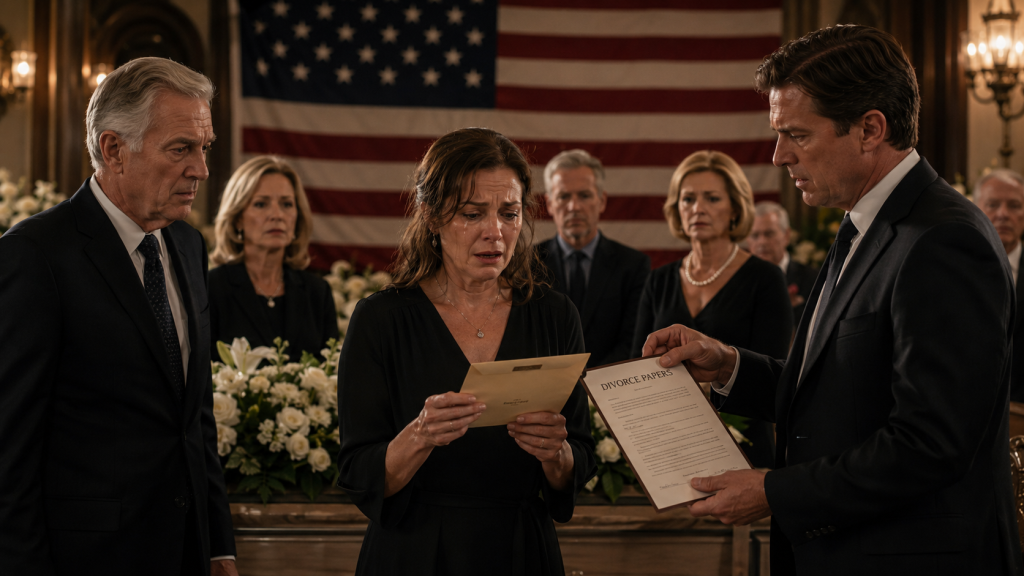
Then he reached into the inside pocket of his suit jacket and pulled out a folded packet.
“I didn’t want to do this before the service.”
I stared at the papers.
For a moment, my mind refused to understand.
Then I saw the words.
Petition for Dissolution of Marriage.
Divorce papers.
At his mother’s funeral.
I looked up at him.
“Dean.”
His expression stayed flat.
“It’s been over for years, Rachel.”
My name sounded strange in his mouth.
Cold.
Formal.
Like I was a problem he had finally scheduled time to solve.
“I spent twelve years caring for your mother,” I whispered.
“I know.”
“You know?”
His jaw tightened.
“And I appreciate that. But we can’t pretend we’ve had a marriage.”
My chest hurt so badly I thought I might faint.
Before I could answer, a man in a dark overcoat approached us.
Mr. Alden.
Eleanor’s lawyer.
I recognized him from the paperwork I had helped Eleanor organize over the years.
He looked at Dean, then at me.
“Mrs. Whitmore,” he said gently, “Eleanor instructed me to give you this before anyone else.”
Dean frowned.
“What is that?”
Mr. Alden ignored him and handed me a sealed envelope.
My hands were trembling so hard I almost dropped it.
Dean stepped closer.
“Rachel, give me a minute to—”
“No,” Mr. Alden said.
His voice was calm, but firm.
Dean blinked.
“Excuse me?”
“This envelope is for Rachel.”
Something flickered across Dean’s face.
Annoyance.
Suspicion.
Fear.
I opened the envelope with shaking fingers.
Inside was a letter.
And a deed.
At first, I could not make sense of the words.
Then one sentence rose from the page and struck me still.
I leave my home, my personal savings, and the lake property to Rachel Whitmore, the only child who stayed.
I stopped breathing.
Dean snatched at the air, but Mr. Alden stepped between us.
“What does that mean?” Dean demanded.
“It means exactly what it says,” Mr. Alden replied.
Dean laughed once.
Sharp and ugly.
“That’s impossible. My mother wouldn’t cut out her own children.”
Mr. Alden’s face did not change.
“She did not cut you out entirely. She left you, Nathan, and Claire the investment account, divided equally.”
Dean’s mouth tightened.
“What investment account?”
“The one she liquidated last year.”
Dean went very still.
I looked at Mr. Alden.
“What?”
He turned to me.
“Eleanor changed her estate plan eight months ago. She was fully evaluated and deemed competent at the time. She wanted the house and lake property protected.”
Dean’s voice rose.
“Protected from whom?”
Mr. Alden looked directly at him.
“From people who only visited when they wanted something.”
The words hit like a slap.
Dean’s face turned red.
“This is manipulation. Rachel must have pressured her.”
I almost laughed.
I had just been handed divorce papers beside his mother’s casket, and he still found a way to make himself the victim.
Mr. Alden opened his briefcase.
“Eleanor anticipated that accusation.”
He removed a second document.
“A video statement was recorded with two witnesses present.”
Dean stared at him.
“She recorded a video?”
“Yes.”
“When?”
“Three months ago.”
Dean turned to me.
“You knew?”
“No.”
And I hadn’t.
Eleanor had kept secrets better than all of us.
Mr. Alden looked at me softly.
“She asked me to tell you that she was sorry she could not protect you sooner.”
That was when I broke.
Not loudly.
Not dramatically.
I simply folded in on myself.
The funeral program slipped from my hand.
I had lost Eleanor.
My husband had abandoned me.
And somehow, from beyond the grave, the woman I had cared for was still trying to hold me up.
Dean leaned close, his voice low and furious.
“You are not keeping my mother’s house.”
I looked at him through tears.
Then I looked down at the divorce papers in his hand.
For twelve years, I had been tired.
For twelve years, I had swallowed disappointment, loneliness, and resentment because I thought sacrifice was love.
But something changed in that moment.
Maybe Eleanor’s letter gave it to me.
Maybe Dean’s cruelty burned away the last thread tying me to him.
I lifted my chin.
“No, Dean,” I said quietly. “I’m not keeping your mother’s house.”
His eyes narrowed.
“I’m keeping Eleanor’s house.”
His face hardened.
“You’ll regret this.”
Mr. Alden stepped forward.
“Mr. Whitmore, I strongly advise you not to threaten a beneficiary in front of witnesses.”
Dean looked around.
People were watching now.
Nathan stood near the hearse, pale and confused.
Claire had one hand over her mouth.
Dean straightened his jacket, trying to recover his dignity.
“This isn’t over.”
Then he walked away.
But it was over.
Not legally.
Not yet.
But inside me, something had ended.
The next few weeks were brutal.
Dean moved into a downtown apartment.
Later, I learned he had already signed the lease two months before Eleanor died.
Two months.
While I was bathing his mother, feeding her soup, and sleeping in a chair beside her bed, he was planning his escape.
His siblings called immediately.
Nathan sounded embarrassed.
Claire sounded angry.
Neither of them asked how I was.
They asked about the will.
“Rachel, you have to understand,” Claire said. “That house is family property.”
“I was family when I was caring for your mother,” I replied.
She went silent.
Nathan tried a softer approach.
“Maybe we can all sit down and work something fair.”
“Fair?” I asked.
“Yes.”
“Fair would have been you visiting more than twice a year.”
He said nothing after that.
Dean filed objections.
Of course he did.
He claimed undue influence.
He claimed emotional manipulation.
He claimed I isolated Eleanor from her children.
That last one hurt so much I had to sit down when my attorney read it.
Isolated her?
I was the one who set up video calls when Nathan forgot.
I was the one who bought Claire’s birthday cards for Eleanor to sign.
I was the one who reminded Dean to sit with his own mother for ten minutes before bed.
But people who take without helping often rewrite history to protect themselves.
Then came the video.
Mr. Alden played it in a conference room with lawyers present.
Eleanor appeared on the screen in her favorite blue cardigan.
Her hair was thin.
Her hands rested in her lap.
But her voice was steady.
“My name is Eleanor Whitmore,” she said. “I am making this statement freely and clearly.”
Dean sat across from me, arms crossed.
Nathan and Claire sat beside him.
The video continued.
“My children may not like my choices. But I have watched people show me who they are. Nathan sends flowers when reminded. Claire calls on holidays. Dean visits the room I sleep in but does not see the woman in the bed.”
Dean flinched.
I stared at the screen.
“And Rachel,” Eleanor said, her voice softening, “Rachel gave me twelve years of her life. She did not do it for money. She did not ask me for anything. She gave up work she loved. She gave up vacations, comfort, and sleep. She held my hand when my own children were too busy.”
My eyes filled.
“If the law allows me one final act as a mother, let it be this: I will not let my daughter be discarded after my son has used up her kindness.”
No one spoke.
Even Dean’s attorney looked uncomfortable.
Then Eleanor looked directly into the camera.
“Rachel, if you are watching this, forgive me. I should have told you sooner. But I hope what I leave behind gives you somewhere to stand.”
The video ended.
The room was silent.
Dean’s face had gone gray.
Claire cried quietly.
Nathan stared at his hands.
My attorney slid a tissue toward me.
I did not realize I was crying until then.
After that, Dean’s case weakened.
Not immediately.
Men like Dean do not surrender quietly.
He tried to pressure me during divorce negotiations.
He argued that because I had not worked in twelve years, I had contributed less financially.
My attorney nearly smiled when he said it.
“Mr. Whitmore,” she replied, “your career advanced because my client provided unpaid full-time care for your mother. We will be discussing the value of that labor.”
For the first time, I saw Dean understand that the world outside our marriage might not accept his version of events.
The house became mine before the divorce was final.
I moved into Eleanor’s old room first.
Not permanently.
Just for a week.
I needed to sit with the silence.
Her teacup was still on the windowsill.
Her knitted blanket still hung over the chair.
In the drawer beside the bed, I found a notebook.
Inside were letters.
Not legal letters.
Personal ones.
One for Nathan.
One for Claire.
One for Dean.
And one for me.
Mine was tucked inside a pale yellow envelope.
My Rachel,
If you are reading this, then I am gone, and my son has likely shown you the part of himself I hoped he would outgrow.
I am sorry.
A mother wants to believe the best of her child.
Sometimes that belief becomes an excuse.
You deserved better from him.
You deserved better from all of us.
I kept reading through tears.
Eleanor wrote about the first day I came to her house with soup after her diagnosis.
How I rearranged her medicine cabinet without making her feel helpless.
How I stayed awake during a storm because she was frightened but too proud to admit it.
Then she wrote something that changed me forever.
Do not confuse being needed with being loved. You were needed here, yes. But you were also loved. By me. Deeply.
I pressed the letter to my chest and sobbed.
For years, I had feared that if I stopped giving, I would disappear.
Eleanor had seen me.
Even when Dean did not.
The divorce took nine months.
By the time it ended, I was forty-seven years old with no current career, no husband, and a house filled with memories.
But I was not empty.
Dean married someone else less than a year later.
A woman from his office.
I had suspected there was someone.
I did not ask.
I did not need the details.
Claire sent me a letter of apology after the estate case closed.
Nathan called once and said, “I should have done more.”
“Yes,” I said.
He exhaled.
“I know.”
We were not close after that.
But we were honest.
That mattered more.
I used part of Eleanor’s savings to renovate the lake property.
Not into a vacation home.
Into a retreat for family caregivers.
People like me.
People who had given years of their lives to care for someone and were left exhausted, unseen, and unsure who they were afterward.
I named it Eleanor House.
The first weekend we opened, six women came.
One had cared for her father with dementia.
One had left teaching to care for her disabled husband.
One had moved across the country for an aunt whose own children never visited.
We sat on the porch overlooking the lake and talked until the sun went down.
No one had to explain the loneliness.
Everyone already knew.
A year after Eleanor’s funeral, I returned to Marlow Chapel.
Not for grief.
For peace.
I brought white roses and placed them at Eleanor’s grave.
“Your house is loud now,” I told her. “You’d like it.”
The wind moved softly through the trees.
I smiled.
“I’m working again too. Slowly.”
And I was.
An old client heard what had happened and asked me to design a small library.
Then another project came.
Then another.
My nameplate, the brass one Dean had bought me years ago, now sits on my new desk.
But it means something different now.
It no longer reminds me of what he believed I might become.
It reminds me of what I survived.
Sometimes people ask if I hate Dean.
I don’t.
Hatred is too heavy to carry.
But I no longer protect him from the truth.
He served me divorce papers at his mother’s funeral because he thought I had nothing left.
No career.
No income.
No power.
No place to go.
But Eleanor knew better.
She knew the difference between the people who carried her casket and the woman who carried her life.
She knew who stayed.
And in the end, she gave me more than a house.
She gave me proof.
Proof that my sacrifice had not been invisible.
Proof that love can come from unexpected places.
Proof that sometimes, the person everyone overlooks is the one holding the whole family together.
The last line of Eleanor’s letter is framed above my desk now.
You were never the help, Rachel. You were my daughter.
Every morning, I read it before I begin work.
And every morning, I remember the moment Dean handed me divorce papers beside a grave, thinking he had ended my life.
He didn’t.
He only ended the part where I let myself disappear.
THE END! THANKS FOR READING!