

My 73-year-old mother babysat our neighbor’s child for four weeks and never received a single dollar.Every morning, she arrived early with homemade snacks from her own kitchen. She folded laundry she had no obligation to touch.
She cleaned up toys.
She wiped counters.
She cared for that little girl with the patience only a grandmother could give.
The agreement had been simple.
Eighty dollars a day.
Claire, our neighbor, had asked my mother for help because her regular sitter canceled suddenly.
“I only need you for a few weeks,” Claire had said sweetly. “You’re such a lifesaver, Mrs. Bennett.”
My mother smiled because that was who she was.
She was the kind of woman who believed people meant what they said.
She was the kind of woman who wrote everything down in a little notebook but still trusted a handshake more than a contract.
For the first week, Claire said, “I’ll pay you Friday.”
Friday came.
Claire smiled and said, “Next week. My paycheck is late.”
My mother nodded.
The second Friday came.
Same excuse.
The third Friday came.
Another excuse.
By the fourth week, my mother had worked twenty full days.
She had spent her own money on fruit cups, crackers, craft supplies, and little hair ribbons because Claire’s daughter, Lily, loved pretending to run a beauty salon.
Mom never complained.
Not once.
Then, finally, she asked politely.
“Claire, I’m sorry to bother you, but I do need the payment. It has been four weeks.”
Claire leaned against her doorway, smiled, and said, “At your age, you really shouldn’t take jobs without contracts.”
My mother blinked.
Then Claire added, “Besides, it’s not like you had anything better to do anyway.”
My mother came home quietly.
She did not slam the door.
She did not shout.
She did not call Claire names.
She only sat at the kitchen table, opened her little notebook, and crossed out four weeks of unpaid wages with a trembling hand.
That broke me.
Not the money.
The humiliation.
The way my mother tried to act like it did not hurt.
I looked at the page.
Twenty days.
Eighty dollars a day.
One thousand six hundred dollars.
Underneath, Mom had written: Claire said no contract.
I asked, “Why didn’t you tell me sooner?”
She smiled weakly.
“I didn’t want trouble.”
“Mom, she used you.”
“She has a child.”
“That doesn’t give her the right to cheat you.”
My mother looked down at her hands.
“She said I should have known better.”
Something inside me snapped.
Because Claire thought kindness meant weakness.
And the first thing I did that night was walk straight into our garage.
Two years earlier, I had installed security cameras after someone stole packages from our street.
One camera faced our driveway.
One faced the sidewalk.
One caught the front of Claire’s house clearly enough to show every morning my mother walked across the street with a tote bag and every evening she came back exhausted.
I downloaded four weeks of footage.
Then I printed every text message Claire had sent my mother.
Can you come at 7:30 tomorrow?
Lily loved your muffins.
I’ll pay Friday, promise.
Can you stay late today?
Don’t forget her allergy medicine.
Thank you, you’re saving me.
I placed them all in a folder labeled: Payment Due.
Then I called three other neighbors and asked one question.
“Did Claire do this to you too?”
At first, there was silence.
Then Mrs. Alvarez from two houses down sighed.
“She still owes my niece three hundred dollars for pet sitting.”
Then Mr. Nolan said Claire had borrowed tools and never returned them.
Then a younger mother named Jenna admitted Claire had convinced her teenage son to mow the lawn for “summer cash” and paid him only once.
By midnight, my folder had become a file.
By morning, it had become a case.
I did not go to Claire’s house angry.
That would have been too easy for her.
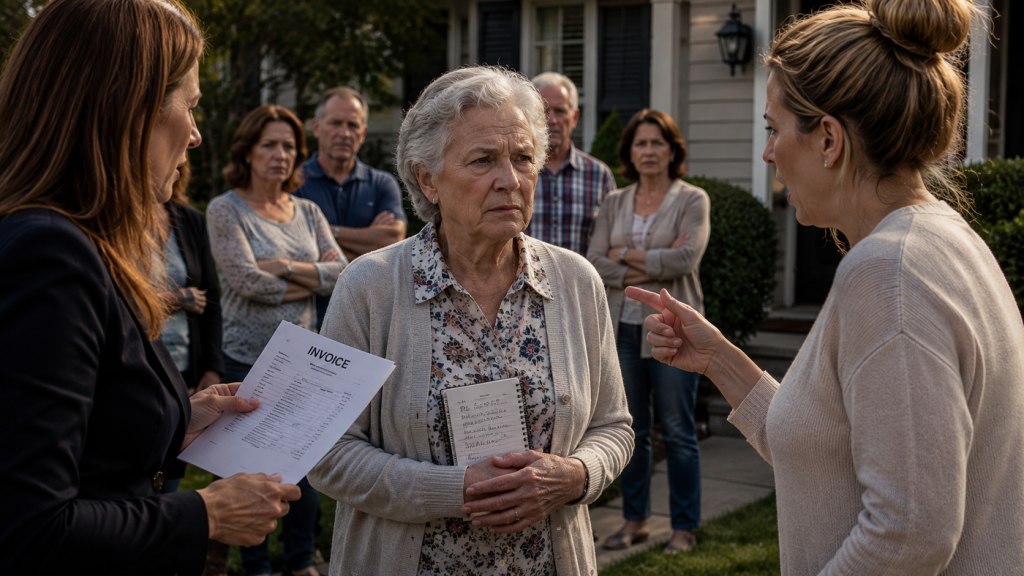
Instead, I typed a simple invoice.
Four weeks of childcare.
Twenty days.
$80 per day.
Total due: $1,600.
Additional reimbursement for snacks and supplies: $142.36.
Payment deadline: Friday, 5:00 p.m.
Attached: supporting documentation.
I printed two copies.
Then I walked across the street.
Claire opened the door wearing yoga pants, holding a coffee mug, and looking annoyed before I even spoke.
“Oh,” she said. “Is your mom here to apologize?”
I smiled.
“No. I’m here to give you this.”
I handed her the invoice.
She glanced down and laughed.
“You’re joking.”
“I’m not.”
“She has no contract.”
“She has written messages confirming dates, times, responsibilities, and your promise to pay.”
Claire’s smile faded slightly.
I continued.
“She also has video footage showing her arrival and departure every day. And several neighbors are willing to confirm your pattern of avoiding payment.”
Claire’s face hardened.
“Are you threatening me?”
“No,” I said calmly. “I’m giving you a chance to pay before this becomes public and legal.”
Her eyes narrowed.
“You people are unbelievable.”
“You people?”
She looked past me toward my house.
“Your mother is retired. She was bored. I gave her something to do.”
I felt heat rise in my chest, but I kept my voice steady.
“My mother gave your child care, safety, food, and affection. You gave her excuses.”
Claire stepped onto the porch.
“Listen, I am not paying some elderly woman sixteen hundred dollars for playing with a child.”
That was her second mistake.
Her first was cheating my mother.
Her second was saying that loudly enough for Mrs. Alvarez, who was watering flowers next door, to hear.
Mrs. Alvarez turned off the hose.
“Claire,” she called, “you should pay what you owe.”
Claire’s head snapped toward her.
“This is none of your business.”
Mr. Nolan stepped out of his garage.
“It becomes the street’s business when you keep doing it.”
Within minutes, Claire’s perfect little front porch had become a courtroom without walls.
Jenna came outside too.
Then another neighbor.
Then another.
Claire looked around, realizing too late that people had been quiet, not blind.
“You’re all ganging up on me,” she snapped.
“No,” I said. “We’re comparing notes.”
That afternoon, I filed a small claims complaint.
I helped Mrs. Alvarez’s niece file one too.
Jenna filed on behalf of her son.
Mr. Nolan sent Claire a written demand for the return or replacement of his tools.
Claire tried to call my mother.
I blocked her number on Mom’s phone.
Then she came over.
I met her at the door.
She had changed her tone completely.
Soft voice.
Tired eyes.
A story ready.
“I think this got out of hand,” she said. “Your mother misunderstood me.”
I stared at her.
“She misunderstood being told she should have gotten a contract?”
Claire shifted.
“I was stressed.”
“She misunderstood you saying she had nothing better to do?”
Her face flushed.
“I shouldn’t have said that.”
“No, you shouldn’t have.”
She glanced behind me.
“Can I talk to her?”
“No.”
“She’s an adult.”
“Yes. And she asked me to handle this because you made her feel ashamed for expecting fair payment.”
Claire looked down.
For a moment, I thought maybe she was sorry.
Then she said, “Can we at least do a payment plan? I have the wedding shower next month, and money is tight.”
There it was.
Still thinking her celebrations mattered more than my mother’s work.
I stepped back and started closing the door.
“You have until Friday.”
Friday came.
No payment.
So we went to court.
My mother was nervous the entire morning.
She wore her pale blue cardigan and clutched her little notebook like it was a passport.
“I don’t like this,” she whispered as we sat on the bench outside the courtroom.
“I know.”
“What if the judge thinks I’m foolish?”
I took her hand.
“Mom, trusting someone does not make you foolish. Taking advantage of trust makes them wrong.”
She nodded, but her hands still trembled.
Claire arrived ten minutes late wearing a cream blazer and an expression of wounded innocence.
She brought a folder too.
Inside were printed articles about “informal family-like childcare” and “volunteer caregiving.”
She smiled at my mother in the hallway.
My mother looked away.
When our case was called, Claire tried everything.
She said there had been no formal agreement.
She said my mother had offered to help.
She said Lily loved my mother like family.
Then the judge asked one question.
“Did you agree to pay Mrs. Bennett eighty dollars per day?”
Claire hesitated.
“I may have mentioned that amount.”
The judge looked over his glasses.
“That was not the question.”
Claire swallowed.
“Yes, but—”
“And did she provide childcare for twenty days?”
Claire looked toward me.
“Yes.”
The judge reviewed the text messages.
Then the footage.
Then my mother’s notebook.
He paused on the page where she had crossed out the wages.
His expression changed.
“Mrs. Bennett,” he said gently, “did you purchase snacks and supplies for the child?”
My mother nodded.
“Yes, Your Honor. She liked strawberries and those little cheese crackers. And she had sensitive skin, so I bought wipes without fragrance.”
The judge looked at Claire.
“Did you reimburse her?”
Claire’s voice was small now.
“No.”
The judgment was awarded in full.
$1,742.36.
Plus filing costs.
My mother stared as if she had not heard correctly.
Claire’s mouth fell open.
“But I can’t pay that today.”
The judge said, “Then you should not have accepted twenty days of labor you did not intend to pay for.”
Outside the courtroom, Claire did not apologize.
People like Claire rarely do when they lose.
They only act injured that consequences finally found them.
But my mother walked differently afterward.
Not proud exactly.
Lighter.
Like someone had handed back a small piece of dignity she thought was gone.
Two weeks later, the payment arrived.
Claire had waited until the last possible day, but she paid.
Every dollar.
My mother deposited part of it into savings.
Then she did something that made me cry.
She bought herself a new winter coat.
For years, she had worn the same old brown one with a broken zipper because “it still works.”
This one was deep green, warm, and beautiful.
When she tried it on in the store, she looked at herself in the mirror and whispered, “Maybe I did earn it.”
I stood behind her and said, “You earned more than that.”
The story spread around the neighborhood.
Not because I posted it online.
Because people talk.
And after that, something changed.
Neighbors stopped asking my mother for “little favors” that took entire afternoons.
They stopped assuming she was available because she was older.
They stopped treating her time like leftover time.
Mrs. Alvarez brought flowers.
Jenna’s son brought a handwritten apology for not speaking up sooner.
Mr. Nolan returned the garden shears he had borrowed from my mother three years ago and forgot to give back.
Mom laughed about that one.
Claire avoided us for months.
Then one afternoon, Lily came running across the lawn while Claire called after her.
The little girl held a crayon drawing.
It showed my mother with a yellow sun over her head.
“I miss you, Mrs. Bennett,” Lily said.
My mother knelt slowly and hugged her.
“I miss you too, sweetheart.”
Claire stood on the sidewalk, looking uncomfortable.
For once, she said nothing.
My mother looked at Lily and smiled.
What Claire had done was wrong.
But Lily was still a child.
And my mother’s heart was still my mother’s heart.
Later, I asked if seeing Lily hurt.
“A little,” Mom said. “But loving a child was never the mistake.”
“What was?”
She folded the drawing carefully.
“Letting her mother decide my kindness had no value.”
A year later, my mother still keeps the little notebook.
But now, on the first page, she wrote something new.
My time matters.
My work matters.
My kindness matters.
She taped the court receipt under it.
Not because she cared about winning.
Because she needed proof that being gentle did not mean being powerless.
And every time I see that green coat hanging by the door, I remember the night she came home and crossed out four weeks of wages with shaking hands.
Claire thought my mother was alone.
She thought an older woman would be too embarrassed to fight back.
She thought kindness meant weakness.
She was wrong.
Kindness is not weakness.
But from now on, in our family, kindness comes with boundaries.
And payment is due on Friday.
THE END! THANKS FOR READING!