

My sister raised me after Mom passed away. She was nineteen. I was twelve. At that age, I did not understand sacrifice. I did not understand what it meant for a young woman to bury her mother on a Friday and become a parent by Monday. I only understood that my life had changed.
Mom died after a short illness that stole her from us faster than anyone expected. One month she was cooking soup in our little kitchen, laughing at the radio, telling me to finish my homework. The next month she was lying in a hospital bed, her hand cold in mine, whispering to my sister, “Take care of her.”
Her name was Clara. She was supposed to start college that fall. She had already been accepted. She had a folder full of brochures, scholarship papers, and handwritten notes about the life she wanted. She wanted to become a nurse. She wanted a small apartment near campus. She wanted to travel one day. But after Mom died, that folder disappeared into a drawer.
Clara never talked about college again. She got a job at a diner two blocks from our apartment. Then she got another job cleaning offices at night. She learned how to cook cheap meals that could last three days. She learned how to argue with landlords. She learned how to fill out school forms, insurance papers, and bills that came with red letters.
She was nineteen, but she moved through life like she was forty.
Back then, I hated her for it.
I hated the tired way she said my name.
I hated when she told me we could not afford new shoes.
I hated when she checked my homework while half asleep at the kitchen table.
I hated when she said, “Study hard, Lily. Don’t end up like me.”
To me, that sounded like a warning.
To her, I now know, it was a prayer.
As I grew older, I became ashamed of her.
That is the part that hurts the most to admit.
At school, my friends had parents who showed up in clean cars, wearing perfume and pressed clothes. Clara came to parent meetings in her diner uniform, smelling like coffee, fried onions, and bleach.
She would smile at my teachers and say, “I’m Lily’s guardian.”
I hated that word.
Guardian.
Not mother.
Not sister.
Something in between.
Something that made people look at us with pity.
When I won awards, Clara came. When I got sick, Clara stayed up all night. When I needed money for school trips, Clara picked up extra shifts. When I cried about not having Mom, Clara cried in the bathroom where she thought I could not hear.
But I was young, proud, and cruel in the quiet way children can be when they do not understand love.
I told myself I would never become like her.
I would leave that apartment.
I would have a real career.
I would wear clean white coats and speak in rooms where people respected me.
And I did.
I studied like my life depended on it.
Maybe because it did.
Clara worked. I studied.
Clara skipped meals. I bought textbooks.
Clara wore the same winter coat for six years. I wore a graduation gown.
She never complained.
Not once.
When I got accepted into medical school, Clara cried harder than I did. She grabbed me in the kitchen and spun me around like I was still twelve.
“You did it,” she said.
I pulled away, embarrassed.
“We did it,” she whispered.
I remember rolling my eyes.
At the time, I thought she was trying to take credit for my success.
Now I understand she was simply proud of surviving long enough to see it.
Medical school changed me.
Or maybe it revealed what had already been growing inside me.
I learned how to speak confidently. I learned how to hide exhaustion. I learned how to introduce myself as Doctor Lily Morgan.
People admired me.
People praised me.
People asked about my story, and I learned to polish it until it shined.
“My mother passed away when I was young,” I would say. “I worked hard. I pushed myself. I made something of my life.”
I left Clara out of that story.
Not because she was unimportant.
Because deep down, I was embarrassed by how much of my life had been built on her back.
Graduation day arrived on a bright spring morning.
The university lawn was full of families, flowers, cameras, and proud parents crying behind sunglasses.
I stood in my cap and gown, my white coat folded over my arm, feeling like I had finally climbed out of the life I was born into.
Then I saw Clara.
She was standing near the back of the crowd.
She wore a faded blue dress I had seen too many times before. Her hair was pinned back neatly, but she looked tired. Thinner than I remembered. Older somehow.
Still, when she saw me, her face lit up.
She waved with both hands like I was the only person in the world.
For a second, I felt twelve again.
Then one of my classmates whispered, “Is that your sister?”
I heard the surprise in her voice.
I felt shame burn up my neck.
“Yes,” I said quietly.
After the ceremony, Clara pushed through the crowd and hugged me so tightly I could barely breathe.
“Oh, Lily,” she said. “Mom would be so proud.”
She was crying.
I should have held her.
I should have said thank you.
I should have told her that every step across that stage belonged to her too.
Instead, I looked at her cheap dress, her tired hands, her worn shoes, and something ugly came out of me.
“See?” I said. “I climbed the ladder. You took the easy road and became a nobody.”
The words fell between us like glass.
For a moment, the whole world seemed to go silent.
Clara’s smile froze.
Her eyes did not fill with anger.
That would have been easier.
They filled with pain.
A deep, quiet pain that made her look suddenly very small.
She looked at me for a long time.
Then she reached up and gently touched my cheek.
“I hope you never understand what my road cost,” she said.
Then she turned and walked away.
I let her go.
That is the part I replay the most.
I let her go.
For three months, she did not call.
At first, I was angry.
I told myself she was being dramatic. I told myself she should have been proud of me. I told myself the truth hurt because she knew I was right.
She had stayed behind.
I had moved forward.
I worked long shifts at the hospital. I started my residency. I answered messages from friends and ignored the empty space where Clara’s name used to appear on my phone.
Sometimes I opened our old message thread.
The last message was from her the morning of graduation.
Big day, baby girl. I’m already proud.
I never replied.
Three months passed before guilt finally became louder than pride.
I had a free weekend, so I drove back to the town I had once promised myself I would escape forever.
The streets looked smaller than I remembered.
The diner where Clara worked was still there, though the sign was faded. I parked outside our old apartment building and sat in the car for several minutes, gripping the steering wheel.
I told myself I would knock.
She would open the door.
I would say something cold at first, something like, “Are you done ignoring me?”
Then maybe she would cry.
Maybe I would apologize.
Maybe everything would go back to normal.
But when I reached the apartment door, something felt wrong.
The welcome mat was gone.
The little plant Clara kept by the door was dead.
I knocked.
No answer.
I knocked again.
An older woman from across the hall opened her door.
“Lily?” she asked softly.
I turned.
Her face changed when she saw me.
“You don’t know?” she whispered.
My stomach dropped.
“Know what?”
She covered her mouth with one hand.
“Oh, honey.”
Those two words broke something inside me before I even knew why.
The landlord came with a key. He said Clara had left instructions that I could enter if I ever came.
If I ever came.
The door opened.
I stepped inside.
The apartment was almost empty.
The couch was gone. The kitchen table was gone. The pictures were off the walls. The curtains Clara had washed every month were missing.
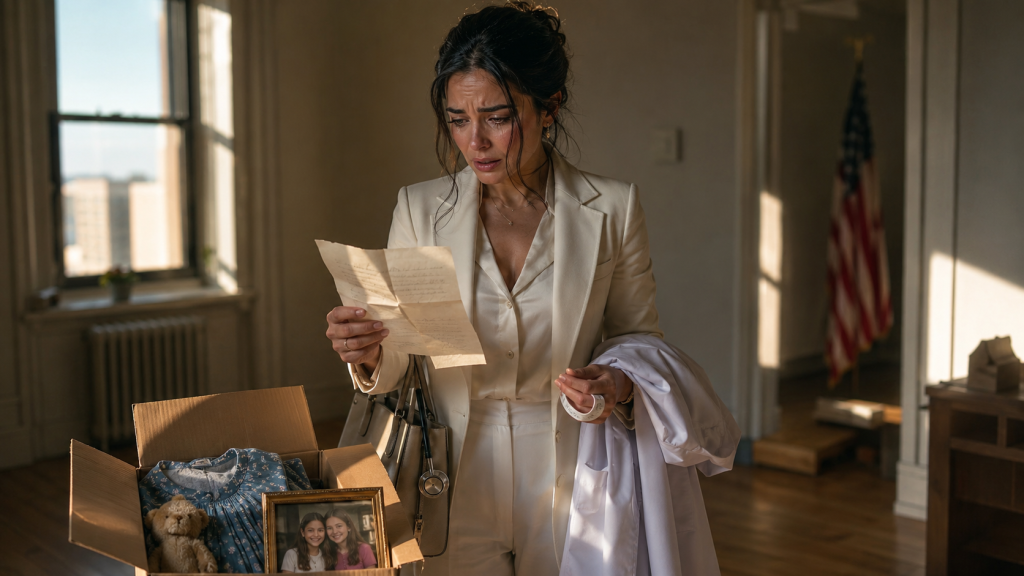
Only one cardboard box sat in the middle of the living room.
On top of it was a white envelope with my name written in Clara’s handwriting.
Beside it lay a hospital bracelet.
I stared at the bracelet first.
Clara Morgan.
Oncology Ward.
My legs went weak.
“No,” I whispered.
I opened the letter with shaking hands.
My sweet Lily,
If you are reading this, it means you finally came home. I am sorry I did not tell you everything sooner. I tried many times, but every time I picked up the phone, I imagined how busy you were, how hard you were working, how close you were to becoming everything Mom dreamed you could be.
The cancer came back last year.
I knew before your graduation.
I did not want that day to become about me.
You deserved to stand in the sun and feel proud.
I sat down on the floor because my knees could no longer hold me.
The words blurred, but I forced myself to keep reading.
When you said I became nobody, it hurt. I won’t lie. But I need you to know something. I was never nobody.
I was the person who signed your permission slips when my hands were shaking from double shifts.
I was the person who watered down soup so you could eat more than me.
I was the person who sold Mom’s necklace to pay for your exam fees.
I was the person who told every man who wanted to marry me that I already had a child to raise.
I was the person who gave up one dream so yours could live.
And I would do it again.
A sound came out of me that I did not recognize.
It was not crying.
It was something deeper.
Something like a soul breaking open.
I kept reading.
I am not writing this to make you feel guilty. I am writing it because one day, when the world calls you successful, I want you to remember that success is not only climbing higher. Sometimes success is staying behind so someone you love can climb.
I am proud of you, Doctor Lily Morgan.
I have always been proud of you.
But please, baby girl, do not spend your life thinking love is weakness. Love is the only reason either of us survived.
Inside the box are some things I kept for you.
Mom’s recipe book.
Your first report card.
Every certificate you ever brought home.
And the blue dress.
I wore it to every important day because it was the last dress Mom bought me.
That was when I stopped reading.
I crawled to the box and opened it.
Inside were pieces of my life I had not known she saved.
My childhood drawings.
My spelling bee ribbon.
A photo of me asleep at twelve, tucked under a blanket, while Clara sat beside me studying bills with a calculator.
A newspaper clipping from my medical school acceptance.
A stack of birthday cards she had written but never given me because I had always been too busy to come home.
At the bottom was the blue dress.
I pressed it to my face and finally cried like the child I had refused to be.
The neighbor told me Clara had passed away two weeks earlier.
Two weeks.
She said Clara had asked not to call me until after my first big hospital rotation ended. She did not want me distracted.
Even at the end, she was protecting me.
The funeral had been small.
Diner workers.
Neighbors.
A nurse from the oncology ward.
People I had once thought were beneath me.
They had all shown up for my sister.
I had not.
I found her grave the next morning.
The grass was new.
The stone was simple.
Clara Morgan.
Beloved Daughter. Beloved Sister.
I stood there in my expensive coat, with my doctor’s badge still clipped to my purse, and I felt smaller than I had ever felt in my life.
“I’m sorry,” I whispered.
But the wind gave no answer.
For a long time, I visited every week.
At first, I came with flowers and guilt.
Then I came with stories.
I told Clara about my patients. About the first life I helped save. About the first family I had to comfort after losing someone.
I started to understand her then.
Not as the tired sister who raised me.
Not as the woman in cheap shoes.
But as the strongest person I had ever known.
One year later, I opened a free clinic in our old neighborhood.
I named it The Clara Morgan Community Clinic.
On opening day, people asked me who Clara was.
I stood in front of the building, holding the same blue dress folded carefully in my arms, and for the first time in my life, I told the whole truth.
“My sister raised me after our mother died,” I said. “She was nineteen. I was twelve. She gave up everything so I could become a doctor. I once called her nobody because I was too proud to see what love looked like.”
My voice broke.
Then I looked at the sign above the door.
“But she was never nobody. She was the ladder.”
Now, every time a young patient comes in scared, hungry, or ashamed of where they come from, I think of Clara.
I remember her tired hands.
Her watered-down soup.
Her blue dress.
Her words.
I hope you never understand what my road cost.
I understand now.
And if I could go back to graduation day, I would run to her.
I would hold her before she walked away.
I would tell her that every title before my name belonged to her first.
But life does not let us return to the moments we ruined.
It only gives us the chance to build something better from the ashes.
So I work.
I serve.
I remember.
And every morning, before I put on my white coat, I touch the small photo on my desk.
Two sisters.
One nineteen.
One twelve.
One smiling like she still believed she could save us both.
And she did.
She saved me.
I just learned it too late.
THE END! THANKS FOR READING!