

My son removed me from the family group chat, and when I asked him why, he said, “Mom, it was for working adults. You don’t understand what we talk about.” A week later, all twelve of them showed up at my farm with suitcases, meat, coolers, and speakers, convinced that I would once again leave the key under the flowerpot.
But that night, by the locked gate, a sign and a notebook were waiting for them. A notebook they never should have looked down on. It was not the moment my son removed me from the family chat that hurt me the most. It was the sentence that came after.
Said with that cold calm only children use when they stop seeing you as their mother and start seeing you as a burden.
“Mom, it was for working adults. You don’t understand what we talk about.”
I am seventy-six years old.
I have been a widow for eleven years.
And that sentence stayed stuck inside me like a thorn under my ribs, because they were not just leaving me out of a conversation.
They were slowly erasing me from my own family.
My name is Benita Morales.
My husband, José, and I built our farm from nothing.
Not from inheritance.
Not from luck.
From sunburned backs, cracked hands, and coins saved inside glass jars beneath the bed.
When we first bought the land, there was barely a house on it.
The roof leaked.
The well water tasted of metal.
The soil was hard and stubborn.
But José would stand in the field at sunrise with his hands on his hips and say, “Benita, one day our grandchildren will run here.”
And I believed him.
So we worked.
We sold vegetables at the market before dawn.
We raised chickens.
We planted lemon trees, orange trees, and rows of tomatoes that stained our hands red.
We fixed one wall at a time.
One roof tile at a time.
One fence post at a time.
Every corner of that farm carried a story.
The old stone path was where my eldest son, Carlos, learned to ride a bicycle.
The kitchen window was where my daughter, Laura, used to wait for José to come back from the fields.
The big walnut tree was where Diego carved his initials with a pocketknife and blamed it on a neighbor boy.
That farm was not just land.
It was our life written in wood, soil, sweat, and love.
But after José died, something changed.
At first, my children visited because they missed him.
Then they visited because the farm was peaceful.
Then they visited because it was free.
Free rooms.
Free food.
Free firewood.
Free babysitting.
Free weekends away from the city.
I told myself that was love.
I told myself they came because they wanted to be near me.
So I kept clean sheets ready.
I canned peaches and tomato sauce.
I filled the refrigerator before every holiday.
I left the key beneath the large flowerpot near the porch, just like I had when they were teenagers.
They came with suitcases.
They came with friends.
They came with coolers full of meat for grilling.
They came with speakers loud enough to scare the hens.
They opened my cupboards, used my towels, drank my coffee, and left wet footprints across the floors José and I had laid with our own hands.
And I cleaned after them.
I cleaned because mothers clean.
I cooked because mothers cook.
I smiled because mothers are supposed to be grateful when their children remember them.
But little by little, they stopped remembering me.
They stopped asking how my knees felt in the winter.
They stopped noticing when my hands shook.
They stopped calling before arriving.
One Friday, I was making soup when my phone chimed.
It was a message from the family chat.
Except when I opened the app, the chat was gone.
I thought I had pressed something wrong.
I put on my glasses and looked again.
Nothing.
So I called Carlos.
He answered on the fourth ring.
“Mom? Everything okay?”
“Carlos,” I said, trying to keep my voice light, “I think something happened to the family chat. I cannot see it.”
There was a pause.
Then he sighed.
Not worried.
Annoyed.
“Oh. Yeah. We made a new one.”
“A new one?”
“It was just easier.”
“Easier for what?”
“For planning things. Adult things.”
I smiled sadly though he could not see me.
“Carlos, I am an adult.”
He laughed softly.
Not cruelly.
That was what made it worse.
Like I was being silly.
“Mom, you know what I mean. It was for working adults. You don’t understand what we talk about.”
I stood there with the spoon in my hand while the soup bubbled.
Working adults.
As if I had not worked since I was thirteen.
As if every tomato, every jar of preserves, every school uniform, every doctor bill, every birthday cake had fallen from the sky.
“I see,” I said.
“Don’t take it personally,” he replied. “We just don’t want to bother you.”
But they did bother me.
They bothered me when they needed the farm.
They bothered me when they needed childcare.
They bothered me when they wanted jars of peaches.
They bothered me when someone forgot a charger, a jacket, a wallet, a toy.
They only did not want to bother me when they were making decisions about me.
I hung up and sat at the kitchen table for a long time.
The soup burned.
I did not notice until the smell filled the room.
One week later, my daughter-in-law, Patricia, sent me a private message.
Benita, leave the keys where they always are. We’re coming Friday with the kids.
No please.
No thank you.
No “How are you?”
That was how I discovered they had planned an entire weekend at my farm without even telling me.
Twelve people.
My three children.
Their spouses.
My grandchildren.
Two of Laura’s friends, apparently.
Twelve people coming to my house as if the owner did not exist.
As if I were just another piece of furniture.
That was the day something inside me hardened.
Not into hatred.
Into clarity.
The next morning, I packed a small bag and went to the farm a day early.
Juan, the caretaker, was fixing the chicken wire near the back field when I arrived.
He had worked with José for years. He was younger than my children but treated me with more respect than all of them combined.
The moment he saw my face, he put down his tools.
“Doña Benita,” he said softly. “Is everything all right?”
“No,” I said.
He nodded once.
He did not ask questions.
He made me tea with mint from the garden and left me alone in the living room.
The house was quiet.
Too quiet.
Sunlight came through the curtains and fell across the old table.
On that table sat the brown leather notebook José had sewn with his own hands almost forty years earlier.
He had made it from scraps of leather and thick paper because he said every serious family needed a book of truth.
At first, we used it for numbers.
How much the well cost.
How many sacks of fertilizer we bought.
How much we earned at the market.
When the roof was replaced.
When the lemon trees were planted.
How much remained after paying school fees.
Then, over the years, the notebook became something more.
José wrote little notes in the margins.
Carlos broke the hoe today pretending to be a knight.
Laura cried because the calf would not follow her.
Diego stole two peaches and blamed the wind.
Benita says we need another cupboard. She is right, as always.
After José died, I could not open it for months.
When I finally did, I found one note on the last page written in his careful hand.
If the children forget what this place cost, the notebook will remember.
I touched those words with my fingertips.
Then the front door opened.
Carlos arrived first.
He came in without knocking.
He was carrying a cooler in one hand and his phone in the other.
When he saw me, his eyebrows pulled together as if I had interrupted him.
“Mom? What are you doing here already?”
I looked at him.
“My house, Carlos.”
He forced a smile.
“Of course. I just meant we thought you’d come later.”
“You did not tell me you were coming at all.”
He sighed.
That same sigh from the phone.
“Mom, Patricia messaged you.”
“After everything was already decided.”
“We didn’t want to bother you with the planning.”
“With adult things?” I asked.
He looked away.
“Don’t start.”
I felt something sharp twist inside me, but I kept my voice calm.
“You removed me from the family group.”
“It was just easier, Mom.”
“For whom?”
“For everyone.”
There it was.
Everyone.
A family decision made without the old woman who had built the place they were standing in.
His eyes moved to the table.
He saw the notebook.
“What’s that old thing still doing out?”
He picked it up before I could stop him.
His fingers flipped through the pages carelessly.
He did not read the numbers.
He did not read his father’s notes.
He did not see the years pressed between those pages.
He laughed under his breath.
“These things only collect dust, Mom.”
Then he tossed the notebook into the trash basket beside the table.
“You should clean up a little before everyone gets here.”
For a moment, I could not breathe.
The sound of the notebook hitting the bottom of the trash was small.
But inside me, it echoed like a door slamming.
I looked at my son.
My first child.
The boy I had carried through fever.
The boy whose shoes José patched because we could not afford new ones.
The boy who once fell asleep on my lap under the walnut tree.
And I saw a stranger.
I did not cry in front of him.
I simply stood.
“Your rooms are not ready,” I said.
He frowned.
“What?”
“I said your rooms are not ready.”
He looked annoyed.
“Mom, don’t be difficult. Everyone’s on the way.”
“Then everyone can wait.”
He stared at me as if I had spoken a language he did not understand.
Then his phone rang, and he stepped outside to answer.
I walked to the trash.
I took out the notebook.
I cleaned the corner with the edge of my apron.
Then I carried it to my bedroom and locked the door.
From the window, I watched the others arrive.
Patricia came with suitcases and bags of snacks.
Laura came wearing sunglasses, speaking loudly into her phone.
Diego carried speakers and meat for the grill.
The grandchildren ran toward the porch without greeting me.
The adults laughed in the driveway, unpacking as if they had rented the place.
No one knocked.
No one asked permission.
No one looked for me except to ask where things were.
“Where are the clean towels?”
“Did you make the peach preserves?”
“Is there enough coffee?”
“Can the kids sleep in the back room?”
“Why is the pantry so empty?”
The pantry was not empty.
It was simply no longer full for people who never said thank you.
That evening, I did not cook.
That alone caused confusion.
Patricia stood in the kitchen holding a bag of rice.
“Benita, are you not making dinner?”
“No,” I said.
She blinked.
“But we brought meat.”
“Then cook it.”
Laura laughed.
“Mom is in one of her moods.”
I looked at her.
“I am in my house.”
The room went quiet for a second.
Then Diego turned up the music outside and the moment passed.
They grilled.
They drank.
They laughed.
They left grease on the counter and muddy shoes by the door.
The children spilled soda on the rug José bought me for our thirtieth anniversary.
No one apologized.
By midnight, the house smelled of smoke, beer, and strangers.
I went to my room and locked the door.
I did not sleep.
I took the notebook from my drawer and opened it again.
There, tucked between two old pages, was a small key.
José had taped it there years ago.
A key to the loose floorboard beneath our bed.
We had hidden important things there when the children were young.
Cash for emergencies.
Birth certificates.
Land papers.
The deed.
I moved the rug, lifted the board, and took out the metal box.
Inside were the documents my children had never cared enough to ask about.
The original deed.
The survey papers.
The tax records.
The trust documents I had started preparing six months earlier after a neighbor told me his sons were pressuring him to sell.
At the time, I had felt ashamed for even thinking my children might do the same one day.
Now I felt ashamed for waiting so long.
The next morning, before anyone woke, I called my lawyer.
His name was Mr. Alvarez.
He had been José’s friend.
When I told him what had happened, he was quiet for a long moment.
Then he said, “Benita, are you ready to finish what we started?”
I looked out at the fields glowing under morning light.
“Yes,” I said. “I am ready.”
By noon, everything was signed.
By evening, the locks were changed.
At six o’clock, while the family had driven into town to buy more drinks, I asked Juan to help me.
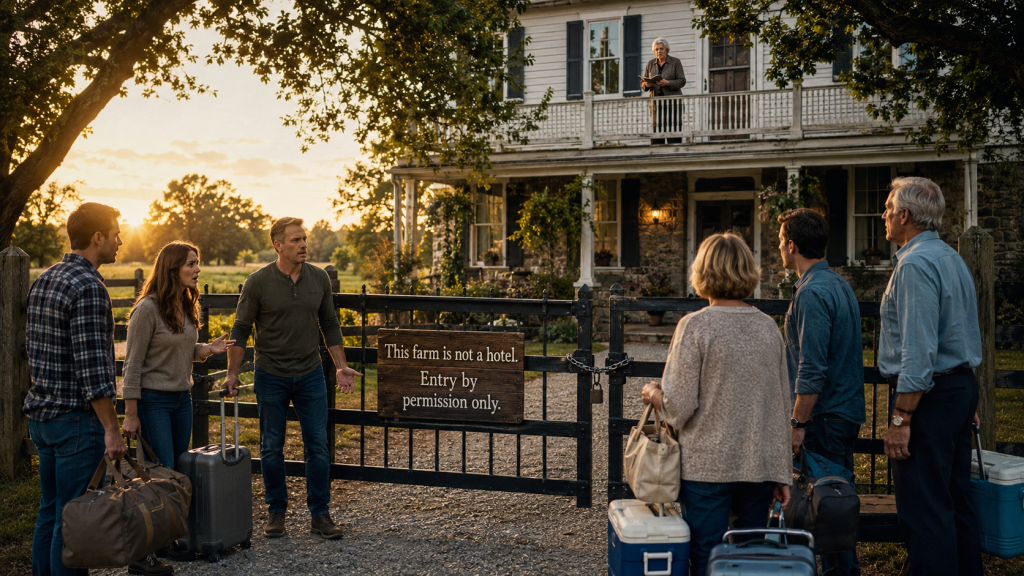
We locked the main gate with a new chain.
Then we nailed a wooden sign to the fence.
This farm is not a hotel. Entry by permission only.
Beside the sign, we placed a sealed plastic box.
Inside was the brown leather notebook.
Not the original.
A copy.
The original was safe with my lawyer.
On top of the copy, I placed a letter.
Read before calling me.
Then I went upstairs and waited by the bedroom window.
They returned at sunset.
Two cars.
Then three.
Music still thumping from one of them.
The children got out first, running toward the gate.
Then Carlos stepped out and froze.
He saw the chain.
He saw the sign.
For a second, he laughed.
A short, disbelieving laugh.
“Mom!” he shouted. “Very funny!”
No answer.
Patricia tried the gate.
“It’s locked.”
Diego came forward.
“What do you mean locked?”
Laura looked up at the house and saw me in the window.
“Mom, open the gate!”
I did not move.
Carlos’s face darkened.
“Mom, stop this nonsense. We have groceries in the car.”
Juan stepped from the side path.
He held his hat in both hands, calm as always.
“Doña Benita left the box for you.”
Carlos glared at him.
“This is family business.”
Juan nodded.
“Yes. That is why she wants all of you to read it.”
Laura snatched the box first.
She pulled out the notebook copy and the letter.
Carlos grabbed it from her.
He read the first line aloud in a mocking voice.
If you are standing at the locked gate, it means you have finally noticed the boundary.
No one laughed.
He continued reading silently.
His face changed.
The letter explained everything.
That the farm belonged to me.
That no one had the right to enter without permission.
That the locks had been changed.
That the contents of the notebook had been copied and filed.
That every receipt, every tax payment, every repair record, and every note from José proved the farm had been built and maintained by us, not inherited by entitled children.
Then came the part they were not expecting.
The farm had been transferred into a family trust for the grandchildren.
Not my children.
My grandchildren.
But with conditions.
No adult child could sell, rent, borrow against, occupy, or use the farm without my written permission while I was alive.
After my death, the farm could not be sold until the youngest grandchild turned thirty.
If any adult child attempted to pressure, manipulate, or legally challenge the trust, their household would lose use privileges entirely.
Carlos stopped reading.
His jaw worked as if words were stuck behind his teeth.
Patricia whispered, “She can’t do that.”
I opened the upstairs window.
“I already did.”
All twelve faces turned upward.
The wind moved through the lemon trees.
For the first time in years, my children looked at me as if I were someone real.
Carlos raised the notebook.
“You did this because of a group chat?”
“No,” I said. “I did this because of what the group chat revealed.”
Laura’s voice shook with anger.
“Mom, you’re being dramatic.”
I looked at her calmly.
“You came to my house without asking. You used my food, my beds, my work, and my silence. You threw your father’s notebook in the trash.”
Carlos looked down.
For a moment, shame crossed his face.
Then pride covered it again.
“It was old paper.”
“It was your father’s life,” I said.
Diego stepped forward.
“So what, you’re locking us out forever?”
“No. I am locking out disrespect.”
Patricia crossed her arms.
“And where are we supposed to sleep tonight?”
I let the question hang.
For years, I had solved every discomfort before they even felt it.
Not that night.
“That is an adult thing,” I said. “You will figure it out.”
The words landed hard.
Carlos looked at me.
Really looked.
Maybe he remembered what he had said.
Maybe he did not.
But I saw him flinch.
The grandchildren were quiet now.
The youngest one, Mateo, looked confused.
“Abuela,” he called, “are we in trouble?”
My heart softened, because children should not pay for adult arrogance.
“No, my love,” I said. “You are not in trouble. But your parents need to learn how to ask before taking.”
Laura looked embarrassed then.
Not because she understood.
Because her child had heard.
Carlos tried calling me.
My phone rang in my pocket.
I did not answer.
He texted.
Mom, open the gate. We’ll talk inside.
I replied from the window.
We can talk tomorrow at noon. At the gate.
Then I closed the window.
That night, they left.
Some went to a hotel.
Some drove back to the city.
Carlos stayed parked outside for almost an hour before finally leaving.
I watched his taillights disappear down the road.
Then I went downstairs.
The house was quiet again.
Not lonely.
Quiet.
Juan helped me bring in the sign.
I made tea.
For the first time in years, I sat in my kitchen without dishes piled in the sink, without children shouting, without adults demanding, without music drowning out the crickets.
I opened the original notebook.
I turned to the last page and wrote beneath José’s words.
They forgot for a while. Today, I remembered for all of us.
The next day at noon, Carlos came back alone.
He stood outside the gate, holding the notebook copy.
He looked tired.
Older.
“Mom,” he said.
I waited.
He swallowed.
“I’m sorry about the notebook.”
I said nothing.
“And the group chat.”
Still I waited.
“And for acting like this place was ours.”
I nodded.
“That is a beginning.”
His eyes filled with tears.
“My kids asked why we made Abuela sad.”
I looked at my son, and for a moment I saw the boy he had been.
“Good,” I said softly. “Maybe they will grow up better than you did.”
He almost laughed, but it broke into something like a sob.
“I don’t know how to fix this.”
“You start by knocking,” I said.
“What?”
I pointed to the gate.
“You start by asking permission.”
He looked at the locked gate between us.
Then he stepped back.
He raised his hand and knocked gently on the metal.
“Mom,” he said, voice cracking. “May I come in?”
I opened the gate.
Not because everything was forgiven.
Because boundaries are not walls.
They are doors with handles on the right side.
Over the next months, things changed slowly.
Not perfectly.
People who are used to taking do not become grateful in one day.
Laura complained.
Patricia sulked.
Diego stayed away for a while.
But Carlos began calling before visiting.
He brought groceries without being asked.
He fixed the broken step on the porch.
He asked about the lemon trees.
One Sunday, he sat at the kitchen table and asked if he could read the original notebook.
I watched him turn the pages carefully.
This time, he did not laugh.
This time, when he reached José’s notes, he cried.
Laura came later.
She apologized badly at first.
Then better.
Diego eventually arrived with new hinges for the barn and no cooler.
That was the day I knew he was learning.
As for the grandchildren, they still come.
They run under the walnut tree the way José dreamed they would.
But now their parents call first.
They bring food.
They wash dishes.
They strip the beds before leaving.
And the key is no longer under the flowerpot.
It hangs around my neck on a small chain, beside José’s wedding ring.
Sometimes people say I was harsh.
Maybe I was.
But a mother can love her children and still refuse to be used by them.
A mother can open her door and still own the door.
A mother can grow old and still understand everything perfectly.
My children thought the notebook was old trash.
They were wrong.
That notebook remembered what they forgot.
It remembered the years of sacrifice.
It remembered the cost of every roof tile, every seed, every meal, every dream.
It remembered José.
It remembered me.
And when my children tried to turn our life’s work into their weekend convenience, the notebook stood at the locked gate and spoke louder than I ever had.
This farm is not a hotel.
This family is not a group chat.
And this old woman is not finished being heard.
THE END! THANKS FOR READING!