

My 22-year-old daughter brought her boyfriend over for dinner, and I welcomed him with a smile. But when he dropped his fork for the third time, I saw something under the table and dialed 911 without anyone hearing me. My daughter was pale.
He wasn’t blinking. And his shoe was stepping on her foot like a threat. My name is Mary Davis, and that night I made pot roast, mashed potatoes, green beans, and sweet tea because Danielle was finally going to introduce me to the man who, according to her, “had saved her life.”
“His name is Evan, Mom,” she told me over the phone that morning. “Please don’t judge him, okay?”
There was something in her voice that made me pause with the laundry basket in my hands.
“I don’t plan to judge him,” I said gently. “I just want to meet him.”
“He’s good to me,” she said too quickly.
A mother knows when a sentence is real.
And a mother knows when her child is trying to convince herself.
Danielle arrived at eight, wearing a beige dress, soft lipstick, and that fake smile only a mother recognizes. She had worn that same smile at seventeen when she lied about being fine after her father died. She had worn it again at nineteen when her first boyfriend broke her heart and she pretended she did not care.
But this time was different.
This smile had fear hiding behind it.
Evan stepped in behind her.
Tall.
Handsome.
White shirt.
Flowers in hand.
Too proper.
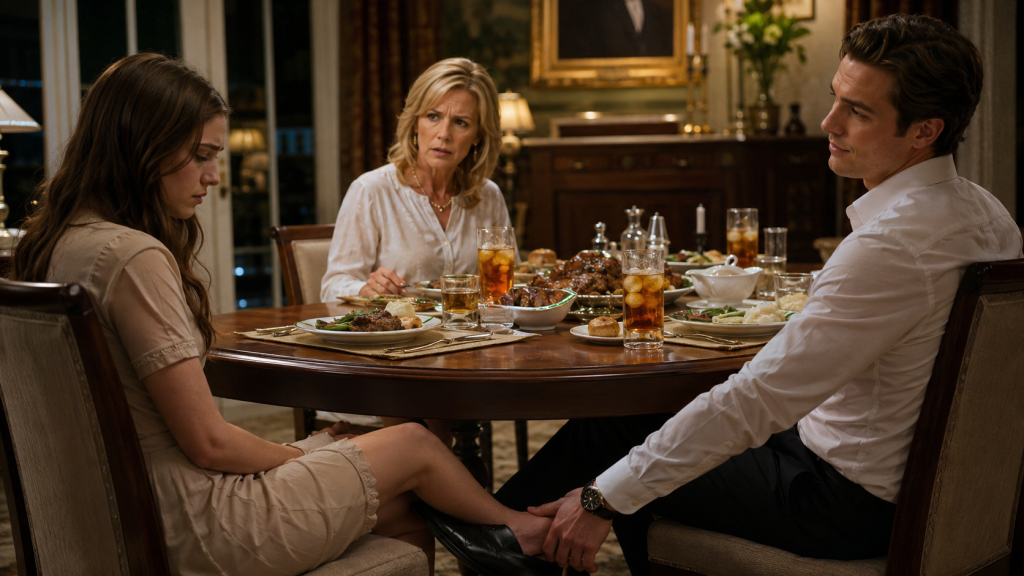
“Mrs. Davis,” he said, leaning in for a polite hug. “It’s a pleasure to finally meet you.”
He smelled of expensive cologne and something else I could not name at first.
Then I realized what it was.
Control.
He didn’t walk into my house like a guest.
He walked in like a man inspecting property.
At the table, Evan spoke well. He said he had businesses in Dallas. He said he believed in marriage young because “women need stability before the world teaches them rebellion.” He smiled when he said it, as if it were charming.
I looked at my daughter.
Danielle stared at her plate.
“You still working at the clinic, honey?” I asked her.
Before she could answer, Evan said, “Danielle is taking a break from that. Too stressful for her.”
Danielle’s fork froze halfway to her mouth.
“I didn’t know that,” I said.
“She was going to tell you,” he replied smoothly. “I just help her make better decisions.”
Better decisions.
I felt my fingers tighten around my napkin.
I had raised Danielle to speak for herself. I had watched her argue with teachers, defend classmates, and stand in front of a room full of people without trembling.
But that night, she barely lifted her eyes.
Every time I asked her something, Evan answered.
“Danielle doesn’t drink soda anymore.”
“Danielle prefers not to talk about old friends.”
“Danielle gets overwhelmed by too many questions.”
And each time, my daughter became smaller in her chair.
Then the first fork fell.
Clink.
“How clumsy of me,” Evan said.
He bent under the table to pick it up. When he came back up, he looked straight at me.
Not embarrassed.
Not apologetic.
Watching.
A few minutes later, it happened again.
Clink.
This time, his hand brushed against Danielle’s ankle.
She flinched so hard her glass shook.
“Everything okay, sweetie?” I asked.
“Yes, Mom.”
But it wasn’t her voice.
It was fear shaped like a word.
Evan reached for her hand on the table and squeezed it. Not lovingly. Warningly.
“She’s just tired,” he said.
The third time, the fork fell farther away, almost near my chair.
Clink.
“I’ll get it,” Evan said.
But I moved first.
I bent down, pretending to reach for the fork.
And there, under my own dining table, I saw the truth.
Evan’s right shoe was planted firmly on top of Danielle’s foot, crushing it against the floor.
My daughter’s toes were trapped beneath his polished black shoe.
But that was not what made my blood run cold.
It was her calf.
Old bruises.
A poorly hidden bandage.
And taped beneath the hem of her dress, just high enough that Evan would not see it, was a small folded piece of paper.
Danielle had put it there for me.
My hand trembled, but I forced myself to move slowly.
Evan bent down too.
“I said I’d get it, ma’am.”
He smiled.
But his eyes ordered me to let it go.
I grabbed the fork with one hand. With the other, I pinched the paper between two fingers and ripped it free.
Then I stood.
“I’m going to get more napkins,” I said.
I walked into the kitchen without running.
Because if I ran, he would know.
Because if Danielle cried, he would punish her.
Because my house, the same house where I had baked birthday cakes and wrapped Christmas presents, suddenly felt like a cage.
I opened the note by the sink.
It had only six words, written in black eyeliner.
Mom, don’t argue. He’s armed.
For a moment, I could not breathe.
The kitchen tilted.
My little girl was sitting ten feet away from me with a man who had a weapon and his foot on her body like she belonged to him.
From the dining room, Evan called out, “Everything okay, Mom?”
Mom.
The word made my stomach turn.
I reached into the drawer where I kept recipes, coupons, and my old cell phone charger. My phone was there. I unlocked it with shaking fingers and dialed 911.
When the operator answered, I turned on the sink faucet to cover my whisper.
“911, what is your emergency?”
“Private residence,” I breathed. “My daughter is in danger. Armed man inside. Please hurry.”
“Ma’am, stay on the line.”
But Evan’s chair scraped.
“Mary,” he said, closer now. “Who are you talking to?”
I ended the call and slid the phone into my apron pocket.
When I turned, he was standing in the kitchen doorway.
He was not smiling anymore.
Danielle stood behind him, crying silently.
“Mom, I’m sorry,” she whispered.
I looked at her hands.
Empty.
Then I looked at Evan’s belt.
There it was.
The black grip of a handgun beneath his jacket.
Evan tilted his head. “Danielle told me you were an obedient woman.”
I did not answer.
Because mothers are many things.
Soft.
Tired.
Forgiving.
But obedient is not one of them.
The doorbell rang.
Once.
Twice.
Evan’s face changed.
He pulled the gun out and pressed it against Danielle’s waist.
“Not one sound,” he whispered. “Send whoever it is away, or I swear she pays first.”
Danielle’s eyes locked on mine.
She was begging me not to be brave.
But I knew something Evan did not.
The 911 operator had heard enough.
I lifted both hands slightly. “It’s probably Mrs. Jenkins from next door. She borrows sugar all the time.”
He dragged Danielle with him as I walked toward the front door.
“Smile,” he hissed.
I opened the door just three inches.
Two police officers stood on my porch.
No sirens.
No flashing lights.
Just two calm faces and hands ready near their belts.
“Good evening, ma’am,” one officer said. “We got a disconnected call from this address.”
Behind me, Evan pressed closer.
I could feel his rage like heat.
“Everything is fine, officers,” I said carefully. “My daughter’s boyfriend is just leaving.”
For one second, no one moved.
Then Danielle did something I will remember until the day I die.
She drove her heel down hard onto Evan’s foot and screamed, “He has a gun!”
The officers moved faster than I could blink.
One shoved the door open.
The other pulled Danielle toward me.
Evan raised his arm, but the first officer slammed him into the hallway table before he could aim. The vase of yellow flowers shattered against the floor. The gun skidded across the hardwood and stopped beside the welcome mat.
I grabbed Danielle and pulled her behind me.
She collapsed in my arms, shaking so violently I could barely hold her.
“You’re safe,” I kept saying. “Baby, you’re safe.”
But she kept whispering, “I’m sorry, Mom. I’m so sorry.”
The police cuffed Evan face-down on my floor.
Even then, he was not afraid.
He turned his head and smiled at Danielle.
“You think this ends here?” he said.
One officer pushed his shoulder down. “Stop talking.”
Then Evan’s phone started ringing.
It was on the floor near his hand.
The screen lit up with one name.
Boss.
A message appeared beneath it.
Did her mother find the note?
The officer saw it too.
His expression changed.
He picked up the phone with gloved fingers and looked at Danielle.
“Miss Davis,” he asked gently, “is there someone else involved?”
Danielle shut her eyes.
And that was when I understood.
This was not just a bad boyfriend.
This was something darker.
At the police station, Danielle finally told us everything.
Evan had not saved her life.
He had trapped it.
She met him six months earlier after her car broke down outside a grocery store. He paid for the tow truck. He bought her coffee. He listened to her talk about grief, work, loneliness, and how hard it had been since her father died.
At first, he seemed kind.
Then he started choosing her clothes.
Then her friends.
Then her phone passwords.
Then her work schedule.
By the time she realized she was afraid of him, he had copies of her keys, control of her bank account, and enough threats to keep her silent.
The bruises on her legs came from “corrections,” as he called them.
The bandage covered a burn from the night she tried to leave.
I wanted to scream.
I wanted to find him and make him feel one second of what he had made my child feel.
But Danielle needed a mother more than she needed rage.
So I held her hand while she gave her statement.
The detectives traced the messages on Evan’s phone. The “Boss” was not some criminal mastermind like in a movie.
It was his older brother, Marcus.
Together, they had been using young women for fake loans, fake businesses, and stolen identities. Evan chose women who were lonely or grieving. He made them dependent. Then he used fear to make them sign papers, open accounts, and disappear from everyone who loved them.
Danielle had been his next target.
That dinner was supposed to be his final test.
If I approved of him, he planned to push Danielle into marrying him.
If I challenged him, he planned to take her away from me completely.
But my daughter was braver than he knew.
She had written that note in the bathroom with eyeliner, taped it beneath her dress, and prayed I would see it.
Two days later, the police arrested Marcus.
A week later, Danielle came home.
Not for dinner.
To stay.
The first night, she slept in her old room with the lamp on. I sat outside her door until sunrise, listening for nightmares. Around five in the morning, she opened the door and found me in the hallway.
“You don’t have to guard me, Mom,” she said softly.
I looked up at her.
“Yes, I do,” I said. “For a little while.”
She sat beside me on the floor and rested her head on my shoulder.
For months, healing came slowly.
Some days she laughed.
Some days she cried because a door closed too loudly.
Some days she apologized for things that were never her fault.
I reminded her every time.
Love does not crush your foot under a table.
Love does not answer for you.
Love does not call fear direction.
The trial happened in November.
Evan walked into court in a clean suit, looking like the kind of man strangers would trust. He tried to stare at Danielle the way he had stared at her in my dining room.
This time, she did not look down.
She stood before the judge with her shoulders straight.
“My mother saved my life,” she said. “But first, I had to believe I was worth saving.”
I cried then.
Not quietly.
Not politely.
I cried like a mother who had almost lost everything.
Evan was sentenced. Marcus too. Their businesses were exposed, their accounts frozen, and more women came forward after Danielle spoke.
A year later, Danielle moved into her own apartment three streets from mine.
She returned to work at the clinic.
She bought a yellow couch.
She adopted a tiny gray cat with one eye and named him Fork.
When she told me the name, we both laughed until we cried.
Every Sunday, she comes over for dinner.
Sometimes pot roast.
Sometimes chicken.
Always sweet tea.
There is still a small dent in my hallway wall where Evan hit the table that night. I never repaired it. People ask why I leave it there.
I tell them it reminds me of the night my house stopped being a cage and became a door.
A door my daughter walked through alive.
And every time Danielle sits at my table now, she stretches her feet out comfortably beneath it.
No one steps on them.
No one speaks for her.
No one tells her she needs direction.
And when she smiles at me across the table, it is no longer the fake smile of a woman asking silently for help.
It is my daughter’s real smile.
The one I thought I had lost.
The one that says she survived.
The one that says she came home.
THE END! THANKS FOR READING!