

I adopted twins I found abandoned on a plane—their mother showed up eighteen years later and handed them a document. I am seventy-three years old now, but there are certain memories that still feel close enough to touch. The smell of airplane coffee. The low hum of engines. The ache in my chest so deep I thought it would stop my heart.
Eighteen years ago, I boarded a flight home to bury my daughter. Her name was Claire. She was my only child, my bright girl, my reason for every sacrifice I had ever made. She had died in a car accident two days earlier, along with my little grandson, Ben, who was only four years old. I remember sitting by the window with my hands folded in my lap, staring at the clouds like they might open and give them back to me.
People around me complained about luggage, delays, crying children, bad seats.
I heard none of it at first.
Then the crying became impossible to ignore.
Three rows ahead, two infants were screaming.
A boy and a girl.
They could not have been more than six months old. Their little faces were red. Their tiny hands trembled. One had kicked off a sock. The other clutched a thin blanket like it was the only safe thing left in the world.
Passengers muttered angrily.
“Where is their mother?”
“Can someone shut them up?”
“This is disgusting.”
A flight attendant came by twice, her smile stiff and helpless, but every time she leaned close, the babies cried harder.
No one claimed them.
No one reached for them.
I told myself not to get involved. I was empty. I was broken. I had nothing left to give anyone.
Then the young woman sitting beside me touched my arm.
She was maybe twenty-three or twenty-four, dressed nicely, with soft brown hair and tired eyes. She looked at the babies, then at me.
“Someone needs to be the bigger person here,” she whispered. “Those babies need someone.”
Something in her voice cut through the fog around my grief.
I looked again.
The baby boy had stopped screaming and was making a small choking sound, like he had cried himself past hope. The baby girl’s lower lip trembled, but no sound came out anymore.
That silence broke me worse than the crying had.
Before I could think, I stood.
I walked down the aisle and lifted the boy first. He was warm and shaking. Then I gathered the girl against my other shoulder. Somehow, though I had not held a baby in decades, my arms remembered.
The moment I held them, they stopped crying.
The cabin went still.
The boy buried his face in my neck. The girl pressed her cheek against mine and grabbed my collar with surprising strength.
I turned slowly and called out, “Is there a mother on this plane? Please, if these are your children, come forward.”
No one moved.
Not a single person looked guilty.
The young woman beside my seat watched me with a strange, sad smile.
“You saved them,” she said quietly when I returned to my row. “Maybe they were meant to find you.”
At the time, I thought she was being kind.
I did not know she had just handed me the rest of my life.
When the plane landed, I carried both babies to airport security.
Social services came. Police came. They searched the airport, checked the passenger list, questioned the crew, reviewed footage. A diaper bag had been found under a seat, but there was no identification inside.
No one reported missing babies.
No one came forward.
The next day, I buried my daughter and grandson beneath a gray sky.
I stood beside two coffins and thought my life had ended with theirs.
But that night, in my cold house, I could not stop thinking about the twins.
The boy who clung to my shoulder.
The girl who grabbed my collar.
The way their crying stopped as if my arms had told them, You are safe now.
Two days later, I went to social services.
I said, “I know I am old. I know this sounds impossible. But I want to be considered for them.”
The woman behind the desk looked at me gently.
“Mrs. Whitaker, fostering two infants at your age is not simple.”
“I did not ask for simple,” I told her. “I asked for a chance.”
It took background checks, interviews, home visits, forms, court dates, and more tears than I can count.
Three months later, I became their foster mother.
One year later, I became their mother.
I named them Ethan and Sophie.
Ethan was serious from the beginning, always watching the world like he was trying to understand how it worked. Sophie laughed with her whole face and cried whenever someone else cried.
They saved me before they ever knew what saving meant.
When I could not sleep, I listened to them breathing.
When grief tried to pull me under, Ethan would reach for my finger from his crib.
When I missed Claire so badly I thought I might break in half, Sophie would smile at me with mashed carrots on her chin, and somehow the world would keep turning.
People said I was too old.
People said I was crazy.
People said I was replacing my daughter.
They were wrong.
No one replaces a child.
Love does not work that way.
Claire remained a room inside my heart, locked and sacred. Ethan and Sophie simply opened another door.
For eighteen years, I raised them with everything I had.
I sold my bigger house and moved into a smaller one near good schools. I took part-time bookkeeping work. I learned about science fairs, soccer cleats, online homework portals, and teenage heartbreak.
Ethan grew tall and quiet, with a sharp mind and a fierce sense of justice. If someone was bullied, he stepped in. If a teacher was unfair, he wrote a three-page argument explaining why.
He wanted to become a lawyer.
Sophie was bright, warm, and stubborn in the gentlest way. She volunteered at shelters, tutored younger kids, and remembered everyone’s birthdays. She could look at a person for five seconds and know exactly where they were hurting.
She wanted to become a doctor.
On their eighteenth birthday, I gave them each a small silver keychain engraved with one word.
Chosen.
Sophie cried.
Ethan tried not to.
“Mom,” he said, his voice rough, “you didn’t just choose us. We chose you too.”
I thought that was the happiest ending I was ever going to get.
Then, last week, someone knocked on my door.
I was in the kitchen, making tea. Ethan and Sophie were upstairs packing for college orientation. Our hallway was lined with photographs—birthdays, graduations, Christmas mornings, scraped knees, missing teeth, first cars.
I opened the door and saw a woman in designer clothes.
She wore a cream-colored coat, gold earrings, and perfume expensive enough to announce itself before she spoke.
“Hello, Margaret,” she said calmly.
My hand tightened on the door.
“Do I know you?”
Her smile was small.
“I’m Alicia. We met on a plane eighteen years ago.”
The floor seemed to tilt beneath me.
For a moment, I saw her younger face in my memory—the woman beside me, touching my arm, whispering that someone needed to help the babies.
“You were sitting next to me,” I said.
“I was.”
Before I could invite her in, she stepped past me.
Her eyes moved over my walls, pausing on every photograph of Ethan and Sophie.
Graduation robes.
Birthday cakes.
Prom night.
Family vacations.
A life built from what she had left behind.
“What do you want?” I asked.
Alicia turned to face me.
“I’m also the mother of those twins you took from the plane.”
The words landed like a slap.
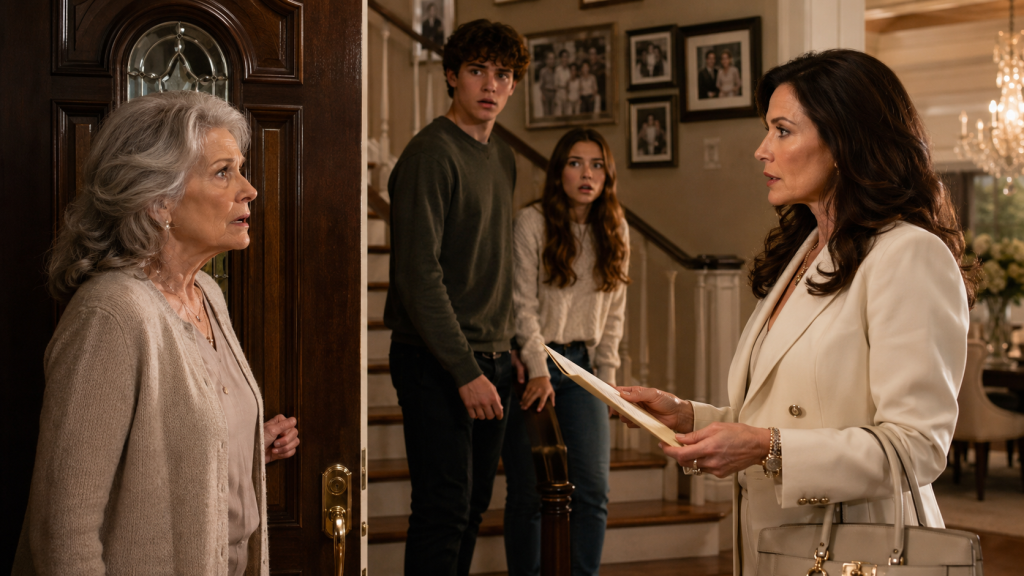
Behind me, I heard movement on the stairs.
Ethan and Sophie had come down halfway and stopped.
Their faces went white.
“You abandoned them,” I said. “You left two helpless babies alone on a plane.”
Alicia did not flinch.
“I was twenty-three. Terrified. Broke. I had been offered a job overseas. A real opportunity. I never planned for twins.”
“You never planned for responsibility,” Ethan said coldly.
Alicia looked at him, and for the first time, her mask cracked. Her eyes moved over his face hungrily, searching for herself in him.
“Ethan,” she whispered.
He stepped lower on the stairs but did not come closer.
“You don’t get to say my name like you earned it.”
Sophie’s hand found the railing.
“Why are you here now?”
Alicia reached into her purse and pulled out a thick envelope.
“I need you both to sign something.”
I almost laughed from shock.
“You came here with paperwork?”
“I came here with the truth,” she said. “And an opportunity.”
She placed the envelope on my dining table.
None of us touched it.
Alicia opened it herself and spread the documents neatly, like she was in a boardroom.
“My father died last month,” she said. “He was very wealthy. He left behind a trust worth twelve million dollars. But there is a condition. His biological descendants must be legally acknowledged before the trust can be released.”
Ethan stared at her.
“So this is about money.”
“Not only money.”
Sophie’s voice shook. “You left us as babies, waited eighteen years, then came back because there’s an inheritance?”
Alicia’s jaw tightened.
“You had a good life.”
“Because of her,” Ethan snapped, pointing at me. “Not because of you.”
Alicia looked at me then.
“I knew you would take care of them.”
My breath caught.
“What?”
“I saw you on that plane,” she said. “You were grieving. Broken. I heard you tell the flight attendant you were going home for a funeral. I thought…” She swallowed. “I thought maybe you needed them as much as they needed someone.”
For eighteen years, I had wondered how any mother could leave her children by accident.
Now I knew.
It had not been an accident.
“You set me up,” I whispered.
“I gave them a better life than I could have.”
“No,” I said, my voice rising. “You used my grief as a hiding place for your cowardice.”
For the first time, Alicia looked ashamed.
But it passed quickly.
“There is more,” she said.
She pulled another document from the envelope.
It was not a trust form.
It was a medical report.
“I am in kidney failure,” Alicia said.
The room went silent.
Sophie blinked.
“What?”
“I need a transplant. My doctor said a biological child may be a strong match. The trust will cover every medical cost, every school loan, every future expense. But first, you have to sign acknowledgment papers.”
Ethan gave a bitter laugh.
“So you didn’t come back for your children. You came back for their kidneys.”
Alicia’s face collapsed.
“I came back because I am dying.”
“People die,” Ethan said, his voice sharp with pain. “Our first mother died the day she walked off that plane.”
“Ethan,” I said softly.
He looked at me, and I saw the little boy from the airplane again, trembling against my shoulder.
Sophie stepped down the stairs and walked to the table.
She picked up the medical report, read it, then set it down carefully.
“Are you really sick?” she asked.
“Yes,” Alicia whispered.
“And if we do nothing?”
“I will stay on the transplant list. I may get lucky. I may not.”
Sophie closed her eyes.
She was compassionate, my Sophie. Even when wounded, she could still see another person’s pain.
But compassion is not the same as surrender.
She turned to me.
“Mom, did you know anything about this?”
“No,” I said. “Never.”
Sophie came to my side and took my hand.
Then she looked at Alicia.
“You gave birth to us. That matters biologically. But it does not make you our mother.”
Alicia’s lips trembled.
“I know.”
“No,” Ethan said. “You don’t. Because if you knew, you wouldn’t have walked in here like Mom was just a babysitter whose job was finished.”
Alicia lowered her eyes.
“I was wrong.”
Those three words should have brought comfort.
They did not.
They were eighteen years late.
Ethan walked to the table and picked up the envelope. He flipped through the pages slowly, his jaw tight.
“You want legal acknowledgment?”
“Yes,” Alicia said.
“You want access to medical testing?”
“Yes.”
“And the trust?”
“It belongs to you too. I did not come to take from you.”
Ethan looked at Sophie.
Sophie looked at me.
I wanted to tell them to throw Alicia out.
I wanted to protect them from every ugly truth.
But motherhood is not ownership. Love does not mean deciding for your children forever.
So I said the hardest thing.
“You do not owe her anything. But whatever choice you make, I will stand beside you.”
Sophie began to cry then.
Not loudly.
Just tears sliding down her cheeks.
“I hate that I feel sorry for her,” she whispered.
“That means I raised you well,” I said.
Ethan exhaled shakily.
“I’ll do the medical test,” he said. “But not because she deserves it.”
Alicia looked up, stunned.
Sophie nodded slowly. “I will too. But we are not signing anything until a lawyer reads every page.”
Ethan pointed at the photographs on the wall.
“And any legal document will state one thing clearly. Margaret Whitaker is our mother. Our only mother.”
Alicia covered her mouth.
Maybe she expected anger.
Maybe she expected greed.
Maybe she expected two abandoned babies to come running into her arms because blood had finally knocked on the door.
Instead, she found two adults who knew exactly where they belonged.
Three days later, a lawyer reviewed the documents.
The trust was real.
The medical need was real.
So was Alicia’s manipulation.
The acknowledgment forms were rewritten. Ethan and Sophie agreed to confirm biological relation for inheritance and medical history only. Nothing changed their adoption. Nothing changed their names. Nothing changed our family.
Both twins were tested.
Sophie was not a match.
Ethan was.
That night, he came into the kitchen where I was washing the same mug three times because my hands would not stop shaking.
“Mom,” he said, “I’m going to donate.”
I turned off the water.
“You don’t have to.”
“I know.”
“She hurt you.”
“I know.”
“You are allowed to walk away.”
“I know.”
“Then why?”
He leaned against the counter, looking suddenly like the man he had become and the baby he had been, all at once.
“Because you taught us that someone else’s failure doesn’t get to decide who we become.”
I cried then.
Harder than I had cried in years.
Ethan survived the surgery.
So did Alicia.
But recovery did not turn her into our family overnight.
Life is not that neat.
She sent flowers. Sophie returned them at first. Ethan ignored her calls. I did not encourage forgiveness, and I did not forbid it.
Forgiveness, like motherhood, cannot be forced.
Months passed.
Alicia began writing letters. Not excuses. Not demands. Just the truth, page after page.
She wrote about fear.
About poverty.
About selfishness.
About the moment she walked off that plane and realized too late that freedom can feel exactly like damnation.
Sophie read every letter.
Ethan read none of them for a while.
Then one evening, I found him at the dining table, one letter open beneath his hand.
He looked up at me.
“I still don’t know if I forgive her.”
“You don’t have to know today,” I said.
He nodded.
Then he folded the letter carefully and placed it back in the envelope.
A year has passed since Alicia knocked on my door.
She is healthier now.
She sees Ethan and Sophie sometimes, always on their terms. They call her Alicia. Not Mom.
As for me, I am still Margaret Whitaker.
Seventy-three years old.
A woman who lost a daughter and grandson, then found two abandoned babies in the sky.
For years, I believed grief had ended my story.
But grief did something strange.
It hollowed me out just enough for new love to enter.
People ask me if I regret taking those babies into my arms.
Never.
Not once.
Because the truth is simple.
Alicia may have left them on that plane.
But Ethan and Sophie did not become abandoned children.
They became my children.
And eighteen years later, when their past came knocking with documents, money, sickness, and secrets, they did not lose themselves.
They stood in the home we built together.
They held my hand.
And they chose love over blood.
Again.
THE END! THANK YOU FOR READING!