

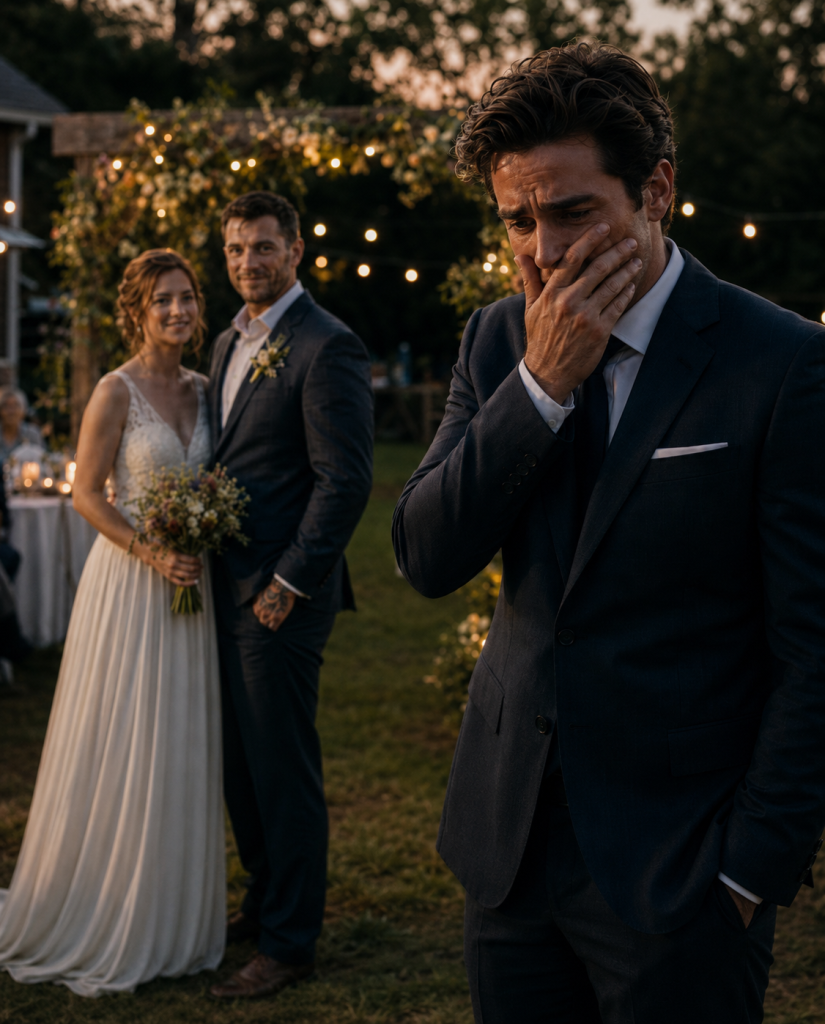
When I found out that my ex-wife had married a poor laborer, I went to her wedding with the intention of mocking her. But the moment I saw the groom, I turned around and burst into tears of pain. My name is David Harris.
I am thirty-two years old, and I live in New York City. For years, I believed success could be measured by the height of an office building, the shine of a watch, the price of a car, and the kind of woman standing beside you at business dinners.
I believed money could make a man better.
I believed poverty made people small.
And because of that, I lost the only woman who had ever loved me before I became someone worth showing off.
Her name was Sophie Moore.
I met Sophie at Columbia University.
She worked part-time at the campus library, stacking books and helping exhausted students find research materials at midnight.
I was an economics student with too much confidence and not enough humility.
Back then, I had only two suits, both bought on discount, and one pair of shoes I polished until the leather nearly gave up.
But I talked like I already owned Manhattan.
Sophie used to laugh at that.
Not because she mocked me.
Because she believed me.
“You really think you’re going to run the world one day, don’t you?” she asked once while handing me a book I needed for class.
I smiled and said, “Maybe not the whole world. Just the part with money.”
She rolled her eyes.
“You’re impossible, David Harris.”
But she kept smiling.
That was Sophie.
Soft, patient, kind in a way that never looked weak.
She remembered everyone’s coffee order.
She gave away half her lunch if someone forgot theirs.
She called her mother every Sunday and cried quietly after hanging up because her family struggled, but she never complained.
I fell in love with her slowly.
Then all at once.
We studied together.
Ate cheap noodles together.
Walked through campus in the snow together.
When I had nothing but ambition, Sophie looked at me like that was enough.
After graduation, I was hired by an international company in Manhattan.
The salary felt impossible.
The office had glass walls, city views, and people who wore confidence like armor.
I became obsessed immediately.
The late nights.
The promotions.
The numbers.
The applause from men who only respected people they could profit from.
Sophie, meanwhile, struggled.
Despite her degree and all my advice, she only managed to get a job as a receptionist at a small hotel.
She worked long shifts behind a front desk, wearing simple blouses and comfortable shoes.
When I picked her up from work, I would see her helping tourists with luggage, smiling politely at rude guests, translating directions for elderly visitors.
At first, I admired her patience.
Then I started feeling embarrassed by it.
I hate admitting that.
But truth does not become softer because we regret it.
I began comparing her to the women around me at work.
Women in designer suits.
Women who spoke three languages and never seemed tired.
Women who knew which wine to order with clients and how to laugh at jokes that were not funny.
Sophie seemed too simple beside them.
Too gentle.
Too ordinary.
One night, after a company dinner where my colleagues brought wives and girlfriends dressed like magazine covers, I drove Sophie home in silence.
She noticed, of course.
She always noticed.
“Did I do something wrong?” she asked.
“No.”
“Then why are you upset?”
I gripped the steering wheel.
“I just think… maybe we want different things.”
She stared at me.
“What does that mean?”
“It means I’m moving fast, Sophie. My life is changing.”
“And I’m not part of that?”
I should have stopped then.
I should have looked at her and remembered who held my hand when my father died.
Who stayed awake with me before interviews.
Who celebrated my first paycheck like I had won a crown.
Instead, I said the sentence that would shame me for years.
“I need someone who fits where I’m going.”
Sophie went still.
She did not scream.
She did not insult me.
She only looked out the window as if something inside her had quietly folded in half.
When I pulled up outside her apartment, she opened the door, then turned back once.
“I hope where you’re going is worth what you’re leaving behind.”
Then she got out.
I told myself I had done the right thing.
Ambitious men made hard decisions.
Successful men did not let emotion slow them down.
That was what I believed.
The woman I chose after Sophie was Valerie Richards.
She was the daughter of the company’s CEO.
Rich, elegant, polished, and proud.
She had the kind of confidence I once mistook for strength.
She introduced me to people I could never have reached on my own.
Her father noticed me.
My career accelerated.
The first time Valerie wore my arm at a company gala, I felt like I had finally become the man I had pretended to be.
But marriage to Valerie was not love.
It was a contract I could never win.
She despised my humble beginnings.
Whenever something displeased her, she reminded me exactly where I came from.
“Without my father, you’d still be a miserable salesman.”
If I worked late, she called me desperate.
If I came home early, she called me useless.
If I disagreed with her, she laughed and said, “Careful, David. Men like you are replaceable.”
I lived like a shadow inside my own home.
From outside, my life looked perfect.
Deputy Director of Sales.
BMW.
Luxury apartment.
A wife from a powerful family.
Expensive vacations.
Tailored suits.
Inside, I was slowly disappearing.
Five years passed.
I stopped thinking about Sophie every day.
But I never stopped completely.
Sometimes I saw a woman in a bookstore with the same warm brown hair and my chest tightened.
Sometimes I heard someone laugh softly in a café and turned too quickly.
Sometimes, when Valerie mocked me, I remembered Sophie saying, “You can do this,” and wondered how I had ever mistaken gentleness for smallness.
Then one evening, at a gathering with old college friends, someone mentioned her name.
“Hey, David,” my friend Mark said, stirring his drink. “Remember Sophie Moore?”
My heart gave a strange kick.
“Of course.”
“She’s getting married soon.”
I tried to keep my face neutral.
“Married? To whom?”
Mark shrugged.
“Some construction worker. Very poor, from what I heard. But people say she’s happy.”
Something ugly rose in me.
Jealousy dressed as superiority.
I let out a sarcastic laugh.
“Happy with a poor guy? She truly never knew how to pick the right people.”
Mark gave me a look I ignored.
That night, I could not sleep.
Valerie was away at a spa weekend with friends, and the apartment felt colder than usual.
I searched Sophie online.
There were not many photos.
She had never been someone who performed her life for strangers.
But I found one.
A simple engagement photo.
Sophie stood in a field at sunset, wearing a yellow dress, laughing with her head tilted back.
Beside her stood a man in a work shirt, his arm around her waist.
He was broad-shouldered, sun-browned, ordinary-looking at first glance.
His hands were rough.
His smile was quiet.
Sophie looked happier than I had ever made her.
That hurt.
So I turned the hurt into arrogance.
I decided to go to the wedding.
Not to congratulate her.
Not to apologize.
To prove something.
To show Sophie what she had lost.
To let her see the successful man I had become.
To look at her poor laborer husband and feel superior.
That was my intention.
I drove upstate on the day of her wedding in a dark suit that cost more than my first semester’s rent.
My BMW shone under the September sun.
The wedding was held in a small town in Upstate New York, at a modest house with a wide backyard.
String lights hung between trees.
Wooden tables were covered with simple white cloths.
Mason jars held wildflowers.
There was no valet.
No orchestra.
No champagne tower.
Just family, neighbors, homemade food, and people laughing like they actually meant it.
I got out of my car and adjusted my jacket.
Some guests turned to look.
I liked that.
I felt refined.
Successful.
Like I had arrived from another world.
Then I saw Sophie.
She stood near a wooden arch decorated with flowers, wearing a simple white dress.
Not designer.
Not expensive.
But beautiful.
She looked older, calmer, brighter.
There was a softness around her eyes that had not been there when I left her crying outside her apartment.
For one moment, shame brushed my chest.
Then pride shoved it away.
I told myself she had settled.
I told myself happiness in a backyard was not real happiness.
I told myself a poor man could never give her what I could have.
Then I saw the groom.
My heart stopped.
He was standing beside the arch, speaking with an older woman, laughing gently.
His dark hair was shorter now.
His shoulders broader.
But it was his hands that pulled the past out from under me.
Scarred hands.
Burn marks across the knuckles and wrists.
Thick, pale lines climbing toward his forearms.
I knew those hands.
Three years earlier, I had been driving back from Albany after a client meeting.
It had been raining hard.
I was exhausted, angry after an argument with Valerie, and driving too fast.
A truck swerved ahead of me.
I lost control.
The car spun across the highway, slammed into the barrier, and rolled into the ditch.
I remember smoke.
The taste of blood.
The smell of gasoline.
I remember hearing people shouting from far away.
Then heat.
Flames.
My door would not open.
My seatbelt had locked.
I could not move my left leg.
I screamed until my throat tore.
Cars stopped.
People gathered.
I saw faces through the shattered window, but nobody came close.
Then one man did.
A construction worker in a reflective vest.
He ran toward the burning car while others yelled for him to stay back.
He wrapped his jacket around his arms, smashed more glass away, reached inside, and kept saying, “Stay with me, brother. Stay with me.”
I remember his hands bleeding.
Then burning.
I remember him cursing when the metal cut into him.
I remember him pulling me free seconds before the front of the car burst into flames.
He dragged me across wet grass and held my head until the ambulance arrived.
I tried to ask his name.
He only said, “You made it. That’s what matters.”
At the hospital, I asked about him.
No one knew.
A nurse said he had refused treatment at first because he wanted to make sure I lived.
By the time I could walk again, he was gone.
I searched for weeks.
I called hospitals.
Police departments.
Fire stations.
No one could tell me who the man was.
Eventually, life swallowed the miracle.
I told the story at parties sometimes.
The brave stranger who saved me.
People admired it.
I enjoyed the attention.
But I never found him.
Until Sophie’s wedding.
The poor laborer I had come to mock was Michael Carter.
The man who had carried me out of death.
My arrogance collapsed in one breath.
My knees weakened.
The sounds of the wedding blurred.
Children laughing.
Chairs scraping.
Someone tuning a guitar.
All of it faded behind the roar of blood in my ears.
Michael turned slightly.
His eyes met mine.
For a second, he stared as if searching memory.
Then recognition softened his face.
He did not look angry.
He did not look impressed.
He simply nodded.
“You made it,” he said softly.
Those three words broke me.
Not because they were dramatic.
Because they were exactly what he had said the night he saved my life.
You made it.
I had made it out of the fire.
But what had I become after surviving?
A man who measured people by money.
A man who abandoned love for status.
A man who drove to a wedding to humiliate the person he once wounded.
I turned away before Sophie reached me.
But tears came before I made it to my car.
I leaned against the door, shaking.
For the first time in years, I did not feel successful.
I felt small.
Not poor.
Not powerless.
Small in the only way that mattered.
My chest hurt so badly I could barely breathe.
Behind me, I heard footsteps on the gravel.
“David?”
It was Sophie.
I wiped my face quickly, but she had already seen.
She stood a few feet away, holding part of her dress so it would not drag on the ground.
Her expression was careful.
Not cruel.
Not warm either.
Just careful.
“You came,” she said.
I forced a laugh that sounded broken.
“I did.”
“Why?”
There was no lie good enough.
No polished answer.
No version of myself I could perform in front of her anymore.
So I told the truth.
“I came to look down on you.”
She did not flinch.
Maybe part of her had expected it.
“I see.”
“I heard you were marrying a construction worker. I thought… I thought you had settled.”
Her face remained calm, but pain moved through her eyes.
“And now?”
I looked toward the backyard.
Michael was watching us from a distance, not possessively, not anxiously, just present.
The same way he had been present beside my burning car.
“He saved my life,” I whispered.
Sophie’s expression changed.
“What?”
“Three years ago. There was an accident outside Albany. My car caught fire. People stood around filming. He ran in. He pulled me out.”
I covered my face with one hand.
“I searched for him. I never found him. And today I came here to mock him.”
The words tasted like ash.
Sophie looked back at Michael.
Then at me.
“He never told me your name,” she said softly.
“He probably didn’t know it.”
“He told me once that he saved a man from a car accident and hoped the man went on to live well.”
That sentence hit harder than any insult could have.
I had not lived well.
I had lived richly.
There is a difference.
“I’m sorry,” I said.
The words sounded too small for what they needed to carry.
“I’m sorry for leaving you the way I did. I’m sorry for thinking your job made you less. I’m sorry for coming here today with cruelty in my heart.”
Sophie looked down.
For a long moment, she said nothing.
Then she said, “You hurt me very badly, David.”
“I know.”
“No, I don’t think you do.”
I deserved that.
I nodded.
“You’re right.”
“When you left, I believed you. I believed I wasn’t enough for the life you wanted.”
My throat tightened.
“You were more than enough.”
“I know that now.”
She said it without bitterness.
That was what made it hurt.
She had healed.
Not because I apologized.
Not because I came back.
Because someone else had loved her correctly.
“Michael never made me feel small,” she said. “Not once.”
I looked at the ground.
“I’m glad.”
And I meant it.
That surprised me.
Because somewhere beneath jealousy and regret, I was glad.
Glad she had not stayed broken where I left her.
Glad someone had seen her clearly.
Glad the man who saved my life was good enough to hold hers.
Michael walked over then.
Up close, the scars on his hands were even more visible.
I stared at them, ashamed.
He noticed.
“Old story,” he said gently.
“I owe you everything,” I said.
He shook his head.
“No. You owe me nothing.”
“I do.”
“You were a man in danger. I helped. That’s all.”
That’s all.
As if risking his life for a stranger were ordinary.
As if courage were not something he wore in silence every day.
I reached for my wallet, then stopped immediately.
The gesture itself embarrassed me.
Michael saw it.
A faint smile touched his face.
“You can’t pay for that kind of thing.”
“I know,” I said.
For once, I did know.
Sophie looked between us.
The music started behind her.
People were gathering.
Her wedding was waiting.
I had already taken too much space in a day that belonged to her.
“I should go,” I said.
Sophie nodded.
“Maybe you should stay for the ceremony.”
I looked at her, stunned.
“I don’t deserve that.”
“No,” she said gently. “But maybe you need to see it.”
So I stayed.
I stood at the back, under a maple tree, while Sophie walked down the grass aisle toward Michael.
There was no dramatic orchestra.
Only a guitar and the sound of leaves moving in the wind.
Michael cried when he saw her.
Not ashamed.
Not hiding it.
A strong man in a simple suit, crying because the woman he loved was walking toward him.
I thought of how many times I had hidden tenderness because I thought it made me look weak.
I thought of Valerie laughing whenever I showed emotion.
I thought of Sophie, years ago, waiting for me to become kinder.
When they exchanged vows, Michael did not promise wealth.
He promised presence.
“I cannot give you the fanciest life,” he said, voice shaking. “But I promise you will never wonder whether you are valued. You will never have to earn gentleness from me. You will never stand alone while I have breath.”
Sophie cried.
So did half the backyard.
So did I.
The man I had dismissed as poor had just offered her something I had never understood how to give.
Safety.
After the ceremony, I left quietly.
I did not stay for food.
I did not try to insert myself into their happiness.
Before I reached my car, Michael called my name.
I turned.
He walked toward me with two slices of wedding cake wrapped in napkins.
“One for the road,” he said.
I almost laughed.
Almost.
Instead, I accepted it with both hands.
“Thank you.”
He held my gaze.
“Live well,” he said.
There was no accusation in it.
Only hope.
That made it harder.
On the drive back to New York, I pulled over twice because I could not see through tears.
When I got home, Valerie was in the living room, scrolling on her phone.
She looked up at my face and frowned.
“What happened to you?”
I took off my jacket.
“I went to Sophie’s wedding.”
Her mouth twisted.
“The receptionist?”
“The woman I should have respected.”
Valerie laughed.
I looked at her and realized the sound did not hurt anymore.
It only clarified.
Two months later, Valerie and I separated.
Not because of Sophie.
Not because I thought I could return to a past I had destroyed.
Because I finally understood that a life built on status can still be empty enough to echo.
The divorce was ugly.
Valerie told everyone I was having a breakdown.
Maybe I was.
But sometimes a breakdown is just a false self falling apart.
I left the luxury apartment.
Sold the BMW.
Moved into a smaller place in Brooklyn.
For the first time in years, I learned how to live without applause.
I started therapy.
Real therapy.
Not the kind where a man complains about his wife and waits to be validated.
The kind where I had to sit with the version of myself who abandoned Sophie.
The version who used money as proof of worth.
The version who nearly died in a fire and still failed to become grateful.
I wrote Sophie one letter.
Only one.
I did not ask to meet.
I did not ask for forgiveness.
I simply apologized fully, without excuses, and thanked her for loving me when I had not known what love was.
I never expected a reply.
Three weeks later, one came.
David,
Thank you for saying this. I forgave you a long time ago, not because you asked, but because I needed my heart back. I hope you become the kind of man you once pretended to be.
Sophie
I kept that letter.
Not as hope.
As instruction.
A year later, I saw a photo of Sophie and Michael online.
They had opened a small community workshop where Michael taught teenagers basic construction skills, and Sophie helped with reading, resumes, and job applications.
In the picture, Michael stood with his scarred hands resting on a workbench.
Sophie stood beside him, smiling.
No mansion.
No luxury car.
No corporate title.
Just purpose.
I stared at the photo for a long time.
Then I donated anonymously to the workshop.
Not to impress them.
Not to buy peace.
Only because good things should be supported when we finally recognize them.
I am still learning.
I still catch myself measuring success in old ways.
A watch.
A title.
A room full of important people.
But then I remember Michael’s burned hands.
Sophie’s simple wedding dress.
The backyard lights.
The wedding cake wrapped in napkins.
And the sentence that stripped me bare.
You made it.
I had made it out of the fire years before.
But that wedding was the day I realized survival is not the same as becoming worthy of being saved.
Worth is not salary.
It is not status.
It is not marrying someone who makes your résumé look better.
Worth is who runs toward the fire.
Who stays when life becomes ordinary.
Who makes another person feel safe.
Who does not need witnesses to be kind.
I went to Sophie’s wedding intending to mock the poor laborer she had chosen.
Instead, I met the man who had once risked his life to save mine.
And I saw, with painful clarity, that Sophie had not married beneath her.
She had married above everything I used to worship.
As for me, I drove there believing I was a successful man.
I drove back knowing I was only a man who had been given another chance to become human.
THE END! THANKS FOR READING!