

I was eight months pregnant when my husband traded our family for a fitness model. The gift I sent to their wedding altar left the guests in awe. My name is Rebecca Hale. I am forty-five years old. Eight kids. Eight pregnancies. Fifteen years spent building a life I truly believed my husband and I both wanted.
By the time Evan left me, I could barely bend down to tie my own shoes. My ankles were swollen, my back hurt all the time, and the nursery still smelled like fresh paint because I had spent the last week trying to finish it alone. The crib was still in pieces on the floor. I was sitting there with an instruction booklet in my lap, struggling to twist a screw into place with swollen fingers, when Evan walked into the doorway.
He had a suitcase in his hand.
Not a grocery bag.
Not work files.
A suitcase.
At first, I honestly thought he was leaving for a business trip he had forgotten to mention. Evan did that sometimes. He had become distant in the last year, more secretive, always on his phone, always irritated by the normal noise of our house.
A spilled cup.
A crying toddler.
A teenager asking for help with homework.
A baby kicking inside me while I tried to fold laundry at midnight.
All of it seemed to annoy him.
But I still did not understand what was happening until he said it.
“I can’t do this anymore.”
His voice was calm.
That was what hurt the most.
Not the words.
The calmness.
He said it like he was canceling a subscription.
I looked up at him from the nursery floor.
“What are you talking about?”
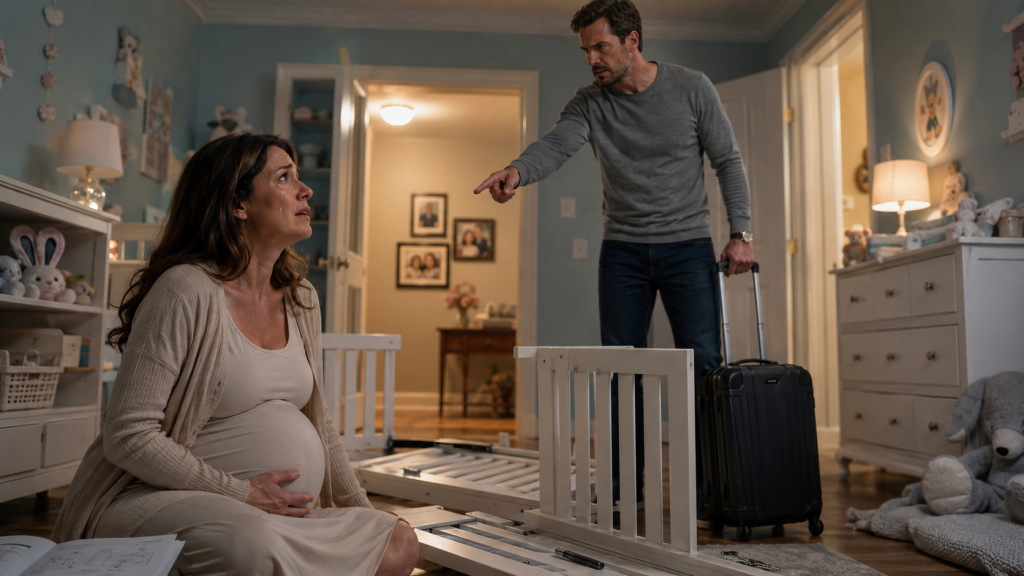
He glanced around the room with disgust, like the painted walls, the tiny blankets, and the half-built crib were evidence against me.
“The noise,” he said. “The diapers. The bills. The chaos. And this.”
Then he pointed at my stomach.
Eight months pregnant.
Our daughter kicked beneath his finger, hard and sudden, as if even she understood she had just been rejected before taking her first breath.
I placed both hands over my belly.
“Evan,” I whispered, “this is your child.”
He looked away.
“I know.”
Two words.
No shame.
No grief.
Just irritation.
I tried to stand, but my body was heavy and slow. I had to grip the side of the crib box to pull myself up. For a moment, I hoped that seeing me struggle would wake something in him.
Love.
Guilt.
Humanity.
Anything.
But he only stepped back, careful not to help me.
“I need a different life,” he said.
“A different life?” I repeated. “You have seven children sleeping in this house, Evan. You have one more coming in a few weeks.”
“I never wanted this many.”
The sentence struck me harder than if he had raised his hand.
Because it was a lie.
It was a cruel, deliberate lie.
He had wanted the big family.
He had kissed my forehead after every positive pregnancy test.
He had painted bedrooms, chosen names, bragged at church, posted family photos with captions about blessings and legacy.
And now he stood there pretending I had trapped him in a life he helped create.
“You’re tired,” I said, because I was still trying to save us. “We’re both tired. We can talk tomorrow.”
“No,” he said. “I’m done talking.”
Then his phone buzzed.
He looked down.
And smiled.
It was small, quick, almost invisible.
But I saw it.
A woman’s name flashed across his screen.
Brielle.
I had seen the name before. Likes on his posts. Comments under gym pictures. Little fire emojis. Hearts. Compliments written like innocent jokes.
She was twenty-three years old.
A fitness influencer.
Smooth skin, perfect body, perfect lighting, perfect smile.
Everything I was not anymore.
I was stretch marks, tired eyes, gray hairs, maternity leggings, and milk-stained shirts from children I had spent years raising.
“Is there someone else?” I asked.
He did not answer.
He did not need to.
I felt the answer settle in the room like smoke.
He picked up his suitcase again.
“Don’t make this ugly, Rebecca.”
I laughed once.
Not because anything was funny.
Because I could not believe he had the nerve to ask me for grace while abandoning me on the floor of our unborn baby’s nursery.
“Ugly?” I said. “You are walking out on your pregnant wife and seven children.”
His face hardened.
“I’ll send money when I can.”
“When you can?”
“I need to build my new life too.”
His new life.
Those words became a blade that stayed inside me for weeks.
He walked downstairs.
I followed slowly, one hand on the railing, one hand on my belly.
Our oldest, Grace, was fourteen. She stood frozen in the hallway wearing her school sweatshirt, her hair still damp from a shower.
“Dad?” she said.
Evan stopped.
For one second, his face changed.
Then it closed again.
“I’ll call you soon,” he said.
Grace looked at the suitcase.
Then at me.
Then at him.
“Where are you going?”
He did not answer her either.
He walked out the front door.
Just like that.
No hug.
No explanation.
No goodbye to the little boys asleep upstairs.
No kiss on the forehead for our three-year-old daughter who still asked him every night to check under her bed for monsters.
No hand on my stomach.
No apology.
Nothing.
I stood at the window and watched his car disappear around the corner.
The baby kicked again.
Hard.
I pressed my palm against my belly and whispered, “I know, sweetheart.”
Behind me, Grace started crying.
That was the moment I learned a mother does not get to fall apart when her children are watching.
So I turned around, wiped my face before the tears could fully come, and held my daughter while my own heart broke quietly behind her back.
Two days later, Evan was all over social media.
Not hidden.
Not ashamed.
All over it.
Photos at a rooftop bar.
Photos in a sports car.
Photos with Brielle wrapped around him, her glossy hair spilling over his shoulder, her caption reading:
“Sometimes the universe gives you the love story you deserve.”
I stared at that sentence for a long time.
The love story he deserved.
Meanwhile, at home, our seven-year-old twins were fighting over cereal because I had forgotten to buy the kind they liked.
Our ten-year-old had outgrown his sneakers.
Our toddler had a fever.
Our oldest was pretending not to cry while packing lunches because she thought helping me meant becoming an adult overnight.
And I was eight months pregnant, sitting at the kitchen table with bills spread in front of me like a map of a country I no longer knew how to survive in.
Then the bank called.
The mortgage payment had bounced.
At first, I thought it was a mistake.
Evan had always handled most of the accounts. Not because I was incapable, but because years ago, when the kids were small and I was exhausted, he had said, “Let me take care of the money. You take care of the home.”
I had trusted him.
That trust cost me nearly everything.
The joint savings account was almost empty.
The emergency fund was gone.
The credit card he had told me was “for family needs” was maxed out.
Hotel charges.
Designer stores.
Restaurants.
Flights.
Jewelry.
A charge from a luxury resort in Miami.
Another from a boutique gym.
Another from a bridal shop.
A bridal shop.
I sat there staring at the screen until the letters blurred.
Then I called him.
He answered on the fourth ring, annoyed.
“What?”
“Where is the money, Evan?”
A pause.
Then a sigh.
“I took what I needed.”
“What you needed? The mortgage bounced.”
“I told you I’d send money when I can.”
“We have children.”
“And I have expenses.”
The room tilted.
“You stole from your family.”
“I earned most of that money.”
I gripped the phone so hard my knuckles turned white.
“I raised your children so you could work those hours.”
“I’m not arguing with you.”
“You drained our accounts.”
“I need it to build my new life.”
There it was again.
His new life.
I looked across the kitchen at Grace, who was trying to help our five-year-old zip his backpack. She heard enough. Her little face changed, not into sadness this time, but into something sharper.
Disappointment.
Children should never have to see their heroes shrink.
“Evan,” I said quietly, “you need to come home and fix this.”
“No.”
“Then at least pay the mortgage.”
“I can’t right now.”
“You mean you won’t.”
He went silent.
Then he said, “Don’t make me the villain because you can’t handle the life you chose.”
I hung up before he could hear me break.
For three weeks, I slept on the couch because climbing the stairs made my hips ache so badly I cried into a pillow. The baby pressed against my ribs. My back throbbed. My feet swelled until even slippers hurt.
Bill collectors called.
The electric company sent a warning.
The mortgage company sent another.
I sold jewelry Evan had given me back when he still pretended to love me. I returned baby items I had bought with excitement. I applied for assistance. I called a lawyer whose fee made me feel sick. I took notes. I gathered bank records. I printed screenshots.
At night, when the little ones were asleep, Grace sat beside me with a notebook.
“Mom,” she said one evening, “is Dad coming back?”
I wanted to lie.
I wanted to say yes.
Instead, I said, “I don’t think so, honey.”
She nodded like she already knew.
“He chose her.”
I swallowed.
“He made a selfish choice.”
Her eyes filled.
“Did we do something wrong?”
That question nearly destroyed me.
I reached for her hand.
“No. Listen to me. Not you. Not your brothers. Not your sisters. Not the baby. None of you did anything wrong. Your father’s choices belong to him.”
She looked down at my belly.
“Does the baby know?”
I touched my stomach.
“I think she knows she is loved.”
Grace leaned against me.
“We’ll love her extra.”
I closed my eyes.
That was how we survived.
Not because I was strong every second.
I was not.
I cried in the shower.
I screamed into towels.
I sat in the parked minivan outside the grocery store counting coins and wondering how my life had become something I would have pitied if I saw it happening to another woman.
But every morning, I got up.
Because seven children still needed breakfast.
One baby still needed a mother.
And I refused to let Evan’s abandonment become the story that defined us.
Then one evening, everything changed.
I was scrolling through social media, exhausted, numb, only looking because pain becomes a strange addiction when someone has humiliated you publicly.
And there it was.
A wedding announcement.
Evan and Brielle.
Beach ceremony.
White roses.
Gold chairs.
Live music.
A livestream link for family, friends, and followers.
The caption read:
“Join us as we begin forever.”
Forever.
He had left us less than a month earlier.
I was still pregnant with his child.
Our children were still asking why Dad did not call.
And he was planning forever with a woman who posted workout videos in the same hotel room he had paid for with money stolen from our savings.
I stared at the announcement until my breathing changed.
Not crying.
Not shaking.
Something else.
Stillness.
A cold, clear stillness I had never felt before.
That night, after the kids went to bed, I opened the folder I had been building.
Bank statements.
Messages.
Screenshots.
Voicemails.
Emails from the mortgage company.
Proof of the emptied accounts.
Proof of the bridal charges.
Proof of everything.
Then I found one video on my phone that I had forgotten about.
It was from six months earlier.
A family barbecue in our backyard.
Evan had been standing with a paper plate in his hand, laughing while our children ran through sprinklers.
Someone had asked him how he handled such a big family.
He had pulled me close, kissed my temple, and said to the camera, “This is my kingdom. My wife and my kids are everything. I’d be nothing without them.”
I watched it three times.
Then I started to build his wedding gift.
Not a revenge gift.
Not exactly.
A truth gift.
The kind of truth people only call cruel when it exposes cruelty.
I ordered a beautiful ivory box.
Inside, I placed a framed photo taken that same week.
Not of me.
Not of him.
Our seven children stood in the unfinished nursery, arranged around the crib pieces, holding a tiny pair of pink baby shoes.
Grace had asked to write the note herself.
I hesitated at first.
She was only fourteen.
She should not have been part of adult pain.
But she looked at me and said, “Mom, he left us too.”
So I let her write it.
In careful handwriting, she wrote:
“Congratulations, Dad. Since you chose a new family, we brought the old one to say goodbye.”
Behind the frame, I placed a small digital screen.
On it, I loaded a short video.
Not edited to lie.
Not exaggerated.
Just the truth.
Evan’s old barbecue clip saying his family was everything.
Then screenshots of his wedding charges.
His message saying he needed the money to build his new life.
His voicemail saying I had chosen this life.
The mortgage warning.
The bank balance.
And finally, a short video of the kids.
They did not cry.
I would not let them perform pain for strangers.
They simply stood together in the nursery while Grace spoke.
“Dad, we hope your new life makes you happy. We just wish you had said goodbye to us first.”
That was all.
No screaming.
No insults.
No threats.
Truth does not need decoration.
On the morning of the wedding, I woke up with cramps in my lower back.
For one terrifying moment, I thought labor had started.
But the pain faded.
I sat on the couch in the dim morning light, one hand on my belly, listening to the house breathe.
The kids woke one by one.
Nobody asked if we were watching.
They already knew.
At noon, the livestream began.
The beach looked expensive and perfect.
White fabric moved in the wind.
Guests sat in gold chairs facing an arch covered in flowers.
Brielle appeared first, glowing in a sleek dress that probably cost more than our monthly mortgage.
Then Evan stood at the altar in a cream suit, smiling like a man without a past.
The children sat around me in silence.
My youngest climbed into my lap, resting her head against my belly.
“Is Daddy getting married?” she whispered.
I kissed her hair.
“Yes.”
“Are we invited?”
My throat tightened.
“No, baby.”
She thought about that.
Then she said, “That’s not nice.”
No, it was not.
The ceremony began.
The officiant spoke about destiny.
Second chances.
True love.
I almost turned it off.
Then, on the screen, I saw a staff member walk carefully down the aisle carrying an ivory box tied with gold ribbon.
For a second, confusion moved through the guests.
Brielle smiled, delighted, probably thinking it was some dramatic romantic surprise.
Evan smiled too.
He loved attention.
He loved being admired.
The staff member handed him the box.
The officiant paused.
Someone near the camera laughed softly.
Evan looked at the tag.
His smile faltered.
He knew my handwriting.
The wind moved around him.
For a long moment, he did nothing.
Then Brielle leaned toward him.
“What is it?” she whispered.
The microphone picked it up.
Evan swallowed.
He should have set the box aside.
He should have waited.
But pride is a foolish thing.
He opened it.
The first thing he saw was the photo.
Our children.
His children.
Standing in the nursery he had abandoned.
The tiny pink shoes in Grace’s hands.
The note.
I watched his face drain of color.
Brielle leaned in, confused.
“What is that?”
He tried to close the box.
But the screen inside turned on automatically.
His own voice filled the beach.
“This is my kingdom. My wife and my kids are everything. I’d be nothing without them.”
A murmur moved through the guests.
Then came the screenshots.
The drained account.
The unpaid mortgage.
The bridal shop charge.
His message.
I need it to build my new life.
Someone gasped.
The camera shifted as the person filming moved closer.
Brielle’s face changed slowly from confusion to horror.
Then Grace appeared on the small screen.
“Dad,” her recorded voice said, steady but quiet, “we hope your new life makes you happy. We just wish you had said goodbye to us first.”
The beach went silent.
Not dramatic silence.
Real silence.
The kind that happens when a room full of people realizes they are witnessing the truth in public.
Brielle stepped back from Evan.
“Is this real?” she asked.
Evan’s mouth opened.
Nothing came out.
Her father stood from the front row.
A woman in a blue dress covered her mouth.
The officiant looked like he wanted to disappear.
Evan finally grabbed the box and snapped it shut, but it was too late.
The livestream comments exploded.
Who are those kids?
Is his wife pregnant?
Did he abandon them?
Brielle, did you know?
My phone started ringing.
Evan.
I looked at the screen.
Let it ring.
He called again.
Then again.
Then texts came in.
Answer me.
Take it down.
You humiliated me.
You ruined everything.
Rebecca, answer the phone.
For the first time in weeks, I smiled.
Not because I had won.
There was no winning in a family breaking apart.
I smiled because he finally understood what it felt like to be powerless while someone else controlled the story.
Grace looked at me.
“Are you okay?”
I looked at my children, all crowded around me on the couch, their faces lit by the screen.
“No,” I said honestly. “But I will be.”
The wedding did not continue.
Brielle walked away.
Her mother followed.
Guests stood awkwardly, whispering behind manicured hands.
Evan tried to chase Brielle, still holding the ivory box, but her father stepped between them.
Then the livestream cut off.
For a while, nobody moved.
Then my five-year-old son said, “Can we have pancakes?”
And just like that, life reminded me that children do not pause for heartbreak.
So I made pancakes.
Eight months pregnant, aching, exhausted, standing at the stove while my whole world burned and somehow kept spinning.
That evening, Evan came to the house.
I knew he would.
He knocked first.
Then rang the bell.
Then pounded.
Grace gathered the little ones upstairs without me asking.
I opened the door but left the chain on.
He looked terrible.
His perfect wedding suit was wrinkled. His hair was windblown. His eyes were red with anger.
“How could you?” he hissed.
I stared at him.
“How could I?”
“You destroyed my life.”
I laughed softly.
“You walked out of ours.”
His jaw tightened.
“You turned everyone against me.”
“No, Evan. I showed them what you did. There’s a difference.”
He leaned closer to the crack in the door.
“You had no right to involve the kids.”
“They were already involved when you abandoned them.”
He looked past me into the house.
“Let me in.”
“No.”
“This is my house too.”
“Then you should have helped pay for it.”
His face twisted.
“I made a mistake.”
That sentence landed between us.
A month earlier, I would have wanted it.
I would have begged for it.
I would have grabbed those words like a rope.
But now they sounded too small.
A mistake was forgetting milk.
A mistake was missing an appointment.
Leaving your pregnant wife, draining accounts, humiliating your children, and marrying another woman on a beach was not a mistake.
It was a series of choices.
“You made many,” I said.
He lowered his voice.
“Brielle left me.”
I almost felt sorry for him.
Almost.
“She said she didn’t know about the money,” he continued. “She said you made me look like a monster.”
“No,” I said. “You made yourself look like one. I just sent a mirror.”
His eyes filled suddenly.
Whether from guilt or panic, I did not know.
“Rebecca, please. I need to see the kids.”
“You can arrange that through my lawyer.”
“Your lawyer?”
“Yes.”
His expression changed.
“You can’t afford a lawyer.”
That was the old Evan speaking.
The one who thought I was too tired, too pregnant, too dependent, too buried under children to fight back.
“I found one,” I said.
It was true.
After the livestream, my inbox had filled with messages. Some cruel, yes. But many kind. Women offering advice. A retired attorney from our church. A cousin I had not spoken to in years who worked in family law. A neighbor who had seen more than I realized.
People are strange.
Some vanish when your life falls apart.
Others appear with flashlights.
“I’ll fix the mortgage,” Evan said quickly. “I’ll put money back.”
“You should.”
“Then we can talk.”
“No.”
His face went still.
“No?”
“No, Evan. We are done.”
“You don’t mean that.”
“I do.”
“You’re emotional. You’re pregnant.”
I opened the door as far as the chain allowed and looked him directly in the eye.
“I am pregnant, not stupid.”
For the first time, he had no answer.
A week later, Brielle posted a statement.
She claimed she had not known Evan was still married in every meaningful sense, had not known I was pregnant, had not known about the children being cut off financially.
Maybe that was true.
Maybe it was not.
I stopped caring.
My concern was not Brielle.
It was the seven children already here and the daughter still inside me.
The legal process was ugly.
Evan tried to paint himself as overwhelmed.
He said I had become obsessed with motherhood.
He said the house was chaotic.
He said he deserved peace.
The judge looked at him for a long time and asked if peace required emptying accounts used to feed children.
Evan had no good answer.
Temporary support was ordered.
The mortgage was brought current.
The accounts were reviewed.
His wages were garnished before he could “forget.”
And me?
I had the baby three weeks later.
A little girl.
We named her Hope.
Not because life had become easy.
It had not.
I delivered her after twelve hours of labor with Grace holding one hand and my sister holding the other. Evan arrived at the hospital after she was born, carrying flowers from the gift shop downstairs.
He asked if he could hold her.
I looked at my newborn daughter, wrapped in a white blanket, her tiny mouth opening and closing like she was already trying to speak.
Then I looked at him.
“You may sit,” I said. “You may meet her. But you do not get to walk in and out of her life whenever your conscience hurts.”
He cried when he saw her.
I will not pretend that meant nothing.
It meant he was human.
It did not mean he was safe.
That is something women learn the hard way.
A man can cry and still hurt you again.
A man can regret consequences more than choices.
A man can miss his children and still fail to become the father they deserve.
So I watched him carefully.
Not with hate.
With boundaries.
Months passed.
The house changed.
Not right away.
Not magically.
There were still bills.
Still court dates.
Still nights when one child cried for the old version of Dad and another refused to say his name.
But there was laughter too.
Grace joined the debate team.
The twins learned to make scrambled eggs.
My ten-year-old started mowing neighbors’ lawns for pocket money and proudly bought diapers once, though I made him keep his money after that.
Hope grew fat-cheeked and bright-eyed, loved fiercely by seven siblings who acted like she belonged to all of them.
The nursery was finished by the people who stayed.
My sister painted clouds on the wall.
A neighbor assembled the crib.
Grace placed the pink shoes from the wedding gift on a shelf.
Not as a sad memory.
As proof.
Proof that we had been left, but not erased.
One afternoon, nearly a year after Evan walked out, I found the ivory box in the back of my closet.
The frame was still inside.
The screen was dead.
The gold ribbon had come loose.
Grace saw me holding it.
“Do you regret sending it?” she asked.
I thought about that.
I thought about the beach.
The silence.
Evan’s face.
The way strangers had seen our pain.
The way my children had watched their father exposed.
“No,” I said slowly. “But I wish he had never given us a reason to send it.”
Grace nodded.
That was the truth.
I was not proud because I embarrassed him.
I was proud because I stopped protecting the image of a man who had stopped protecting his family.
For years, I had softened Evan’s edges for everyone.
“He’s tired.”
“He’s stressed.”
“He works hard.”
“He didn’t mean it.”
Women are taught to translate cruelty into exhaustion.
Neglect into pressure.
Selfishness into needing space.
But there comes a moment when translation becomes betrayal.
And I refused to betray myself anymore.
Evan never married Brielle.
He moved into a small apartment across town.
He sees the children on a schedule now.
Some visits go well.
Some do not.
Healing is not a straight road, especially for children.
Grace is polite but distant.
The little ones still run to him sometimes, because love does not disappear just because someone failed you.
That is one of the hardest parts.
Watching children love a parent who broke their hearts.
But I do not poison them against him.
I also do not lie for him.
When they ask hard questions, I answer gently.
When they cry, I hold them.
When they hope, I let them hope.
And when they are disappointed, I remind them that another person’s weakness does not make them unworthy.
As for me, I am not the same woman who sat on the nursery floor holding a screwdriver with swollen hands while her husband pointed at her pregnant belly like it was a burden.
I am softer in some places.
Harder in others.
I still have stretch marks.
Still have tired eyes.
Still have days when the laundry wins.
But now, when I look in the mirror, I do not see the woman Evan left.
I see the woman who stayed.
Stayed for her children.
Stayed for herself.
Stayed long enough to rebuild.
People still ask about the wedding gift sometimes.
They say it was savage.
Iconic.
Brilliant.
They want to hear the dramatic version, the one where the abandoned pregnant wife destroys the cheating husband at the altar.
But that is not really what happened.
The real story is quieter.
The real story is a mother sitting in the dark, afraid she will lose her home.
A fourteen-year-old girl learning too early that fathers can fail.
Seven children standing in a half-finished nursery holding baby shoes.
A newborn named Hope sleeping through chaos.
A woman discovering that silence is not always dignity.
Sometimes silence is just the cage someone else built for you.
So yes, I sent a gift to their wedding altar.
And yes, the guests were stunned.
But the gift was not revenge.
It was a goodbye.
A goodbye to the lies.
A goodbye to the version of Evan I had defended for too long.
A goodbye to the woman I had been when I believed keeping a family together meant letting myself disappear.
That day, Evan opened an ivory box in front of everyone and finally saw what he had thrown away.
But I opened something too.
A door.
A future.
A life where my children and I were no longer waiting by the window for a man who had already chosen to leave.
And when Hope was old enough to walk, she took her first steps in that finished nursery, beneath painted clouds, with seven siblings cheering so loudly the whole house shook.
For once, the noise did not feel like chaos.
It felt like proof of life.
And I realized something then.
Evan had been wrong.
The diapers, the bills, the noise, the mess, the crying, the fingerprints on glass, the cereal under the table, the tiny socks in every drawer, the midnight fevers, the school projects, the bedtime prayers, the baby kicks beneath my ribs—
That was never the burden.
That was the blessing.
He traded it for an illusion.
I kept the family.
And in the end, I was the one who got the better life.
THE END! THANK YOU FOR READING!