

Before his time was up, a prisoner asked only to lay eyes on his dog one last time. But the second the German Shepherd stepped into the prison yard, something happened that no one inside Blackridge Correctional Facility would ever forget. His name was Daniel Reeves.
For twelve years, he had lived inside cell B-17. Twelve years of gray walls. Twelve years of cold meals pushed through a slot. Twelve years of hearing keys turn, boots march, men scream, and silence return. Every morning, he woke before the lights came on. Not because he wanted to. Because sleep had become a place where the past hunted him.
In his dreams, he was always back in that alley behind Mason’s Auto Repair, rain pouring down his face, sirens flashing red and blue against brick walls.
And always, always, he heard the same words.
“Daniel Reeves, you are under arrest for murder.”
He had not killed anyone.
He had said it then.
He said it during questioning.
He said it in court.
He said it when the jury looked away from him, already convinced by the blood on his jacket and the knife found beside the body.
He said it when the judge sentenced him to die.
But truth means little when the world has already chosen the story it wants to believe.
The dead man was named Victor Hale, a local businessman with more enemies than friends.
Daniel had found him bleeding behind the repair shop late one November night.
He had been walking home from his second job when he heard a groan from the alley.
Anyone else might have kept walking.
Daniel did not.
He ran toward the sound.
He knelt beside Victor and pressed his hands against the wound.
That was how the blood got on him.
That was why the police found him holding the man as Victor gasped his last breath.
Daniel remembered Victor’s eyes.
Not angry.
Not afraid.
They were desperate.
Victor tried to say something before he died.
A name, maybe.
A warning.
But the words drowned in blood.
Then came the sirens.
Then came the handcuffs.
Then came twelve years of being called a killer.
Daniel fought at first.
He wrote letters.
He begged lawyers.
He filed appeals with shaking hands under a prison lamp that flickered like it was tired of living too.
He gave names.
He gave timelines.
He told them about the second set of footprints in the mud.
He told them about the dark sedan that had sped away moments before he reached Victor.
He told them about the missing security footage from the repair shop’s back camera.
No one listened.
The prosecutor painted him as an angry mechanic who owed Victor money.
The newspapers called him cold-blooded.
The town spat his name like poison.
His friends disappeared.
His neighbors forgot him.
His relatives sent one letter in the first year, then nothing.
Only one living soul remained faithful to him.
A German Shepherd named Ranger.
Daniel had found Ranger years before his arrest, when the dog was only a puppy.
It was winter then, cruel and bitter.
Daniel was walking home from work when he heard tiny whimpers coming from behind a dumpster.
There he was.
A shivering black-and-tan puppy with one torn ear and ribs showing beneath wet fur.
Daniel wrapped him in his coat and carried him home.
He had no money for expensive food or fancy toys, but he had warmth.
He had patience.
He had love.
That was enough.
Ranger grew into a strong, intelligent dog with bright eyes and a heart that seemed tied directly to Daniel’s.
Where Daniel went, Ranger followed.
To the grocery store.
To the park.
To the garage.
To the little porch where Daniel drank coffee every morning before sunrise.
People used to joke that Ranger understood English better than most humans.
Daniel believed it.
He could tell Ranger anything.
His fears.
His hopes.
His loneliness.
The dog would simply rest his head on Daniel’s knee and listen as if every word mattered.
When Daniel was arrested, Ranger was in the apartment.
A neighbor later told Daniel that the dog had scratched at the door for hours after police took him away.
For months, Ranger refused to eat properly.
Eventually, he was taken in by an old woman named Mrs. Clara Dunn, Daniel’s former neighbor.
She brought Ranger to visit him whenever the prison allowed it.
Those visits kept Daniel alive.
He could survive the insults.
The cold.
The fear.
The long nights hearing other men cry into their pillows.
But only because, every few months, he could see Ranger on the other side of the fence, tail trembling, eyes locked on him like no time had passed.
Then Mrs. Dunn died.
After that, Ranger was placed with a retired prison chaplain named Thomas Greer, a quiet man who believed Daniel was innocent even when he could not prove it.
For years, Thomas brought Ranger faithfully.
But time was cruel.
Ranger’s muzzle turned gray.
Daniel’s hair thinned.
Appeals failed.
Witnesses vanished.
Lawyers stopped returning calls.
And then, one Monday morning, the warden came to cell B-17 carrying a single white sheet of paper.
Daniel already knew.
He saw it in the warden’s face.
His final sentence had been scheduled.
Execution at midnight.
Seven days away.
The warden, Harold Briggs, was not a cruel man.
He had seen enough cruelty to know it did not need his help.
He stood outside the bars and cleared his throat.
“Reeves,” he said, voice low. “You’re allowed a final request. Within reason.”
Daniel stared at the paper.
Some men requested steak.
Some asked for cigarettes.
Some asked for a priest.
Some asked to hear their mother’s voice.
Daniel’s hands rested on his knees.
He was strangely calm.
Not because he was brave.
Because after twelve years of trying to make the world hear him, something inside him had grown tired.
“I want to see my dog,” he said.
The warden blinked.
“Your dog?”
“Ranger,” Daniel whispered. “My German Shepherd. One last time.”
The guards exchanged looks.
One of them gave a short laugh.
Another muttered that it could be some kind of escape trick.
But the warden looked at Daniel for a long moment.
He saw no scheme in his face.
Only a tired man asking for the last piece of love this world had not stolen from him.
“I’ll see what I can do,” Briggs said.
The morning of the execution arrived colder than anyone expected.
A hard frost covered the yard.
The sky was pale and empty, the kind of winter sky that looked as if the sun had forgotten the world.
Daniel was taken from cell B-17 just after dawn.
Two guards walked beside him.
One in front.
One behind.
His wrists were chained, but loosely.
There was nowhere to run.
He wore the same gray prison uniform he had worn for years, cleaned for the occasion as if death required neatness.
When the doors opened to the prison yard, icy air struck his face.
Daniel stopped.
For the first time in months, he could see open sky.
Not through bars.
Not through wire.
Just sky.
He swallowed hard.
At the far end of the yard stood Warden Briggs, Chaplain Thomas Greer, four guards, and a handler holding Ranger’s leash.
Daniel almost did not recognize the dog at first.
Ranger was older now.
His legs were stiff.
His face was silver around the muzzle.
But his eyes were the same.
Sharp.
Loyal.
Alive with a love Daniel had not deserved but had always received.
“Ranger,” Daniel breathed.
The dog’s ears shot up.
For one second, the world froze.
Then Ranger broke free.
The handler shouted.
The leash snapped from his grip.
Ranger charged across the yard, paws pounding over frozen dirt.
Two guards reached for their batons, but the warden raised a hand.
“Let him go.”
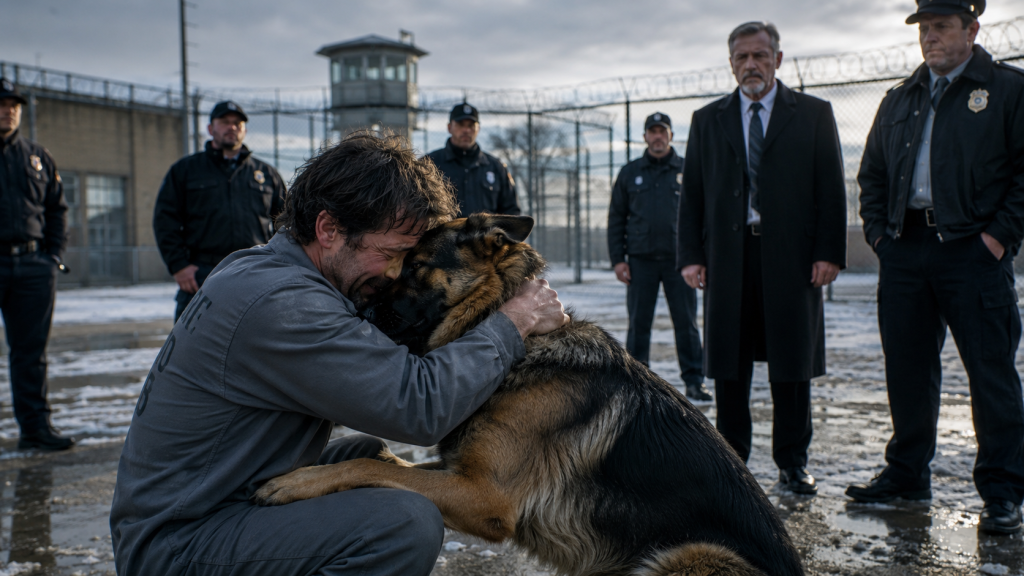
Daniel dropped to his knees as far as the chains allowed.
Ranger crashed into him with a force that nearly knocked him over.
The dog whined, barked, and pressed his whole body against Daniel’s chest.
Daniel buried his face in Ranger’s fur.
For twelve years, he had not cried in front of anyone.
Not during trial.
Not during sentencing.
Not when his final appeal was denied.
But now, holding his dog under the white prison sky, Daniel broke.
“I’m sorry, boy,” he whispered. “I’m so sorry.”
Ranger licked his face again and again, whining in a way that made even the guards look down.
For a few minutes, nobody moved.
There are some kinds of grief that command silence.
Then Ranger suddenly stopped.
His body went stiff.
His ears turned toward the far corner of the yard.
Daniel felt the change immediately.
“Ranger?”
The dog pulled away from him.
He sniffed the air.
Then the ground.
Then he began growling.
Low.
Deep.
Not at Daniel.
Not at the guards.
At the corner of the yard near the old maintenance shed.
The handler stepped forward.
“Ranger, come.”
The dog ignored him.
His nose dragged across the frozen dirt.
He moved like he had caught a scent buried beneath time itself.
The guards stiffened.
One of them said, “What’s wrong with him?”
Ranger barked.
Once.
Twice.
Then he sprinted toward the shed.
“Grab him!” a guard shouted.
But Ranger was already clawing at the ground beside the shed’s foundation.
He dug furiously, throwing dirt and frost behind him.
Daniel stood slowly, chains rattling.
His face had gone pale.
The warden frowned.
“What is he doing?”
Daniel did not answer.
He was staring at the shed.
A memory moved inside him.
A cold, terrible memory.
The night Victor Hale died.
The alley.
The rain.
The dark sedan.
Victor trying to speak.
A word Daniel had never understood.
“B… seventeen?”
No.
Not B-17.
Not his cell.
What had Victor said?
“Box… shed…”
Daniel’s breath caught.
“Let him dig,” he whispered.
The nearest guard looked at him. “What?”
“Let him dig!” Daniel shouted, and his voice cracked across the yard.
Everyone froze.
Ranger barked again, wild and desperate.
The warden looked from Daniel to the dog, then to the patch of earth.
Something about Ranger’s urgency unsettled him.
“Get a shovel,” Briggs ordered.
“Sir, the execution—”
“Get a shovel.”
A guard ran to the maintenance closet.
Ranger kept digging until his paws bled.
Daniel strained against his chains.
“Please,” he said. “Don’t pull him away.”
The shovel arrived.
One guard began digging where Ranger had clawed.
The first few inches were frozen hard.
Then the dirt softened.
The shovel struck something metallic.
Clang.
The sound rang through the yard like a bell.
No one spoke.
The guard knelt and brushed dirt away with gloved hands.
He pulled out a rusted metal lunchbox wrapped tightly in layers of plastic.
The warden stepped closer.
“What is that?”
The guard handed it to him.
Briggs opened the plastic with a pocketknife.
Inside the box were several items.
Old photographs.
A small recorder.
A sealed envelope.
And a bloodstained leather glove.
Daniel stared at the glove and felt his knees weaken.
“I’ve never seen that before,” he whispered.
The warden opened the envelope.
The paper inside was yellowed, but the writing was clear.
At the top, one sentence was written in bold black ink.
If Daniel Reeves is still alive when this is found, then an innocent man has been paying for my crime.
The yard seemed to tilt.
The warden read silently at first.
His face changed with every line.
Then, slowly, he read aloud.
“My name is Marcus Vale. Twelve years ago, I killed Victor Hale behind Mason’s Auto Repair. Victor discovered I was stealing money through his company accounts. He threatened to expose me. I followed him that night. I stabbed him during an argument. I saw Daniel Reeves coming down the alley, so I ran. I planted the knife where police would find it.”
Daniel’s mouth opened, but no sound came out.
The guards stared.
Chaplain Greer covered his mouth with one trembling hand.
The warden continued reading.
“I paid Officer Carl Benson to erase the security footage. I hid this box on prison property because Benson told me Daniel had been placed in Blackridge. If Benson ever turned on me, I wanted insurance. The glove has my blood and Victor’s. The recorder has my full confession. I cannot live with what I did, but I am too afraid to come forward.”
The paper shook in the warden’s hand.
One guard whispered, “Marcus Vale?”
Everyone knew the name.
Marcus Vale had been Victor Hale’s business partner.
He had testified at Daniel’s trial.
He had stood in court wearing a black suit and told the jury Daniel had argued with Victor over debt.
His testimony had helped bury Daniel alive.
Daniel remembered him clearly.
The clean-shaven face.
The polished shoes.
The careful sadness.
A liar wearing grief like a costume.
The warden removed the recorder from the lunchbox.
It was old, but when a guard found batteries in the shed and inserted them, the machine clicked.
Then a voice filled the yard.
Static.
Breathing.
Then a man speaking.
“My name is Marcus Vale, and if anyone hears this, Daniel Reeves did not kill Victor Hale. I did.”
Daniel swayed.
Chaplain Greer rushed to steady him.
Ranger returned to Daniel’s side and pressed against his leg, whining softly.
The warden did not waste another second.
“Get my office on the phone,” Briggs snapped. “Call the governor’s office. Call the attorney general. Call the court clerk. Tell them we have new evidence in the Reeves case. Tell them the execution is suspended until further notice.”
A guard ran.
Another stood frozen, staring at Daniel like he was seeing him for the first time.
Not as inmate B-17.
Not as a condemned murderer.
As a man.
A living, breathing man who had been telling the truth for twelve years.
Daniel sank to the ground.
His chains clattered against the frozen dirt.
Ranger placed his head in Daniel’s lap.
“How did you know?” Daniel whispered.
The dog closed his eyes.
Later, people would try to explain it.
Some said Ranger must have smelled the old leather.
Some said the scent had been exposed by the frost cracking the ground.
Some said dogs remembered places and people better than humans ever could.
But Daniel believed something else.
He believed Ranger had always known there was one more thing left to find.
The hours that followed passed in chaos.
The execution chamber was closed.
The witnesses who had already arrived were sent away without explanation.
Phones rang nonstop in the warden’s office.
Lawyers who had ignored Daniel for years suddenly wanted to speak.
Reporters gathered outside the prison gates by afternoon, shouting questions into cameras.
The story spread faster than fire.
Condemned man’s dog uncovers hidden confession.
Execution halted one hour before sentence.
New evidence may prove innocence.
But inside the infirmary, Daniel heard none of it.
He sat on a narrow bed with a blanket over his shoulders.
Ranger slept at his feet, exhausted, both front paws bandaged.
Chaplain Greer sat beside him.
For a long time, neither man spoke.
Finally, Daniel said, “I stopped believing this day would come.”
Thomas looked at him gently.
“I didn’t.”
Daniel gave a broken laugh.
“You brought Ranger all those years.”
“He needed to see you,” Thomas said. “And you needed to see him.”
Daniel looked down at the dog.
“I thought I asked to see him so I could say goodbye.”
His voice trembled.
“But maybe he came to save me.”
That night, instead of walking Daniel to the execution chamber, the guards returned him to cell B-17.
But something had changed.
The walls were still gray.
The cot was still hard.
The bars were still locked.
Yet Daniel could breathe.
For the first time in twelve years, tomorrow existed.
Three weeks later, the court officially stayed his sentence.
Two months later, Marcus Vale was arrested in a private hospital, where he had been living under another name after years of illness.
Officer Carl Benson, long retired, was also arrested after investigators matched old records to the missing security footage.
The glove from the box contained traces that modern testing had never been allowed to examine before.
Victor Hale’s blood.
Marcus Vale’s blood.
Not Daniel’s.
The recorder was authenticated.
The letter was verified.
The photographs showed Marcus and Benson together near Mason’s Auto Repair on the night of the murder.
Every lie began to collapse.
Daniel attended the hearing in a suit Chaplain Greer bought for him.
It was too big in the shoulders, but Daniel did not care.
Ranger lay beside his chair, wearing a service vest the court had allowed after public pressure.
When the judge read the decision, the courtroom was silent.
“Mr. Reeves,” she said, removing her glasses, “this court acknowledges that a grave miscarriage of justice occurred. Your conviction is vacated. The charges against you are dismissed.”
Daniel closed his eyes.
He expected joy.
He expected relief.
But what came first was pain.
Twelve years.
Twelve years did not return because a judge spoke the right words.
His youth did not return.
His mother, who had died believing he might still come home, did not return.
The birthdays, the sunsets, the ordinary mornings on his porch with coffee and Ranger beside him—they did not return.
Still, when the bailiff unlocked the restraints from his wrists for the final time, Daniel wept.
Not loudly.
Not dramatically.
Just silently, as a free man.
Outside the courthouse, cameras flashed.
Reporters shouted his name.
“Daniel, how do you feel?”
“Do you blame the justice system?”
“What will you do now?”
Daniel said nothing at first.
He knelt beside Ranger and wrapped his arms around the old dog’s neck.
Then he looked up.
“I asked to see my dog before I died,” he said quietly. “Instead, he gave me my life back.”
The headline appeared everywhere the next morning.
THE DOG WHO SAVED A CONDEMNED MAN.
People sent letters.
Money.
Apologies.
Some from strangers.
Some from people in his old town who had once called him a killer.
Daniel read a few.
Then he stopped.
He did not want apology from the crowd.
He wanted peace.
The state offered compensation months later.
It was a large amount of money, the kind of number that made reporters speak with excitement.
Daniel accepted it, but not for revenge.
He bought a small house outside the city.
Nothing fancy.
A white porch.
A fenced yard.
A kitchen window facing east so the morning sun came in gently.
The first thing he did after receiving the keys was open the back door.
Ranger walked slowly into the yard, sniffed the grass, and lay down beneath an oak tree.
Daniel stood there watching him.
For twelve years, he had imagined freedom as something loud.
Trumpets.
Tears.
People cheering.
But freedom was quiet.
It was sunlight on an old dog’s fur.
It was making coffee with your own hands.
It was opening a door without asking permission.
It was sleeping through the night without hearing keys.
Daniel planted flowers near the porch because Mrs. Dunn had once told him every home needed something alive by the door.
He placed Ranger’s bed near the fireplace.
He cooked chicken and rice when the dog’s stomach was weak.
He took slow walks every evening, never rushing Ranger, never pulling the leash.
Sometimes children in the neighborhood asked if they could pet him.
Daniel always smiled and said, “Ask Ranger first.”
The dog would sniff their hands, then lean into them if he approved.
One afternoon, Chaplain Greer visited.
He brought a framed photograph taken outside the courthouse.
Daniel kneeling.
Ranger beside him.
Both of them looking tired, wounded, and alive.
Daniel hung it in the hallway.
Not because he wanted to remember prison.
But because he wanted to remember the moment the world changed.
Years later, when people asked Daniel why Ranger ran to that exact spot in the prison yard, he never pretended to know for certain.
Maybe it was scent.
Maybe memory.
Maybe instinct.
Maybe love.
All he knew was this:
Humans had failed him.
Lawyers failed him.
Judges failed him.
Witnesses lied.
Friends disappeared.
Even time turned against him.
But a dog remembered him.
A dog loved him.
A dog crossed a frozen prison yard and refused to stop digging until the truth came out of the ground.
Ranger lived two more years after Daniel came home.
They were gentle years.
Peaceful years.
Daniel made sure of that.
On Ranger’s last morning, the old shepherd lay beneath the oak tree in the yard, his head in Daniel’s lap.
The sun was warm.
The world was quiet.
Daniel stroked the gray fur between his ears.
“You saved me, boy,” he whispered.
Ranger opened his eyes one final time.
His tail moved once against the grass.
Then he was gone.
Daniel buried him beneath the oak tree.
Not with sadness alone, but with gratitude so deep it felt like prayer.
He placed a simple stone over the grave.
On it were carved six words:
RANGER
THE FRIEND WHO FOUND THE TRUTH
Every morning after that, Daniel sat on the porch with coffee in his hands.
Sometimes he still looked toward the yard expecting Ranger to rise from the grass and come trotting toward him.
The ache never fully left.
But neither did the love.
And whenever people came to interview him, hoping for anger, bitterness, or a dramatic speech, Daniel only gave them one answer.
“Never underestimate a loyal heart,” he said. “Sometimes the truth has a voice. Sometimes it has paws.”
And on quiet evenings, when the wind moved through the oak leaves, Daniel liked to believe Ranger was still there.
Still watching.
Still guarding.
Still reminding the world that innocence may be buried for years…
But love knows where to dig.
THE END! THANK YOU FOR READING!