

Crowds packed the boardwalk of Puerto Vallarta one early July afternoon. The Pacific waves murmured behind the noise of tourists, mariachi music, children’s laughter, and vendors calling out prices for coconut water and handmade bracelets. For most people, the boardwalk was a place of color, sun, and joy.
But for Mrs. Elena Morales, it was a scar. Eight years earlier, on that very beach, her only daughter had disappeared. Sofía had just turned ten. She had been wearing an embroidered yellow huipil dress, white sandals, and two braids tied with blue ribbons. In her arms, she carried a small cloth doll named María, a doll Elena had sewn by hand during one rainy season in Mexico City.
That day had started like a blessing.
Elena and her husband, Javier, had brought Sofía to Puerto Vallarta for her birthday. They ate grilled fish near the shore, bought mango slices with chili, and laughed as Sofía chased foam from the waves.
Then Elena turned around for only a moment.
Only a moment.
Her straw hat had blown across the sand, and she went to pick it up.
When she looked back, Sofía was gone.
At first, Elena did not panic.
Children wandered. Children chased birds. Children ran toward music, ice cream, balloons, and other children.
She called her daughter’s name.
“Sofía!”
No answer.
She walked farther down the beach, still smiling nervously.
“Sofía, enough hiding!”
Nothing.
Within minutes, her voice became sharper.
Within an hour, it became broken.
Beach authorities used loudspeakers.
Police officers searched the sand.
Rescue teams went into the water.
Tourists were questioned. Vendors were questioned. Security footage was checked.
Nothing.
Not one sandal.
Not one ribbon.
Not the little María doll.
It was as if the ocean, the crowd, and the sun had swallowed Sofía whole.
The newspapers carried her picture for weeks.
“Ten-year-old girl mysteriously disappears on beach.”
“Family begs for answers.”
“Possible kidnapping investigated.”
Elena’s face appeared beside Sofía’s on television, her eyes swollen, her hands clutching a photo until the edges bent.
Javier tried to be strong at first.
He printed flyers.
He drove across towns following tips.
He stood outside police stations for hours, demanding updates from men who stopped meeting his eyes.
But grief is a sickness that enters quietly.
Three years after Sofía vanished, Javier’s heart failed.
On the morning of his funeral, Elena placed Sofía’s photo beside his coffin.
“My love,” she whispered to him, “when you see God, ask Him where our daughter is.”
After Javier’s death, people told Elena to rest.
They told her eight years was too long.
They told her maybe Sofía was in heaven.
Elena would nod politely, then return to her small sweet-bread shop in Roma Norte, where she continued to sell conchas, bolillos, and pan de muerto when the season came.
Every morning before opening, she lit a candle beneath Sofía’s photograph.
Every night before locking the door, she said the same sentence.
“Wherever you are, mija, your mother is still looking.”
Then, one hot April morning, everything changed.
Elena was sitting near the entrance of her bakery, fanning herself with an old newspaper, when a dusty pickup truck stopped outside.
Several young men climbed out.
They were sunburned, tired-looking, and dressed like workers who had been driving for hours.
They entered the shop laughing softly among themselves.
“Good morning, señora,” one of them said. “Do you have conchas?”
“Fresh,” Elena replied.
She began placing bread into a paper bag.
The men bought water, sweet rolls, and one small cake wrapped in plastic. Elena barely paid attention at first. Her hands moved automatically.
Then one of the men reached across the counter to take his change.
His sleeve lifted.
Elena saw the tattoo on his right arm.
The whole world fell silent.
It was a girl’s face.
A simple black-ink portrait.
Round cheeks.
Bright eyes.
Two braids.
A small smile that looked shy and stubborn at the same time.
Elena’s breath caught in her chest.
The coins slipped from her fingers and scattered across the floor.
The young man looked down, startled.
“Señora? Are you okay?”
Elena did not answer.
She stepped closer, her hand trembling as she pointed at his arm.
“My son,” she whispered, “this tattoo… who is it?”
The young man’s expression changed.
His smile disappeared.
For one second, fear flashed across his face.
He pulled his sleeve down quickly, but it was too late.
Elena grabbed the counter to keep herself standing.
“That is my daughter,” she said, her voice breaking. “That is Sofía.”
The other men went quiet.
The young man stared at her as if he had just seen a ghost.
“What did you say?” he asked.
“My daughter,” Elena said, louder now. “Her name was Sofía Morales. She disappeared eight years ago in Puerto Vallarta. She had braids. She had those eyes. That face. Why do you have my daughter tattooed on your arm?”
The young man swallowed hard.
His friends stepped back.
One of them murmured, “Diego, maybe we should go.”
But the tattooed man did not move.
His name was Diego.
He looked at Elena for a long, painful moment, then slowly reached under his shirt.
From around his neck, he pulled out a small silver chain.
A charm hung from it.
Our Lady of Guadalupe.
Elena’s knees weakened.
She knew that necklace.
Javier had bought it for Sofía on her tenth birthday, two days before their trip to Puerto Vallarta.
Elena pressed both hands against her mouth.
“No,” she whispered. “No, no, no…”
Diego’s eyes filled with tears.
“She gave it to me,” he said. “She told me if I ever found her mother, I had to show it.”
Elena stumbled around the counter and grabbed his arm.
“Where is she?”
Diego looked toward the door, then back at her.
“Señora, I didn’t know her name was Sofía. We called her Luna.”
“Where is my daughter?” Elena cried.
Diego lowered his head.
“I don’t know where she is now.”
The words struck Elena harder than any blow.
She shook him once, desperate and furious.
“What do you mean you don’t know? You have her face on your skin. You have her necklace. You know something.”
“I do,” Diego said. “But what I know… it is not simple.”
Elena locked the bakery door and turned the sign to Closed.
The other men waited outside, whispering nervously near the pickup truck.
Inside, Diego sat at one of the little tables while Elena stood before him with Sofía’s framed photo in her hands.
Diego looked at the photo.
His face folded with grief.
“That’s her,” he whispered. “That’s Luna.”
“Sofía,” Elena corrected.
Diego nodded.
“Sofía.”
He took a long breath.
“I met her seven years ago,” he began. “In a house near Tepic. I was fourteen. I had run away from my uncle because he beat me. I thought the streets would be better, but they weren’t. A man promised me work selling fruit. Instead, he took me to a house where children were kept.”
Elena gripped the back of a chair.
Diego’s voice shook, but he continued.
“There were six of us. Some were older, some younger. They made us beg, clean, carry packages, and sometimes pretend to be family so no one would suspect anything. The adults changed our names. They told us if we tried to escape, police would arrest us or our families would die.”
Elena closed her eyes.
Her daughter had been alive.
Alive and afraid.
“Luna was already there when I arrived,” Diego said. “She was small but brave. She shared food. She sang to the younger children when they cried. She said she had a mother who made sweet bread and a father who laughed like thunder. But she could not remember the way home. They had moved her too many times.”
Elena began to cry silently.
Diego touched the tattoo through his sleeve.
“One night, I had a fever. I thought I was dying. The adults did not care. Luna stayed beside me, putting a wet rag on my forehead. She gave me this necklace and said Our Lady would protect me because her papa had told her so.”
He held up the charm.
“She said, ‘When I go home, I will ask my mama to make you bread with sugar on top.’”
Elena turned away, pressing her fist to her mouth to stop herself from sobbing.
“What happened to her?” she asked.
Diego looked down.
“When I was sixteen, we tried to escape.”
Elena froze.
“We had planned it for weeks,” Diego said. “Luna found an old phone hidden in a drawer. It didn’t work except for the camera. She used it to take pictures of us, of the rooms, of one man’s truck. She said evidence mattered. She was only twelve or thirteen, but she thought like an adult.”
A faint, proud ache passed through Elena’s grief.
That sounded like Sofía.
Stubborn.
Smart.
Always watching.
Diego continued.
“We escaped before sunrise. Three of us made it past the fence. Luna stayed behind for a few seconds because a little boy named Mateo was too scared to climb. She pushed him over first.”
His voice cracked.
“Then they caught her.”
Elena’s hand flew to her chest.
“No…”
“I wanted to go back,” Diego said, crying now. “But she screamed at me to run. She screamed, ‘Find my mother!’ I ran with Mateo and another girl. We reached a highway. A truck driver helped us. The police came. Some people were arrested later, but not everyone. The house was empty when they found it. Luna was gone.”
Elena stood perfectly still.
The bakery smelled of sugar and yeast, but suddenly she felt as if she were back on the beach, screaming into the open air.
“Why didn’t anyone tell me?” she whispered.
Diego wiped his face.
“I tried. But I did not know her real name. I only knew she said her mother made sweet bread in Mexico City. Do you know how many bakeries there are? I was a scared boy. I entered a shelter. Then I was moved to another state. Years passed.”
He showed her his tattoo again.
“I got this when I turned eighteen. I promised I would not forget her face. I promised that if I ever found her mother, I would tell her Luna was brave. I never thought I would walk into your shop by accident.”
Elena sank into the chair across from him.
“Accident?” she repeated.
Diego shook his head slowly.
“Maybe not.”
He reached into his wallet and pulled out a folded piece of paper. It was worn and soft from being opened many times.
“I kept this too.”
Elena unfolded it with trembling hands.
It was a child’s drawing.
A bakery storefront with a striped awning.
A woman standing at the door.
A little girl beside her holding a cloth doll.
At the bottom, written in uneven letters, were the words:
Mamá Elena.
Elena made a sound that was half cry, half prayer.
She pressed the paper to her chest.
For several minutes, neither of them spoke.
Then Diego said something that made her lift her head sharply.
“There is one more thing.”
“What?”
“Two months ago, I saw someone who looked like her.”
Elena’s eyes widened.
“Where?”
“In Guadalajara,” Diego said. “Near the old bus terminal. I was delivering furniture. I saw a young woman selling flowers outside a church. She had a scar near her left eyebrow. Luna had that scar from a broken window in the house. I called her name, but she looked scared and walked away quickly.”
Elena grabbed his wrist.
“You are sure?”
Diego hesitated.
“I am not completely sure. She was older. Thin. Her hair was shorter. But her eyes…”
He looked at the tattoo.
“Her eyes were the same.”
Within an hour, Elena had closed the bakery, packed a small bag, and taken the first bus to Guadalajara with Diego.
She did not tell the neighbors.
She did not call distant relatives who would tell her not to hope too much.
Hope was the only thing that had kept her alive for eight years.
She would not apologize for it now.
The bus ride felt endless.
Elena sat by the window, clutching Sofía’s old photograph, the drawing, and the Guadalupe charm Diego had finally placed in her hands.
At sunset, they reached Guadalajara.
The city was loud, hot, and restless.
Diego led her toward a church near the bus terminal.
Vendors were packing up.
Women sold flowers from plastic buckets.
Men carried boxes.
Children chased pigeons across the plaza.
Elena scanned every face until her eyes hurt.
No Sofía.
They returned the next morning.
And the next.
For three days, Elena and Diego searched the area. They showed Sofía’s photo discreetly. Some people shrugged. Others shook their heads. A flower vendor said she remembered a quiet young woman who sometimes sold roses but had not seen her that week.
“What name did she use?” Elena asked.
The vendor frowned.
“Luz,” she said. “I think she said her name was Luz.”
Light.
Luna.
Sofía.
So many names for one lost girl.
On the fourth evening, rain began falling over the plaza.
Elena stood beneath the church archway, exhausted and heartbroken, when she saw a young woman across the street helping an old man gather fallen flowers.
The woman wore a faded blue dress.
Her hair was cut to her shoulders.
She was thin, too thin.
But when she turned slightly, Elena saw the scar near her left eyebrow.
The world stopped.
Elena stepped into the rain.
“Sofía,” she whispered.
The young woman froze.
Diego, standing behind Elena, whispered, “Luna.”
The young woman looked up.
Her eyes moved from Diego to Elena.
For a moment, she looked confused.
Then terrified.
She dropped the flowers and backed away.
Elena did not run toward her.
Every instinct screamed for her to do so, but she stayed still, afraid one sudden movement would send her daughter disappearing again.
Instead, she took the Guadalupe charm from her pocket and held it up.
The young woman stared at it.
Her lips parted.
Elena’s voice broke.
“Mija,” she said, “your papa gave this to you for your birthday.”
The young woman’s eyes filled with tears.
Elena pulled out the cloth doll from her bag.
It was not the original María. That one had vanished with Sofía. This was another doll Elena had made years later, unable to stop sewing the same little face, the same little dress.
“I kept making her,” Elena whispered. “Because I believed one day I would give her back to you.”
The young woman covered her mouth.
A sound escaped her, small and wounded, like a child waking from a nightmare.
“Mamá?” she whispered.
Elena nearly collapsed.
“Yes,” she sobbed. “Yes, my love. I am here.”
Sofía took one step.
Then another.
Then she ran.
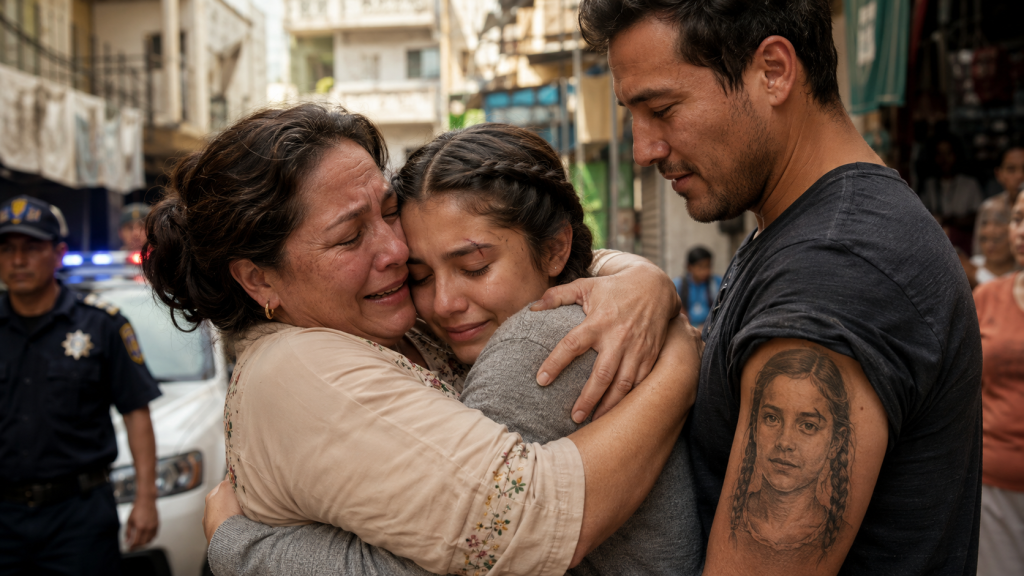
Elena opened her arms, and her daughter fell into them with such force that both of them nearly dropped to the wet pavement.
Eight years of prayers, grief, birthdays, dead ends, and unanswered questions broke open in that embrace.
Elena held her daughter’s face in both hands.
She was not ten anymore.
She was eighteen.
Her cheeks were sharper, her eyes older, her body marked by years Elena had not been there to protect her from.
But she was alive.
Sofía was alive.
“I tried to come home,” Sofía cried. “I tried, Mamá. I forgot streets. I forgot names. They told me you were dead. They told me Papa was dead. I didn’t know what was true.”
Elena kissed her forehead again and again.
“Your papa looked for you until his heart could not carry the pain anymore,” Elena whispered. “He died loving you. He died believing you were alive.”
Sofía sobbed harder.
Diego stood a few steps away, crying quietly in the rain.
Sofía saw him and reached for his hand.
“You found her,” she whispered.
Diego nodded, unable to speak.
That night, Elena took Sofía to a safe place and contacted trusted authorities, not the careless officers who had failed her years before, but a victims’ advocate Diego knew from his shelter days.
Statements were taken.
Old files were reopened.
Names were connected.
The drawing, the tattoo, the necklace, and Sofía’s memories became pieces of a truth that had been buried too long.
The road ahead would not be simple.
Sofía had nightmares.
She flinched at loud footsteps.
Sometimes she forgot where she was and woke calling herself Luna or Luz.
Elena did not rush her.
She did not demand the daughter she had lost return exactly as she had been.
Instead, she learned the daughter who had survived.
A month later, Elena reopened the bakery.
For the first time in eight years, two women stood behind the counter.
Elena shaped the dough.
Sofía sprinkled sugar on conchas.
Customers whispered when they recognized the girl from the faded photograph near the candle.
Some cried.
Some crossed themselves.
Some simply bought bread and smiled gently, understanding that miracles did not always arrive clean and easy.
Sometimes miracles came thin, trembling, and afraid.
Sometimes they came with scars.
One afternoon, Diego returned to the bakery.
Sofía saw the tattoo on his arm and touched it softly.
“You made me look braver than I was,” she said.
Diego shook his head.
“No,” he replied. “I made you exactly as I remembered.”
Elena placed a warm concha in his hands.
“With sugar on top,” she said, her voice trembling.
Diego looked at Sofía.
She smiled through tears.
A promise from a stolen childhood had finally been kept.
That evening, after closing, Elena lit a candle beneath Javier’s photograph.
Beside it, she placed the old picture of ten-year-old Sofía.
Then she placed a new photo next to it.
Sofía at eighteen, standing in front of the bakery, holding her mother’s hand.
Elena looked upward.
“Javier,” she whispered, “our daughter came home.”
Behind her, Sofía entered quietly and rested her head on her mother’s shoulder.
For a long time, neither spoke.
Outside, Mexico City moved on with its usual noise: traffic, vendors, distant music, barking dogs.
Inside the bakery, there was only the smell of warm bread and the silence of two hearts learning how to beat together again.
Elena had spent eight years asking where her daughter was.
Now she finally had the answer.
Sofía had been in darkness.
But she had carried her mother’s love like a small candle.
And somehow, against every cruel thing the world had done, that candle had never gone out.
THE END! THANK YOU FOR READING!