

My daughter woke up before the sun on Christmas Eve. Not because of presents. Not because of excitement. Because she wanted to bake cupcakes for my mother. At seven in the morning, I found Lily standing in the kitchen in her little pink robe, hair messy, eyes still sleepy, holding the recipe card she had copied from a video online.
“Mom,” she whispered, like the house might break if she spoke too loudly, “can we start now?” I smiled even though I was exhausted. The night before, I had wrapped gifts until almost two in the morning. My husband, Daniel, had offered to help, but I told him to sleep because he had to work half a day before meeting us at my parents’ house.
So it was just me and Lily in the kitchen.
Flour on the counter.
Sugar on the floor.
Pink sprinkles rolling everywhere.
And my daughter standing on a step stool with the seriousness of a professional baker.
“These have to be perfect,” she said, carefully cracking an egg into the bowl.
I wiped a little flour from her cheek.
“They don’t have to be perfect, honey. They just have to be made with love.”
She looked up at me with those big brown eyes and asked, “Do you think Grandma will like them?”
That question landed heavy in my chest.
Because the truth was, I didn’t know.
My mother, Margaret, had never been easy to please.
Not when I was a child.
Not when I became an adult.
Not even when I gave her a granddaughter who tried desperately to earn her love.
My mother believed affection was something children should work for.
She called it discipline.
I called it cruelty, though I had only recently learned to say that word out loud.
Lily, however, still believed in her.
She believed Grandma only needed the right drawing, the right hug, the right handmade gift, the right cupcake.
So I swallowed my bitterness and said, “I think she’ll see how hard you worked.”
That was not the same as saying she would like them.
But Lily smiled anyway.
For three hours, she baked.
She mixed the batter slowly.
She filled each paper cup with careful spoonfuls.
She watched through the oven glass as if the cupcakes were tiny miracles.
When they cooled, she piped pink frosting on top with trembling hands.
Some swirls leaned to the side.
Some had too many sprinkles.
One cupcake had a fingerprint in the frosting because she accidentally touched it, then nearly cried until I told her it made that one special.
By noon, there were twelve cupcakes arranged on a white tray.
Pink frosting.
Silver sprinkles.
Tiny sugar pearls.
Lily wrote a note and tucked it under the tray.
“Merry Christmas Grandma. I made these myself. Love, Lily.”
She wore her best dress that evening, a pale blue one with little embroidered snowflakes near the hem.
She asked me to curl her hair.
She asked if she should carry the cupcakes herself.
She asked if she should say “Merry Christmas” before or after handing them over.
Every question tightened something inside me.
Daniel noticed too.
When he got home, he stood in the doorway watching Lily wrap the tray carefully in clear plastic.
Then he looked at me.
His face said everything.
Please don’t let your mother hurt her.
I wish I could have promised him.
But families like mine didn’t wound you with knives.
They wounded you with smiles.
They made cruelty look like manners.
My parents’ house looked perfect, as always.
White lights wrapped around the porch columns.
A wreath hung on the red door.
Through the windows, I could see the chandelier glowing over the dining room table.
My mother opened the door wearing pearls, a velvet green dress, and the kind of smile she saved for guests and photographs.
“There you are,” she said, kissing the air beside my cheek.
Then she looked down at Lily.
“And what do we have here?”
Lily straightened.
“I made cupcakes for Christmas, Grandma.”
She held the tray up with both hands.
For one second, I saw my daughter’s whole heart sitting on that tray.
My mother glanced at the cupcakes.
Not lovingly.
Not proudly.
Like she was inspecting a stain on a tablecloth.
“Oh,” she said. “Cute.”
Lily’s smile flickered.
My mother took the tray.
“Try your best, right?”
I felt Daniel’s hand move to my lower back, steadying me before I said something.
Lily nodded quickly.
“Yes, Grandma. I tried really hard.”
My mother was already turning away.
My sister, Vanessa, appeared behind her with a glass of champagne in her hand.
Vanessa had inherited my mother’s sharp tongue and somehow sharpened it further.
She smiled at Lily.
“Baking is harder than it looks, sweetheart. Maybe next time your mom can help you make them more even.”
“I did help,” I said.
Vanessa blinked innocently.
“Oh, I just meant presentation matters.”
Daniel’s jaw tightened.
But Lily looked down at her shoes, and I decided not to start the night with a fight.
Not on Christmas Eve.
Not in front of my daughter.
Not yet.
Dinner began the way all dinners at my mother’s house began.
With compliments that were actually insults.
My mother told Daniel he looked tired and asked if his job was “still stable.”
Vanessa asked me if I had gained weight or if my dress was “just cut strangely.”
My father, seated at the head of the table, said nothing.
He had built a lifetime around saying nothing.
He stirred his soup while the women in his family drew blood with polished fingernails.
Lily sat beside me, hands folded in her lap.
Every few minutes, she glanced toward the kitchen.
I knew what she was waiting for.
Dessert.
Her cupcakes.
Her little moment.
Her chance to see my mother smile and say, “Thank you.”
Halfway through dinner, my mother rose from the table.
“I’ll check the roast,” she said.
She disappeared into the kitchen.
A minute later, Vanessa followed her.
Their voices drifted back faintly.
I couldn’t hear the words, only the tone.
Low.
Amused.
Dismissive.
Then I heard the lid of the trash can open.
A strange feeling went through me.
I pushed my chair back.
Daniel looked at me.
“What is it?” he whispered.
“I’ll be right back.”
I walked toward the kitchen.
Behind me, I heard a tiny chair scrape.
Lily followed.
I wish she hadn’t.
I wish, even now, that I had turned around and told her to stay seated.
But I didn’t know.
I didn’t know that when I stepped into the kitchen, I would find my daughter’s heart in the trash.
The white tray was tilted inside the garbage can.
All twelve cupcakes had been dumped upside down.
Pink frosting smeared against coffee grounds, onion peels, and crumpled paper towels.
Dishwashing liquid had been poured over them, blue and shiny and cruel, soaking into the cake like poison.
My mother stood at the sink washing her hands.
Vanessa leaned against the counter with a smirk.
For a moment, I could not speak.
I could only stare.
Then I heard Lily behind me.
A small sound.
Not a gasp.
Not a cry.
Something worse.
The sound a child makes when she is trying very hard not to fall apart.
I turned.
Her eyes were fixed on the trash.
Her lips were parted.
Her little hands curled slowly into fists at her sides.
“Mom,” she whispered, “did Grandma throw them away?”
My mother turned around, drying her hands on a towel.
“Don’t make a scene,” she said.
I stared at her.
“Are you serious?”
“They weren’t suitable for the table,” my mother replied calmly. “I didn’t want to embarrass her in front of everyone.”
Vanessa gave a soft laugh.
“It’s honestly better she learns now. People don’t have to praise everything just because a child made it.”
I felt something in me detach.
For years, I had swallowed comments.
For years, I had told myself that keeping peace mattered.
For years, I had let my mother humiliate me because I thought I was strong enough to take it.
But Lily was eight.
She had woken before sunrise.
She had worked with her small hands until her fingers were sticky with frosting.
She had brought a gift, not a competition.
And my mother had covered it in soap.
I knelt in front of Lily.
Her face was pale.
Tears clung to her lashes but had not fallen yet.
“I’m sorry,” I said.
She shook her head quickly, like she was the one who had done something wrong.
“Maybe they tasted bad.”
That broke me.
I stood slowly.
My mother sighed.
“Oh, please. Don’t be dramatic. Children need resilience.”
“No,” I said quietly. “Children need kindness.”
Vanessa rolled her eyes.
“This is exactly why Lily is so sensitive. You protect her from everything.”
I looked at her.
“And you mistake cruelty for honesty because it makes you feel superior.”
Her face changed.
My mother stepped forward.
“You will not speak to your sister like that in my house.”
I laughed.
It was not a happy laugh.
It was sharp and ugly and came from somewhere deep.
“You’re worried about manners now?”
My father appeared in the kitchen doorway.
“What’s going on?”
I pointed to the trash.
“Your granddaughter’s Christmas gift is in the garbage, covered in dish soap.”
He glanced down.
For half a second, shame crossed his face.
Then he looked away.
“Margaret,” he muttered, “was that necessary?”
My mother lifted her chin.
“I will not serve messy cupcakes at a formal Christmas dinner.”
“They were made by your granddaughter,” Daniel said from behind my father.
I hadn’t heard him come in.
His voice was low, controlled, dangerous.
My mother looked annoyed.
“And they were not appropriate.”
Daniel stepped past my father and reached for Lily.
She went to him immediately, pressing her face into his jacket.
That was the moment I realized something important.
My daughter did not feel safe in my mother’s house.
And maybe she never had.
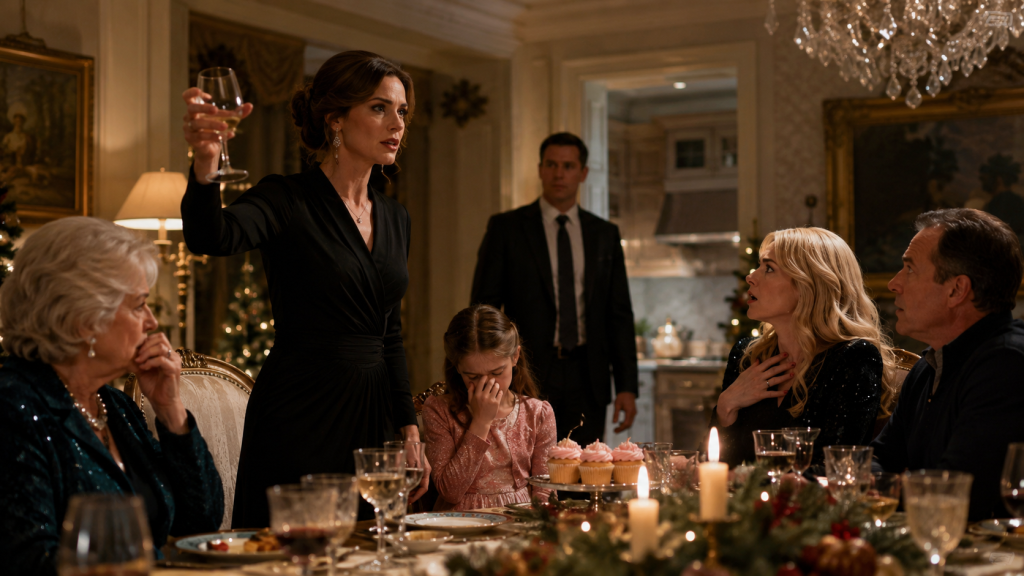
I walked back into the dining room.
Everyone else had gone quiet.
Cousins, uncles, neighbors my mother had invited for appearances.
They all looked at me.
I picked up my wine glass.
My hand was steady.
My mother entered behind me, whispering my name like a warning.
I ignored her.
I raised the glass.
“Everyone,” I said.
The table went still.
My sister crossed her arms.
My father lowered his eyes.
Daniel stood near the doorway holding Lily, who had buried her face against his shoulder.
I smiled.
“Come on,” I said. “Let’s drink up to our last family dinner together.”
My mother’s face drained of color.
Someone coughed.
Vanessa whispered, “Are you insane?”
I looked directly at my mother.
“No. I’m finally awake.”
Then I set the glass down without drinking.
I took my daughter’s coat from the hallway closet.
Daniel took mine.
No one tried to stop us until we reached the front door.
Then my mother grabbed my wrist.
“You are overreacting,” she hissed. “You would cut off your family over cupcakes?”
I looked at her hand on me.
Slowly, she let go.
“No,” I said. “I’m cutting off my family because you saw a child’s love and decided it was trash.”
We left.
Outside, snow had begun to fall.
Lily cried in the car.
Not loudly.
Not dramatically.
Just silently, with tears sliding down her cheeks as she stared out the window.
Daniel drove with one hand on the wheel and the other reaching back to hold her ankle gently, the way he had done when she was a baby in her car seat.
At home, Lily went straight to her room.
I followed her.
She sat on the edge of her bed and whispered, “I don’t want to bake anymore.”
I sat beside her.
“You don’t have to bake for people who don’t deserve it.”
She leaned against me.
“Did I do bad?”
“No,” I said, my voice breaking. “You did something beautiful.”
That night, after Lily fell asleep, Daniel and I sat at the kitchen table.
For a long time, neither of us spoke.
Then Daniel placed his phone in front of me.
“I recorded her giving your mother the cupcakes,” he said.
I nodded.
“I know.”
He tapped the screen.
“And the kitchen camera caught what happened after.”
I stared at him.
“What kitchen camera?”
He exhaled.
“The one your mother installed after she claimed the housekeeper stole silver last year. It connects to the family cloud. Your father gave me access months ago when he asked me to fix the app.”
I felt cold.
“You have the footage?”
Daniel nodded.
“All of it.”
I watched it once.
Only once.
My mother carrying the tray into the kitchen.
Vanessa laughing.
My mother dumping every cupcake into the trash.
The blue dish soap pouring over the pink frosting.
Then me walking in.
Then Lily seeing it.
After that, I closed the phone.
“I want a copy,” I said.
Daniel didn’t ask why.
He just sent it to me.
On Christmas morning, my phone had thirty-seven missed calls.
My mother.
My sister.
My father.
Unknown relatives.
I ignored all of them.
By noon, Vanessa had posted on social media.
Some daughters ruin Christmas because they can’t handle honesty. Sad when children are raised to be fragile.
She did not name me.
She did not have to.
People knew.
My cousins commented with hearts.
My mother’s friends wrote things like, “Stay strong, Vanessa,” and “Kids today need thicker skin.”
I stared at the post for a long time.
Then I uploaded two videos to the family group chat.
The first showed Lily presenting the cupcakes.
Her little voice saying, “I made these myself, Grandma.”
The second showed my mother dumping them into the trash and pouring soap over them.
I added one sentence.
This is what you are defending.
Then I muted the chat.
I expected anger.
I expected excuses.
I expected my mother to call me ungrateful.
I did not expect what happened next.
My cousin Mara saved the video before anyone could delete it.
Then she sent it to my aunt.
My aunt sent it to the church committee because my mother was organizing the children’s charity bake sale that weekend.
Someone from the committee called my mother.
Then another.
Then another.
By the afternoon of December twenty-sixth, my mother’s phone would not stop ringing.
Neither would Vanessa’s.
Because Vanessa owned a boutique bakery.
A bakery built on posts about family, kindness, homemade love, and supporting children’s creativity.
Someone had sent the video to her business page.
Within hours, reviews appeared.
Not fake reviews.
Real people asking why a woman who mocked a child’s cupcakes should be trusted to make cakes for children’s birthdays.
Vanessa called me twenty-two times.
I answered on the twenty-third.
She was crying.
Not because she was sorry.
Because she was scared.
“Take it down,” she snapped.
“I didn’t post it publicly.”
“You sent it to the family group!”
“Yes.”
“You knew someone would share it!”
“No,” I said. “But I’m not surprised someone had a conscience.”
She cursed under her breath.
“You’re destroying my business over a kid’s cupcakes.”
I closed my eyes.
There it was again.
A kid’s cupcakes.
Not Lily.
Not her niece.
Not a child they had hurt.
Just cupcakes.
“You destroyed your own reputation,” I said.
Then I hung up.
An hour later, my bank app sent a notification.
Deposit received: $12,000.
I stared at the number, confused.
Then a text came from my father.
Please accept this and calm things down. Your mother is very upset. Vanessa could lose everything. We are family.
I laughed so hard I almost dropped the phone.
Daniel read the message over my shoulder.
His face darkened.
“They think they can buy silence.”
“No,” I said. “They think they always have.”
But the money was not the biggest surprise.
The biggest surprise came ten minutes later when my lawyer called.
Her name was Elaine Porter.
I had contacted her three months earlier for something I had not yet told my family.
My grandmother’s trust.
My father’s mother had left money for me when she died, but my mother had always said it was “complicated” and “not worth fighting over.”
A few months earlier, I found old paperwork in a storage box.
It showed my grandmother had left educational funds not only for me, but for any child I had.
Including Lily.
When I asked my parents about it, my mother brushed me off.
My father told me not to dig up the past.
So I hired Elaine.
That Christmas week, she had finally received the bank records.
“Claire,” Elaine said when I answered, “we found the transfers.”
My stomach tightened.
“What transfers?”
“Multiple withdrawals from the trust account over the past six years. Some labeled as family expenses. Some went to your sister’s business. One went toward your parents’ kitchen renovation.”
I sat down slowly.
“How much?”
There was a pause.
“Over eighty thousand dollars.”
The room seemed to tilt.
My mother had thrown away twelve cupcakes while standing in a kitchen paid for partly with money meant for my daughter.
Suddenly the $12,000 deposit made sense.
It was not an apology.
It was panic.
Elaine continued, “The timing of today’s transfer is interesting. Do not spend it. We will document it.”
“I won’t,” I said.
“Do you want to move forward?”
I looked toward the living room.
Lily was on the floor beside Daniel, building a puzzle. Her eyes were still a little swollen from crying the night before, but she was smiling faintly as he pretended to be terrible at finding corner pieces.
I thought about all the years I had stayed quiet.
All the dinners where I laughed off insults.
All the times I told myself my mother was just difficult.
All the times I let Lily walk into that house carrying hope in both hands.
“No more silence,” I said.
Elaine’s voice softened.
“Then we move forward.”
By evening, my mother came to my house.
She did not call first.
She appeared on my porch in her long wool coat, pearls still around her neck, face tight with rage disguised as sorrow.
I opened the door but did not invite her in.
She looked past me.
“Where is Lily?”
“Safe.”
Her mouth tightened.
“I want to speak to my granddaughter.”
“No.”
“You cannot keep her from me.”
“I can.”
She stared at me like she did not recognize me.
“You’ve become cruel.”
I almost smiled.
“No, Mom. I learned from you. Then I chose differently.”
Her eyes flashed.
“This family has given you everything.”
I stepped onto the porch and closed the door behind me.
“You took money from Grandma’s trust.”
For the first time in my life, my mother had nothing to say.
Not immediately.
That silence told me more than any confession could have.
Then she recovered.
“You don’t understand finances.”
“I understand theft.”
Her face hardened.
“Be careful.”
“No,” I said. “You be careful. From now on, you speak to my lawyer.”
She looked toward the window.
Inside, Lily moved past the curtain, then disappeared.
My mother saw her.
For one second, her face softened.
But it was too late.
Love that only appears after consequences is not love.
It is strategy.
“You’ll regret this,” she whispered.
I shook my head.
“I regret not doing it sooner.”
Then I went back inside and locked the door.
Two weeks later, Vanessa closed her bakery temporarily.
My mother resigned from the church bake sale committee.
My father sent three more messages.
The last one said, Your grandmother would hate this fighting.
I replied only once.
Grandma would hate that you stole from her great-granddaughter.
Then I blocked him too.
The legal case took months.
There were documents.
Meetings.
Ugly emails.
Relatives choosing sides.
My mother claimed misunderstanding.
Vanessa claimed loans.
My father claimed he had only followed what Margaret told him.
But Elaine was good.
Better than good.
By spring, the trust was restored with interest.
Lily’s education fund was placed where no one in my family could touch it again.
The $12,000 transfer was counted as partial repayment.
My parents avoided court by signing an agreement that included repayment, legal fees, and a written admission of misuse.
They hated that part most.
Not the money.
Not the loss of access.
The admission.
People like my mother can survive being cruel.
They cannot survive being seen.
On Lily’s ninth birthday, she asked if we could bake cupcakes.
I tried not to react too strongly.
“Are you sure?”
She nodded.
“But not pink.”
“What color?”
She thought about it.
“Yellow. Like happy.”
So we baked yellow cupcakes with vanilla frosting and gold sprinkles.
They were uneven.
The frosting leaned.
One had too many sprinkles.
One had a fingerprint in it.
They were perfect.
That afternoon, Daniel invited a few of Lily’s friends from school. Our kitchen filled with laughter and crumbs and music.
At one point, Lily handed me a cupcake.
“For you, Mom.”
I took it carefully.
“Thank you.”
She watched me.
I understood what she was really asking.
So I took a bite right away.
The frosting was too sweet.
The cake was slightly dry.
It was the best thing I had ever tasted.
Lily smiled.
A real smile.
Not nervous.
Not hopeful in a painful way.
Just happy.
Later that night, after everyone left, I found a small note on the counter.
In Lily’s handwriting, it said, Thank you for not throwing me away too.
I sat on the kitchen floor and cried.
Not because my family was gone.
But because my daughter had thought love could be thrown away like garbage.
And I had finally proven to her that in our home, it never would be.
People still ask if I regret ending things over cupcakes.
I always tell them the same thing.
It was never about cupcakes.
It was about a child learning whether her love was safe in someone’s hands.
It was about a mother deciding that peace without respect is just another kind of prison.
It was about the moment I raised my glass and said goodbye to the people who taught me to stay small.
Two days later, their phones would not stop ringing.
Months later, their secrets would not stop unraveling.
And for the first time in my life, I did not clean up the mess for them.
I let the truth ring.
I let it echo.
And then I took my daughter’s hand and walked forward without turning back.
THE END! THANK YOU FOR READING!