

After my husband passed away, a nurse handed me a pink pillow and said, “He’d been hiding this every time you were about to visit him.” My name is Helen Carter. I am 55 years old, and for nearly twenty-five years, I believed I knew every corner of my husband’s heart.
Anthony was not a loud man. He did not make grand speeches, did not throw money around, did not fill rooms with attention. But he was steady. He was the kind of man who checked the locks twice at night, warmed up my car before work in winter, and always left the last slice of cake for me even though he pretended not to like sweets.
For almost twenty-five years, he was my home.
We had no children.
Not because we did not want them.
God knows we wanted them.
In our thirties, we spent years in doctors’ offices, sitting under cold fluorescent lights while strangers explained my body to me in soft, pitying voices.
Tests.
Treatments.
Hope.
Failure.
More hope.
More failure.
Then one day, a doctor folded his hands across his desk and told us that having a child naturally was almost impossible.
I cried in the parking lot for an hour.
Anthony held me and said, “Then it will be us, Helen. Just us. And that will still be enough.”
I believed him.
For years, I believed him.
We built a quiet life together in a small yellow house on Maple Street.
He worked as a mechanic, then later opened his own repair shop.
I worked at a library.
We were not rich, but we were comfortable enough.
On Sundays, we made breakfast together.
On Christmas Eve, he always bought me a ridiculous ornament and acted offended when I laughed.
On our anniversary, he played the same old song from our wedding and danced with me in the kitchen.
That was Anthony.
At least, that was the Anthony I thought I knew.
Two weeks before everything changed, he collapsed in our living room.
It was a Tuesday evening.
I remember because I had just taken a casserole out of the oven, and he was standing near the window, looking at the rain.
“Anthony?” I said.
He did not answer.
Then his hand went to his chest.
The plate he was holding slipped from his fingers and shattered on the floor.
By the time I reached him, his knees had buckled.
I screamed his name so loudly our neighbor came running.
The ambulance arrived in seven minutes.
Those seven minutes felt like seven years.
At the hospital, the doctors told me they needed to run tests.
At first, they sounded calm.
Then the tests became more tests.
Bloodwork.
Scans.
Monitors.
Specialists.
Words I did not understand.
Anthony lay in that bed, pale and quiet, his eyes following me whenever I walked into the room.
I visited every single day.
Sometimes twice.
I brought him clean socks, his reading glasses, the old baseball cap he liked.
I sat beside him and held his hand.
I talked about normal things because I was afraid of silence.
I told him the neighbor’s dog had gotten loose again.
I told him the library had finally replaced the broken copier.
I told him the hospital coffee tasted like burned dirt, and if he loved me, he would wake up properly and save me from it.
Sometimes he smiled.
But not the way he used to.
There was something behind his eyes.
Something heavy.
Something unsaid.
“Anthony,” I asked one afternoon, brushing his gray hair away from his forehead, “are you scared?”
He looked at me for a long time.
Then he said, “I’m sorry.”
I frowned.
“For what?”
His lips trembled.
Then the nurse came in to check his medication, and he closed his eyes.
I thought he meant he was sorry for being sick.
I thought he was apologizing because the medical bills were piling up on our kitchen table, because I had been sleeping badly, because our life had suddenly become hospital rooms and insurance forms.
I kissed his hand and said, “Don’t you dare apologize to me. We are married. This is what we do.”
He turned his face toward the window.
A tear slid down his cheek.
I should have asked again.
I should have forced him to tell me.
But when someone you love is lying in a hospital bed, you become afraid of adding pain.
So I swallowed my questions.
Three days before his death, the doctors told me he needed emergency surgery.
They said there was a complication.
They said they had to move quickly.
Anthony looked frightened when they wheeled him toward the operating room.
I walked beside the bed until they told me I could go no farther.
His hand gripped mine.
“Helen,” he whispered.
“I’m here.”
“There’s something—”
A nurse touched my shoulder gently.
“We need to go now.”
I leaned down and kissed his forehead.
“You can tell me when you wake up,” I said.
His eyes filled with such sorrow that for one second, I almost stopped them.
But then the doors opened.
The bed rolled away.
And that was the last time I saw my husband alive.
One hour later, my phone rang.
The voice on the other end said, “Mrs. Carter, you need to come to the hospital immediately.”
I do not remember driving there.
I remember a red light.
I remember my hands shaking on the steering wheel.
I remember running through the hospital entrance with my coat half open and my purse slipping off my shoulder.
When I reached the surgical floor, a doctor was waiting.
He did not have to say a word.
His face told me everything.
I heard myself say, “No.”
He said my name softly.
I said, “No, no, no.”
Then the world cracked open.
They let me see him.
Anthony looked peaceful, which felt cruel.
I wanted him to look like he was fighting.
I wanted some sign that he had tried to stay.
I touched his face and begged him to wake up.
I told him I was not ready.
I told him he had promised me another Christmas.
I told him he could not leave me alone in that house with all his coffee mugs and old jackets and unfinished crossword puzzles.
But he did not move.
My husband of nearly twenty-five years was gone.
I thought that was the worst pain I would ever feel.
Then I stepped into the hallway.
A nurse was waiting there.
Her name was Maribel.
I had seen her several times during Anthony’s stay.
She was kind, usually warm, with tired eyes and gentle hands.
But that afternoon, she looked pale.
Uneasy.
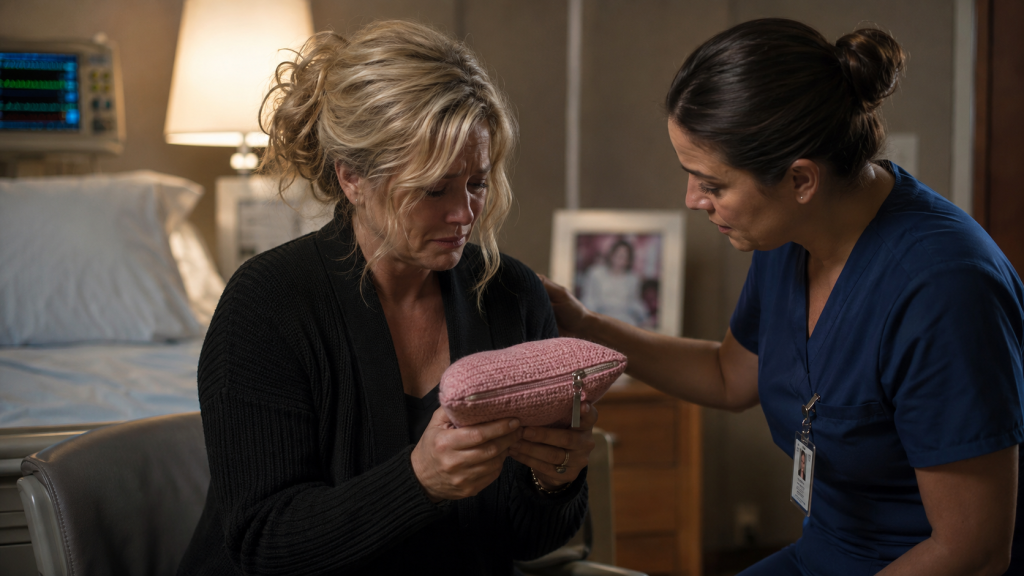
She held a small faded pink pillow against her chest.
It was knitted, old, and soft-looking, with a little zipper along one side.
I stared at it through my tears.
“That isn’t Anthony’s,” I said.
Maribel swallowed.
“It is.”
I shook my head.
“No. I’ve never seen that before.”
“He kept it under his bed,” she said quietly. “Every time you came to visit, he made sure it was hidden.”
Something cold moved through me.
“What are you talking about?”
She looked over her shoulder, as if afraid someone might hear.
“He asked me not to tell you unless he didn’t make it.”
My grief sharpened into fear.
“Tell me what?”
Maribel’s eyes filled with sympathy.
“He said you deserved the truth. He said he was too much of a coward to give it to you himself.”
My hands went numb.
She held the pillow out.
I did not take it at first.
I just stared at it.
A pink pillow.
Childish.
Faded.
Completely wrong in my husband’s world of work boots, motor oil, baseball caps, and black coffee.
“What’s inside?” I whispered.
Maribel’s voice dropped.
“You should open it alone.”
I looked at her, unable to breathe.
“Was he cheating on me?”
The question came out before I could stop it.
Her face twisted.
“No,” she said. “Not the way you think.”
That answer was worse.
She pressed the pillow into my arms.
“Unzip it, Mrs. Carter. You deserve to know.”
Then she turned and walked away.
I carried that pillow out of the hospital like it was something alive.
In the parking lot, I sat inside my car for twenty minutes.
Rain streaked down the windshield.
People came and went around me, laughing, crying, carrying flowers, holding balloons.
Life continued, shamelessly.
But I could not move.
The pillow sat in my lap.
My husband was dead upstairs, and in my hands was a secret he had hidden from me until the very end.
Finally, with trembling fingers, I found the zipper.
It stuck halfway.
I pulled harder.
The pillow opened.
I reached inside.
My fingers touched something cold and unpleasant.
Metal.
I pulled it out slowly.
It was a tiny rusted key tied with red string to an old photograph.
The photograph was faded at the edges.
Anthony stood in it, younger by at least twenty years.
He was wearing jeans and a blue work shirt, smiling uncertainly.
Beside him stood a little girl with dark curls.
She could not have been more than five or six.
She was holding that same pink pillow against her chest.
I stopped breathing.
On the back of the photograph, in Anthony’s handwriting, were four words.
Forgive me, my daughter.
My daughter.
The words blurred.
My fingers shook so badly the photograph slipped onto my lap.
Anthony had a daughter.
My Anthony.
My husband.
The man who held me while I cried over infertility.
The man who told me it would be just us.
The man who promised our childless life was enough.
He had a daughter somewhere in the world.
For a moment, grief became anger so fierce it frightened me.
I hit the steering wheel with my palm.
“How could you?” I sobbed. “How could you let me grieve a child while you already had one?”
Inside the pillow, there was more.
An envelope.
Yellowed.
Sealed.
My name was written on the front.
Helen.
I tore it open.
The letter inside was three pages long.
The handwriting was shaky, as though written by a man who knew time was running out.
My dearest Helen,
If you are reading this, then I ran out of courage and time.
I have lied to you, and there is no gentle way to say that.
Before I met you, when I was twenty-eight, I had a daughter.
Her name is Lily.
Her mother, Clara, and I were never married.
We were young, foolish, and broken in different ways.
When Lily was born, I wanted to be her father. I swear to you, I wanted to be there.
But Clara’s family hated me. They said I was poor, unstable, not good enough. Maybe they were right at the time.
When Lily was six, Clara got sick.
Cancer.
I tried to help. I tried to visit. But her parents blocked me. They told Lily I had abandoned her.
Then Clara died.
Her parents took Lily away.
I looked for her for years.
I hired people I could barely afford.
I wrote letters that came back unopened.
Then I met you.
And for the first time in my life, I felt peace.
I should have told you then.
I should have told you before I married you.
But I was afraid.
Afraid you would leave.
Afraid you would think I was a man who abandoned his child.
Afraid because, by then, Lily was gone from my reach, and I did not know how to explain a wound I could not fix.
Then we started trying for a baby.
Helen, every tear you cried broke me.
Every time you said you were sorry your body could not give me a child, I wanted to scream that you had nothing to apologize for.
I wanted to tell you I was the one carrying the shame.
I already had a child, and I had failed her.
I kept Lily’s pillow because it was the only thing I had left of her.
She gave it to me the last time I saw her and said, “Keep it until I come back.”
She never came back.
I spent years searching quietly.
I told myself I was protecting you from pain.
The truth is, I was protecting myself from your disappointment.
But last month, I found her.
She is alive.
Her name is Lily Dawson now.
She lives in Brookhaven.
She has a son.
Helen, I was going to tell you after I met her.
I wanted to explain everything to her first.
But then I got sick.
The key opens a small box in my shop office, inside the bottom drawer of the filing cabinet.
There are letters, records, and the address I found.
Please do not carry my cowardice as your burden.
You owe Lily nothing.
But if there is any kindness left in your heart for me, please give her the truth.
Tell her I did not forget her.
Tell her I loved her every day.
And tell her I am sorry.
I love you, Helen.
I loved you honestly, even inside my lie.
Anthony.
By the time I finished reading, my throat hurt from crying.
I wanted to hate him.
Part of me did.
Not for having a past.
Everyone has a past.
I hated him for letting me believe we were grieving the same empty space.
I hated him for hiding a child’s existence while I folded tiny baby clothes we never got to use and cried in the nursery we eventually turned into a guest room.
But beneath the anger was something else.
A little girl with dark curls.
A pink pillow.
A promise.
Keep it until I come back.
I drove home in a storm so heavy I could barely see the road.
The house was dark when I arrived.
For the first time in twenty-five years, Anthony did not turn on the porch light for me.
I walked inside and stood in the living room.
His slippers were beside his chair.
His coffee cup was still in the sink.
His jacket hung by the door.
I wanted to scream at all of it.
Instead, I went to his repair shop.
The shop was behind our house, a converted garage that always smelled like oil, dust, and metal.
I had not gone inside since he was admitted to the hospital.
The fluorescent light flickered when I switched it on.
His desk was cluttered with invoices, pens, a half-eaten pack of peppermints.
I found the filing cabinet.
Bottom drawer.
The key fit into a small lockbox tucked behind old tax folders.
Inside were letters.
Dozens of them.
Some written to Lily.
Some returned unopened.
Some never sent.
There were copies of legal documents, old addresses, private investigator reports, and a newer printed page with one name circled in blue ink.
Lily Dawson.
Brookhaven, Ohio.
There was also a photograph from the internet.
A woman in her early thirties stood outside a school building, holding a little boy’s hand.
She had dark curls.
Anthony’s eyes.
I sat on the cold concrete floor and covered my mouth.
She was real.
Not a memory.
Not a secret.
A living woman.
A mother.
My husband had died with one last wish, and now that wish sat in my hands like a stone.
For two days, I did nothing.
I planned Anthony’s funeral.
I chose the dark suit he hated least.
I answered calls from relatives.
I listened to people say, “He was such a good man,” and felt my heart twist every time.
Was he?
Yes.
No.
Both.
That was the terrible thing.
A person could love you deeply and still betray you.
A person could be kind and cowardly in the same breath.
At the funeral, people spoke of his patience, his generosity, his quiet humor.
I stood beside his casket wearing black, holding the pink pillow in my purse.
No one knew.
After everyone left, I stayed behind.
The cemetery was damp from morning rain.
I placed my hand on his casket and whispered, “You should have trusted me.”
Then I went home and called Lily Dawson.
My finger hovered over the number for nearly ten minutes.
When she answered, her voice was cautious.
“Hello?”
I closed my eyes.
“Is this Lily Dawson?”
“Yes. Who is this?”
“My name is Helen Carter,” I said, and my voice cracked. “I was married to Anthony Carter.”
Silence.
Then a sharp breath.
“Anthony?”
“Yes.”
Another silence.
When she spoke again, her voice was smaller.
“Is he alive?”
The question broke something in me.
“No,” I whispered. “He passed away three days ago.”
I heard a sound on the other end.
Not quite a sob.
Not quite a gasp.
“I’m sorry,” I said. “I know this is sudden. I found your name in his things.”
Her voice hardened.
“In his things?”
“Yes.”
“So he knew where I was.”
The accusation was not aimed at me, but it hit anyway.
“He found you recently,” I said. “He was planning to contact you.”
“That’s convenient.”
“I know.”
“You know?” she snapped. “Do you know what it feels like to grow up believing your father chose not to come back?”
I gripped the phone.
“No,” I said quietly. “But I know what it feels like to discover your husband kept a daughter hidden for twenty-five years.”
There was silence again.
This time, it was different.
Less angry.
More stunned.
“You didn’t know?”
“No.”
Lily let out a shaky breath.
“I don’t understand.”
“Neither do I,” I admitted. “But I have letters. Records. A photograph. And a pink pillow.”
The line went completely still.
Then Lily whispered, “What did you say?”
“A pink knitted pillow.”
For a moment, I heard only breathing.
Then she began to cry.
“I thought they threw it away,” she said.
“Who?”
“My grandparents. They hated him. They told me he left because he didn’t want me.”
I closed my eyes.
“He kept it,” I said. “All these years.”
Lily cried harder.
I cried too.
Two women connected by the same man and the same wound, standing on opposite sides of a truth that had arrived too late.
We agreed to meet three days later at a small café halfway between our towns.
I almost turned around twice on the drive.
What was I to her?
The wife of the father she lost.
What was she to me?
Proof of my husband’s greatest lie.
When I walked into the café, I recognized her instantly.
Dark curls.
Anthony’s eyes.
She stood near a corner table, arms wrapped tightly around herself.
Beside her was a boy about seven years old, coloring on a napkin.
Lily looked at me with fear and anger and grief all tangled together.
“You’re Helen,” she said.
I nodded.
“And you’re Lily.”
Her eyes dropped to the bag in my hands.
“Is it there?”
“Yes.”
We sat down.
For several minutes, neither of us knew how to begin.
Then I placed the pink pillow on the table.
Lily touched it with trembling fingers.
The moment her hand met the fabric, her face crumpled.
“I made this with my mom,” she whispered. “I gave it to him the last time he visited. I told him he had to bring it back.”
“He never stopped keeping it,” I said.
Her son looked up.
“Mom?”
She wiped her face quickly.
“It’s okay, Noah.”
Noah.
Anthony had a grandson named Noah.
The thought hit me with unexpected force.
Lily looked at me.
“Did he really try to find me?”
I opened the folder I had brought.
Letters.
Reports.
Returned envelopes.
Dates.
Proof.
She read through them one by one.
With every page, her anger shifted.
It did not disappear.
Maybe it never would.
But something softened.
“My grandparents lied,” she whispered.
“Yes.”
“And he let them.”
I did not defend him.
“He should have fought harder.”
Lily looked surprised by my honesty.
I continued, “He should have told me. He should have told you. He should have done a lot of things differently.”
Her eyes filled again.
“But he loved me?”
I pushed one letter toward her.
It was worn at the folds, written when she would have been eight.
My Lily,
Today I fixed a bicycle for a little girl about your age. She had purple shoes and talked too fast. I wondered if you talk fast now. I wondered if you still sleep with one foot outside the blanket. I wonder every day.
Lily pressed the letter to her chest.
For the first time since Anthony died, I felt something inside me loosen.
Not forgiveness.
Not yet.
Maybe not ever fully.
But understanding.
Anthony had not hidden Lily because he did not love her.
He had hidden her because shame had swallowed him whole.
That did not excuse him.
But it explained the sorrow in his eyes.
Before we left the café, Lily asked if she could come to Anthony’s grave.
I said yes.
The next morning, she arrived with Noah.
We drove together in my car.
At the cemetery, Lily stood before the headstone, clutching the pink pillow.
For a long time, she said nothing.
Then she knelt.
“I waited for you,” she whispered. “I waited so long.”
Noah held her hand.
I stood a few steps behind, feeling like both an intruder and a witness.
Lily placed one hand on the grass.
“I’m angry,” she said. “I don’t know if I forgive you. But I know now that you didn’t forget me.”
The wind moved through the trees.
She looked back at me.
“Do you hate me?”
The question startled me.
“Hate you?”
“For existing.”
My eyes filled with tears.
I thought of all those years of empty bedrooms, failed treatments, Mother’s Day sermons that made me ache, baby showers I attended with a smile that hurt my face.
Then I looked at Lily.
She was not the thief of my dream.
She was a child who had lost her father twice.
“No,” I said. “I hate the lie. Not you.”
Her face crumpled again.
I stepped forward, unsure if I had the right.
She reached for me first.
We held each other in front of Anthony’s grave and cried for the life he had broken, the love he had given, and the truth he had left behind.
In the weeks that followed, Lily and I began meeting every Sunday.
At first, it was awkward.
We were careful around each other, like people walking through a room full of glass.
She asked questions about Anthony.
What did he eat for breakfast?
Did he snore?
Was he funny?
Did he ever sing?
I told her everything I could.
I told her he burned pancakes but made perfect omelets.
I told her he cried during old movies but denied it.
I told her he kept a box of birthday cards he bought for her but never mailed.
She told me about her life.
About growing up with grandparents who were strict, bitter, and full of stories that made Anthony into a villain.
About becoming a mother young.
About working as a school secretary.
About the nights she wondered if she had done something wrong as a child that made her father leave.
Each truth hurt.
But each truth also stitched something together.
Noah started calling me Miss Helen.
Then one day, while helping me water flowers in the yard, he asked, “Were you Grandpa Anthony’s wife?”
I swallowed.
“Yes.”
“So are you like my grandma?”
I froze.
Lily looked over from the porch, her eyes wide.
I did not know what to say.
Noah shrugged and went back to watering the marigolds.
Children can open doors adults are too afraid to touch.
That night, after Lily and Noah left, I sat in Anthony’s chair.
The house was still quiet.
But not as empty.
The pink pillow rested on the table beside me.
For weeks, I had not known what to do with it.
Part of me wanted to burn it.
Part of me wanted to bury it with him.
Part of me wanted to give it to Lily and never see it again.
Instead, I unzipped it once more.
Deep inside, tucked into a corner I had missed before, was a tiny folded note.
My hands shook as I opened it.
It was not Anthony’s handwriting.
It was a child’s.
Daddy,
Bring this back when you come get me.
Love,
Lily.
I pressed the note to my lips and cried harder than I had cried since the hospital.
Because suddenly, I understood the full weight of that pillow.
It was not just a secret.
It was a promise Anthony had failed to keep.
But maybe it had found its way back for a reason.
The next Sunday, I gave Lily the note.
She read it.
Then she sat down slowly, as if her knees had weakened.
“I wrote this,” she whispered.
“I know.”
She held it against the pillow.
“I don’t remember writing it.”
“Maybe part of you did.”
She looked at me for a long time.
Then she said, “I think he wanted you to fix what he couldn’t.”
I shook my head.
“I can’t fix it.”
“No,” she said softly. “But you came.”
Those three words stayed with me.
You came.
Anthony had not.
Not in time.
Not in the way she needed.
But I had.
Maybe not because I was brave.
Maybe because grief had dragged me there.
But I came.
Months passed.
The medical bills still arrived.
The house still ached with memories.
Some mornings I woke up angry at Anthony.
Some nights I missed him so badly I forgot how to breathe.
Grief is not clean.
Love is not simple.
A person can be your greatest comfort and your deepest wound.
I learned that slowly.
One afternoon, Lily came over with a cardboard box.
Inside were old photographs her mother had kept.
There was one of Anthony holding baby Lily, his face young and terrified and full of wonder.
I touched the photograph.
“He looked happy,” I said.
“He did,” Lily whispered.
She hesitated, then pulled out another picture.
It was Anthony and me, from a newspaper clipping about his repair shop opening years ago.
“I found this online when I was twenty,” she said. “I used to stare at it and wonder if you were the reason he never came.”
The confession pierced me.
“I didn’t know,” I said.
“I know that now.”
She took my hand.
“I hated you for a long time.”
“I understand.”
“I don’t hate you anymore.”
I squeezed her fingers.
“I’m glad.”
That Christmas, for the first time since Anthony’s death, I decorated the house.
Not much.
Just a small tree.
A few lights.
The ridiculous ornaments Anthony had bought me over the years.
Lily and Noah came over on Christmas Eve.
Noah hung a wooden truck ornament near the bottom branch.
Lily placed the pink pillow on the armchair beside the tree.
For a moment, none of us spoke.
Then Lily said, “Maybe it belongs here tonight.”
I nodded.
We made dinner together.
Lily burned the rolls.
I laughed because Anthony used to do the same thing.
She laughed too.
And for the first time, the sound did not feel like betrayal.
It felt like inheritance.
Later that night, after Noah fell asleep on the couch, Lily and I sat by the tree.
She looked at the pink pillow glowing softly under the Christmas lights.
“Do you forgive him?” she asked.
I stared at Anthony’s old ornament, a tiny crooked snowman with one missing eye.
“I don’t know,” I said honestly. “Some days I do. Some days I don’t.”
She nodded.
“Me too.”
“But I loved him,” I said. “And I think he loved us both. Badly sometimes. Fearfully. Imperfectly. But he did.”
Lily wiped her eyes.
“I wish he had told the truth sooner.”
“So do I.”
Outside, snow began to fall.
Inside, the house was warm.
Not healed.
Not whole in the way it had once been.
But alive.
I thought back to the hospital hallway, to Maribel’s pale face, to the pillow pressed into my arms.
I had believed, in that moment, that Anthony’s secret would destroy what was left of me.
Instead, it split my life open and placed someone new inside it.
A daughter who was not mine by birth.
A grandson I never expected.
A truth that hurt like fire but also lit a path forward.
A year after Anthony died, Lily and I visited his grave together.
Noah brought flowers.
I brought the pink pillow.
We stood under a gray sky while leaves moved across the grass.
Lily took my hand.
“I think we should leave it with him today,” she said.
I looked down at the pillow.
For so long, it had carried secrets, shame, grief, and unanswered questions.
But now Lily knew.
I knew.
The truth was no longer trapped inside fabric and zipper teeth.
I knelt and placed the pillow against the headstone.
Then I whispered, “You don’t have to hide it anymore, Anthony.”
Lily knelt beside me.
“And I’m not waiting anymore,” she said softly.
We stayed there for a while.
When we finally walked back to the car, Noah ran ahead, jumping over puddles.
Lily linked her arm through mine.
The air was cold, but her arm was warm.
I looked back once.
The pink pillow rested against Anthony’s name.
For twenty-five years, I thought my life was a story about a husband and wife who never had children.
But I was wrong.
My life was also about a little girl who waited, a man who loved and failed, and a woman who discovered that the truth can break your heart without ending it.
I still miss Anthony.
I still get angry.
I still sometimes speak to him in the kitchen when no one is there.
But now, on Sundays, Lily brings Noah over for dinner.
He calls me Grandma Helen.
The first time he said it, I had to turn away so he would not see me cry.
And every Christmas, we hang one special ornament near the top of the tree.
A tiny pink pillow.
Not hidden.
Not secret.
Right where everyone can see it.
Because some truths arrive too late to save the past.
But sometimes, if you are brave enough to open what was hidden, they can still give you a future.
THE END! THANK YOU FOR READING!