

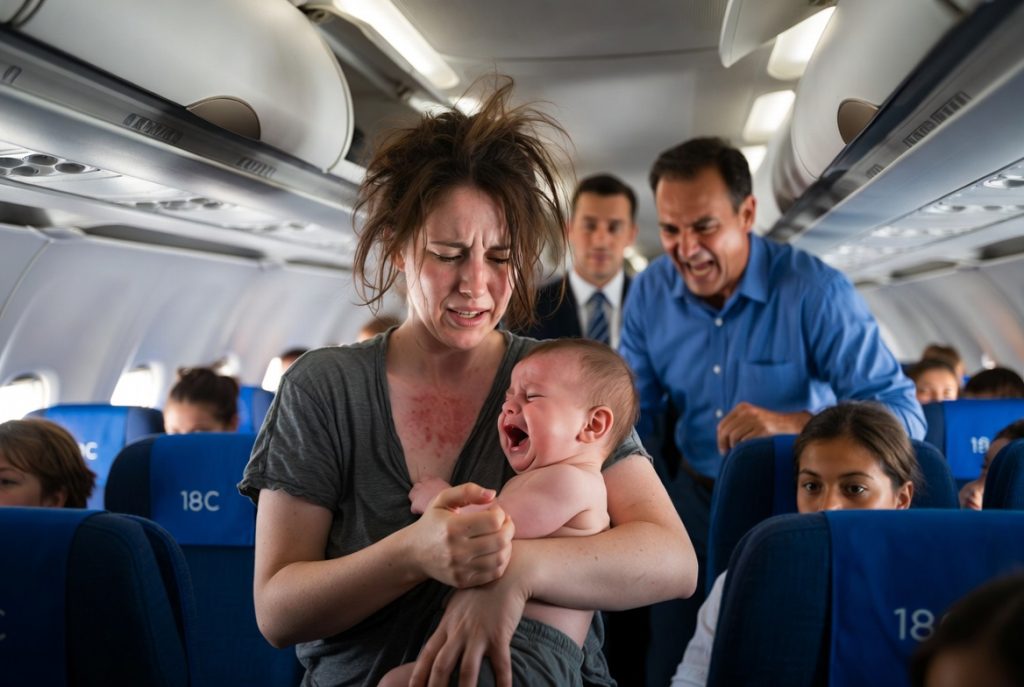
“It’s too noisy, I’m not paying to listen to your baby cry for three hours on this flight.” Those words were shouted at me before the plane had even finished boarding. I was standing in the narrow aisle with my six-month-old son pressed against my chest, one diaper bag slipping off my shoulder, my hair sticking to my damp forehead, and my heart beating so hard I could barely hear anything over it.
But I heard him. Everyone heard him. The man in seat 18C leaned out into the aisle and glared at me like I had personally ruined his life. He was in his late forties, maybe early fifties, with a silver watch, polished shoes, and the kind of confidence that made other people shrink before he even opened his mouth.
My baby, Ethan, was crying.
Not screaming to annoy anyone.
Not crying because I was careless.
Just crying because he was tired, overwhelmed, hungry, warm, and too little to understand why we were surrounded by strangers and metal walls and strange sounds.
“I’m so sorry,” I whispered.
I said it to the man.
I said it to the woman across the aisle.
I said it to everyone who looked at us.
Mostly, I said it because I had been apologizing for existing for almost a year.
Six months before Ethan was born, my husband, David, died in a car accident.
One second, he was calling me from the grocery store, asking if I wanted green apples or red ones.
The next, two police officers were standing on my porch.
I was six months pregnant when they told me.
I remember putting one hand over my belly and asking them to repeat it because the words had gone into the room but not into my mind.
David was gone.
Just like that.
No goodbye.
No hospital room.
No last squeeze of my hand.
Only a plastic bag of his belongings, a folded receipt, his wedding ring, and the apples he never brought home.
After that, joy and grief lived together inside me.
When Ethan kicked, I cried.
When I folded tiny baby clothes, I cried.
When I built the crib alone with swollen ankles and a screwdriver I barely knew how to use, I cried until the instructions blurred.
People told me I was strong.
I hated that word.
Strong was what people called you when they needed your pain to be quieter.
After Ethan was born, I looked into his face and saw David everywhere.
His chin.
His dark hair.
The tiny crease between his eyebrows when he was annoyed.
I loved him so much it hurt.
But love did not pay rent.
Love did not cover formula.
Love did not stop the power company from sending pink notices.
Bills began to stack up like little cliffs on my kitchen counter.
Hospital bills.
Rent.
Insurance forms.
Groceries.
Diapers.
Every envelope felt like another hand around my throat.
Survival became a language I had to learn quickly.
I clipped coupons.
I filled out welfare forms.
I cleaned offices at night when my neighbor could watch Ethan.
I took online typing jobs that paid almost nothing.
I sold David’s old tools.
Then I sold two of my coats.
Then I sold the necklace he had given me on our first anniversary, telling myself it was just a thing, even though I cried in the pawn shop parking lot until Ethan woke up in the back seat.
My mother lived three states away.
She called every day.
Sometimes I answered.
Sometimes I let it ring because I could not bear to hear kindness while standing in the middle of my disaster.
One evening, after Ethan had cried for nearly two hours from teething pain, I sat on the bathroom floor with him on my lap and finally answered her call.
“Come home for a week,” Mom said.
“I can’t afford it.”
“I’ll help.”
“I don’t want to be a burden.”
“You are my child,” she said. “And he is my grandson. You are not a burden. You are tired.”
That sentence broke something open inside me.
You are tired.
Not lazy.
Not failing.
Not dramatic.
Just tired.
I searched for flights that night after Ethan fell asleep.
The cheapest ticket left at dawn from a small airport almost two hours away.
No luggage.
No seat choice.
One layover.
A terrible time.
But it was the only one I could afford.
I counted cash at the kitchen table.
Then I counted again.
Then I opened the little jar where I kept coins for emergencies.
By midnight, I had enough.
Barely.
I booked the ticket with shaking hands.
When the confirmation email came through, I whispered, “We’re going to Nana’s, baby.”
For the first time in weeks, I slept for almost three hours.
The morning of the flight, everything went wrong.
Ethan had a diaper blowout before we left.
The neighbor who promised to drive me arrived twenty minutes late.
Security pulled my diaper bag aside to inspect the formula.
I had to take off my shoes while holding Ethan and trying not to drop the boarding pass clenched between my teeth.
By the time we reached the gate, I was sweating through my shirt.
Ethan was already fussy.
His cheeks were red.
His eyes were heavy.
I bounced him gently and whispered, “Almost there. Just a little longer.”
But babies do not understand almost.
They only understand now.
The plane smelled like coffee, perfume, and recycled air.
People shoved bags into overhead bins.
A man complained about boarding groups.
Someone’s phone played a video too loudly.
The flight attendant smiled at me with sympathy as I stepped onto the plane.
“Seat 18B,” she said, glancing at my boarding pass.
The middle seat.
Of course.
I made my way down the aisle, bumping shoulders and apologizing, Ethan crying harder with every step.
When I reached row 18, the man in 18C looked up from his phone.
His eyes moved over me, then Ethan, then the diaper bag.
He sighed loudly.
The woman at the window, 18A, gave me a small smile and pulled her knees sideways so I could squeeze in.
“I’m sorry,” I whispered again.
The man did not move.
“Excuse me,” I said.
He rolled his eyes and stood just enough for me to get past him.
By the time I sat down, Ethan was wailing.
I tried everything.
Pacifier.
Bottle.
Soft singing.
Bouncing.
Patting his back.
Holding him upright.
Holding him sideways.
Whispering nonsense into his ear.
Nothing helped.
His cries grew sharper.
I felt every stare.
Maybe not everyone was staring, but it felt like they were.
My fingers trembled as I opened the diaper bag.
I needed his spare onesie.
The one he had on was damp from sweat and milk.
I pulled out wipes, a burp cloth, a tiny blanket, and a plastic bag before I found it.
My hand slipped.
The onesie fell into the aisle.
The man in 18C looked down at it like it was garbage.
Then he leaned toward me.
“Shut that baby up.”
I froze.
The woman by the window turned her head sharply.
“I’m trying,” I said, my voice barely above a whisper.
“I paid good money for this flight,” he snapped. “Did I pay to listen to this for the next three hours?”
A few people nearby went quiet.
My neck burned.
“I’m sorry,” I said. “He’s just overwhelmed.”
“Then maybe don’t bring him on a plane.”
The words hit harder than they should have.
I wanted to tell him I had no choice.
I wanted to explain David.
The funeral.
The bills.
The sleepless nights.
The mother waiting three states away with a crib in her guest room and soup in the freezer.
But I had learned something after grief.
People who are determined not to understand you will only use your explanation as another place to step.
Ethan screamed again.
The man laughed loudly.
“That’s disgusting,” he said. “Take your baby to the bathroom and stay there until he calms down. Or better yet, stay there for the whole flight.”
My eyes filled instantly.
I hated myself for it.
I hated that he could make me feel small while I was already carrying so much.
I stood up because I did not know what else to do.
The seat belt sign was not on yet.
People were still boarding.
I held Ethan close, his damp lashes brushing my cheek, his little fists opening and closing against my shirt.
Walk to the bathroom.
Don’t cry.
Just walk.
I stepped into the aisle.
That was when a tall man in a black suit appeared in front of me.
He looked like he belonged somewhere quieter than row 18 of an overbooked flight.
He was maybe in his fifties, with neatly combed dark hair touched with gray, a calm face, and eyes that missed nothing.
He had been standing a few rows ahead, waiting while someone struggled with a carry-on.
Now he looked at Ethan.
Then at me.
Then past me, toward the man in 18C.
His expression did not change, but something in the air did.
“Ma’am,” he said gently, “come with me.”
I blinked.
“I’m sorry?”
“Come with me,” he repeated, softer this time.
He turned to a flight attendant and spoke quietly.
I could not hear what he said, but she nodded immediately.
Then he guided me forward, not touching me, just walking slowly enough that I could follow.
People moved aside.
I wanted to disappear.
I thought he was taking me to the galley.
Instead, he led me through the curtain into business class.
The space felt like another world.
Wider seats.
Quiet voices.
Warm lights.
A woman in pearls looked up, then looked quickly away.
The man stopped beside a window seat in the first row.
“My seat,” he said.
I shook my head at once.
“No. I can’t accept that.”
“The bassinet attaches here,” he said, pointing to the wall. “There’s more space. You can sit. He can rest.”
“I can’t.”
“You can.”
“I didn’t pay for this.”
His face softened.
“You’re not accepting a gift,” he said. “You’re accepting space.”
Something about that sentence made my throat close.
Space.
I had not had space in months.
No space to grieve.
No space to sleep.
No space to fall apart.
No space to be anything except fine.
The flight attendant came over with a bassinet and a kind smile.
“Let’s get you settled, honey,” she said.
Honey.
I almost cried again.
The man in the black suit placed his small leather bag overhead and took my diaper bag from my shoulder.
“May I?”
I nodded.
He set it down carefully by my feet.
“I’ll go sit in your seat,” he said.
“No, please, that man—”
“I know,” he said.
His tone was calm.
Too calm.
Then he turned and walked back through the curtain.
I sat down slowly, still stunned.
The flight attendant helped attach the bassinet.
She brought warm water for Ethan’s bottle.
Within minutes, the crying softened from desperate screams to tired little hiccups.
I could hear voices from economy.
Then one voice rose above all the others.
The same man from 18C.
“Finally, that woman and her baby are gone!” he announced loudly. “Oh my God, I’m so happy!”
The cabin went quiet.
Even from business class, I felt it.
The kind of silence that comes when everyone realizes someone has gone too far.
I looked through the small gap in the curtain.
The man in the black suit had stopped in the aisle beside row 18.
He turned slowly toward 18C.
His voice was soft when he spoke.
“Mr. Cooper?”
The rude man’s face changed.
At first, he looked annoyed.
Then confused.
Then suddenly pale.
The color drained from him so quickly I thought he might be sick.
“Do I know you?” he asked.
The man in the black suit tilted his head.
“I believe you do.”
Mr. Cooper swallowed.
The woman in 18A leaned back slightly, watching.
The people around them stopped pretending not to listen.
“I’m Daniel Reeves,” the man said.
The rude man’s mouth opened.
No sound came out.
Daniel Reeves.
Even I knew that name.
Not personally, of course.
But I had seen it in headlines while scrolling through news on my phone during late-night feedings.
Reeves International.
Hospitals.
Technology.
Charity foundations.
The kind of money that did not need to announce itself.
The kind of person men like Mr. Cooper probably chased through glass buildings and expensive lunches.
“Mr. Reeves,” Cooper said quickly. “I didn’t recognize you.”
“No,” Daniel said. “You didn’t.”
Cooper tried to laugh, but it came out dry.
“This is embarrassing. I’m sorry if there was a misunderstanding.”
Daniel’s expression remained calm.
“There was no misunderstanding.”
The cabin stayed silent.
Cooper adjusted his tie.
“I’ve just had a long morning. The baby was very loud, and I—”
“And you told a grieving young mother to hide in an airplane bathroom with her infant because her child inconvenienced you.”
The words landed like stones.
My breath caught.
How did he know I was grieving?
Had I said something?
Then I remembered my phone.
At the gate, while bouncing Ethan, I had been on a call with my mother.
I had said David’s name.
I had said I was tired of doing it alone.
Maybe Daniel Reeves had been nearby.
Maybe he had heard enough.
Cooper’s eyes flicked around the cabin.
“Sir, with respect, this is a private matter.”
Daniel gave a faint, humorless smile.
“You made it public when you shouted.”
Someone behind them murmured, “Exactly.”
Cooper’s jaw tightened.
“Look, I apologize. I shouldn’t have snapped.”
“No,” Daniel said. “You shouldn’t have.”
Cooper leaned closer, lowering his voice, but not enough.
“Mr. Reeves, please. We have a meeting tomorrow. My team has worked on that proposal for months.”
“I know,” Daniel replied.
Cooper’s hands gripped the armrest.
“We are prepared to offer very favorable terms.”
“I’m sure you are.”
“Our company is exactly what your expansion needs.”
Daniel looked at him for a long moment.
Then he said, “Your company may have numbers. It may have assets. It may have projections. But companies are led by people, Mr. Cooper. And people reveal themselves most clearly when they think there are no consequences.”
Cooper said nothing.
“You did not know who she was,” Daniel continued. “You did not know who was watching. You did not know whether she had money, power, or influence. So you treated her as if she had none.”
My hand tightened around Ethan’s bottle.
Tears slipped down my cheeks.
This time, I did not wipe them away.
Daniel’s voice stayed even.
“That tells me everything I need to know.”
Cooper’s lips moved.
“Mr. Reeves—”
“The meeting is canceled.”
A ripple moved through the cabin.
Cooper turned fully gray.
“No, please. You can’t cancel over one bad moment.”
Daniel leaned slightly closer.
“One bad moment does not create character. It reveals it.”
Then he reached into his jacket pocket, took out his phone, and made a call.
“Yes,” he said. “Cancel tomorrow’s meeting with Cooper & Lane. All pending discussions are closed.”
Cooper stared at him in horror.
Daniel listened for a second.
“No reconsideration.”
Then he ended the call.
The entire cabin remained frozen.
Daniel looked at Cooper one last time.
“I hope the next time a baby cries near you, you remember that the child may not be the problem.”
Then he sat down in my old middle seat.
Seat 18B.
Between the woman at the window and the man who now looked like he wanted to melt into the carpet.
The flight attendant closed the curtain.
I sat in business class, shaking.
Ethan’s cries had faded into tired little sounds.
The flight attendant touched my shoulder.
“Are you okay?”
I nodded, then shook my head.
“I don’t know.”
“That man was awful,” she said softly.
“I’m used to people being annoyed.”
“No,” she said. “Don’t get used to that.”
That sentence stayed with me.
Don’t get used to that.
I looked down at Ethan.
His tiny mouth moved around the bottle.
His lashes were wet.
He looked exhausted.
I was exhausted too.
For the first time since David died, someone had stepped between me and cruelty without asking me to prove I deserved help.
The plane took off.
Ethan fell asleep before we reached cruising altitude.
The bassinet held him safely.
His tiny chest rose and fell.
I stared out the window at the clouds and finally let myself breathe.
A meal came.
I almost refused it out of habit.
Then I remembered Daniel’s words.
You’re accepting space.
So I accepted the food.
I ate slowly, surprised by how hungry I was.
The woman across the aisle in business class smiled at me.
“He’s beautiful,” she whispered.
“Thank you.”
“How old?”
“Six months.”
She looked at Ethan with tenderness.
“My son cried through an entire flight once,” she said. “He’s thirty-two now and still dramatic.”
I laughed.
It was small and rusty, but it was real.
Halfway through the flight, the flight attendant came back with a folded note.
“Mr. Reeves asked me to give you this.”
My stomach tightened.
I opened it carefully.
The handwriting was neat.
Ma’am, I apologize for overhearing part of your phone call at the gate. I lost my wife many years ago, and for a long time I believed grief was something people had to carry alone. I was wrong. Please allow others to be kind to you. It does not make you weak. It makes you human. — Daniel Reeves
Under the note was a business card.
And beneath that, written in the same neat handwriting:
My assistant will arrange transportation when you land. No obligation. No questions. Just help.
I stared at the note until the words blurred.
My first instinct was to refuse.
Pride rose up quickly.
Then exhaustion pushed it back down.
I thought of arriving at the airport alone.
Finding the shuttle.
Carrying Ethan, the diaper bag, and the car seat.
Calling my mother from the curb while trying not to cry.
No obligation.
No questions.
Just help.
I folded the note and held it against my chest.
“Thank you,” I whispered, though Daniel could not hear me.
When the plane landed, everyone stood at once as usual.
Bags came down.
Phones turned on.
The curtain opened.
I saw Daniel Reeves standing from seat 18B.
Mr. Cooper remained seated, staring straight ahead.
His face looked ten years older.
As I stepped into the aisle with Ethan sleeping against me, people moved back to give me room.
The woman from 18A touched my arm.
“You did nothing wrong,” she said.
I nodded, unable to speak.
Then, from somewhere behind her, a man began to clap.
Just once.
Then again.
A few others joined.
It was not loud or dramatic.
It was gentle.
A quiet wave of support from strangers who had watched me be humiliated and had watched someone refuse to let it stand.
My cheeks burned again, but this time not from shame.
Daniel met me near the front of the plane.
“Did he sleep?” he asked, nodding toward Ethan.
“Almost the whole flight.”
“Good.”
I looked up at him.
“Thank you. I don’t know how to repay you.”
His expression softened.
“You don’t.”
“I mean it.”
“So do I.”
We walked off the plane together.
At the gate, a woman in a navy blazer was waiting with a sign that read: Ms. Carter.
My last name.
I looked at Daniel.
He nodded toward her.
“This is my assistant, Claire. She’ll help you get to your mother safely.”
I shook my head.
“You’ve already done too much.”
“No,” he said gently. “I did what someone should have done sooner.”
The words broke me.
I covered my mouth with one hand.
“I’m sorry,” I whispered.
“For what?”
“For crying.”
Daniel looked at me with a sadness I recognized.
The kind that comes from having lived through your own ruin and survived it.
“Never apologize for grief,” he said.
Claire stepped forward kindly.
“Car is ready whenever you are.”
I managed to thank them both.
Before leaving, Daniel reached into his coat and handed me another card.
“This has my foundation’s number. We support families who lose a parent unexpectedly. Legal guidance, childcare grants, emergency bills. Call when you’re ready.”
I stared at him.
“I can’t take charity.”
“It isn’t charity,” he said. “It’s a bridge.”
A bridge.
I thought of cliffs of bills.
I thought of my kitchen table.
I thought of David’s ring in a small box by my bed.
I thought of Ethan growing up with stories of a father he would never remember.
Then I took the card.
“Thank you,” I said.
This time, my voice was steady.
Claire helped me through baggage claim even though I had no checked bag.
She carried the car seat.
She spoke to me like I was not a problem to solve but a person to care for.
In the car, Ethan woke up and looked around with wide, confused eyes.
“It’s okay,” I whispered. “We made it.”
My mother was waiting outside her little yellow house when we arrived.
She had not even put on shoes.
She ran down the walkway in slippers and wrapped both arms around me and Ethan.
For the first time in months, I let someone hold me.
Not a quick hug.
Not a polite hug.
A real one.
The kind that says, You can stop standing now.
Inside, the house smelled like soup, clean laundry, and lavender.
A bassinet stood in the corner of the living room.
There were diapers stacked by the couch.
A soft blue blanket folded over the rocking chair.
My mother had prepared everything.
I sat down and began to cry again.
She knelt in front of me.
“Oh, baby.”
“I’m so tired, Mom.”
“I know.”
“I miss him.”
“I know.”
“I don’t know how to do this.”
She took Ethan from my arms and kissed his forehead.
“You don’t have to know tonight.”
That night, I slept for seven hours.
Seven.
When I woke up, sunlight was coming through the curtains, and for one terrifying second, I panicked because I did not hear Ethan.
Then I heard my mother laughing softly in the kitchen.
I found her holding him while making eggs.
He was smiling.
A real gummy smile.
Like the world had not been cruel the day before.
Like everything could still be good.
Over the next week, my mother helped me make calls.
We contacted Daniel Reeves’s foundation.
I expected paperwork and judgment.
Instead, I got a woman named Marisol who spoke gently and said, “We can help with the overdue electric bill first. Then we’ll look at childcare and rental assistance.”
I cried on that call too.
Apparently crying had become my second language.
But slowly, something changed.
The foundation helped me find a part-time remote job with flexible hours.
They helped me apply for a widow’s benefit I had not known Ethan qualified for.
They connected me with a grief counselor.
They even helped me find a local childcare program for when I returned home.
One afternoon, while Ethan napped, I searched Cooper & Lane Financial online.
There was a short business article.
Major partnership talks with Reeves International had collapsed unexpectedly.
No details.
No explanation.
Just corporate language covering one man’s public cruelty.
I closed the laptop.
I did not feel happy that Mr. Cooper had lost something.
Not exactly.
But I felt something like justice.
Not revenge.
Just the simple truth that sometimes the way you treat a stranger becomes the loudest résumé you ever write.
Two months later, I received a letter.
Not an email.
A real letter.
It was from Daniel Reeves.
He wrote that he hoped Ethan and I were safe.
He said his foundation had approved a new emergency travel fund for widowed parents and caregivers flying with infants.
He said the idea came from our flight.
At the bottom, he had written:
Sometimes one seat can change more than a flight.
I read that line three times.
Then I looked at Ethan, who was lying on the floor trying very seriously to chew his own sock.
“One seat,” I whispered.
He squealed like he agreed.
A year passed.
Life did not become easy.
That only happens in stories people tell to make pain prettier.
There were still hard mornings.
Still bills.
Still nights when I missed David so much I slept wearing one of his old shirts.
Still days when Ethan cried and I had to remind myself that crying was not failure.
But we were not falling anymore.
We had a bridge.
I found work.
I found help.
I found a rhythm.
And slowly, I found myself again.
On Ethan’s first birthday, my mother and I made cupcakes with blue frosting.
I lit one candle.
Then I placed David’s photo beside the cake.
Ethan smashed frosting into his hair.
My mother laughed until she cried.
I cried too, but this time grief and joy sat beside each other without fighting.
That night, after Ethan fell asleep, I took out Daniel’s note from the small box where I kept important things.
David’s ring.
Ethan’s hospital bracelet.
My first Mother’s Day card from my mom.
And the note from the stranger in the black suit.
Please allow others to be kind to you.
It does not make you weak.
It makes you human.
I used to think survival meant doing everything alone.
Now I know better.
Sometimes survival is accepting the seat.
Accepting the meal.
Accepting the ride.
Accepting the hand that reaches toward you when you are too tired to ask.
And sometimes, the person who tries to shame you in front of everyone becomes the reason someone else finally sees you.
I do not know what happened to Mr. Cooper after that day.
I hope he changed.
I hope the next time he heard a baby cry, he heard something different.
Not noise.
Not inconvenience.
But a tiny human asking for comfort in the only language he had.
As for Daniel Reeves, I only met him once after that.
The foundation invited families to a small event, and my mother insisted I go.
I brought Ethan, now toddling in tiny brown shoes.
Across the room, Daniel saw us.
His face brightened.
“Well,” he said, crouching slightly, “is this the young man who disrupted an entire corporate deal?”
Ethan stared at him seriously.
Then handed him a cracker.
Daniel accepted it like it was a priceless gift.
I laughed.
“Thank you,” I said again.
He stood.
“You already said that.”
“I know. But I’ll probably keep saying it.”
He smiled.
“Then I’ll keep saying you’re welcome.”
I looked around the room at other parents.
Other babies.
Other people carrying invisible stories.
Loss.
Debt.
Fear.
Hope.
All of us standing there because someone had built a bridge.
“I thought that flight was going to break me,” I admitted.
Daniel looked down at Ethan, who was now trying to put a sticker on his polished shoe.
“Maybe,” he said. “Or maybe it showed you that you were not as alone as you believed.”
I carried those words home.
Years from now, Ethan will ask me about his father.
I will tell him David was kind.
Funny.
Gentle.
The kind of man who asked about apples and kissed my forehead when he thought I was asleep.
I will tell him grief came early to our door.
But I will also tell him about the flight.
About the man who shouted.
About the stranger in the black suit.
About the seat in business class.
About the whole cabin going silent when cruelty was finally answered with calm truth.
And I will tell him this:
There will always be people who mistake your struggle for weakness.
There will always be people who call your pain inconvenient.
But there will also be people who make room.
People who stand up.
People who remind you that dignity does not belong only to the rich, the powerful, or the perfectly quiet.
It belongs to mothers holding crying babies.
It belongs to widows counting coins at kitchen tables.
It belongs to tired people trying to make it one more mile.
That day, I boarded a plane believing I was a burden.
I left it knowing I was a person.
And sometimes, that is the miracle.
Not that someone saves you forever.
But that someone gives you enough space to breathe until you remember how to save yourself.
THE END! THANK YOU FOR READING!