

My daughter married a Korean man when she was twenty-one. She hasn’t come home in twelve years. But every year, exactly eighty thousand dollars arrived in my bank account. Not seventy-nine thousand. Not eighty-one. Exactly eighty thousand.
Every single year. People in my town called me blessed. They said, “Theresa, your daughter is a good girl. She married a rich man and still remembers her mother.” Some even envied me.
They looked at the new roof on my small house, the repaired porch, the better medicine I could afford for my knees, and they thought money had filled the empty space inside me.
But they were wrong.
Money can buy comfort.
It can buy silence from creditors.
It can buy medicine, food, heat, and clean curtains.
But money cannot sit across from you at Christmas dinner.
Money cannot call you Mom and lean its head on your shoulder.
Money cannot laugh in your kitchen while stealing a piece of beef from the stew pot.
And money cannot replace the child you raised alone.
My name is Theresa Hale.
I am sixty-three years old.
I was widowed when my daughter, Mary Lou, was only five.
Her father died in a construction accident on a rainy Tuesday morning, and from that day forward, it was just the two of us.
I worked wherever I could.
I cleaned houses.
I washed dishes.
I took in laundry.
I skipped meals so Mary Lou could have new shoes for school.
She was my whole world.
She was smart, gentle, and stubborn in the way only a girl with dreams can be stubborn.
She loved books, old songs, and beef stew with too many carrots.
Everyone said she was destined for a better life than mine.
I believed that too.
I just never imagined her better life would take her so far away from me.
When Mary Lou was twenty-one, she met a Korean man named Kang Jun.
He was almost twenty years older than her.
He was polite, well-dressed, and soft-spoken.
The first time she brought him home, he bowed slightly before shaking my hand.
“Mrs. Hale,” he said, “I am honored to meet you.”
He brought flowers and expensive tea.
He spoke carefully, as though every word had been polished before leaving his mouth.
But something inside me tightened the moment I saw him standing beside my daughter.
Not because he was Korean.
Not because he came from another country.
It was the age difference.
It was the distance.
It was the way Mary Lou looked at him as if he had already offered her a door out of our small life.
After dinner, when he left, I begged her to think carefully.
“Mary Lou,” I said, “you’re still so young. He’s older. He has a whole life across the ocean. Marriage is not a vacation.”
She folded her arms and looked at me with wet, angry eyes.
“Mom, I know what I’m doing.”
“You don’t know Korea. You don’t know his family. You don’t know what life will be like there.”
“I love him.”
“Love is not enough when you’re lonely.”
She stared at me then, and her voice softened.
“Maybe I’m lonely here too.”
Those words broke something in me.
I had given her everything I had, but maybe everything I had was not enough.
They married less than a month later.
The wedding was simple.
No big hall.
No fancy dress with a train.
Just a small church, a few friends, a plain white dress, and Kang Jun standing beside her like a man who knew exactly where his future was going.
At the airport, Mary Lou hugged me so tightly I could hardly breathe.
She cried into my shoulder like a little girl.
“I’ll come back soon, Mom,” she whispered.
I held her face between my hands.
“Promise me.”
“I promise.”
Then she walked through security beside her husband, turning back again and again until the crowd swallowed her.
That was the last time I touched my daughter for twelve years.
At first, she called often.
She told me Korea was beautiful.
She said the food was different but good.
She said Kang Jun’s house was quiet, his neighborhood safe, and his work kept him busy.
But little by little, the calls became shorter.
Then they became rare.
Then they turned into messages.
Mom, I’m doing well. Take care of yourself.
I miss you, Mom. Work is busy.
I’ll visit when things calm down.
Things never calmed down.
The first eighty thousand dollars arrived one year after she left.
I thought it was a mistake.
I called the bank three times.
Then Mary Lou sent a message.
Mom, please use this. Fix the roof. Buy medicine. Don’t worry about me.
I called her immediately.
She answered after a long pause.
“Mary Lou, what is this money?”
“It’s for you, Mom.”
“Where did it come from?”
“Kang Jun is doing well.”
“That much money?”
She laughed, but it sounded thin.
“Mom, please. Just accept it. I want you comfortable.”
I should have asked more questions.
But I was poor, proud, and tired.
The roof leaked over my bed.
My knees hurt so badly some mornings I had to crawl to the bathroom.
So I accepted it.
The next year, another eighty thousand arrived.
Then another.
And another.
Twelve years.
Every year.
Always the same amount.
Always followed by the same kind of message.
Mom, I’m doing well.
I began to hate those words.
Doing well.
What did that mean?
Was she happy?
Was she safe?
Was she loved?
Was she lonely?
Once, during the fifth year, I demanded a video call.
She refused at first.
I kept calling until she answered.
When her face appeared on the screen, my breath caught.
She was still beautiful, but something had changed.
Her smile came too fast and disappeared too quickly.
Her eyes kept moving, as though someone might be standing just outside the frame.
“Mary Lou,” I said, “why don’t you come home?”
She looked down.
“Work is very busy, Mom.”
“For five years?”
“I’m sorry.”
“Is Kang Jun there?”
Her mouth tightened.
“He’s working.”
“Let me speak to him.”
“Not now.”
“Mary Lou, are you in trouble?”
Her eyes filled with tears, but she blinked them away.
“No, Mom. I’m doing well.”
Then the call ended.
I sat in the dark holding the phone until my fingers went numb.
After that, I became afraid to ask.
Sometimes a mother becomes a coward because she fears the truth more than silence.
Every Christmas, I set a place for Mary Lou at the table.
A plate.
A spoon.
A folded napkin.
A glass of water.
I cooked beef stew the way she liked it, with too many carrots and pepper.
Neighbors invited me over, but I refused.
I told them I liked the quiet.
That was a lie.
I hated the quiet.
But I hated pretending even more.
By the twelfth Christmas, something inside me changed.
Maybe it was age.
Maybe it was loneliness.
Maybe it was the way my hand shook while placing her empty plate on the table.
I looked at that plate and said aloud, “No more.”
The next morning, I asked my neighbor, Mrs. Darlene, to help me buy a plane ticket to South Korea.
She stared at me like I had announced I was climbing a mountain.
“Theresa, does Mary Lou know?”
“No.”
“You’re just going to show up?”
“Yes.”
“What if she’s not home?”
“Then I’ll wait.”
“What if something is wrong?”
I looked at her.
“That is exactly why I’m going.”
For a woman who had never left the country, the journey felt impossible.
The airport was too large.
The plane was too crowded.
The flight seemed endless.
My hands gripped the armrests until my knuckles ached.
I prayed during takeoff.
I prayed during turbulence.
I prayed when I landed in a place where the signs looked like drawings and every voice around me spoke words I could not understand.
At the airport in Korea, I clutched the paper with Mary Lou’s address.
A young woman at an information desk helped me find a taxi.
The driver spoke little English, but he nodded when he saw the address.
As the taxi moved through the city, I stared out the window.
Everything felt bright, fast, and unfamiliar.
Tall buildings.
Crowded streets.
Small shops.
Mountains in the distance.
I wondered which of these things my daughter had seen every day.
I wondered if any of them had made her feel at home.
After nearly an hour, the taxi stopped in a quiet neighborhood.
Mary Lou’s house was two stories tall, painted pale gray, with a black gate and a small garden.
It looked expensive.
It looked clean.
It looked cold.
I paid the driver and stood outside the gate with my suitcase.
My heart beat so hard I felt dizzy.
The gate was not locked.
I walked in slowly.
The garden was neat, but lifeless.
No children’s toys.
No muddy shoes.
No chair on the porch.
No sound of a television.
No smell of cooking.
I rang the bell.
No answer.
I waited.
Rang again.
Still nothing.
The front door was slightly open.
A cold fear slid down my back.
“Mary Lou?” I called.
No response.
I pushed the door open.
The living room was spacious and spotless.
Too spotless.
Everything sat perfectly in place.
The couch pillows were straight.
The glass table had no fingerprints.
There were plastic flowers in a vase.
There were no family photos on the wall.
No shoes by the entrance.
No jacket tossed over a chair.
No sign that people lived there.
I stepped inside.
“Mary?”
My voice sounded small in that beautiful, empty room.
The kitchen was just as clean.
The refrigerator held only bottled water, two apples, and some withered fruit.
There were no leftovers.
No sauces.
No rice.
No coffee cup in the sink.
Nothing.
I climbed the stairs, holding the railing tightly.
There were three doors.
The first room was a bedroom.
A single bed.
One pillow.
A perfectly straight quilt.
The closet was full of women’s clothes.
Mary Lou’s clothes.
There was not one man’s shirt, not one pair of men’s shoes, not one tie.
The second room was an office.
A desk.
A chair.
A computer.
Neatly stacked papers.
But again, no photos.
No personal items.
No sign of Kang Jun.
I opened the third door.
And my knees nearly failed me.
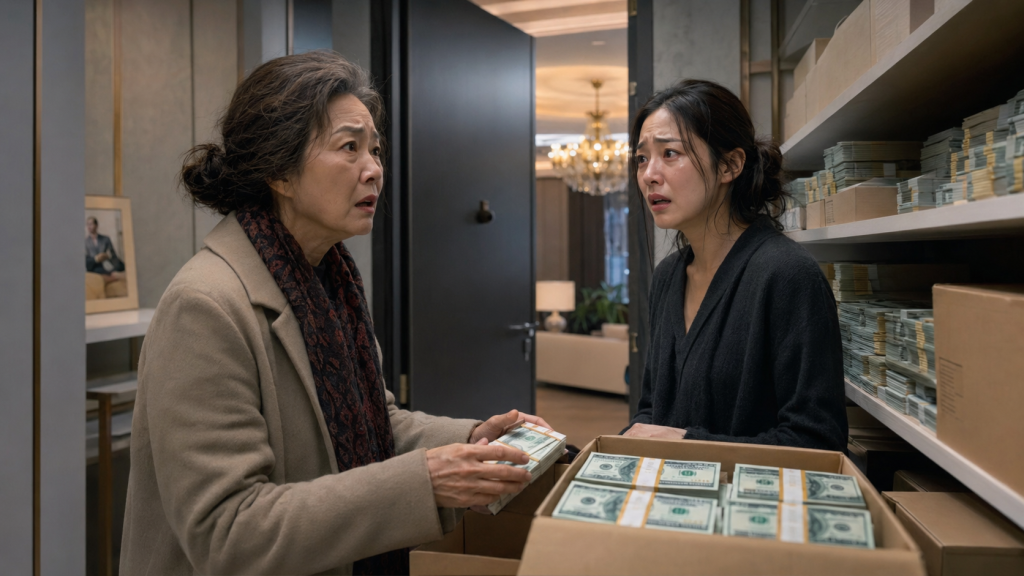
The room was full of boxes.
Some were taped shut.
Some were open.
Inside the open ones were stacks of cash.
Dollars.
So many dollars.
I stepped forward slowly, as if the money might vanish if I moved too quickly.
My hand trembled as I touched one bundle.
Real.
It was real.
My daughter had sent me eighty thousand dollars every year.
But this room held far more than that.
Where had it come from?
Why was it hidden?
Why was there no husband in this house?
Then, downstairs, I heard a door open.
I froze.
A slow footstep crossed the floor below me.
Then another.
My first instinct was to hide, but my body would not obey.
“Who’s there?” a woman’s voice called.
It was weak.
Korean-accented English.
Familiar and broken.
My heart nearly stopped.
“Mary?” I whispered.
Silence.
Then hurried footsteps rushed up the stairs.
When my daughter appeared at the doorway, I nearly cried out.
She was still Mary Lou.
But she looked nothing like the bright girl from the airport twelve years ago.
Her face was pale.
Her cheeks were hollow.
Dark circles sat beneath her eyes.
She stared at me as if I were a ghost.
“Mom?”
Her voice cracked.
“What are you doing here?”
I wanted to run into her arms.
I wanted to hold her and never let go.
But my eyes fell to the boxes of money.
“Mary Lou,” I said, my voice shaking, “where is your husband? Why is all this cash here?”
Her face changed.
Fear.
Then pain.
Then something like surrender.
She stepped inside the room and closed the door behind her.
“Mom,” she whispered, “Kang Jun has been dead for seven years.”
The words did not make sense at first.
I stared at her.
Dead?
Seven years?
I shook my head.
“No. No, that can’t be true. You told me he was working. You told me everything was fine.”
Tears filled her eyes.
“I lied.”
“Why?”
She covered her mouth with one hand.
“Because I was ashamed.”
“Ashamed of what?”
She looked at the money.
Then she looked back at me.
“Of surviving.”
I reached for the wall to steady myself.
Mary Lou began to cry silently.
Not the way people cry in movies.
No loud sobs.
No dramatic collapse.
Just tears slipping down a face that looked too tired to fight anymore.
“Kang Jun was not rich the way everyone thought,” she said. “He had money when I met him, yes. But most of it came from debt. Investments. Borrowed money. Bad business.”
I listened, unable to move.
“When we came here, I found out he owed people. Dangerous people. He had borrowed money from private lenders. He told me not to worry. He said he could fix it.”
She laughed once, bitterly.
“He couldn’t.”
“What happened?”
“He got sick first. His liver. He drank too much. Worked too much. Lied too much. By the time I understood everything, the debts were already in my name too.”
I felt cold.
“In your name?”
She nodded.
“He made me sign papers. I didn’t understand Korean well then. He said they were for the house. For insurance. For business. I trusted him.”
My hands curled into fists.
“Oh, Mary Lou.”
“After he died, the lenders came.”
Her voice dropped.
“They said if I didn’t pay, they would take the house. They would sue. They would ruin me. One man told me he knew where my mother lived in America.”
My breath caught.
“That’s why you never came home.”
She nodded.
“At first, yes. I thought if I went home, they might follow. Or they might think I had run away and come after you.”
“But the money?” I whispered.
She wiped her face.
“Kang Jun had one thing left. An insurance policy. Not huge by rich people’s standards, but enough to start paying. I wanted to come home after that, but then I found something else.”
She walked to one of the boxes and opened it wider.
Inside were not only cash bundles, but notebooks, receipts, contracts, and photographs.
“Kang Jun had been hiding money from his lenders,” she said. “Cash from business deals. Some legal. Some not. After he died, I found it in storage units, bank boxes, even hidden inside furniture.”
“You kept it?”
“I didn’t know what to do. If I reported it, I was afraid I would be blamed for whatever he had done. If I spent it, I was afraid someone would trace it. If I sent it all to you, you might ask questions.”
“So you sent eighty thousand every year.”
Her face crumpled.
“I wanted to make sure you were safe. Comfortable. I wanted at least one good thing to come from this nightmare.”
I stared at my daughter.
My beautiful, foolish, suffering daughter.
“For seven years,” I said, “you lived alone in this house with all this fear?”
She nodded.
“I worked. I paid debts. I learned the language. I hired a lawyer. Then another. Some helped. Some stole from me. I kept records. I kept quiet. And every Christmas, I almost bought a ticket home.”
“Why didn’t you?”
Her tears fell faster.
“Because I didn’t want you to see what I had become.”
I crossed the room and took her face in my hands.
“You are my daughter.”
She squeezed her eyes shut.
“I was supposed to have a beautiful life. I was supposed to prove you wrong.”
“Oh, Mary Lou.”
“I thought if I came home broken, everyone would know. They’d say you were right. They’d pity me. They’d whisper.”
“Let them whisper,” I said.
She opened her eyes.
I pulled her into my arms.
For twelve years, I had imagined this moment.
I thought I would scold her.
I thought I would demand answers.
I thought anger would come first.
But when I felt her thin body shaking against mine, all the anger melted into grief.
She was not a rich woman enjoying a glamorous life abroad.
She was a daughter trapped by shame, debt, lies, and fear.
And I had been eating Christmas dinner alone while she had been surviving alone on the other side of the world.
We stood there for a long time.
Finally, I asked, “Are you still in danger?”
She hesitated.
“Not like before. Most of the debts are settled. My current lawyer says the remaining money can be declared and cleaned through legal channels. But I was afraid.”
“Of prison?”
“Of losing everything.”
“Mary Lou, you already lost twelve years.”
She looked away.
Those words hurt her, but they were true.
That evening, she made tea with trembling hands.
The house felt less like a showroom with her in it, but still too quiet.
I sat at the kitchen table while she told me everything.
Kang Jun had been charming, but desperate.
He married her quickly because he wanted someone loyal, someone who would trust him, someone far from her own family.
At first, he was kind.
Then came secrets.
Calls at night.
Arguments behind closed doors.
Documents she could not read.
Debts she did not understand.
He never beat her, she said, but fear does not always need fists.
Sometimes fear enters through papers, signatures, silence, and threats.
After his death, she had built a life out of control.
She controlled the house.
Controlled the money.
Controlled the story.
Controlled every word she sent me.
But control had become another prison.
“Do you hate me?” she asked.
I looked at her across the table.
“For lying?”
“For staying away.”
I reached for her hand.
“I hated the silence. I never hated you.”
She bowed her head and cried again.
The next morning, I met her lawyer.
His name was Mr. Park, a calm man in his fifties with silver glasses and a serious face.
He spoke English well enough for me to understand.
He confirmed much of what Mary Lou had said.
Kang Jun’s estate had been messy.
There were debts, hidden cash, suspicious business records, and several people who had tried to pressure Mary Lou after his death.
But over the years, she had paid, documented, and protected herself better than she realized.
“She is not criminal,” Mr. Park said firmly. “She is frightened. There is a difference.”
I held Mary Lou’s hand under the table.
Mr. Park explained the next steps.
The money would be reported properly.
Taxes would be paid.
Any remaining claims would be handled legally.
Some money might be lost.
Some might be kept.
But the hiding would end.
Mary Lou listened quietly.
For the first time, I saw something like relief on her face.
That night was Christmas Eve.
I had traveled so far that I had forgotten what day it was until Mary Lou opened a cabinet and pulled out a small wrapped box.
“I bought this months ago,” she said. “I was going to mail it.”
She handed it to me.
Inside was a scarf.
Soft blue wool.
My favorite color.
I pressed it to my face and breathed in.
Then I opened my suitcase and took out a small container wrapped in foil.
Mary Lou frowned.
“What is that?”
“Beef stew.”
Her mouth fell open.
“You brought beef stew on a plane?”
“I froze it first.”
For the first time in twelve years, my daughter laughed.
A real laugh.
A laugh that filled the dead kitchen with life.
I warmed the stew on her spotless stove.
The smell rose slowly, rich and familiar.
Mary Lou stood beside me, crying and smiling at the same time.
“It smells like home,” she whispered.
“It is home,” I said. “At least a piece of it.”
We ate at the kitchen table.
No fancy dishes.
No perfect presentation.
Just stew, tea, and two women who had wasted too many years pretending they were fine.
Later, Mary Lou took out her phone.
Her hands shook.
“What are you doing?” I asked.
She swallowed.
“I’m booking two tickets.”
“Where?”
She looked at me.
“Home.”
My chest tightened.
“For a visit?”
She looked around the cold house.
At the spotless counters.
At the empty rooms.
At the boxes upstairs.
Then she shook her head.
“No, Mom. Not a visit. I want to come home.”
I covered my mouth as tears filled my eyes.
“But what about everything here?”
“I’ll finish it with Mr. Park. I can return if needed. But I don’t want to live inside this secret anymore.”
I nodded because I could not speak.
Three weeks later, after meetings, signatures, reports, and arrangements, Mary Lou walked through the airport beside me.
This time, I was not watching her leave.
This time, I was bringing her home.
When we arrived in my town, Mrs. Darlene was waiting with a coat and a shocked expression.
She hugged Mary Lou and cried as if she were family.
By sunset, neighbors had already seen us.
The whispers began immediately.
Mary Lou is back.
Did she leave her husband?
Where is the Korean man?
Is she still rich?
I heard them.
Mary Lou heard them too.
She stood stiffly beside me on the porch.
I took her hand.
“Let them whisper,” I said again.
She smiled faintly.
Christmas had passed, but I cooked beef stew anyway.
This time, when I set the table, I placed two plates.
Two spoons.
Two glasses.
Mary Lou sat across from me, thinner than before, older than before, but alive.
My daughter was home.
For a long while, neither of us spoke.
Then she looked at the empty third chair where her father used to sit when she was small.
“I’m sorry I was gone so long,” she said.
I reached across the table and touched her hand.
“I’m sorry you felt you couldn’t come back broken.”
Her eyes filled with tears.
I smiled softly.
“Children always think mothers only want to see them succeed. But that isn’t true. We want to see them. Happy, sad, proud, ashamed, rich, poor, broken, healed. We just want them home.”
Mary Lou lowered her head.
“I was scared you would be disappointed.”
“I was scared I would die before holding you again.”
That made her cry.
I stood and went around the table.
She leaned into me like she had at the airport twelve years earlier.
Only this time, no security gate waited to separate us.
No plane waited to take her away.
No lie stood between us.
Months passed.
The legal matters in Korea continued, but from a distance.
Mr. Park handled most of it.
Some of the money was surrendered.
Some was taxed.
Some was cleared.
Mary Lou kept enough to begin again, but not enough to hide behind.
She found work at a small translation office.
She started therapy.
She learned to sleep without checking the locks three times.
Some nights were hard.
Some days, shame still came for her.
But she stayed.
Every Christmas after that, I still cooked beef stew.
Only now, I did not set an empty place for a daughter who might never come.
I set a full plate for the woman sitting across from me.
People still said I was lucky.
This time, I agreed.
Not because of the money.
Not because my house was repaired.
Not because my daughter had once sent eighty thousand dollars a year.
I was lucky because one winter morning, I bought a plane ticket with shaking hands.
I was lucky because I opened a door I was afraid to open.
I was lucky because behind that door, I found the truth.
Painful.
Messy.
Terrifying.
But still the truth.
And the truth gave me back my daughter.
Money had arrived every year for twelve years.
But the greatest gift Mary Lou ever gave me was not in a bank account.
It was the sound of her key turning in my front door.
It was her voice calling from the hallway, tired but real.
“Mom, I’m home.”
And every time I heard it, my heart answered the same way.
Yes, my child.
At last.
You are home.
THE END! THANK YOU FOR READING!