

A cleaning lady’s son became the target of a billionaire’s mockery. “I’ll give you one hundred million dollars if you can open the safe.” At first, everyone laughed.
The kind of laughter that came easily to rich men who had never been hungry, never waited outside a landlord’s door with rent money missing, never watched their mother skip dinner and call it “not being hungry.”
But the laughter died the moment the barefoot child lifted his head and replied.
“Are you offering the money because you think I can’t open it, or because you’re afraid someone like me might?”
The executive floor went silent.
It was the kind of silence that could swallow a whole room.
High above the city, behind glass walls and marble floors, the headquarters of Whitmore Global looked like a palace built in the clouds. From that height, traffic seemed like tiny streams of light, people looked like dots, and the city’s noise could not reach the men sitting around the long black conference table.
Those men made decisions that destroyed families without ever meeting them.
They shut down factories.
They bought buildings.
They raised rents.
They turned people’s lives into numbers on glowing screens.
At the far end of the room sat Nathaniel Whitmore, the billionaire who owned most of what everyone else rented.
He was fifty-four, silver-haired, always smiling in a way that made people nervous. His suits were handmade in Italy, his watch cost more than a house, and his name was carved into hospitals, libraries, and towers across the country.
People called him generous.
People called him brilliant.
People who worked beneath him called him something else, but only when the doors were closed.
Near the entrance stood Rosa Alvarez, holding a mop like it was a shield.
She had worked in that building for six years.
Every evening after the executives left, she cleaned fingerprints off glass walls, coffee stains from polished tables, and cigar ash from balconies where men bragged about charity while underpaying the people who emptied their trash.
Rosa had learned to move quietly.
She had learned not to look too long at anything expensive.
She had learned that in buildings like this, the poor were allowed inside only if they were invisible.
But that morning, she had not been invisible.
Because her son was standing beside her.
Mateo was eleven years old.
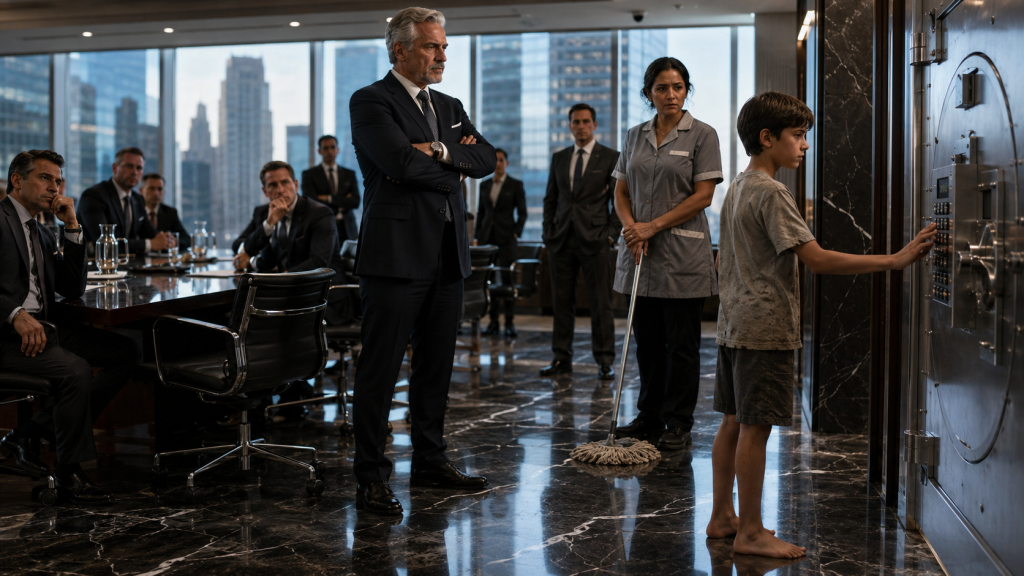
Thin, quiet, with serious eyes that seemed older than his face. His school had closed for the day because of a water problem, and Rosa had no one to leave him with. Her neighbor was sick, her sister lived three buses away, and missing work meant losing pay she could not afford to lose.
So she brought him with her.
She told him to sit by the service hallway.
She told him not to speak.
She told him not to touch anything.
And most of all, she told him not to let anyone notice him.
But his shoes had finally fallen apart two weeks earlier.
The soles had split open so badly that rainwater came through. Rosa had tried to glue them together twice, but by that morning they were useless. Buying new shoes would have meant paying rent late, and rent late meant another warning from the landlord.
So Mateo came barefoot.
His toes touched marble that probably cost more than everything in their apartment.
He did not complain.
He never complained.
That was what hurt Rosa most.
She could handle hunger.
She could handle exhaustion.
She could handle the ache in her back from bending over floors that reflected chandeliers.
But she could not handle the quiet way her son accepted less than other children.
He stood beside her, clutching his worn backpack, eyes fixed on the steel safe built into the wall.
The safe was enormous.
Custom-made.
Triple-locked.
Hidden behind a moving panel of dark wood and polished metal.
Nathaniel Whitmore had ordered it installed after bragging to a magazine that “trust was for amateurs.” The safe supposedly held rare contracts, private documents, diamonds, emergency cash, and things people whispered about but never confirmed.
To the executives, it was a symbol of power.
To Mateo, it was a puzzle.
Nathaniel noticed him during a discussion about layoffs.
A junior executive was explaining how cutting four hundred workers could increase quarterly projections by three percent when Nathaniel suddenly raised one hand.
His eyes had moved past the screen to the boy near the door.
“Well,” he said, leaning back. “Looks like we’ve got a guest.”
Everyone turned.
Rosa’s stomach dropped.
Her fingers tightened around the mop handle.
“I’m sorry, sir,” she said quickly. “His school closed today. I’ll keep him outside. I can leave early if—”
Nathaniel smiled.
Not kindly.
“Sit tight, Rosa. This could be fun.”
A few men chuckled.
One woman at the table looked uncomfortable but said nothing.
Mateo lowered his eyes, but he did not move behind his mother.
Nathaniel stood and walked toward the safe.
He loved performing.
He loved making people look small.
With a dramatic clap of his hands, he said, “Young man, since you seem so interested in my safe, let’s make a deal.”
Rosa stepped forward. “Please, sir, he didn’t mean anything.”
Nathaniel ignored her.
He pointed to the safe.
“I’ll give you one hundred million dollars if you can open it.”
The room exploded with laughter.
Someone slapped the table.
Another executive covered his mouth as if the joke was too delicious.
“Careful,” one man said. “He might bankrupt you.”
“Maybe he has a secret degree from Harvard,” another added.
The laughter grew louder.
Rosa felt heat rise to her face.
She wanted to grab Mateo’s hand and run.
She wanted to disappear.
But Mateo did not cry.
He did not shrink.
He stared at the safe, then looked up at the billionaire.
“Can I ask a question first?”
Nathaniel raised an eyebrow.
“Sure, kid. Go ahead.”
Mateo tilted his head.
“Are you offering the money because you think I can’t open it, or because you’re afraid someone like me might?”
The laughter stopped.
A man near the window coughed.
Nathaniel’s smile froze for half a second before returning.
“Bold,” he said. “I like bold.”
Rosa whispered, “Mateo, please.”
But Mateo’s voice stayed calm.
“My mother says never accept a promise from a rich person unless witnesses hear it.”
A few faces changed.
Nathaniel laughed once, sharp and short.
“Fine. Everyone heard me. One hundred million dollars if you open my safe.”
Mateo looked around the table.
“Did everyone hear?”
No one answered.
Mateo waited.
The uncomfortable woman at the table finally said, “Yes. We heard.”
Mateo nodded.
“Then I’ll try.”
Rosa grabbed his arm.
“No.”
He looked up at her, and for the first time that morning, his expression softened.
“Mamá,” he whispered. “Trust me.”
She shook her head.
“You don’t have to prove anything to these people.”
“I’m not proving anything,” he said. “I’m asking for what they owe you.”
Rosa went still.
Nathaniel heard it.
His eyes narrowed.
“What was that?”
Mateo stepped closer to the safe.
“My mother cleans this floor every night. Sometimes until two in the morning. But her paycheck says she only worked until eleven.”
The room shifted.
An executive from operations looked down at the table.
Rosa’s face went pale.
“Mateo, stop.”
But the boy continued.
“She says mistakes happen. But mistakes don’t happen every week for six years.”
Nathaniel’s expression cooled.
“This is not the time for complaints.”
Mateo pointed at the safe.
“You made it the time.”
No one spoke.
The city glittered beyond the glass walls, beautiful and far away.
Mateo approached the safe, careful not to touch it yet.
He studied the keypad.
The fingerprint panel.
The polished handle.
Then he shook his head.
“That isn’t the real lock.”
Nathaniel folded his arms.
“Oh?”
“That part is for people you want to impress.”
A few executives exchanged glances.
Mateo moved his eyes slowly along the frame of the safe.
“There’s another panel.”
Rosa stared at him.
She had never seen her son like this.
Quiet, yes.
Smart, always.
But not afraid.
Not even a little.
Mateo raised his hand and touched a narrow seam beside the safe, so thin it looked like part of the design. A small hidden screen blinked awake.
Someone gasped.
Nathaniel’s smile vanished.
“How did you know that?” he asked.
Mateo did not look at him.
“My mother cleans here. I sit in the hallway sometimes and do homework. People think children don’t listen. They do.”
The hidden screen glowed blue.
Mateo stepped back instead of touching it again.
“I can’t open it from here.”
Nathaniel let out a breath that sounded almost like relief.
But Mateo turned and pointed toward the long conference table.
“The release is not at the safe. It’s under your chair.”
All eyes moved to Nathaniel’s chair.
For the first time, the billionaire looked truly angry.
“That’s enough.”
Mateo looked at him.
“You said if I could open it.”
“I said that as a joke.”
“My mother’s missing pay isn’t a joke.”
The uncomfortable woman stood suddenly.
Her name was Evelyn Park, the company’s legal counsel.
“Mr. Whitmore,” she said carefully, “perhaps we should end the meeting.”
Nathaniel snapped, “Sit down.”
Evelyn did not sit.
Mateo walked toward Nathaniel’s chair.
Two security guards near the door shifted forward, but Nathaniel raised a hand. His pride would not allow him to look frightened of an eleven-year-old.
“Let him,” Nathaniel said coldly. “Let the boy embarrass himself.”
Mateo knelt beside the chair.
His bare knees touched the marble.
Rosa felt shame twist inside her, not because of Mateo, but because every person in that room was watching a hungry child kneel on a billionaire’s floor like entertainment.
Mateo reached under the chair and found a small metal switch hidden along the inner edge.
He pressed it.
The safe clicked.
The sound was soft.
But it rolled through the room like thunder.
The steel door loosened by an inch.
Every executive went still.
Nathaniel stepped forward.
“Don’t touch that door.”
Mateo stood.
“I opened it.”
“You triggered an outer release,” Nathaniel said. “That isn’t opening it.”
Mateo looked at him calmly.
“You’re changing the rules.”
“No,” Nathaniel said. “I’m clarifying them.”
Mateo nodded slowly.
“My teacher says people clarify rules when they’re losing.”
Someone at the table made a sound like a swallowed laugh.
Nathaniel’s face darkened.
“You think you’re clever?”
Mateo looked at the safe again.
“No. I think you’re careless.”
That made the room colder.
Mateo pointed to the hidden screen.
“You don’t use numbers because numbers can be guessed. You use a voice phrase. But the phrase is not about money. It’s about your daughter.”
Nathaniel went completely still.
Evelyn’s eyes widened.
Rosa whispered, “What daughter?”
The room knew.
Or at least some of them did.
Nathaniel Whitmore had one child, a daughter named Claire, though he rarely mentioned her. Years earlier, newspapers had written about her leaving the family business after a bitter argument. Since then, she had lived quietly, teaching art at a small community center.
Nathaniel donated millions to children’s charities.
But he had not spoken to his own daughter in eight years.
Mateo looked at the hidden screen.
“The phrase is something you said to her on a call.”
Nathaniel’s voice dropped.
“How would you know that?”
Mateo swallowed.
For the first time, he looked like a child again.
“Because you shouted it in this room three months ago. My mother was cleaning the bathroom. I was outside doing math. You said it three times.”
The billionaire’s jaw tightened.
Mateo faced the safe.
In a small voice, he repeated the phrase.
“I don’t need anyone who questions me.”
The safe beeped.
Then the steel door opened.
Not all the way.
Just enough.
But enough for everyone to see the darkness inside.
Enough to prove that the barefoot child had done what a billionaire said he never could.
No one breathed.
Rosa’s mop slipped from her hand and clattered against the floor.
Nathaniel lunged toward the safe and slammed it shut before anyone could see inside.
But it was too late.
The room had seen something.
Not jewels.
Not cash.
Not contracts.
A stack of red folders with names printed across them.
Employee settlements.
Wage disputes.
Safety complaints.
And on top, one folder labeled:
R. Alvarez.
Rosa saw her name.
So did Evelyn Park.
So did every executive at the table.
Mateo saw it too.
His voice changed.
“My mother has a folder in your safe?”
Nathaniel turned to the room.
“This meeting is over.”
No one moved.
Evelyn walked slowly toward the safe.
“Mr. Whitmore, why is an employee wage complaint stored in your private safe instead of legal records?”
Nathaniel glared at her.
“Because I own the company, Evelyn.”
She met his eyes.
“You do not own the law.”
The sentence cracked something open.
Rosa stood frozen near the door, her hand trembling.
For six years she had been told her missing hours were payroll errors.
For six years she had been told to be grateful.
For six years she had cleaned the offices of men who had discussed her like a number, while her son outgrew shoes she could not replace.
And all that time, her name had been locked inside Nathaniel Whitmore’s private safe.
Mateo turned to the billionaire.
“You knew.”
Nathaniel said nothing.
Mateo’s voice grew louder.
“You knew she wasn’t being paid.”
Nathaniel looked at Rosa with irritation, not guilt.
“Your mother signed her contracts.”
Rosa finally found her voice.
“They were in English.”
Nathaniel shrugged.
“You worked here long enough to learn.”
Evelyn said sharply, “Mr. Whitmore.”
But Rosa stepped forward.
Her face was pale, but her eyes were no longer lowered.
“I asked payroll every month,” she said. “They told me I was mistaken.”
Nathaniel’s mouth tightened.
“People at your level often misunderstand.”
Mateo flinched as if struck.
Then he looked around the room.
“At her level?”
No one answered.
He pointed toward the windows.
“My mother leaves our apartment before sunrise. She takes two buses. She cleans your bathrooms, your coffee cups, your floors. When you spill food, she picks it up. When you leave trash, she carries it. When you go home, she stays. She isn’t below you. She’s holding up the floor you stand on.”
For a moment, no one moved.
Even Nathaniel looked shaken, though only for a second.
Then he laughed.
It was forced.
“This is touching. Really. But feelings don’t open bank accounts.”
Mateo looked at him.
“You promised one hundred million dollars.”
The room stiffened.
Nathaniel smiled cruelly.
“And you believed me?”
Mateo did not blink.
“There were witnesses.”
“A childish joke is not a contract.”
Evelyn’s expression became unreadable.
“That depends,” she said.
Nathaniel turned to her.
“What?”
She spoke slowly.
“You made a verbal offer in front of multiple executives. The condition was clear. The child performed the condition. You may argue it was a joke, but after the safe opened, your conduct and the surrounding evidence become very complicated.”
Nathaniel stared at her.
“You work for me.”
Evelyn’s voice was calm.
“I work for the company. Not for your ego.”
A murmur moved through the room.
One of the executives, a man named Grant, stood.
“I’m not getting dragged into this.”
Another said, “There are cameras.”
Nathaniel whipped around.
“What cameras?”
Grant pointed weakly toward the ceiling.
“Board security. Always recording executive meetings.”
Nathaniel’s face drained of color.
For years, he had believed the cameras protected him.
Now they had witnessed him.
Mateo turned to Evelyn.
“Can my mother get her pay?”
Evelyn looked at Rosa.
Her expression softened.
“Yes. And likely more than pay.”
Rosa covered her mouth.
She did not cry yet.
She had spent too many years swallowing tears until they turned to stone.
Nathaniel stepped between them.
“This is ridiculous. I will not be extorted by a janitor and her barefoot son.”
The word barefoot seemed to hit the room differently this time.
Not funny.
Not small.
Not shameful.
Evidence.
Evelyn took out her phone.
“Then I recommend you call outside counsel.”
Nathaniel leaned close to her.
“You’re fired.”
She nodded once.
“Then I am no longer your counsel, which makes this easier.”
She looked at Rosa.
“Mrs. Alvarez, do I have your permission to contact the labor board and preserve the security footage from this room?”
Rosa stared at her, unable to speak.
Mateo gently took his mother’s hand.
“She says yes.”
Rosa squeezed his fingers.
“Yes,” she whispered. “Yes.”
Nathaniel slammed his palm on the table.
“No one leaves this room with company information.”
The security guards looked at him.
Then they looked at the child.
Then at Rosa.
Then at Evelyn.
One guard, a tall man with kind eyes, stepped away from the door.
“I heard the promise too,” he said quietly.
The other guard nodded.
“My sister works nights in one of your hotels,” he added. “Same missing hours.”
That was when the room truly changed.
Not because Nathaniel lost power all at once.
Power rarely collapses like glass.
It leaks.
First through one crack.
Then another.
Then another.
Evelyn sent messages.
Grant called a board member.
Someone else quietly forwarded the meeting recording to an independent compliance director.
Rosa stood in the middle of the room, still wearing her cleaning uniform, still holding her son’s hand, while billion-dollar men began trying to distance themselves from the billionaire they had laughed with ten minutes earlier.
Nathaniel watched it happen with disbelief.
He looked at Mateo as if the boy had performed magic.
But Mateo had done nothing magical.
He had listened.
He had remembered.
He had refused to be ashamed.
That was all.
Within an hour, Rosa and Mateo were no longer allowed to leave through the service elevator.
Evelyn insisted they walk out through the main lobby.
Rosa resisted.
“I don’t belong there,” she said.
Evelyn looked at her.
“Yes, you do.”
So Rosa walked through the lobby where she had always entered from the side.
Her uniform was wrinkled.
Her hands were rough.
Her son was barefoot.
But every receptionist, assistant, and security guard watched them pass.
Some had already heard whispers.
Some understood immediately.
One older woman at the front desk quietly removed her own heels and placed them beside Mateo.
“They won’t fit,” she said, tears in her eyes. “But I want you to know I saw you.”
Mateo smiled shyly.
“Thank you.”
Outside, the city noise rushed back.
Cars honked.
People hurried past.
The world had not changed yet.
But Rosa’s world had cracked open.
That evening, she and Mateo returned to their tiny apartment.
The ceiling still leaked above the kitchen.
The fridge still hummed too loudly.
The rent notice was still taped beside the door.
Nothing looked different.
And yet everything was.
Rosa sat at the table and stared at her hands.
“I should have protected you,” she whispered.
Mateo sat across from her.
“You did.”
She shook her head.
“I brought you there. I let them laugh.”
“You brought me because you had to work,” he said. “That isn’t shame.”
Rosa’s eyes filled.
“When did you become so brave?”
Mateo looked down at his bare feet.
“I’m not brave. I was angry.”
She reached across the table and touched his cheek.
“Sometimes anger can be brave if it protects someone.”
For the first time that day, Mateo’s face crumpled.
He leaned into his mother’s arms and cried like the child he still was.
Rosa held him tightly.
That night, she did not sleep.
Her phone rang again and again.
Evelyn called.
Then a reporter.
Then three other workers from the building who had heard what happened.
By morning, the video had leaked.
Not the inside of the safe.
Not the private files.
But enough.
Nathaniel Whitmore’s voice rang across every screen in the country.
“I’ll give you one hundred million dollars if you can open it.”
Then Mateo’s reply.
“Are you offering the money because you think I can’t open it, or because you’re afraid someone like me might?”
People replayed it millions of times.
Some watched for the billionaire’s face.
Some watched for the executives’ silence.
Most watched the barefoot boy standing on marble and speaking with more dignity than anyone in a suit.
By noon, Whitmore Global released a statement claiming the situation had been “misinterpreted.”
By evening, three former employees came forward.
By the next morning, it was forty-seven.
Then two hundred.
Then more than a thousand workers from cleaning crews, hotels, warehouses, and private buildings connected to Whitmore companies began sharing stories of missing wages, unpaid overtime, unsafe conditions, and threats.
The safe had opened more than a door.
It had opened a flood.
Nathaniel tried to fight.
He hired lawyers.
He denied everything.
He claimed the boy had been coached.
He claimed Rosa was part of a scheme.
But the security footage was clear.
The payroll records were clearer.
And Evelyn Park, once his legal counsel, became the whistleblower who handed over the documents that proved what workers had known for years.
Rosa’s folder had not been the only one in the safe.
There were hundreds.
Each one a person.
Each one a story someone had tried to lock away.
Three weeks later, Rosa sat in a hearing room wearing the best dress she owned.
Mateo sat beside her in new shoes.
They were simple black sneakers, bought by Rosa with money Evelyn had insisted was only the beginning of what she was owed.
Nathaniel sat across the room.
For the first time since Rosa had known him, he looked smaller than the people around him.
Not poor.
Not powerless.
But exposed.
The judge reviewed the footage.
The room watched silently as Nathaniel mocked the child, made the offer, and then saw his safe opened.
When the video ended, the judge removed her glasses.
“Mr. Whitmore,” she said, “it appears you believed humiliation was harmless when directed downward.”
Nathaniel’s lawyer stood.
“Your Honor, the alleged reward was clearly made in jest.”
The judge looked at him.
“Perhaps. But the wage theft was not.”
Rosa closed her eyes.
Wage theft.
The words sounded heavy and official.
For years, she had called it mistakes because she was afraid to call it stealing.
The court called it what it was.
The final settlement did not happen in one day.
Things like that never do.
There were hearings, filings, investigations, and headlines.
But the result came months later.
Rosa received years of unpaid wages, damages, and compensation large enough to move her and Mateo into a safe apartment with sunlight in the kitchen.
Hundreds of other workers received settlements too.
Whitmore Global was forced to create an independent worker protection fund.
Evelyn helped establish a legal clinic for low-wage employees.
As for the one hundred million dollars, Nathaniel fought it bitterly.
His attorneys argued.
Evelyn argued back.
The case became famous.
Was a billionaire’s public promise enforceable?
Was humiliation a joke when the poor were made into entertainment?
Was a child’s dignity worth less because he was barefoot?
In the end, the court did not award Mateo the full hundred million as a prize.
But it did something better.
Under pressure from regulators, shareholders, and a public that would not let the story disappear, Nathaniel Whitmore was forced into a massive consent agreement.
One hundred million dollars was placed into a trust.
Not for Mateo alone.
Mateo asked for that.
When Evelyn told him there was a chance the money could be negotiated in his name, he shook his head.
“My mother needs enough,” he said. “But other mothers were in those folders too.”
So the trust was named The Open Door Fund.
It paid stolen wages.
It bought school shoes.
It funded childcare for night workers.
It paid for legal help, rent emergencies, and scholarships for children whose parents cleaned buildings they could never afford to enter.
At the opening ceremony, reporters crowded around Mateo.
He hated cameras.
He stood close to Rosa, wearing a clean shirt and the same black sneakers.
A journalist asked, “Mateo, when you opened that safe, did you know your life would change?”
He thought about it.
Then he answered honestly.
“I wasn’t trying to change my life. I was trying to make them stop laughing at my mother.”
Rosa began to cry.
This time, she did not hide it.
Nathaniel Whitmore resigned from his company two days later.
Officially, he stepped down to “focus on family and personal reflection.”
But everyone knew the truth.
He had built towers of glass so he could look down on the city.
And he had been brought down by a barefoot boy who looked up and refused to bow.
Years passed.
Mateo grew taller.
He kept studying puzzles, machines, and numbers. Eventually, he earned a scholarship to one of the best engineering schools in the country.
At his graduation, Rosa sat in the front row.
She wore a navy dress and a silver necklace Mateo had bought her with money from his first internship.
Her hands were still rough.
She was proud of that.
Those hands had carried them through hunger, shame, fear, and long nights no one applauded.
After the ceremony, Mateo handed her his diploma.
“This belongs to you too,” he said.
Rosa shook her head.
“No, mijo. You earned it.”
He smiled.
“You held up the floor.”
She laughed through tears.
Later that evening, they walked past the old Whitmore tower.
It had a new name now.
The company had changed owners.
The executive floor had been remodeled.
The safe was gone.
For a moment, Rosa stopped on the sidewalk and looked up.
The glass walls reflected the sunset.
Mateo stood beside her.
“Do you ever think about that day?” she asked.
He nodded.
“Sometimes.”
“Do you regret it?”
He looked at her, surprised.
“No.”
Rosa watched people enter through the front doors: lawyers, cleaners, assistants, executives, delivery drivers. All of them walking beneath the same lights.
“I used to think power meant being untouchable,” she said.
Mateo looked up at the tower.
“I think power is when people who were invisible start being seen.”
Rosa smiled.
“That sounds like something your teacher would say.”
“No,” he said. “That sounds like something my mother taught me.”
She took his hand.
He was no longer a barefoot child.
But in her heart, she could still see him standing on that marble floor, small and thin and brave, facing a room full of men who thought money made them giants.
They had laughed at him.
They had laughed at her.
They had thought poverty meant weakness.
They had thought silence meant stupidity.
They had thought a locked safe could keep the truth buried forever.
But they had forgotten something simple.
Locks are made by people.
Secrets are kept by people.
And sometimes, the person everyone ignores is the one who has been listening the whole time.
That was how a cleaning lady’s son opened a billionaire’s safe.
Not with a code.
Not with force.
But with memory.
With courage.
And with a question powerful enough to silence a room full of people who had forgotten how to feel shame.
“Are you offering the money because you think I can’t open it,” he had asked, “or because you’re afraid someone like me might?”
Years later, people still repeated that line.
They printed it on posters.
They painted it on walls.
They taught it in classrooms.
But Rosa remembered what came after better than anyone.
The silence.
The click.
The opening of the door.
And the moment her son looked at the most powerful man in the room and proved that dignity does not need shoes, wealth, or permission.
It only needs a voice.
And the courage to use it.
THE END! THANK YOU FOR READING!