

The night I quietly whispered, “I saw you,” after catching my husband kissing another woman, I walked away without another word. Four years later, he would come face-to-face with two little boys he never knew existed.
And in that moment, Nathan Cole would finally understand that the family he destroyed had been waiting just beyond his reach all along. I didn’t scream when I discovered Nathan’s betrayal. No tears. No shattered glasses.
No dramatic confrontation beneath the glittering skyline of downtown Chicago.
Just silence.
I stood in the doorway of his twenty-eighth-floor office holding the insulated dinner bag I had carried across the city for our fifth wedding anniversary.
Inside were steak tartare, warm bread, and his favorite black cherry tart from the tiny French restaurant we used to love before success consumed his life.
Nathan stood beside the conference table.
Wrapped in his arms was Chloe Bennett, his twenty-four-year-old executive assistant.
Her lipstick was smeared across his mouth.
For a moment, nobody moved.
The city lights sparkled through the floor-to-ceiling windows while my marriage collapsed in complete silence.
Chloe stepped back first, her hand flying to her mouth.
Nathan looked at me as if he had seen a ghost.
“Emily,” he said.
His voice cracked on my name.
I looked at the man I had loved since I was twenty-three years old.
The man who once cried when he proposed to me on a cold pier in Michigan.
The man who promised me that no ambition, no success, no amount of money would ever come before us.
Then I looked at the woman beside him.
Young.
Beautiful.
Frightened.
She was still holding the edge of his jacket like she belonged there.
That was when I knew.
This was not an accident.
This was not a mistake that happened in one reckless second.
This was a door that had been opening for weeks, maybe months, while I stood on the other side pretending not to hear it.
Nathan stepped forward.
“Emily, wait. Please. Let me explain.”
I set the dinner bag down on the carpet.
The warm bread inside shifted softly.
The smell of rosemary and butter filled the office, and for some reason, that hurt worse than the kiss.
I had chosen every item carefully.
I had wanted to remind him of us.
Of who we used to be.
Of the tiny apartment where we once ate takeout on the floor because we had no dining table.
Of the nights when he would fall asleep with his head in my lap while I ran my fingers through his hair.
Of the man who used to come home before midnight.
Now that man stood with another woman’s lipstick on his mouth.
I said the only words that mattered.
“I saw you.”
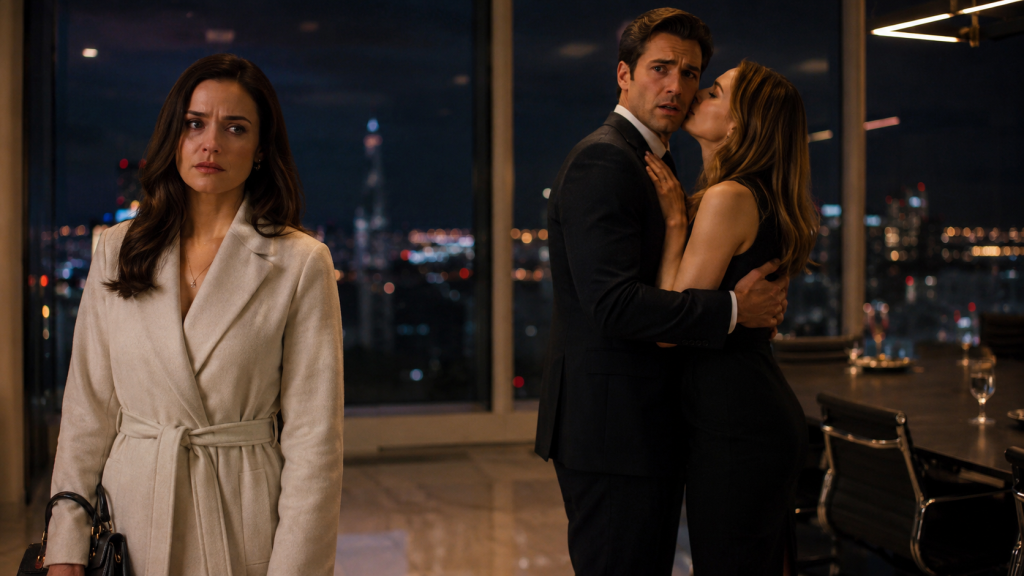
Nathan froze.
The color drained from his face.
He opened his mouth, but no words came out.
Maybe he expected me to cry.
Maybe he expected me to rage.
Maybe he expected the kind of chaos that would let him defend himself.
But I gave him nothing.
I turned around and walked away.
Behind me, he called my name again.
Louder this time.
“Emily!”
The elevator doors opened.
I stepped inside.
As they closed, I saw him running toward me, but he was too late.
The last thing I saw was his face breaking apart.
Only after the doors sealed shut did one tear slide down my cheek.
Just one.
Enough to remind me I was still alive.
By sunrise, I had disappeared.
I packed two suitcases, a box of old photographs, my documents, and the chipped blue coffee mug Nathan always teased me for keeping.
It had a crack near the handle, but I loved it because it was the first thing we bought together.
I left behind the diamond necklace he gave me after forgetting my birthday.
The designer bags he bought after canceling vacations.
The expensive apologies.
I left all of it on the bed.
I left no letter.
No voicemail.
No explanation.
Only absence.
Nathan called constantly.
Texts.
Emails.
Flowers delivered to my parents’ house.
My mother sent the flowers back with one message.
“She asked you not to look for her.”
That was when Nathan finally panicked.
He went to my best friend.
He went to my parents.
He even went to the tiny French restaurant where we used to eat every anniversary.
Nobody told him where I was.
Because nobody knew.
I had driven east until the city disappeared behind me.
For two days, I stayed in cheap motels and slept with my phone turned off.
On the third morning, I stopped outside Albany, New York, in a quiet town where nobody knew Nathan Cole’s name unless they read business magazines.
I found a small furnished apartment above a bakery.
The stairs creaked.
The walls were thin.
The kitchen window faced a brick alley.
It was nothing like the penthouse Nathan and I had owned in Chicago.
And yet, for the first time in months, I could breathe.
I told myself I would stay only a little while.
Just long enough to heal.
Just long enough to decide what came next.
Then two weeks later, I sat alone on the bathroom floor holding a pregnancy test.
Positive.
My hands shook so badly I dropped it into the sink.
For a long moment, I could not move.
I pressed both hands over my mouth and stared at my reflection in the mirror.
Pale face.
Red eyes.
A woman who had just lost her husband and found out she was carrying his child.
I laughed once.
A broken, soundless laugh.
Then I cried until my chest hurt.
At my first ultrasound, the doctor smiled gently.
“Congratulations,” she said. “You’re having twins.”
Twins.
The word filled the room like thunder.
I stared at the screen where two tiny heartbeats flickered side by side.
Two lives.
Two miracles.
Two pieces of a man I was trying desperately to forget.
For one terrifying second, I thought about calling Nathan.
I imagined his voice when he heard.
I imagined his shock.
His guilt.
His promises.
Then I remembered Chloe in his arms.
I remembered him telling me not to be dramatic.
I remembered all the lonely dinners, the unanswered texts, the birthdays he missed, the excuses he made.
And I made my decision.
Nathan Cole would not know.
Not yet.
Maybe not ever.
I told myself I was protecting my babies.
I told myself a father who betrayed their mother did not deserve to rewrite the story just because children were involved.
I told myself many things in those months.
Some were true.
Some were only pain wearing the mask of wisdom.
Pregnancy was hard.
I worked part-time at the bakery downstairs until my belly grew too large to hide behind the counter.
The owner, Mrs. Alvarez, became my first friend in that town.
She was a sharp-tongued widow with kind hands and a habit of feeding anyone who looked sad.
When she found me crying one morning over burnt croissants, she simply pulled up a chair.
“Men,” she said, handing me a napkin. “They make disasters and call them mistakes.”
I laughed through my tears.
She helped me find a better doctor.
She drove me to appointments when my ankles swelled.
She brought soup when I was too tired to cook.
When I went into labor six weeks early during a thunderstorm, she was the one who held my hand in the ambulance.
Noah came first.
Small.
Furious.
Screaming like he had been personally insulted by the world.
Liam came seven minutes later.
Quieter.
Wide-eyed.
His tiny fingers curled around mine as if he already knew I needed him.
I named them Noah James and Liam Cole.
Yes, I gave them Nathan’s last name.
I told myself it was because paperwork was easier.
But deep down, I knew the truth.
A part of me still loved the man Nathan used to be.
The boys were born with dark hair, serious eyes, and the same crooked smile that once made me forgive too much.
Every day, they looked more like him.
Every day, I loved them more fiercely.
Motherhood remade me.
It exhausted me.
It frightened me.
It healed places inside me I thought had gone permanently cold.
There were nights when both babies cried and I sat between their cribs whispering, “Please, please, please,” because I had nothing left to give.
There were mornings when I looked at their sleeping faces and felt joy so sharp it almost hurt.
I learned how to live without Nathan.
I learned how to fix leaky faucets.
How to stretch money.
How to soothe two fevers at once.
How to smile when people asked about their father.
“He isn’t in our lives,” I would say.
No more.
No less.
As the boys grew, their personalities bloomed.
Noah was cautious and observant.
He lined up his toy cars by color and frowned when anyone moved them.
He asked questions before he trusted anyone.
Liam was sunlight.
Wild curls.
Sticky fingers.
A laugh that filled every corner of the apartment.
He hugged strangers, collected rocks, and once tried to bring a frog into the bathtub because it “looked lonely.”
I built a life around them.
Small.
Quiet.
Real.
Meanwhile, Nathan’s life became something I only heard about accidentally.
A magazine article in a waiting room.
A headline online.
A photo of him leaving a charity gala, thinner than before, his smile empty.
His company struggled after a major investor pulled out.
Then recovered.
Then expanded.
Nathan Cole was still successful.
Still powerful.
Still admired.
But sometimes, in photographs, I saw something in his eyes that made me look away.
Regret.
Or maybe I only wanted it to be regret.
Four years passed.
The boys turned four on a Saturday in May.
We had cupcakes with blue frosting.
Noah asked for a telescope.
Liam asked for a dinosaur that roared.
That night, after they fell asleep tangled together under a blanket, I sat in the kitchen and stared at an invitation on the table.
The invitation was for a charity event in Chicago.
The Children’s Hope Foundation was hosting a fundraiser for pediatric hospitals.
My small community bookstore had been invited to help organize donated books because I had started a children’s reading program the year before.
At first, I laughed at the idea.
Chicago.
The city I had escaped.
The city where Nathan still lived.
But the foundation offered to cover travel costs, and the program needed donations.
So I said yes.
I told myself Chicago was a city of millions.
The chances of seeing Nathan were almost impossible.
I was wrong.
The event was held in a grand hotel ballroom with gold chandeliers, white roses, and soft piano music floating through the air.
I wore a navy dress and kept my hair pinned low.
Noah and Liam wore matching little suits because Mrs. Alvarez insisted they needed to “look like tiny gentlemen.”
They hated the bow ties.
I bribed them with cookies.
For the first hour, everything was fine.
I helped arrange donated books on long tables.
Noah stayed close to me, carefully stacking picture books by size.
Liam wandered two steps away at a time, distracted by balloons, flowers, and anyone carrying dessert.
Then someone announced that the foundation’s largest donor had arrived.
The room shifted.
People turned.
Cameras flashed near the entrance.
I did not look up at first.
Then I heard a voice I had not heard in four years.
Older.
Quieter.
Still unmistakable.
“Thank you. The children are the reason we’re here tonight.”
My body went cold.
Slowly, I turned.
Nathan Cole stood near the entrance in a dark suit.
He looked almost the same.
Handsome.
Composed.
Powerful.
But something had changed.
There were faint lines around his eyes now.
His face was leaner.
His smile did not reach as easily.
For a moment, I could not breathe.
All the years vanished.
I was back in that office.
Back under the city lights.
Back holding a dinner bag while my heart broke silently.
I turned quickly, hoping he had not seen me.
But fate is cruelest when it moves quietly.
“Noah,” I whispered. “Liam. Stay close.”
Before I could reach him, Liam slipped away toward the dessert table.
Noah followed to stop him.
And then it happened.
Noah bumped straight into Nathan.
“Sorry, sir,” Noah said politely.
Nathan looked down.
His entire body went still.
Liam came running up behind his brother.
“Sorry,” Liam echoed, though he was still staring at a chocolate fountain.
Nathan’s face changed slowly.
Confusion.
Recognition.
Shock.
Pain.
He looked at Noah.
Then Liam.
Two little boys with his eyes.
His mouth.
His childhood dimple.
His gaze lifted across the room and found mine.
The noise of the ballroom faded.
For one endless second, nobody else existed.
“Emily,” he whispered.
I walked toward them because my legs gave me no other choice.
Noah reached for my hand immediately.
Liam leaned against my side, still unaware that the world beneath us had just cracked open.
Nathan stared at them.
Then at me.
His voice was barely audible.
“Are they mine?”
I wanted to lie.
I wanted to say no.
I wanted to protect the life I had built with my bare hands.
But Noah was looking up at me.
So was Liam.
And I could not build their future on a lie spoken in front of them.
“Yes,” I said.
Nathan closed his eyes.
For a moment, he looked as if someone had struck him.
When he opened them again, they were wet.
“I have sons,” he said.
Not as a question.
As a confession.
His knees seemed to weaken.
He crouched slowly, bringing himself to their level, but he did not touch them.
“What are your names?” he asked.
Noah studied him carefully.
“I’m Noah.”
Liam lifted his chocolate-covered hand.
“I’m Liam. I like dinosaurs.”
A broken laugh escaped Nathan.
It sounded almost like a sob.
“Dinosaurs,” he repeated.
Liam nodded seriously.
“The big ones. Not the tiny ones.”
Nathan looked at me again.
Four years of silence stood between us.
Four years of birthdays.
Fevers.
First words.
First steps.
Sleepless nights.
Questions I answered alone.
“You never told me,” he said.
There was pain in his voice.
But there was accusation too.
I straightened.
“No,” I said. “I didn’t.”
“Why?”
The question was soft, but it cut deep.
I looked around the ballroom.
People were beginning to stare.
“Nathan, not here.”
He nodded immediately.
For once, he did not argue.
We moved to a quiet side hallway near a closed meeting room.
The boys sat on a bench with cookies, watched by Mrs. Alvarez, who had traveled with us and now glared at Nathan like she might hit him with her purse.
Nathan and I stood a few feet apart.
The distance felt both too small and too impossible.
He spoke first.
“I looked for you.”
“I know.”
“I thought you hated me.”
“I did.”
He flinched.
Then nodded, accepting it.
“I deserved that.”
I folded my arms tightly across my chest.
“Did you love her?”
His eyes lowered.
“No.”
“Did you sleep with her?”
He hesitated.
That hesitation answered before his mouth did.
“Once,” he said quietly. “After you left. I was drunk. Angry. Stupid. And then I ended it. I fired her with severance and a recommendation because I was still too much of a coward to be cruel properly.”
I looked away.
The old pain rose, but strangely, it no longer controlled me.
Four years ago, that answer would have destroyed me.
Now it only confirmed what I already knew.
“You didn’t lose me because of one kiss,” I said.
Nathan looked at me.
“You lost me because I had been disappearing beside you for a long time, and you didn’t notice. You made me feel lonely in our marriage. You made me feel needy for wanting basic love. You called me dramatic when I was begging you to see me.”
His jaw tightened.
“I know.”
“No,” I said. “You know now. You didn’t know then.”
He swallowed hard.
“You’re right.”
The simplicity of his answer unsettled me.
The Nathan I remembered would have defended himself.
Explained.
Justified.
This man only stood there and took the truth.
“I found out I was pregnant two weeks after I left,” I continued.
His face crumpled.
“Emily…”
“I almost called you,” I admitted. “I picked up the phone more than once. But every time, I remembered that office. I remembered your mouth on hers. And I thought, if I tell him, he’ll come back because of the babies, not because of me.”
His eyes filled.
“I would have come back for you.”
I gave him a sad smile.
“Would you have? Or would you have come back because losing control scared you?”
He had no answer.
That was answer enough.
Behind us, Liam laughed at something Mrs. Alvarez said.
Nathan turned toward the sound like a starving man hearing music.
“I missed everything,” he whispered.
“Yes.”
“Their birth?”
“Yes.”
“Their first steps?”
“Yes.”
“Their first words?”
“Yes.”
Each answer landed like a stone.
He pressed a hand over his mouth.
For the first time in all the years I had known him, Nathan Cole looked completely powerless.
“I don’t know how to survive that,” he said.
My voice softened despite myself.
“You survive it by not making your pain heavier than theirs.”
He looked back at me.
“They don’t know me.”
“No.”
“Do they know about me?”
“They know they have a father. They know he is not in our lives.”
His face twisted.
“Do they hate me?”
“They’re four, Nathan. They don’t hate you.”
He nodded slowly.
Then whispered, “Do you?”
That question stayed between us.
Once, the answer would have been easy.
Yes.
I hated him for the office.
For Chloe.
For every night I cried alone.
For every doctor appointment where I wished he was beside me.
For every time one of the boys asked why other children had dads at school events.
But hatred is heavy.
And motherhood had taught me I could not carry everything.
“No,” I said finally. “I don’t hate you anymore.”
His breath shook.
“But forgiveness is not the same as trust.”
“I know.”
“And regret is not the same as change.”
“I know that too.”
I studied him.
“You say that, but do you? Because I will not let you walk into their lives just because guilt is eating you alive. They are not medicine for your regret.”
Nathan’s eyes sharpened with pain, but he did not look away.
“I don’t want to use them to feel better.”
“Then what do you want?”
He looked past me toward the bench.
Noah was carefully wiping Liam’s chocolate-covered fingers with a napkin.
That small brotherly gesture nearly broke him.
“I want the chance to know them,” he said. “Slowly. However you allow it. With rules. With time. With supervision. I want to earn whatever place I can. Even if it’s small at first.”
“And me?”
He looked back at me.
The question surprised him.
“What do you want from me, Nathan?”
His voice dropped.
“I want to say I’m sorry in a way that doesn’t ask you for anything.”
I felt my throat tighten.
He stepped back, giving me more space, as if he finally understood that love was not something he could demand his way into.
“I’m sorry,” he said. “For Chloe. For the kiss. For the affair after you left. For every night I made you feel invisible before that. For using work as a wall. For turning gifts into replacements for tenderness. For making you question whether your pain was real. You were never dramatic, Emily. You were lonely. And I was too arrogant to listen.”
I looked down.
For four years, I had imagined this apology.
Sometimes I imagined screaming through it.
Sometimes I imagined slapping him.
Sometimes I imagined feeling nothing.
But standing there, hearing the words I once needed so badly, I felt something unexpected.
Grief.
Not for the marriage we lost.
But for the two people who had loved each other and still failed.
“I loved you,” I said.
His eyes closed.
“I know.”
“No,” I whispered. “I really loved you. Not your money. Not your company. Not the version of you everyone applauded. I loved the man who burned pancakes in our first apartment and danced with me barefoot in the kitchen.”
A tear slid down his face.
“I lost him too,” he said.
For the first time, I believed him.
Not enough to run back.
Not enough to erase the past.
But enough to see that he had been living inside the wreckage too.
The boys came running toward us then.
Liam reached me first.
“Mommy, can we have more cookies?”
“No,” I said automatically.
He sighed dramatically.
Nathan gave a small, stunned laugh.
Noah looked between us.
“Mommy, do you know this man?”
The hallway went silent.
I knelt beside my sons.
My hands trembled, but my voice stayed calm.
“Yes, sweetheart,” I said. “I know him.”
Liam tilted his head.
“Is he your friend?”
I looked at Nathan.
He looked terrified.
I could have said no.
I could have ended it there.
But the boys deserved truth in small, gentle pieces.
“He is someone important from Mommy’s past,” I said. “And he is also your father.”
Noah went very still.
Liam blinked.
“Our father?” Noah asked.
I nodded.
Nathan crouched again, keeping distance.
“I’m sorry I wasn’t there,” he said softly. “That was not your fault. Not ever.”
Noah studied him with Nathan’s own serious eyes.
“Did you know about us?”
Nathan’s face broke.
“No,” he whispered. “I didn’t know.”
Liam frowned.
“Why not?”
The question was innocent.
Brutal.
I answered before Nathan could drown in it.
“Because grown-ups made mistakes,” I said. “And now we are going to be careful and kind while we figure out what happens next.”
Noah looked at Nathan.
“Do you like dinosaurs?”
Nathan wiped his face quickly.
“I can learn.”
Liam gasped as if this was the most promising answer in the world.
That was the beginning.
Not a reunion.
Not a happy ending wrapped in music and forgiveness.
A beginning.
Nathan did not come home with us that night.
He did not ask to.
Instead, he gave me his number, though I already had it memorized.
Two days later, he sent one message.
“Thank you for letting me meet them. I will follow your pace.”
And he did.
For the first month, he video-called twice a week.
Never late.
Never pushy.
He listened while Noah showed him drawings of rockets and Liam explained dinosaur battles with extreme seriousness.
The first time Nathan came to Albany, he stayed in a hotel.
He met us at a park.
He brought no expensive gifts.
Only two books about dinosaurs and space, because he had been paying attention.
Noah accepted his book with cautious politeness.
Liam climbed onto his lap after twenty minutes.
Nathan looked at me over Liam’s curls with tears in his eyes.
I looked away.
Some wounds heal better when nobody stares at them.
Months passed.
Nathan showed up.
Again and again.
School events.
Doctor visits, when I allowed it.
Birthdays.
Weekend lunches.
He learned their favorite snacks.
Their fears.
Their bedtime routines.
He learned that Noah hated loud hand dryers and Liam cried when bugs died.
He learned fatherhood not as a title, but as a thousand small acts of presence.
And slowly, the boys made room for him.
One evening, after their fifth birthday, Noah asked if Daddy could read the bedtime story.
The word Daddy slipped out naturally.
Nathan froze in the doorway.
I saw him grip the book like it was something sacred.
Then he sat between their beds and read every word with a trembling voice.
I stood in the hallway and cried silently.
Not because everything was fixed.
But because something broken had become gentle.
As for Nathan and me, people always ask whether we found our way back to each other.
The truth is more complicated than romance.
Trust does not return because someone is sorry.
Love does not erase betrayal.
Children do not magically repair a marriage.
For a long time, we were only parents.
Careful.
Respectful.
Bruised.
We went to counseling separately, then together, not to rebuild a marriage at first, but to build a family that would not collapse under old pain.
Nathan never asked me to move back to Chicago.
He never asked me to forget.
He never once said, “It was years ago.”
He learned that remorse means standing patiently outside the door you broke until the person inside decides whether to open it.
Two years after that charity event, on a quiet autumn evening, he came to my apartment for dinner.
The boys were six.
They had made a cardboard castle in the living room and declared Nathan the dragon.
He spent forty minutes crawling on the carpet, roaring badly while they attacked him with pillows.
After they fell asleep, we sat in the kitchen with two cups of tea.
The chipped blue mug sat in front of him.
He touched the crack near the handle.
“You kept it,” he said.
“I did.”
His eyes lifted to mine.
“That was the first thing we bought together.”
“I remember.”
Silence settled between us.
Not painful this time.
Just full.
Nathan looked older now.
Softer.
Humbled in ways success never could have taught him.
“I’m still in love with you,” he said quietly. “But I’m not saying that because I expect anything. I just don’t want to hide behind silence anymore.”
I looked at him for a long time.
The old Emily would have wanted certainty.
A perfect answer.
A guarantee that pain would never return.
But life had taught me that love was not safe because no one ever hurt you.
Love was safe when truth could survive in the room.
“I don’t know what we are,” I said.
He nodded.
“That’s okay.”
“But I know you’re not the man I left in that office.”
His eyes glistened.
“No,” he whispered. “I’m not.”
“And I’m not the woman who walked away.”
A small smile touched his mouth.
“No. You’re stronger.”
I looked toward the boys’ bedroom, where Noah and Liam slept side by side, their night-light glowing softly.
“I had to be.”
Nathan reached across the table.
Slowly.
Carefully.
Giving me time to refuse.
I looked at his hand.
Then, after four years of silence, two years of rebuilding, and a lifetime of pain between us, I placed my hand in his.
It was not forgiveness all at once.
It was not forgetting.
It was not pretending the past had never happened.
It was simply a choice to stop letting one night define every day that came after it.
Some families are built easily.
Some are broken before they understand how fragile love can be.
And some are rebuilt slowly, with trembling hands, honest words, and children who deserve better than the mistakes that came before them.
Nathan still remembers the night I whispered, “I saw you.”
He told me once that those three words haunted him more than any scream could have.
Because they were not only about the kiss.
They were about everything.
I saw your betrayal.
I saw your neglect.
I saw the man you became.
But years later, when he stood in a quiet hallway staring at two little boys with his eyes, I think he finally heard what those words had always meant.
I saw you.
And I walked away.
Now show me who you are when you come back.
THE END! THANK YOU FOR READING!