

One year after my divorce, my ex-mother-in-law saw me sitting in the waiting room of Westbridge Fertility Clinic in Denver. Of all the places I thought the past might find me, I never imagined it would be there.
Not in that quiet room with pale blue walls, soft instrumental music, and women holding folders against their chests like they were carrying fragile pieces of hope. Not beneath the warm glow of the clinic’s chandelier, with my name printed neatly on a patient file in my lap and my heart already beating too fast.
But then the elevator doors opened.
And Patricia Parker stepped out.
She looked exactly the same.
Pearls at her throat. Cream coat over her shoulders. Silver hair shaped into the kind of perfect helmet that never moved, not even in a storm. Her perfume reached me before she did, heavy and sharp, the same scent that had clung to the courthouse hallway the day my marriage ended.
For a second, I thought she would walk past me.
Then her eyes found mine.
She stopped.
A slow smile spread across her face.
“Well,” Patricia said, loud enough for the receptionist to glance up, “isn’t this interesting?”
I closed the folder in my lap.
“Hello, Patricia.”
She tilted her head and looked me up and down, as if a year had not passed, as if I were still standing in family court while her son explained to a judge why our marriage had failed.
“I heard you were still alone,” she said.
The words were wrapped in sugar, but the knife underneath was obvious.
I said nothing.
That was something I had learned after the divorce. Silence could be stronger than any defense. People like Patricia fed on reaction. They wanted tears. They wanted shaking hands. They wanted proof they had wounded you.
I would not give her that.
Patricia stepped closer, her leather handbag swinging from her wrist.
“I suppose some things never change,” she continued. “You always did have a talent for looking miserable.”
A nurse at the desk shifted uncomfortably.
I looked down at my folder, then back at Patricia.
“Are you here for an appointment?” I asked.
Her smile sharpened.
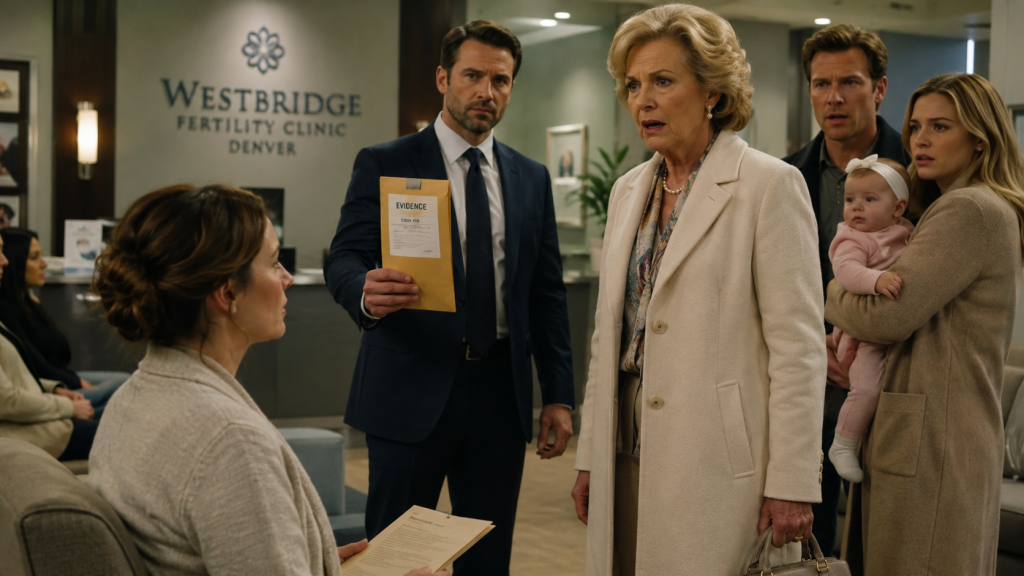
“Oh, not for me,” she said. “I came with Megan. She’s here for a follow-up. You remember Megan, don’t you?”
My fingers tightened around the folder.
Megan Ellis.
My former best friend.
The woman who had held my hand through hormone injections, pregnancy tests, miscarriages, and the kind of grief that makes your bones feel hollow.
The woman who had cried with me after my second failed transfer.
The woman who later slept with my husband.
“Yes,” I said quietly. “I remember Megan.”
Patricia’s eyes gleamed.
“Of course you do. How could you forget? She gave Ryan what you never could.”
The words landed exactly where she intended them to.
For years, Ryan and I had tried to have a child.
At first, we had been hopeful.
We painted a guest room yellow before there was any baby to put inside it. We bought tiny socks after our first positive test. We kept names written on a folded piece of paper in Ryan’s wallet. We told ourselves every injection, every appointment, every bill, every sleepless night would be worth it.
Then came the first miscarriage.
Then the second.
Then the failed transfer.
Then the doctor’s careful voice explaining that we still had two frozen embryos stored at Westbridge Fertility Clinic, but that we should take time before trying again.
Time.
That was what everyone told me I needed.
But grief does strange things to a marriage.
I turned inward.
Ryan turned away.
At first, he stayed late at work.
Then he stopped coming to appointments.
Then Megan started checking on him.
“She’s just worried about us,” he told me one night when I saw her name light up his phone at midnight.
I believed him because I wanted to.
Because Megan was my friend.
Because Ryan was my husband.
Because the alternative was too cruel.
Three months later, Ryan asked for a divorce.
He stood in our kitchen, beneath the yellow light we had once chosen together, and said he felt “emotionally abandoned.”
That was the phrase his lawyer later repeated in court.
Emotionally abandoned.
As if I had left him.
As if my grief had been an inconvenience he had suffered through politely before finding someone easier to love.
Megan sat behind him during the hearing, one hand on her stomach even though she was not showing yet. Patricia sat beside her, whispering comfort like Megan was the wounded wife and I was the intruder.
Six months after the divorce, Megan announced she was pregnant.
Patricia called it a miracle.
Ryan called it a blessing.
I called it the end of whatever small piece of me still believed in fairness.
Until three weeks ago.
Three weeks ago, a clinic billing notice arrived in my old email.
At first, I thought it was a mistake.
I had not been back to Westbridge in over a year. After the divorce, I could barely look at the clinic’s name without feeling sick.
But the subject line included my patient number.
I opened it.
The notice showed a transfer date.
Two weeks after Ryan filed for divorce.
Two weeks after he moved out.
One month before Megan announced she was pregnant.
I stared at the date until the screen blurred.
Then I read the line beneath it.
Embryo transfer authorized by both genetic contributors.
Both.
My body went cold.
Because I had never authorized anything.
I had never signed a consent form.
I had never agreed to use one of our frozen embryos.
And yet, according to the clinic, one had been transferred.
To Megan.
At first, I thought grief was making me misunderstand.
I printed the notice.
I called the clinic.
They transferred me twice, placed me on hold, and finally connected me with an administrator who spoke too carefully.
“Yes, Mrs. Bennett,” she said, using my maiden name because I had changed it back after the divorce. “There is documentation on file.”
“What documentation?”
“A consent form.”
“My consent?”
A pause.
“Yes.”
“I never signed anything.”
Another pause.
Then she said, “You may want to come in and speak with our legal department.”
That was when I called Detective Andrew Cole.
Not because I knew him well.
I knew him because of Ryan.
Years earlier, Detective Cole had investigated Ryan’s former business partner for insurance fraud. Ryan had spent months talking about him at dinners, calling him arrogant, relentless, dangerous.
“He doesn’t let go once he smells blood,” Ryan had said once.
At the time, I thought he sounded annoyed.
Now I understood he sounded afraid.
Detective Cole listened to my story without interrupting.
Then he asked one question.
“Do you still have copies of your original embryo storage agreement?”
I did.
Ryan never knew that.
During our marriage, I had kept everything. Every medical bill. Every consent packet. Every insurance statement. Every email.
When grief makes you powerless, paperwork becomes proof that something real happened.
I gave Detective Cole everything.
And now, one year after my divorce, he walked into Westbridge Fertility Clinic carrying a sealed evidence envelope.
Patricia saw him before I did.
Her smile faltered.
Then disappeared.
Detective Cole was tall, broad-shouldered, and dressed in a navy suit that looked too formal for the softness of the clinic. He walked with the calm confidence of a man who never needed to raise his voice to make a room go quiet.
He came straight toward us.
“Mrs. Bennett,” he said, nodding to me.
Then he looked at Patricia.
“Mrs. Parker. Good. You’re here too.”
Patricia gripped her handbag.
“Why would I need to be here?”
Detective Cole held up the envelope.
“Because your son’s daughter was created using Mrs. Bennett’s frozen embryo,” he said. “And the consent form appears to have been forged.”
The waiting room went silent.
The receptionist froze with her hand above the keyboard.
A woman near the window lowered her magazine.
Patricia’s lips parted, but no sound came out.
I looked at her and said softly, “Still think he made the best choice?”
Color drained from her face.
“This is absurd,” she snapped. “Ryan would never do something like that.”
Detective Cole’s expression did not change.
“Ryan already admitted he was present when Megan checked in under Mrs. Bennett’s patient authorization.”
Patricia took one step back.
“No.”
“Yes,” he said. “And the signature on the consent form does not match Mrs. Bennett’s verified medical records.”
Her eyes flicked toward me.
For the first time in all the years I had known Patricia Parker, she looked afraid.
Not sorry.
Afraid.
That distinction mattered.
The clinic manager appeared from the hallway, pale and nervous, followed by a woman in a gray suit who introduced herself as corporate counsel. They asked Detective Cole to come into a private room.
He glanced at me.
“Are you ready?”
I stood.
My legs felt weak, but I did not let myself sit back down.
“Yes.”
Patricia looked between us.
“I’m calling Ryan,” she said.
Detective Cole looked at her phone.
“You can. But he is already on his way.”
That was when the front doors opened again.
Ryan walked in first.
Megan followed him.
And in Megan’s arms was a little girl wearing a pink sweater, white tights, and tiny shoes with bows on them.
The child had soft brown curls.
Ryan’s mouth opened when he saw me.
Then he saw Detective Cole.
His face collapsed.
Megan clutched the little girl tighter against her chest.
For one moment, no one moved.
I had imagined seeing Ryan again many times.
In my mind, I was always stronger. Colder. Perfectly prepared.
But nothing prepared me for the child.
She was about nine months old.
Round-cheeked. Sleepy. Innocent.
She rested her head against Megan’s shoulder and blinked at the room with wide hazel eyes.
My eyes.
The same hazel eyes my grandmother used to say looked golden in sunlight.
The same eyes I saw every morning in my mirror.
My breath caught.
Ryan noticed.
Something like guilt flashed across his face, but it vanished quickly under panic.
“Emily,” he said.
I had not heard my name in his voice for a year.
It still hurt.
Not because I missed him.
Because I remembered the woman I had been when I loved him.
“Ryan,” I said.
Megan’s eyes filled with tears immediately.
That had always been her gift.
Crying before anyone could accuse her.
“This isn’t what you think,” she whispered.
I looked at the baby again.
“No,” I said. “I think it is exactly what I think.”
Patricia moved toward Ryan.
“Tell them this is a mistake.”
Ryan did not answer.
Detective Cole opened the door to the consultation room.
“We should speak privately.”
Inside, the room was too small for all the secrets being carried into it.
There was a round table, six chairs, a box of tissues, and a framed photograph of a newborn’s feet.
I sat on one side.
Ryan and Megan sat across from me.
Patricia refused to sit at first, then lowered herself into a chair beside her son.
The baby slept against Megan’s chest, unaware that every adult in the room was trying not to look too long at her.
Detective Cole placed the sealed envelope on the table.
The clinic attorney folded her hands.
“Mrs. Bennett,” she said carefully, “I want to begin by saying the clinic is cooperating fully.”
I almost laughed.
Cooperating.
Such a clean word for something so ugly.
“Did your clinic transfer my embryo into another woman?” I asked.
The attorney swallowed.
“We are reviewing the chain of authorization.”
“That is not an answer.”
The clinic manager looked down.
Detective Cole slid a copy of the consent form across the table.
My name was at the bottom.
Emily Bennett.
The handwriting tried to be mine.
But it leaned wrong.
The E was too sharp.
The double t in Bennett did not connect the way mine always did.
I stared at it for a long time.
Then I looked at Ryan.
“Who signed it?”
He rubbed both hands over his face.
“Emily, please.”
“Who signed my name?”
Megan began to cry.
Patricia said sharply, “Don’t answer anything without a lawyer.”
Detective Cole looked at her.
“That is his right. But he has already given a preliminary statement.”
Ryan’s head snapped up.
“You said that was informal.”
“It was recorded,” Detective Cole replied.
Patricia’s face went gray.
I leaned back slowly.
“What did he say?”
Detective Cole did not take his eyes off Ryan.
“He said the idea began after the divorce filing. He believed, incorrectly, that because the embryos were created during the marriage, he had the right to use them.”
“That’s not true,” the clinic attorney said quickly. “Our policy requires signed consent from both parties.”
Ryan’s jaw tightened.
Megan whispered, “We were desperate.”
I looked at her.
“You were desperate?”
Her tears spilled over.
“Ryan was grieving too. He wanted a child. He said you were never going to use the embryos again. He said they would just sit frozen forever.”
“So you took one?”
“I didn’t think of it that way.”
“What way did you think of it?”
She hugged the baby tighter.
“I thought of her as ours.”
The room went silent.
I felt something inside me crack, but it was not the same crack grief had made.
This one was colder.
Cleaner.
“You thought of my embryo as yours,” I said.
Megan flinched.
Ryan leaned forward.
“I didn’t know what else to do.”
I stared at him.
“You could have asked me.”
His face twisted.
“You would have said no.”
“Yes,” I said. “I would have.”
The honesty of it seemed to stun him.
I continued, “Not because I wanted to hurt you. Not because I wanted to punish you. Because those embryos were part of my body, my grief, my marriage, and my future. You did not get to steal one because you were impatient.”
Patricia slammed her palm on the table.
“That child is my granddaughter.”
The baby stirred.
Everyone froze.
Megan rocked her gently.
I looked at Patricia.
“No one is blaming the child.”
Patricia’s mouth tightened.
“You want to take her from us.”
For the first time, my voice rose.
“I want the truth.”
Ryan whispered, “Emily…”
I turned back to him.
“Did you forge my signature?”
He looked away.
That was answer enough.
But Detective Cole spoke anyway.
“Mr. Parker stated that the signature was completed at his home using an old signed medical form as reference.”
My stomach turned.
Ryan closed his eyes.
Megan sobbed harder.
Patricia stared at her son as if seeing him clearly for the first time.
“You did what?” she whispered.
Ryan’s face reddened.
“You don’t understand.”
“No,” Patricia said, voice shaking. “I told everyone Megan was a miracle.”
Megan looked at her.
“She is.”
Patricia turned on her.
“Did you know?”
Megan’s silence filled the room.
Patricia stood so fast her chair scraped back.
“You knew?”
Megan cried into the baby’s hair.
“I thought Ryan handled the legal part.”
“Did you know it was Emily’s embryo?” Patricia demanded.
Megan looked at me.
Her face crumpled.
“Yes.”
The word was small.
But it destroyed everything.
For a moment, Patricia looked like she might fall.
All her cruelty, all her smugness, all the stories she had told herself about me being broken and Megan being chosen, came crashing down around her.
She had not gained a perfect family.
She had celebrated a theft.
The clinic attorney cleared her throat.
“This matter will likely require civil proceedings regarding damages, medical consent violations, and parental rights questions.”
Parental rights.
The words made the room tilt.
I looked at the baby.
She was awake now.
Her hazel eyes were open.
She looked at me with innocent curiosity, one tiny hand gripping Megan’s collar.
I had spent a year thinking my story had ended in loss.
But sitting in that room, I realized my grief had been carrying a secret life somewhere outside my reach.
I did not know what I wanted.
I did not know what I was allowed to want.
Was she my daughter?
Biologically, yes.
Legally, the answer was a maze.
Emotionally, it was unbearable.
Megan noticed me looking and turned slightly away.
The movement was small, protective, almost instinctive.
And it hurt more than I expected.
Because she loved the child.
That was the cruelest part.
The baby was not being raised by monsters in a dark room.
She was being held, kissed, fed, loved.
By people who had done something unforgivable.
Detective Cole stood.
“There will be formal interviews. Mr. Parker, Ms. Ellis, I strongly suggest you contact legal counsel. Mrs. Parker, you may also be contacted regarding what you knew and when.”
Patricia shook her head.
“I knew nothing.”
I believed her.
That surprised me.
Patricia was cruel. Proud. Classist. Bitter.
But in that moment, her shock was real.
Ryan reached for his mother’s hand.
She pulled away.
“Don’t,” she said.
His face broke.
“Mom.”
“No,” Patricia whispered. “You let me humiliate her. You let me tell people that baby proved she was the problem.”
She looked at me then.
For the first time since I had met her, Patricia Parker had no insult ready.
“I…” she began.
I waited.
She swallowed.
“I didn’t know.”
It was not an apology.
Not yet.
But it was the first honest thing she had ever said to me.
I stood.
“I have spent a year being blamed for losing everything,” I said. “My marriage. My family. My chance at motherhood. And all that time, you were raising a child created from what Ryan and I made together.”
Ryan covered his face.
Megan whispered, “I’m sorry.”
I looked at her.
“No, you’re sorry you got caught.”
She started to protest, but I raised one hand.
“You sat beside me through every injection. You saw what those embryos meant to me. You watched me bleed through two miscarriages. You knew.”
Her tears kept falling, but I felt no softness toward them anymore.
“Emily,” Ryan said hoarsely. “What do you want?”
That question followed me out of the clinic.
It followed me into the parking lot.
It followed me home.
What did I want?
Revenge?
Custody?
Money?
An apology?
A time machine?
For three nights, I did not sleep.
My attorney, Marissa Vale, laid out the possibilities in careful language.
The forged consent could lead to criminal charges.
The clinic could be liable.
Ryan and Megan could be sued.
A judge could order genetic testing, psychological evaluation, emergency mediation.
But no outcome would be simple.
“No court can undo what happened,” Marissa told me. “The law can address harm. It cannot erase it.”
I knew that.
Still, the case moved quickly.
Once Detective Cole submitted the evidence, Westbridge suspended two employees pending investigation. One was an administrative coordinator who had accepted Megan’s identification without proper verification. The other was Dr. Alan Reeves, the physician who performed the transfer.
Dr. Reeves claimed he believed all consent forms were valid.
Then the investigators found an email.
From Ryan.
To the coordinator.
It included a scanned copy of my driver’s license from an old insurance file and the words:
Please make this easy. We’ve been through enough.
That sentence made me shake with rage.
We.
As if I had been part of it.
As if my consent could be assumed because he had once worn a ring beside me.
Patricia called me five days after the clinic confrontation.
I almost did not answer.
When I did, she was quiet.
“Emily,” she said. “I need to speak with you.”
“You can speak to my attorney.”
“I know,” she said. “But this is not about the case.”
I said nothing.
She took a shaky breath.
“I am sorry.”
The words were stiff, unfamiliar in her mouth.
“I am sorry for what I said at the clinic. And before. At the courthouse. At family dinners. For all of it.”
I looked out my kitchen window at the bare trees.
“Why now?”
“Because I believed what Ryan told me.”
“That explains some of it,” I said. “Not all.”
“I know.”
Her voice cracked.
“I wanted you to be the reason things failed. It was easier than admitting my son could be cruel.”
That was the first apology I accepted.
Not because it fixed anything.
Because it named the truth.
Two weeks later, the first hearing took place.
The courtroom was smaller than the one where my divorce had been finalized. Ryan sat at one table with his lawyer. Megan sat beside him, pale and trembling. Patricia sat behind them, alone.
I sat with Marissa.
When the judge entered, everyone stood.
The hearing was not to decide custody.
Not yet.
It was to establish facts, order testing, and determine temporary restrictions while the investigation continued.
Ryan’s lawyer argued that the child, named Lily, had only ever known Megan and Ryan as her parents.
My attorney did not dispute that.
She stood and said, “My client is not here to traumatize an infant. She is here because her genetic material was used without consent, through fraud, after years of infertility trauma, and she has a right to know the child created from her embryo.”
The judge listened without expression.
Then came the evidence.
The forged signature.
The transfer record.
The clinic footage showing Megan entering through a side hallway on the day of the procedure.
Ryan’s emails.
Megan’s intake form, where she had written “embryo donation within family arrangement.”
Family arrangement.
I almost stood up.
Marissa placed a hand over mine.
“Breathe,” she whispered.
Then the judge ordered DNA testing.
He also ordered that Lily not be removed from the state, that Ryan and Megan surrender her passport, and that I be permitted supervised introductory contact after consultation with a child psychologist.
Ryan turned around then.
His eyes met mine.
For the first time, I saw something beyond fear.
I saw loss.
Not remorse.
Loss.
He was beginning to understand that stealing a life did not mean he could keep control of it.
The first time I met Lily, it was in a child therapist’s office with soft rugs and wooden toys.
Megan brought her in.
Ryan was not allowed inside that session.
Megan looked exhausted. No makeup. Hair pulled back. Dark circles beneath her eyes.
For a moment, she looked like the girl I had known in college, before betrayal made her unrecognizable.
Lily sat on the rug between us, banging two blocks together.
The therapist spoke gently.
“This is Emily.”
Lily looked up.
I smiled, though my throat burned.
“Hi, Lily.”
She crawled toward me without hesitation and offered me one of the blocks.
It was red.
I took it like it was made of glass.
“Thank you.”
Megan began crying silently.
I did not look at her.
For twenty minutes, I played blocks with my biological daughter.
Not my daughter in the way I had dreamed.
Not yet.
Maybe not ever.
But she was real.
Warm.
Laughing.
Alive.
And when she reached for my necklace, I felt something inside me that was not grief.
It was not joy either.
It was more complicated.
It was the ache of a door opening in a house I thought had burned down.
The legal battle lasted eleven months.
Ryan eventually pleaded guilty to forgery and unlawful use of reproductive material under related fraud charges. His sentence included probation, restitution, and a suspended term that would become active if he violated any court order.
Megan accepted a civil settlement and admitted in a sworn statement that she knew the embryo had been created by Ryan and me.
Westbridge Fertility Clinic settled separately.
The amount was confidential.
People asked if money made it better.
It did not.
Money paid legal fees. It paid therapy. It built a college fund for Lily. It did not give me back the moment I should have had a choice.
The hardest decision was custody.
Everyone expected me to fight for full custody.
Some even told me I had a moral duty.
“She’s yours,” they said.
But Lily was not property.
She was not evidence.
She was not a prize for whoever had been wronged most.
She was a child.
And children should not be punished for the sins of adults.
After months of evaluation, mediation, and tears, the court granted a shared guardianship structure.
Ryan’s rights were restricted.
Megan remained Lily’s primary residential parent at first, but I received expanding visitation, decision-making rights in education and medical care, and legal recognition as Lily’s biological mother.
It was imperfect.
Painful.
Strange.
But it was built around Lily, not revenge.
The first time she called me “Emmy,” I cried in my car for fifteen minutes.
The first time she fell asleep on my chest, I did not move for two hours.
The first time Patricia saw me holding her at a supervised family event, she stood across the room with tears in her eyes.
She approached slowly.
“May I?” she asked.
I looked down at Lily, who was chewing on a cracker and kicking one foot.
Then I nodded.
Patricia sat beside us.
For a long time, none of us spoke.
Finally, she said, “She has your eyes.”
I looked at her.
“Yes.”
Patricia’s lips trembled.
“I used to say that like it would hurt you.”
“I know.”
“I am ashamed of that.”
I believed her.
Time did not make Patricia warm.
But truth made her quieter.
As for Ryan, he lost almost everything he had tried to protect.
His reputation.
His business contracts.
His mother’s blind loyalty.
His marriage to Megan cracked under the pressure of lawyers, guilt, and blame. They separated before Lily turned two.
Megan once asked to speak with me privately.
We met outside the therapist’s office.
She looked smaller than I remembered.
“I loved her from the moment I knew she existed,” she said.
“I know.”
“I know that doesn’t excuse it.”
“No,” I said. “It doesn’t.”
She wiped her cheeks.
“I was jealous of you.”
That surprised me.
“Of me?”
“You had history with him. The house. The embryos. His family talked about you like you were the tragedy that shaped him. Even when he was with me, you were still everywhere.”
I shook my head slowly.
“So you took the one thing that still connected me to him.”
She closed her eyes.
“Yes.”
The honesty hurt more than another lie would have.
But it also released something.
I did not forgive her that day.
Maybe I never fully would.
But I stopped needing her to suffer in order for my pain to matter.
Three years after that morning at Westbridge, Lily started preschool.
On her first day, she wore a yellow dress.
Yellow, like the nursery Ryan and I had painted years before everything broke.
I stood beside Megan outside the classroom, both of us holding extra tissues, both of us pretending not to cry.
Lily ran ahead, then turned back.
“Emmy!” she called.
I knelt.
She threw her arms around my neck.
Then she ran to Megan and hugged her too.
Her teacher smiled.
“Two lucky moms,” she said.
Megan looked at me, uncertain.
I looked at Lily through the classroom window.
Then I said, “One lucky little girl, I hope.”
That was the truth I chose.
Not because it was easy.
Because someone had to choose something better than what had been done to me.
People think revenge is the moment the guilty person falls.
But sometimes revenge is quieter.
Sometimes it is walking into a clinic as a woman everyone thought was broken and walking out with the truth.
Sometimes it is refusing to let bitterness raise a child.
Sometimes it is watching the people who humiliated you finally understand that they built their happiness on a lie.
And sometimes it is standing in a preschool hallway, hearing a little girl with your eyes call your name, and realizing that the life stolen from you did not end your story.
It changed it.
It made it harder.
Messier.
More painful than anyone could understand.
But it did not erase you.
Patricia once asked me if I hated Ryan.
We were sitting on a park bench while Lily chased bubbles across the grass.
I watched my biological daughter laugh in the sunlight.
Then I answered honestly.
“No.”
Patricia looked surprised.
“I thought you would.”
“I did,” I said. “For a long time.”
“And now?”
I watched Lily run toward me with a fistful of dandelions.
“Now I don’t have room for him.”
Lily climbed into my lap and pressed the flowers into my hand.
“For you, Emmy.”
I kissed her forehead.
Behind us, Patricia began to cry quietly.
I did not comfort her.
Some tears belong to the person who earned them.
But I did let her sit beside us.
Because Lily reached for her too.
And that was the lesson none of us had expected.
Love did not erase consequences.
Truth did not erase pain.
Family did not always begin cleanly.
But if we were careful, if we were honest, if we placed Lily above our pride, maybe something good could grow from the wreckage.
Years earlier, Patricia had stood in a clinic waiting room and told me her son had made the right choice leaving me.
She believed Megan’s child was proof that I had failed.
But she was wrong.
Lily was not proof that Ryan chose right.
She was proof that truth has a way of surviving even when buried under signatures, lies, and silence.
She was proof that what is stolen does not stop belonging to you simply because someone else claims it.
And she was proof that I had not been empty.
Not then.
Not ever.
The last time I went to Westbridge Fertility Clinic, it was not for an appointment.
It was to collect the records after the case closed.
The waiting room had been repainted. The music was different. The receptionist was new.
For a moment, I stood near the same chair where Patricia had found me.
I remembered her smile.
Ryan’s panic.
Megan’s tears.
Detective Cole’s envelope.
The sentence that had split the truth open.
Because your son’s daughter was created using Mrs. Bennett’s frozen embryo.
I thought it would hurt to stand there again.
But instead, I felt strangely calm.
The woman who had sat in that chair had been waiting for justice.
The woman who left that day had learned justice was not a single moment.
It was a long road.
It was paperwork, courtrooms, therapy rooms, hard conversations, and small hands reaching for yours.
It was choosing not to become cruel just because cruelty had found you first.
As I stepped outside, my phone buzzed.
A photo from Lily’s preschool teacher.
Lily holding a painting.
Three stick figures under a yellow sun.
One had brown curls.
One had dark hair like mine.
One had blonde hair like Megan’s.
Above them, in uneven letters, the teacher had helped her write:
My family.
I stared at the picture until my eyes blurred.
Then I smiled.
Not because everything was fixed.
Some things never would be.
But because the story Patricia once told about me had finally died.
I was not the abandoned wife.
I was not the broken woman.
I was not the empty one.
I was Emily Bennett.
And after everything they stole, lied about, and tried to bury, I was still standing.
This time, I was not alone.
THE END! THANK YOU FOR READING!