

For twelve years, I brought groceries to my eighty-four-year-old neighbor every Sunday. After his funeral, his lawyer handed me a battered suitcase. And when I opened it, what I found inside made my hands shake so badly I had to sit down.
Ezra Harrison had lived in the house next to mine for as long as I could remember. He was not the kind of neighbor who invited people over for barbecues or leaned over the fence to gossip. He kept his lawn neat, his curtains half closed, and his porch light on every night until exactly ten.
For years, that was all I knew about him.
He was the quiet old man next door.
We waved when we saw each other in the driveway. Sometimes we exchanged a simple “Good morning” or “Looks like rain.” Nothing more.
I had my own life, my own problems, my own worries.
Back then, I was thirty-six, recently divorced, and trying to convince everyone around me that I was fine.
I was not fine.
My marriage had ended badly. My daughter, Lily, was living with her mother three towns over, and I only saw her every other weekend. The house felt too big and too empty. Most evenings, I came home from work, ate dinner standing over the kitchen sink, and fell asleep with the television still on.
I thought loneliness was something that belonged to old people.
Then one Sunday afternoon, I saw Ezra struggling in his driveway with two grocery bags.
One bag was hooked over his wrist, the other clutched against his chest. He was moving slowly, carefully, like every step had to be negotiated with his body first.
Just as I stepped out to check my mailbox, one of the bags slipped.
A carton of eggs hit the driveway and cracked open.
Ezra bent down too quickly, lost his balance, and grabbed the side of his car to steady himself.
I crossed the yard without thinking.
“Let me help you with those,” I said.
He looked embarrassed.
“I’ve got it,” he muttered.
“No offense, Mr. Harrison, but the eggs disagree.”
For the first time, I saw him smile.
It was small, tired, but real.
He handed me the bags.
“Ezra,” he said.
“What?”
“If you’re going to carry my groceries, you may as well call me Ezra.”
I carried the bags inside.
His house was exactly what I expected from the outside: quiet, orderly, and full of things that looked like they had not moved in decades.
There were framed black-and-white photographs on the walls. A wooden clock ticking in the hallway. A brown armchair near the window with a folded blanket on one side.
The air smelled like coffee, old paper, and lemon polish.
I set the bags on the kitchen counter.
“Coffee?” he asked.
I almost said no.
I had laundry to do. Bills to ignore. A life to pretend was not falling apart.
But something about the way he asked made me pause.
It was not casual. It was hopeful.
“Sure,” I said. “One cup.”
One cup became nearly an hour.
Ezra told me he had grown up in Ohio. He had worked as a mechanic before joining the army. After that, he became a high school shop teacher for thirty-one years. His wife, Ruth, had died fifteen years earlier. They never had children.
He said that last part quickly, like he had trained himself not to linger on it.
I told him a little about my divorce. Not everything. Just enough.
He listened without interrupting.
That was rare.
Most people listened only while preparing what they wanted to say next. Ezra listened like your words mattered.
When I finally stood to leave, I joked, “Next time you need groceries, just call me. Save the eggs.”
He chuckled.
“Careful,” he said. “I might take you up on that.”
Neither of us knew it then, but that simple sentence would become a twelve-year tradition.
The next Sunday, I was pulling into my driveway when Ezra stepped out onto his porch.
He held up a grocery list.
I laughed.
“You’re serious?”
“You offered,” he said.
So I took the list.
It was written in neat, old-fashioned handwriting.
Milk.
Bread.
Oatmeal.
Bananas.
Coffee.
Chicken soup.
Peppermints.
At the bottom, he had written: Eggs, if Anthony is feeling brave.
That was the first Sunday.
Then came the second.
Then the third.
After a while, Ezra stopped pretending it was temporary.
Every Sunday morning, he would leave a list and cash in an envelope by his front door. I would pick up his groceries when I bought mine, then carry everything into his kitchen.
At first, I only stayed ten minutes.
Then twenty.
Then an hour.
Sometimes we talked about his past.
He told me about Ruth, how she sang off-key while cooking and hated roses because she said they looked too proud.
He told me about students he had taught, boys who did not believe they were good at anything until he put tools in their hands and showed them how to build something.
He told me about old cars, old wars, and old regrets.
Sometimes he asked about Lily.
When she was with me on weekends, she came along.
At first, she was shy around him. She was seven then, all missing teeth and tangled hair. Ezra won her over with peppermints and a wooden birdhouse he helped her paint in his garage.
From then on, she called him Grandpa Ezra.
He never corrected her.
I noticed that.
The years moved quietly.
Lily grew taller. I grew a little softer around the edges. Ezra grew older.
His steps became slower. His hands shook when he poured coffee. He started using a cane, then a walker. The grocery lists became shorter, simpler.
Sometimes I found him sitting in his chair by the window, looking out as if he were waiting for someone who had already missed the appointment.
One Sunday, I walked in and found him holding an old photograph.
It was of Ruth.
She was young in the picture, standing beside a lake, laughing at something outside the frame.
“She was beautiful,” I said.
Ezra nodded.
“She made everything feel less heavy.”
I did not know what to say.
After a moment, he looked up at me.
“You ever think life gives you people late?”
“What do you mean?”
He tapped the photograph gently.
“Some people come when you’re young. Some come after you’ve already learned how to be lonely.”
I thought about that for days.
There were times I tried to do more for him.
I offered to call a home nurse. I offered to help him arrange rides to appointments. I told him he should think about assisted living.
He always shook his head.
“This is my home,” he said. “I intend to leave it the same way Ruth did.”
I hated when he talked like that.
But I understood.
His house was not just a house. It was the last place where his wife still existed in small ways.
Her mug in the cabinet.
Her recipe cards in a tin.
Her blue sweater folded in the hall closet.
By the tenth year, Sunday visits were no longer something I did out of kindness. They were part of my life.
I did not realize how much I depended on them until one Sunday when a snowstorm hit and the roads were almost impossible.
I called Ezra and told him I might not make it.
He said, “Don’t be foolish, Anthony. I have enough soup to survive a month.”
But I heard the disappointment in his voice.
So I went anyway.
It took me nearly an hour to drive what should have taken fifteen minutes. When I arrived, Ezra opened the door wearing a sweater vest and a scowl.
“You’re an idiot,” he said.
“Probably.”
Then he stepped aside.
“But since you’re here, coffee’s on.”
We drank coffee while snow buried the street outside.
That day, he told me something he had never told me before.
He and Ruth had almost adopted a child once.
A boy.
The boy had been five years old, with dark hair and serious eyes. Ezra and Ruth had met him three times. They had started preparing a room.
Then a relative came forward at the last minute and took custody.
Ruth had cried for weeks.
“We packed away the little bed and the toys,” Ezra said, staring into his cup. “After that, we never tried again.”
“I’m sorry,” I said.
He nodded.
“Some losses don’t look like losses to other people. But you still carry them.”
I remembered those words too.
By then, Lily was almost grown.
She still visited Ezra when she came home from college. She brought him muffins, showed him pictures from campus, and kissed his cheek before leaving.
Every time, his eyes shone with quiet pride.
“You raised a good girl,” he told me once.
“I got lucky.”
“No,” he said. “Luck is finding a good person. Raising one takes work.”
The last Sunday I saw Ezra alive, spring was just beginning.
The trees had small green buds, and the air smelled like rain.
His list was shorter than usual.
Bread.
Tea.
Applesauce.
Crackers.
Peppermints.
When I brought the groceries inside, he was sitting in his chair by the window with a blanket over his legs.
He looked thinner.
Too thin.
“You eating enough?” I asked.
He gave me a look.
“You sound like Ruth.”
“Good. She was probably right most of the time.”
He smiled.
“She was always right. I only admitted it after she was gone.”
I put the groceries away and made tea instead of coffee because he said coffee had started upsetting his stomach.
We sat quietly for a while.
Then he reached over and touched my wrist.
It startled me.
Ezra was not a man who touched people often.
“Anthony,” he said, “you know you didn’t have to keep coming all these years.”
“I know.”
“No. I mean it. A lot of people do something kind once and call themselves good. You kept showing up.”
I looked away, uncomfortable.
“It was just groceries.”
He shook his head.
“No. It was never just groceries.”
I did not know then that those would be the last real words he ever said to me.
Two mornings later, I noticed his porch light was still on.
It was nearly noon.
Ezra never left his porch light on during the day.
At first, I told myself maybe he had forgotten.
Then I saw the newspaper still lying near the steps.
I went over and knocked.
No answer.
I knocked again, harder.
“Ezra?”
The silence on the other side felt wrong.
I called emergency services.
They found him in his bed.
Peaceful, they said.
As if that word was supposed to soften the blow.
He had passed away in his sleep.
He was eighty-four.
The funeral was held four days later.
I expected more people.
Ezra had lived a long life. He had taught for decades. He had been someone’s neighbor, someone’s friend, someone’s memory.
But the chapel was nearly empty.
There were a few former students, now old men themselves. A woman from his church. Two distant cousins who spent most of the service whispering about the house.
Lily came with me.
She cried more openly than I did.
I sat still, staring at the closed casket, thinking about all the Sundays that would no longer happen.
No list by the door.
No coffee.
No chair by the window.
No old man calling me an idiot for driving in snow.
When the service ended, people stood and spoke in low voices.
I was about to leave when a man in a dark suit approached me.
“Are you Anthony Miller?” he asked.
“Yes.”
“Anthony, the neighbor who used to help Mr. Harrison?”
I nodded.
The man extended his hand.
“My name is Samuel Greene. I was Mr. Harrison’s attorney.”
I shook his hand, confused.
“I’m sorry,” I said. “Was there something you needed from me?”
“In a way,” he said.
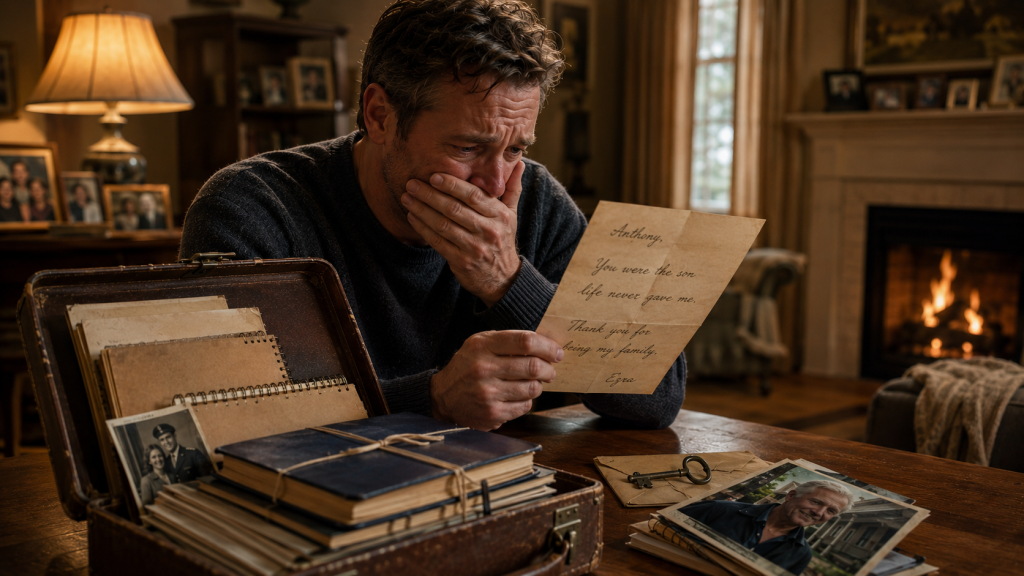
He turned and picked up a battered brown suitcase from beside the pew.
It was old leather, scuffed at the corners, with one brass latch that looked slightly bent.
“Mr. Harrison specifically instructed me to give this to you after the funeral.”
“To me?”
“Yes.”
I stared at it.
“I don’t understand.”
Mr. Greene’s expression softened.
“He said you would.”
He placed the suitcase in my hands.
It was heavier than I expected.
Lily looked at me with wide eyes.
“Dad, what is it?”
“I don’t know.”
I carried it home in silence.
The house next door looked painfully still.
Ezra’s curtains were closed. His porch light was off. For the first time in years, the place looked empty.
Inside my own house, I set the suitcase on the kitchen table.
For several minutes, I just stared at it.
Part of me was afraid to open it.
Not because I expected something frightening, but because it felt like opening it would make his death final.
Lily sat across from me.
“Do you want me to stay?”
I nodded.
My hands trembled as I unlatched the suitcase.
The hinges creaked.
Inside, there was no money.
No gold.
No hidden treasure.
Just notebooks.
Dozens of them.
Stacked carefully, tied with faded blue ribbon.
Each notebook had a year written on the cover.
The oldest one was from twelve years earlier.
The newest one was from the current year.
On top of them was a white envelope with my name written across the front.
Anthony.
I opened the first notebook.
The first page was dated on the Sunday I had helped him with the groceries.
Anthony from next door carried my groceries today. Broke half my eggs, though he claims gravity is to blame. Stayed for coffee. First real conversation I’ve had in months. Maybe longer.
My throat tightened.
I turned the page.
He came again today. I left a list as a joke, but he took it seriously. There are people who offer help because it sounds polite. Then there are people who show up.
I kept reading.
Every Sunday was there.
Every visit.
Every small thing I had forgotten.
Anthony looked tired today but said he was fine. He is not fine. I remember saying that too after Ruth died.
Lily came with him today. Missing two front teeth. Painted a birdhouse like it was a cathedral. Called me Grandpa Ezra by accident. I pretended not to hear because I was afraid if I reacted, she might stop.
The words blurred.
Lily covered her mouth.
I opened another notebook.
Anthony got the promotion he said he didn’t care about. He cared. I could see it in his shoulders.
Anthony’s ex-wife remarried. He smiled when he told me. Bad smile. The kind a man wears when he thinks pain is more polite if it’s quiet.
Lily graduated high school today. She hugged me after the ceremony. I have no right to be proud, but I am.
Page after page.
Year after year.
Ezra had recorded our Sundays not like a diary of obligation, but like a man preserving proof that he had not been alone.
Then I found a final envelope taped inside the newest notebook.
My name was written on it again.
I opened it slowly.
Anthony,
If you are reading this, then I have finally gone home to Ruth.
Do not be angry that I did not say goodbye properly. I never liked goodbyes. They ask too much from the living.
You spent twelve years telling yourself you were only bringing me groceries.
You were wrong.
You brought noise into a quiet house.
You brought laughter into rooms that had forgotten the sound.
You brought your daughter, and for that alone, I owe you more than I could ever repay.
I had a son once, almost. Ruth and I lost him before he was truly ours. After that, I believed fatherhood had passed me by.
Then you showed up with broken eggs and an awkward smile.
I watched you become a better man than you believed you were. I watched you raise Lily with patience, fear, love, and more courage than you gave yourself credit for.
You were never just my neighbor.
You were the son life never gave me.
By then, I was crying.
Not quietly.
Not politely.
The kind of crying that bends your body forward and steals your breath.
Lily came around the table and wrapped her arms around me.
“There’s more,” she whispered.
At the bottom of the envelope was a key.
And a folded legal document.
I called Mr. Greene the next morning.
He asked me to come to his office.
I sat across from him with red eyes and the suitcase at my feet.
He explained that Ezra had left me his house.
Not because I had done chores.
Not because I had asked.
Because, in Ezra’s words, family is not always the people who inherit your blood. Sometimes family is the person who keeps showing up when nobody else does.
I tried to refuse.
I said it was too much.
Mr. Greene shook his head.
“He was very clear, Anthony. He wanted you to have it.”
“What about his cousins?”
“They were provided for in a small way. But the house was his choice.”
I looked down at the key in my palm.
It felt heavier than metal.
For weeks, I could not bring myself to enter Ezra’s house alone.
When I finally did, Lily came with me.
Everything was exactly as he had left it.
The brown chair by the window.
The folded blanket.
The clock ticking in the hall.
The coffee tin on the counter.
On the kitchen table was one last grocery list.
Mr. Greene must have left it there for me.
Bread.
Tea.
Applesauce.
Peppermints.
And beneath it, in Ezra’s handwriting:
No eggs this time. Anthony has suffered enough.
I laughed through tears.
That was the moment I felt him there, not as a ghost, not as grief, but as memory.
Warm.
Stubborn.
Kind.
I did not sell the house.
I could have. People told me I should. They said the market was good, that old houses were expensive to maintain, that sentiment was not practical.
But some things are worth more than practical.
Lily and I cleaned it slowly.
We boxed up what needed to be stored. We donated what Ezra had asked to be donated. We kept Ruth’s recipe tin, the wooden clock, and the notebooks.
Especially the notebooks.
On Sundays, I started going there again.
At first, I just sat in the chair by the window with coffee.
Then one Sunday, I noticed Mrs. Alvarez three houses down trying to carry a laundry basket up her porch steps.
She was newly widowed.
I had waved to her for years but never really spoken to her.
I stood up.
I crossed the yard.
“Let me help you with that,” I said.
She looked embarrassed.
“I’ve got it.”
I smiled.
“No offense, Mrs. Alvarez, but the laundry disagrees.”
She laughed.
And after I carried the basket inside, she offered me coffee.
I almost declined.
Then I thought of Ezra.
I thought of broken eggs.
I thought of twelve years of Sundays.
“I’d like that,” I said.
People think inheritance is money.
A house.
A suitcase.
A key.
But Ezra left me something far greater than property.
He left me proof that small kindness can become someone’s reason to stay.
He left me the knowledge that loneliness does not always announce itself. Sometimes it lives quietly next door with the porch light on.
And he left me a question I carry every Sunday now.
Who is waiting for someone to show up?
Because I know the truth.
It is never just groceries.
It is never just coffee.
It is never just a few minutes of your time.
Sometimes, without knowing it, you become the family someone prayed for.
And sometimes, long after they are gone, you open a battered suitcase and realize they were yours too.
THE END! THANK YOU FOR READING!