

Three weeks after my son’s wedding, the wedding coordinator called and told me, “Sir, I recorded something awful. Come alone, and do not tell your children.” I went there expecting a misunderstanding.
Maybe a vendor had overcharged us. Maybe someone had damaged the venue. Maybe there was a missing payment, a legal form, or a complaint from one of the staff. I never imagined that one phone call would change the way I looked at my own children forever.
My name is William Carter.
I am sixty-four years old, a widower, and until that morning, I believed my family was the one thing in my life that money could not ruin.
I had built a comfortable life over four decades. Not billionaire wealthy, not private-jet wealthy, but wealthy enough that people smiled differently when they saw my last name on a check.
I owned two apartment buildings, a small chain of hardware stores, a lake house in Tahoe, and a family home in Sacramento that my late wife, Eleanor, had decorated with her own hands.
But none of that mattered to me as much as my children.
Ethan, my oldest, was thirty-two.
Smart, polished, charming when he wanted something.
Marissa, my daughter, was twenty-nine.
Beautiful, sharp, and always able to cry at exactly the right moment.
Their mother used to say, “William, don’t love them by giving them everything. Love them by teaching them who they are without your wallet.”
I laughed whenever she said that.
Now I wish I had listened.
Eleanor died four years before Ethan’s wedding.
Cancer took her slowly.
Too slowly.
The last week of her life, she held my hand in the hospital and made me promise one thing.
“Don’t let grief make you weak,” she whispered.
I thought she meant I should eat, sleep, and keep living.
I did not understand that she was warning me.
After she died, I became soft in all the wrong places.
When Ethan wanted money to start a business, I gave it.
When Marissa needed help with her condo, I paid the down payment.
When Ethan asked if I could cover most of his wedding because he wanted “one perfect day before life became serious,” I wrote the checks.
The venue.
The catering.
The flowers.
The photographer.
The string quartet.
The custom champagne wall.
Even the honeymoon deposit.
Vanessa, my new daughter-in-law, thanked me with tears in her eyes.
“You’re giving us a dream,” she said, hugging me in the vineyard courtyard.
I believed her.
That was the painful part.
I believed all of them.
The wedding was held at an old vineyard estate outside Napa.
Stone archways.
Golden hills.
Rows of grapes stretching into the sunset.
Eleanor would have loved it.
During the reception, Ethan asked me to make a speech.
I stood under strings of warm lights with a microphone in my hand and looked at my son in his black tuxedo, Vanessa beside him in lace, Marissa wiping her eyes at the family table.
I spoke about fatherhood.
About love.
About Eleanor.
I said, “Your mother would have been proud of the man you became.”
Ethan stood and hugged me in front of everyone.
“Love you, Dad,” he whispered.
People clapped.
I cried.
Three weeks later, I learned he had been laughing at me before the night was over.
The phone call came on a Thursday morning.
I was in the kitchen, drinking coffee from Eleanor’s favorite blue mug, when my phone rang.
The caller ID said Claire Benson.
She was the wedding coordinator.
I nearly ignored it, thinking it was some final invoice issue.
But something made me answer.
“Mr. Carter?” she said.
Her voice was low.
Tight.
Afraid.
“Yes, this is William.”
There was a pause.
“Sir, I recorded something awful. Please come alone. And do not tell your children.”
My fingers tightened around the mug.
“What are you talking about?”
“I don’t want to say it over the phone.”
“Is someone hurt?”
“No,” she said quickly. “Not physically. But you need to hear it yourself.”
“Claire, if this is about the wedding bill—”
“It’s not about money.”
That silenced me.
Then she added, “Please. Come alone.”
I drove to the vineyard the next morning.
The place looked different without music and flowers.
Empty.
Too quiet.
The same courtyard where guests had toasted my son’s future now felt like a stage after actors had removed their costumes.
Claire met me near the entrance.
She looked exhausted.
Her red hair was pulled into a loose bun, and there were dark circles beneath her eyes.
“Thank you for coming,” she said.
“What is this?”
She glanced around as if someone might be listening.
“In my office.”
I followed her down a hallway behind the tasting room.
She closed the door.
Then she locked it.
That was when my stomach turned cold.
“Claire.”
She turned around with trembling hands.
“I didn’t know whether to call the police first.”
“The police?”
“I don’t know if what they said is criminal. But it was cruel. And maybe dangerous.”
I sat down slowly.
“Play it.”
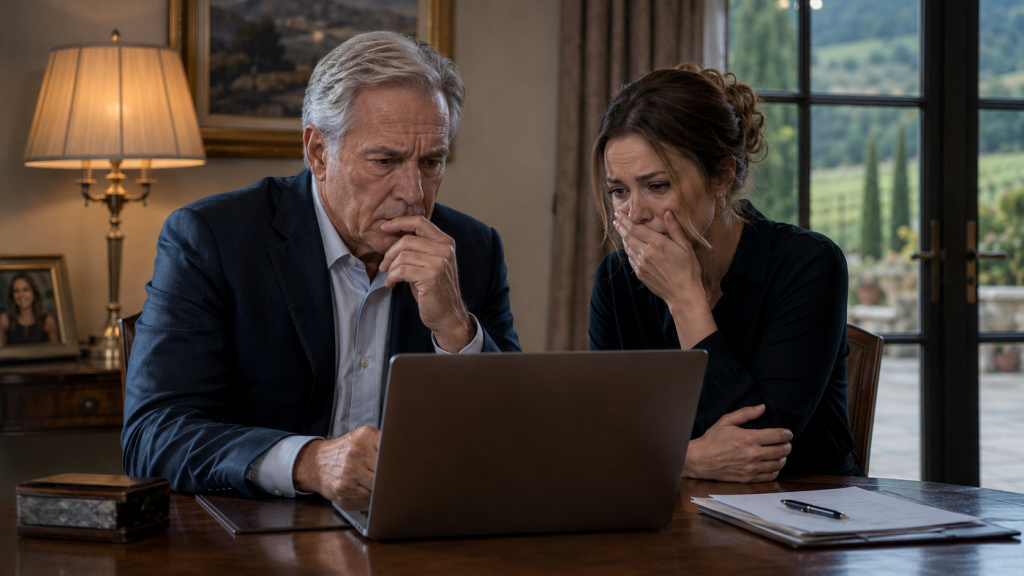
She opened her laptop.
“After the reception, I was cleaning up near the bridal suite. My phone was still recording voice notes for vendor timing because we had a dispute about the schedule. I didn’t realize it was still recording when I passed the private lounge.”
“My children were there?”
She nodded.
“Ethan, Marissa, and Vanessa.”
I nearly laughed from nerves.
“They probably said something stupid. Weddings are stressful.”
Claire did not smile.
She pressed play.
At first, there was muffled music.
A burst of laughter.
The faint clink of glass.
Then my daughter’s voice came through clearly.
“Dad looked so pathetic during the father-dance speech. He really thinks Ethan loves him.”
For a moment, I stopped breathing.
Then Ethan laughed.
Not a nervous laugh.
Not a shocked laugh.
A real one.
Vanessa’s voice followed.
“Just keep him emotional until he signs the lake house transfer. After that, we can stop pretending.”
Marissa replied, “He’ll sign. He’s lonely. Mention Mom and he’ll do anything.”
My hands went numb.
Then Ethan said the words that made the room tilt.
“Once the house and accounts are moved, we can put him somewhere managed. He won’t fight us. He still thinks we’re his family.”
Claire reached toward the laptop, but I lifted one hand.
“Let it play.”
There was a pause.
Then Vanessa laughed softly.
“He paid for the wedding and still doesn’t know he wasn’t invited into the future.”
I stared at the screen.
Everything inside me went quiet.
The kind of quiet that comes before something in a man breaks.
Claire whispered, “Mr. Carter, I’m so sorry.”
I stood slowly.
“Don’t be,” I said. “You just saved my life.”
She looked like she wanted to cry.
“There’s more.”
I closed my eyes.
Of course there was.
She played the next section.
Marissa said, “We need to get him to sign before Uncle Robert visits. Robert still watches everything.”
Ethan answered, “Dad trusts me. I’ll tell him Vanessa and I want to build memories at the lake house before we have kids.”
Vanessa laughed.
“Grandkids. That word works every time.”
Then Marissa said, “And if he starts asking questions?”
Ethan replied, “We use Mom. We say she would want the family assets protected.”
The recording ended.
I sat there for a long time.
When I finally spoke, my voice sounded like someone else’s.
“Send me a copy.”
Claire nodded.
“I already made one. And a backup.”
“Good.”
She hesitated.
“Mr. Carter, I know this is none of my business, but please don’t go home and confront them alone.”
I almost smiled.
Not because anything was funny.
Because only a stranger had cared enough to warn me.
“My children think I am a lonely old man,” I said.
Claire swallowed.
“And are you?”
I looked at the laptop.
“No,” I said. “Not anymore.”
I drove home with the recording saved on three separate drives and my hands locked around the steering wheel like it was the only thing keeping me from falling apart.
Ethan called twice before I reached Sacramento.
I did not answer.
Marissa texted.
Dad, we need to talk about the lake house paperwork. Ethan says you were going to sign this week.
Vanessa followed ten minutes later.
We are so grateful for you, Dad. You’re the heart of this family ❤️
I nearly pulled over.
Not because I wanted to cry.
Because I wanted to scream until my voice disappeared.
For thirty-one years, I had believed being a father meant giving until nothing was left.
But that morning, sitting in traffic beneath a pale California sky, I finally understood the difference between love and being used.
When I got home, the house was silent.
Eleanor’s portrait hung above the fireplace.
She wore the blue dress from our thirtieth anniversary, smiling with that knowing softness in her eyes.
I stood beneath it and whispered, “You tried to warn me.”
Then I called my attorney.
His name was Daniel Price, and he had handled my business contracts for more than twenty years.
“William,” he said cheerfully. “How are you?”
“Change everything.”
The cheer vanished.
“What happened?”
“The trust. The accounts. The lake house documents. The medical power of attorney. Everything.”
A pause.
“Are you in danger?”
I looked at Eleanor’s portrait.
“I was.”
“Can you come to my office?”
“No. Come to my house. Today.”
Daniel arrived two hours later with his assistant and a leather folder.
I played the recording.
By the time it ended, Daniel’s face had changed.
He no longer looked like a lawyer meeting an old client.
He looked like a man preparing for war.
“Do not sign anything they give you,” he said.
“I won’t.”
“Do not meet them alone.”
“They are coming tonight.”
His head snapped up.
“What?”
“Ethan called again. Marissa texted that they want to discuss the lake house.”
Daniel closed his folder.
“Then I’m staying.”
“No,” I said. “I need them to think I am alone.”
“William—”
“I said they think I am weak. I want them comfortable enough to tell me who they really are to my face.”
Daniel studied me.
Then he nodded slowly.
“I’ll be in the study. Door cracked. Recording.”
That evening, the doorbell rang at 7:04.
I remember the exact time because I was standing in the kitchen staring at the old clock Eleanor bought from an antique shop in Monterey.
Ethan entered first.
He wore a navy blazer and a concerned expression.
Marissa came behind him with a casserole dish, as if betrayal tasted better with baked pasta.
Vanessa entered last, holding a cream-colored folder.
“Dad,” Ethan said softly, opening his arms. “You’ve been avoiding us.”
I let him hug me.
It took every ounce of strength I had not to push him away.
Marissa kissed my cheek.
“You look tired.”
Vanessa smiled.
“We’ve been worried.”
I looked at her folder.
“I’m sure.”
We sat in the living room.
They arranged themselves like a team.
Ethan beside me.
Marissa across from me, hands folded with practiced concern.
Vanessa nearest the coffee table, folder ready.
“Dad,” Ethan began, “we’ve been thinking about the future.”
I said nothing.
He leaned forward.
“You’ve done so much for us. Too much, honestly.”
Marissa nodded.
“We just want to protect you.”
That was when something inside me almost laughed.
Protect me.
From what?
From themselves?
Vanessa opened the folder.
“We spoke to a financial planner. Nothing official yet, of course. But there are smart ways to organize family assets before taxes and legal complications become a problem.”
I looked at the papers.
At the top of the first page were the words:
PROPERTY TRANSFER AGREEMENT.
The lake house.
Of course.
Ethan placed his hand on my shoulder.
“Dad, Mom would want us to keep the family together.”
There it was.
Eleanor.
The key they thought could open every locked door inside me.
My daughter’s eyes filled with tears right on time.
“She loved that lake house,” Marissa said. “It should stay with us.”
I looked at my children.
My beautiful, cruel children.
“Tell me something,” I said quietly. “When did you decide I was no longer part of the family?”
The room froze.
Ethan blinked.
“What?”
Vanessa’s smile faltered.
“William, no one said that.”
I reached for the small speaker on the side table.
Then I pressed play.
At first, there was music.
Muffled laughter.
A glass clink.
Then Marissa’s voice filled the room.
“Dad looked so pathetic during the father-dance speech. He really thinks Ethan loves him.”
Marissa’s face went white before the worst part even came.
Ethan stood.
“Dad, where did you get that?”
I looked at him.
“So it is real.”
He opened his mouth.
Closed it.
Vanessa whispered, “This is illegal.”
Daniel stepped out of the study.
“No,” he said calmly. “California’s consent laws may be complicated, but this was accidentally recorded by a vendor during the performance of her duties at the venue, and we are not in court yet. But thank you for immediately worrying about yourself.”
Vanessa’s mouth snapped shut.
The recording continued.
“Just keep him emotional until he signs the lake house transfer.”
Ethan looked at Marissa.
Marissa looked at Vanessa.
No one looked at me.
That told me enough.
When the line came about putting me “somewhere managed,” I saw Daniel’s jaw tighten.
When Vanessa’s voice said, “He paid for the wedding and still doesn’t know he wasn’t invited into the future,” I stopped the recording.
Silence filled the room.
I waited.
Part of me wanted them to fall to their knees.
Part of me wanted Ethan to say he was drunk, stupid, ashamed.
Part of me wanted Marissa to sob and say she did not mean it.
But betrayal is most revealing in the first seconds after exposure.
Ethan’s first words were not apology.
They were, “You had no right to spy on us.”
Something in me died cleanly then.
Marissa snapped, “That was private.”
Vanessa added, “You’re overreacting.”
I nodded slowly.
“Am I?”
Ethan dragged a hand through his hair.
“Dad, people say things. It was a stressful day.”
“You said I thought you loved me.”
His face twitched.
“That’s not what I meant.”
“What did you mean?”
He said nothing.
I turned to my daughter.
“You said I was lonely and that mentioning your mother would make me do anything.”
Marissa’s tears finally came.
But they were not tears of remorse.
They were tears of being caught.
“Dad, I was frustrated.”
“With what?”
“With everything!” she burst out. “Do you know what it’s like to always wait? To know all of this will be ours one day but still have to ask for help like children?”
Daniel inhaled sharply.
Ethan said, “Marissa, stop.”
But she had opened a door she could not close.
“No,” I said. “Let her speak.”
Marissa stood, shaking.
“You have three houses, Dad. Accounts. Businesses. Investments. And we’re supposed to act grateful when you give us little pieces? You’re sixty-four. You could live another twenty years.”
The room went still.
There it was.
Not hidden.
Not disguised.
The truth.
I looked at Ethan.
“Do you feel the same?”
His silence answered before his mouth did.
“We just wanted security,” he said.
“At my expense.”
“For the family.”
“I am the family.”
Vanessa laughed under her breath.
I looked at her.
She realized too late that I heard it.
“You married my son for access to what I built,” I said.
Her eyes hardened.
“I married Ethan because I love him.”
“No,” Daniel said from behind me. “You brought pre-drafted transfer papers to a grieving widower’s home three weeks after he paid for your wedding.”
Vanessa turned on him.
“This is none of your business.”
“It became my business when William hired me.”
Ethan stared at me.
“Hired him for what?”
I stood.
“To change everything.”
Marissa’s face fell.
“What does that mean?”
“It means the lake house is no longer available for transfer. It has been moved into a charitable trust in your mother’s name.”
Ethan stepped back.
“What?”
“It means my medical power of attorney no longer names either of you. It names Daniel and my brother Robert.”
Marissa whispered, “Dad.”
“It means the family trust has been revised. You will receive what I choose, when I choose, under conditions I choose.”
Vanessa gripped the folder so tightly it bent.
“You can’t punish them because they had one conversation.”
“One conversation did not create your plan,” I said. “It revealed it.”
Ethan’s voice turned cold.
“You’re making a mistake.”
I looked at my son, and for the first time, I saw the man beneath the charm.
“No,” I said. “I made the mistake years ago when I confused giving with parenting.”
Marissa began crying harder.
“Mom would hate this.”
I stepped toward her.
For a second, her face softened because she thought the old spell still worked.
But I was not the same man anymore.
“Do not use your mother as a weapon again.”
Her tears stopped.
“Your mother was generous,” I said. “But she was not stupid. And if she were standing here now, she would be more ashamed of you than I am.”
Marissa flinched as if I had slapped her.
Maybe words can do that when they are true.
Ethan grabbed Vanessa’s folder.
“We’re leaving.”
“Yes,” I said. “You are.”
He moved toward the door, then turned back.
“You’ll regret this when you’re alone.”
That was the final cruelty.
The threat beneath every fake smile.
Do what we want, or we will abandon you.
I walked to the door and opened it.
“I was alone before Claire called me,” I said. “Now I’m just aware of it.”
They left without another word.
Vanessa looked back once.
Not with guilt.
With calculation.
Daniel waited until their car pulled away before speaking.
“That went worse than I expected.”
I sat down.
“No,” I said. “It went exactly as needed.”
The next week was ugly.
Ethan called twenty-three times.
Marissa sent long messages filled with guilt, anger, apology, and blame, often in the same paragraph.
Vanessa sent nothing.
That frightened Daniel more than the rest.
“Quiet people are planning,” he said.
He was right.
Ten days later, Vanessa’s attorney sent a letter claiming I had promised the lake house as a wedding gift and that Ethan and Vanessa had made life decisions based on that promise.
Daniel laughed when he read it.
Then he sent back copies of the unsigned transfer documents they had brought, the wedding payment records, and a formal notice that any attempt to harass or exploit me would be met with immediate legal action.
Two days after that, Marissa came to my house alone.
I saw her through the doorbell camera.
She looked smaller than usual.
No makeup.
Red eyes.
For a moment, I almost did not open the door.
Then I thought of Eleanor.
Not the memory they used as a weapon.
The real Eleanor.
The woman who believed in truth, even when truth hurt.
I opened the door.
Marissa stood on the porch holding an old photo album.
“Can I come in?”
I did not move.
“Are you here because you love me or because you lost access?”
Her face crumpled.
“I don’t know.”
That answer hurt.
But it was the first honest thing she had said.
I let her in.
We sat at the kitchen table.
The same table where Eleanor had helped with homework, wrapped birthday gifts, planned vacations, and written grocery lists in blue ink.
Marissa opened the album.
Photos of her and Ethan as children.
Ethan missing two front teeth.
Marissa asleep on Eleanor’s lap.
Me holding both of them at the lake.
“I was angry,” she whispered. “After Mom died.”
“So was I.”
“No. I was angry at you.”
I looked at her.
“Why?”
“Because you kept living in the house with all her things. Because you talked about her like she was still here. Because every time you gave us money, it felt like you were buying a way to not talk about how broken we were.”
I absorbed that.
There was some truth in it.
Pain does not excuse cruelty, but sometimes it explains the road that led there.
“I failed you after your mother died,” I said.
She looked up, startled.
“I did. I gave you money when I should have given you honesty. I paid for distractions. I did not know how to talk about losing her, so I became useful instead.”
Tears slipped down her cheeks.
“But what you said on that recording was not grief, Marissa. That was contempt.”
She closed her eyes.
“I know.”
“Do you?”
She nodded.
“I hated needing you. Then I hated you for having what I needed. Then Vanessa started saying it wasn’t fair. Ethan agreed. And I just… I let it become normal.”
“Planning to put me somewhere managed became normal?”
Her face twisted.
“I didn’t mean that part.”
“You laughed.”
She covered her mouth.
“I know.”
For the first time, I saw real shame.
Not the shame of being exposed.
The shame of seeing herself clearly.
“I’m not here to ask for the money back,” she said. “I’m not here about the trust.”
“Then why are you here?”
She pushed the photo album toward me.
“Because I found this in my closet. Mom wrote something inside.”
On the first page, in Eleanor’s handwriting, were the words:
Family is not inheritance. Family is how we carry one another when there is nothing to gain.
I touched the page.
My throat tightened.
Marissa whispered, “I forgot who she was.”
I looked at my daughter.
“No. You forgot who you were.”
She bowed her head.
That day did not fix us.
Real life does not heal in one kitchen conversation.
But it was the first crack in the wall.
Ethan did not come.
Not then.
Not for months.
Vanessa filed complaints, sent threats, pushed Ethan to sue, then left him when she realized the money would not come.
Six months after the wedding, Ethan appeared at my hardware store just before closing.
He looked thinner.
Older.
There were circles beneath his eyes.
“Vanessa left,” he said.
I turned off the register.
“I heard.”
“She said I was useless without the lake house.”
I said nothing.
He laughed once, bitterly.
“Guess she meant what she said.”
“Yes,” I replied. “She did.”
He looked at the floor.
“I’m sorry.”
I waited.
He swallowed.
“I don’t even know if I’m sorry because I hurt you or because everything fell apart.”
“That is at least honest.”
His eyes filled.
“I became someone I don’t recognize.”
“No,” I said. “You became someone you refused to recognize.”
That broke him.
He cried in the aisle between paint rollers and garden hoses, and I let him.
Not because crying erased anything.
It did not.
But because I was still his father.
And being a father did not mean giving him what he wanted.
It meant standing there while he faced what he had done.
“I can’t put you back in the trust,” I said.
He nodded quickly.
“I know.”
“I can’t pretend I didn’t hear what I heard.”
“I know.”
“And I can’t be your wallet anymore.”
He wiped his face.
“I don’t want that.”
“Good,” I said. “Then maybe someday we can find out whether there is anything left when money is removed.”
It has been two years since Claire Benson called me.
The lake house now belongs to the Eleanor Carter Foundation, which provides quiet retreats for widows and widowers learning how to live after loss.
Every summer, people sit on that porch and look out over the water, carrying grief I understand.
I still visit sometimes.
Not as an owner.
As a guest of the woman who saved me long before I understood her warning.
Marissa and I have dinner twice a month.
She works with a counselor now.
She pays her own mortgage.
Sometimes she still reaches for old habits, soft guilt, emotional pressure, small manipulations dressed as vulnerability.
Then she catches herself.
That matters.
Ethan works at one of my hardware stores.
Not as a manager.
Not as an heir.
As an employee.
He stocks shelves, handles deliveries, and learns what a dollar feels like before it becomes entitlement.
Some customers recognize him from wedding photos still buried online.
He keeps his head down.
That is good for him.
We are not healed.
We are honest.
That is better than what we were.
Claire Benson and I became friends.
Every year on the anniversary of that phone call, I send flowers to her office.
The card always says the same thing.
Thank you for telling the truth.
Last month, I returned to the vineyard for the first time.
Not for a wedding.
For a charity event supporting the foundation.
The courtyard was lit with the same golden string lights.
The same stone archways stood against the darkening sky.
For a moment, I could hear the echo of my own speech from Ethan’s wedding.
Your mother would have been proud of the man you became.
I no longer believe that.
But I believe she might be proud of the man I became after learning the truth.
Near the end of the evening, Marissa stood beside me with two glasses of sparkling water.
“Do you ever wish Claire had never called?” she asked.
I looked across the vineyard.
Ethan was helping an elderly guest down the steps.
Slowly.
Patiently.
Without anyone praising him.
“No,” I said.
Marissa nodded.
“I hate that recording.”
“I know.”
“But sometimes I think it saved us too.”
I looked at my daughter.
Maybe it had.
Not in the gentle way people prefer to be saved.
Not with forgiveness wrapped in ribbons.
But with a blade sharp enough to cut rot away from the root.
Later that night, I drove home alone.
The house was quiet when I entered.
Eleanor’s portrait still hung above the fireplace.
I stood before it for a long time.
“You were right,” I whispered.
Then I smiled sadly.
“You usually were.”
On the table beneath her portrait sat the old photo album Marissa had brought me.
I opened it to Eleanor’s note.
Family is not inheritance. Family is how we carry one another when there is nothing to gain.
For years, I thought giving everything proved my love.
But love without boundaries becomes a feast for selfish people.
And grief without wisdom becomes an open door.
My children did not lose me because I stopped loving them.
They lost the version of me they could use.
And maybe, one day, they will earn a place beside the man who remained.
Not as heirs waiting for signatures.
Not as adults circling assets.
But as family.
Real family.
The kind that does not ask what your loneliness is worth.
The kind that does not weaponize the dead.
The kind that stays when there is nothing left to take.
Three weeks after my son’s wedding, a stranger called and told me to come alone.
I thought I was going there to solve a problem.
Instead, I walked into the truth.
It broke my heart.
It saved my life.
And for the first time since Eleanor died, I finally understood what she meant.
Don’t let grief make you weak.
So I didn’t.
Not anymore.
THE END! THANK YOU FOR READING!