

My mom died when I was ten years old. For a long time after that, our house felt like someone had taken the sun out of the sky and told me to keep living under the same roof anyway. My mother’s name was Evelyn Harper, and when I say she was gentle, I don’t mean weak.
She was the kind of gentle that made a room feel safe. She sang when she cooked. She left notes in my lunch box. She smelled like vanilla soap and gardenias, and every Sunday morning, she would sit on the back porch with coffee in one hand and a book in the other while I played guitar badly beside her.
Dad used to say she made life feel expensive, even when we didn’t have much.
After she died, Dad changed.
Not all at once.
At first, he was simply quiet.
Then he was tired.
Then he started forgetting dinner, forgetting my school events, forgetting that grief can feel twice as heavy when the only adult in the house stops looking at you.
I was fourteen when he remarried.
Her name was Cheryl.
Cheryl came into our lives wearing pearl earrings, soft perfume, and a smile that belonged in church bulletins.
Everyone said Dad was lucky.
“She’s so patient with him,” people whispered.
“She’ll help raise the boy,” they said.
But they never saw what Cheryl was like when Dad was not in the room.
They never saw how quickly that church smile vanished.
They never heard the way her voice sharpened when she said my name.
“Don’t touch the good plates.”
“Don’t leave your guitar in the living room.”
“Stop acting like this house belongs to you.”
At first, I tried to make her like me.
I washed dishes without being asked.
I kept my grades high.
I stopped playing guitar in the house because she said it gave her headaches.
I even called her “ma’am” once, hoping it would soften something.
It didn’t.
She only looked at me over the rim of her wine glass and said, “Don’t try so hard. It makes people uncomfortable.”
Dad didn’t notice.
Or maybe he didn’t want to.
He had started traveling more for work, and when he was home, Cheryl became someone else.
She touched his shoulder. She brought him tea. She asked about his day in a voice so soft it almost made me doubt my own memories.
Sometimes I would stand in the hallway and watch her perform kindness like a woman reading lines from a script.
Then Dad would look at me and smile weakly.
“Cheryl’s trying, buddy,” he’d say.
So I stopped telling him.
By the time I was nineteen, I had learned to survive inside that house by becoming quiet.
I went to college nearby because Dad wanted me close.
I worked part-time at a music shop.
I saved whatever money I could.
And I kept my mother’s old guitar under my bed, wrapped in the same faded blue blanket she had used to cover me when I had nightmares as a kid.
Then Dad died.
It happened so suddenly that I still remember the phone call like a scar.
A heart attack.
One minute he was at his office.
The next, he was gone.
At the funeral, Cheryl cried beautifully.
That was the only word for it.
Beautifully.
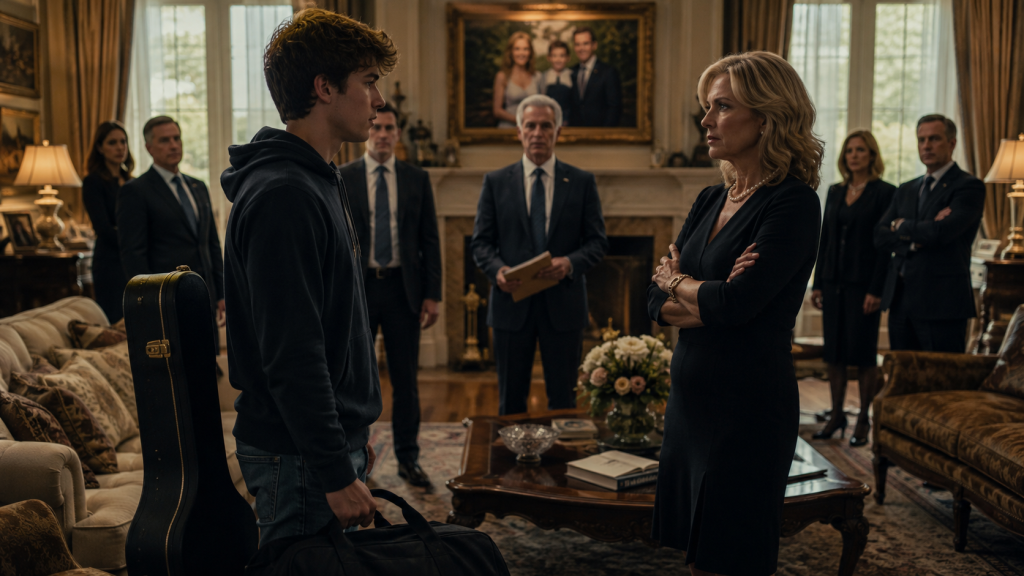
She wore a black dress and a lace veil. She dabbed her eyes with a handkerchief. She leaned on people like grief had stolen her bones.
People hugged her.
People whispered, “Poor Cheryl.”
No one noticed that she never once looked at me.
I stood near Dad’s casket with my hands folded, staring at the man who had raised me, loved me imperfectly, disappointed me quietly, and left without warning.
I wanted to be angry.
I wanted to forgive him.
I wanted to be ten years old again, sitting between him and Mom on the porch before everything broke.
Two days after the funeral, Cheryl came into the kitchen while I was washing a coffee mug.
She wasn’t crying anymore.
Her veil was gone.
Her softness was gone.
She crossed her arms and leaned against the counter like she had waited years for that exact moment.
“You need to pack,” she said.
I turned slowly.
“What?”
“You heard me.”
I stared at her.
“Dad just died.”
“And this house is no longer your concern.”
My hands tightened around the mug.
“This is my home.”
Cheryl gave a small laugh.
A cold one.
“No, sweetheart. This was your father’s home. Then it became my marital residence. You are nineteen years old. You are not a child. You’re not family anymore. Get out.”
The mug slipped slightly in my hand.
For a second, I thought I had misheard her.
But she smiled.
Not the church smile.
The real one.
The one she saved for moments when she had power.
“Cheryl,” I said, my voice barely working, “you can’t just throw me out.”
“I can, and I am.”
She stepped closer.
“You have until tonight. Take whatever fits in one bag. Anything else left behind becomes mine.”
“My mother’s things are here.”
Her eyes flickered.
Then she shrugged.
“Your mother is dead.”
Something inside me cracked so sharply I thought I heard it.
I wanted to shout.
I wanted to smash every plate in that perfect kitchen.
Instead, I walked upstairs.
My room looked smaller than it ever had.
The walls still had the faint outlines where childhood posters used to hang. My desk was covered in old textbooks. My guitar case sat beside the bed, dusty but safe.
I packed one duffel bag.
Clothes.
A toothbrush.
My mother’s photograph.
The guitar.
When I came downstairs, Cheryl was waiting near the front door with my father’s old house keys in her palm.
“Keys,” she said.
I looked at them.
Then at her.
“I’ll come back tomorrow for the rest of my things.”
Her smile tightened.
“We’ll see.”
I handed her the keys.
The metal sounded final when it hit her palm.
Outside, the air smelled like rain.
I walked down the driveway with a duffel bag over my shoulder and my guitar case in one hand.
I didn’t look back until I reached the sidewalk.
Cheryl stood in the doorway, framed by the warm light of the house my mother had decorated, the house where my father had taught me to ride a bike in the driveway, the house where every memory I had was being stolen from me one room at a time.
Then she shut the door.
That night, I slept in my car behind the music shop.
I kept waking up because every sound felt like danger.
At three in the morning, I opened my mother’s photograph.
She was sitting on the porch, smiling at me behind the camera. Dad had written on the back in blue ink: Evelyn and our boy, summer 2011.
I pressed the picture to my chest and whispered, “I don’t know what to do.”
By sunrise, I knew one thing.
I was going back.
Not to fight.
Not to beg.
Just to get what was mine.
My mother’s jewelry box.
Her recipe notebook.
The blue blanket.
Dad’s old watch.
The few things Cheryl hadn’t yet turned into weapons.
At eight in the morning, I parked across the street from the house.
And froze.
Five black SUVs were lined along the curb.
Expensive ones.
Dark windows.
Engines off.
Men in suits stood near the driveway, speaking into phones.
For one wild second, I thought Cheryl had hired security to keep me away.
My stomach dropped.
Maybe she had already changed the locks.
Maybe she had called some lawyer.
Maybe she had told everyone I was unstable, greedy, dangerous.
I almost drove away.
Then the front door opened.
Cheryl stepped out.
She saw my car.
Her face changed so fast it felt impossible.
The color drained from her cheeks. Her mouth opened slightly. Her hand went to her necklace.
Then she smiled.
A nervous, trembling smile.
I had never seen Cheryl nervous before.
I got out of the car slowly.
My duffel was still in the back seat. My guitar case sat beside it like a silent witness.
Cheryl hurried down the porch steps.
“Oh!” she said, too brightly. “I was just about to call you, sweetheart.”
Sweetheart.
Yesterday, I hadn’t been family.
Today, I was sweetheart.
I blinked.
“What’s going on?”
Her eyes darted toward the SUVs.
“Nothing. Just some paperwork. Your father had business associates. You know how these things are.”
“No,” I said. “I don’t.”
She gave a small laugh, but it shook.
“Come inside. We’ll talk.”
I stepped past her into the house.
The living room was full of strangers.
Men and women in dark suits stood near the fireplace, around the dining table, beside Dad’s old bookcase. One man had a leather folder tucked under his arm. Another was speaking quietly to a woman holding a tablet.
It didn’t feel like a security detail.
It felt like a meeting.
The kind of meeting people don’t invite you to unless money is involved.
One of the men turned when he saw me.
He was older, maybe in his sixties, with silver hair and sharp eyes.
His expression changed from professional calm to unmistakable recognition.
“You must be Daniel’s son,” he said.
My throat tightened.
Daniel.
Dad.
Before I could answer, Cheryl stepped quickly between us.
“He was just leaving,” she said.
The room went silent.
The silver-haired man looked at her.
His face did not change, but something in his eyes hardened.
“Actually, Mrs. Harper,” he said, “he is the reason we are here.”
Cheryl’s hand clenched.
“That’s unnecessary.”
“It is entirely necessary.”
He turned back to me.
“My name is Arthur Bell. I was your father’s attorney.”
I swallowed.
“I didn’t know Dad had an attorney.”
Arthur’s gaze softened.
“He had several things he wanted kept quiet until the proper time.”
Cheryl laughed suddenly.
It came out thin and sharp.
“This is ridiculous. Daniel and I discussed everything. I am his wife.”
“Yes,” Arthur said. “You were his wife.”
The word were landed hard.
Cheryl’s face twitched.
Arthur opened the leather folder and pulled out a thick envelope.
My name was written across the front.
Not typed.
Written.
In Dad’s handwriting.
My chest tightened so badly I could barely breathe.
Arthur held it out.
“Your father left instructions. This was to be given to you under specific circumstances.”
My fingers shook when I took it.
“What circumstances?”
Arthur looked at Cheryl.
Then back at me.
“If Mrs. Harper attempted to remove you from the home within thirty days of his death.”
The room became so quiet I could hear the wall clock ticking.
Cheryl whispered, “Daniel wouldn’t do that.”
Arthur said nothing.
I opened the envelope.
Inside was a letter.
Dad’s handwriting covered three pages.
The first line broke something open inside me.
Son, if Cheryl ever throws you out, open this in front of witnesses.
My knees weakened.
I sat down on the edge of the sofa.
The same sofa where Mom used to fold laundry while watching old movies.
I kept reading.
I am sorry.
I should have protected you better while I was alive.
I saw more than you thought I saw.
I knew Cheryl was kind to me and cruel to you.
I knew you stopped playing guitar in the house because of her.
I knew you stopped talking because you thought I would choose peace over truth.
And sometimes I did.
That is my deepest shame.
I pressed my hand over my mouth.
For years, I had believed Dad didn’t know.
For years, I had swallowed loneliness because I thought telling him would only make life worse.
But he knew.
He knew and did not stop it.
And yet, here in my hands, he was trying to speak after death.
The letter continued.
Your mother knew what kind of world this could become without her. Before she died, she created a trust for you using her inheritance, her shares in the family company, and the lake property from her parents.
I was the trustee until you turned twenty-one, unless I died first.
If I died before then, control passes to Arthur Bell and the board until you are ready.
Cheryl has no legal claim to the trust.
No legal claim to your mother’s property.
No legal claim to the house.
The house was never mine alone.
Your mother placed it inside the trust before she passed.
I looked up slowly.
Cheryl was staring at the paper like it had turned into a snake.
Arthur spoke gently.
“Your mother was a very careful woman.”
I could barely form the words.
“This house belongs to me?”
“To your trust,” Arthur said. “And you are the sole beneficiary.”
Cheryl exploded.
“No. No, that is impossible. Daniel lived here. I lived here. I am his widow.”
“You were allowed to reside here during the marriage,” Arthur said calmly. “But ownership never transferred. Daniel signed a prenuptial agreement acknowledging that. You signed it as well.”
Cheryl’s face went red.
“I didn’t understand what I was signing.”
Arthur looked at her without blinking.
“You were represented by counsel.”
She turned to me.
The anger vanished in an instant.
Her eyes filled with tears.
Fake tears.
Practiced tears.
“Sweetheart,” she said, stepping closer, “this is all confusing. Your father would never want us fighting. We are grieving. I was emotional yesterday. I didn’t mean what I said.”
I stared at her.
Not family anymore.
Get out.
Your mother is dead.
The words stood between us like ghosts.
“You meant every word,” I said.
Her lips trembled.
“I raised you.”
“No,” I said. “You lived in the same house while I raised myself.”
A woman near the dining table lowered her eyes.
Arthur cleared his throat.
“There is more.”
He placed another document in front of me.
“Your father’s personal estate includes accounts, investments, and his remaining ownership in Harper Logistics. A portion passes to Mrs. Harper as required by agreement. However, the controlling shares, voting rights, and all assets inherited from Evelyn Harper remain with your trust.”
I didn’t understand all of it.
The numbers blurred.
But I understood Cheryl’s face.
She had expected to own everything.
The house.
The company.
The money.
Maybe even my mother’s things.
Instead, she had thrown out the one person she needed to be kind to.
Arthur continued.
“Your father also included a clause. If Mrs. Harper attempted to dispose of, conceal, sell, or remove property belonging to the trust, she would immediately lose the right to remain in the residence during the transition period.”
Cheryl went still.
Too still.
Arthur noticed.
“What did you remove, Mrs. Harper?”
“Nothing,” she snapped.
The woman with the tablet looked up.
“Mrs. Harper, we already received notice from the estate security team that three boxes were loaded into your vehicle at 6:14 this morning.”
Cheryl’s mouth opened.
No sound came out.
My heartbeat pounded in my ears.
“What boxes?” I asked.
No one answered for a moment.
Then I turned and ran upstairs.
My room door was open.
My drawers had been pulled out.
My closet was half empty.
The mattress was crooked.
My mother’s blue blanket was gone.
I ran to the hall closet.
The cedar chest was open.
Empty.
The jewelry box was gone.
Her recipe notebooks were gone.
Her letters were gone.
Everything of my mother’s that Cheryl had always pretended not to care about had vanished.
I went back downstairs shaking.
“Where is it?” I asked.
Cheryl lifted her chin.
“I don’t know what you’re talking about.”
I took one step toward her.
Arthur put a hand out, not touching me, just steadying the moment.
“Mrs. Harper,” he said, “you should answer carefully.”
She looked around the room and realized everyone was watching.
The old mask cracked.
“You ungrateful little parasite,” she hissed.
There she was.
The real Cheryl.
“You think because some dead woman signed papers, you can come in here and take everything?”
Arthur’s voice went cold.
“Enough.”
“No,” she snapped. “I gave five years to this house. Five years smiling at his boring business dinners, listening to him talk about his dead wife like she was a saint. And this boy—this spoiled, miserable boy—walks away with everything?”
I felt strangely calm.
Maybe because the worst thing about Cheryl had never been her cruelty.
It was that nobody believed me.
Now everyone could hear her.
Everyone could see.
“You threw me out two days after my father’s funeral,” I said.
Cheryl pointed at me.
“Because you don’t belong here.”
Arthur looked to one of the men near the fireplace.
“Call the sheriff’s office and request a civil standby.”
Cheryl laughed.
“You can’t remove me from my own home.”
Arthur closed the folder.
“It is not your home.”
That was the moment her expression changed from anger to fear.
Real fear.
Not nervousness.
Not embarrassment.
Fear.
Because for the first time since she entered our lives, Cheryl was standing in a room where charm didn’t work.
The sheriff arrived twenty minutes later.
By then, Cheryl had stopped crying and started bargaining.
She told Arthur there had been a misunderstanding.
She told the sheriff she was being bullied.
She told me Dad would be ashamed of me.
Then one of the estate security men returned from the garage carrying two cardboard boxes.
My mother’s name was written on one in Dad’s handwriting.
EVELYN — KEEP SAFE.
I crossed the room so fast I nearly tripped.
Inside were Mom’s recipe notebooks, her letters, her jewelry box, and the blue blanket.
I touched the blanket first.
It smelled like dust and cedar.
I don’t know why that undid me, but it did.
I sat on the floor right there, holding that blanket to my chest, and cried harder than I had cried at Dad’s funeral.
Not because of the money.
Not because of the house.
Because for one terrible night, I thought the last pieces of my mother had been stolen.
Arthur crouched beside me.
“Your father instructed us to protect these items specifically.”
I wiped my face.
“He knew she’d take them?”
Arthur hesitated.
Then nodded.
“He feared she might.”
That hurt in a different way.
Dad had seen the danger clearly enough to plan for it after death, but not enough to stop it while alive.
I didn’t know how to forgive that yet.
Maybe I never fully would.
The sheriff gave Cheryl one hour to collect personal belongings under supervision.
Not my mother’s belongings.
Not Dad’s business papers.
Not furniture.
Not art.
Not anything attached to the trust.
Just her clothes, toiletries, and personal documents.
She screamed when they told her.
Then she cried.
Then she begged me.
“Please,” she whispered when no one else was close enough to hear. “I have nowhere to go.”
I looked at her.
For a second, I saw not the monster of my childhood, but a frightened woman who had built her life on taking things that did not belong to her.
But pity is not the same as permission.
“You told me that yesterday,” I said.
Her face hardened.
“You’ll regret this.”
“No,” I said. “I already regret letting you make me feel homeless in my own life.”
She was escorted out just before noon.
She left wearing sunglasses, carrying two suitcases, and looking smaller than I had ever seen her.
When the door closed behind her, the whole house seemed to exhale.
Arthur stayed.
The others left one by one.
The black SUVs pulled away from the curb, and suddenly the house was quiet again.
Too quiet.
I stood in the living room with my mother’s blanket in my arms and Dad’s letter in my pocket.
Arthur handed me a business card.
“There will be a great deal to handle,” he said. “You don’t have to understand everything today.”
I nodded.
“Why didn’t Dad tell me?”
Arthur looked at the family photograph on the mantel.
Dad, Mom, and me.
Back when all of us were smiling.
“Your father was a complicated man,” he said carefully. “He loved you. He also avoided conflict. Those two truths caused harm.”
That was the most honest thing anyone had said about him.
After Arthur left, I walked through the house alone.
Every room felt familiar and strange.
In the kitchen, Cheryl’s wine glass still sat near the sink.
I threw it away.
In the dining room, Dad’s chair was pushed in perfectly.
I pulled it out and sat there for a while.
On the wall across from me hung a painting Cheryl had bought two years earlier, some cold abstract thing in gray and gold.
I took it down.
Behind it was a small nail hole and a square of unfaded wallpaper.
I knew exactly what used to hang there.
A framed photo of Mom at the lake.
Cheryl had removed it the week after she moved in.
I found it in the basement wrapped in newspaper.
The glass was cracked.
The frame was dusty.
But Mom was still there, standing barefoot on the dock in a yellow dress, laughing at whoever held the camera.
I carried it upstairs and placed it back on the wall.
Then I brought my guitar in from the car.
For five years, I had played quietly, outside, in parking lots, in the back room of the music shop, anywhere but home.
That afternoon, I sat on the living room floor and opened the case.
The strings were slightly out of tune.
My hands shook as I adjusted them.
Then I played the song Mom used to ask for on Sunday mornings.
Badly at first.
Then better.
The notes filled the room, soft and uneven, and for the first time since I was fourteen, no one told me to stop.
A week later, Cheryl filed a challenge.
Arthur warned me she would.
“She may claim undue influence,” he said.
“She may claim your father lacked capacity.”
“She may claim the trust documents are invalid.”
I sat across from him in his office, wearing my only decent shirt, feeling like a kid pretending to be an adult.
“Can she win?”
Arthur leaned back.
“Not likely. Your mother created the trust before she became ill. Your father reaffirmed it multiple times. Cheryl signed the prenup. The documents are strong.”
“Then why fight?”
“Because people who believe they deserve everything often consider fairness an insult.”
That sentence stayed with me.
Cheryl’s lawsuit dragged on for months.
She gave interviews to anyone who would listen.
Not newspapers, exactly, but gossip blogs, old family friends, church people.
She told them I had manipulated my grieving father.
She said I was troubled.
She said I had always hated her.
She said she had loved me like her own son.
That one made me laugh out loud when I read it.
Not because it was funny.
Because the lie was so large it almost became absurd.
Then Arthur found the emails.
Cheryl had written to her sister six months before Dad died.
Daniel is weaker than ever. Once he’s gone, I’ll finally get the house. The boy will be easy to remove. He has no backbone.
Another one said:
I need to find out where Evelyn’s jewelry is. Daniel keeps saying it belongs to the trust, but once he’s dead, who will stop me?
Arthur slid the printed emails across the conference table.
My hands went cold.
There it was.
Proof.
Not just of cruelty, but intention.
For years, she had not merely disliked me.
She had been waiting.
Waiting for Dad to die.
Waiting to erase Mom.
Waiting to throw me away.
The judge did not appreciate the emails.
Cheryl’s case collapsed quickly after that.
By the end of the hearing, she looked nothing like the polished woman who had once stood beside Dad’s casket.
Her hair was pinned too tightly.
Her lipstick was too bright.
Her smile had nowhere to land.
The judge upheld the trust, the will, the prenup, and the removal order.
Cheryl received exactly what Dad’s agreement allowed her to receive.
No more.
No less.
When it was over, she turned to me in the courthouse hallway.
For a second, I thought she might apologize.
Instead, she said, “You think you won because you got the house?”
I looked at her.
“No,” I said. “I won because I don’t have to live with you anymore.”
Her face twisted.
I walked away before she could answer.
The first thing I did after the case ended was open every curtain in the house.
Cheryl had always kept them half-closed, saying sunlight faded furniture.
Mom had loved sunlight.
So I opened everything.
The living room glowed.
Dust floated in the air like tiny stars.
I hired a cleaning crew.
Then a painter.
Then I spent three days going through boxes in the basement.
I found old Christmas ornaments Mom had made by hand.
I found Dad’s college jacket.
I found birthday cards from grandparents I barely remembered.
And behind a stack of storage bins, I found a locked metal case.
The key was taped underneath.
Inside were letters.
Dozens of them.
All addressed to me.
Some were from Mom.
Some were from Dad.
Mom had written them before she died.
For my birthdays.
For graduation.
For my wedding someday.
For days when I missed her.
For days when I felt alone.
I opened the first one with shaking hands.
My beautiful boy,
If you are reading this, then I missed another year with you.
I am sorry.
I need you to know something very important.
Love does not disappear because a body leaves.
Love changes rooms.
It moves into songs, recipes, old blankets, and the way sunlight comes through a window.
Find me there.
I read that letter sitting on the basement floor, surrounded by dust and boxes, and cried until my chest hurt.
Then I read Dad’s letter from the same case.
Son,
I failed you in ways I did not want to face.
I thought keeping peace was protecting you.
It was not.
It was protecting my own weakness.
Your mother would have been braver.
I hope one day you can build a life in this house that feels like hers again.
Not perfect.
Just kind.
I sat there for a long time.
Anger is easier when the person who hurt you is only a villain.
Dad was not a villain.
He was a grieving man who chose comfort over courage too many times.
That didn’t erase the damage.
But it made the grief heavier.
More human.
That winter, I moved back into the house fully.
Not as a scared nineteen-year-old with a duffel bag.
As the owner of my own future.
I turned Cheryl’s sitting room into a music room.
I put Mom’s photo by the window.
I hung Dad’s watch above the desk.
I gave away the furniture Cheryl had chosen and brought back warmth slowly.
A blue rug.
Oak shelves.
Soft lamps.
Plants.
Books.
A kitchen table with scratches instead of shine.
I learned how to run the trust with Arthur’s help.
I went back to college part-time.
I kept working at the music shop because it made me happy.
And every Sunday morning, I made coffee, sat on the back porch, and played guitar.
Sometimes I played badly.
Sometimes I played well.
Either way, nobody told me to stop.
A year after Dad died, I hosted a small memorial at the lake property.
Not the kind with black clothes and whispered condolences.
A real one.
With food, music, sunlight, and stories.
People came who had loved Mom.
People came who had worked with Dad for years.
Even Arthur came, wearing a linen jacket and looking uncomfortable around paper plates.
At sunset, I stood on the dock where Mom’s old photo had been taken.
The lake turned gold.
I held my guitar and played her Sunday song.
When I finished, nobody clapped right away.
They just stood quietly.
And somehow, that meant more.
Later, Arthur handed me an envelope.
“What is this?”
“Your father asked me to give it to you one year after his death.”
I laughed softly.
“Another letter?”
“He was fond of delayed conversations.”
I opened it by the water.
Son,
If a year has passed, then you have survived the hardest part.
I hope the house feels less like a battlefield now.
I hope Cheryl is gone.
I hope you found your mother’s letters.
And I hope you know that the best parts of me were always the parts that loved you and your mother.
I cannot ask you to forgive me.
Forgiveness is not an inheritance I can leave behind.
But I can leave you the truth.
Your mother was the reason we had anything worth keeping.
You were the reason I tried to become better, even when I failed.
Live differently than I did.
Choose courage sooner.
Love people out loud.
And never let anyone make you feel like a guest in a life that belongs to you.
I folded the letter and looked out over the lake.
For the first time, thinking of Dad did not feel like being stabbed.
It felt like touching a bruise that had finally started to heal.
Years later, people would ask me why I stayed in that house.
They assumed it was because of the money.
Or the company shares.
Or the victory over Cheryl.
But that was never it.
I stayed because one morning, after being thrown out with a duffel bag and a guitar, I came back expecting humiliation and found the truth waiting in five black SUVs.
I stayed because my mother had protected me before I even knew I needed protection.
I stayed because my father, flawed and frightened as he was, had finally told the truth in ink.
I stayed because Cheryl had tried to erase me, and the house itself refused to let her.
Now, when sunlight fills the living room, it falls across Mom’s picture first.
Then Dad’s watch.
Then my guitar.
Sometimes I still hear Cheryl’s voice in memory.
You’re not family anymore.
Get out.
But it has no power now.
Because family was never something Cheryl had the right to take from me.
Family was in my mother’s letters.
In my father’s regret.
In the blue blanket she tried to steal.
In the music that came back to the house after years of silence.
And every Sunday morning, when I sit on the porch with coffee beside me and my guitar in my hands, I finally understand what Mom meant.
Love changes rooms.
And sometimes, after years of darkness, it opens every curtain and comes home.
THE END! THANK YOU FOR READING!