

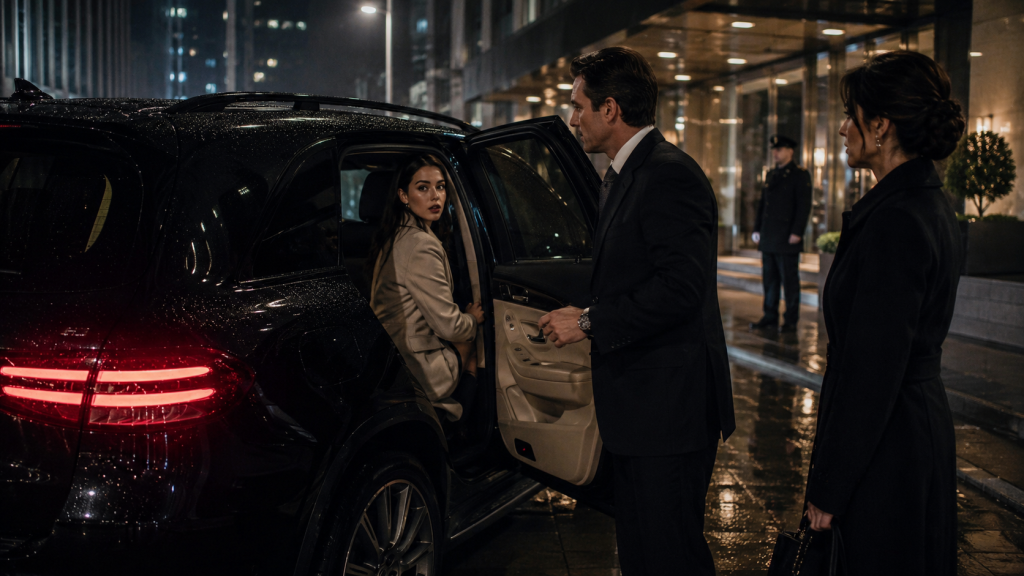
My husband buckled another woman into the front seat of my car while I stood in the freezing rain like a stranger he had accidentally inconvenienced. Not a cab. Not a company vehicle. My car.
The Mercedes SUV I had helped pay for during the year his real estate firm nearly collapsed. The car where we had once eaten takeout fries in parking lots because we were too broke and too tired to go inside a restaurant. The car where he had held my hand after our first miscarriage scare and promised, “When I make it, Catherine, you’ll never sit behind anyone again.”
But that evening, under the glass awning of his Manhattan office tower, David Sterling opened the passenger door for his twenty-four-year-old secretary, Cecilia Moore, and said in a voice loud enough for the doorman to hear, “Cat, get in the back. She gets carsick.”
I stared at him through the rain dripping from my lashes.
Cecilia stood beneath his umbrella, perfectly dry, her small hand pressed to her forehead as if she might faint from the cruelty of New York traffic. Her beige coat was buttoned wrong. Her glossy pink nails clutched a purse that probably cost more than her rent. She looked at me once, eyes wide and wet, then quickly looked down like a wounded dove.
“David,” I said slowly, trying not to raise my voice. “That is my seat.”
He clicked his tongue.
That sound was worse than a slap.
It was the sound he used on careless contractors, slow waiters, interns who forgot coffee orders.
“Don’t be ridiculous,” he said. “She almost passed out upstairs. She can’t ride in the back.”
“She can take a cab.”
“It’s pouring.”
“I drove through the same rain to pick you up.”
His jaw tightened. Behind us, a black town car honked. A delivery cyclist shouted something obscene from the curb. Rainwater slid down the collar of my silk blouse, cold against my skin.
Cecilia made a tiny, trembling sound.
“I can sit in the back, Mr. Sterling,” she whispered. “I don’t want to cause trouble.”
David turned to her with an expression I had not seen directed at me in years.
Soft.
Protective.
Almost tender.
“You’re not causing trouble,” he said.
Then he looked back at me, and the tenderness vanished.
“Catherine is just being sensitive.”
Sensitive.
The word sliced through me because he knew exactly how to use it. Sensitive meant irrational. Sensitive meant jealous. Sensitive meant a woman whose pain could be dismissed because it was inconvenient to a man.
“I am your wife,” I said, each word controlled. “You are asking me to sit in the back of my own car so your secretary can sit beside you.”
David’s face hardened.
“And I’m asking you to show basic human compassion for a young woman who feels sick. Are you really threatened by an employee?”
Cecilia lowered her head. Her shoulders shook.
At first I thought she was crying.
Then I saw it.
A tiny smile.
It appeared for less than a second at the corner of her mouth, hidden from David, meant only for me.
Not guilt.
Not fear.
Victory.
Something inside my chest went very still.
David reached across Cecilia’s body and pulled the seat belt over her. His hand lingered near her shoulder.
“Careful,” he murmured. “You’re shaking.”
I watched his fingers brush a strand of hair away from her cheek.
The doorman looked away.
A man in a gray coat stopped pretending not to watch.
For twelve years, I had stood beside David Sterling when he was nobody. I had edited his proposals at two in the morning, sold my mother’s emerald bracelet to cover payroll, entertained investors who barely acknowledged me, and smiled through dinners where men credited him for decisions I had made.
I had made myself smaller so he could become larger.
And now, in front of strangers, he reduced me to luggage.
I opened the rear door and got in.
The leather was cold beneath my soaked skirt. David slid behind the wheel, perfume and rainwater filling the air. Cecilia reclined the passenger seat slightly and turned her face toward the window, but I caught her reflection in the glass.
That smile again.
David pulled into traffic.
“Is the heat okay, Cece?” he asked.
Cece.
Not Cecilia.
Cece.
“Maybe a little warmer,” she said softly. “I’m sorry, Mrs. Sterling. I feel awful.”
I stared at the back of her head.
“No,” I said. “You don’t.”
David’s eyes flashed in the rearview mirror.
“What was that?”
“Nothing.”
The storm swallowed Manhattan in silver sheets. Taxi lights smeared across the wet pavement. My husband asked his secretary if she wanted water, gum, a mint, his jacket, his shoulder.
He did not ask if I was cold.
At her apartment in Queens, he walked her to the door with the umbrella tilted entirely over her. He came back smiling like a man returning from a first date.
The smile died when he saw my face in the rearview mirror.
“You’re still mad?” he said. “Grow up, Cat.”
I looked at him calmly.
For the first time in our marriage, I did not answer.
That frightened him more than shouting would have.
Three nights later, I found the perfume bottle under her seat.
Pink Fantasy.
Cheap.
Sweet.
Teenage.
The passenger seat had been reclined almost flat. My Chanel scent had been erased by hers.
David had told me he was flying to Chicago for an emergency inspection. But by noon, a winery in the Hamptons had reposted a photo from a private account: two hands intertwined over a table, vineyard behind them, a man’s wrist wearing the blue-dial Patek Philippe I had bought my husband for our anniversary.
The caption read:
My boss takes the best care of me. Best getaway ever.
I sat on our bed, staring at the screen until the woman I used to be finally stopped breathing.
I did not call him.
I did not cry.
I opened my laptop.
First, I checked the deed to the townhouse.
Still mine.
Then the bank accounts.
Still accessible.
Then the number for my lawyer.
Still saved.
David had put his secretary in my front seat.
So I decided to remove him from every seat of power he had ever stolen from me.
My lawyer, Marjorie Vale, answered on the second ring.
“Catherine,” she said. “Tell me everything.”
I did.
Not emotionally.
Not dramatically.
I gave dates. Transactions. Property documents. Business history. Receipts. Screenshots. Names.
Marjorie had represented me before I married David, back when I inherited my father’s brownstone and a modest investment account. She had warned me to keep my assets separate.
“Love,” she had said twelve years ago, “does not require financial blindness.”
At the time, I thought she was cold.
Now, I wanted to send her flowers.
When I finished speaking, there was a pause.
Then Marjorie said, “You need to listen carefully. The townhouse is still solely in your name. The Mercedes is titled to you. The emergency loan to Sterling Properties was documented as a personal loan from you to the company, not a gift. His equity is vulnerable if he defaulted on repayment terms.”
I sat very still.
“What does that mean?”
“It means your husband has been living inside a life he does not own.”
I closed my eyes.
For years, David had called everything his.
His house.
His car.
His firm.
His success.
His wife.
But the paperwork told another story.
A colder story.
A cleaner story.
The truth.
“Can I sell the townhouse?” I asked.
“Yes,” Marjorie said. “But not recklessly. We do this properly.”
“And the car?”
“It is yours.”
“And the business?”
“If he breached the loan agreement, we can call the debt. We can also review whether marital funds were used to entertain his secretary.”
I thought of the winery photo.
The hotel charges I had ignored.
The dinners he said were client meetings.
The jewelry boxes hidden in office bags.
“Find everything,” I said.
Marjorie’s voice softened.
“Catherine, are you safe?”
I looked around the bedroom I had decorated, the bedroom where David had stopped reaching for me, stopped seeing me, stopped asking how I felt.
“No,” I said. “But I will be.”
David came home the next morning smelling like vineyard wine and another woman’s perfume.
He walked into the kitchen with his coat over one shoulder, still wearing the confidence of a man who believed every door in his life opened because he deserved it.
I was drinking coffee at the marble island.
He dropped his keys beside my cup.
“We need to talk about your attitude,” he said.
I looked at the keys.
Then at him.
“No, David. We need to talk about ownership.”
He gave a short laugh.
“What is that supposed to mean?”
I turned my laptop toward him.
On the screen were copies of the townhouse deed, the Mercedes title, and the loan agreement between me and Sterling Properties.
His smile faded slowly.
“Cat.”
He only used my nickname when he wanted something.
“What did you do?”
“Nothing yet.”
His shoulders relaxed slightly.
“That’s good. Because whatever tantrum you’re planning, you need to stop before you embarrass yourself.”
I tilted my head.
“Embarrass myself?”
He pulled open the refrigerator, took out a bottle of water, and twisted the cap with unnecessary force.
“Yes. You have been acting unstable. Jealous. Dramatic. Cecilia is an employee. A young employee who looks up to me. You are turning something innocent into a problem.”
I stared at him.
“Did you sleep with her?”
His hand froze around the bottle.
There it was.
Not confession.
Not denial.
Calculation.
He turned slowly.
“You need help.”
I almost laughed.
That was David’s favorite trick. When he could not defend himself, he diagnosed me.
“Did you take her to the Hamptons?”
His eyes narrowed.
“Are you spying on me now?”
“Did you use company money?”
“Catherine.”
“Did you put another woman in my car, take her to a winery, buy her gifts, and then come home to tell me I’m sensitive?”
His face darkened.
“You don’t understand what pressure I’m under. Cecilia makes my life easier. She doesn’t question everything. She doesn’t walk around with this superior expression like she built me.”
I stood slowly.
“I did build you.”
He slammed the water bottle on the counter.
“No. You helped. There’s a difference.”
That sentence landed between us like a body.
For a moment, I saw him clearly. Not as the man I loved. Not as the man I had protected. Not as the struggling dreamer who once cried in my arms after losing his first investor.
I saw a man who had taken every sacrifice I made and renamed it support so he would never have to call it debt.
“You’re right,” I said quietly.
He blinked, surprised.
“I helped,” I continued. “I helped so much that I forgot to keep myself separate from your hunger.”
He scoffed.
“Here comes the speech.”
“No speech.”
I picked up his keys.
Just one clean movement.
He watched my hand close around them.
“What are you doing?”
“These are mine.”
He laughed again, but this time it cracked at the edges.
“The car? Catherine, don’t be petty.”
“It is titled to me.”
“You gave it to me.”
“No. I let you drive it.”
His face changed.
Small panic. Quickly buried.
“You can’t just take my car.”
“I already scheduled it for pickup.”
“What pickup?”
“The dealership is buying it back this afternoon.”
Silence.
For the first time in our marriage, David Sterling had no immediate answer.
Then he smiled, ugly and thin.
“You’re bluffing.”
My phone buzzed.
A message from the dealership.
Driver arriving in thirty minutes.
I turned the screen toward him.
He looked at it once.
His mouth opened.
Then closed.
“Cancel it,” he said.
“No.”
“Catherine.”
“No.”
His voice dropped.
“You are making a mistake.”
“No, David. I made a mistake twelve years ago when I confused ambition with character.”
He stepped toward me.
Not close enough to touch.
Close enough to threaten the air.
“You think you can punish me? You think you can humiliate me because some girl made you feel old?”
The old me would have flinched.
The new me simply picked up my coffee.
“You already humiliated me. I’m just handling the paperwork.”
His face went pale with rage.
Then my phone buzzed again.
This time it was Cecilia.
I did not have her number saved, but I recognized the profile photo from office holiday cards. Her message appeared on my locked screen.
Is David with you? He told me we’d be moving in together soon. I’m worried. He isn’t answering me.
I looked at David.
He saw the message.
For one beautiful second, panic stripped him bare.
“Cat,” he said quickly. “That’s not what it looks like.”
I laughed softly.
That laugh scared him more than any scream.
“Oh, David. It is exactly what it looks like.”
He lunged for the phone.
I stepped back.
“Don’t.”
He stopped.
His eyes were sharp now.
“Give me the phone.”
“No.”
“That is private.”
“So was our marriage.”
Another buzz.
Cecilia again.
She wrote:
You promised you were leaving her after the townhouse sale. You said she didn’t even know the house was yours.
I read the message out loud.
David’s face twisted.
“She’s emotional,” he snapped. “She exaggerates.”
I smiled.
“She learned from you.”
He grabbed his coat from the counter.
“I’m leaving.”
“No,” I said. “You’re not.”
He turned back.
“What?”
“You’re staying here until the tow driver arrives. You are handing over the Mercedes keys yourself.”
He laughed bitterly.
“Or what?”
“Or I forward every screenshot, every credit card charge, and every hotel receipt to the board of Sterling Properties before your ten o’clock investor call.”
His jaw worked.
“You wouldn’t.”
I leaned closer.
“You put her in my seat.”
Thirty minutes later, David stood in the driveway of my townhouse while a man in a navy jacket inspected the Mercedes.
Rain had stopped, but the sky was still gray. The street was damp. The neighbors’ curtains moved in quiet little betrayals.
David held the keys like they were a piece of his spine.
The driver extended his hand.
David did not move.
I stood behind him in my wool coat.
“Give him the keys.”
His shoulders rose and fell.
“Catherine,” he said under his breath. “Please.”
That one word almost got me.
Please.
Not because it was sincere.
Because I remembered when it had been.
Please believe in me.
Please don’t give up.
Please tell me I’m not a failure.
The man in front of me had used my love as a bridge, crossed it, and then charged tolls to anyone who tried to follow.
“Give him the keys,” I repeated.
David placed them into the driver’s palm.
The Mercedes pulled away five minutes later.
Cecilia arrived two minutes after that.
She climbed out of a yellow cab wearing oversized sunglasses and a pale pink scarf. She looked smaller without the office lighting, without David’s protection, without my passenger seat beneath her.
“David?” she called.
He turned.
Her gaze jumped from him to me, then to the empty curb where the Mercedes had been.
“What happened to the car?”
I smiled.
“I sold it.”
Her mouth parted.
David ran a hand through his hair.
“Cece, not now.”
Not now.
The phrase told her everything.
She looked at him like a child watching a magician remove the curtain and reveal a cheap trick.
“You said it was yours.”
“It was,” he snapped.
“No,” I said. “It wasn’t.”
Cecilia’s eyes flickered to me. For the first time, there was no smile.
“You said the townhouse was yours too,” she whispered.
David closed his eyes.
I almost pitied her.
Almost.
She had wanted a throne and discovered it was rented.
“You should go home,” I said.
She straightened.
“Don’t talk to me like that.”
“Like what?”
“Like I’m nothing.”
I looked at her carefully.
“You are not nothing, Cecilia. You are a young woman who chose to enjoy another woman’s humiliation because a married man made you feel special. That is not nothing. That is a choice.”
Her face flushed.
“He said you were cold.”
“I was cold,” I said. “I was standing in the rain.”
David turned on me.
“Enough.”
“No,” I said. “Not enough. Not nearly enough.”
Cecilia looked at David.
“You told me she depended on you.”
He said nothing.
“You told me she couldn’t leave.”
Still nothing.
I watched the truth settle over her, heavier than rain.
“You told her the same thing you told me,” I said. “That you were the source. The provider. The prize.”
Cecilia swallowed hard.
Then she whispered, “You promised me an apartment.”
David’s head snapped toward her.
“Cece.”
I raised my eyebrows.
“An apartment?”
Cecilia’s pride cracked.
“He said after the divorce, he would put me in the townhouse until we found somewhere better.”
I laughed once.
The sound surprised all three of us.
“My townhouse?”
Cecilia looked like she might be sick for real now.
David’s phone began ringing.
He looked down.
His business partner.
Then another call.
Investor.
Then Marjorie.
He stared at the screen as if it were attacking him.
“What did you do?” he asked.
“I told you,” I said. “Paperwork.”
By noon, Sterling Properties’ board had received formal notice that the personal loan I issued during the firm’s collapse was in default.
By one, the company accountant had been ordered to preserve all spending records.
By two, three investors had asked why David had used corporate cards for “assistant travel support” during weekends when no business meetings were scheduled.
By four, his partner, Michael Reyes, called me.
Not David.
Me.
“Catherine,” he said, voice tense. “Is it true you can call the loan immediately?”
“Yes.”
A long silence.
“Can we meet?”
“We can.”
“Without David?”
“Yes.”
That evening, David came back to the townhouse with red eyes and no tie.
Cecilia was gone.
For good, apparently.
She had sent him a final text calling him a liar, a parasite, and a middle-aged fraud with borrowed furniture.
I knew because he screamed it at me.
“You ruined my life!” he shouted in the foyer.
I stood at the bottom of the staircase.
“No. I stopped funding it.”
He pointed at me.
“You think you’re innocent? You liked being Mrs. Sterling. You liked the parties, the charity seats, the attention.”
“Yes,” I said. “I liked believing my husband and I had built something together.”
“You’re vindictive.”
“I’m awake.”
He paced like a trapped animal.
“Michael wants me to step down temporarily.”
“Good.”
“Good?” His voice broke. “That company is mine.”
“It is a company you saved with my mother’s bracelet, my inheritance, my unpaid labor, and my silence.”
He stared at me.
For once, he looked less angry than afraid.
“Cat,” he said quietly. “Please. I made a mistake.”
I descended one step.
“No. A mistake is forgetting an anniversary. A mistake is signing the wrong form. You built an entire second life on top of my dignity and then asked me to sit in the back of my own car to make room for it.”
His face crumpled, but I did not trust it.
Men like David did not cry when they hurt you.
They cried when hurting you became expensive.
“I’ll end it,” he said. “I already ended it.”
“She ended it because she found out you were poorer than you pretended.”
His mouth tightened.
“That’s cruel.”
“Yes,” I said. “Truth often feels cruel to people who survive on lies.”
He sank onto the bench by the door.
For a moment, he looked like the younger David again. Tired. Afraid. Desperate.
Once, I would have sat beside him.
Once, I would have put my hand on his back and told him we would fix it together.
But love is not supposed to be a courtroom where one person keeps pleading for mercy while the other keeps committing crimes.
“I need somewhere to sleep,” he said.
“There is a hotel three blocks away.”
“This is my home.”
“No,” I said gently. “It was the place where I allowed you to live.”
He looked up sharply.
“You’re throwing me out?”
“I am asking you to leave before I make it legal tonight.”
He stood slowly.
“You’ll regret this.”
“No, David. I regret letting you believe love meant access.”
He left with two suitcases.
Not the expensive leather ones, because I had purchased those too.
He took old black luggage from the basement. One wheel squeaked as he dragged it over the threshold.
I watched from the doorway.
He paused at the gate and turned back, waiting for me to soften.
I did not.
The next week moved like a storm with a schedule.
Marjorie filed for divorce.
The townhouse went under contract faster than anyone expected. A family from Boston paid cash. They loved the garden, the original staircase, the sunroom where I had once imagined a nursery.
I thought selling it would destroy me.
Instead, I felt the walls exhale.
Michael Reyes and the board forced David into a buyout negotiation. His “empire” turned out to be heavily leveraged, poorly documented, and held together by charm, intimidation, and the assumption that I would never examine the foundation.
I examined everything.
The company settled the loan.
The money returned to an account with only my name on it.
Cecilia tried to contact me once.
Her email was short.
Mrs. Sterling, I know you probably hate me. I believed him. I’m sorry for smiling that night. I wanted to feel chosen. I didn’t understand what kind of woman I was helping him hurt until it was me.
I read it three times.
Then I replied:
I don’t hate you. But never mistake another woman’s pain for proof of your power again.
She never wrote back.
David did.
Many times.
At first, he was furious.
Then sentimental.
Then desperate.
Then religious.
Then sick.
Then sorry.
Always in that order.
He sent photos from our early years. Us eating fries in the Mercedes before it was a Mercedes, before it was anything but a used sedan with bad heat. Us painting the first office. Me asleep on a stack of contracts. Him kissing my forehead at a rooftop party after his first major deal.
He wrote:
We were real once.
I answered only once.
Yes. That is why betrayal mattered.
Six months later, the divorce was finalized.
David kept a reduced share of the business, though not control. He moved into a rented apartment in Hoboken. The Patek Philippe disappeared from his wrist. I heard from mutual friends that he told people I had become “cold after success.”
I let him.
People who needed the truth came to me.
People who preferred his version had never known me anyway.
As for me, I bought a smaller apartment overlooking the Hudson.
Not as grand as the townhouse.
Not as impressive.
But every key was mine.
Every chair was mine.
Every window opened because I wanted it open.
On the first night there, I sat on the floor with takeout fries and a paper cup of coffee, rain tapping softly against the glass.
For a moment, grief sat beside me.
Not for the marriage I had lost.
For the woman who had spent years earning a front seat in a life she was already paying for.
I wished I could go back and tell her.
You do not have to wait for someone to choose you.
You do not have to shrink so someone else can feel tall.
You do not have to call disrespect love just because it arrives wearing your husband’s face.
A week later, I received a package.
No return address.
Inside was the bottle of Pink Fantasy perfume.
Empty.
Along with a note in Cecilia’s handwriting.
He tried to give me this apartment key. It opened nothing. I thought you should know.
At the bottom, she had written one more line.
Thank you for showing me what borrowed power looks like.
I threw the perfume bottle away.
Then I opened my balcony door and let the cold air in.
For once, I did not mind the chill.
It reminded me that I was awake.
One year after the night in the rain, I saw David again.
It happened outside a charity gala at the same Manhattan tower where he had once ordered me into the back seat.
I almost didn’t recognize him.
He looked thinner. Older. His suit was expensive but not new. He stood under the glass awning alone, phone pressed to his ear, voice low and tight.
When he saw me, he stopped speaking.
I was wearing a navy dress, my hair pinned back, my mother’s emerald bracelet restored on my wrist. I had bought it back from the collector who purchased it years earlier. It cost me more than David’s first office rent.
It was worth every penny.
His eyes fell to the bracelet.
Something passed over his face.
Shame, maybe.
Memory, maybe.
Loss.
“Catherine,” he said.
“David.”
He ended the call.
For a few seconds, rain filled the silence between us.
Then he looked toward the curb.
A black car waited.
My new driver stepped out and opened the rear passenger door for me.
David gave a sad little smile.
“Still don’t like the back seat?”
I looked at the open door.
Then at him.
“No,” I said. “I don’t mind it now.”
He seemed confused.
I smiled.
“The difference is, I choose where I sit.”
His face tightened.
“I loved you,” he said suddenly.
Maybe he believed it.
Maybe some part of him had loved me as much as a selfish man can love anyone who makes his life easier.
“I know,” I said. “But you loved being admired more.”
He looked away.
“I lost a lot.”
“Yes.”
“Did that make you happy?”
I thought about the house, the car, the business, Cecilia standing by the curb with her broken fantasy, David dragging squeaking luggage through the gate.
Then I thought about my apartment, my quiet mornings, my name on my accounts, my mother’s bracelet warm against my wrist.
“No,” I said. “Losing you didn’t make me happy. Finding myself did.”
The driver waited.
This time, no one told me where to sit.
No one clicked their tongue.
No one called me sensitive.
Before I got into the car, David spoke again.
“Was there ever a chance you would forgive me?”
I paused.
“There was a time when I would have forgiven almost anything,” I said. “That was the problem.”
Then I stepped into the car.
The door closed softly between us.
Through the tinted window, I watched David Sterling stand beneath the awning, alone in the rain he had once left me in.
The car pulled away.
For the first time in twelve years, I did not look back.
Not once.
Because the front seat was never the point.
The car was never the point.
The house, the money, the company, the secretary, the perfume, the lies — they were only symptoms of the same disease.
David had mistaken my love for weakness.
He had mistaken my patience for permission.
He had mistaken my silence for surrender.
And Cecilia had mistaken my humiliation for her victory.
They both learned the truth too late.
A woman who has helped build a man’s kingdom knows exactly where the doors are.
She knows which walls are load-bearing.
She knows where the keys are hidden.
And when she finally stops begging for a seat at the table, she does not need to shout.
She simply stands.
Signs the papers.
Takes back her name.
And lets the whole borrowed palace fall.
THE END! THANK YOU FOR READING!