

My 81-year-old mother dismissed her gentle caregiver and replaced her with a tattooed biker. When I finally discovered the reason, my legs nearly gave out beneath me. My mother, Margaret Harlow, had been confined to bed for twelve years.
A stroke stole the strength from her right side when she was sixty-nine. It left her unable to walk, unable to dress herself, unable to move through the house she once ruled with a wooden spoon in one hand and a laundry basket balanced on her hip.
But it never stole her mind.
That was the strange thing about Mom.
Her body betrayed her, but her memory stayed sharp enough to cut glass.
She remembered every birthday, every unpaid debt, every lie I told in high school, every recipe my grandmother carried from Tennessee in a blue notebook. She remembered the names of nurses who smiled too falsely. She remembered the exact day my father left, even though she pretended for years that it didn’t matter.
For twelve years, Brenda Cook had cared for her while I was at work.
Brenda was from our church, a soft-spoken widow with silver hair, lavender perfume, and a Bible verse for every bad afternoon. She changed Mom’s sheets without complaint. She rubbed lotion into Mom’s fragile hands. She sang old hymns while folding towels.
I trusted Brenda.
More importantly, I thought Mom trusted her too.
Then, two months ago, Brenda called me sobbing while I was in the break room at the accounting firm where I worked.
“Anna,” she gasped. “Your mother threw me out.”
I froze with my coffee halfway to my mouth.
“What do you mean she threw you out?”
“She told me to pack my bag and never come back. She already hired someone else.”
“That’s impossible. Mom can’t hire anyone without me.”
“She did,” Brenda cried. “And believe me, you don’t want to know who he is.”
He.
That word landed hard.
“Who, Brenda?”
But she only sobbed harder.
“I tried to warn you. I tried to help her. She said if I told you anything, she’d never forgive me.”
I left work without asking permission.
All the way home, my hands shook on the steering wheel. I pictured some scammer, some fake nurse, some criminal who had charmed his way into my mother’s bedroom.
When I reached the house, Brenda’s little blue Honda was gone.
In its place sat a black motorcycle.
A massive machine with chrome pipes and leather saddlebags.
My heart climbed into my throat.
I rushed inside, dropped my purse in the hallway, and hurried to Mom’s room.
Then I stopped cold.
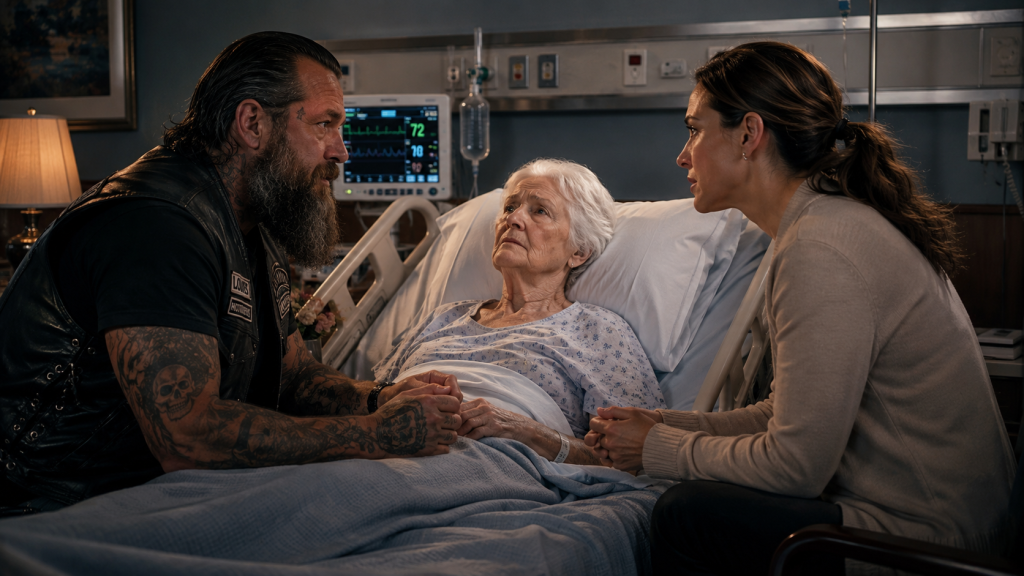
Beside my mother’s bed sat the largest man I had ever seen.
He wore a black leather vest over a dark T-shirt. His arms were thick, tattooed from wrist to shoulder. More ink climbed up his neck and disappeared beneath a beard that reached his chest.
A silver chain hung from his belt. His boots looked heavy enough to crack tile.
And there he was, carefully feeding my mother chicken soup from a porcelain bowl.
He held the spoon like it was made of glass.
“Small sip, Miss Margaret,” he said in a low, gentle voice. “Don’t rush.”
My mother smiled at him.
Not politely.
Not nervously.
She smiled like he was the best thing that had happened to her in years.
“Mom,” I said slowly.
Her eyes moved to me.
For one second, guilt crossed her face.
Then she lifted her chin.
“Anna. You’re home early.”
“Can I speak with you? Alone?”
The biker didn’t even glance up.
He simply wiped the corner of Mom’s mouth with a napkin and stood.
“I’ll be in the garden, Miss Margaret.”
“Thank you, Louis,” Mom said softly.
Louis.
The name did not match the man.
Or maybe it did.
He walked past me with a respectful nod.
“Ma’am.”
The moment the door closed, I exploded.
“Have you lost your mind?”
Mother’s eyes narrowed.
“Lower your voice.”
“No. Absolutely not. You fired Brenda, the woman who cared for you for twelve years, and hired a man who looks like he just stepped out of a prison documentary?”
Her mouth tightened.
“Do not speak about him that way.”
“Mom, you don’t know him.”
“Yes,” she said. “I do.”
“How? From where?”
She turned her face toward the window.
“That is not your concern.”
“Not my concern? I pay the bills. I manage your medication. I arrange your care. I’m your daughter.”
“I know exactly who you are.”
Something in her tone stung me.
“Then act like it.”
She looked back at me.
“He is staying, no matter what. I want Louis to care for me.”
“Why?”
Her eyes filled with tears so suddenly that my anger faltered.
“Because I said so.”
That was all she would give me.
So Louis stayed.
At first, I watched him like a guard.
I checked the medicine bottles every morning. I counted the cash in Mom’s drawer. I inspected her skin for bruises. I asked neighbors if they saw anything strange.
But nothing was wrong.
In fact, everything improved.
Mom ate more.
She slept better.
She stopped staring at the ceiling for hours.
Louis rearranged her room so sunlight reached her bed in the mornings. He brought in flowers from the garden, even though half the stems were crooked and wild. He learned how she liked her tea, how thin she wanted her toast, how to position pillows beneath her knees so pain didn’t wake her.
He trimmed her nails with the concentration of a surgeon.
He brushed her hair every evening.
Sometimes I stood outside the door and listened.
Not because I wanted to spy.
Because I could not understand what I was hearing.
My mother laughed.
Really laughed.
A deep, breathless sound I had not heard since before the stroke.
Louis told her stories about long roads, desert sunsets, diners where waitresses called everyone honey, and stray dogs that followed motorcycles for miles.
Mom told him stories too.
At least, she did until I entered the room.
Whenever I walked in, their conversations stopped.
Just stopped.
Like a radio clicked off.
“What were you talking about?” I asked once.
Mom looked at Louis.
Louis looked at his hands.
“Nothing important,” she said.
But it was important.
I knew it was.
The secrecy grew around them like vines.
Sometimes, when Mom thought I was asleep, I heard Louis reading to her from old letters. Sometimes I heard her crying. Not pain crying. Memory crying.
Once, I found them holding hands.
Not romantically.
Something deeper.
Something older.
I hated that I was jealous.
I hated that this frightening stranger had found a door into my mother that I could not open.
Then everything changed on a Thursday morning in November.
I was at work when Louis called.
“Anna,” he said, his voice steady but tight. “Your mother had an attack. Ambulance is here. We’re going to St. Agnes.”
My knees weakened.
“What kind of attack?”
“She couldn’t breathe right. Her eyes rolled back. I stayed with her. She’s conscious now.”
“I’m coming.”
By the time I reached the hospital, Mom was in a bed with wires on her chest and oxygen under her nose. Her skin looked paper-thin. Her white hair fanned across the pillow like snow.
Louis sat beside her.
His enormous hand wrapped around hers.
He looked as if he had not moved since arriving.
The doctor said it was a complication of her illness, not anyone’s fault. Her body was tired. Her lungs were weak. These episodes could happen.
But grief and fear do not care about medical explanations.
I needed someone to blame.
So I blamed Louis.
He sat there too naturally. Too close. Too calm.
As if he belonged.
As if he were family.
As if he were her son.
When Mom finally fell asleep, I turned to him.
“I want you to quit.”
He looked up.
“No.”
“I’ll pay you triple.”
His face did not change.
“No.”
“She doesn’t need this stress.”
“You’re right,” he said quietly. “She doesn’t.”
That made me angrier.
“Then leave.”
Louis studied my face for a long moment.
There was no anger in his eyes. That made it worse.
He stood and walked out of the room.
I followed him.
“Louis.”
He kept walking.
“Louis, don’t you walk away from me.”
He pushed through the hospital doors into the cold evening air.
I followed him outside, my coat unbuttoned, my breath fogging in front of me.
He stopped near the ambulance bay.
Orange lights flashed across his face.
For the first time since I had met him, his hands trembled.
“It’s time you knew the truth,” he said. “She asked me to keep silent, but I can’t do that anymore.”
My heart dropped.
“What was she hiding?”
Louis looked toward the hospital windows.
Then he reached into the inside pocket of his vest and pulled out a small envelope, yellowed with age.
He held it carefully.
Like it might break.
“Your mother isn’t just my patient,” he said.
I stared at him.
“She’s my mother too.”
The world tilted.
For a moment, the sounds of the hospital faded away.
The ambulance engine.
The sliding doors.
The distant voices.
Everything became hollow.
“What did you say?”
Louis swallowed.
“She gave birth to me when she was sixteen.”
“No.”
“She named me Louis Michael.”
“No.”
“Her father forced her to give me up. He told her she had sinned, that she had shamed the family, that no decent man would marry a girl with a baby.”
“Stop.”
“She held me for two days before they took me away.”
I stepped back.
The cold air hit my face, but I could not feel it.
“My mother would have told me.”
“She wanted to.”
I shook my head.
“No. She would have told me.”
Louis opened the envelope and took out a faded photograph.
My mother was in it.
Young. Almost unrecognizable.
Her hair was dark and long. Her cheeks were wet with tears. In her arms was a newborn wrapped in a blue blanket.
The baby’s face was turned toward her chest.
On the back, written in my mother’s unmistakable handwriting, were the words:
My first son, Louis. Please forgive me.
My fingers went numb.
I looked at the photo until it blurred.
“No,” I whispered.
“I found her two years ago,” Louis said. “An adoption search group helped me. I had her name, the hospital, the date. At first, she refused to see me.”
I looked up.
“Why?”
“She thought I hated her. She thought I had come to ask why she gave me away.”
“Did you?”
His eyes shone.
“Yes.”
“And what did she say?”
He looked down at the pavement.
“She said, ‘Because I was a child, and no one let me be your mother.’”
My throat closed.
All my life, I had thought I knew the shape of my mother’s sorrow.
My father leaving.
The stroke.
The loneliness.
The bed.
But there had been another grief underneath it all.
A child-shaped grief.
Older than me.
Older than my entire life.
“Why didn’t she tell me?” I asked.
Louis smiled sadly.
“She was afraid.”
“Of what?”
“Of losing you.”
I almost laughed, but it came out broken.
“She thought I would leave her because she had a baby before me?”
“No,” Louis said. “She thought you would hate her for keeping me secret. She thought you would think your whole life was built on a lie.”
I looked back at the hospital window.
Behind that glass, my mother slept with oxygen beneath her nose, carrying sixty-four years of silence in her chest.
“Why did she fire Brenda?” I whispered.
Louis’s jaw tightened.
“Because Brenda found the adoption papers.”
I turned sharply.
“What?”
“She was cleaning out the bottom drawer of Miss Margaret’s dresser. She found the letters, the photo, the documents. Your mother begged her not to say anything.”
“Brenda called me crying.”
“She didn’t just find them,” Louis said. “She threatened to tell the church before your mother was ready.”
I stared at him.
“Brenda wouldn’t do that.”
“I wish that were true.”
His voice was calm, but the pain in it was real.
“She told your mother it was shameful. Said people deserved to know the truth if a strange biker was coming in and out of the house. Said she could not be party to deception.”
I thought of Brenda’s lavender perfume, her hymns, her folded hands, her gentle voice.
Then I remembered something else.
The way Mom had sometimes stiffened when Brenda prayed too loudly.
The way Brenda called Mom stubborn when Mom refused visitors.
The way she once told me, “Your mother carries old secrets. Secrets are heavy things.”
I had smiled politely then.
Now, my stomach turned.
“Louis,” I said, and my voice cracked. “I didn’t know.”
“I know.”
“I was awful to you.”
“Yes,” he said.
The honesty hurt, but I deserved it.
Then his expression softened.
“But you were scared for your mother. I understand that.”
Before I could answer, the hospital doors slid open behind us.
A nurse stepped out.
“Family for Margaret Harlow?”
We both turned.
“She’s awake,” the nurse said. “And she’s asking for both of her children.”
Both.
The word went through me like lightning.
Louis closed his eyes.
I watched his face crumple for one second before he pulled himself together.
Inside the room, Mom looked smaller than ever.
Her eyes moved from Louis to me.
She knew.
Of course she knew.
Mothers always know when secrets have escaped the room.
“Anna,” she whispered.
I stood at the foot of her bed, holding the old photograph.
My hands shook so badly the paper fluttered.
“Is it true?”
Tears filled her eyes.
“Yes.”
The word was barely sound.
I felt like a little girl again, standing in the kitchen after breaking a vase, waiting for my mother to explain why the world had suddenly become dangerous.
“You had a son.”
She nodded.
“Before me.”
Another nod.
“And you never told me.”
Her mouth trembled.
“I wanted to.”
“When?”
She looked away.
“When you were old enough. When you were married. When your father left. When I got sick. Every year, I told myself I would tell you before Christmas. Then before my birthday. Then before I died.”
“Why didn’t you?”
She closed her eyes.
“Because every time I tried, I became sixteen again.”
Louis sat down slowly beside her bed.
Mom reached for him.
He took her hand.
“I was a coward,” she whispered.
“No,” he said.
“Yes,” she insisted. “I let fear steal years from all of us.”
I wanted to be angry.
Part of me was.
I wanted to shout that I had spent decades believing we were only two women left after my father abandoned us. I wanted to ask how many times she had looked at me and remembered another child. I wanted to know if I had been a replacement, a second chance, a daughter born into the shadow of a son I never knew existed.
But then I looked at her.
Not as my mother.
As a girl.
Sixteen.
Afraid.
Bleeding.
Holding a baby she was not allowed to keep.
The anger did not disappear.
It changed shape.
It became grief.
“Did you look for him?” I asked.
Mom nodded, tears sliding down her temples.
“For years. Quietly. I wrote letters I never sent. I saved every dollar I could. When your grandfather died, I tried the adoption agency. Records were sealed. Later, I hired someone, but they found nothing.”
Louis squeezed her hand.
“I found you, Mama.”
Mama.
The word broke something open in the room.
Mom covered her mouth with her weak hand and sobbed.
I had never heard my mother sob like that.
Not when Dad left.
Not when the stroke came.
Not when she realized she would never walk again.
This was a lifetime of crying delayed until her body could no longer hold it.
Louis leaned forward and rested his forehead against her hand.
“I found you,” he repeated.
I turned away because I felt like I was witnessing something sacred.
Something I had no right to interrupt.
But then Mom reached toward me.
“Anna.”
I stepped closer.
“I was afraid you’d think I loved him more because I lost him first.”
That sentence pierced me.
I sat on the edge of her bed.
“Did you?”
Her eyes widened with pain.
“No. Love doesn’t divide like cake. It grows rooms. I had a room for him that never closed. And I had a room for you that kept me alive.”
I covered my mouth.
“I wish you had trusted me.”
“I know.”
“You let me treat him like a stranger.”
“I know.”
“You let me think Brenda was the victim.”
Her face hardened slightly.
“Brenda was kind to my body. Not always to my soul.”
That was the first time I understood.
Care is not just changing sheets.
Care is not just medicine and schedules.
Care is dignity.
Care is knowing when silence is protection and when it becomes a prison.
“I’m sorry,” Mom whispered.
I took her hand.
Her fingers were thin and cool.
“I’m angry,” I said.
She nodded.
“I deserve that.”
“But I’m still here.”
Her face crumpled.
“And Louis?”
I looked at him.
This enormous man with tattooed hands, wet eyes, and a child’s hope hidden behind a biker’s beard.
“I think,” I said slowly, “I have a brother.”
Louis stared at me.
Then he looked down, and his shoulders shook.
He tried to hide it.
He failed.
A week later, Mom came home.
Not better.
Not cured.
But lighter.
Something inside her had unclenched.
The house changed.
Not all at once.
Slowly.
Louis still cared for her during the day, but now I stopped watching him like an intruder.
I watched him like family.
Awkward family.
Unexpected family.
Family with leather boots by the door and a motorcycle that made the windows tremble when it started.
He learned how I liked my coffee.
I learned that he hated peas, loved old country music, and had three grandchildren in Ohio.
He showed me photographs of his adoptive parents, a kind couple who had loved him fiercely. He spoke of them with gratitude, never bitterness. That made me respect him more.
“They were my parents too,” he told me. “Finding Margaret didn’t erase them.”
One evening, I found Mom and Louis in her room with a box of old letters between them.
This time, when I entered, they did not stop talking.
Mom patted the chair beside her bed.
“Sit, Anna.”
So I did.
She handed me a letter.
It was dated forty-two years earlier.
My dear son,
I do not know your name now. I do not know if they kept the one I gave you. I do not know if you are happy, if you are warm, if someone kisses your forehead when you cry.
I am told I must forget you.
But I won’t.
Not ever.
I read the letter three times.
The paper blurred.
“How many are there?” I asked.
Mom gave a tiny smile.
“One for every birthday.”
Louis looked away.
I reached across the bed and placed the letter in his lap.
“They’re yours.”
He shook his head.
“They’re ours.”
That was the beginning.
Not of a perfect family.
Perfect families are mostly photographs and lies.
We were something messier.
Better.
Real.
There were hard conversations.
There were questions Mom could not answer without crying.
There were moments when I felt cheated by the secret, and moments when Louis felt cheated by the years.
There were days when Mom apologized too much.
There were days when neither of us let her.
Brenda came by once.
She stood on the porch with a casserole dish and red eyes.
“I heard Margaret was home,” she said.
I did not invite her in.
“She is resting.”
Brenda looked past me into the hallway.
“I cared for her for twelve years.”
“I know.”
“I loved her.”
“Maybe,” I said. “But love without respect can still wound.”
Her lips tightened.
“I was trying to protect her reputation.”
“No,” I said. “You were protecting the version of her that made you comfortable.”
She flinched.
I took the casserole gently from her hands.
“I’ll tell her you came.”
Then I closed the door.
Later, Mom asked who it was.
“Brenda.”
Her expression changed.
“Did she want to come in?”
“Yes.”
“Did you let her?”
“No.”
Mom was quiet.
Then she said, “Thank you.”
Three months later, on Mom’s eighty-second birthday, Louis brought his motorcycle club to the house.
I nearly fainted when six enormous bikers pulled into the driveway carrying balloons, flowers, and a cake shaped like a teapot.
Mom insisted on sitting by the window.
She wore lipstick for the first time in years.
Louis rolled her bed slightly so she could see everyone.
One by one, the bikers came inside and removed their caps like schoolboys.
“Happy birthday, Miss Margaret,” they said.
Mom laughed until she coughed.
I stood in the doorway watching this strange parade of leather, tattoos, tenderness, and devotion.
Then Louis placed a small gift in her lap.
Inside was a silver locket.
On one side was a picture of him as a baby.
On the other was a picture of me at six years old, missing both front teeth.
Mom pressed it to her lips.
“My children,” she whispered.
Not my secret.
Not my loss.
My children.
That night, after everyone left, I sat beside her bed.
Louis was in the kitchen washing cake plates, humming badly.
Mom looked tired, but peaceful.
“Anna,” she said.
“Yes?”
“Are you still angry with me?”
I thought about lying.
But we had wasted enough years protecting each other with lies.
“Sometimes.”
She nodded.
“I understand.”
“But I love you.”
Her eyes filled.
“And I love you.”
I looked toward the kitchen.
“And I’m learning to love him too.”
A tear slid down her cheek.
“You don’t have to.”
“I know.”
That was the gift.
No one forced me.
No one demanded instant forgiveness.
Love was allowed to arrive slowly, with questions, with pauses, with room to breathe.
Mom lived nine more months.
They were not easy months.
Her illness continued. Her body weakened. Some days she could barely speak. Some nights Louis and I took turns sitting awake, listening to every breath.
But those nine months were also full of things I never expected.
Stories.
Photographs.
Music.
Laughter.
Truth.
Louis called her Mama every day.
I called him my brother for the first time at a pharmacy counter when the clerk asked if we were related.
“He’s my brother,” I said, before I had time to overthink it.
Louis pretended to study a shelf of cough drops.
But I saw him wipe his eyes.
On Mom’s last morning, rain tapped softly against the windows.
Louis sat on one side of the bed.
I sat on the other.
Mom’s hands rested in ours.
She looked from him to me.
“My first baby,” she whispered.
Then to me.
“My last baby.”
Her breathing grew shallow.
“I got to have you both,” she said. “At the end, I got to have you both.”
Those were her last clear words.
She passed just before sunset.
Peacefully.
With both of her children holding her hands.
At the funeral, Louis stood beside me.
Some people stared.
Let them.
Brenda sat in the third row, crying quietly.
The pastor spoke about forgiveness, hidden burdens, and grace.
But I barely listened.
I was looking at the photograph near Mom’s casket.
Not the formal church portrait I had chosen at first.
A newer one.
Mom in bed, laughing, with me on one side and Louis on the other.
His tattooed hand rested gently on her blanket.
My hand rested over hers.
For once, nothing was hidden.
After the burial, Louis and I stood together beneath a maple tree.
He looked at the fresh earth.
“I had sixty-four years without her,” he said. “Nine months wasn’t enough.”
“No,” I said. “It wasn’t.”
“But it was something.”
I took his hand.
“Yes. It was something.”
He squeezed my fingers carefully, as if still afraid I might pull away.
I didn’t.
A year later, I still sometimes hear his motorcycle before I see him.
Every Sunday afternoon, he comes to my house for dinner.
He brings flowers for Mom’s old room, even though the bed is gone now.
Sometimes we cook from Grandma’s blue notebook.
Sometimes we sit on the porch and talk about her.
Not as a saint.
Not as a liar.
As a woman.
A girl who lost a baby.
A mother who carried a secret until it nearly crushed her.
A human being who made mistakes and still deserved to be loved in truth.
I used to think family was the people whose stories you already knew.
Now I know better.
Sometimes family is the stranger beside a hospital bed.
Sometimes family arrives on a motorcycle, covered in tattoos, holding an old photograph that changes everything.
Sometimes the person you fear is taking your mother away is the missing piece she has been praying to find.
And sometimes, when the truth finally comes out, it does not destroy the family you had.
It makes room for the family that was waiting all along.
THE END! THANK YOU FOR READING!