

Her husband introduced his mistress at a family lunch without realizing his wife had a document in her handbag that could save them from financial ruin. “If she is truly the woman who belongs beside you, then let her sign today and rescue your family.”
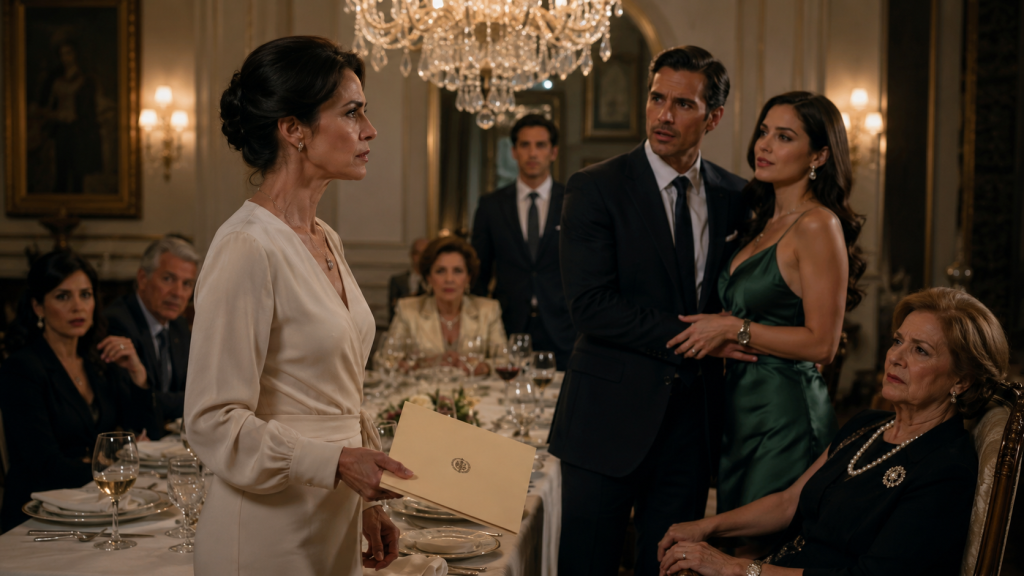
Mariana López’s words fell across the dining room like a wineglass shattering against the marble floor. No one moved. Not Santiago Arriaga, her husband, who still stood with one hand resting on Renata’s waist — the woman he had just introduced to everyone as “someone who actually knew how to behave in society.”
Not Doña Beatriz, his mother, seated at the head of the table with pearls tight around her neck and a gaze filled with polished cruelty.
Not the cousins, the uncles, or the servants moving in and out with plates of chile en nogada and glasses of white wine inside that enormous house in Lomas de Chapultepec.
Mariana did not shout.
She did not cry.
She did not cause a scene.
She simply placed her napkin neatly on the table, looked at Santiago, and waited.
Only minutes earlier, he had lightly tapped his glass with a knife to get everyone’s attention.
“I know this may feel uncomfortable,” he said, barely looking at Mariana, “but this family needs maturity. Renata understands the world we live in. She has presence, class, ease. Qualities that… well, have been missing for years.”
Renata lowered her eyes as if embarrassed, but her smile told another story.
Mariana felt her fingers grow cold.
For nine years, she had endured insults disguised as advice.
“Dress better.”
“Don’t talk about numbers at the table.”
“Let Santiago handle the business.”
“An elegant wife knows how to stand beside her husband without getting in the way.”
Those words had followed Mariana through every hallway of the Arriaga mansion.
They had slipped into Sunday lunches, Christmas dinners, charity galas, business receptions, even ordinary breakfasts where Doña Beatriz would look over Mariana’s simple blouse and sigh as though poverty had entered the room wearing perfume.
Mariana had married Santiago when he still smiled with warmth.
Back then, he had seemed different from his family.
He would take her hand beneath restaurant tables and whisper that her calmness grounded him.
He had admired the way she understood contracts, cash flow, and numbers.
When Mariana’s father, a careful businessman from Guadalajara, passed away, he left her not only land and properties but a lesson carved into her heart.
“Never let anyone make you feel small because you are quiet,” he had told her. “Quiet women hear everything.”
Mariana heard everything.
She heard when Doña Beatriz told guests that Santiago had married “beneath expectation but above disaster.”
She heard when cousins joked that Mariana looked more like the accountant than the wife.
She heard when Santiago began answering her ideas with impatience.
“You think too much.”
“You always make things complicated.”
“My family understands these matters better than you.”
At first, Mariana argued.
Then she explained.
Then she defended herself.
And finally, she became silent.
Not weak.
Not defeated.
Silent.
There was a difference.
Three months before that Sunday lunch, Santiago had come home late with worry pressed into his face.
Grupo Arriaga, the family’s construction and hospitality company, was drowning in debt.
A luxury hotel project in Valle de Bravo had stalled.
A real estate partner had withdrawn.
Suppliers were demanding payment.
Banks had stopped smiling.
For the first time in years, Santiago had come to Mariana’s room.
They had not slept in the same bedroom for nearly eight months by then.
He stood at the door, tie loosened, eyes red from stress.
“Mariana,” he said, using her name softly, like he still remembered how to be kind. “I need your help.”
She looked up from the book in her lap.
“What kind of help?”
He walked in slowly.
“The company needs a guarantee. Just temporary. A bridge restructuring. The bank wants confidence.”
Mariana closed the book.
“Your mother said I should never talk about numbers.”
His jaw tightened.
“This is not the time.”
“No,” Mariana said. “It is exactly the time.”
He exhaled, rubbed his face, and sat on the edge of the chair across from her.
“For God’s sake, Mariana. Hundreds of employees depend on us.”
That was the first honest thing he had said in months.
So she listened.
Over the next two weeks, Mariana reviewed balance sheets that Santiago had never bothered to show her before.
She found careless spending, inflated family withdrawals, unpaid taxes, hidden loans, and a terrifying dependence on appearances.
The Arriagas looked rich because they had spent years pretending that pride was the same as money.
Still, the company could be saved.
Not easily.
Not without sacrifice.
But it could be saved.
Mariana contacted Arturo Salinas, a bank manager who had known her father.
She offered a limited guarantee secured by two inherited properties in Guadalajara, but only under strict conditions.
No more family withdrawals without board approval.
A repayment schedule monitored by the bank.
A temporary freeze on nonessential luxury expenses.
And Santiago would sign a marital asset separation agreement confirming that Mariana’s inherited estate could not be touched by Arriaga family creditors beyond the specific guarantee she approved.
Arturo agreed.
The bank agreed.
The lawyer prepared the documents.
The final signature meeting was scheduled for Sunday afternoon after lunch at the Arriaga mansion because Doña Beatriz insisted important things should happen “at home, under family eyes.”
Santiago knew there would be a meeting.
He knew Mariana had to attend.
He never asked why.
To him, she was part of the furniture — useful, quiet, always available.
That Sunday, Mariana dressed carefully.
Not in the sparkling clothes Doña Beatriz preferred, but in an ivory dress her father once said made her look like herself.
She placed the beige folder inside her black handbag.
Before leaving, she stood in front of the mirror for a long moment.
She was thirty-eight years old.
Still beautiful, though sadness had sharpened her face.
Her dark hair was pinned neatly at the back of her neck.
Her eyes held the tired dignity of a woman who had survived humiliation without becoming cruel.
She whispered to her reflection, “One last time.”
She meant one last time saving them.
One last time entering that house as if she needed permission to exist.
One last time allowing Santiago to decide how much of her dignity he could borrow.
When she arrived, the family was already gathered.
Doña Beatriz sat like a queen beneath the chandelier.
Santiago was speaking with Uncle Ernesto near the bar.
And beside him stood Renata.
Young.
Elegant.
Expensive.
She wore a pale green dress, diamond earrings, and the relaxed smile of someone who had been promised a place that did not belong to her.
Mariana knew immediately.
Women always know before men confess.
It is in the way a husband does not turn fast enough.
It is in the silence between greetings.
It is in the mistress’s careful sweetness.
Santiago came forward.
“Mariana,” he said, too formally. “You made it.”
“As requested.”
His eyes flicked to her handbag.
“Good.”
Not “you look lovely.”
Not “thank you for coming.”
Just “good.”
Doña Beatriz kissed the air beside Mariana’s cheek.
“Mariana, dear. I hope you wore something appropriate for later. Arturo Salinas is very traditional.”
Mariana smiled faintly.
“My signature will be appropriate.”
Doña Beatriz’s brow tightened, but she said nothing.
Lunch began with the practiced elegance of wealthy families hiding disaster.
The table was covered with linen, silver, crystal, and flowers arranged so perfectly they looked afraid to breathe.
Servants moved silently.
Conversation floated above the room like perfume.
No one mentioned the debt.
No one mentioned the frozen accounts.
No one mentioned that half the jewelry in the room was probably already pledged against loans.
They spoke of weddings, club memberships, vacations, and political rumors.
Renata laughed at everything Santiago said.
Sometimes she touched his sleeve.
Sometimes he let his hand rest too long near hers.
Mariana ate slowly.
She watched.
She listened.
Then Santiago tapped his glass with a knife.
The room fell quiet.
He stood.
Renata stood beside him.
Mariana felt something inside her go very still.
“I know this may feel uncomfortable,” Santiago began, his voice rehearsed, “but this family needs maturity.”
Mariana looked at him.
He did not look back.
“Renata has become important to me,” he continued. “She understands the world we live in. She has presence, class, ease. Qualities that… well, have been missing for years.”
A few people looked down.
Doña Beatriz lifted her chin.
Renata lowered her eyes, pretending shame while enjoying triumph.
Santiago finally looked at Mariana.
“I don’t want conflict. I want honesty. We can settle things privately, with dignity.”
Dignity.
The word almost made Mariana laugh.
He had brought his mistress to a family lunch, announced her like an upgrade, and then asked the wife he humiliated to provide dignity.
For nine years, Mariana had swallowed insults to protect peace.
But peace without respect was only silence wearing a polite dress.
She placed her napkin on the table.
She looked at Santiago’s hand resting on Renata’s waist.
Then she spoke.
“If she is truly the woman who belongs beside you, then let her sign today and rescue your family.”
The room froze.
Santiago’s face changed first.
Confusion.
Then irritation.
Then fear.
“Don’t start with the drama,” he said. “You’re only doing this because you felt attacked.”
Mariana’s voice remained calm.
“I felt described by all of you for far too long.”
Doña Beatriz set her glass down.
“Mariana, don’t forget where you are.”
“I know exactly where I am,” she replied. “I am sitting at the table where I was asked to save a company while my husband introduced me to his mistress.”
Uncle Ernesto lowered his eyes.
Someone swallowed hard.
Renata let out a short laugh.
“How convenient. Now suddenly you’re indispensable?”
Mariana opened her handbag, took out the beige folder, and placed it beside her plate.
The sound of paper touching wood was louder than all the humiliations that had come before it.
“Not indispensable,” she said. “Just the person you should never have treated as invisible.”
Santiago stepped toward her.
“Sit down. We’ll talk about this later.”
Mariana slowly stood.
“Later was before you brought her to my table.”
She picked up her handbag, leaving the folder closed beside her plate.
Then she walked toward the exit without looking back.
No one stopped her at first.
They were too shocked.
The heels of her shoes clicked against the polished floor.
In the foyer, the doorman opened the door for her with more respect than that family had shown her in years.
Just as she stepped onto the first stair, a gray car stopped in front of the entrance.
Arturo Salinas got out, followed by a lawyer carrying a briefcase.
“Mrs. Mariana,” Arturo said with relief. “Thank goodness you are still here. Without your signature, the restructuring of the eighty million cannot move forward.”
Behind her, Santiago went pale.
Doña Beatriz appeared in the hallway.
Renata’s smile disappeared.
Mariana turned slowly.
The afternoon sun fell across her face.
For the first time in years, the Arriaga family looked at her not as decoration, not as inconvenience, not as Santiago’s quiet wife.
They looked at her as the door between them and ruin.
Arturo sensed the tension immediately.
“Is everything all right?”
Mariana looked at Santiago.
His mouth opened, but nothing came out.
Doña Beatriz moved forward with sudden warmth.
“Arturo, welcome. Please come in. We were just about to discuss everything.”
“No,” Mariana said.
One word.
Soft.
Final.
Doña Beatriz stopped.
Mariana walked back into the foyer, not because they had called her, but because she had chosen to return on her own terms.
The family gathered behind the dining room entrance.
Renata stayed beside Santiago, but her body had shifted away from him.
Arturo held the documents carefully.
The lawyer opened his briefcase.
“We prepared the final guarantee agreement,” he said. “Mrs. López’s inherited assets secure the restructuring facility, subject to the conditions previously agreed.”
Renata’s eyes widened.
“Inherited assets?”
Mariana looked at her.
“Yes. My assets.”
Santiago whispered, “Mariana, please.”
It was the first time he had said please all day.
Maybe all year.
She turned to Arturo.
“Before we continue, I want everyone in this room to understand what was about to happen. The bank was prepared to restructure eighty million pesos in debt because I agreed to guarantee part of the risk with property that has belonged to my family for generations.”
Doña Beatriz’s face tightened.
“That level of detail is unnecessary.”
“No,” Mariana replied. “Humiliation was public. Clarity can be public too.”
Uncle Ernesto gave a small nod, almost invisible.
Mariana continued.
“For months, this family has been hiding the collapse of Grupo Arriaga behind chandeliers, wine, and Sunday lunches. You have unpaid suppliers. Workers waiting for salaries. Loans stacked against loans. And while all of you laughed at my plain dresses and my interest in numbers, I was the only one reading the papers closely enough to understand how bad this had become.”
Santiago’s voice cracked.
“I was going to tell you properly.”
“You asked me for help when you needed my money. You introduced Renata when you thought you no longer needed my dignity.”
Renata stepped back.
“Santiago, you told me the company had temporary liquidity problems.”
Mariana looked at her calmly.
“Temporary problems do not require an eighty million peso restructuring.”
Renata turned to him.
“You said your family was stable.”
Doña Beatriz snapped, “Young lady, this is a private matter.”
Renata gave a bitter little laugh.
“Private? He introduced me at your table.”
For a moment, Mariana almost felt sorry for her.
Almost.
Renata had wanted luxury, position, a name.
Instead, she had been handed debt wrapped in linen.
Santiago reached for Mariana’s arm.
She stepped away before he touched her.
“Don’t.”
The word cut through him.
He dropped his hand.
“Mariana, I made a mistake.”
“No. A mistake is forgetting a birthday. This was a decision.”
His eyes filled with panic.
“I was confused. Under pressure. Renata doesn’t mean—”
Renata gasped.
Santiago stopped.
It was too late.
The entire room had heard him reduce her from grand love to negotiable inconvenience.
Mariana looked at Renata.
“That is what men like him do. First, they tell you that you are special. Then, when the cost becomes too high, they call you confusion.”
Renata’s face flushed.
She grabbed her purse from a chair.
“Santiago, do not call me.”
“Renata, wait—”
But she was already walking toward the door.
Doña Beatriz looked horrified, not because of the betrayal, but because the mistress had dared to leave first.
The front door closed.
The sound echoed through the mansion.
Now only the family remained.
No distraction.
No pretty young woman to blame.
Just the truth.
Arturo cleared his throat.
“Mrs. López, should we proceed?”
Mariana looked at the documents.
She thought of the employees.
The drivers, accountants, hotel cleaners, engineers, receptionists, cooks, and office assistants who had nothing to do with Santiago’s cruelty.
She thought of her father’s properties.
She thought of the years she had been told she did not belong.
Then she looked at Doña Beatriz.
The older woman’s expression had changed entirely.
Gone was the polished cruelty.
In its place was calculation.
“Mariana,” Doña Beatriz said, voice softened, “we are family.”
Mariana almost smiled.
Family.
The word had arrived exactly when money was needed.
“Do you remember,” Mariana asked, “what you told me at Christmas three years ago?”
Doña Beatriz stiffened.
“I say many things.”
“You said I was fortunate Santiago had not replaced me with a woman who understood his world.”
Silence.
Mariana continued.
“And today he tried.”
Doña Beatriz’s lips pressed together.
“That was unfortunate.”
“No,” Mariana said. “It was educational.”
Santiago stepped forward.
“I will end it. Right now. I swear. We can fix this. I’ll do anything.”
Mariana studied his face.
Once, she had loved him.
She remembered a younger Santiago buying flowers from a street vendor because he said roses from shops looked too proud.
She remembered him staying beside her at her father’s funeral, holding her hand while she wept.
She remembered believing they would build something gentle together.
But the man before her now did not want forgiveness.
He wanted rescue.
Those were not the same thing.
“You will still sign the marital separation agreement,” Mariana said.
Santiago nodded quickly.
“Yes. Anything.”
“And the company restructuring conditions stay in place. No withdrawals for family luxuries. No private payments. No covering personal expenses through company accounts. The bank monitors everything.”
Doña Beatriz looked outraged.
“You cannot dictate how this family lives.”
Mariana turned to her.
“I am not dictating how you live. I am deciding how I will risk my inheritance.”
Uncle Ernesto finally spoke.
“She is right, Beatriz.”
Doña Beatriz glared at him.
He looked tired.
“We all knew the spending was out of control. We let Santiago hide it because it was easier. If Mariana is willing to keep the company alive, then we follow her conditions.”
A murmur spread across the room.
For the first time, Doña Beatriz did not command it into silence.
Mariana turned to Arturo.
“I will sign only after one additional clause is added.”
The lawyer lifted his pen.
“What clause?”
Mariana looked at Santiago.
“If Santiago files for divorce, pursues a separation, transfers assets, or attempts to challenge my inheritance in any way, my guarantee is automatically withdrawn.”
Santiago’s face went white.
Doña Beatriz whispered, “You would trap him?”
Mariana shook her head.
“No. I am freeing myself from being trapped.”
Santiago swallowed.
“And us? What happens to us?”
Mariana met his eyes.
“There is no us. Not as you understand it.”
His face collapsed.
“I love you.”
The words fell between them, weak and late.
Mariana felt the old ache rise in her chest, but it no longer owned her.
“No, Santiago. You loved having a wife who absorbed your shame quietly. You loved knowing I would protect your name while you damaged mine.”
He had no answer.
The lawyer wrote the clause.
Arturo reviewed it.
Mariana read every word.
The family waited as if their lungs depended on the movement of her pen.
At last, she signed.
Not for Santiago.
Not for Doña Beatriz.
Not for the Arriaga name.
She signed because hundreds of innocent employees should not suffer for the arrogance of people who had never learned the cost of their own pride.
When she finished, she handed the pen back to the lawyer.
“The company has one chance,” she said. “Do not waste it.”
Arturo gathered the papers.
“We will file these immediately.”
Doña Beatriz sat down slowly, looking suddenly older.
Santiago remained standing, staring at Mariana as though seeing her for the first time.
But Mariana knew the truth.
He was not seeing her.
He was seeing what he had lost.
That evening, Mariana did not return to the bedroom she had occupied like a guest.
She drove to a quiet hotel in Polanco and requested a suite under her own name.
For the first time in years, no one asked where she was going.
No one criticized what she wore.
No one measured her worth against the shine of another woman’s earrings.
She ordered tea, removed her shoes, and stood by the window watching the city lights flicker awake.
Her phone rang seventeen times.
Santiago.
Doña Beatriz.
Uncle Ernesto.
Santiago again.
Then messages began arriving.
Please answer.
We need to talk.
My mother is upset.
Renata misunderstood.
I made a terrible mistake.
Mariana read none of them.
The next morning, she called a divorce attorney.
Not because she wanted revenge.
Revenge still ties you to the person who hurt you.
Mariana wanted distance.
Clean, legal, permanent distance.
Her lawyer advised patience.
“The guarantee clause gives you leverage,” he said. “Use it wisely.”
“I do not want his company,” Mariana replied. “I want my life.”
“Then we will recover it properly.”
Over the next weeks, the Arriaga family discovered what Mariana’s silence had protected them from.
The bank froze luxury withdrawals.
Company cars assigned to cousins were recalled.
A beach house rental paid through corporate accounts was canceled.
Doña Beatriz’s monthly “household allowance” was reviewed and reduced.
Uncle Ernesto resigned from two meaningless advisory roles.
Santiago spent his days in meetings with auditors, lawyers, and angry suppliers.
The family blamed Mariana at first.
Of course they did.
They called her cold.
Ungrateful.
Manipulative.
One cousin posted vague messages online about “women who destroy families when they cannot control men.”
Mariana did not respond.
Three days later, the same cousin’s consulting payments were flagged by the bank and stopped.
The post disappeared.
Renata did not return.
Rumor said she had moved on to a businessman in Monterrey.
Santiago sent flowers to Mariana’s hotel every morning for nine days.
She donated them to the lobby.
On the tenth day, the flowers stopped.
Then came a letter.
Not a message.
Not a call.
A handwritten letter.
Mariana almost threw it away, but something made her open it.
Mariana,
I do not know how to apologize without sounding like I am asking for something. Maybe that is because most of my apologies have been requests in disguise.
You were right.
I did not see you.
Or worse, I saw you and chose not to value you because valuing you would have forced me to admit how weak I had become.
Renata was not love. She was applause. She made me feel important when I knew I was failing.
That does not excuse anything.
My mother taught me that image was survival. I believed her. I became exactly what she raised me to be.
I am sorry.
Not because the company almost collapsed.
Not because you saved us.
Because you sat beside me for years while I let my family make you smaller, and I called your silence peace.
I do not ask you to come back.
I only wanted, once, to tell the truth without asking you to rescue me from it.
Santiago.
Mariana folded the letter.
For a long time, she sat still.
Then she placed it in a drawer.
Some apologies arrive too late to change the ending, but not too late to confirm the wound was real.
Six months later, Grupo Arriaga was still alive.
Smaller.
Stricter.
Less glamorous.
But alive.
Several family members had been removed from payroll.
The Valle de Bravo project had been sold to cover debts.
Employees were paid.
Suppliers were repaid in installments.
The mansion in Lomas de Chapultepec became quieter.
Doña Beatriz stopped hosting Sunday lunches.
There was nothing left to display.
Mariana moved into a sunlit apartment overlooking a park.
She filled it with books, plants, and photographs of her father.
No marble floors.
No crystal chandeliers.
No portraits of ancestors staring down with judgment.
Only peace.
One afternoon, Arturo Salinas invited her to lunch to discuss the final bank review.
“The company is stabilizing,” he said. “Your conditions saved them.”
Mariana stirred her coffee.
“The employees saved the company. I only stopped the family from bleeding it dry.”
Arturo smiled.
“Your father would have been proud.”
Mariana looked out the window.
For the first time in a long while, hearing her father mentioned did not hurt.
It steadied her.
Later that week, Santiago came to see her.
He waited in the lobby of her building, holding no flowers, no jewelry, no dramatic gifts.
Just an envelope.
Mariana agreed to meet him in the public sitting area downstairs.
He looked thinner.
Older.
Humbled, perhaps.
But Mariana no longer mistook humility for transformation.
“Thank you for seeing me,” he said.
She nodded.
“What do you need?”
The question seemed to wound him, but he accepted it.
“I signed the divorce agreement.”
He handed her the envelope.
“No challenge to your inheritance. No claim against your properties. No delays.”
Mariana took it.
“Good.”
He looked down.
“My mother wanted me to fight.”
“I know.”
“I told her no.”
“That is also good.”
He gave a sad smile.
“She says you changed.”
Mariana shook her head.
“No. I returned.”
Santiago looked at her then, really looked.
Perhaps he understood.
Perhaps he only understood what loss felt like.
Either way, it no longer mattered.
“I hope one day you forgive me,” he said.
Mariana considered him carefully.
“I hope one day you become someone who does not need forgiveness from every woman who loved you.”
His eyes lowered.
He nodded.
Then he left.
Mariana watched him walk through the glass doors and into the afternoon.
There was no triumph in her chest.
No dramatic satisfaction.
Just a quiet opening, like a window after a storm.
A year after that terrible Sunday lunch, Mariana received an invitation printed on thick cream paper.
Doña Beatriz Arriaga requested her presence at a charity dinner.
Mariana stared at the invitation for a full minute.
Then she laughed.
Not bitterly.
Honestly.
She placed it in the recycling bin.
That evening, she hosted dinner at her apartment.
Not for society.
Not for appearances.
For people she actually loved.
Her old college friend Elena came with her husband.
Arturo and his wife attended.
Uncle Ernesto arrived too, carrying a bottle of wine and an expression of sheepish gratitude.
“I hope I’m welcome,” he said.
Mariana opened the door wider.
“Only if you talk about something other than business.”
He smiled.
“I will try.”
They ate at a wooden table that seated eight.
No servants moved silently.
No pearls tightened around anyone’s throat.
No one introduced a mistress.
No one insulted a woman and called it honesty.
They laughed.
They passed plates by hand.
When someone spilled wine, Mariana handed them a towel and laughed with everyone else.
Later, as the guests left, Elena stayed behind to help gather dishes.
“You look different,” Elena said.
Mariana glanced at her.
“Older?”
“No. Lighter.”
Mariana smiled.
“I think I finally stopped carrying a family that never carried me.”
Elena touched her arm.
“That is not easy.”
“No,” Mariana said. “But it is possible.”
After Elena left, Mariana stood alone in her quiet apartment.
She opened the window.
Warm city air drifted in.
Somewhere below, cars moved through the night.
A dog barked.
Someone laughed on the sidewalk.
Life continued, ordinary and beautiful.
Mariana walked to her desk and opened the drawer where Santiago’s apology letter still lay.
She read it once more.
Then she took out a small wooden box, placed the letter inside, and closed the lid.
Not to preserve him.
To preserve the proof that she had survived that chapter.
On the top shelf of her bookcase sat a framed photograph of her father.
Mariana touched the frame gently.
“You were right,” she whispered. “Quiet women hear everything.”
Then she smiled.
Because quiet women also know when to leave.
And when Mariana López finally walked away from the Arriaga family, she did not leave empty-handed.
She left with her inheritance protected.
Her dignity restored.
Her future untouched.
And the knowledge that the people who once treated her as invisible had learned, far too late, that she had always been the strongest person in the room.
THE END! THANK YOU FOR READING!