

My daughter-in-law looked me directly in the eyes and said, “My entire family is coming here for Christmas. It’s only around twenty-five people.” I smiled and replied, “Wonderful. I’ll be away for a few days. Since you decided to host, you can take care of the cooking and cleaning too. I’m not interested in being treated like hired help inside my own home.”
She stared at me, completely speechless. And in that moment, she realized the real Christmas surprise had not arrived yet. At 6:18 p.m. that Tuesday, the neighborhood looked like something from a holiday card. Porch lights glowed in the winter dark.
Plastic reindeer rocked in the wind.
The community mailboxes stood beneath the streetlamp like silent witnesses waiting for the next piece of gossip.
Inside my kitchen, roasted chicken, lemon cleaner, and a cooling chocolate pie filled the air.
I had baked it because my grandchildren still believed Christmas meant coming to Grandma’s house.
The refrigerator hummed behind me.
Warm air drifted from the vents.
A small American flag magnet my late husband had placed on the fridge years earlier still hung crooked, exactly where he had left it.
Then Tiffany walked in as if the house had already become hers.
Her heels clicked sharply against the kitchen tile.
Without asking, she set her phone beside my grocery bags.
Her makeup was flawless.
Her hair was perfect.
She wore the same polished smile she always used when she was about to volunteer my labor and call it family tradition.
“I’m glad you’ve already started getting ready,” she said.
I put down the dish I was holding.
“Getting ready for what?”
She sat on one of the stools and began listing names.
Her sister Valeria.
The kids.
Uncle Alex.
Cousins.
Nieces.
Nephews.
And a few family friends who supposedly had nowhere to spend Christmas.
Then she looked around at the decorations, the spotless counters, and the pie on the rack.
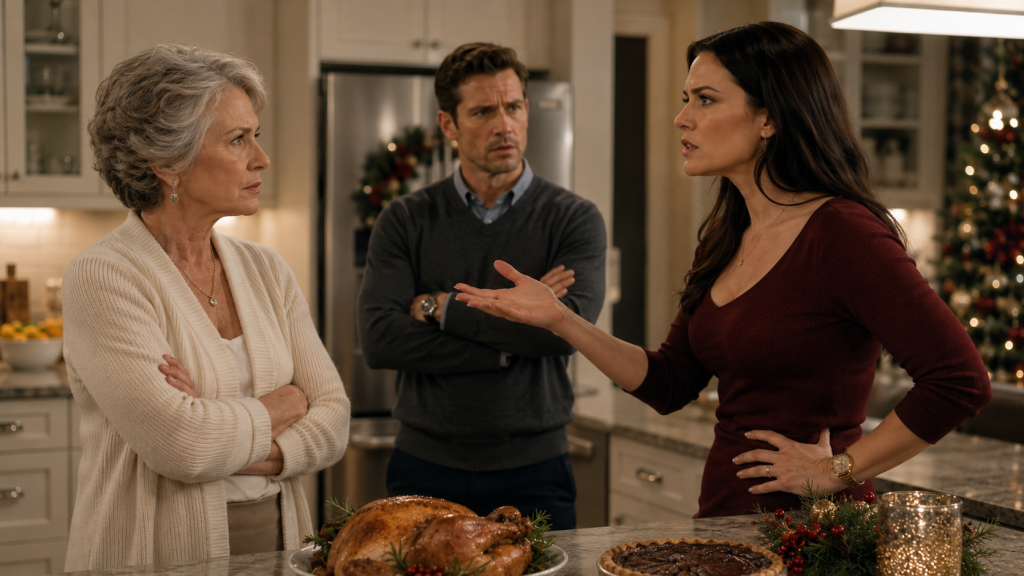
“My whole family is spending Christmas here,” she announced. “It’s only twenty-five people.”
Only.
That word irritated me more than the number itself.
For years, I had been the person quietly doing everything.
I woke first to brew coffee.
I washed dishes while everyone else rested.
I packed leftovers, bought extra groceries, washed towels, changed sheets, scrubbed bathrooms, and smiled every time Tiffany handed me another empty serving dish without a single thank-you.
People do not become invisible in one moment.
It happens when they make themselves useful too many times.
“And what exactly are you expecting me to do?” I asked.
Tiffany looked annoyed that I had interrupted her arrangement.
“Well, the food, obviously,” she said. “Three turkeys. Your chocolate pie. The mashed potatoes Kevin likes. The green bean casserole. The breakfast casserole for the morning. And the house has to look good for pictures.”
For pictures.
Not for love.
Not for family.
For pictures.
People who never help often mistake service for love.
The moment you stop doing everything, they accuse you of being selfish.
I folded the dish towel neatly.
Then folded it once more.
My voice stayed even.
“You did not ask me,” I said. “You informed me. If you want to host, then you can host.”
Her face went still.
“Kevin won’t agree to that.”
I almost laughed.
After sixty-six years of paying bills, raising children, solving problems, burying my husband, and holding this family together, someone was standing in my kitchen as if my son had authority over my choices.
Then Tiffany leaned back and said what she had clearly believed all along.
“This will be our house someday anyway.”
The words sat between us like a dropped match.
My hand tightened around the dish towel.
“My house,” I said quietly.
She blinked.
“What?”
“This is my house. Your father-in-law and I bought it together. We paid for it. We repaired it. We raised Kevin here. I buried my husband from this house. And I am still very much alive inside it.”
Tiffany’s lips pressed into a thin line.
“I didn’t mean it like that.”
“Yes,” I said. “You did.”
Before she could answer, the garage door rattled open.
Kevin walked in holding a paper coffee cup, his work badge hanging from his belt.
He looked tired, the same way he always did after a long day.
His shoes squeaked across the tile.
Tiffany rushed toward him.
“Your mother refuses to help,” she said.
Kevin rubbed his forehead.
“Mom, it’s Christmas.”
“I am not refusing Christmas,” I said. “I am refusing to be assigned work without being asked.”
Tiffany folded her arms.
“We can’t afford catering. Everything is booked. I already told everyone it was handled.”
Kevin shifted uncomfortably.
Then he said something quietly that caught my attention.
“The apartment deposit wiped out our savings.”
Apartment deposit.
Another major decision I only heard about after it was already done.
And somehow, I was still expected to clean up the aftermath.
I looked at both of them beneath the kitchen lights.
Tiffany looked irritated.
Kevin looked trapped.
“Then maybe inviting twenty-five people to someone else’s home was not a very smart decision,” I said.
Neither of them answered.
The dishwasher clicked softly in the silence.
Outside, an inflatable Santa bumped against a neighbor’s porch railing.
Then Tiffany’s face changed.
It was not anger.
It was something colder.
Calculation.
“Fine,” she said. “We’ll figure something out.”
Their argument continued upstairs in low voices.
One door slammed.
Then another.
By 10:47 p.m., the house was so quiet I could hear the ice maker drop cubes into the freezer bin.
I sat on the edge of my bed and pulled a blue folder from the drawer beside me.
Bank statements.
Printed emails.
A leasing receipt.
Screenshots from county records.
For almost three weeks, I had been collecting information.
Not because I wanted a fight, but because Kevin’s numbers never matched Tiffany’s stories.
The deposit was real.
So were several unexplained transfers.
Valeria’s name appeared again and again in the emails.
Alejandro was connected to the holiday plans.
And Marco, the real estate contact Tiffany loved name-dropping to sound important, appeared in one message describing my property in a way that made my stomach tighten.
This was not confusion.
It was not stress.
It was not poor planning.
It was a strategy dressed up as family.
At 11:12 p.m., I opened my laptop at the kitchen table.
The screen cast a pale blue light across the room.
The refrigerator hummed nearby, and the little flag magnet reflected the glow from the door.
I started a new email.
Then I attached the first document.
Subject: Christmas Plans, The House, and the Missing Deposit.
Because Tiffany thought the only problem was that I refused to cook.
She had no idea what was coming next.
Then a floorboard creaked in the hallway behind me.
I turned slowly, expecting Kevin.
But Tiffany stood in the hallway wearing my late husband’s robe, her face pale in the laptop glow.
My late husband’s robe.
That gray flannel robe had hung on the back of my bedroom door since Harold died.
I had not worn it.
I had not washed it.
I had not moved it.
It still smelled faintly of cedar and the aftershave he wore every Sunday morning.
Seeing Tiffany wrapped inside it made something old and tender inside me go silent.
“What are you doing?” she asked.
I closed nothing.
Hid nothing.
“Sending the truth before you rewrite it.”
Her eyes dropped to the folder, then to the subject line.
For the first time since I had known her, that perfect smile disappeared.
“You went through our private business?”
“No,” I said. “I went through mine. My house. My bank statements. My county records.”
She stepped closer.
“You don’t understand. Kevin and I needed help.”
“Help is requested,” I replied. “This was planned.”
The floor creaked again, and Kevin appeared behind her, looking from me to the screen.
“Mom?”
I opened the email wider so he could see Valeria’s name, the leasing receipt, and Marco’s message describing my home as a future family asset.
Kevin’s face drained of color.
Tiffany whispered, “I was going to explain after Christmas.”
I looked at the decorations, the pie, the crooked flag magnet, and the house my husband and I had paid for with forty years of work.
Then I clicked send.
“No,” I said. “You were going to move in after Christmas.”
The email went to Kevin.
It went to my attorney.
It went to my financial adviser.
And, most importantly, it went to myself, where no one could delete it.
Kevin stepped toward the laptop.
“Mom, wait. What exactly is this?”
“It is what I have been asking myself for three weeks.”
Tiffany’s face tightened.
“You’re making this sound uglier than it is.”
I turned to her.
“Then explain it beautifully.”
She looked at Kevin.
He looked at her.
For once, neither of them knew who should speak first.
The kitchen felt colder, though the heat was still running.
Christmas lights blinked in the window above the sink.
Red.
Green.
Red.
Green.
Like warning signals.
I tapped the first printed email.
“This message is from Valeria to you. She says, ‘Once we do Christmas there, she’ll see how natural it feels having everyone around. Old people get lonely. She’ll agree if we make it emotional.’”
Kevin’s jaw tightened.
“Tiffany?”
Tiffany folded her arms.
“My sister talks too much.”
I tapped another page.
“This one is from Marco. He says the property has enough equity to support a family restructuring loan once ownership planning begins.”
Kevin took the paper from my hand and read it.
His eyes moved faster and faster.
Then he looked at Tiffany.
“What is ownership planning?”
Tiffany’s voice rose.
“It was just a conversation.”
I opened the county records screenshot.
“Marco searched my property value two days after Thanksgiving.”
Kevin turned another page.
“Why is there a draft quitclaim deed?”
Tiffany went still.
I had watched people lie many times in my life.
Children lie with fear.
Men lie with pride.
But Tiffany lied with irritation, as if the truth was rude for interrupting her plans.
“That was never going to be used,” she said.
I stared at her.
“Then why did it exist?”
She did not answer.
Kevin sat down slowly on the kitchen stool.
He looked like a boy again.
Not my grown son with gray at his temples and a mortgage problem he never told me about.
A boy.
The same boy who once cried because he broke Harold’s fishing rod.
The same boy who promised his father on the hospital porch that he would look after me.
“Mom,” he said softly, “I didn’t know about this.”
“I believe you wanted not to know.”
That hurt him.
I saw it land.
Good.
Some pain is necessary.
Tiffany turned on him immediately.
“Don’t let her do this. She’s making me look like some kind of villain.”
Kevin looked up.
“Why was there a quitclaim deed?”
“My uncle said there were ways to protect the house.”
“From what?”
“From being wasted.”
I laughed once.
Not loudly.
Just enough that both of them looked at me.
“Wasted?”
Tiffany flushed.
“You live here alone in a four-bedroom house.”
“I live here because it is my home.”
“And we are struggling.”
“You rented an apartment you could not afford.”
“Because we needed space.”
“You had space here until you treated this place like an inheritance warehouse.”
Kevin put his head in his hands.
“Stop. Both of you, just stop.”
But I was done stopping.
For years, I had stopped myself from saying what needed to be said.
I stopped when Tiffany criticized my curtains.
I stopped when she rearranged my cabinets because her system “made more sense.”
I stopped when she told the grandchildren Grandma was old-fashioned.
I stopped when she invited people over and left me washing dishes at midnight.
I stopped because I loved Kevin.
But love for a son should not require a mother to become furniture.
I stood and took Harold’s robe from Tiffany’s shoulders.
She gasped, offended.
I held it against my chest.
“Do not wear this again.”
Her eyes narrowed.
“It’s just a robe.”
“No,” I said. “It was his.”
For a moment, the house became so quiet I could hear the wind push against the windows.
Kevin looked at the robe.
Then at me.
Something in his face changed.
Shame, maybe.
Memory.
He had forgotten that this house was not just property.
It was a life.
His father’s coffee mug still sat in the cabinet.
The pencil marks measuring Kevin’s height were still on the pantry doorframe.
The rosebush Harold planted for our fortieth anniversary was sleeping beneath frost outside the dining room window.
The mortgage papers were not the soul of the place.
We were.
Tiffany reached for her phone.
“I’m calling Valeria.”
“No,” Kevin said.
His voice was not loud, but it stopped her.
She stared at him.
“What?”
“You are not calling your sister until you explain why her emails mention my mother’s house.”
Tiffany’s mouth opened.
Closed.
Then opened again.
Kevin’s face hardened.
“And why there’s a draft deed.”
“It was never serious,” she snapped.
“Was Christmas serious?”
“What does that mean?”
“You invited twenty-five people here,” he said slowly, “to make Mom feel pressured.”
Tiffany threw up her hands.
“Oh, please. Your mother loves playing martyr. She would have cooked anyway.”
I looked at Kevin.
He looked at me.
There it was.
The whole truth in one careless sentence.
She would have cooked anyway.
She would have cleaned anyway.
She would have smiled anyway.
She would have given in anyway.
Tiffany had built her plan on the history of my silence.
But this time, I had changed the ending.
Kevin stood.
“Go upstairs,” he said.
Tiffany stared at him.
“Excuse me?”
“Pack a bag.”
Her face twisted.
“You’re kicking me out because your mother is being dramatic?”
“I’m asking you to leave because I need to know what else you’ve done.”
“You’re choosing her over me?”
Kevin flinched.
That old trap.
The favorite trap of people who want loyalty without honesty.
I expected him to fold.
For a second, I saw the boy in him again, desperate to avoid conflict.
Then he said, “I’m choosing the truth.”
Tiffany’s eyes filled, but not with sadness.
With fury.
“You’ll regret this.”
“Maybe,” he said. “But I already regret not paying attention.”
She went upstairs.
The sound of drawers opening and closing followed.
Kevin sank back onto the stool.
He looked exhausted.
Older.
“Mom,” he said, voice breaking. “I’m sorry.”
I sat across from him.
“I know.”
“No, you don’t. I let her treat you like staff in your own house.”
“Yes,” I said. “You did.”
He blinked at the bluntness.
I reached across the table, but I did not take his hand.
Not yet.
“I love you, Kevin. But love does not erase what you allowed.”
He looked down.
“I thought keeping peace was better.”
“So did I,” I said. “That is how we got here.”
Upstairs, Tiffany slammed a closet door.
Kevin rubbed his face.
“The deposit,” he whispered. “She said it went to the apartment.”
“Some of it did.”
He looked up.
“What do you mean?”
I slid over the bank statement.
“There were transfers to Valeria. Three of them.”
Kevin read the numbers.
His face darkened.
“She told me that was furniture.”
“Maybe Valeria was planning to sit on it.”
A tiny sound escaped him.
Not quite laughter.
Not quite pain.
The absurdity was finally catching up to him.
Twenty minutes later, Tiffany came downstairs with a suitcase.
She had changed out of my husband’s robe and into a white sweater, her hair still perfect.
Even leaving, she wanted the scene to look curated.
She stopped at the kitchen entrance.
“My family is still coming for Christmas.”
“No,” I said. “They are not.”
She looked at Kevin.
He said nothing.
That silence was the answer.
Tiffany’s lips trembled.
“You are both making a mistake.”
I stood.
“No, Tiffany. The mistake was yours. You confused my kindness with permission.”
She left without saying goodbye.
The front door closed.
The Christmas wreath trembled against it.
Kevin remained in the kitchen long after her car pulled away.
Neither of us spoke.
There are moments when conversation would only get in the way of truth settling.
Finally, he said, “I need to call a lawyer.”
“Yes.”
“And the bank.”
“Yes.”
“And maybe a marriage counselor.”
“That is your decision.”
He looked at me.
“What would you do?”
I thought about Harold.
About vows.
About forgiveness.
About all the women I had known who were told that endurance was the highest form of love.
Then I looked at my son.
“I would ask myself whether she is sorry she hurt you, or sorry she got caught.”
He nodded slowly.
“That’s what scares me.”
The next morning, the house smelled of coffee and cold pie.
Kevin had slept on the couch.
I found him sitting at the kitchen table, looking through the folder again.
His face was gray with sleeplessness.
“I found more,” he said.
He turned the laptop toward me.
Tiffany had not logged out of a shared cloud account on his old tablet.
There were messages between her, Valeria, Alejandro, and Marco.
Not vague ones.
Detailed ones.
Christmas was meant to be a test run.
They planned to bring Tiffany’s family into my home, overwhelm me with noise and children, compliment me, exhaust me, and then raise the idea of Kevin and Tiffany moving in “temporarily” while saving for a better place.
Once they were in, Valeria would visit often.
Then Alejandro.
Then Tiffany would push for legal authority “in case something happened to me.”
The phrase appeared more than once.
In case something happened.
Not because they feared losing me.
Because they wanted access before they did.
Kevin read the messages until his hands shook.
“I’m going to be sick.”
I closed the laptop gently.
“Then be sick. But after that, be useful.”
He looked at me, startled.
I softened my voice.
“Your father used to say panic is just energy without direction.”
Kevin wiped his face.
“What do we do?”
“We protect the house.”
By noon, my attorney, Elaine Porter, sat at my dining room table with a legal pad, a black pen, and the expression of a woman who had seen every version of family greed.
She was seventy-one, wore red lipstick, and had once told a probate judge he was “confusing gray hair with confusion.”
I trusted her completely.
Elaine reviewed everything.
The emails.
The draft deed.
The bank records.
The messages.
Then she looked at Kevin.
“Did you sign anything related to your mother’s property?”
“No.”
“Did she?”
“No.”
“Good. Then this is mostly attempted manipulation, not completed transfer. But we still act now.”
She turned to me.
“You need a revised estate plan. Today.”
“I thought mine was clear.”
“It is clear. I want it sharper.”
By four o’clock, I had signed documents placing the house into a protected trust.
Kevin could not sell it.
Tiffany could not touch it.
No in-law, cousin, friend, or real estate opportunist could claim interest in it.
If I ever needed care, Elaine and my financial adviser would oversee the house and funds.
Not Kevin alone.
When Kevin heard that, his face tightened.
Not with anger.
With hurt.
I looked at him gently.
“This is not punishment. This is protection.”
He nodded.
“I understand.”
“Do you?”
He swallowed.
“I’m trying to.”
Elaine leaned back.
“Trying is acceptable. Signing is better.”
Kevin signed a notarized statement confirming that he had no claim to my property and had never been authorized to negotiate, transfer, lease, or discuss ownership of it.
His hand shook as he wrote his name.
Mine did not.
On Christmas Eve, Tiffany’s family arrived anyway.
Not all twenty-five.
Only nine.
Valeria came first, wearing a red coat and carrying a tray covered in foil as if baked goods could soften trespassing.
Behind her were Alejandro, two cousins, three children, and an older aunt who immediately started admiring my porch.
Kevin opened the door before I could.
His voice was calm.
“There is no gathering here tonight.”
Valeria blinked.
“What? Tiffany said—”
“Tiffany does not live here.”
The porch went quiet.
I stood behind Kevin, holding a cup of tea.
Valeria saw me and smiled too brightly.
“Mrs. Miller, we just wanted to bring holiday cheer.”
“My holiday cheer is doing very well inside,” I said. “It does not require nine unexpected guests.”
Alejandro stepped forward.
“Come on, it’s Christmas.”
Kevin’s jaw tightened.
“It is also private property.”
Valeria’s smile vanished.
“You’re really doing this? To family?”
I tilted my head.
“Whose family?”
Her face colored.
Then Kevin said, “If anyone comes back without an invitation, I will call the police.”
Valeria stared at him as if he had slapped her.
He had not.
He had simply drawn a line.
People who are used to taking often mistake boundaries for violence.
They left.
The tray of food went with them.
I was grateful.
I did not trust it.
That night, Kevin and I ate roasted chicken, mashed potatoes, and chocolate pie at the kitchen table.
No crowd.
No noise.
No Tiffany directing pictures.
No strangers treating my home like a holiday venue.
Just my son and me, sitting beneath soft yellow lights while snow began to fall outside.
After dinner, Kevin stood to clear the plates.
I almost told him to sit.
Habit.
Then I stopped myself.
He washed every dish.
Wiped the counters.
Took out the trash.
Packed leftovers.
When he returned to the table, he looked embarrassed.
“I should have been doing this for years.”
“Yes,” I said.
He smiled sadly.
“You don’t soften anything anymore, do you?”
“I softened too much. It made everyone careless.”
He nodded.
On Christmas morning, the grandchildren came.
Tiffany dropped them off at the curb and did not come inside.
I watched through the front window as she sat in her car, face turned away.
The children burst through the door with hugs, coats, scarves, and the beautiful chaos of innocence.
They did not know the full story.
They only knew Grandma’s house smelled like cinnamon rolls and the tree had presents beneath it.
Kevin helped them hang two new ornaments.
One was shaped like a snowman.
The other was a tiny wooden house.
My youngest granddaughter, Lily, placed it carefully near the crooked American flag ornament Harold used to love.
“This one is Grandma’s house,” she said.
I felt tears rise.
Kevin saw and looked away to give me privacy.
Children understand what adults complicate.
A home is not an asset.
It is not a future plan.
It is not a backup solution for poor decisions.
It is where love is supposed to arrive with respect.
By New Year’s, Tiffany had moved in with Valeria.
Kevin started counseling alone.
Then, eventually, marriage counseling.
Whether the marriage survived was not my decision.
That was another lesson I had to learn.
A mother can guide.
She can warn.
She can love.
But she cannot live her son’s life for him.
What I could do was stop letting his life consume mine.
In January, I booked a three-day trip to Charleston with my friend Marjorie.
We stayed in a small inn with blue shutters.
We ate seafood near the water.
We walked slowly through historic streets and bought scarves we did not need.
For the first time in years, I missed no one’s laundry.
No one’s grocery list.
No one’s expectations.
On the second night, Marjorie raised her glass and said, “To becoming difficult.”
I laughed.
“To becoming unavailable.”
When I came home, Kevin had fixed the loose railing on the porch.
The pantry doorframe, the one with his childhood height marks, had been carefully sealed so the pencil lines would not fade.
On the kitchen counter sat a note.
Mom,
I cannot undo what I allowed.
But I can start noticing what should never have been invisible.
I love you.
Kevin.
I read it twice.
Then I taped it inside the cabinet beside Harold’s old coffee mug.
Not because everything was healed.
Because repair, when real, deserves a place to begin.
Spring came slowly that year.
The rosebush beneath the dining room window bloomed brighter than it had in years.
Elaine finalized the trust.
My finances were organized.
The house was protected.
And for once, when people asked what I was doing for the holidays next year, I did not automatically say, “Hosting.”
I said, “I haven’t decided.”
That answer felt like freedom.
The following December, Tiffany called me for the first time in months.
Her voice sounded smaller.
Less polished.
“Linda,” she said, using my name instead of Mom. “I owe you an apology.”
I stood in the kitchen, rolling pie dough.
“Go on.”
She was silent for a moment.
“I treated your home like something waiting for us. I treated you like someone who would always give in. I let my family push ideas that were wrong.”
“You did.”
“I’m sorry.”
I wanted to believe her.
Part of me did.
But age teaches you that apologies are seeds, not fruit.
They must grow before they feed anyone.
“Thank you for saying it,” I replied.
She waited, maybe expecting more.
An invitation.
A promise.
Immediate forgiveness wrapped in holiday music.
I gave her none of that.
After a while, she said, “Can the kids come by Christmas afternoon?”
“The children are always welcome,” I said. “You and Kevin can bring them at two. Dinner will be simple. Everyone will help clean.”
She exhaled.
“Of course.”
“And Tiffany?”
“Yes?”
“My house is not a venue.”
Her voice softened.
“I know.”
“And I am not hired help.”
“I know that now.”
“Good,” I said. “Then we may have a Christmas.”
When I hung up, I looked around my kitchen.
The same kitchen.
The same refrigerator.
The same crooked American flag magnet.
The same windows where Christmas lights reflected at night.
But everything felt different.
Not because the house had changed.
Because I had.
I was no longer waiting for people to value what I gave.
I was deciding what I would give.
That Christmas, twelve people came.
Not twenty-five.
Everyone brought something.
Kevin made the mashed potatoes.
Tiffany washed dishes without being asked.
Valeria was not invited.
No one touched Harold’s robe.
After dinner, my grandchildren curled up on the couch watching an old Christmas movie while snow tapped softly against the windows.
Kevin stood beside me at the sink, drying plates.
“Mom,” he said quietly, “thank you for not giving up on me.”
I looked at him.
“I gave up on being used,” I said. “Not on you.”
His eyes shone.
He nodded.
Later that night, after everyone had gone home, I walked through the quiet rooms turning off lights.
The dining room.
The hallway.
The living room.
At the fireplace, I paused beside Harold’s photograph.
He smiled from the frame in his old navy sweater, the one with a tiny burn mark on the sleeve from a Thanksgiving candle years ago.
I touched the frame.
“You would have been proud,” I whispered.
Maybe he would have.
Maybe he would have told me I should have done it sooner.
He was always braver than I was about confrontation.
Outside, the neighborhood glowed beneath fresh snow.
Porch lights shimmered.
Plastic reindeer leaned in the wind.
The mailboxes stood under the streetlamp, waiting for gossip they would not get from me.
Inside, my house was clean.
Not because I had exhausted myself while everyone else rested.
Because everyone who came had respected it.
I made a cup of tea, sliced myself the last piece of chocolate pie, and sat at the kitchen table.
The little American flag magnet still hung crooked on the fridge.
For years, I had considered straightening it.
That night, I finally understood why I never did.
Harold had placed it that way.
Imperfect.
Stubborn.
Still holding on.
Just like me.
And when the house settled around me with its familiar creaks and quiet warmth, I smiled.
Because Tiffany had been right about one thing.
There had been a Christmas surprise.
But it was not the twenty-five guests.
It was not the cooking.
It was not even the email.
The real surprise was that after all those years of being useful, quiet, and available, I had finally remembered who owned the house.
Not just the deed.
Not just the walls.
The life inside it.
And that life belonged to me.
THE END! THANK YOU FOR READING!