

At Christmas, I gave my son Daniel a brand-new car and his wife, Marissa, a designer purse, because I still believed love could survive disrespect.
I believed that if I kept showing up, kept opening my home, kept setting another plate at the table and wrapping another gift with careful hands, eventually my son would remember who I was.
Not a bank.
Not a backup plan.
Not a lonely old woman they could flatter when they needed something and mock when they didn’t.
Just his mother.
My name is Evelyn Carter, and I live in Franklin, Tennessee, in the same white-brick house where my husband, Robert, and I raised Daniel from the time he was three years old.
Robert died six years ago.
A heart attack took him in the middle of an ordinary Tuesday morning, while he was trimming the rosebushes along the front porch. One minute, he was outside humming an old country song. The next, I was standing in the yard with my hands covered in dirt, screaming his name while the ambulance sirens came closer.
After that, the house became too quiet.
Daniel was already married by then. He and Marissa had been together for four years, and at first, I thought she was a blessing. She was polished, confident, quick with compliments, and she seemed to adore Daniel. She called me “Mom Evelyn” before the wedding and told me she had always wished for a mother-in-law she could be close to.
I believed her.
I wanted to believe her.
When Robert died, Daniel came over almost every night for two weeks. He fixed things that didn’t need fixing. He sat at the kitchen island while I made coffee neither of us drank. He cried once, very quietly, while holding one of Robert’s old fishing hats.
Then life pulled him away.
Or maybe Marissa did.
The visits became phone calls.
The phone calls became texts.
The texts became requests.
“Mom, can you help with the insurance this month?”
“Mom, Marissa’s car needs repairs.”
“Mom, we’re short because of a business investment.”
“Mom, it’s only temporary.”
And because I was his mother, and because grief had left a hole in me that generosity seemed to fill for a moment, I helped.
I paid the late utility bill.
I covered the emergency dental work.
I loaned Daniel money for a “business opportunity” he swore would turn into something big.
I let them live rent-free in the townhome Robert and I had bought years ago as an investment property.
I told myself I was helping my son build a life.
But slowly, the way they looked at me changed.
Daniel stopped saying thank you like he meant it.
Marissa started making little jokes at my expense.
At Sunday dinner, she once told my sister Claire, “Evelyn’s love language is writing checks.”
Everyone laughed awkwardly.
I smiled because I didn’t want to cause a scene.
Another time, when I brought homemade chicken casserole to their townhome because Daniel said Marissa was sick, I overheard her on the phone.
“She just needs to feel needed,” Marissa said. “It’s sad, honestly, but useful.”
I stood in the hallway holding that warm glass dish against my chest, feeling the heat burn through my sweater.
I should have left right then.
Instead, I knocked louder and pretended I hadn’t heard.
That was my mistake.
Not the first one.
But maybe the most important.
Because when people show you what they think of you and you keep rewarding them, they don’t become kinder.
They become braver.
That Christmas was supposed to be different.
I had spent two weeks preparing for it.
Robert had loved Christmas more than anyone I knew. He always put up too many lights, always bought too much ribbon, always insisted on a real tree even when the needles ended up everywhere.
“Christmas is the one day nobody gets to feel alone,” he used to say.
So even after he died, I kept the tradition.
I hung garlands along the staircase.
I placed white candles in the windows.
I baked pecan pies, sugar cookies, honey-glazed ham, and sweet potato casserole with toasted marshmallows because Daniel loved it as a boy.
I invited my sister Claire, her husband Mark, my nephew Austin, and of course Daniel and Marissa.
I wanted warmth.
I wanted laughter.
I wanted one day where the distance between us didn’t feel so sharp.
And yes, I bought gifts.
Too many.
For Daniel, I bought a car.
A silver Lexus sedan with a red bow on the hood.
Daniel’s old car had been breaking down for months. He had mentioned it constantly, sometimes directly, sometimes with that heavy sigh adult children use when they want help but don’t want to ask.
I told myself it was practical.
I told myself it was safe.
I told myself Robert would have wanted Daniel to have reliable transportation.
For Marissa, I bought the designer purse she had circled in a magazine and left on my kitchen counter two months earlier.
I knew what she was doing.
I bought it anyway.
I even placed the purse inside a cream-colored box, wrapped it in gold paper, and tied it with satin ribbon.
On Christmas morning, I woke before sunrise.
The house smelled like cinnamon, pine, and coffee. Snow wasn’t falling, but frost silvered the lawn, and the sky had that pale winter glow that made everything look softer than it really was.
I stood in the living room for a moment, looking at the tree.
Robert’s favorite ornament hung near the top: a small wooden rocking horse Daniel had painted in kindergarten. The paint was uneven, one eye bigger than the other, but Robert had always called it “the masterpiece.”
I touched it gently.
“Help me today,” I whispered.
By noon, everyone had arrived.
Claire hugged me tightly and said the house looked beautiful.
Austin teased me for making enough food to feed a church.
Daniel arrived late, wearing a dark wool coat and a watch I recognized because I had bought it for him the year before.
Marissa swept in behind him in cream boots, red lipstick, and a smile bright enough to look expensive.
“Merry Christmas, Mom Evelyn,” she sang, kissing the air beside my cheek.
I smelled perfume and peppermint.
Daniel hugged me with one arm.
“Hey, Mom.”
“Hi, sweetheart,” I said.
He was forty-one years old, but sometimes, when he stood in my doorway, I still saw the little boy who used to run inside with scraped knees and ask for peanut butter sandwiches cut into triangles.
That was the dangerous thing about motherhood.
Your child grows up.
Your memory doesn’t.
Dinner was lovely at first.
We ate in the dining room under the chandelier Robert had installed himself, even though it had taken him three weekends and three arguments with the wiring.
Claire told stories about her grandchildren.
Austin made everyone laugh by describing his disastrous attempt at deep-frying a turkey.
Daniel seemed relaxed.
Marissa complimented the ham, then asked if the serving platter was antique.
“It was Robert’s mother’s,” I said.
“Oh,” she replied. “So it’s sentimental, not valuable.”
Claire looked down at her plate.
I pretended not to hear.
After dinner, we moved into the living room.
The fire crackled.
Christmas music played softly from the speakers.
The tree lights reflected in the windows, making the whole room shimmer.
I decided to give Daniel his gift first.
“Everyone,” I said, standing near the fireplace, “Daniel’s present is outside.”
He frowned.
“Outside?”
Marissa’s eyes sharpened.
We all walked to the front window.
There, in the driveway, sat the silver Lexus with the red bow across the hood.
For a second, nobody spoke.
Then Daniel said, “Mom… are you serious?”
I smiled.
“Merry Christmas.”
He rushed outside like a teenager.
Marissa followed him, shrieking.
Claire put a hand over her mouth.
“Oh, Evelyn,” she whispered.
Daniel opened the door, sat behind the wheel, and started the engine. The headlights washed across the front lawn. Austin whistled from the porch.
Marissa filmed everything on her phone.
“My husband just got a new car from his mother,” she said to the camera, turning her face to catch the right angle. “Christmas blessings!”
I should have noticed that she said “my husband got” instead of “we are grateful.”
But I was watching Daniel.
He looked happy.
And for one bright hour, that was enough.
When we came back inside, I gave Marissa her gift.
She tore the wrapping paper carefully, as if she already suspected something expensive waited inside. When she lifted the purse from the box, she screamed.
Not a small scream.
A performance.
“Oh my God! Daniel! Look!”
She hugged the purse first.
Then she hugged me.
“Mom Evelyn, you are too much,” she said into my shoulder.
I closed my eyes for one second and let myself pretend the affection was real.
Everyone clapped.
Claire smiled, but I could feel her watching me.
She had warned me before.
“Evelyn,” she’d said one afternoon while helping me arrange flowers, “there’s a difference between generosity and letting people use you.”
“I know,” I had answered.
But I hadn’t known.
Not fully.
Not until Daniel stood beside the Christmas tree later that evening with his hands in his pockets and a strange smile on his face.
The gifts had mostly been opened.
Claire gave me a blue cashmere scarf.
Austin gave me a framed photo of Robert teaching him to fish years ago.
Mark gave me a book of garden designs.
Then I noticed there were no packages left under the tree from Daniel and Marissa.
Not one.
I didn’t care about the price.
I would have treasured a handwritten card.
A framed photo.
A candle.
A five-dollar ornament.
Anything that said, We thought of you.
Daniel cleared his throat.
“Mom,” he said, loud enough for everyone to hear, “there’s something we wanted to say.”
Marissa moved closer to him.
She had her new purse hanging from her arm already.
My stomach tightened.
Daniel smiled in a way I didn’t recognize.
“My wife told me to teach you a lesson,” he said. “So no gifts this year.”
The room went silent.
The fire popped softly behind me.
I blinked once.
“A lesson?” I asked.
Marissa smiled wider.
“You always use money to make people love you,” she said. “We decided not to reward that behavior.”
My sister inhaled sharply.
Daniel added, “You need to learn that we’re not children waiting for handouts.”
I looked at him.
Then I looked out the window at the Lexus in the driveway.
Then I looked at the purse on Marissa’s arm.
For a moment, I couldn’t speak.
Not because I was weak.
Because something inside me was breaking cleanly, without noise.
There are moments in life when pain becomes clarity.
This was one of them.
I thought of every check I had written.
Every excuse I had made.
Every disrespectful comment I had swallowed because I was afraid that if I demanded respect, I would lose my son completely.
I thought of Robert.
He would have been furious.
Not loud furious. Robert was never a shouting man.
He would have gone quiet, the way he did when something unforgivable had happened.
Then he would have stood beside me.
I looked at Daniel and saw that he expected tears.
Maybe an apology.
Maybe a trembling speech about how much I loved him.
Marissa expected embarrassment.
She wanted me small in front of my own family.
She wanted me corrected.
Instead, I reached into my handbag.
My fingers touched the envelope inside.
It had been there since that morning.
Not because I planned to use it.
Because my attorney, Rebecca Hayes, had told me to keep it close.
“Evelyn,” Rebecca had said two days earlier, “you need to stop making decisions from guilt. Bring the papers. You don’t have to give them anything. But bring them.”
At the time, I thought she was being dramatic.
Now I understood.
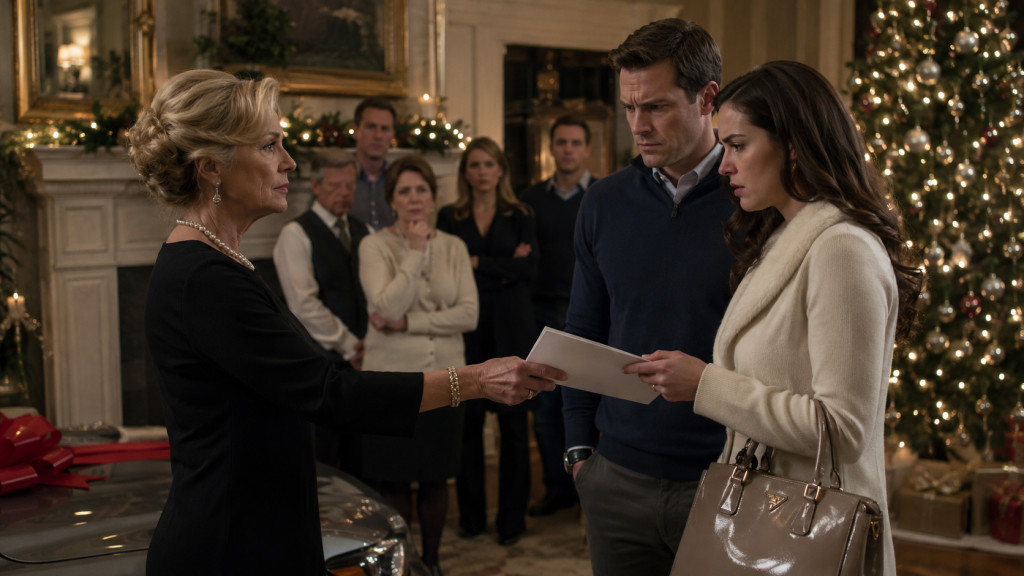
I pulled the sealed envelope from my bag.
The paper was thick, cream-colored, and calm in my hand.
I walked toward Daniel and Marissa.
“Then I have one final gift for you both,” I said.
Daniel frowned.
“What is that?”
“Open it.”
Marissa snatched it first, still smiling.
She opened the flap and pulled out the papers.
Her expression changed before she finished the first page.
The smugness drained from her face so quickly it was almost frightening.
Daniel leaned over her shoulder.
“What?” he muttered.
Marissa didn’t answer.
She turned to the second page, then the third.
Her hand began to shake.
Daniel grabbed the papers from her.
His face went pale.
Inside the envelope was a thirty-day notice ending their free occupancy of the townhome I owned.
There was also a cancellation letter for the $150,000 house down payment I had planned to give them in January.
And finally, there was a letter from my attorney confirming that the Lexus title would remain in my name until Daniel repaid the personal loan he had signed six months earlier.
A loan he had insisted he would repay by Thanksgiving.
A loan he had not made a single payment on.
The room was so quiet I could hear the clock ticking on the mantel.
Daniel looked up slowly.
“Mom.”
I held his gaze.
“Yes?”
“You can’t be serious.”
“I am.”
Marissa’s mouth opened and closed.
“You can’t do this,” she whispered.
“I just did.”
Daniel stepped closer, lowering his voice.
“Mom, come on. This is insane. We were making a point.”
“So was I.”
His jaw tightened.
“You’re kicking us out at Christmas?”
“No,” I said. “I’m giving you thirty days’ legal notice after allowing you to live rent-free for nearly three years.”
Marissa laughed once, sharp and panicked.
“Rent-free? You offered that place.”
“I did. And now I’m withdrawing the offer.”
Daniel looked toward Claire as if someone else might rescue him.
“Aunt Claire?”
Claire stood slowly.
Her face was pale, but her voice was firm.
“Don’t look at me, Daniel. You humiliated your mother after accepting a car from her.”
Daniel flushed.
“It wasn’t humiliation.”
I tilted my head.
“What would you call it?”
He looked at Marissa.
She was staring at the papers like they were burning her hands.
“We just thought,” she said, suddenly softer, “that maybe you needed boundaries.”
I nodded.
“You’re right.”
Her eyes flicked up.
“I am?”
“Yes. Boundaries are exactly what this family needed.”
For the first time all night, Marissa had no answer.
Daniel rubbed his forehead.
“What about the car?”
I extended my hand.
“The keys, please.”
His eyes widened.
“Mom.”
“The keys.”
“That’s my Christmas gift.”
“No,” I said. “That was a car I purchased and insured in my name for a son I believed still respected me. After what you said tonight, I think it’s best we handle everything properly.”
“You’re taking it back because we didn’t buy you a present?”
I almost smiled.
“No, Daniel. I’m taking back my access to being used.”
The words seemed to hit him harder than shouting would have.
For a second, I saw something flicker in his face.
Not remorse.
Not yet.
But fear.
The kind of fear that comes when a person realizes the floor beneath them was never theirs.
Marissa clutched the purse against her body.
“And this?” she asked.
I looked at it.
“You can keep it.”
Relief flashed across her face.
Then I added, “Consider it my final unnecessary expense.”
Claire made a small sound behind me. Maybe a laugh. Maybe a sob.
Daniel pulled the Lexus keys from his pocket.
He didn’t hand them over at first.
His fingers curled around them, knuckles white.
“You’re really choosing money over your own son?” he asked.
There it was.
The sentence I had been trained by guilt to fear.
I took one step closer.
“No, Daniel. I’m choosing dignity over manipulation. There’s a difference.”
His face twisted.
Marissa touched his arm.
“Daniel, just give them to her.”
He looked at his wife, shocked.
She whispered, “We need to think.”
That was when I knew Marissa had already moved from performance to calculation.
Daniel dropped the keys into my palm.
They landed cold against my skin.
I closed my fingers around them.
“Merry Christmas,” I said quietly.
The evening ended soon after that.
Not with shouting.
Not with dramatic exits.
Just the awkward gathering of coats, the avoidance of eye contact, the silence of people who had witnessed something they would talk about for years.
Daniel and Marissa left in their older car, the one they had complained about for months.
Marissa still carried the purse.
Daniel didn’t look back.
When the door closed behind them, I stood in the foyer and listened to the fading sound of their engine.
Claire came up beside me.
For a moment, she said nothing.
Then she took my hand.
“I’m proud of you,” she whispered.
That was when I finally cried.
Not loudly.
Not because I regretted it.
I cried because I had spent years mistaking surrender for love.
Claire stayed after everyone else left.
We cleaned the kitchen together in silence, wrapping leftovers, rinsing plates, wiping counters that were already clean.
At midnight, she poured us both tea.
“You know he’ll call,” she said.
“I know.”
“What will you say?”
I looked toward the living room, where the Christmas tree still glowed softly.
“I don’t know yet.”
But I did know one thing.
I would not apologize.
Daniel called the next morning at 8:12.
I let it ring.
He called again at 8:14.
Then Marissa called.
Then Daniel texted.
Mom, we need to talk.
I stared at the message while drinking coffee from Robert’s old mug.
I typed back: I agree. You may contact my attorney about the townhome and the loan. Personal conversations can wait until you are ready to speak respectfully.
Three dots appeared.
Disappeared.
Appeared again.
Then he wrote: Are you serious right now?
I set the phone down.
For the first time in years, I did not answer immediately.
That afternoon, Marissa’s mother called me.
I almost laughed when I saw the name.
I had met Patricia twice. Both times she had treated me like a hotel clerk who had misplaced her reservation.
I answered anyway.
“Evelyn,” Patricia said, icy and dramatic, “I cannot believe what I’m hearing.”
“Then perhaps you should ask fewer biased questions.”
She paused.
“My daughter is devastated.”
“Then she has learned disappointment. That can be useful.”
“She and Daniel are family.”
“Yes,” I said. “And family should not publicly humiliate the person hosting Christmas.”
Patricia scoffed.
“Marissa says you gave them legal papers in front of everyone.”
“Marissa is correct.”
“That was cruel.”
“No,” I said. “Cruel was accepting a purse with one hand and insulting me with the other.”
Patricia had no response to that.
So she changed tactics.
“You’re going to destroy your relationship with your son.”
The old Evelyn would have trembled.
The old Evelyn would have apologized to keep peace.
But peace built on disrespect is not peace.
It is just silence with a prettier name.
“My relationship with my son was already being destroyed,” I said. “I simply stopped funding the demolition.”
Then I ended the call.
For two weeks, Daniel sent angry messages.
Then desperate ones.
Then sentimental ones.
He reminded me of childhood memories.
He sent photos of Robert.
He said Dad would be ashamed.
That one nearly broke me.
I sat at the kitchen table for a long time, staring at those words.
Dad would be ashamed.
Then I walked to Robert’s study.
I hadn’t changed much in there since he died. His books still lined the shelves. His old leather chair still sat by the window. His reading glasses were still in the top drawer of the desk.
I opened the drawer to put my phone away before I said something emotional.
That was when I saw the envelope.
It was old, yellowed at the corners, with my name written in Robert’s handwriting.
Evelyn.
My breath caught.
I had seen it before, years ago, but I had never opened it. Robert had written letters during a health scare ten years before he died, then recovered and told me to forget about them.
I sat in his chair and opened mine.
The letter was short.
My Evelyn,
If you are reading this, I hope you remember one thing clearly: love is not measured by how much of yourself you can give away before you disappear.
You have the softest heart I’ve ever known, but even soft hearts need fences.
If Daniel ever forgets the woman who raised him, do not buy his memory back.
Make him remember.
And if he won’t, live anyway.
I love you more than every Christmas we ever had.
Robert.
I pressed the letter to my chest and cried harder than I had cried in years.
Not because I felt alone.
Because for the first time since his death, I felt like he had answered me.
After that, I stopped reading Daniel’s messages for a few days.
I let my attorney handle the townhome.
Daniel and Marissa moved out on the twenty-eighth day.
They left the place dirty, but not destroyed.
That was something, I suppose.
The Lexus was returned to the dealership. I took a small loss and considered it the price of education.
The $150,000 stayed in my investment account.
And my house became quiet again.
But this time, the quiet did not feel empty.
It felt clean.
In February, Daniel showed up at my door.
Alone.
He looked thinner. Tired. Humbled in a way I had never seen before.
I opened the door but did not step aside.
“Hi, Mom,” he said.
“Hello, Daniel.”
He swallowed.
“Can I come in?”
I studied his face.
“Are you here to apologize or negotiate?”
His eyes lowered.
“Apologize.”
I stepped aside.
We sat in the kitchen.
Not the formal living room.
Not beside the Christmas tree, which had long since been packed away.
The kitchen had always been where truth happened in our family.
Daniel looked around like he was seeing the house differently.
“I messed up,” he said.
I waited.
He rubbed his hands together.
“Marissa and I had been talking about you. About money. About how you always helped. She said it made her feel controlled.”
“Did you feel controlled?” I asked.
He hesitated.
“No. I felt relieved.”
That honesty surprised me.
He continued.
“But I also felt ashamed. And instead of dealing with that, I let her turn it into something ugly. I let myself believe you were the problem because that was easier than admitting I kept taking.”
My throat tightened, but I stayed quiet.
Daniel’s eyes filled.
“When Dad died, I should have been there more. I knew you were lonely. I knew you were trying to keep the family together. And I used that.”
A tear slipped down his cheek.
“I’m sorry, Mom.”
It was not perfect.
It did not erase everything.
But it was real.
So I nodded.
“Thank you.”
He looked at me like he expected more.
I gave him tea.
Not money.
Not forgiveness wrapped in instant comfort.
Just tea.
We talked for almost an hour.
He told me he and Marissa were staying in a small apartment. He was working extra hours. They were arguing. He didn’t ask me to fix it.
That mattered.
When he stood to leave, he paused at the back door.
“Do you hate her?” he asked.
“Marissa?”
He nodded.
I thought about it.
“No.”
He looked surprised.
“I don’t hate her. But I won’t allow her to mistreat me anymore. And I won’t allow you to hide behind her when you mistreat me.”
He flinched.
Then nodded.
“That’s fair.”
At the door, he hugged me.
This time, with both arms.
I did not pretend everything was healed.
Healing is not a switch.
It is a road.
And sometimes, the person who hurt you has to walk a long way before you decide whether to meet them anywhere.
Months passed.
Daniel visited every other Sunday.
Sometimes he came alone.
Sometimes he brought groceries and cooked for me.
Once, he fixed the loose railing on the porch without mentioning it.
He started repaying the loan in small monthly payments.
Not much.
But consistently.
Marissa did not come.
I did not ask why.
Then in June, I received a card in the mail.
No return address.
Inside was a simple note.
Evelyn,
I was cruel to you because I was insecure and jealous of how much Daniel relied on you. That does not excuse what I did. I am sorry for humiliating you on Christmas. You were generous, and I turned it into something ugly.
Marissa.
There was no request attached.
No excuse.
No mention of money.
I read it twice.
Then I placed it in a drawer.
Not because it fixed everything.
Because it was a beginning.
The next Christmas, I hosted again.
Smaller this time.
Claire came.
Austin came.
Daniel came alone, carrying a covered dish and a wrapped gift.
He looked nervous when he handed it to me.
“Merry Christmas, Mom.”
I opened it slowly.
Inside was a wooden ornament.
A small rocking horse.
Hand-painted.
One eye was bigger than the other.
Just like the one he had made in kindergarten.
My vision blurred.
Daniel’s voice broke.
“I found the old one in a photo. Tried to copy it.”
I held the ornament in my palm.
It was imperfect.
Simple.
Probably cost less than ten dollars to make.
It was the best gift my son had given me in twenty years.
I stood and hugged him.
Across the room, Robert’s old Christmas music played softly.
The fire crackled.
The house smelled like cinnamon and pine.
And for the first time in a long time, Christmas did not feel like a performance.
It felt like a promise.
Not that everything would be the same again.
It wouldn’t.
Not that love meant pretending pain never happened.
It didn’t.
But that respect could return where truth had finally been spoken.
That boundaries could save what guilt almost destroyed.
And that sometimes, the final gift you give the people you love is not money, comfort, or another chance to use you.
Sometimes the final gift is the moment you stop begging them to value you.
Because when you finally choose yourself, the people who truly love you have only two choices.
They can walk away.
Or they can learn how to love you properly.
That Christmas, Daniel began to learn.
And I finally began to live.
THE END! THANK YOU FOR READING!