

My parents forced me to cook and clean all weekend for my sister’s party with fifty guests. When I asked for help, Mom laughed, “You’re the only one without a real job.” I smiled, put the dishes down, and left.
One hour later, my sister called crying, “Who did you call?” My name is Emily Carter, and for most of my life, my family treated me like the extra chair in the garage. Useful when guests came over. Ignored when no one needed anything.
My younger sister, Madison, was turning twenty-five, and my parents decided her birthday party had to be unforgettable.
Not sweet.
Not intimate.
Unforgettable.
That meant a rented tent in the backyard, fifty guests, a floral photo wall, champagne, a dessert table, and food that looked catered even though no caterer had been hired.
Because, according to my mother, hiring help was wasteful when they had me.
Madison worked part-time at a boutique in downtown Westfield, New Jersey.
She called herself a brand consultant because she posted outfits online and tagged expensive handbags she did not own.
My parents adored it.
Every post was “creative.”
Every minor achievement was “inspiring.”
Every bad decision was “part of finding herself.”
I worked remotely as an operations manager for a logistics company.
I managed contracts, shipments, vendors, employee schedules, and corporate event support for a national firm.
My job paid well.
It also allowed me to work from my apartment in sweatpants.
To my mother, Patricia Carter, that meant I did not have a real career.
To my father, Harold, it meant I was “available.”
To Madison, it meant I was convenient.
That Friday afternoon, I drove to my parents’ house thinking I was helping with setup.
I had even told myself not to be bitter.
It was Madison’s birthday.
I could help for one weekend.
I could arrange a few trays, wipe a few counters, and smile through the usual comments.
By the time I parked in their driveway, my mother was already waiting on the porch with a clipboard in her hand.
Not a hug.
Not a hello.
A clipboard.
“Good, you’re here,” she said. “The guest bathroom needs deep cleaning, and the dining chairs have to be moved outside before six.”
I stared at her.
“Hi, Mom.”
She waved her hand. “Yes, hello. Come on, Emily, we’re behind.”
That was how the weekend began.
By Friday evening, I had scrubbed two bathrooms, vacuumed the entire downstairs, folded napkins, washed serving platters, carried boxes of decorations from the basement, and polished silverware my mother had not used in ten years.
Madison came downstairs around seven wearing silk pajamas and holding an iced coffee.
“Oh good,” she said, looking at the dining room. “You’re doing the gold chargers.”
I looked up from the table.
“Yes, Madison. I am doing the gold chargers.”
She smiled like she had not heard the edge in my voice.
“Can you make sure they’re not scratched? I want everything to look expensive.”
I wanted to say, Then pay for expensive.
Instead, I swallowed it.
My father sat in the living room watching TV while I carried chairs through the sliding door.
Every time I passed him, he lifted his feet so I could vacuum under the coffee table.
Not once did he ask if I needed help.
At ten that night, I was in the kitchen marinating chicken skewers while my mother tasted sauces with a critical frown.
“Too much lemon,” she said.
“You asked for lemon herb chicken.”
“I asked for delicate lemon. Not aggressive lemon.”
I put the spoon down.
“Mom, I’m tired.”
She looked surprised.
“Already?”
Already.
As if I had not been working since the minute I walked in.
As if my body was family property.
As if exhaustion was something I had not earned.
I went to bed near midnight in my old bedroom, which had become storage for Christmas decorations, old curtains, and Madison’s rejected furniture.
My childhood posters were gone.
My trophies were gone.
The room smelled like dust and cardboard.
Madison’s old bedroom, meanwhile, had been kept perfectly intact after she moved out.
Fresh sheets.
New curtains.
Framed photos.
A vanity mirror.
I lay on the narrow bed and stared at the ceiling, remembering all the times I had told myself it did not matter.
But it did.
It had always mattered.
Saturday morning began before seven.
My mother knocked once and opened the door before I could answer.
“Emily, the bakery called. They can’t deliver until noon, so you need to pick up the cake.”
I sat up slowly.
“Good morning to you too.”
She frowned. “Don’t be snippy. We have a lot to do.”
By eight, I had picked up coffee for everyone.
By nine, I had cleaned the kitchen again.
By ten, I was arranging shrimp trays.
By eleven, I was steaming Madison’s dress while she sat on the bed scrolling through her phone.
“Careful with the bodice,” she said. “It wrinkles easily.”
“You could do this yourself,” I said.
She laughed.
“I don’t know how.”
“You could learn.”
She looked at me as if I had suggested she build a bridge.
“Emily, don’t be weird.”
That was my family’s favorite word for me.
Weird.
I was weird when I asked for fairness.
Weird when I set a boundary.
Weird when I did not laugh at jokes made at my expense.
Weird when I did not want to be treated like unpaid staff.
By noon, my back ached.
My hands smelled like bleach, garlic, lemon, and dish soap.
The backyard looked beautiful.
The tent had gone up.
White tablecloths covered rented tables.
Gold chairs surrounded them.
There were flowers on every surface and string lights running from the tent poles to the trees.
If a guest had walked in then, they would have thought my mother had created a magazine-worthy party.
They would not have seen me kneeling on the kitchen floor thirty minutes earlier wiping spilled marinade from the grout.
They would not have seen me carrying trash bags to the curb.
They would not have seen my mother changing every little thing I finished because she loved control more than gratitude.
At one o’clock, Madison came into the kitchen in leggings and a robe.
“Are the caprese skewers done?”
I looked at the pile of ingredients on the counter.
“No. I’m still finishing the pasta salad.”
She sighed.
“Emily, guests arrive in three hours.”
I slowly turned to her.
“You could help.”
Madison blinked.
“With what?”
“With anything.”
My father, sitting at the kitchen table with his tablet, did not look up.
My mother, who was arranging flowers near the window, gave a short laugh.
“Help you?” she said. “Honey, you’re the only one without a real job.”
The kitchen went silent.
Madison smirked.
“Mom, don’t be mean.”
But she did not move.
My father chuckled under his breath.
Something inside me went completely still.
Not angry.
Not loud.
Still.
For years, I had imagined that one day they would realize how much they took from me.
That they would see me.
That my mother would say thank you.
That my father would say he was proud.
That Madison would admit I had carried more than my share.
But standing there in that kitchen, with a knife in my hand and fifty people’s worth of food waiting around me, I finally understood.
They knew.
They had always known.
They simply did not care.
I set the knife down.
Then I dried my hands on a towel.
My mother glanced at me.
“What are you doing?”
I smiled.
“You’re right.”
Her frown deepened.
“About what?”
“I don’t have a real job,” I said. “So I should stop pretending I’m useful.”
Madison rolled her eyes.
“Oh my God, don’t start.”
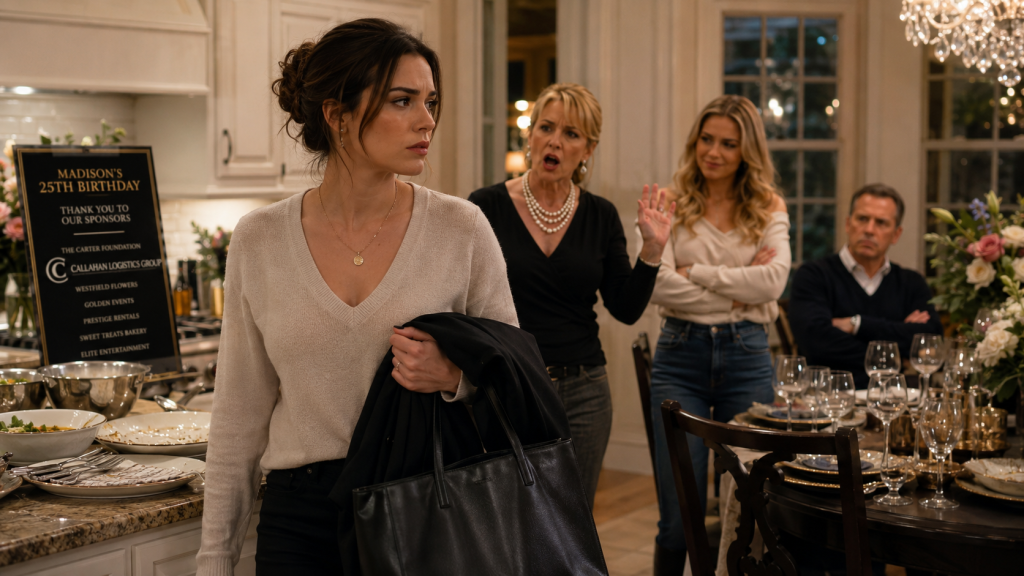
I walked to the hallway closet, grabbed my purse, and slipped on my coat.
My father finally looked up.
“Emily,” he said sharply, “where do you think you’re going?”
“Home.”
Madison stood. “Are you serious? My party is tonight.”
I opened the front door.
“Then I hope you all know how to cook.”
My mother followed me onto the porch, her face flushed with anger.
“If you leave now,” she hissed, “don’t bother coming back.”
I looked at her for a long second.
All my life, I had been terrified of that sentence.
Terrified of being excluded.
Terrified of being unloved.
Terrified of being erased from family photos and holiday dinners.
But in that moment, I felt strangely calm.
“That,” I said, “was the first generous thing you’ve said all weekend.”
Then I walked out.
In my car, I sat for five minutes gripping the steering wheel.
I did not cry.
I did not scream.
I breathed.
Once.
Twice.
Three times.
Then I made one phone call.
Not to punish them.
At least, that was what I told myself.
But maybe a part of me did want them to understand what it felt like when the invisible person stopped holding everything together.
I called my boss, Mr. Callahan.
His full name was Gregory Callahan, CEO of Callahan Logistics Group.
Most employees called him Mr. Callahan because he had the kind of presence that made first names feel too casual.
He answered on the third ring.
“Emily? Everything all right?”
I almost lied.
That was my habit.
“I’m fine” was practically stitched into my bones.
But instead, I said, “No. I’m not.”
He went quiet.
Then he said, “Tell me.”
So I did.
Not everything.
Not all the childhood wounds.
Not every holiday where I washed dishes while Madison opened gifts.
Not every time my mother called my work “computer stuff.”
But enough.
I told him I had been expected to prepare my sister’s entire party while my family mocked my job.
I told him I had left.
Then I told him the part that made him go silent.
“My mother has been telling people she arranged the Carter Foundation partnership with Callahan Logistics.”
There was a pause.
“She said what?”
I closed my eyes.
“My parents invited several local donors tonight. They’ve been bragging that they secured your company as a sponsor for their foundation dinner next month.”
The Carter Foundation was my parents’ pride.
A small but polished charity that hosted annual dinners, accepted donations, and made my mother feel important in front of wealthy neighbors.
The truth was, the foundation had been struggling.
Donations had dropped.
Their reputation had become more social than charitable.
Months earlier, my mother had asked me if my company sponsored community events.
I had made one introduction.
Just one.
Then I handled the proposal professionally because that was my job.
The partnership was not finalized yet.
It was under review.
But my mother had already started acting as if she had personally negotiated a corporate sponsorship.
Mr. Callahan’s voice became very calm.
“Emily, were they planning to present us publicly tonight?”
“I think so,” I said. “There’s a printed board in the dining room with sponsor logos. I saw Callahan Logistics on it.”
Another pause.
“They used our logo without final approval?”
“Yes.”
His voice changed.
Not loud.
Worse.
Controlled.
“I’ll handle it.”
“Sir, I’m not asking you to—”
“I know what you’re asking,” he said. “You’re asking me whether your work matters. It does. And if someone is misrepresenting my company while insulting the person who actually made that connection possible, I would like to see it myself.”
I stared through the windshield.
“What do you mean?”
“I’m in town. Text me the address.”
That was the call.
That was all.
I drove to my apartment, washed my hands twice, changed into jeans and a sweater, and sat on my couch with the silence wrapped around me like a blanket.
For the first time all weekend, no one was calling my name from another room.
No one was demanding.
No one was laughing.
Then my phone rang.
Madison.
I considered ignoring it.
But something made me answer.
The second I did, I heard crying.
“Emily,” Madison choked. “Who did you call?”
I sat upright.
“What happened?”
“Mom just saw him and—oh my God—she’s freaking out.”
“Who?”
“The man from your company. The CEO or whatever. He’s here with two people in suits.”
My stomach tightened.
In the background, I heard my mother’s voice rising.
Then my father shouting.
Then Madison whispered, “Emily, what did you do?”
The line filled with more shouting.
Then it went dead.
I sat there staring at my phone.
For five minutes, I debated.
I could stay home.
I could let them deal with the mess they made.
I could protect my peace.
But Madison had sounded genuinely scared.
Not annoyed.
Not dramatic.
Scared.
So I grabbed my keys and drove back.
When I pulled into the driveway, the scene looked like a storm had passed through.
The rented tent was half finished.
A stack of chair covers sat near the garage.
The kitchen window showed chaos inside.
Guests had not arrived yet, but two delivery drivers stood awkwardly near the side entrance, unsure where to place several boxes.
And on the front porch stood Mr. Callahan in a navy suit, flanked by two senior managers from legal and partnerships.
My mother stood in the foyer, pale and rigid.
My father’s face had gone gray.
Madison stood near the stairs, crying into a napkin.
When I walked in, everyone turned.
My mother’s voice came out thin.
“Emily.”
I looked at Mr. Callahan.
“Sir, I didn’t expect you to come personally.”
He gave a polite nod.
“I was nearby. And I prefer clarity.”
My father tried to recover first.
“Mr. Callahan,” he said, forcing a smile, “this is all a misunderstanding. Emily is emotional today.”
I almost laughed.
There it was.
Their emergency strategy.
Emily is emotional.
Emily is dramatic.
Emily misunderstood.
Emily overreacted.
But Mr. Callahan did not smile back.
“Mr. Carter,” he said, “my understanding is that your foundation displayed our company logo without formal approval and represented a pending partnership as confirmed.”
My mother swallowed.
“We were going to explain tonight that it was in progress.”
“Were you?” he asked.
She looked toward the dining room.
I followed her eyes.
There, leaning against the wall, was a large printed board.
Carter Foundation Annual Giving Dinner.
Proudly Sponsored By Callahan Logistics Group.
My company logo was centered at the top.
Large.
Official-looking.
False.
Mr. Callahan’s legal manager stepped forward.
“That design implies finalized sponsorship,” she said. “It also uses protected company branding.”
My father’s mouth opened, then closed.
Madison wiped her face.
“Mom told everyone she arranged it,” she whispered.
My mother shot her a furious look.
“Madison.”
But Madison kept going.
“She said Emily just sent an email because she had spare time. She told Aunt Linda that she was the one who convinced Mr. Callahan.”
I looked at my mother.
She would not meet my eyes.
For some reason, that hurt more than the insult in the kitchen.
Not because she lied.
I expected lies.
But because she had been willing to take credit for my work while calling it not real.
Mr. Callahan turned to me.
“Emily, did you manage the proposal?”
“Yes.”
“Did Patricia or Harold Carter communicate directly with our sponsorship team?”
“No,” I said. “All communication went through me because I was coordinating it professionally.”
My mother snapped, “You didn’t have to say it like that.”
I turned toward her.
“How should I say it, Mom? Softly, so your lie feels comfortable?”
Her face reddened.
“Do not embarrass me in my own home.”
I looked around at the half-prepared party.
The trays I had arranged.
The flowers I had fixed.
The floors I had cleaned.
The food I had chopped.
“Your home,” I said quietly, “has been embarrassing me for years.”
The room went silent.
My father stepped forward.
“Enough. Emily, apologize to your mother.”
I looked at him.
“For what?”
“For causing a scene.”
That old instinct rose inside me.
Apologize.
Smooth it over.
Be good.
Be quiet.
Save the family from discomfort.
But I did not move.
“No.”
My father blinked.
“What did you say?”
“I said no.”
Madison stared at me as if she had never seen me before.
Maybe she had not.
Maybe none of them had.
Mr. Callahan cleared his throat.
“Given what we have seen, Callahan Logistics will be reviewing the partnership.”
My mother’s face collapsed.
“Reviewing?”
“Yes,” he said. “And if the event materials are not corrected immediately, the review will not be favorable.”
My father turned to me, suddenly desperate.
“Emily, fix this.”
There it was.
Not “I’m sorry.”
Not “We were wrong.”
Fix this.
The family motto.
I looked at him for a long second.
Then I said, “No.”
My mother’s voice trembled.
“Emily, this foundation matters.”
“So does my job.”
“It was just a comment.”
“No,” I said. “It was not just a comment. It was the truth you’ve been telling yourselves for years because it made it easier to use me.”
Madison whispered, “Emily…”
I turned to her.
“And you. You sat there while I worked all weekend for your party. You watched Mom laugh at me. You smirked.”
Tears ran down her face.
“I didn’t think—”
“That’s the problem, Madison. You never have to think. Someone always cleans up before you notice the mess.”
She flinched.
For a moment, I felt cruel.
Then I remembered my hands shaking around a dish towel while they laughed.
No.
Truth was not cruelty.
Truth was just unfamiliar in that house.
Mr. Callahan spoke again.
“Emily, we can leave if you prefer.”
My mother suddenly reached for my arm.
“Please,” she whispered. “Please just tell him we made a mistake. Tell him we’re good people.”
I looked down at her hand on my sleeve.
For most of my life, I would have done it.
I would have protected her.
I would have smiled at Mr. Callahan and explained that everyone was stressed.
I would have saved the party.
Saved the foundation.
Saved the family image.
Then gone home empty.
But something had changed.
Maybe it was the way she said I did not have a real job.
Maybe it was the sponsor board.
Maybe it was Madison crying only after consequences arrived.
Or maybe I had simply run out of myself to give.
I gently removed my mother’s hand.
“You want me to tell him you’re good people,” I said. “But good people do not treat their daughter like a servant and then steal credit for her work.”
My mother’s eyes filled with tears.
For once, I did not rush to comfort her.
Mr. Callahan gave the legal manager a quiet nod.
She took a photo of the sponsor board.
Then he turned to my parents.
“Remove our logo from all materials. Any future partnership discussions will go through our legal department.”
My father’s shoulders dropped.
That was the moment he understood.
Not when I left.
Not when Madison cried.
Not when my mother panicked.
Only when the money and reputation started slipping away.
Guests began arriving thirty minutes later.
The house was still not ready.
Half the food was unfinished.
The kitchen was a disaster.
The sponsor board had been turned around against the wall.
My mother tried to smile at people, but her face looked tight and panicked.
Madison’s makeup was ruined from crying.
My father kept disappearing into the garage to make angry phone calls.
And me?
I stood near the front door with my purse still on my shoulder.
My mother approached quietly.
“Emily, can you at least help finish the food?”
I stared at her.
She seemed smaller somehow.
Not sorry.
Just scared.
“No.”
Her lips parted.
“But people are here.”
“I know.”
“What are we supposed to do?”
I looked toward the kitchen, where trays sat half-filled and the sink overflowed.
“Hire someone.”
“It’s too late.”
“Then tell the truth.”
Her eyes sharpened.
“What truth?”
“That you planned a fifty-person party without hiring help because you assumed I would do everything.”
She looked offended, as if the truth had bad manners.
“I am still your mother.”
“And I am still your daughter,” I said. “But you forgot that first.”
Madison came over slowly.
She looked embarrassed.
Not polished.
Not smug.
Just young and shaken.
“Emily,” she said, “I’m sorry.”
I waited.
She swallowed.
“I should have helped.”
“Yes.”
“And I shouldn’t have laughed.”
“No, you shouldn’t have.”
She looked toward the backyard, where guests were beginning to ask questions.
“I don’t know how to fix this.”
I studied her face.
For the first time, she was not asking me to fix it for her.
She was admitting she did not know how.
That was different.
I softened slightly.
“Start by taking off the robe and putting on an apron.”
She blinked.
“What?”
“It’s your party. Feed your guests.”
Madison stared at me.
Then, slowly, she nodded.
“Okay.”
My mother looked horrified.
“Madison, you’ll ruin your dress.”
Madison turned to her.
“Mom, it’s my party. I can help.”
For a moment, Patricia Carter looked as if her entire world had shifted two inches to the left.
Madison went upstairs, changed out of her birthday dress, and came back wearing jeans, a blouse, and an apron.
The guests noticed.
Of course they noticed.
They noticed when Madison carried trays outside herself.
They noticed when my father had to refill ice buckets.
They noticed when my mother had to explain why dinner was late.
And they definitely noticed when I did not lift a finger.
I stayed for twenty minutes.
Not to help.
Not to gloat.
To make sure Madison was not having a complete breakdown.
Then I walked toward the door.
My father followed me into the hallway.
“Emily.”
I stopped.
His voice was quieter now.
“Don’t leave like this.”
I turned around.
“How should I leave?”
He rubbed his forehead.
“I know your mother can be difficult.”
I smiled sadly.
That was all he had.
Your mother can be difficult.
Not “I let it happen.”
Not “I joined in.”
Not “I failed you.”
Just a careful little sentence that placed all blame somewhere else.
“You laughed too, Dad.”
He looked away.
“I didn’t mean anything by it.”
“You never do,” I said. “That’s what makes it easy for you.”
He had no answer.
I opened the door.
This time, no one told me not to come back.
Three days later, my mother called.
I let it go to voicemail.
Then my father called.
I let that go too.
Madison texted first.
I’m sorry. Really.
I stared at the message for a long time before replying.
I believe you’re sorry the party went badly. I don’t know yet if you’re sorry for how you treated me.
She did not answer for an hour.
Then she wrote back.
That’s fair.
It was the first fair thing anyone in my family had said in years.
The foundation partnership was suspended.
Not permanently, at first.
Mr. Callahan told me the company would reconsider only if the Carter Foundation completed an ethics and governance review and corrected all false promotional materials.
My mother was humiliated.
I knew because three different relatives called me to say so.
Aunt Linda said, “Your mother is devastated.”
I said, “I’m sure.”
She said, “Family should support each other.”
I said, “Exactly.”
Then I ended the call.
For the first time in my life, I did not explain myself to everyone.
I did not send long messages.
I did not beg to be understood.
I simply stepped back.
Two weeks passed before I agreed to meet Madison for coffee.
She arrived without makeup, wearing a simple sweater and nervous hands.
“I didn’t know how much you did,” she said.
I looked at her.
“You didn’t want to know.”
She nodded slowly.
“You’re right.”
That surprised me.
She continued, “Mom always made it seem like you liked helping. Like you were better at things, so it made sense.”
“I was better because no one gave me a choice.”
Madison looked down.
“I know.”
I waited.
She took a shaky breath.
“The party was awful after you left.”
“I heard.”
“I burned two trays of chicken. Dad dropped a bowl of pasta salad. Mom cried in the laundry room. Guests left early.”
Despite myself, I laughed.
Madison laughed too, but then her face crumpled.
“I deserved it.”
“No,” I said. “You deserved a normal birthday. But I deserved a normal family.”
Her eyes filled with tears.
“I want to do better.”
“Then do better without making me your teacher.”
She nodded.
“Okay.”
That was the beginning of something.
Not instant closeness.
Not forgiveness wrapped in a bow.
But something honest.
My parents took longer.
My mother sent messages that were apologies shaped like accusations.
I’m sorry you felt unappreciated.
I’m sorry you misunderstood.
I’m sorry things got out of hand.
I did not respond.
Then one day, nearly a month later, she sent a different message.
I am sorry I said your job was not real. I knew it was. I said it because I wanted you available.
I read that sentence three times.
Then I cried.
Not because it fixed everything.
It did not.
But because for once, she had told the truth.
My father sent his own message the next day.
I should have helped. I should have defended you. I am sorry.
I did not rush back.
I did not pretend years of hurt had vanished.
But I agreed to dinner at a restaurant.
Neutral ground.
No family kitchen.
No dishes waiting for me.
When I arrived, my mother stood up like she wanted to hug me, then stopped herself.
That restraint meant more than the hug would have.
Dinner was awkward.
Painfully awkward.
But no one asked me to organize anything.
No one mocked my job.
No one handed me a task.
When the check came, my father paid.
Then he said, “Thank you for coming.”
Just that.
No lecture.
No guilt.
No demand.
I drove home that night feeling strange.
Not healed.
Not broken either.
Maybe this was what boundaries felt like at first.
Lonely, but clean.
A few months later, the Carter Foundation held its annual dinner.
Callahan Logistics did not sponsor it that year.
But I heard my parents hired an actual event coordinator.
They paid caterers.
They paid cleaners.
They paid staff.
Imagine that.
Madison texted me a photo from the event.
She was standing beside my mother, both of them smiling carefully.
Under the photo, she wrote:
We hired help. No one died.
I laughed so hard I nearly spilled my coffee.
Then another message came.
Also, I told three people you’re the reason the foundation even got reviewed in the first place. Proper credit this time.
I smiled.
Progress.
Small, imperfect progress.
A year after the birthday disaster, Madison invited me to dinner at her apartment.
Just me.
No parents.
No party.
No fifty guests.
When I arrived, she opened the door wearing an apron.
“I cooked,” she said proudly.
I raised an eyebrow.
“Should I be worried?”
“Maybe.”
The pasta was overcooked.
The salad had too much dressing.
The garlic bread was slightly burned.
But she had made it herself.
And after dinner, when I stood to help clear the table, Madison stopped me.
“No,” she said. “You’re my guest.”
My throat tightened.
Such a small sentence.
Such a huge thing.
I sat back down.
She carried the plates to the sink.
And for once, I let someone else clean up.
That night, driving home through quiet streets, I thought about the old version of me.
The one who would have stayed that Saturday.
The one who would have finished the food, smiled at guests, saved the sponsor board scandal, cleaned until midnight, and gone home with aching hands and a hollow chest.
That Emily had been kind.
But she had also been tired.
So tired.
I used to believe love meant being useful.
I used to believe family meant showing up no matter how badly they treated you.
I used to believe saying no made me selfish.
Now I know better.
Love without respect is just labor.
Family without gratitude is just obligation.
And saying no is sometimes the first honest thing you ever say to people who only love your yes.
My parents still have a long way to go.
So does Madison.
So do I.
Healing a family is not like cleaning a kitchen.
You cannot scrub hard enough and make everything shine in one afternoon.
Some stains are old.
Some cracks are deep.
Some things need time, distance, and people willing to stop pretending.
But that weekend changed something forever.
My mother learned I was not free labor.
My father learned silence has consequences.
Madison learned parties do not prepare themselves.
And I learned that walking out the door does not always mean losing your family.
Sometimes it means finally finding yourself.
So when people ask why I left my sister’s birthday party three hours before guests arrived, I do not tell them I was angry.
I tell them the truth.
I was done.
Done being the extra chair in the garage.
Done being useful but unseen.
Done being called dramatic for having a spine.
Done letting people who depended on me pretend I did nothing important.
I set down the dishes.
I picked up my purse.
I walked out.
And one hour later, when my sister called crying, “Who did you call?” the answer was simple.
I had called the one person my family could not dismiss.
Someone who knew exactly what my “not real job” was worth.
But the real call I made that day was not to my boss.
It was to myself.
And for the first time in my life, I answered.
THE END! THANK YOU FOR READING!