

Right before my wedding day, I stopped by my future mother-in-law’s house. As I was leaving, I realized I had forgotten my cardigan. I walked back inside to grab it—and what I saw made me call off the wedding right there.
It was not a dramatic scene at first. No shouting. No broken glass. Just a quiet Chicago hallway, a half-closed luxury condo door, and my hand frozen inches from the doorbell.
My mother had stitched two tiny flowers onto that cardigan before she passed, and somehow, that one forgotten piece of fabric led me back to the exact conversation I was never supposed to hear.
The night before my wedding was supposed to feel soft, warm, and almost holy.
That was what people kept telling me.
“Enjoy every second,” my coworkers said.
“Tomorrow goes by so fast.”
My best friend Sienna texted me a row of white hearts and told me to drink water, get sleep, and stop checking the weather app every ten minutes.
The makeup artist was coming at eight in the morning.
The hotel suite was already booked.
My wedding dress was hanging in my tiny Logan Square studio like a promise I had spent five years believing in.
Five years with Julian Mercer.
Five years of dinners, birthdays, holidays, hard conversations, soft apologies, and all the little routines that make you think love has roots.
Julian was charming in a way that never looked forced.
He remembered people’s names.
He brought flowers to hospital rooms.
He held doors open for strangers and called waiters by “sir” and “ma’am.”
He knew exactly how to make a room feel warmer when he walked into it.
That was why I had ignored the smaller things.
The way he avoided talking about money unless he needed some.
The way his mother’s opinion always seemed to arrive before his own.
The way every serious decision became “something we should discuss after the wedding.”
I had told myself that was normal.
Marriage was a big step.
People got nervous.
Families got involved.
And Eleanor Mercer was not an easy woman to say no to.
Eleanor was Julian’s mother, elegant in that polished Chicago Gold Coast way, always wearing cream cashmere, gold earrings, and a smile that made you feel like you were being judged and blessed at the same time.
She lived on the twenty-second floor of a luxury building with a doorman who knew everyone’s last name and a lobby that smelled faintly of lilies and money.
That evening, she had invited me over for what she called “one last family tea.”
“It’s important,” she said over the phone. “Before tomorrow, I want a quiet moment with my future daughter.”
Future daughter.
Those words had touched something tender inside me.
My own mother had been gone for almost two years.
She died before she could see me walk down the aisle, before she could help me fasten my necklace, before she could cry quietly in the front row and pretend she had allergies.
So when Eleanor said “future daughter,” I wanted to believe her.
I wanted to believe I was not only marrying Julian.
I was gaining a family.
At her dining table that evening, Eleanor held both my hands and looked at me like I was precious.
“Tomorrow,” she said, “you become one of us.”
At the time, I thought it was sweet.
Now those words feel different.
Julian’s younger sister, Chloe, had been curled on the couch nearby, scrolling through her phone and pretending to care about the wedding.
“You’re going to look stunning,” she said without really looking up.
“Thank you,” I said.
Eleanor poured more tea into my cup.
Then she asked, casually, “Is the Lincoln Park condo all settled?”
“Yes,” I said. “The closing paperwork is done.”
“Still just in your name?”
I smiled because I did not understand the weight beneath the question.
“For now. Julian and I can talk about it after the wedding.”
Eleanor nodded slowly.
“Of course,” she said. “After the wedding.”
The condo was not just real estate to me.
It was six years of corporate late nights, skipped vacations, careful budgeting, and the small inheritance my mother left me before she passed.
It was thirteen hundred square feet near the park, with hardwood floors, tall windows, and a balcony just big enough for coffee and two chairs.
It was not huge, but it was mine.
My mother had squeezed my hand from her hospital bed and said, “Keep one thing in your name, Harper. Love is real, but paperwork remembers.”
I had laughed then.
“Mom, Julian is not like that.”
She had looked tired, but certain.
“Then he won’t mind.”
That sentence came back to me when I was halfway home and reached for my cardigan.
The passenger seat was empty.
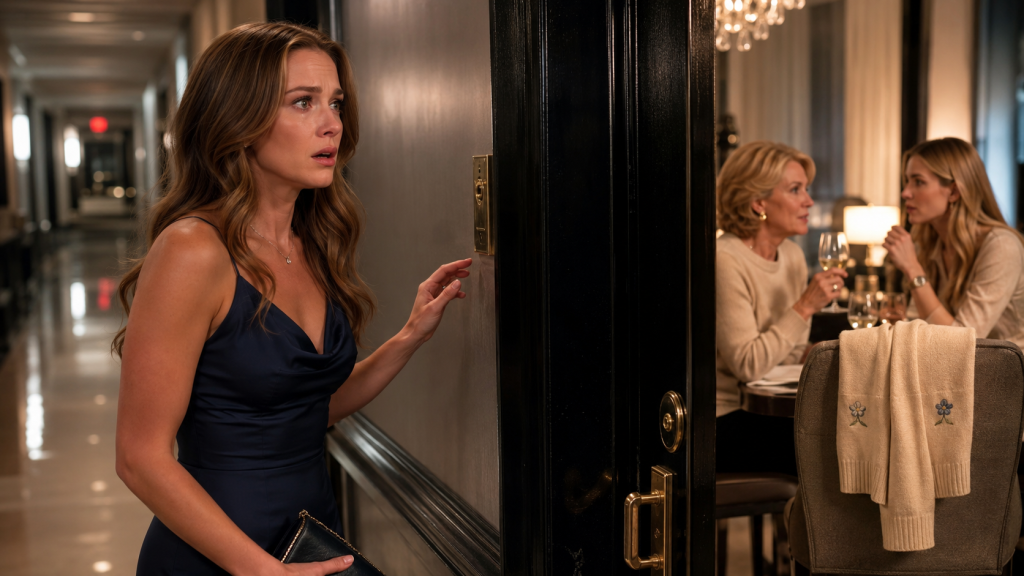
My cream cardigan was still at Eleanor’s condo, draped over the back of her dining chair.
For anyone else, it would have been just a sweater.
For me, it was the last thing my mother had ever made with her hands.
Near the collar, she had stitched two tiny flowers.
One pale blue.
One white.
She said one meant peace.
The other meant protection.
Her fingers had been weak by then, but she insisted on finishing it.
“This way,” she had whispered, “I can still go places with you.”
I could not leave it overnight in someone else’s home.
So I turned the car around.
The city lights blurred across my windshield as I drove back toward the Gold Coast.
I told myself it was ridiculous to feel nervous.
I was only going back for a sweater.
I would ring the bell, apologize, grab it, and leave.
Tomorrow, I would wake up early, put on the dress my mother helped me choose, and marry the man I had loved for five years.
The elevator in Eleanor’s building was mirrored on all sides.
I saw myself from every angle.
Soft waves in my hair.
Dusty pink lipstick.
Navy rehearsal dinner dress.
Engagement ring catching the overhead light.
A bride, I thought.
But my smile in the mirror looked strained.
When the elevator opened on the twenty-second floor, the hallway was quiet except for the hum of recessed lights.
I walked toward Eleanor’s black lacquered door and lifted my hand toward the bell.
Then I heard my name.
“Harper just left,” Eleanor said from inside.
Her voice was clear, almost bright.
“Thank God. I thought I would have to smile until my jaw locked.”
My finger stopped in midair.
Chloe laughed.
“Mom, you are such a good actress. She thinks you actually adore her.”
My chest tightened so fast I could barely breathe.
For one second, my mind tried to protect me.
Maybe I misunderstood.
Maybe they were joking.
Maybe there was another Harper in their life, even though there was no other Harper and my cardigan was sitting inside their dining room.
Then Eleanor spoke again.
“I have adored that girl for five years for a reason. Do you think I enjoy listening to her talk about her projects and her mother’s advice?”
The hallway seemed to tilt beneath my feet.
I lowered my hand slowly.
Inside, a glass clicked against the table.
Chloe’s voice dropped, excited and sharp.
“Once the wedding is done, the condo situation gets easier, right?”
“Of course,” Eleanor said. “After tomorrow, Julian can make it emotional. Not legal. Emotional works better with Harper. He’ll say he feels like a guest in his own home. He’ll talk about trust, family, future children. She’ll fold.”
I leaned back against the wall.
My mother’s voice rose in my memory.
Paperwork remembers.
Chloe asked, “And once his name is on it?”
“Then they can refinance, sell, restructure. Whatever Julian needs for the startup. That condo is too valuable to sit there as Harper’s little safety blanket.”
Safety blanket.
The phrase hit harder than an insult because that was exactly what it was.
My safety.
My proof that after losing my mother, I could still build something stable.
My own door.
My own lock.
My own future.
I wanted to knock.
I wanted to step inside and ask Eleanor to repeat every word to my face.
Instead, I reached into my purse.
My hand was shaking, but my mind became strangely clear.
I opened the voice memo app and hit record.
Then I crouched slightly and held the phone near the bottom of the door.
Eleanor kept talking.
“Her mother left money too,” she said. “Julian cannot ask too quickly. He needs to look hurt, not eager. Harper likes to feel useful.”
Chloe giggled.
“She really does.”
“She is eager to belong,” Eleanor said. “That is the whole point.”
The timer on my phone passed one minute.
Two.
Three.
I did not cry.
That surprised me.
Maybe the pain had gone somewhere too deep for tears to reach.
Maybe my body understood that crying could come later, when I was safe.
Right there, in that hallway, I was no longer a bride.
I was a woman standing outside a door, hearing the map of her own future being drawn by people who had never loved her.
Then Chloe asked the question that split me open.
“Do you think Julian actually loves her?”
The pause that followed was worse than the question.
Eleanor finally answered, calm as ever.
“Julian loves what Harper can do for him. At this stage of life, that is close enough.”
I stopped recording.
For a moment, all I could hear was my own breathing.
The cardigan was still inside.
My mother’s little stitched flowers were probably still resting over Eleanor’s dining chair, surrounded by crystal cups, white walls, and all that clean, expensive pretending.
I wanted to take it back.
I wanted to hold it against my chest and say, “Mom, I heard you too late.”
But then I realized something.
My mother’s flowers did not need to be rescued from that room.
They had already done their job.
Peace had brought me back.
Protection had made me listen.
I slipped my phone into my purse, turned away from Eleanor’s door, and walked to the elevator without ringing the bell.
My hands shook only after the doors closed.
By the time I reached the lobby, I had sent the recording to Sienna with one message.
“Do not let me marry him tomorrow.”
She called immediately.
I let it ring.
Then I typed, “I’m going to Julian.”
Her reply came seconds later.
“Harper, where are you?”
I did not answer.
Julian was at the Palmer House hotel, drinking with his groomsmen.
He had told me it would be “nothing wild,” just a few drinks before the big day.
I found them in the bar beneath gold light, laughing over expensive whiskey.
Julian looked perfect.
Of course he did.
White shirt, loosened tie, clean jaw, that easy smile that had fooled me for years.
When he saw me, his face changed.
“Harper?”
He stood quickly.
“What happened? Are you okay?”
His friends went quiet.
I walked to the table.
My legs felt numb, but my voice was steady.
I looked at the man I had planned to marry in less than twelve hours and realized I did not know him at all.
I pulled the ring from my finger.
Julian’s eyes dropped to my hand.
“Harper,” he said softly. “What are you doing?”
I placed the ring gently into his whiskey glass.
The diamond sank with a tiny sound.
The whole table froze.
“Ask your mother,” I said.
His face went pale.
“What?”
“Ask your mother,” I repeated. “And ask yourself why she sounded so sure you would break me.”
Then I turned and walked out before he could lie.
He followed me into the hotel lobby.
“Harper, stop.”
I kept walking.
“Please,” he said. “Whatever you heard, you misunderstood.”
That made me stop.
I turned around beneath a chandelier so bright it made his face look exposed.
“I never told you what I heard.”
His mouth opened.
Then closed.
And that silence gave me the answer I had been afraid to ask for.
My phone began ringing again.
Sienna.
This time, I answered.
“I’m at the Palmer House,” I said.
“I’m coming,” she said.
Julian stepped closer.
“Harper, don’t do this here.”
“Why?” I asked. “Because people can see you?”
His jaw tightened.
“That is not fair.”
“No,” I said quietly. “What is not fair is planning to use my home to fix your business.”
His expression flickered.
Just once.
But I saw it.
Five years had taught me his face well enough to recognize panic hiding behind charm.
He lowered his voice.
“My mother talks too much.”
I almost laughed.
That was his defense.
Not “she lied.”
Not “I would never.”
Just my mother talks too much.
“So it’s true,” I said.
He reached for my hand, but I pulled away.
“It’s complicated,” he said.
“No,” I said. “It is actually very simple.”
“Harper, I love you.”
“Do you?”
His eyes softened.
That old practiced softness.
The one that used to make me forgive him before he even apologized.
“Of course I do.”
I took out my phone and played the recording.
Only ten seconds.
Just enough.
Julian loves what Harper can do for him.
At this stage of life, that is close enough.
Julian closed his eyes.
I stopped the recording.
Around us, hotel guests moved through the lobby with suitcases and champagne laughter, living normal lives while mine cracked in two.
Julian whispered, “She should not have said that.”
“But she did.”
“She doesn’t speak for me.”
“She spoke like a woman repeating a plan.”
He rubbed his forehead.
“My startup is under pressure. I should have told you. I was going to tell you.”
“When? Before or after my name was no longer the only one on the deed?”
He said nothing.
That was the moment the last small piece of hope in me died.
Sienna arrived twenty minutes later in sweatpants, sneakers, and a winter coat thrown over pajamas.
She came through the revolving doors like a storm.
When she saw Julian standing in front of me, she stepped between us without hesitation.
“Move,” she told him.
“Sienna, this is between Harper and me.”
“No,” she said. “It became mine when she sent me the recording.”
His face tightened.
“You sent it to her?”
I looked at him.
“You are worried about that?”
For the first time, I saw anger break through his polished exterior.
“You don’t understand what you’re doing,” he said. “There are deposits. Guests. Family flying in. My father’s partners are coming.”
I stared at him.
Not once did he say, “You are hurt.”
Not once did he say, “I’m sorry.”
He only saw the inconvenience.
The embarrassment.
The ruined performance.
Sienna took my arm.
“We’re leaving.”
Julian’s voice dropped.
“If you walk out now, Harper, don’t expect me to chase you.”
I looked back at him one last time.
“You were never chasing me,” I said. “You were waiting for me to hand you the keys.”
Then I left.
That night, I did not go back to my studio alone.
Sienna took me to her apartment, sat me on her couch, wrapped me in a blanket, and put a mug of tea in my hands.
Only then did I cry.
Not pretty tears.
Not movie tears.
I cried until my throat hurt.
I cried for the wedding that would not happen.
For the guests who would wake up to phone calls and confusion.
For the dress hanging in my apartment.
For the version of Julian I had loved.
For my mother, who had tried to warn me with the gentlest sentence in the world.
Love is real, but paperwork remembers.
At three in the morning, Julian called eleven times.
Then Eleanor called.
Then Chloe sent a message.
“Please don’t overreact. Mom was just stressed.”
I stared at the screen until the words blurred.
Sienna took the phone from me.
“No replies tonight,” she said.
By six in the morning, I had made three calls.
One to the wedding planner.
One to the venue.
One to my attorney, who had helped me close on the condo.
By eight, the same time I should have been sitting in a makeup chair, Sienna was beside me at her kitchen table while I sent a message to every guest.
“With deep sadness, the wedding between Julian and me will not take place today. I ask for privacy and understanding. Thank you for respecting this decision.”
I did not explain.
Not yet.
But Eleanor did.
By nine-thirty, she had already started calling people.
She told Julian’s relatives I had suffered “an emotional episode.”
She told one bridesmaid I was “overwhelmed by commitment.”
She told a family friend that grief over my mother had made me unstable.
That was when I posted the recording in our private wedding group chat.
Not the whole thing.
Just the part that mattered.
Eleanor’s voice.
Chloe’s laughter.
Julian’s name.
The condo.
The plan.
Then I wrote one sentence.
“This is why there will be no wedding.”
The group chat went silent.
Then my aunt wrote, “Your mother protected you.”
That was the message that broke me all over again.
Julian showed up at Sienna’s building that afternoon with red eyes and no tie.
The doorman called upstairs.
Sienna looked at me.
“You do not have to see him.”
“I know,” I said.
But I needed to.
Not for closure.
For proof that I could face him and not fold.
We met in the lobby.
He looked smaller without the wedding day around him.
“Harper,” he said. “Please. I handled everything badly.”
“Handled?” I asked.
He swallowed.
“I was scared. The business is in trouble. My investors pulled back. I didn’t want to burden you.”
“So you planned to manipulate me instead.”
His eyes filled.
“I never wanted to hurt you.”
“But you were willing to.”
That landed.
He looked down.
“My mother pushed the condo idea.”
“And you let her.”
He nodded slowly.
“I let her.”
For five years, I had waited for Julian to become brave enough to choose me without needing permission.
Standing in that lobby, I finally understood he never would.
Even his confession sounded borrowed.
Even his regret seemed shaped by what he had lost.
Not me.
The condo.
The future.
The image of himself as a good man.
“I would have helped you,” I said.
He looked up quickly.
“What?”
“If you had come to me honestly, I would have listened. I would have cared. I might not have given you my home, but I would have stood beside you while you rebuilt.”
His face twisted.
“Then why can’t we still—”
“Because you did not ask for help, Julian. You planned a trap.”
He flinched.
I removed the wedding band I had bought for him from my purse.
I had picked it up the week before, proud and nervous, imagining the moment I would slide it onto his hand.
Now I placed the small box into his palm.
“This belongs to the man I thought you were.”
He held it like it burned.
“I do love you,” he whispered.
I believed him then, in a sad and limited way.
Maybe Julian did love me.
But he loved comfort more.
He loved his mother’s approval more.
He loved rescue more.
And I had mistaken being needed for being cherished.
“Maybe you do,” I said. “But not in a way that keeps me safe.”
I walked away.
The days after the canceled wedding were humiliating in a thousand tiny ways.
The florist called.
The hotel called.
My dentist’s receptionist, who had been invited through Julian’s family somehow, sent a message asking if everything was okay.
Boxes of wedding favors sat unopened in my apartment.
My dress hung untouched behind a garment bag.
For two days, I could not look at it.
On the third day, I went back to Eleanor’s condo.
Not alone.
Sienna came with me.
So did my attorney.
Eleanor opened the door wearing pearl earrings and a wounded expression.
“Harper,” she said softly. “This has gone far enough.”
I looked past her into the dining room.
My cardigan was still there.
Draped over the same chair.
Waiting.
“I came for my sweater,” I said.
Her mouth tightened.
“Of course.”
She stepped aside.
I walked in and picked up the cardigan.
For a second, my fingers rested over the two tiny flowers.
Peace.
Protection.
Eleanor watched me.
“You have made a mistake,” she said.
I folded the cardigan carefully over my arm.
“No,” I said. “I almost made one.”
Her eyes sharpened.
“You think a condo will keep you warm at night?”
I smiled then.
Not because anything was funny.
Because she still did not understand.
“No,” I said. “But neither would a family that only wanted the deed.”
Chloe stood near the kitchen, silent for once.
I turned to her.
“I hope someday you learn the difference between loyalty and cruelty.”
Her face flushed.
She looked away.
Eleanor crossed her arms.
“Julian is devastated.”
“I am sure he is.”
“He may never forgive you.”
That almost made me laugh.
“He was not the one being used.”
Then I left with my mother’s cardigan in my hands.
Six months later, the Lincoln Park condo was fully mine.
No added name.
No refinance.
No “family restructuring.”
Just my signature, my keys, my balcony, and my mother’s flowers framed in a shadow box near the entryway.
I moved in on a rainy Saturday.
Sienna brought pizza.
My aunt brought champagne.
We sat on the floor because my furniture had not arrived yet, eating from paper plates and laughing harder than the situation deserved.
At sunset, I stepped onto the balcony alone.
Chicago stretched around me, silver and gold beneath the clouds.
For the first time in months, I felt quiet inside.
Not happy exactly.
Not healed.
But free.
My phone buzzed.
A message from an unknown number.
It was Julian.
“I miss you. I think about what happened every day. I wish I had been stronger.”
I read it twice.
Then I typed back, “So do I.”
I did not send it.
Instead, I deleted the message, blocked the number, and went back inside to the people who had shown up when my life fell apart.
A year after the canceled wedding, I wore the cream cardigan to my mother’s grave.
The stitched flowers had faded a little, but they were still there.
I sat beside her headstone with a cup of coffee and told her everything.
About the hallway.
About the recording.
About the ring in the whiskey glass.
About the condo.
About how sometimes I still missed the man I thought Julian was, but I no longer confused missing someone with needing them back.
The wind moved softly through the cemetery trees.
I touched the little flowers near my collar.
“You were right,” I whispered. “Paperwork remembers.”
Then I smiled through my tears.
“But so do daughters.”
And for the first time since the night before my wedding, I felt my mother with me completely.
Not as a warning.
Not as grief.
But as peace.
And protection.
Exactly where she had promised to be.
THE END! THANK YOU FOR READING!