

I welcomed into my home the little girl everyone accused of making my daughter disappear. Ten years later, she looked me in the eyes and whispered, “Everything you’ve believed about that night… is false.”
My name is Daniel Mercer, and for most of my life, I believed grief was something that hollowed a man out slowly. I was wrong. Grief does not always move slowly. Sometimes it arrives at your front door wearing muddy shoes, shaking hands, and the face of a terrified child.
After my wife, Laura, passed away from cancer, my daughter Emily became the only family I had left.
She was thirteen when we lost her mother.
Old enough to understand death.
Too young to carry it.
For months after Laura’s funeral, Emily stopped singing in the kitchen. She stopped leaving little drawings on the refrigerator. She stopped running into my arms when I came home from work.
She became quiet in a way that frightened me.
Every morning, I would stand outside her bedroom door and listen for movement, terrified that sadness had swallowed her completely.
Then Nora came into her life.
Nora Bell was Emily’s closest friend from school.
She had no parents, no stable home, and no one who truly belonged to her.
Her mother had abandoned her when she was little. Her father was a name on a birth certificate and nothing more. She bounced from relatives to temporary guardians to foster placements that never lasted long enough to feel real.
The first time Emily brought Nora home, the girl stood in our entryway like she was afraid the floor might reject her.
She was thin, pale, and quiet, with tangled brown hair and eyes that looked older than any child’s eyes should.
Emily took her hand and pulled her inside.
“Dad,” she said, smiling for the first time in weeks, “this is Nora. She’s basically my sister.”
Nora looked down immediately, as though being called family was too dangerous to believe.
But from that day on, she was always there.
She came over after school. She ate dinner with us. She helped Emily with homework at the kitchen table. Sometimes I would hear the two girls laughing upstairs, and that sound became the closest thing to healing I had known since Laura died.
Emily changed because of Nora.
She smiled again.
She talked again.
She even started singing softly while doing dishes, the same way her mother used to.
I should have been grateful without fear.
But loss teaches a man to worry about every good thing.
I used to watch the two girls walking side by side down our quiet street, their shoulders touching, their voices bright in the evening air, and I would feel something in my chest loosen.
Then I would immediately fear losing that too.
One chilly evening in October, Emily and Nora asked if they could take a short walk near the neighborhood trail.
They had done it dozens of times before.
The trail curved behind our row of houses, crossed a little wooden footbridge, and looped back by the old church. It was safe. Familiar. The kind of place where neighbors walked dogs and children rode bikes in summer.
I told them to be home before dark.
Emily rolled her eyes, kissed my cheek, and said, “Dad, we’ll be gone twenty minutes.”
Those were the last words I heard my daughter speak for ten years.
Only Nora returned.
I remember the knock.
Not loud.
Not steady.
Three weak taps against the front door.
When I opened it, Nora stood there alone.
Her shoes were caked in mud.
Her hair was soaked from misty rain.
Her hands shook from the cold, and her lips had turned a faint shade of blue. She looked as if she had been running, crying, or both.
For one frozen second, my mind refused to understand what my eyes already knew.
“Where’s Emily?” I asked.
Nora stared somewhere beyond me.
Her mouth opened, but no words came out.
I grabbed her shoulders.
“Nora. Where is my daughter?”
Her eyes finally lifted to mine.
“I…” she whispered. “I don’t know.”
The hours after that became a nightmare without edges.
Police came.
Neighbors came.
Flashlights moved through the woods like restless ghosts.
Volunteers searched every trail, every creek, every abandoned shed, every drainage ditch, every dark corner of our small Georgia town.
They called Emily’s name until their voices broke.
They brought dogs.
They brought divers.
They brought helicopters.
They brought hope.
Then, little by little, they brought silence.
Emily was never found.
No shoe.
No scarf.
No backpack.
No sign of struggle.
No trace.
She simply disappeared.
And because Nora had been the last person to see her, suspicion fell on her like a storm.
At first, people whispered.
Then they stopped whispering.
Mothers pulled their children away from Nora at the grocery store.
Men stared at her from across parking lots.
Students at school called her murderer under their breath.
My own brother, Jack, came to my house three days after Emily vanished and slammed his fist against my kitchen table.
“She knows something,” he said. “That girl knows exactly what happened.”
Nora sat in the living room, wrapped in a blanket, staring at the wall.
She had barely eaten. Barely spoken. She flinched every time someone raised their voice.
I looked at her and tried to see what everyone else saw.
A liar.
A suspect.
A monster hiding behind tears.
But I couldn’t.
All I saw was a frightened little girl who had lost the only friend who had ever made her feel loved.
The police questioned her again and again.
Her story never changed.
She and Emily had walked the trail. Emily had stopped near the footbridge because she thought she heard someone calling her name. Nora said she turned around for only a moment because she heard branches cracking behind them.
When she looked back, Emily was gone.
Nora had searched. Called. Run. Fallen in mud. Screamed until her throat hurt.
Then she came to me.
No one believed her.
Maybe I shouldn’t have either.
But grief had not made me blind.
It had made me recognize pain.
And Nora’s pain was real.
Two months after Emily disappeared, Nora’s temporary guardian said she could no longer keep her.
“She brings trouble,” the woman told a social worker. “The whole town thinks she did something. I can’t have that around my family.”
That night, Nora was sitting on a bench outside the police station with a plastic bag of clothes beside her.
She looked smaller than ever.
A child blamed for a tragedy no adult could explain.
I stood in front of her for a long time.
Then I said, “Come home.”
Her eyes widened.
“What?”
“Come home with me.”
She shook her head immediately. “Mr. Mercer, no. People will hate you.”
“They already do.”
“They’ll say I tricked you.”
“Let them.”
Her chin trembled. “What if Emily comes back and thinks I stole her place?”
I could barely breathe after hearing that.
I knelt in front of her.
“No one can steal Emily’s place,” I said. “But that doesn’t mean you deserve to be alone.”
Three months later, I adopted Nora.
The town turned against me overnight.
People called me naïve. Delusional. A broken man driven mad by grief.
My brother stopped visiting.
Parents refused to let their kids near my house.
Someone spray-painted “SHE KNOWS” across my garage door.
Another person left a dead daisy on my porch on the one-year anniversary of Emily’s disappearance.
I washed the paint away myself.
I buried the flower.
And Nora watched from the window, crying silently.
She never tried to replace Emily.
Not once.
She refused to sleep in Emily’s bedroom.
She never touched Emily’s clothes, books, jewelry, or keepsakes.
Whenever I found myself standing in Emily’s room too long, Nora would leave a cup of tea outside the door but never come in unless I asked.
Every year, on October seventeenth, the anniversary of Emily’s disappearance, Nora quietly placed a single white daisy on Emily’s pillow.
I pretended not to know.
She pretended not to cry.
That was how we survived.
Year by year.
Silence by silence.
Pain by pain.
Nora grew up in my house, but always as if she were afraid love could be taken away for any mistake.
At seventeen, she got a part-time job at a diner.
At eighteen, she won a scholarship to the local college but chose to live at home so I wouldn’t be alone.
At twenty, she started calling me Dad.
The first time she said it, she dropped a plate in the sink immediately afterward and apologized as if she had broken a law.
I stood there with dish soap on my hands, unable to speak.
Then I pulled her into my arms and held her while she cried into my shirt.
“You don’t have to call me that,” I whispered.
“I know,” she said. “But you are.”
Still, Emily’s ghost lived with us.
Not in a frightening way.
In the way missing people live inside the furniture, the photographs, the half-finished memories.
Her pink scarf remained folded in the kitchen drawer because I couldn’t bring myself to put it away.
Her bedroom stayed almost exactly as she left it.
Her favorite cereal still made my throat tighten whenever I passed it in the store.
Ten years passed.
People moved on.
The town found new scandals, new tragedies, new gossip.
Children who had whispered about Nora became adults who avoided eye contact when they saw her.
My brother Jack eventually returned to my life, but something between us stayed cracked.
He never apologized for accusing Nora.
He only said, “I was angry.”
As if anger explained everything.
But I had learned that grief does not excuse cruelty.
Last night began like any other rainy October evening.
The house was quiet.
Nora was working a late shift at the diner.
I sat alone in the dimly lit kitchen, running my fingers across Emily’s faded pink scarf.
It still smelled faintly of lavender, though I knew that was impossible after ten years.
Maybe memory has its own scent.
The clock above the stove ticked softly.
Rain tapped against the window.
I was thinking about Laura.
About Emily.
About how a man can lose so much and still somehow wake up every morning.
Then the front door opened.
Nora stepped inside.
Rain dripped from her coat.
Her face was pale.
Not tired pale.
Terrified pale.
“Dad,” she said softly.
Something in her voice made me stand.
“What happened?”
She didn’t answer right away.
She shut the door behind her but kept one hand on the knob, as if she might need to run.
Her lips trembled.
“I need to tell you something.”
I felt cold spread through my chest.
“Nora?”
She looked at Emily’s scarf in my hand and started crying.
“Everything you think happened the night Emily disappeared…” she whispered. “None of it is true.”
My heartbeat pounded so hard it felt like it would burst from my throat.
I grabbed the back of a chair to steady myself.
“What are you talking about?”
“Please,” she said. “Just stay calm. I can’t keep this secret anymore.”
“What secret?”
Nora wiped her face with both hands, but the tears kept coming.
“She’s alive.”
The kitchen seemed to tilt.
For a moment, I heard nothing.
Not the rain.
Not the clock.
Not my own breathing.
Then I laughed once.
A broken, awful sound.
“No.”
Nora flinched.
“Dad—”
“No,” I said louder. “Don’t do that. Don’t say that unless you know. Don’t you dare put that in my head unless you know.”
“I know.”
“How?”
She swallowed.
“Because she’s outside.”
The world stopped.
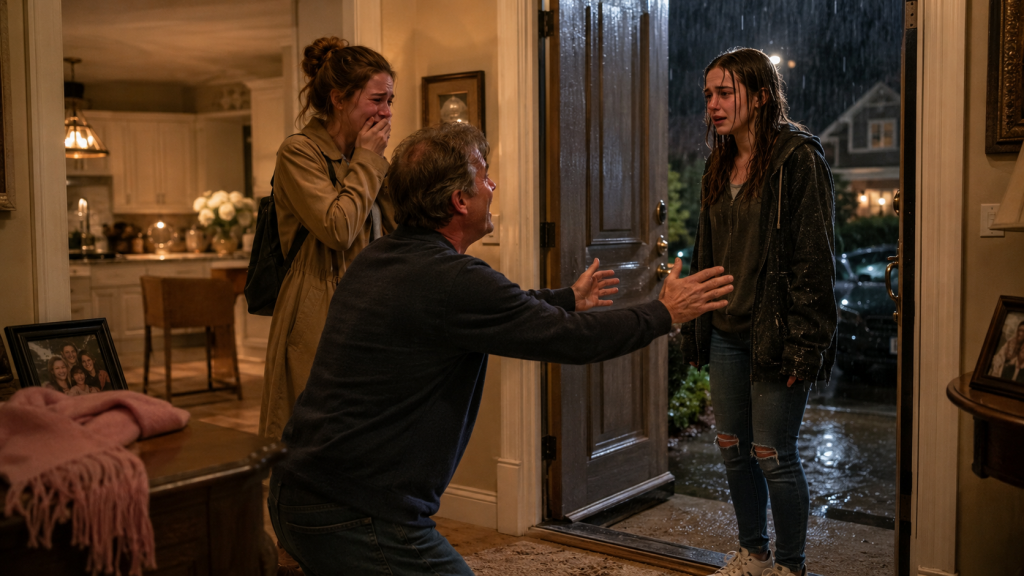
Nora walked to the front door and pulled it open.
And when I saw the person standing on my porch, my legs gave out beneath me.
Emily.
Older.
Thinner.
Her face sharper with years I had never witnessed.
Her hair longer, darker, soaked from the rain.
But those eyes…
My daughter’s eyes.
Laura’s eyes.
The same eyes that had looked up at me from a hospital blanket thirteen years before.
The same eyes that had begged me not to cry at her mother’s funeral.
The same eyes I had searched for in every crowd for ten years.
“Dad,” she whispered.
I crawled toward her before I realized I was moving.
My hands shook so badly I could barely reach for her.
But when I did, she flinched.
That tiny movement broke me more than her disappearance ever had.
I froze.
Emily saw my face and began sobbing.
“I’m sorry,” she said. “I’m so sorry.”
I couldn’t stand.
I couldn’t think.
All I could do was stare at my daughter, alive and broken, standing in the doorway of the home she had been stolen from.
Nora knelt beside me, crying into her sleeve.
“I wanted to tell you for years,” she said. “But she made me promise.”
“Who?” I asked.
Emily stepped inside slowly.
Rainwater pooled beneath her shoes.
Her gaze moved around the house like every wall hurt to look at.
Then she said a name I had not spoken in years.
“Aunt Valerie.”
My wife’s sister.
Valerie Hart.
The woman who had disappeared from our lives shortly after Laura died, claiming grief made it too painful to stay near us.
The woman who had sent flowers to Emily’s memorial service but never attended.
The woman I had once trusted to sit beside my daughter at her mother’s funeral.
My mouth went dry.
“No,” I said.
Emily’s face twisted.
“Yes.”
Nora reached into her coat pocket and pulled out an old envelope, sealed in a plastic bag.
“She told me tonight I had to bring Emily here,” Nora said. “Because Valerie found out Emily escaped.”
“Escaped?” I repeated.
Emily wrapped her arms around herself.
“She kept me hidden,” she whispered. “Not in one place. She moved me around. Georgia, Alabama, Tennessee. Sometimes cabins. Sometimes rentals. Sometimes houses owned by people who owed her favors.”
I stared at her.
“Why?”
Emily looked at the scarf in my hand.
“Because of Mom.”
My wife’s name seemed to fill the whole room.
“Your mother?”
Emily nodded.
“Mom left something behind. Something Valerie wanted. At first, I didn’t understand. I was thirteen. I thought she loved me. She came to the trail that night and said you had sent her.”
I shook my head, already crying.
“I never—”
“I know,” Emily said quickly. “I know that now.”
Her voice trembled as she continued.
“She said you were too broken after Mom died. She said you were planning to send me away because looking at me hurt too much. I didn’t believe her. I told her she was lying. Then she showed me letters.”
“Letters?”
“Fake letters,” Nora said. “With your signature.”
Emily looked at me with agony in her face.
“They said you couldn’t raise me anymore. That Nora made things easier. That maybe it would be better if I lived with Valerie for a while.”
I felt as if someone had reached inside my chest and crushed my heart in their fist.
“I would never write that.”
“I know,” Emily whispered. “But I was a grieving child. I had already lost Mom. Valerie knew exactly where to cut.”
My hands curled around the scarf.
“What happened on the trail?”
Emily closed her eyes.
“Nora heard something behind us. She turned. Valerie stepped out from behind the trees and grabbed my arm. She told me not to scream. She said if I made a sound, she would make sure you blamed Nora forever.”
Nora covered her mouth.
“I saw her,” she cried. “Only for a second. Valerie told me Emily had chosen to leave. She said if I told anyone, she would say I helped. She said no one would believe a foster kid with no family.”
I turned to Nora.
“You knew Valerie took her?”
Nora’s entire body shook.
“I was thirteen,” she whispered. “I was scared. I tried to tell the police, but when I said I saw a woman, they kept asking why I hadn’t said it first. Then Valerie found me outside the station. She told me if I said her name, Emily would vanish forever and it would be my fault.”
Emily stepped closer.
“She showed Nora one of my hair ribbons two days later,” Emily said. “To prove she still had me.”
Nora broke down.
“I’m sorry,” she sobbed. “I’m so sorry, Dad. I thought keeping quiet was the only way to keep Emily alive.”
I looked at the girl I had raised.
The girl I had defended.
The girl I had loved while the whole town hated her.
For one terrible second, anger rose in me.
Not because she had been cruel.
Because she had been a child forced to carry an adult’s evil.
I pulled Nora into my arms.
She collapsed against me, crying so hard she could barely breathe.
“You were a child,” I said. “You hear me? You were a child.”
Emily cried harder when she heard that.
She sank to the floor beside us, and for the first time in ten years, both my daughters were in my arms.
One stolen.
One blamed.
Both wounded by the same lie.
For a long time, none of us moved.
Then Emily pulled back and handed me the envelope.
“Mom left this for you.”
My fingers trembled as I opened it.
Inside was a letter in Laura’s handwriting.
Daniel, if you are reading this, then Valerie has already tried to take what was never hers.
I covered my mouth.
Laura had known.
She had known something was wrong before she died.
The letter explained everything.
Before Laura became sick, she had inherited a large amount of money from her grandmother. Not just money, but land, investments, and a trust meant for Emily.
Laura had never told Valerie the full amount because Valerie had struggled with debt, manipulation, and jealousy for years.
Valerie believed Laura had stolen the inheritance from her.
But according to the letter, their grandmother had left Valerie nothing because Valerie had tried to pressure her into changing the will while she was ill.
Laura had quietly placed Emily’s inheritance into a protected trust.
Only two people could access it when Emily turned twenty-three.
Emily herself.
And me.
Unless I was declared unfit, dead, or legally separated from Emily.
I read the final lines through tears.
If Valerie ever tries to make you believe our daughter is gone, look in the blue music box. The proof is there. Protect Emily. Protect Nora too. That child has no one, and Emily loves her like a sister.
I looked up.
“The blue music box,” I whispered.
Emily’s eyes widened.
“You still have it?”
I stood on shaking legs and walked to the living room.
On the highest shelf of the bookcase sat Laura’s blue music box.
I had not opened it in years.
My hands felt numb as I lifted the lid.
The little ballerina inside turned slowly.
A soft, broken melody played.
Beneath the velvet lining was a folded document.
A copy of the trust.
A written statement about Valerie’s threats.
And a small flash drive.
Nora gasped.
I stared at the flash drive in my palm as though it were a piece of Laura herself.
“What’s on it?” Emily asked.
“I don’t know.”
We went back to the kitchen.
I plugged it into my old laptop with hands that barely worked.
There was one video file.
Laura appeared on the screen.
Alive.
Thin from illness.
Wearing the pale blue robe she had worn near the end.
The moment I heard her voice, I nearly lost the strength to remain upright.
“Daniel,” she said softly, “I hope you never have to watch this.”
Emily made a sound beside me.
Laura continued.
“Valerie has been asking about the trust. She thinks money will fix what is broken inside her. It will not. If anything happens to me, promise me you will not let her near Emily. And promise me you will look after Nora. Emily told me that Nora feels like a sister. I believe some families are given by blood, and some are chosen by love.”
Emily pressed both hands over her mouth.
Nora sobbed silently.
Then Laura’s voice changed.
“She has forged signatures before. She has lied before. She has threatened me before. Daniel, if our daughter ever disappears, do not believe the easiest story. Look closer.”
The video ended.
For a moment, there was only rain.
Then I reached for the phone.
This time, I did not call my brother.
I did not call neighbors.
I called the police.
By sunrise, our house was filled with officers.
Emily gave her statement.
Nora gave hers.
I handed over Laura’s letter, the trust documents, and the flash drive.
At first, the detective looked cautious. Cases like Emily’s do not reopen easily after ten years.
But then Emily gave them something no one could ignore.
A location.
Valerie was staying at a rental house two towns away.
Emily had escaped three nights earlier after finding an old phone hidden in a drawer. She contacted Nora first because she was afraid Valerie might still be watching me.
Nora had met her secretly.
For three days, they had gathered courage.
Then Valerie called Nora at the diner and said, “Bring her back, or Daniel loses everything too.”
That was when Nora brought Emily home.
Police found Valerie that afternoon.
She was not some wild-eyed villain when they arrested her.
That was the most disturbing part.
She opened the door wearing pearls and a cream sweater, as if she had been expecting guests.
When officers asked her about Emily, she smiled.
“My niece was troubled,” she said. “I saved her from an unstable father.”
But the house betrayed her.
In the basement, behind a locked storage door, they found boxes.
Emily’s childhood clothes.
Fake school records.
Forged documents.
Old photographs of my daughter growing year by year in places I had never seen.
There were also files about the trust.
Pages of notes.
Copies of my signature.
Letters she had written in my name.
Valerie had not acted out of love.
She had built a prison out of greed and called it protection.
When my brother Jack heard the news, he came to my house that evening.
He stood on the porch, looking ten years older than he had the day before.
Emily was upstairs resting.
Nora was sitting with her.
Jack took off his hat and stared at the floor.
“I blamed Nora,” he said.
I said nothing.
“I blamed a child.”
“Yes,” I replied.
His eyes filled with tears.
“I told everyone she knew something.”
“She did,” I said. “She knew enough to be terrified. And none of us protected her from that fear.”
Jack swallowed hard.
“Can I apologize to her?”
“That is up to Nora.”
He nodded.
Then he looked at me.
“And Emily?”
My throat tightened.
“She needs time.”
We all did.
People imagine reunions as perfect moments.
They picture running arms, happy tears, music swelling in the background.
But real reunions after deep trauma are quieter.
Harder.
Emily did not suddenly become the thirteen-year-old girl I had lost.
She was twenty-three.
She had lived a whole hidden life of fear, control, and confusion.
She did not like being touched unexpectedly.
She woke from nightmares.
She stared at doors.
Some mornings, she sat in Emily’s old bedroom, which was now both hers and not hers, and cried because she could not remember the sound of her own laugh from before.
I had to learn her again.
Her favorite food had changed.
Her handwriting had changed.
Her voice had changed.
But sometimes, when she was tired, she rubbed the corner of her sleeve between two fingers exactly the way she had as a child.
And in those moments, I saw my little girl.
Nora struggled too.
For ten years, she had carried guilt like a stone inside her chest.
Even after Emily forgave her, Nora could not forgive herself.
One night, I found her standing outside Emily’s room with a daisy in her hand.
“She’s home,” I said softly. “You don’t have to leave flowers on her pillow anymore.”
Nora looked at the flower.
“I know.”
“Then why are you crying?”
She whispered, “Because I spent ten years mourning someone who was alive and suffering. And I lived in her house. I called her father Dad. I got the life she should have had.”
Emily opened the door before I could answer.
She had heard everything.
Nora tried to step back, but Emily took the daisy from her hand.
Then she pulled Nora into a hug.
“You didn’t steal my life,” Emily said. “You kept my place warm.”
Nora broke.
So did I.
In the months that followed, the truth spread through town.
The same people who had stared at Nora in grocery stores now tried to apologize in parking lots.
Some brought flowers.
Some sent cards.
Some cried and said they had always wondered.
Nora accepted very few apologies.
She did not owe them forgiveness just because their guilt had finally caught up with them.
Valerie’s trial came the following spring.
I sat in the courtroom between my daughters.
Emily held my left hand.
Nora held my right.
Valerie’s attorney tried to paint her as a grieving aunt who had made desperate choices.
But Laura’s video destroyed that lie.
So did the forged letters.
So did the locked rooms.
So did Emily’s testimony.
When Emily stood before the court, her voice shook at first.
Then she looked at Valerie and became steady.
“You told me my father didn’t want me,” Emily said. “You told me Nora betrayed me. You told Nora that I would die if she spoke. You stole ten years from all of us. But you did not make us stop loving each other.”
Valerie looked away first.
That was the moment I knew she had lost.
Not the case.
Not the money.
Something deeper.
She had lost the power to define our story.
Valerie was convicted.
The inheritance she had tried to steal remained untouched in Emily’s name.
But Emily did something none of us expected.
She used part of it to create a foundation for foster children who had been blamed, abandoned, or ignored.
She named it The Daisy House.
When I asked her why, she looked at Nora.
“Because someone left flowers for me even when the world told her not to love me.”
Nora cried for nearly an hour after that.
Today, our house is not the same house it was ten years ago.
Emily’s room is open now.
Not preserved like a shrine.
Alive again.
There are new blankets on the bed. New books on the shelves. New photographs on the walls.
One photograph is of Laura holding baby Emily.
One is of Emily and Nora at thirteen, laughing in the backyard before everything changed.
One is of the three of us standing in front of the courthouse after Valerie’s sentencing.
My hair is gray now.
My hands shake some mornings.
I still keep Emily’s pink scarf in the kitchen drawer, but I no longer hold it like a grave marker.
I hold it like proof.
Proof that love can survive lies.
Proof that family can be stolen from you and still find its way home.
Proof that sometimes the person everyone blames is the person who has been suffering in silence the longest.
Last October, on the anniversary of Emily’s disappearance, Nora walked into Emily’s room with a white daisy.
For the first time, she did not place it on the pillow.
She placed it in a vase by the window.
Emily stood beside her.
I watched from the doorway as the two girls, now women, leaned into each other.
Neither of them spoke.
They didn’t need to.
After a while, Emily turned and saw me watching.
“Dad,” she said, “come here.”
For ten years, I had dreamed of hearing that word from her again.
I walked into the room.
Emily took my hand.
Nora took the other.
And for the first time since that chilly October night, I stopped feeling like I was standing in the moment after a door had slammed shut.
I was standing in a room where something had opened.
A future.
A family.
A truth.
People still ask me how I knew Nora was innocent.
I never have a perfect answer.
I only know this.
When the world looked at her, they saw suspicion.
When I looked at her, I saw a child shaking on my porch, carrying a secret too heavy for her small hands.
And maybe loving her did not bring Emily home right away.
But it kept enough light burning in the house for Emily to find us when she finally escaped the dark.
That is what love does.
It waits.
It protects.
It refuses to let lies have the final word.
And when the truth finally knocks on the door, soaked in rain and trembling, love opens it.
Even if it falls to its knees first.
THE END! THANK YOU FOR READING!