

My little sister gave away all her lunch money to buy a severely ill boy a birthday cake. The next morning, we found a black balloon in the center of our lawn, tied to a red box. And when I opened it, the contents made me go pale.
My name is Nora Ellis, and by the time I was nineteen years old, I had already learned what most people spend a lifetime trying to avoid learning. Bills do not care that you are grieving. Landlords do not care that your parents are missing.
And children still need breakfast, clean socks, school forms signed, and someone to tell them the world is safe, even when you know it is not.
My little sister, Della, was eight.
She still believed in cloud animals, lucky pennies, and the idea that if you wished hard enough before blowing dandelion fluff into the wind, the universe would listen.
I used to believe in things too.
Then our parents disappeared.
They had gone hiking on a Saturday morning in Pine Hollow Ridge, the kind of trip they took twice a month.
Dad packed granola bars.
Mom packed her red windbreaker.
They kissed Della on the forehead and told me they would be home before dinner.
They never came back.
For three weeks, search teams combed the ridge.
Dogs followed trails that vanished into rain.
Helicopters circled the tree line.
Volunteers tied orange ribbons to branches and shouted their names until their voices broke.
But nothing was found.
No backpack.
No phone.
No jacket.
No bodies.
Just silence.
The official report said they were presumed dead.
Della did not understand that word.
Presumed.
She kept asking when they would stop being presumed and start being home.
I did not have an answer.
So I became the answer.
I dropped out of community college.
I took the first job I could get at a diner before sunrise, then stocked shelves at a grocery store until nearly midnight.
We moved out of our parents’ rented townhouse into a one-bedroom house on Ashford Lane, the cheapest place I could find that was still close enough for Della to stay in the same school.
The house was old, narrow, and always smelled faintly of dust no matter how much I cleaned.
The kitchen floor slanted toward the back door.
The heater coughed before it worked.
The bathroom faucet screamed when you turned on hot water.
But it had a roof.
It had a lock.
And it had a tiny patch of grass in the front where Della planted three marigold seeds in a cracked coffee mug because we could not afford flower pots.
She never complained.
Not once.
Other kids came to school with glitter backpacks, light-up shoes, lunch boxes shaped like cartoon animals.
Della carried a faded purple backpack with one broken zipper and a lunch bag I washed every night by hand.
Sometimes I packed peanut butter crackers and apple slices.
Sometimes rice and boiled eggs.
Sometimes just a banana and whatever leftovers I could stretch from dinner.
I hated those mornings the most.
The mornings when I opened the fridge and had to pretend I was choosing simply, not struggling.
Della would smile and say, “That’s okay, Nora. I like bananas.”
She called me Nora most of the time.
Only when she was scared did she call me Sissy.
And every time she did, something inside me cracked.
For months, I noticed she had started saving her lunch money.
At first, I did not know where it came from.
Our neighbor, Mrs. Cline, sometimes gave her a dollar for helping bring in groceries.
Her teacher gave out coins for classroom chores that could be used at the school snack cart.
Sometimes I found her counting change on the floor beside her bed, lips moving silently, eyes serious.
She kept the coins in an old mint tin that used to belong to our dad.
It was scratched silver, with a faded green label and a dent in one corner from the time Dad dropped it while fixing the truck.
I thought she wanted a toy.
There was a doll all the girls in her class wanted that year.
It cried real tears if you filled its tiny bottle with water.
It came with diapers and a pacifier and cost more than I could justify spending on anything that was not rent, food, or electricity.
I caught Della staring at one in the store once.
Her fingers touched the plastic window of the box so gently it made me ashamed.
“Maybe for Christmas,” I told her.
She smiled too quickly.
“That’s okay. Babies cry too much anyway.”
So when I saw her filling the mint tin, I assumed she had decided to buy it herself.
I was proud and heartbroken at the same time.
I should have asked.
I should have paid more attention.
But when you are twenty-one and raising a child alone, life becomes a long hallway of emergencies.
The electric bill.
A notice from the school.
A flat tire.
A fever at midnight.
A shift you cannot miss.
A pair of shoes with holes in the soles.
You start missing the quiet things.
And Della was always quiet when she was doing something important.
Her school sat three blocks from our house.
Between the school and Ashford Lane stood St. Gabriel Children’s Hospital, a gray brick building with bright murals painted near the entrance to make it less frightening.
Della walked past it every day.
I had tried to adjust my shifts so I could pick her up, but most afternoons I was still at the diner, wiping tables and pretending my feet did not ache.
Mrs. Cline watched from her porch to make sure Della got home safely.
That was our arrangement.
I thought Della came straight home.
I did not know she had made a friend in a hospital window.
His name was Tobias.
He was eleven years old.
His room was on the third floor, facing Maple Street, where the sidewalk curved near the hospital garden.
The first time Della saw him, he was sitting by the window with an IV pole beside him.
She told me later he looked like a ghost wearing dinosaur pajamas.
His head was covered by a blue knit cap.
His face was pale.
His arms were thin.
But his eyes were awake.
Della waved.
Tobias did not wave back.
The next day, she waved again.
He stared.
The third day, she raised both hands and wiggled her fingers like she was casting a spell.
That time, he smiled.
By the end of the week, Tobias waited for her.
She would stop on the sidewalk, look both ways, and then shout things up toward the closed window.
“What’s your name?”
He wrote TOBIAS on a piece of paper and pressed it to the glass.
“I’m Della!” she yelled.
He wrote, NICE NAME.
She told him about school.
He held up drawings.
She showed him her spelling test.
He gave her a thumbs-up when she got a gold star.
The nurses noticed.
One of them, a woman named Marisol, started opening the window a crack when the weather was mild so Tobias could hear Della better.
That was how Della learned his birthday was coming.
It was not from Tobias.
It was from Nurse Marisol.
Della had asked why there were no cards in his room.
Nurse Marisol had hesitated.
Then she told Della only what a child could carry.
Tobias had been very sick for a long time.
His parents had not been able to take care of him.
The hospital and social services were helping.
No family was coming for his birthday.
No party had been planned.
Della came home that day different.
She washed her hands.
She ate half her dinner.
Then she sat on the floor by her bed and opened the mint tin.
I remember passing her doorway and seeing all those coins spread on the blanket.
“What are you counting for?” I asked.
She snapped the tin shut like she had been caught stealing.
“Nothing.”
“Della.”
“It’s a secret.”
“A good secret or a bad secret?”
She thought about that.
“A birthday secret.”
I smiled, tired and distracted, one hand still holding the grocery receipt I was trying to turn into next week’s meal plan.
“For the doll?”
She shook her head.
“No. Something better.”
I wanted to ask more, but my phone buzzed.
The grocery store needed me to come in early.
The diner had cut my hours.
The rent was due in eleven days.
So I let the secret stay a secret.
Last Thursday, Della came home with pink cheeks and empty hands.
Her backpack looked lighter.
Her lunch bag was untouched.
And the mint tin was gone from her bedside shelf.
I noticed immediately.
“Della,” I said, “where’s your tin?”
She froze.
Then her eyes filled.
Not guilty tears.
Big, trembling, exhausted tears.
The kind children cry when they have held a beautiful thing inside them so long it starts to hurt.
“I spent it,” she whispered.
My first thought was fear.
On what?
Had someone tricked her?
Had an older kid taken it?
“Spent it where?” I asked carefully.
“At Miller’s Bakery.”
I blinked.
“What did you buy?”
“A cake.”
“A cake?”
“And a dinosaur.”
I sat down on the edge of the couch.
“Della, honey, why?”
That was when she told me everything.
About the hospital window.
About Tobias.
About his birthday.
About how nobody was coming.
About how she had saved eleven dollars and forty cents, every coin she had, and bought the smallest chocolate cake Miller’s Bakery would sell her.
Mr. Miller had added blue frosting when he heard it was for a child.
The stuffed dinosaur came from the dollar store.
It had one crooked eye and green felt spikes.
Della had given both to Nurse Marisol at the hospital entrance.
She was too young to go upstairs alone, so the nurse carried them to Tobias.
Then Della stood on the sidewalk below his window and sang “Happy Birthday” as loud as she could.
Tobias pressed both hands to the glass.
He was crying.
Della was crying.
The nurse was crying too.
By the time Della finished telling me, I could not breathe properly.
I pulled her into my arms and held her so tightly she squeaked.
“You gave away your lunch money?” I whispered.
“He needed cake more than me,” she said.
That sentence broke me.
Because I was supposed to be the one teaching her kindness.
Instead, poverty had not hardened her.
Loss had not made her selfish.
The world had taken so much from her, and still she looked at someone else’s empty hands and gave them everything she had.
That night, after she fell asleep, I sat on the kitchen floor and cried into a dish towel so she would not hear.
I cried for Tobias.
I cried for Della.
I cried for myself because I was so tired of choosing which need mattered most.
The next morning was Saturday.
For once, I did not have to be at the diner until ten.
I woke to a strange knocking sound outside.
At first, I thought it was rain tapping the windows.
Then I heard Della gasp from the living room.
“Nora.”
Her voice was small.
Not excited.
Afraid.
I ran out of the bedroom.
She stood at the front window in her pajamas, one hand on the curtain.
Her face had gone pale.
I looked past her.
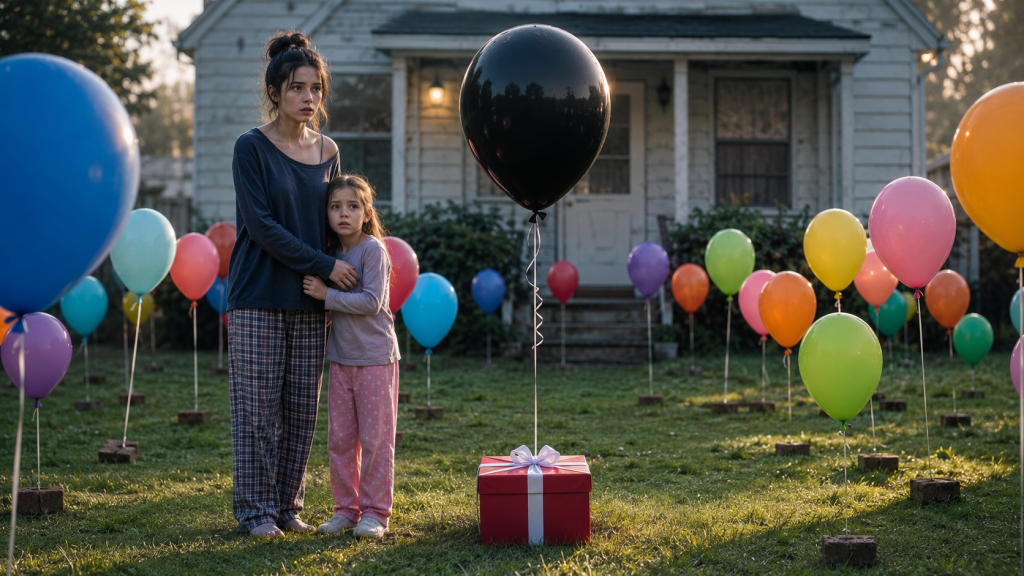
Our entire front lawn was covered in balloons.
Dozens of them.
Red.
Yellow.
Blue.
Purple.
Green.
Pink.
Each balloon was tied to a brick, lined across the grass like someone had planted a garden of floating colors overnight.
They bobbed softly in the morning breeze, bright and impossible against our tired little house.
But in the exact center stood one enormous black balloon.
It was taller than the rest.
Glossy.
Heavy-looking.
It swayed above a red box sitting in the grass.
My stomach dropped.
There is something about a black balloon that makes joy feel like a warning.
Della gripped the back of my shirt.
“Did I do something wrong?” she whispered.
“No,” I said quickly, though my own voice shook. “No, baby.”
I opened the front door.
The air smelled like wet grass and cold morning.
Mrs. Cline’s porch light was still on across the street, but her curtains were closed.
No cars waited at the curb.
No people stood nearby.
Just the balloons.
I walked slowly down the porch steps.
Each brick had a small paper tag tied to it.
At first, I did not read them.
My eyes stayed fixed on the black balloon.
The red box beneath it was about the size of a shoebox, wrapped neatly with a white ribbon.
A folded note was taped to the lid.
The handwriting was uneven.
A child’s handwriting.
You came to my window every day. Nobody else did. And nobody knew one secret about me. Please, open it.
My hands went cold.
Della pressed against my side.
“What secret?” she asked.
“I don’t know.”
Every bad possibility flashed through me.
Had Tobias gotten worse?
Was this some cruel announcement?
Had someone used Della’s kindness to pull us into something we could not handle?
How could a sick, lonely child do this?
How could he fill our yard with balloons?
How could a boy who had nobody arrange something so big?
I untied the ribbon with shaking fingers.
Then I lifted the lid.
The first thing I saw was the mint tin.
Della’s mint tin.
The scratched silver one with the faded green label and dented corner.
For a second, my mind refused to understand.
Della made a sound beside me.
“My tin.”
It sat in the center of folded tissue paper.
But it was not empty anymore.
I opened it.
Inside were bills.
Not coins.
Bills.
Twenties.
Fifties.
A hundred-dollar bill folded carefully beneath a small note.
Under the tin were envelopes.
Gift cards.
A grocery card.
A pharmacy card.
A prepaid card for school supplies.
And a stack of handwritten notes tied with blue yarn.
My knees weakened.
I sank into the grass.
Della knelt beside me.
At the bottom of the box was a photograph.
Tobias sat in his hospital bed, wearing his blue knit cap and dinosaur pajamas.
The tiny chocolate cake rested on a tray in front of him.
The frosting said HAPPY 11TH TOBIAS in shaky blue letters.
The stuffed dinosaur sat under his arm.
Around him stood nurses, doctors, janitors, cafeteria workers, and two security guards.
Every single person in the photo was smiling.
Some were crying.
On the back of the photo, someone had written:
Because your sister reminded everyone he existed.
I covered my mouth.
Della touched Tobias’s face in the picture.
“He looks happy,” she whispered.
I unfolded the first letter.
It was from Nurse Marisol.
Dear Nora and Della,
Tobias asked us to return Della’s mint tin, but none of us could bear to send it back empty.
Yesterday, your sister did something this hospital will never forget.
She stood outside a window and sang to a boy who thought the world had forgotten his birthday.
She gave him cake.
She gave him a dinosaur.
But more than that, she gave him proof that he mattered.
After she left, Tobias told everyone about “the girl on the sidewalk.”
He told doctors.
He told nurses.
He told the night janitor.
He told a cafeteria worker who had been sneaking him extra pudding.
By evening, the whole floor knew.
Then someone said, “That little girl spent her lunch money?”
And everything changed.
We started with a jar at the nurses’ station.
Then the pediatrics floor joined.
Then the emergency department.
Then the bakery owner called us because he wanted to know if the little girl who paid in coins got home safely.
He added something too.
This is not charity.
This is gratitude.
Please let Della know that kindness grows when people see it.
By the time I reached the end, my tears had blurred the page.
Della leaned into me.
“How much is it?” she whispered.
I looked through the envelopes.
There was enough for rent.
Enough for groceries.
Enough for new shoes, school clothes, and the overdue electric bill folded in my kitchen drawer.
More than enough.
Too much.
I started shaking.
Because for so long, I had been surviving one dollar at a time.
I had become used to doing math with fear in my throat.
Rent minus paycheck.
Groceries minus gas.
Medicine minus lunch.
And now this red box sat in the grass like proof that the world had not entirely turned away from us.
I picked up another envelope.
It was from Mr. Miller at the bakery.
Little Miss Della paid me eleven dollars and forty cents for a cake that cost more than that. I took the money because I understood she needed to be the one to give it. But I am returning it now with interest. Tell her the next birthday cake is on me.
Inside was a gift certificate.
And the exact eleven dollars and forty cents.
Every coin.
I pressed the envelope to my chest.
Then Della found a smaller card tucked beneath the tissue paper.
It had a dinosaur sticker on the front.
Her name was written in wobbly letters.
DELLA.
She opened it carefully.
I read over her shoulder.
Dear Della,
Nurse Marisol is helping me write because my hand gets tired.
I never had a birthday party before.
I used to think birthdays were for people with families.
Then you sang to me from the sidewalk and I felt like I had one.
My secret is that I was scared nobody would remember me after I was gone.
But you remembered me before I even left.
So now I am not as scared.
The dinosaur’s name is Captain Mint because he came from your mint money.
He is guarding my bed.
You are my best friend.
Love,
Tobias.
Della stared at the card.
Her chin trembled.
“After he was gone?” she whispered.
I closed my eyes.
I wanted to protect her from the meaning.
But children know more than adults want them to.
“Is Tobias going to die?” she asked.
I pulled her into my lap right there on the wet grass.
“I don’t know, sweetheart.”
“But he thinks he is.”
“Yes.”
She held the card against her heart.
“But maybe he won’t.”
“Maybe he won’t.”
She nodded like she had decided something.
“Then I have to keep waving.”
I could not answer.
I just held her.
A car door closed behind us.
I turned and saw Nurse Marisol standing on the sidewalk.
She wore jeans, a gray sweater, and eyes red from crying.
Beside her stood a tall man in a hospital security jacket holding two more balloons.
One blue.
One green.
“I’m sorry if we scared you,” Marisol said softly. “Tobias insisted on the black balloon. He said it was for the secret.”
Della stood.
“Is he okay?”
Marisol looked at me first, as if asking permission to be honest.
I nodded.
“He had a hard night,” she said. “But this morning, he asked if the balloons had arrived.”
Della wiped her face with both sleeves.
“Can I see him?”
My first instinct was no.
Not because I did not want her to.
Because I was afraid.
Afraid of hospitals.
Afraid of attachments.
Afraid that Della had already lost too much.
Afraid that if Tobias died, another piece of her childhood would be buried with him.
But then I looked at the lawn.
At the balloons.
At the red box.
At the notes from strangers who had been moved because my little sister refused to let a lonely boy be invisible.
Who was I to decide love was too dangerous?
“Yes,” I said. “We can go.”
Della changed faster than I had ever seen her move.
She put on her cleanest shirt, the yellow one with a tiny sun embroidered near the collar.
She brushed her hair badly, so I fixed it.
Before we left, she carried the red box inside and placed Tobias’s card on the kitchen table.
Then she picked up the mint tin.
“Can I bring it?” she asked.
“Why?”
“In case he needs more wishes.”
At the hospital, Nurse Marisol met us near the entrance.
She had gotten permission for Della to visit briefly.
We washed our hands.
We wore masks.
We followed her through hallways that smelled like soap, plastic, and fear disguised as cleanliness.
When we reached Tobias’s room, Della suddenly stopped.
Her courage wavered.
I knelt beside her.
“You don’t have to go in.”
She shook her head.
“Yes, I do.”
The door opened.
Tobias sat propped against pillows.
He was smaller up close than he had looked from the sidewalk.
The blue cap covered most of his head.
The stuffed dinosaur was tucked under his arm.
His face lit up when he saw Della.
“You came,” he whispered.
Della walked to the bed.
“You sent a black balloon.”
“It was dramatic,” he said.
She giggled.
Then she held out the mint tin.
“I got it back.”
“I know.”
“It has wishes now.”
Tobias looked at me.
“You’re Della’s sister?”
“I am.”
“She talks about you.”
My throat tightened.
“Good things, I hope.”
He nodded.
“She says you make pancakes shaped like clouds.”
“They usually look like broken shoes.”
“That’s okay,” he whispered. “Clouds can be weird.”
Della climbed onto the chair beside his bed.
For twenty minutes, they talked like old friends.
She told him about Mrs. Cline’s cat.
He told her Captain Mint had protected him from a bad dream.
She promised to wave every day.
He promised to try to wave back.
Before we left, Tobias looked at me again.
“Did the box help?”
I swallowed.
“Yes,” I said. “More than you know.”
He smiled faintly.
“Good. Della helped me first.”
On the walk home, Della was quiet.
Not sad exactly.
Thoughtful.
When we reached our house, the balloons were still there, shining in the afternoon sun.
Neighbors had started coming out onto their porches.
Mrs. Cline stood near our steps with a tissue in her hand.
“I saw them early,” she said. “Didn’t touch a thing. Figured it was meant for you girls.”
I nodded.
“It was.”
That evening, I paid the electric bill.
I bought groceries without counting every item twice.
I ordered Della a pair of shoes that did not pinch her toes.
And then I did something I had not done in years.
I sat at the kitchen table and breathed.
Della placed the mint tin between us.
“We should not keep all of it,” she said.
I looked up.
“What?”
“Tobias needs things too.”
I smiled through the ache in my chest.
“The hospital collected it for us.”
“But kindness grows,” she said, repeating Nurse Marisol’s words. “So we have to grow it.”
That was Della.
Eight years old.
Already understanding what adults forget.
The next week, we used a small part of the money to make care bags for the children’s hospital.
Coloring books.
Crayons.
Soft socks.
Juice boxes.
Stickers.
Tiny stuffed animals.
Della insisted every bag needed a birthday candle, even if it was nobody’s birthday.
“Just in case,” she said.
Mr. Miller donated cupcakes.
Mrs. Cline knitted small hats.
The grocery store manager gave me a discount when he heard what we were doing.
And every afternoon, no matter how tired she was, Della stopped on the sidewalk and waved to the third-floor window.
Some days Tobias waved back.
Some days Nurse Marisol waved for him.
Some days the curtain stayed closed.
On those days, Della still waved.
“Just so he knows,” she said.
Three weeks later, a letter arrived.
I knew before opening it.
There are envelopes that feel heavy even when they hold only paper.
Tobias had passed away early that morning.
Peacefully, Nurse Marisol wrote.
Captain Mint was under his arm.
Della cried in my lap for nearly an hour.
She did not scream.
She did not ask why the world was unfair.
She just held the dinosaur sticker card and whispered, “He was my friend.”
At the small hospital memorial, there were more people than I expected.
Nurses.
Doctors.
Staff.
Patients who could attend.
Mr. Miller brought a chocolate cake with blue frosting.
Della stood in front of everyone, knees shaking, and read Tobias’s card out loud.
When she reached the line about being remembered, half the room was crying.
Then she added something of her own.
“Tobias thought birthdays were for people with families,” she said. “But family can be someone who waves. Family can be someone who remembers. So please remember him.”
Nobody spoke for a long moment.
Then Nurse Marisol lit one candle on the cake.
Della blew it out for him.
After that, something changed in our town.
It started small.
A donation jar appeared at Miller’s Bakery labeled The Window Fund.
Then the school began collecting birthday supplies for children in long-term hospital care.
Then St. Gabriel created a volunteer program where approved families could send cards, drawings, and small gifts to children who had no visitors.
They named it Captain Mint’s Birthday Project.
Della drew the logo.
A green dinosaur holding a cake.
Months passed.
The balloons were gone.
The red box sat on the top shelf of our closet, filled now with every note we had received.
The mint tin stayed on Della’s nightstand.
Sometimes she put coins in it.
Sometimes she took coins out to buy someone else a small kindness.
A cookie for a classmate who cried at recess.
A pencil for a boy who always borrowed one.
A flower for Mrs. Cline when her cat died.
We were still not rich.
I still worked too much.
The house still slanted.
The faucet still screamed.
But something inside our life had shifted.
Before Tobias, I thought survival meant holding tightly to whatever little we had.
After Tobias, Della taught me that sometimes survival is opening your hand.
One night, almost a year later, Della found me at the kitchen table with bills spread in front of me.
She climbed into the chair across from me and slid the mint tin forward.
It rattled softly.
“For emergencies,” she said.
I smiled.
“What kind of emergency?”
She shrugged.
“Maybe somebody needs cake.”
I reached across the table and took her hand.
In her small fingers, I could still feel the child I had been forced to raise.
But I could also feel something stronger than fear.
Something our parents would have recognized.
Something grief had not managed to kill.
Kindness.
The kind that starts with one little girl on a sidewalk.
One lonely boy in a window.
Eleven dollars and forty cents.
A chocolate cake.
A stuffed dinosaur.
A black balloon.
And a red box that taught me the most important truth of my life.
We are not remembered because we lived without needing anyone.
We are remembered because, at least once, when someone needed us, we showed up.
Della showed up for Tobias.
Tobias showed us that the world still had good people in it.
And every time I see a balloon now, especially a black one, I do not feel fear anymore.
I remember a boy who wanted his secret known.
I remember a little girl who gave away everything she had.
And I remember the morning our poor little lawn became a garden of proof that kindness never stays small.
It always floats.
It always finds someone.
And sometimes, when you least expect it, it comes back tied to a red box, waiting in the grass.
THE END! THANK YOU FOR READING!