

My late wife’s necklace was the only thing I had left of her. When I couldn’t find it, my daughter said, “The necklace was sold. I needed the money for a vacation.” When I called the pawn shop to try to get the necklace back, the man on the phone went quiet.
Then he said, “Sir, you won’t believe what we found when we opened the medallion on the pendant.” I froze. Because in forty-two years of marriage, I never knew that necklace opened.
It was Eleanor’s birthday.
Three years since I had buried the woman I loved more than my own breath, and all I wanted was one quiet hour alone with the gold heart necklace she had worn every day of our marriage.
Not a party.
Not sympathy.
Not visitors bringing casseroles and sad smiles.
Not my daughter telling me I needed to “move on.”
Just the little velvet box in my bedroom drawer.
The one place in the house my daughter’s family had not yet managed to invade.
I had planned the morning carefully.
I woke before sunrise, made black coffee the way Eleanor used to tease me for drinking it, and sat at the kitchen table while the house was still silent.
For those few minutes, it almost felt like mine again.
No television blasting.
No dirty plates left in the sink.
No shopping bags piled on Eleanor’s sewing table.
No voices complaining about bills, vacations, gas prices, or how “boring” Phoenix was.
Just me, the soft hum of the refrigerator, and the pale morning light sliding across the tile floor Eleanor had chosen in 1985.
She had loved that kitchen.
She used to dance there in her slippers when old songs came on the radio.
Sometimes, while stirring soup or folding dish towels, she would touch the gold heart pendant at her throat without even realizing it.
“Why do you always wear that?” I asked her once.
She smiled and said, “Because it reminds me that somebody kept his promise.”
I had bought it for her on our first anniversary.
Back then, we had almost nothing.
I was working overtime at an auto parts warehouse, and Eleanor was answering phones at a dental office. We lived in a small apartment with thin walls, one broken window latch, and neighbors who argued every Friday night.
Still, I saved for three months to buy that necklace.
It was gold, not too heavy, not too flashy, shaped like a heart with a delicate little engraving on the back.
Forever W and E.
Wilbur and Eleanor.
Forever.
She cried when I gave it to her.
Then she wore it every day for the next forty-one years.
She wore it when our daughter Jennifer was born.
She wore it the day we bought our house.
She wore it in every Christmas photo, every church picnic, every anniversary dinner, every hospital room, every ordinary Tuesday I would now give anything to relive.
When cancer took her, the nurse removed the necklace from her neck and placed it in my palm.
I remember how warm it still was.
That was the last warmth I ever felt from Eleanor.
After the funeral, I placed it inside a small velvet box and tucked it into the top drawer of my dresser.
Every year on her birthday, I took it out.
I held it.
I talked to her.
Maybe that sounds foolish, but grief makes fools out of people in gentle ways.
It teaches you to speak to empty rooms.
It teaches you to save the last voicemail.
It teaches you that a piece of jewelry can weigh more than a lifetime.
That morning, I carried my coffee upstairs, closed my bedroom door, and opened the drawer.
The velvet box was there.
Brown.
Small.
Exactly where I had left it.
I let out a breath I hadn’t realized I was holding.
Then I opened it.
The box was empty.
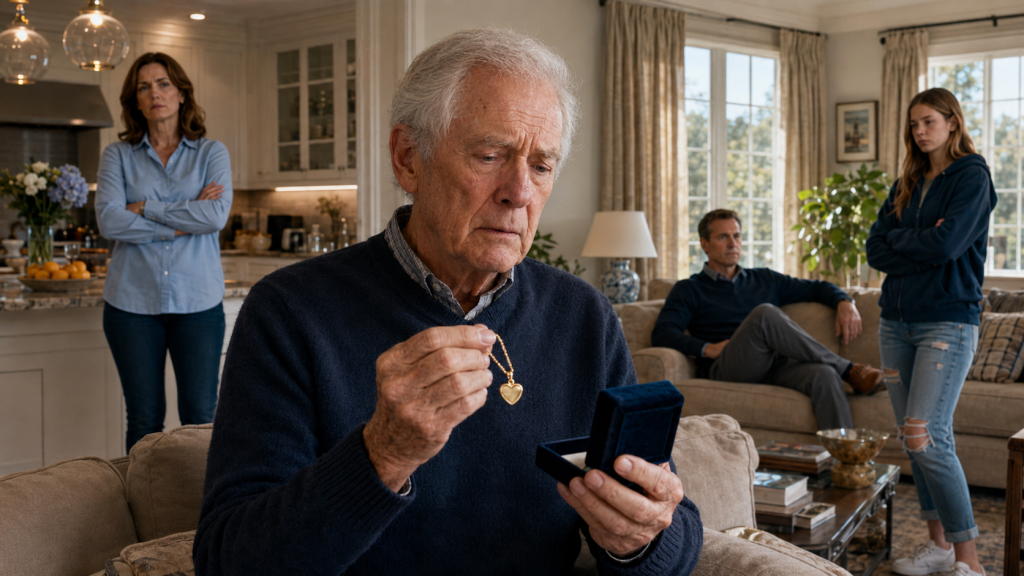
For a moment, I simply stared.
The cream satin interior sat hollow beneath my trembling hands, holding nothing but the shape of what used to be there.
My first thought was that I had moved it.
Maybe grief had finally started bending my memory.
Maybe I had taken the necklace out weeks ago and placed it somewhere else.
I searched the drawer.
Then the drawer beneath it.
Then behind the dresser.
Under the bed.
Inside coat pockets.
In the bathroom cabinet.
In Eleanor’s old jewelry case.
In the linen closet.
In places that made no sense.
The whole time, my heartbeat grew louder.
Downstairs, life went on without noticing that my world had just cracked open.
Jennifer was in the kitchen snapping orders at someone on the phone.
Her husband Michael had the sports broadcast turned up loud in the living room.
My granddaughter Amber was laughing upstairs about how badly she wanted to get back to California, because Phoenix was “basically a waiting room with cactus.”
They had moved into my house after Eleanor died.
“Just until we get back on our feet,” Jennifer had said.
That was three years ago.
Since then, my home had slowly stopped being mine.
My recliner became Michael’s throne.
Eleanor’s sewing room became Jennifer’s overflow closet.
The guest room became Amber’s room, though she spent most nights at friends’ houses and most days asking for money.
The garage filled with boxes no one unpacked.
The kitchen table disappeared under nail polish, fast food bags, unopened mail, and Jennifer’s complaints about how hard life was.
I tried to be patient.
Eleanor had always said Jennifer needed softness.
“She pushes because she feels unsafe,” Eleanor would tell me.
But near the end, even Eleanor’s voice changed when she spoke about our daughter.
One night, a month before she died, she held my hand and whispered, “Wilbur, promise me you’ll protect yourself.”
I thought she meant from loneliness.
I thought she was worried I would stop eating or forget doctor appointments.
I told her I would be fine.
She stared at me with tired eyes.
“No,” she said. “I mean protect yourself from people who love what you give more than they love you.”
I didn’t understand.
Or maybe I didn’t want to.
By the time I walked downstairs that morning, my hands were still shaking, but something inside me had already begun to go cold.
Jennifer stood at the counter, chopping celery with hard, sharp strikes.
“Jennifer,” I said quietly. “Have you seen your mother’s necklace?”
“I’m busy, Dad.”
“It’s gone.”
She sighed without looking up.
“Then you probably misplaced it.”
“I checked everywhere.”
The knife stopped.
For the first time that morning, Jennifer turned around.
There was no panic in her face.
No concern.
No guilt.
Just irritation.
“Fine,” she said. “I sold it.”
I blinked.
The words did not land at first.
“What?”
“I sold it,” she repeated, as if admitting she had thrown away expired milk. “Desert Gold Pawn on Thomas Road. We needed eight hundred dollars for Hawaii. You said no when I asked, so I found another way.”
The kitchen seemed to tilt.
I gripped the back of a chair to steady myself.
“You sold your mother’s necklace?”
Jennifer rolled her eyes.
“Dad, please don’t start.”
“That necklace was Eleanor’s.”
“And Eleanor is gone.”
The silence after that was worse than shouting.
From the living room, Michael did not even sit up.
“It was just sitting there, Wilbur,” he called. “Dead people don’t need jewelry.”
Amber appeared halfway down the stairs, phone in hand.
“Grandpa, you’re being dramatic. It’s just a necklace. Mom got us an awesome vacation.”
I looked at them.
My daughter.
My son-in-law.
My granddaughter.
And for the first time, I saw what Eleanor had tried to make me see for years.
They were not embarrassed.
They were not sorry.
They were waiting for me to accept it.
Jennifer folded her arms.
“Look, I know you’re upset, but we needed that money. Flights are expensive, and Amber has had a stressful semester.”
Amber nodded like this was reasonable.
Michael changed the channel.
Something inside me closed.
Not my heart.
Something weaker.
The part of me that had been making excuses for them.
I turned and walked away.
“Dad,” Jennifer snapped. “Don’t be childish.”
I went upstairs and closed my bedroom door.
The empty velvet box sat on the dresser like a witness.
I picked it up, opened it, closed it, opened it again.
For forty-two years, Eleanor had worn that necklace because it reminded her of my promise.
And I had failed to protect even that.
Then clarity came.
Cold.
Sharp.
Clean.
I took out my phone and began calling pawn shops in Phoenix.
The first had never seen it.
The second put me on hold so long I hung up.
The third was closed.
The fourth did not answer.
Each time, I described it the same way.
Gold chain.
Heart-shaped pendant.
Inscription on the back: Forever W and E.
Sold yesterday, probably by a woman in a hurry.
On the sixth call, a man answered in a low, tired voice.
“Desert Gold Pawn.”
I repeated the description.
There was a pause.
Then the man said, “Oh yes. I remember that piece.”
My chest tightened.
“You have it?”
“I do.”
“I’m the husband,” I said. “My daughter sold it without permission.”
The man went quiet.
When he spoke again, his voice had softened.
“I’m sorry, sir.”
“How much to buy it back?”
“I paid her eight hundred. Fair value is closer to twelve hundred.”
“I’ll pay it.”
Another pause.
“There’s something else you should know.”
I sat down on the edge of the bed.
“What do you mean?”
“When I examined the locket, it opened.”
I frowned.
“Opened?”
“Yes, sir. There was a tiny clasp hidden along the edge. Very clever design. Honestly, I almost missed it.”
My mouth went dry.
“I didn’t know it opened.”
“Well,” he said carefully, “there was something inside.”
I looked at the empty velvet box in my hand.
“What?”
“A small note. Folded very tightly. I removed it carefully so it wouldn’t be damaged. It looked like bank information. A box number, maybe.”
For a second, I couldn’t speak.
Eleanor had hidden a note inside her necklace.
Inside the necklace she wore every day.
Inside the necklace Jennifer had sold for vacation money.
The man cleared his throat.
“I don’t think the woman who sold it knew anything was inside. She seemed in a hurry.”
Of course she had.
Jennifer had looked at her mother’s necklace and seen only cash.
“How soon can I come?” I asked.
“I’ll hold it for you,” he said. “And sir, I won’t sell it to anyone else.”
Thirty minutes later, I stood inside Desert Gold Pawn.
The shop smelled like dust, metal, and old leather. Guitars hung on one wall. Watches gleamed beneath scratched glass. A tired ceiling fan turned slowly overhead.
The man behind the counter was in his sixties, with silver hair, square glasses, and kind eyes.
“Wilbur?” he asked.
I nodded.
“I’m Harold.”
He unlocked a drawer and brought out a folded piece of soft cloth.
When he opened it, Eleanor’s necklace lay inside.
The sight of it nearly brought me to my knees.
Under the fluorescent lights, it looked exactly the way I remembered.
Warm.
Familiar.
Impossible.
I touched the heart with one finger.
“I bought this for her after our first year married,” I said.
Harold nodded quietly, as if he understood that some stories did not need much explanation.
He placed a small envelope beside it.
“The note is in there.”
I paid the twelve hundred dollars without hesitation.
Harold handed me the necklace and receipt.
Then he said, “Sir, if someone sold this without your permission, you may want to speak to an attorney.”
I looked down at the gold heart in my palm.
“I think my wife already wanted me to.”
I drove three blocks before pulling into a shopping center parking lot.
I couldn’t wait any longer.
The afternoon sun poured through the windshield as I held the necklace in my palm.
My thumb found the tiny indentation on the side of the heart.
I pressed.
The locket sprang open.
For forty-two years, Eleanor had worn that secret against her heart.
Inside was a piece of paper rolled so tightly it was barely larger than a grain of rice.
I eased it out with my fingernails and unfolded it against my knee.
The handwriting was Eleanor’s.
Small.
Careful.
Unmistakable.
Bank of Arizona.
Box 4782.
That was all.
No explanation.
No warning.
Just a bank name and a number.
My wife had hidden a secret inside the necklace she wore every day.
A secret my daughter had almost sold to a stranger for a plane ticket to Hawaii.
I drove to the bank with the necklace wrapped around my fist.
The Bank of Arizona branch sat on Camelback Road, cool and polished, smelling faintly of paper and floor wax.
At the front desk, a young woman asked how she could help.
“I need to access a safe deposit box,” I said.
She asked for identification.
Then she looked at the number.
Her smile faded slightly.
“Please wait here, Mr. Harlan.”
For nearly fifteen minutes, I sat in a leather chair beneath a painting of desert mountains, feeling like Eleanor might walk through the door at any moment and explain everything.
Instead, an older manager appeared.
“Mr. Harlan? I’m Rebecca Cole, branch manager. Please come with me.”
She led me into a private office.
“Your wife, Eleanor Harlan, arranged this box before her passing,” Rebecca said. “You are listed as the sole person authorized to access it upon presentation of proper identification and her death certificate.”
I stared at her.
“My wife set this up?”
“Yes, sir.”
“When?”
Rebecca checked the file.
“Four years ago.”
One year before Eleanor died.
My chest tightened.
“She never told me.”
Rebecca’s expression softened.
“Some clients leave instructions for difficult situations.”
Difficult situations.
That phrase stayed with me as she led me to the vault.
A few minutes later, she placed a thin metal box on a private table and left me alone.
For a long time, I only looked at it.
Then I opened the lid.
Inside were three things.
A sealed letter.
A folder of documents.
And a small USB drive.
My hands trembled as I picked up the letter.
On the front, Eleanor had written:
For Wilbur, when you finally need the truth.
I opened it carefully.
My darling Wilbur,
If you are reading this, then something has happened to the necklace.
I know you, my love. You would never open the locket unless someone forced your hand.
That means Jennifer has finally done something cruel enough to wake you up.
I am sorry.
I wish I had been wrong about our daughter.
I wish motherhood had made me blind in the same way fatherhood made you hopeful.
But hope can become a dangerous thing when it keeps you standing in front of people who keep hurting you.
Jennifer has been stealing from us for years.
Small amounts at first.
Cash from my purse.
Checks from the back of the book.
Then credit cards.
Then forged signatures.
I kept records because I knew one day you would need them.
You always saw the little girl who scraped her knee and cried for you.
I saw the grown woman who learned that your love could be used like a key.
Please do not blame yourself.
You loved her.
That was never wrong.
But letting her destroy what we built would be.
Inside this box is everything you need to protect yourself.
I have already transferred the house into the Harlan Family Trust. You are the sole beneficiary during your lifetime. Jennifer has no legal claim to the house, the savings, or my belongings.
If she is living with you, remove her.
If she cries, remember she has practiced crying.
If she threatens you, call Thomas Greer. His card is in the folder.
If you are afraid, hold the necklace.
I wore it every day because you kept your promise to love me.
Now keep one more promise.
Live the rest of your life as yours.
Forever,
Eleanor
By the time I finished, tears had fallen onto the page.
Not loud tears.
Not the kind that shake your body.
Just silent ones.
The kind grief saves for moments when love reaches back from beyond the grave and touches your face.
I opened the folder.
There were copies of bank statements.
Credit card charges.
Forged checks.
Emails.
Loan documents.
A notarized trust agreement.
A deed showing my house was protected.
A list of items Eleanor believed Jennifer had taken from us.
At the back was a business card.
Thomas Greer.
Attorney at Law.
Estate Planning and Elder Financial Protection.
Then I picked up the USB drive.
Rebecca allowed me to use a secure computer in a private office.
When the folder opened, there were videos.
Dozens of them.
The first file was named: Jennifer Kitchen May 14.
I clicked it.
The screen filled with our old kitchen.
Eleanor sat at the table, thinner than I remembered, a scarf wrapped around her head from chemotherapy.
Jennifer stood near the counter, angry.
“You don’t need all that money,” Jennifer said in the video. “You’re dying.”
My breath stopped.
Eleanor’s voice was weak but steady.
“That money is for your father.”
“He won’t know what to do with it.”
“He will live.”
Jennifer laughed coldly.
“For how long? You really think he can manage that house alone?”
Eleanor stared at her.
Then she said something I had never heard my wife say.
“You will not rob him when I am gone.”
Jennifer stepped closer.
“Don’t make me the villain because you’re scared.”
“You made yourself the villain,” Eleanor replied.
The video ended.
I sat frozen.
The next video was worse.
Jennifer admitting she had used one of my cards.
Michael joking that I would never notice.
Amber asking Eleanor why she cared, since “old people don’t even spend money.”
My granddaughter.
My own blood.
I closed the laptop before I could see more.
By the time I left the bank, the sun had begun to lower, turning Phoenix gold and orange.
I sat in my truck with Eleanor’s necklace in my hand.
For three years, I had let Jennifer’s family take over my home because I thought I was being a father.
But Eleanor had known.
She had seen the truth clearly through pain, through sickness, through the fear of leaving me behind.
And she had prepared a way out.
I called Thomas Greer from the parking lot.
He answered on the third ring.
“This is Thomas.”
“My name is Wilbur Harlan,” I said. “My wife Eleanor left me your card.”
There was a pause.
Then his voice changed.
“Mr. Harlan. I’m very glad you called.”
“You knew my wife?”
“Yes. She was a remarkable woman.”
“She left documents.”
“She told me someday you might find them.”
I swallowed hard.
“My daughter sold Eleanor’s necklace.”
Thomas exhaled.
“I’m sorry.”
“I want them out of my house.”
“Then we begin today.”
His certainty steadied me.
For the first time in three years, I did not feel old.
I did not feel helpless.
I felt like a man holding the last gift his wife had left him.
Thomas instructed me not to confront Jennifer alone.
He told me to meet him at his office the next morning with the documents, receipt from the pawn shop, and any proof I had.
But when I pulled into my driveway that evening, Jennifer was waiting on the porch.
Her arms were crossed.
Michael stood behind her.
Amber sat on the porch swing, scrolling through her phone.
“Where have you been?” Jennifer demanded.
I stepped out of the truck.
“Getting your mother’s necklace back.”
Her face flickered.
Only for a second.
Then she hardened.
“You spent money on that? Dad, that was stupid. We needed that money.”
“No,” I said. “You needed it.”
Michael scoffed.
“Here we go.”
I walked past them toward the door.
Jennifer grabbed my arm.
For the first time in my life, I pulled away from my daughter.
“Do not touch me.”
She stared at me as if I had slapped her.
“Excuse me?”
“You sold something that did not belong to you.”
“Oh, stop acting like a victim,” she snapped. “You live in a paid-off house because Mom handled everything. You have savings because Mom saved everything. You would be lost without us.”
I looked at her.
Really looked.
I saw Eleanor’s eyes, but none of her kindness.
“You’re right about one thing,” I said. “Your mother handled everything.”
Jennifer frowned.
I reached into my jacket and touched the necklace.
“She handled more than you knew.”
For the first time, Jennifer went quiet.
That night, I locked my bedroom door.
I slept badly, but I slept with Eleanor’s necklace on the table beside me.
In the morning, I met Thomas Greer.
He was a tall man in his late fifties with gray hair, calm eyes, and a voice that made every sentence feel like a locked door.
He reviewed Eleanor’s documents for nearly an hour.
“She was thorough,” he said.
“She always was.”
“The trust is valid. The deed transfer is valid. The house is protected. Your daughter has no ownership interest.”
I nodded.
“And the necklace?”
“The pawn sale may qualify as theft, depending on value and circumstances. At minimum, we document it. We also prepare a formal notice requiring your daughter and her family to vacate.”
“How long will that take?”
“We can serve notice immediately.”
My hands tightened on the armrests.
“She’s my daughter.”
Thomas’s expression softened.
“I know.”
“I don’t want to ruin her life.”
“Mr. Harlan,” he said gently, “she sold her dead mother’s necklace for vacation money. Protecting yourself is not ruining her life. It is ending her access to yours.”
Those words landed hard.
Ending her access to yours.
By afternoon, legal notices were prepared.
By evening, Thomas arrived at my house with a licensed process server and an officer present to keep the peace.
Jennifer opened the door smiling, assuming someone had come for me.
When she saw the papers, her smile vanished.
“What is this?”
Thomas spoke evenly.
“Formal notice to vacate. You, your husband, and your daughter are required to leave the property within the legal timeframe. You are also being notified to preserve all financial records related to Mr. Harlan and the late Mrs. Harlan.”
Jennifer’s face turned red.
“You can’t do this. This is my childhood home.”
“No,” I said from behind Thomas. “It is my home.”
Michael stepped forward.
“Wilbur, don’t be stupid.”
The officer shifted slightly.
Michael stopped.
Amber began crying.
Not real crying.
Loud crying.
Performance crying.
“Grandpa, you’re kicking us out?”
I looked at her and remembered the video.
Old people don’t even spend money.
“I’m asking you to become responsible for your own life,” I said.
Jennifer pointed at me.
“This is because of that necklace?”
I shook my head.
“No. The necklace only opened my eyes.”
Her expression changed.
She knew.
Maybe not everything.
But enough.
“What did you find?” she whispered.
I looked at my daughter, and for one painful second, I saw the little girl who used to run across this same porch with pigtails bouncing and sidewalk chalk on her hands.
Then I saw the woman in Eleanor’s video.
You’re dying.
“You found out, didn’t you?” she said.
I did not answer.
Her mouth twisted.
“Mom always hated me.”
That was the last lie I allowed in my house.
“Your mother loved you so much it broke her heart,” I said. “But she saw you clearly.”
Jennifer recoiled as if the truth had weight.
The next weeks were ugly.
Jennifer screamed.
Michael threatened.
Amber posted vague messages online about toxic family members and betrayal.
They called relatives.
They twisted the story.
They said grief had made me unstable.
They said I was being manipulated by a lawyer.
They said Eleanor would be ashamed of me.
But Eleanor had left proof.
And proof has a way of silencing people who depend on confusion.
One by one, the relatives stopped calling.
My nephew drove over one Sunday and apologized.
“Aunt Eleanor tried to warn my mom years ago,” he said quietly. “We didn’t listen.”
Jennifer’s family moved out twenty-six days later.
Not gracefully.
Not with apology.
They took too much and left too much.
The house looked wounded after they were gone.
Scratches on the floor.
Stains on the carpet.
Closets packed with things they didn’t want.
Eleanor’s sewing room smelled like perfume and plastic storage bins.
For two days, I walked through the empty rooms unsure what to do with all the silence.
Then I opened the windows.
I cleaned the kitchen table.
I carried Michael’s broken recliner to the curb.
I packed Amber’s abandoned things into boxes.
And in Eleanor’s sewing room, I found her old blue chair buried beneath Jennifer’s coats.
I sat there for a long time.
The afternoon light came through the curtains.
Dust floated in gold stripes.
For the first time in three years, the room felt like hers again.
A month later, Thomas called.
“Jennifer wants to settle the financial claims quietly,” he said.
“Does that mean she admits it?”
“It means she knows we can prove enough.”
I closed my eyes.
“What happens now?”
“She repays a portion. Signs an agreement. No contact except through counsel for a set period, unless you choose otherwise.”
Unless I choose otherwise.
For so long, I had believed family meant keeping the door open no matter who walked through it with muddy shoes.
Eleanor had understood something I had not.
A door is not love.
A door is just access.
And access must be earned.
On Eleanor’s next birthday, I woke before sunrise again.
The house was quiet.
This time, truly quiet.
I made coffee, black as always, and set a second cup across from me out of habit.
Then I went upstairs and opened the drawer.
The velvet box was there.
Inside was the necklace.
Repaired.
Polished.
Safe.
I lifted it gently and pressed the hidden clasp.
The locket opened.
The tiny space inside was empty now, but it did not feel hollow.
It felt like a message had been delivered.
I took Eleanor’s letter from my bedside table and read the last line again.
Live the rest of your life as yours.
Forever,
Eleanor
I carried the necklace downstairs and stepped into the backyard.
The roses Eleanor had planted were blooming badly, uneven and stubborn, but alive.
I smiled at that.
She had always said roses were dramatic flowers.
“Just like people,” she used to say.
I sat on the bench beneath the orange tree and held the necklace in the morning sun.
“I got it back,” I whispered.
The breeze moved lightly through the leaves.
For a moment, I could almost feel her beside me.
Not as a ghost.
Not as a memory.
As love.
The kind that prepares a safe deposit box when it knows it cannot stay.
The kind that hides the truth inside a heart.
The kind that protects you even after death.
I thought losing the necklace meant losing the last piece of Eleanor.
But I was wrong.
The necklace was not the last thing I had left of her.
Her courage was.
Her warning was.
Her love was.
And finally, after three years of living like a guest in my own grief, I stood up, went inside my house, and began living again.
THE END! THANK YOU FOR READING!