

My daughter returned from camp with wet hair, a blanket that wasn’t ours, and a paralyzing fear of entering the bathroom. But I didn’t call the camp director. I called 911.
And before anyone could tell me I was overreacting, I set aside her uniform, her shoes, and that gray blanket. That decision uncovered the truth. Another girl hadn’t come back at all.
Her name was Daniela.
And my daughter knew where she was.
Renata was ten years old.
She had begged me for months to let her go to Saint Emily’s Academy Summer Retreat in the Catskills.
“It’s only five days, Mom,” she had said, bouncing on her heels in our kitchen while clutching the glossy brochure. “They have swimming, crafts, cabins, bonfires, and a talent show.”
The brochure looked perfect.
Smiling children.
Bright blue lake.
Clean wooden cabins.
Teachers with gentle faces.
A chapel at the top of the hill.
The kind of place that promised structure, kindness, and safety.
I had hesitated.
Renata had never spent more than one night away from home without me. She was brave in little ways, but soft-hearted. She cried when our dog stepped on a bee. She apologized to furniture when she bumped into it.
But her best friend Daniela was going.
“Please,” Renata whispered one night, lying beside me on the couch. “I want to try being brave.”
So I signed the form.
I packed her uniform.
I labeled every sock.
I tucked a little note into her backpack that said, “You are loved more than the stars.”
On Monday morning, I watched her climb onto the bus with her pink duffel bag and too-big smile.
Daniela climbed on after her, waving at her mother.
Director Beatrice stood near the bus door, elegant in beige linen, clipboard in hand, calling out each child’s name.
“Gabriela Morales?” she asked.
I lifted my hand.
She smiled.
“Renata is in excellent hands.”
Those words stayed with me.
By Friday night, they would feel like a knife.
The bus was supposed to arrive at eight.
It rolled into the church parking lot at 8:40 p.m.
The other children hopped off screaming, clutching friendship bracelets, backpacks, flashlights, and folded crafts.
Parents laughed.
Children ran into arms.
Someone shouted about marshmallows.
Someone else held up a painted rock like treasure.
Then I saw my daughter.
Renata was the last one out.
She did not run.
She did not smile.
She walked down the bus steps slowly, one hand gripping the rail, her knees pressed together as if every step hurt.
Her hair was damp.
Not messy from lake water.
Not sweaty from a long ride.
Washed.
Flat.
Still wet near the roots.
A gray blanket was draped over her shoulders, even though the air was warm and heavy with summer heat.
Her sneakers were untied.
Her backpack was gone.
The camp coordinator, a woman named Miss Lila, stepped down behind her and smiled too quickly.
“She got carsick on the ride home,” Lila said. “Poor thing. She just needs rest.”
I looked at Renata.
She wouldn’t lift her head.
“Baby,” I said softly. “Where is your backpack?”
Before Renata could answer, Lila said, “It got mixed up with the rest of the luggage. We’ll send it over tomorrow.”
I stared at her.
“And her uniform?”
Renata gripped the blanket tighter.
“It got wet,” she whispered.
“How?”
Lila answered again.
“An accident. Nothing serious.”
I turned my head slowly.
“I asked my daughter.”
The woman’s smile vanished.
Renata grabbed my hand.
Her palm was ice cold.
“Mom,” she said. “Let’s go.”
Something inside me shifted.
It was not panic.
Not yet.
It was older than panic.
A mother’s body recognizing danger before her mind has proof.
I did not argue in the parking lot.
I did not raise my voice.
I did not give Lila a chance to prepare answers.
I put my arm around Renata without squeezing her and walked her to the car.
She climbed into the back seat instead of the front.
That was the first thing that made my throat tighten.
She always rode in front when it was just us.
She liked controlling the radio.
But that night, she curled into the corner of the back seat and wrapped the gray blanket around herself like armor.
“Are you hurting?” I asked.
She shook her head.
But her face twisted like the answer had almost escaped.
The drive home took eighteen minutes.
Renata did not speak once.
She stared out the window.
She smelled of heavy soap.
The sharp kind used in school bathrooms.
Underneath it was something sour.
Fear.
When we got home, our dog Milo ran to the door, tail whipping the air.
Renata did not bend to pet him.
She did not ask for a snack.
She did not go to her room.
She stood just inside the front door with the blanket pulled to her chin.
I set my purse down slowly.
“I’m going to draw you a bath,” I said.
The color drained from her face.
“No.”
“It’s okay, honey. Just to help you get changed.”
“No.”
Her voice cracked.
“I don’t want to go in there.”
“Into the bathroom?”
She started breathing fast.
Her eyes fixed on the hallway as if the bathroom door had become a monster.
“Don’t close the door,” she whispered.
That was when the punch to my chest came.
I crouched down in front of her without touching her.
“Renata,” I said carefully. “I’m going to call a doctor.”
“No.”
“I need to know you’re okay.”
“The teacher said I wasn’t supposed to say anything.”
My blood went cold.
“Which teacher?”
“I can’t.”
“You don’t have to tell me now.”
Her lips trembled.
“She said if we spoke up, the camp would be shut down. And everyone would hate me.”
For one second, the room went silent.
Then my hand reached for my phone.
I dialed 911.
The dispatcher answered, calm and clear.
I forced my voice not to break.
“My ten-year-old daughter just returned from a summer camp. She is in pain. She can’t sit down. She is terrified of the bathroom. Her hair appears to have been washed, her clothes are missing, and an adult told her not to talk. I need an ambulance and a police unit.”
The dispatcher’s voice changed.
Not louder.
Sharper.
“Do not bathe her. Do not change her clothes. Do not wash anything. Do not ask detailed questions. Is she safe with you right now?”
“Yes.”
“Keep her where she is comfortable. Help is on the way.”
I lowered the phone and looked at my daughter.
Renata’s eyes filled with tears.
“Mom,” she whispered. “They’re going to say I made it all up.”
“I won’t.”
“The director says I’m a troublemaker.”
“Did the director speak to you?”
She closed her eyes.
“Everyone spoke to me.”
I wanted to scream.
I wanted to drive back to that camp and tear the doors open with my bare hands.
Instead, I sat on the floor near her.
Not too close.
Not crowding her.
“Can I sit here?”
She nodded.
We waited.
Seven minutes later, red and blue lights flashed against our windows.
The paramedics arrived first.
A woman with kind eyes knelt near Renata and asked permission before every movement.
“Can I look at your hands?”
Renata nodded.
“Can I listen to your breathing?”
Another nod.
The paramedic noticed the blanket.
Then the wet hair.
Then the way Renata kept her legs tucked beneath her.
Her expression shifted.
The softness stayed, but something professional hardened behind her eyes.
“Immediate transport,” she said.
A police officer stepped into the living room.
“Which camp is she coming from?”
“Saint Emily’s Academy,” I said. “The retreat house in the Catskills.”
The officer stopped writing.
He looked at his partner.
The silence between them made my skin prickle.
“What’s going on?” I asked.
“We’ll talk at the hospital,” he said.
Renata overheard.
Her head snapped up.
“Another girl?”
The paramedic knelt down again.
“You don’t have to talk right now.”
My daughter trembled.
“I thought they only punished Daniela.”
The officer looked up.
“Who is Daniela?”
Renata lowered her head.
“The girl who didn’t get back on the bus.”
The ambulance ride blurred.
I sat beside Renata while she stared at the ceiling and clutched my hand.
At the hospital, they moved fast.
A nurse met us at the doors.
A doctor came with a social worker.
The police followed.
They kept the gray blanket.
Sealed.
Dated.
Timed.
They set aside Renata’s shoes.
They wrote down that she had no backpack.
They documented every detail before anyone could destroy the truth.
I was asked to wait outside the examination room while they took care of her.
The nurse saw my face and said gently, “You did the right thing by not bathing her.”
I nodded.
I could not speak.
While I stood in the hallway, my phone began buzzing.
One message.
Then another.
Then another.
Director Beatrice.
“Gabriela, please call me immediately.”
“Renata is confused.”
“It was all just an accident.”
“We need to recover the camp blanket.”
“The blanket belongs to Saint Emily’s.”
“Please do not involve outside parties before we clarify what happened.”
I showed the officer.
He took photos of every message.
“Do not respond,” he said.
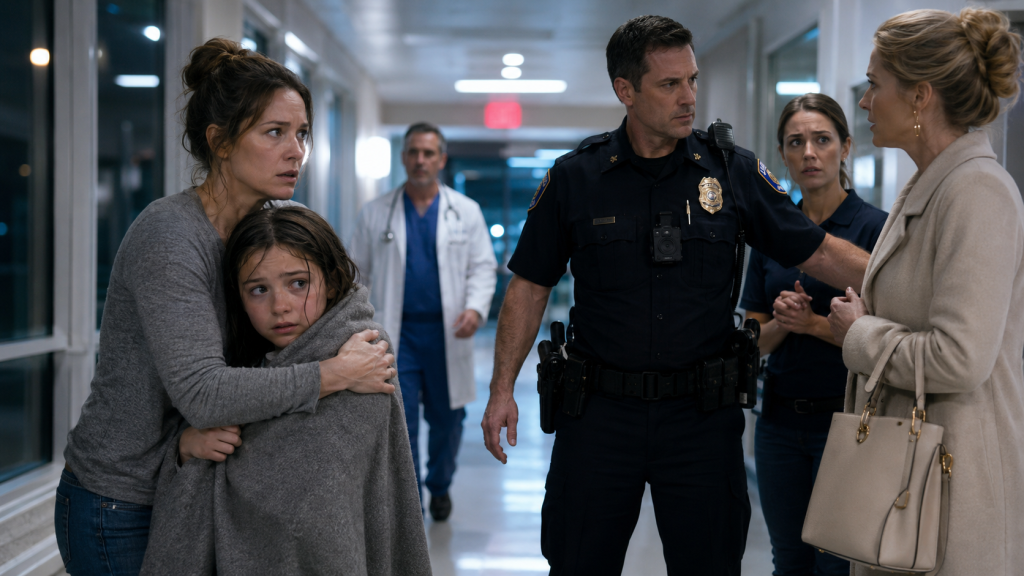
Twenty-five minutes later, Director Beatrice appeared in the hospital hallway.
Impeccable.
Beige coat.
Expensive purse.
Pearl earrings.
Parent-teacher-meeting smile.
Miss Lila followed behind her, pale and stiff.
“Gabriela,” Beatrice said, reaching toward me. “You’re blowing this way out of proportion.”
The officer stepped between us.
“You can’t go in there.”
Beatrice’s eyes narrowed.
“I am the director responsible for the minor.”
The officer did not move.
“Exactly.”
Something flickered across her face.
A tiny crack.
Then she smiled again.
“Renata fell in the showers. She was embarrassed. Children exaggerate when frightened.”
Miss Lila swallowed.
“She fell near the pool,” Lila said suddenly. “That’s what happened.”
The two women looked at each other.
Too late.
The officer noticed.
“So which was it?” he asked.
Beatrice’s mouth tightened.
“Both areas were wet.”
Lila’s phone vibrated.
She pulled it halfway from her pocket, then tried to hide it.
But the screen faced me.
I saw the messages.
“We already cleared the cameras.”
“We still need to find the red backpack.”
My body went numb.
The officer’s voice turned ice cold.
“Hand over the phone.”
Lila looked at Beatrice.
Beatrice said nothing.
“Now,” the officer said.
Lila’s hand shook as she gave it to him.
Then the doctor came out of Renata’s room.
His face was controlled, but his eyes were furious.
“The absurdity,” he said, “is that a child showing these signs was bathed, changed, and sent home without medical evaluation.”
No one answered.
Then Renata came out in a hospital gown.
When she saw Beatrice, her whole body froze.
Beatrice softened her voice.
“Renata, honey. Just tell them it was a fall.”
My daughter stepped backward.
“Mom…”
I moved toward her slowly.
“Can I hug you?”
She nodded.
I wrapped my arms around her, careful and protective.
Then Beatrice said quietly, “Remember what we agreed on.”
The officer turned sharply.
“What did you agree on?”
Renata buried her face in my chest and whispered, “That Daniela was never there.”
The hallway went breathless.
Miss Lila collapsed into a chair.
Beatrice tried to leave.
The police blocked her.
Renata looked up at me, shivering.
“Mom…”
“What is it, baby?”
“Daniela is still at the house.”
“At what house?” the officer asked.
My daughter looked at the director.
“In the room without windows.”
Everything after that happened quickly.
The officer called for backup.
Another detective arrived and demanded the exact address of the retreat house.
Beatrice refused at first.
She said she needed a lawyer.
She said the camp had protocols.
She said children misunderstood discipline.
But then Lila began crying.
Not soft crying.
Broken, terrified sobbing.
“She’s in the lower service building,” Lila said. “Behind the old chapel. The room with cleaning supplies.”
Beatrice spun toward her.
“Quiet.”
That single word told the police everything.
Within forty minutes, patrol cars surrounded Saint Emily’s Academy Retreat House.
I did not see it happen in person, but I heard the details later.
The main building was dark when officers arrived.
A caretaker claimed everyone had gone home.
He said no child was there.
He said he did not have keys to the lower service building.
Then an officer heard a sound.
A faint thump.
Not loud.
Not enough for most people to notice.
But enough.
They broke the lock.
Inside the service building, the air smelled of bleach and mildew.
They found trash bags filled with wet uniforms.
They found children’s shoes.
They found a red backpack hidden behind cleaning supplies.
Daniela’s backpack.
And behind a locked interior door, they found a small storage room with no windows.
Daniela was inside.
Alive.
Curled on the floor beneath a sheet.
Dehydrated.
Terrified.
But alive.
When the officer called from the scene, I collapsed into a hospital chair.
Renata stared at me.
“Is she mad at me?” she whispered.
I pulled her close.
“No, baby. You saved her.”
She began to cry then.
Not the silent tears from before.
Real sobs.
The kind that shook her thin shoulders until I had to hold her upright.
“I tried to help,” she said. “I tried, Mom.”
“I know.”
“They told me I would be next if I didn’t stop asking.”
I closed my eyes.
Every word burned.
“What happened?”
The social worker gently reminded me not to ask for details, not to push, not to lead.
So I stopped.
I kissed the top of Renata’s head and said, “You don’t have to tell me tonight.”
But Renata kept speaking.
Not the full horror.
Not the things no child should have to explain.
Just enough for the truth to take shape.
Daniela had stood up for another camper.
A younger girl had wet her bed, and a counselor had shamed her in front of everyone.
Daniela had said it was cruel.
Renata had agreed.
After that, they were labeled difficult.
Troublemakers.
Disrespectful.
At Saint Emily’s, obedience was everything.
Children who cried were separated.
Children who questioned were punished.
Children who complained were told they were ruining the camp for everyone.
On the last night, Daniela disappeared after dinner.
Renata asked where she was.
The adults said Daniela had gone home early.
But Renata saw Daniela’s red backpack still beside her bunk.
Then, before the bus left, Renata saw Miss Lila carrying the backpack toward the service building.
She followed.
She heard Daniela crying behind a door.
Renata tried to open it.
That was when they found her.
They dragged her back inside.
They washed her hair.
Changed her clothes.
Wrapped her in the gray blanket.
Told her she had been confused.
Told her Daniela had never been there.
Told her if she said one word, her mother would be ashamed of her.
My daughter looked at me when she said that part.
As if she still feared it might be true.
I cupped her face.
“Never,” I said. “There is nothing you could say that would make me stop believing you.”
By dawn, Saint Emily’s Academy was no longer a retreat house.
It was a crime scene.
Parents began arriving before sunrise.
Some had received calls from police.
Some had heard rumors.
Some had been told by the school that there had been a “minor incident.”
The parking lot filled with shouting.
Mothers in pajamas.
Fathers in work boots.
Children wrapped in blankets.
Reporters came next.
Then child protection services.
Then state investigators.
By noon, the story had spread.
But the first official statement from Saint Emily’s was a masterpiece of cowardice.
“We are cooperating fully with authorities regarding an unfortunate misunderstanding involving two campers.”
An unfortunate misunderstanding.
I read those words from Renata’s hospital room and almost threw my phone at the wall.
Daniela’s mother arrived at the hospital that afternoon.
Her name was Marisol.
She looked like a woman whose soul had been ripped out and handed back in pieces.
When she saw me, she stopped.
For one terrible second, neither of us knew what to say.
Then she crossed the hallway and pulled me into her arms.
“Your daughter saved my child,” she sobbed.
I held her while she shook.
Renata watched from the bed.
Daniela was in another room, being treated and protected.
The girls were not allowed to see each other yet.
Doctors wanted both of them calm.
Investigators wanted their statements taken properly.
But Renata asked for paper.
She drew a picture.
Two stick-figure girls holding hands under a tree.
One had brown braids.
One had a red backpack.
At the top she wrote:
I DID NOT FORGET YOU.
I gave the picture to Marisol.
She pressed it to her mouth and cried.
The investigation widened.
Fast.
Parents began calling the police.
Not just from that week.
From previous summers.
One boy had come home refusing to sleep with the lights off.
One girl had developed panic attacks around showers.
Another child had begged never to return but could not explain why.
Their parents had been told the same thing.
Homesickness.
Attention-seeking.
Overactive imagination.
Discipline problems.
Saint Emily’s had built its reputation on obedience.
Rich donors loved it.
Private schools recommended it.
Church boards praised it.
Parents trusted it because it looked respectable.
Because the buildings were clean.
Because the director spoke softly.
Because danger does not always arrive looking like a monster.
Sometimes it wears pearls.
Sometimes it carries a clipboard.
Sometimes it smiles and says your child is confused.
The red backpack changed everything.
Inside Daniela’s backpack, police found her journal.
A folded note from her mother.
A friendship bracelet Renata had made.
And a list.
It was written on Saint Emily’s letterhead.
Names of children.
Dates.
Beside some names were check marks.
Beside others were words.
Defiant.
Emotional.
Unstable.
Punished.
Renata’s name was there.
So was Daniela’s.
Beside both girls’ names, in red ink, was the same word.
Punished.
When the detective told me, I sat in silence.
The hospital room smelled like antiseptic and apple juice.
Renata was asleep under a white blanket, one hand curled around Milo’s collar because my sister had brought him from home.
He lay beside her bed, quiet and watchful.
I looked at my daughter’s face.
Ten years old.
Still with baby softness in her cheeks.
A missing front tooth that was just growing back.
A camp bracelet on her wrist made of blue thread.
How dare they.
How dare they put that word beside her name.
How dare they turn childhood into a ledger.
Director Beatrice was arrested two days later.
So was the caretaker.
Miss Lila agreed to cooperate, but cooperation did not make her innocent.
The police found deleted camera files.
A storage drive hidden in Beatrice’s office.
Fake incident reports.
Unsigned forms.
Records that had been altered after parents complained.
The camp had not made one terrible mistake.
It had protected itself over and over again.
At the first hearing, Beatrice wore the same beige coat.
She looked smaller without her clipboard.
But her eyes still searched the room as if she could find someone to control.
She found Renata.
My daughter sat beside me, wearing a yellow sweater and holding my hand.
She did not have to be there.
The advocate said she could stay home.
But Renata wanted to see one thing.
“I want to see if she still looks scary,” she told me.
“And does she?”
Renata looked across the courtroom.
Beatrice turned her head away.
“No,” Renata whispered. “She looks scared now.”
Marisol sat on my other side with Daniela.
The girls had finally been allowed to meet.
They did not say much at first.
They just hugged.
A long, quiet hug.
Then Daniela whispered, “You came back for me.”
Renata shook her head.
“I told my mom.”
Daniela looked at me.
I had no words.
So I just nodded.
Months passed.
The camp closed permanently.
The sign at the entrance was removed.
The buildings sat empty while the investigation continued.
Families filed lawsuits.
Licenses were revoked.
Board members resigned.
People who once praised Saint Emily’s suddenly claimed they had always had concerns.
I learned something ugly during those months.
Many people prefer a respectable lie over an uncomfortable truth.
They asked why I called 911 so quickly.
Why I didn’t call the director first.
Why I didn’t wait until morning.
Why I didn’t “gather more information.”
They asked these questions because they wanted the world to be polite.
Orderly.
Manageable.
They wanted harm to announce itself clearly.
They wanted evil to look obvious.
But it didn’t.
It looked like a camp coordinator smiling in a parking lot.
It looked like a missing backpack.
It looked like wet hair on a hot night.
It looked like a child whispering, “Don’t close the door.”
Renata healed slowly.
Not in a straight line.
Some days she laughed again.
Some days she could not walk past the bathroom without freezing.
For weeks, we left every door open.
Then we left the hallway light on.
Then one night, she stood at the bathroom doorway with Milo beside her and said, “I want to try.”
I sat outside the door.
Not inside.
Not forcing.
Just there.
She washed her hands.
It took less than a minute.
But when she came out, she looked like she had climbed a mountain.
“I did it,” she whispered.
I cried after she went to sleep.
Not where she could see.
In the kitchen, with the faucet running so she wouldn’t hear.
The trial came nearly a year later.
Renata did not have to describe everything in court.
Her statement had been taken by trained professionals.
Daniela’s too.
But both girls wrote victim impact letters.
Renata asked me to help spell some words.
She wrote:
“My name is Renata Morales. I am not a troublemaker. I was scared, but I told the truth. Daniela was real. What happened was real. Adults should not tell kids to hide bad things so adults can keep their jobs.”
When her letter was read aloud, Beatrice stared at the table.
The judge listened without moving.
Daniela’s letter was shorter.
It said:
“I thought nobody was coming. Renata did.”
That was all.
It was enough.
Beatrice was convicted.
The caretaker too.
Miss Lila received a lesser sentence because she cooperated, but when she apologized in court, Renata did not look at her.
Afterward, reporters waited outside.
Microphones.
Cameras.
Questions.
“How do you feel now?”
“What would you say to other parents?”
“Do you think justice was served?”
I held Renata’s hand and kept walking.
But Marisol stopped.
She turned toward the cameras.
“My daughter came home because another little girl spoke,” she said. “Believe children. Preserve evidence. Call for help. Do not let polite people talk you out of protecting your child.”
That night, Renata and Daniela had pizza at our house.
They sat on the living room floor with Milo between them, watching cartoons.
For the first time in a year, Renata laughed so hard she snorted.
Daniela laughed too.
The sound filled the house.
I stood in the kitchen, holding a plate I had forgotten to put down.
Marisol stood beside me.
Neither of us spoke.
We just listened.
Because sometimes healing does not arrive with grand speeches.
Sometimes it arrives as two little girls eating pizza, arguing about cartoon characters, and remembering they are allowed to be children.
Later, when Daniela went home, Renata came into my room.
She had the gray camp blanket folded in her hands.
The police had returned it after the trial.
I hated that blanket.
I wanted to burn it.
But Renata had asked to keep it until she was ready.
“Mom,” she said. “Can we get rid of this now?”
I sat up.
“Yes.”
We took it outside together.
Not dramatically.
Not with fire.
Not with rage.
We put it in a black trash bag.
Then Renata tied the knot herself.
Her hands shook, but she did it.
The next morning, the garbage truck took it away.
She stood at the window and watched until it disappeared down the street.
Then she turned to me and said, “Can we get pancakes?”
I smiled through tears.
“Of course.”
Two years have passed since that night in the parking lot.
Renata is twelve now.
She is taller.
Louder.
Still gentle, but no longer afraid of her own voice.
She joined the school newspaper.
Her first article was about safety rules for overnight trips.
She interviewed parents, teachers, and a child psychologist.
She asked hard questions.
She did not let anyone answer with empty words.
Daniela is still her best friend.
They have matching bracelets again.
Not from camp.
From a little craft store downtown where they picked the beads themselves.
Red for Daniela.
Blue for Renata.
White between them.
“For the truth,” Daniela said.
Sometimes Renata still has bad days.
Sometimes a smell, a sound, or a closed door brings her back to that place.
Healing is not forgetting.
Healing is learning that the memory does not own every room in your life.
When that happens, we breathe.
We open the door.
We remind her she is home.
And every summer, when camp brochures arrive in the mail, I throw them away.
Not because Renata will never go anywhere again.
She will.
She has already gone on school trips.
She has slept over at Daniela’s house.
She has learned that the world still has good people in it.
But I no longer trust glossy paper.
I ask questions now.
Hard ones.
Who supervises the showers?
Where are the cameras?
What is the medical protocol?
How are complaints documented?
Can parents contact children directly?
What happens if a child says they feel unsafe?
A good organization answers.
A dangerous one gets offended.
That is the difference.
People still ask me how I knew.
I tell them the truth.
I didn’t know.
Not fully.
I only saw what was in front of me.
Wet hair.
A strange blanket.
A missing backpack.
A child afraid of a bathroom.
An adult answering questions that belonged to my daughter.
That was enough.
You do not need proof to ask for help.
You do not need permission to protect your child.
You do not need to be polite when your body is screaming that something is wrong.
That night, the camp director wanted the blanket back.
She wanted the uniform gone.
She wanted the story controlled.
She wanted Daniela erased.
But she made one mistake.
She sent my daughter home to a mother who noticed.
And Renata made one brave choice.
She whispered the truth.
Daniela was real.
Daniela was still there.
And because my daughter spoke, another child came home.
Not untouched by fear.
Not unchanged.
But alive.
Believed.
Held.
Safe.
That is the part I remember when the anger rises.
Not Beatrice in her beige coat.
Not the hallway.
Not the messages.
Not the red ink beside my daughter’s name.
I remember Renata standing at the window two years later, sunlight in her hair, laughing as Daniela ran up our driveway with a birthday gift under her arm.
I remember the girls disappearing into the backyard.
I remember Milo chasing them in circles.
I remember thinking that evil had tried to turn their voices into silence.
But it failed.
Because one frightened little girl told the truth.
And one mother listened before the world could teach her to doubt.
THE END! THANK YOU FOR READING!