

In the divorce courtroom, my husband stood beside his mistress and smirked. “The company, the house, the cars—they’re mine now,” Julian Vance said, loud enough for every person in the courtroom to hear. “You’ll starve in the street.”
The words echoed against the tall wooden walls. For a moment, no one moved. His mistress, Nora Whitlock, stood beside him in a white designer dress, her hand resting lightly on his arm as if she had already replaced me in every way that mattered. She tilted her chin and looked at me with the kind of pity women use when they are certain they have won.
Julian loved audiences.
He always had.
At charity galas, he smiled for cameras.
At medical conferences, he spoke about ethics.
At company retreats, he told employees that Vance Medical Technologies had been built on trust, sacrifice, and family.
But behind closed doors, Julian was never a husband.
He was a man who collected control the way other men collected watches.
And for ten years, I had been his favorite possession.
I sat at the plaintiff’s table in a simple gray coat.
My attorney, Marcus Hale, sat beside me, his hands folded over a black leather folder that had not been opened yet.
Across the aisle, Julian’s attorney looked almost bored. On paper, they had already won.
The mansion was in Julian’s name.
The company was in Julian’s name.
The cars, accounts, investments, patents, and board shares were all under documents that appeared clean and legal.
Three days before I filed for divorce, every joint account had been emptied.
Two days before the hearing, Julian had sent me a message with only four words.
You own nothing now.
He believed that was true.
That was always Julian’s mistake.
He believed paper was stronger than memory.
He believed money was stronger than truth.
He believed silence meant defeat.
“Say something, Iris,” he said softly, but the microphone at his table caught every word. “Beg, maybe.”
A few people in the back shifted uncomfortably.
Nora gave a small laugh behind her hand.
The judge, Honorable Eleanor Marlow, looked down from the bench with narrowed eyes.
“Mr. Vance,” she warned, “this is a courtroom, not a theater.”
Julian smiled.
“My apologies, Your Honor.”
But he was not sorry.
He was glowing.
He had spent years building this moment.
The moment where I looked helpless, where he walked away with the empire, and where Nora stepped into my life like a queen entering a palace.
He thought I had come to court to lose quietly.
My attorney leaned toward me.
His voice was calm, barely above a whisper.
“Now?”
I looked at Julian.
Then at Nora.
Then at the judge.
“Now,” I whispered.
Slowly, I stood.
The legal press lifted their cameras. The clicking began almost instantly.
Julian’s smile faltered.
“Iris,” he said, his voice dropping.
I ignored him.
I unbuttoned my gray coat.
One button.
Then another.
The courtroom became very still.
I slid the coat from my shoulders and placed it carefully over the back of my chair.
Underneath, I wore a sleeveless black dress.
It was modest.
Simple.
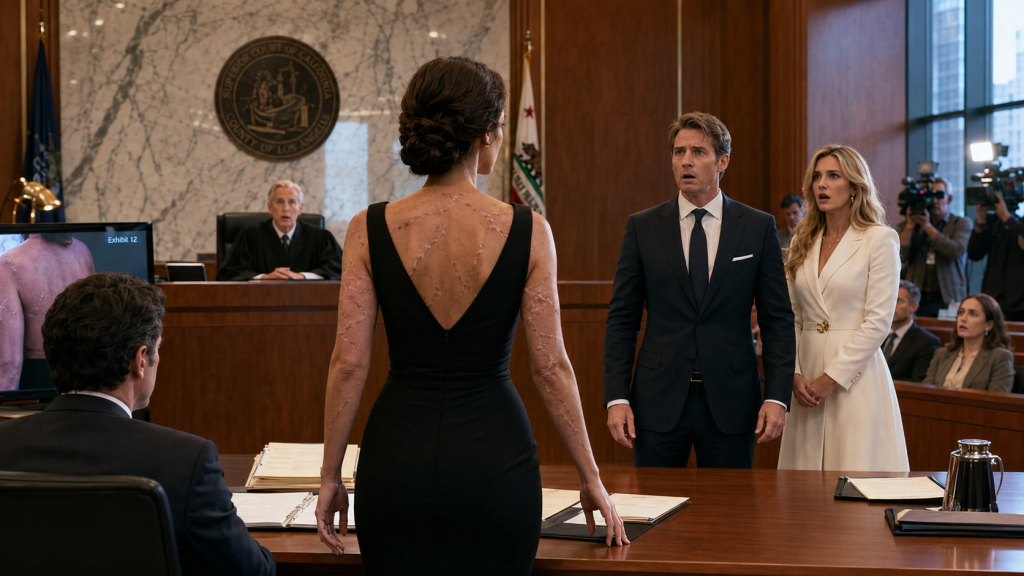
But it revealed what Julian had spent a decade hiding.
Long pale scars marked my shoulders, arms, collarbone, and ribs.
They were not fresh.
They were not theatrical.
They were quiet, old evidence written across my skin.
A gasp moved through the courtroom like wind.
Nora’s hand slipped from Julian’s arm.
Julian went white.
Not pale.
White.
As if all the blood had left his face at once.
Judge Marlow sat forward.
“Mrs. Vance?”
I placed both hands flat on the table.
My voice was low, but it did not shake.
“This is no longer just a divorce trial,” I said. “It is the trial for every dark secret Julian Vance thought would stay buried forever.”
Julian whispered, “Iris, don’t.”
For the first time in ten years, I smiled.
“Don’t what, Julian?”
His jaw tightened.
“Don’t tell them about the locked room beneath the west wing of the mansion?”
The courtroom fell completely silent.
“Don’t tell them about the fake clinical trials?”
His attorney stood.
“Objection, Your Honor. This is outrageous and irrelevant to the marital asset proceedings.”
Marcus rose beside me.
“Your Honor, the defense has built its entire financial claim on forged documents, coerced signatures, hidden corporate transfers, and medical records falsified by Mr. Vance and his associates. We are prepared to show that Mrs. Vance was not only defrauded, but deliberately discredited to conceal criminal misconduct inside Vance Medical Technologies.”
Julian’s lawyer snapped, “These allegations are baseless.”
Judge Marlow looked at Marcus.
“Do you have evidence?”
Marcus opened the black folder.
“Yes, Your Honor.”
Julian’s face hardened.
“Iris,” he said again, quieter this time. “Think carefully.”
I turned toward him.
“I did.”
Then Marcus lifted the first document.
It was a hospital record.
Not one from Julian’s private doctors.
Not one he had paid to write convenient words.
This one came from Mercy General, seven years earlier, under an emergency intake file that Julian had failed to erase because he had not known I kept the discharge copy.
Marcus placed it on the projector.
My name appeared at the top.
Iris Vance.
The date appeared beneath it.
So did the physician’s notes.
The judge read silently.
Her expression changed.
The courtroom followed the highlighted lines.
Nora covered her mouth.
Julian’s attorney stopped moving.
Marcus spoke clearly.
“Mrs. Vance was brought to Mercy General by a housekeeper, not her husband. She reported repeated confinement, coercion, and threats. The injuries recorded by the attending physician were later explained away by Mr. Vance’s private physician as symptoms of emotional instability and self-inflicted distress.”
Julian slammed a hand on the table.
“That is a lie.”
Judge Marlow’s voice cut through the room.
“Sit down, Mr. Vance.”
He did not sit immediately.
The bailiff stepped closer.
Only then did Julian lower himself into his chair.
I remembered that night.
I remembered the rain against the windshield as Mrs. Alvarez, our housekeeper, drove me through the dark with both hands trembling on the steering wheel.
I remembered telling her to turn back three times because I was afraid Julian would ruin her family.
I remembered the young doctor who looked at my arms, then at my face, and asked, “Who did this to you?”
And I remembered answering, “No one who can be stopped.”
I had been wrong.
It had taken ten years.
But Julian could be stopped.
Marcus placed another document on the screen.
A psychiatric evaluation.
Julian’s version of me.
Unstable.
Paranoid.
Delusional.
Unable to manage financial affairs.
Signed by Dr. Elliot Brume, Vance Medical’s private consultant.
Then Marcus placed a second report beside it.
Same date.
Same doctor.
Different conclusion.
“This is the original report recovered from Dr. Brume’s archived server,” Marcus said. “The original states that Mrs. Vance was coherent, consistent, and showed signs of trauma consistent with prolonged coercive control. The version submitted to the court during earlier financial proceedings was altered.”
Julian’s attorney turned sharply toward his client.
Julian did not look at him.
He was staring at me.
For years, he had told me no one would believe me.
He had said truth was useless without access.
He had said proof could be purchased, hidden, rewritten, or buried.
He had not counted on the one person he considered too insignificant to notice.
Mrs. Alvarez.
She had cleaned the mansion for sixteen years.
She had seen everything.
And she had kept copies.
Not because she wanted revenge.
Because she was a mother.
Because one night, when Julian locked me in the old wine room beneath the west wing, she had heard me calling through the vents.
She could not open the door without being caught.
So she did something better.
She began documenting.
Photos of bruised wrists.
Videos of Julian threatening employees.
Receipts from private clinics.
Copies of shredded reports.
And when she died the previous winter, her daughter found a safety deposit key taped beneath a drawer.
The envelope inside had only my name on it.
Iris.
For when you are ready.
I had not been ready then.
But I was ready now.
Marcus lifted a small silver flash drive.
Julian stared at it as if it were a weapon.
“This drive contains internal recordings from Vance Medical Technologies,” Marcus said. “They show Mr. Vance instructing employees to falsify trial data for the Neurovia implant. They also show him threatening staff who refused to comply.”
Judge Marlow’s expression sharpened.
“Are these recordings authenticated?”
Marcus nodded.
“They were reviewed by an independent forensic analyst. We have submitted the chain of custody.”
Julian laughed.
It was sudden, ugly, and desperate.
“You expect the court to believe my bitter wife? She lost her mind years ago. Everyone knows it. Look at her. She is standing here half dressed, performing trauma for sympathy.”
The room chilled.
Nora took one step away from him.
I looked at her.
For the first time, I saw fear in her eyes.
Not compassion.
Fear.
Because Nora had known some of it.
Not all.
But enough.
She knew about the forged signatures.
She knew about the emptied accounts.
She knew about the offshore transfers because she had helped arrange them.
But she did not know about the west wing.
She did not know about the employees.
She did not know that Julian’s empire was not merely cruel.
It was rotten.
“Mrs. Vance,” Judge Marlow said gently, “you may put your coat back on if you wish.”
I glanced at the coat.
Then shook my head.
“No, Your Honor. I wore it long enough.”
Marcus touched the folder again.
“There is another matter.”
Julian’s lawyer closed his eyes briefly.
He knew.
Maybe not everything.
But enough to understand that the divorce case had become something else entirely.
Marcus projected a document onto the screen.
A corporate formation record.
Vance Medical Technologies.
Fifteen years old.
At the bottom were two signatures.
Julian Vance.
And Iris Caldwell.
My maiden name.
A murmur rippled across the courtroom.
Julian’s attorney stood slowly.
“What is this?”
Marcus answered.
“The original incorporation agreement.”
Julian shook his head.
“No.”
I looked at him.
“Yes.”
Before Julian was a billionaire CEO in tailored suits, he was a charming graduate student with debt, ambition, and one prototype device that barely worked.
I was the one with the research grant.
I was the one who built the first investor deck.
I was the one who wrote the patient safety framework that made the company legitimate.
I was the one who sat beside him in a rented office with peeling paint and believed his dreams were our dreams.
The original company had been founded by both of us.
Fifty-fifty.
Then, after our marriage, Julian convinced me to sign “tax restructuring documents.”
He said it would protect us.
He said husbands and wives did not need separate protections.
He said love meant trust.
What he did not say was that the documents transferred my shares into a shell entity controlled by him.
What he did not know was that the first incorporation agreement had been stored with the university archive because the original research funding came through my fellowship.
He had erased the copy in our house.
He had erased the copy in company records.
He had forgotten the university.
Marcus continued.
“The transfer documents Mr. Vance relied on were notarized on a day Mrs. Vance was hospitalized in another state.”
The projector changed.
Flight records.
Hospital records.
A notarized signature.
All on the same date.
The judge stared at Julian’s attorney.
“Counsel?”
The man had no answer.
Julian stood again.
“This is a divorce hearing,” he said sharply. “Not a criminal investigation.”
Judge Marlow’s voice turned cold.
“It may become both.”
That was the first moment Julian looked truly afraid.
Not angry.
Not offended.
Afraid.
And I realized something strange.
I had imagined this moment for years.
I had pictured satisfaction.
Relief.
Maybe even joy.
But what I felt was quieter.
I felt myself returning.
Piece by piece.
Like a house after a long storm, still damaged, but standing.
Marcus placed the final folder on the table.
“This concerns Ms. Nora Whitlock.”
Nora stiffened.
Her lawyer was not there.
She had come to court as Julian’s victorious future wife, not as someone who needed defense.
Marcus looked directly at her.
“Ms. Whitlock, did you sign hotel receipts using Mrs. Vance’s name?”
Nora swallowed.
Julian turned on her instantly.
“Do not answer that.”
Judge Marlow said, “Mr. Vance, one more outburst and I will have you removed.”
Nora’s face trembled.
“I was told it was for privacy.”
“By whom?” Marcus asked.
She looked at Julian.
The silence answered.
Marcus projected a bank transfer.
Two million dollars.
From a Vance Medical consulting account.
To a trust under Nora’s initials.
Then another.
Then another.
“These transfers were made during the same week Mr. Vance claimed marital funds had been lost due to market volatility,” Marcus said.
Nora’s lips parted.
“He said those were gifts.”
I looked at her without hatred.
That surprised me too.
For years, I had imagined Nora as the enemy.
But standing there in that white dress, shaking under the weight of Julian’s lies, she looked less like a queen and more like the next woman he had planned to own.
I did not forgive her.
But I understood the pattern.
Julian used charm like a door.
By the time you realized it locked from the outside, you were already inside.
The judge called a recess.
But no one left quickly.
Reporters rushed into the hallway.
Julian’s attorney bent over him, speaking urgently.
Nora sat alone, staring at her hands.
I finally put my coat back over my shoulders.
Not to hide.
Only because the courtroom had turned cold.
Marcus leaned toward me.
“You did well.”
I looked at the closed courtroom doors.
“I’m not finished.”
Twenty minutes later, court resumed.
This time Julian did not smirk.
His tie was slightly crooked.
His hair, always perfect, had fallen at the temple.
The judge returned to the bench with a stack of papers.
“I have reviewed the emergency submissions,” she said. “Given the allegations of fraud, coercion, document falsification, and potential criminal conduct, this court is freezing all disputed marital and corporate assets pending further investigation.”
Julian’s head snapped up.
“What?”
Judge Marlow continued.
“The mansion, vehicles, investment accounts, and Vance Medical voting shares will remain restricted. No transfers, sales, withdrawals, or executive restructuring may occur without court approval.”
Julian’s lawyer tried to speak.
The judge lifted one hand.
“I am not finished.”
The courtroom held its breath.
“Mrs. Vance has also presented sufficient evidence to question the validity of the share transfers used to remove her from ownership. The court will appoint a forensic accountant and independent corporate examiner.”
Julian looked at me.
There it was.
The look he used to give me behind closed doors.
A promise that I would pay.
But now we were not behind closed doors.
Now everyone saw it.
Judge Marlow saw it too.
“Mr. Vance,” she said, “you will surrender your passport before leaving this building.”
That broke him.
Not loudly.
Not dramatically.
It was smaller than I expected.
His shoulders dropped half an inch.
His eyes shifted toward the exit.
The man who had once locked every door now looked for one.
But there was no door for him anymore.
Only witnesses.
Only records.
Only consequences.
Nora suddenly stood.
“I want to make a statement.”
Julian turned.
“Nora.”
She flinched at her name.
Then she looked at the judge.
“I have documents,” she said. “Emails. Messages. Transfers. He told me they were part of the divorce strategy. I didn’t know everything, but I knew some things.”
Julian’s face twisted.
“You stupid little—”
“Bailiff,” Judge Marlow snapped.
The bailiff moved closer.
Julian stopped.
Nora began crying silently, but her voice continued.
“He told me Iris was unstable. He told me she had tried to destroy the company. He told me everything belonged to him because she was dangerous. But last month, I found a locked file on his laptop. It had her medical records. Photos. Old reports. He kept them.”
The courtroom went still again.
“Why?” the judge asked.
Nora looked at me.
“I think because he liked knowing he could prove the truth and still choose to hide it.”
That sentence landed harder than anything else.
Because it was exactly Julian.
He did not destroy proof because he feared it.
He preserved it because it made him feel powerful.
Marcus requested that Nora’s devices be turned over voluntarily.
She agreed.
Julian stared at her like he had never seen betrayal before.
That almost made me laugh.
After all he had done, he still believed loyalty was something owed to him.
The hearing ended three hours later.
But by then, it was no longer simply a divorce.
The district attorney’s office had been contacted.
Federal investigators were being notified because Vance Medical had participated in government-funded trials.
The board of directors had received emergency notice.
And Julian Vance, the man who had promised I would starve in the street, walked out of the courtroom without his passport, without control of his accounts, and without the mistress he had paraded beside him.
He did not look like a king anymore.
He looked like a man hearing the locks turn from the other side.
Outside the courthouse, cameras flashed.
Reporters shouted my name.
“Mrs. Vance, how long have you been preparing this?”
“Mrs. Vance, are you seeking criminal charges?”
“Mrs. Vance, do you plan to take back the company?”
I stopped at the top of the courthouse steps.
For years, I had hated cameras.
Julian had trained me to fear attention.
He said no one liked emotional women.
He said if I spoke too much, people would call me unstable.
He said silence was safer.
But silence had never saved me.
It had only protected him.
So I turned toward the microphones.
“My name is Iris Caldwell Vance,” I said. “I helped build Vance Medical Technologies. I was erased from my own company, isolated from my own life, and told no one would ever believe me.”
The reporters quieted.
I felt Marcus standing close behind me, steady but not interfering.
I continued.
“What happened today is not revenge. Revenge is personal. This is accountability.”
A woman reporter near the front lowered her microphone slightly.
Her eyes were wet.
I looked straight into the cameras.
“To anyone who has been called unstable because someone powerful needed you silent, keep records. Tell someone. Hide proof if you must. Survive first. Speak when you can.”
My voice almost broke then.
But it did not.
“Today, I spoke.”
I stepped away before the questions could swallow me whole.
Marcus guided me toward the waiting car.
Inside, with the doors closed and the noise muffled, I finally exhaled.
My hands began shaking.
Not from fear.
From the body finally understanding that it did not have to hold the same armor anymore.
Marcus handed me a bottle of water.
“You changed everything today,” he said.
I looked through the tinted window.
Across the courthouse steps, Julian was being surrounded by cameras.
Nora stood far from him, speaking to someone from the district attorney’s office.
Julian turned once and found me behind the glass.
For ten years, his eyes had been a cage.
Today, they were only eyes.
I was surprised by how little power they had left.
Six months passed before the final divorce judgment.
By then, Julian had resigned under pressure.
The board had voted to suspend him from all operations.
The federal investigation had expanded.
Former employees came forward.
Some had been threatened.
Some had been paid.
Some had been afraid for years.
Mrs. Alvarez’s documents opened the first door.
Nora’s files opened the second.
The rest came like rain.
The mansion was awarded to me temporarily during asset review, but I never moved back in.
I sold it after the civil case settled.
People expected me to keep it as a symbol.
But to me, it was not a victory.
It was a beautiful prison with marble floors.
I donated part of the proceeds to a foundation for survivors of coercive control and workplace whistleblowers.
The rest I used to start again.
Not small.
Not hidden.
Again.
Vance Medical Technologies was renamed Caldwell Biomedical after the board restored my founding shares and removed Julian’s family name from the company.
On the day the new sign went up, I stood across the street and watched the workers lower the old letters.
VANCE.
One by one, they came down.
V.
A.
N.
C.
E.
Each letter landed in the truck with a dull metallic sound.
I did not cry.
I thought I would.
Instead, I felt a quiet space open inside me.
A place where fear used to live.
Marcus visited that afternoon with the final court order.
Julian had tried one last time to claim I had manipulated the evidence.
The court rejected it.
The forensic audit confirmed everything.
The forged transfers.
The hidden accounts.
The falsified records.
The altered medical reports.
The judge’s written decision was severe.
But there was one line I read three times.
The court finds Mrs. Iris Caldwell Vance credible.
Credible.
Not unstable.
Not bitter.
Not weak.
Credible.
One word cannot heal a decade.
But it can unlock a door.
A year after the courtroom hearing, I returned to Mercy General.
Not as a patient.
As a donor.
The hospital opened a confidential legal-medical support unit for people experiencing domestic coercion, financial abuse, and intimidation.
At the ribbon cutting, the same doctor who had treated me years earlier approached me.
Her hair had more silver now.
Her eyes were the same.
“I always wondered what happened to you,” she said softly.
I smiled.
“I survived.”
She squeezed my hand.
“No,” she said. “You came back.”
That night, I went home to my new apartment overlooking the river.
It was not a mansion.
There were no marble floors.
No locked wings.
No rooms that held their breath.
Only warm lamps, open windows, and shelves filled with books I had chosen myself.
For dinner, I made soup.
Something simple.
Something quiet.
Halfway through eating, I realized I had not checked the locks three times.
I had not listened for footsteps.
I had not wondered what mood waited on the other side of a door.
I sat there with my spoon in my hand and began to cry.
Not because I was sad.
Because peace felt unfamiliar.
Because safety can feel like grief when you have lived too long without it.
The next morning, a letter arrived from Julian.
It came through his attorney.
I almost threw it away unopened.
But then I sat by the window and read it.
Iris,
You destroyed my life.
That was the first line.
I laughed.
Not loudly.
Just once.
He had not changed.
Not really.
He wrote about betrayal.
About humiliation.
About how everyone had turned against him.
He wrote as if truth had attacked him in an alley.
He wrote as if consequences were cruelty.
At the end, he said:
You were nothing before me.
I folded the letter carefully.
Then I placed it into the shredder.
The machine pulled the paper from my fingers and cut his words into thin white strips.
I watched until every sentence disappeared.
Then I went to work.
The new company lobby smelled of fresh paint and coffee.
Employees greeted me as I passed.
Not with fear.
Not with forced loyalty.
Just respect.
In the main conference room, the leadership team waited.
For years, Julian had sat at the head of every table.
He believed power lived in chairs, titles, signatures, and locked doors.
I had learned power was something else.
Power was evidence kept safe by a housekeeper.
Power was a doctor writing the truth even when no one listened.
Power was a mistress choosing to speak when silence would have protected her.
Power was standing in court with scars visible and refusing to be ashamed of surviving.
I took my seat.
Not at the head of the table.
In the center.
Where I could see everyone.
Where everyone could see me.
The room quieted.
I opened the first folder of the morning.
“We begin with patient safety,” I said.
No one argued.
No one smirked.
No one told me to beg.
And for the first time in a very long time, my life did not feel like something I had escaped.
It felt like something I had reclaimed.
Later that evening, I walked alone along the river.
The city lights shimmered on the water.
My phone buzzed with a news alert.
Julian Vance indicted on multiple counts related to fraud, coercion, and falsified medical trial data.
I stared at the headline for a long moment.
There had been a time when seeing his name made my chest tighten.
Now I felt only distance.
Not forgiveness.
Not yet.
Maybe not ever.
But distance was enough.
I slipped the phone into my coat pocket and kept walking.
The night air was cold, but clean.
Behind me was the courthouse.
Behind me was the mansion.
Behind me was the courtroom where Julian had told me I would starve in the street.
I smiled at the memory now.
Because he had been wrong about everything.
I had not starved.
I had not collapsed.
I had not disappeared.
I had walked into that courtroom carrying the truth beneath my coat.
And when the moment came, I stopped hiding it.
Some people thought the scars were the story.
They were not.
They were only proof that the story had not ended when Julian wanted it to.
The real story began when I stood up.
When I removed the coat.
When I looked at the man who had built an empire from lies and whispered the truth loud enough for the whole world to hear.
This is no longer a divorce trial.
It never was.
It was the day I stopped being evidence of his cruelty.
And became the witness to my own survival.
THE END! THANK YOU FOR READING!