

My husband had always been painfully cheap—until he handed me a luxury handbag at my birthday party. But when I discovered where it came from, my face went cold, and I reached for my phone.
Robert never bought me presents. Not once in fifteen years. “Flowers die,” he always said. “Cards get thrown away. Gifts are just money leaving the house.” So I learned to smile quietly when my friends showed me anniversary bracelets, weekend trips, or small velvet boxes from their husbands.
I learned not to expect anything on Valentine’s Day.
I learned not to look disappointed on Christmas morning when Robert handed me a practical kitchen tool and said, “You needed this anyway.”
I learned to tell myself love did not need wrapping paper.
Robert worked for the county.
We were not rich, but we were not struggling either. We had a modest house, two cars that ran, food in the refrigerator, and enough money to pay the bills without panic.
But Robert guarded every dollar as if it might run away.
He checked receipts.
He complained when I bought name-brand cereal.
He turned off lights behind me like electricity was a personal enemy.
Once, I bought a soft blue sweater on sale for twenty-four dollars, and he stared at the bag like I had dragged home a gambling debt.
“You already own sweaters,” he said.
I stopped showing him what I bought after that.
I stopped hoping he would surprise me.
Then, three months ago, something changed.
Robert started leaving before sunrise and coming home long after midnight.
At first, he said the county office was short-staffed. Then he said there were repairs at one of the public buildings. Then he stopped explaining altogether.
His hands were scraped.
His eyes looked exhausted.
His clothes carried the smell of soap and bleach that did not come from our house.
Some nights, he came home so tired he barely ate dinner. He would stand in the doorway with his lunchbox hanging from one hand, his shoulders slumped, and his face pale under the porch light.
One night, I finally asked, “Robert, what is going on?”
He would not look at me.
“Nothing happened, Elaine.”
“But you are never home anymore.”
“I told you, work is busy.”
“Work has been busy for three months?”
He rubbed the back of his neck.
“It will settle down.”
“When?”
He kissed my forehead, as if that ended the conversation.
But it did not end anything inside me.
It only made the questions louder.
I started noticing things.
He took phone calls outside.
He washed his work shirts separately.
He kept a small notebook in the glove compartment of his truck, and the one time I reached for it, he snapped, “Don’t touch that.”
Robert never snapped at me.
Not like that.
So suspicion moved into our house and sat between us at the dinner table.
I wondered if there was another woman.
I hated myself for thinking it, but what else was I supposed to think?
He was gone at strange hours.
He smelled like unfamiliar places.
He was secretive, nervous, and distant.
And then came my thirty-fifth birthday.
I expected nothing.
That morning, I made my own coffee, packed my own lunch, and found Robert standing at the kitchen counter, staring at me with a strange expression.
“Wear your nice dress tonight,” he said.
I looked up.
“My nice dress?”
“The green one.”
“Why?”
He cleared his throat.
“Just wear it.”
For one wild second, my heart lifted.
Maybe he was taking me to dinner.
Maybe after fifteen years, he had finally realized that love did not have to be expensive, but it did have to be visible.
So I put on the green dress.
I curled my hair.
I used the perfume I saved for weddings and funerals.
When I came downstairs, I found our dining room full of people.
My sister Rachel was there.
Our neighbors were there.
Robert’s brother and his wife were there.
Even my mother, who lived two towns over and rarely drove after dark, sat at the table with a paper party hat tilted on her silver hair.
“Surprise!” everyone shouted.
I laughed because I was supposed to.
For a while, I forgot to be suspicious.
There was cake.
There were candles.
There was music from a small speaker on the counter.
Robert stood beside me, smiling too brightly, watching me as if he were waiting for a verdict.
After everyone sang Happy Birthday, he disappeared into the hallway.
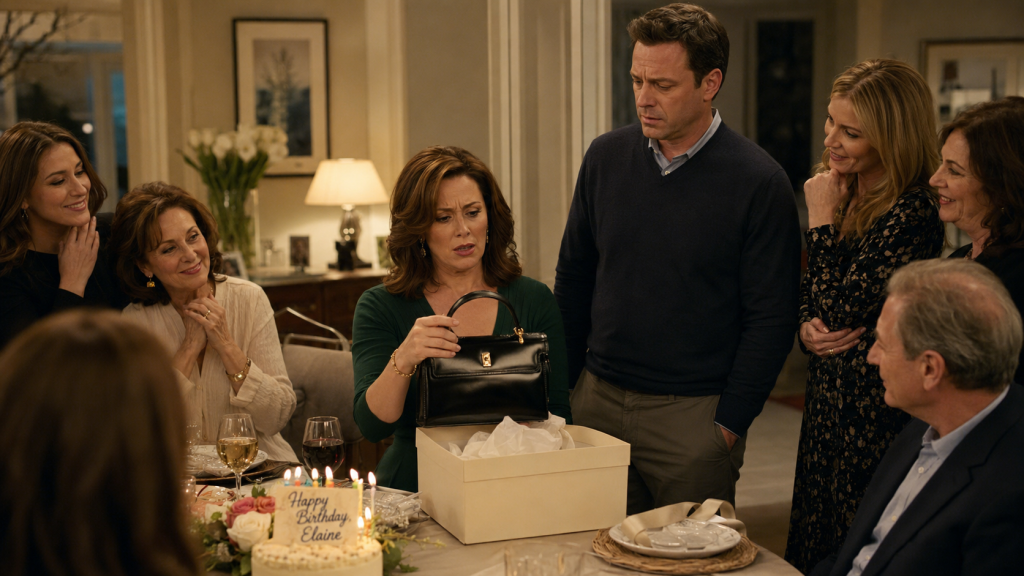
When he returned, he was carrying a cream-colored box tied with black ribbon.
The room went silent.
Robert placed it on the table in front of me.
I stared at it.
“What is this?”
“Open it,” he said.
Rachel leaned close, already grinning.
“Elaine, that box looks expensive.”
I pulled the ribbon loose.
My fingers trembled, not from joy exactly, but from disbelief.
When I lifted the lid, several people gasped.
Inside was a glossy black designer handbag with gold hardware.
Not a department store purse.
Not a knockoff.
A real luxury handbag, the kind I had only ever seen behind glass or on women who walked through airports like the world had been arranged for them.
My sister whispered, “Elaine… that probably costs more than my car.”
Robert smiled at everyone.
“For my beautiful wife,” he announced.
Everyone clapped.
My mother pressed her hand to her chest.
“Oh, Robert, how wonderful.”
I should have cried from joy.
I should have hugged him.
I should have felt loved.
But the moment I touched the handle, my fingers stiffened.
The leather did not feel new.
It was too soft.
Too warm.
Too worn in the exact place another woman’s hand would have held it again and again.
I turned it slightly.
There was a faint scratch near the gold clasp.
A tiny dark mark near the bottom seam.
The handbag was beautiful, but it was not new.
Robert saw my face change.
Only for a second, his smile slipped.
Then he clapped his hands and said, “Cake, everyone. Let’s have cake.”
The party continued around me.
People laughed.
They admired the bag.
They took photos of me holding it.
I smiled because I had learned years ago how to smile while swallowing something sharp.
But inside, my thoughts were racing.
Where did Robert get this?
Why did he pretend it was new?
Why give me something so expensive after fifteen years of refusing even flowers?
Later, while pretending to look inside the bag, I found a hidden pocket beneath the lining.
My fingertips brushed something stiff.
A folded piece of paper.
I almost pulled it out right there in front of everyone.
But Robert was watching me from across the room.
His face had turned gray.
So I left it there.
I smiled through the rest of the party.
I thanked everyone.
I hugged my mother goodbye.
I walked Rachel to the door while she kept saying, “I can’t believe Robert did that. Maybe he finally learned.”
I did not answer.
When the last car pulled away, the house became painfully quiet.
Robert stood in the kitchen beside a stack of dirty plates.
He looked like a man waiting for bad news.
I carried the handbag in both hands and placed it on the counter between us.
“Tell me the truth,” I whispered. “What does this handbag really mean?”
Robert closed his eyes.
When he opened them again, they were wet.
“I will tell you,” he said. “But first, you need to understand something.”
My stomach dropped.
“It is already too late to change it.”
His words sent a chill through me.
With shaking hands, I pulled the folded paper from the bag.
There was no name.
No explanation.
Only a phone number written in careful blue ink.
Robert whispered my name, but I barely heard him.
I never imagined I would do something like that to my husband.
But I grabbed my phone and dialed the number.
The phone rang four times.
Then a woman answered.
Her voice was quiet, careful, and tired.
“Hello?”
I stared at Robert while the blood drained from his face.
“Who is this?” I asked.
The woman went silent.
Then she whispered, “You found the bag.”
My knees weakened.
Robert stepped forward.
“Elaine, please.”
I lifted one hand, warning him not to come closer.
“Where did my husband get this handbag?”
The woman inhaled shakily.
“My name is Claire.”
“Claire who?”
“Claire Bennett. My sister was Marissa Bennett.”
I looked at Robert.
He had turned away from me, one hand pressed against his mouth.
“Was?” I asked.
There was a long pause.
Then Claire said, “She died six weeks ago.”
The kitchen seemed to tilt.
I gripped the edge of the counter.
“What does your dead sister have to do with my husband?”
Robert flinched.
Claire’s voice broke a little.
“She cleaned offices at the county building. That’s where she met Robert.”
Something inside my chest hardened.
“How well did she know him?”
“Not the way you are thinking,” Claire said quickly. “Please, not like that.”
I laughed once, but there was no humor in it.
“You don’t know what I am thinking.”
“I think I do,” she said softly. “And you deserve the truth.”
Robert finally turned around.
“Elaine, let me explain.”
“No,” I said. “She will explain.”
Claire took a breath.
“Marissa got sick last year. Cancer. She kept working longer than she should have because she had a son to support and no savings. She was proud. Too proud. She refused help from almost everyone.”
My grip loosened slightly.
“Then why would Robert help her?”
“Because he found her crying in a storage room one night,” Claire said. “She had just gotten bad news from the doctor. She was too weak to drive home. Your husband drove her.”
I looked at Robert.
Tears had slipped down his face.
He did not wipe them away.
Claire continued, “After that, he started helping. Quietly. He repaired things in her apartment. He brought groceries. He sat with her son when she had treatment. He helped us move furniture after she got too weak to climb stairs.”
My throat tightened.
The bleach.
The scraped hands.
The late nights.
Claire said, “When Marissa died, Robert helped me clear her apartment. We couldn’t afford movers, and I was completely alone. He never asked for anything. He never even let me pay for gas.”
I closed my eyes.
All the angry stories I had built in my mind began to collapse, but they did not disappear completely.
One question still stood in the rubble.
“Then why the handbag?” I asked.
Claire went quiet.
When she spoke again, her voice was different. Smaller.
“That bag was Marissa’s dream.”
I looked down at the glossy black leather.
“She bought it years ago, before she got sick. Back when she had a good job and believed her life was going somewhere. She used to joke that it was the most foolish thing she had ever bought, but she loved it.”
My fingers brushed the scratch near the clasp.
Claire said, “Near the end, she told Robert she wanted you to have it.”
“Me?” I whispered.
“She said any woman married to a man who could give so much in secret deserved to receive something beautiful in public.”
The words hit me so hard I had to sit down.
Robert covered his face.
I stared at him.
For fifteen years, I had believed he was cheap because he did not care.
But now I saw another possibility.
Maybe he was terrified of waste because he had grown up with nothing.
Maybe he did not know how to show love with gifts.
Maybe he thought providing quietly counted more than celebrating loudly.
But even if that was true, he had still hidden all of this from me.
And that hurt too.
“Why didn’t you tell me?” I asked him.
Robert lowered his hands.
His voice came out rough.
“At first, it wasn’t my story to tell.”
“And later?”
He looked ashamed.
“Later, I didn’t know how.”
Claire spoke gently through the phone.
“There is another note.”
I froze.
“What?”
“Inside the lining. Robert didn’t know about it. Marissa told me she tucked something deeper in the bag, but I never found it.”
I turned the bag over with trembling hands.
Robert moved closer, then stopped when I looked at him.
Together, in silence, we searched the lining.
Near the bottom seam, behind a small loose stitch, my fingers caught paper.
This one was smaller.
Folded twice.
The handwriting was careful but weaker than the first note.
I opened it.
Dear Elaine,
You do not know me, and I am sorry that a stranger’s belongings have entered your home with questions attached.
Your husband helped me during the loneliest months of my life.
Not in a romantic way.
Not in a way that should frighten your heart.
He helped like a decent person helps when no one is watching.
He carried boxes.
He fixed my broken sink.
He brought my son pancakes when I was too sick to stand.
He listened when I was afraid of dying.
Every time I thanked him, he said, “My wife would do the same.”
So in a strange way, I felt I knew you.
I wanted you to have this bag because it once made me feel beautiful on days when I felt invisible.
I hope it does the same for you.
But I also hope you ask your husband why he is so afraid to let kindness be seen.
Life is shorter than we think.
Love should not have to hide in storage rooms.
Marissa.
By the time I finished reading, I could not see the paper clearly.
My tears blurred the words.
The kitchen was silent except for the sound of Robert trying not to sob.
I ended the call after thanking Claire, though my voice barely worked.
Then I placed the phone on the counter and looked at my husband.
For a long moment, neither of us spoke.
Finally, I said, “You let me think the worst.”
“I know.”
“You let me feel lonely for years.”
His face crumpled.
“I know.”
“You helped another woman’s family in ways you never let me see inside our own marriage.”
Robert shook his head.
“I thought I was protecting you from worry.”
“No,” I said quietly. “You were protecting yourself from being known.”
He looked at me then, truly looked at me, and something in him seemed to break open.
“My father used to call my mother useless every time she asked for anything,” he said. “A dress. A birthday cake. A ride to see her sister. Anything. He made her feel guilty for wanting anything beautiful.”
He swallowed.
“I promised myself I would never be reckless with money. I thought if I kept us safe, if I paid the bills, if I made sure nothing fell apart, that was love.”
“It is part of love,” I said. “But it is not all of it.”
He nodded, crying now without trying to hide it.
“I didn’t know how to give without feeling afraid.”
I looked at the handbag on the counter.
For an hour, I had hated it.
Now it felt heavier than leather and gold.
It carried Marissa’s final kindness.
It carried Robert’s secret guilt.
It carried fifteen years of silence between us.
“I don’t need expensive things,” I said. “I never did.”
Robert whispered, “I know.”
“No, you don’t. Because you thought this bag would fix something.”
He looked down.
“It won’t.”
“I know.”
“What I needed,” I said, “was to feel chosen without having to beg for it.”
He pressed both hands flat against the counter, as if holding himself up.
“I am sorry, Elaine.”
I wanted to forgive him immediately.
I wanted to step into his arms and let the tenderness of the story erase the pain of the years.
But real forgiveness does not work like a light switch.
So I told him the truth.
“I love that you helped her. I do. I am proud of that part of you.”
He closed his eyes.
“But I am angry that you hid it. I am angry that strangers saw your generous heart while I spent years feeling like I was asking too much.”
Robert nodded.
“You are right.”
That was the first gift he gave me that night.
Not the handbag.
Not the party.
The words.
You are right.
The next morning, Robert did something he had never done before.
He called in sick.
Then he made coffee, sat across from me at the kitchen table, and told me everything.
He told me about Marissa’s son, Jonah, who was nine and loved dinosaurs.
He told me about Claire, who had been driving two hours every weekend to help.
He told me about Marissa falling asleep in a chair while he assembled a secondhand bed frame in the next room.
He told me how she cried when she realized she would not live long enough to see Jonah turn ten.
And he told me how afraid he had been to come home and explain why he smelled like bleach, why his hands were cut, why his heart was somewhere sad that I could not reach.
“I thought you would be angry,” he said.
“I was angry anyway.”
He gave a broken little laugh.
“I see that now.”
A week later, we visited Claire.
I wore a simple gray coat and carried the black handbag.
Not because I wanted to show it off.
Because I wanted Marissa’s sister to see that it was not hidden in a closet like shame.
Claire lived in a small apartment on the second floor of a brick building.
When she opened the door, she looked younger than her voice had sounded, but grief had aged her eyes.
Beside her stood a boy with dark hair and serious cheeks.
Jonah.
He stared at Robert first.
Then he ran straight into his arms.
Robert held him like he had done it before.
And suddenly, I understood how much of my husband’s life had been happening outside my view.
It hurt.
But it also softened something.
Claire made tea.
Jonah showed me a plastic dinosaur with one missing leg.
Robert fixed a loose cabinet handle without being asked.
And when Claire saw the handbag beside my chair, her eyes filled.
“She would have loved that you brought it,” she said.
I touched the handle.
“I wish I had known her.”
Claire smiled sadly.
“She thought she knew you a little.”
Before we left, Jonah handed me an envelope.
“Aunt Claire said this picture is for you.”
Inside was a photograph of Marissa.
She stood in sunlight outside an office building, smiling wide, the black handbag hanging from her arm.
She looked beautiful.
Not because of the bag.
Because for one captured second, she looked alive without fear.
I kept that photo.
I placed it inside the hidden pocket where I had found the phone number.
Months passed.
Robert changed slowly, not perfectly.
He still turned off lights.
He still checked receipts.
But on ordinary Fridays, he brought home flowers from the grocery store.
Not expensive ones.
Small bunches wrapped in plastic.
The first time, he held them out awkwardly and said, “They will die, but maybe that is not the point.”
I laughed so hard I cried.
On our next anniversary, he gave me a card.
His handwriting filled the whole inside.
No grand speech.
No borrowed poem.
Just words that belonged to him.
I am learning that love should not only be useful.
Sometimes it should be seen.
I taped that card inside my closet where I could read it when old loneliness tried to return.
As for the handbag, I did not use it every day.
It was too precious for that.
I carried it to weddings.
To dinners.
To Jonah’s tenth birthday party, where Robert stood beside me with cake frosting on his sleeve and tears in his eyes.
Claire became part of our lives in a quiet way.
Not like family exactly.
Something gentler and stranger.
A reminder that people can enter your marriage without threatening it, if truth is allowed to stand in the room with them.
One evening, almost a year after my birthday, Robert and I sat on the porch while the sky turned pink over our street.
He reached for my hand.
“I thought that bag would make you happy,” he said.
I looked at him.
“It did not make me happy at first.”
“I know.”
“But it gave us the truth.”
He nodded.
“And that was better than happiness.”
Robert squeezed my hand.
For fifteen years, I had thought my husband’s heart was locked behind thrift, fear, and silence.
Then a dead woman’s handbag opened it.
Not gently.
Not easily.
But completely enough for light to get in.
And sometimes, that is how a marriage begins again.
Not with a perfect gift.
Not with applause in a dining room.
But with a phone number, a trembling hand, and the courage to finally ask where love has been hiding.
THE END! THANK YOU FOR READING!