

My father caught sight of the scars stretching across my neck and shoulder, took one slow step backward, and said in a hushed voice, “I’m not walking a damaged woman down the aisle.”
Only three minutes remained before the wedding procession was set to begin when Richard Vale turned his back on me outside the chapel entrance. In that instant, the voices, the music, and the crowd all disappeared.
The only sound left was the faint ringing that had haunted me ever since the explosion in the Arabian Sea.
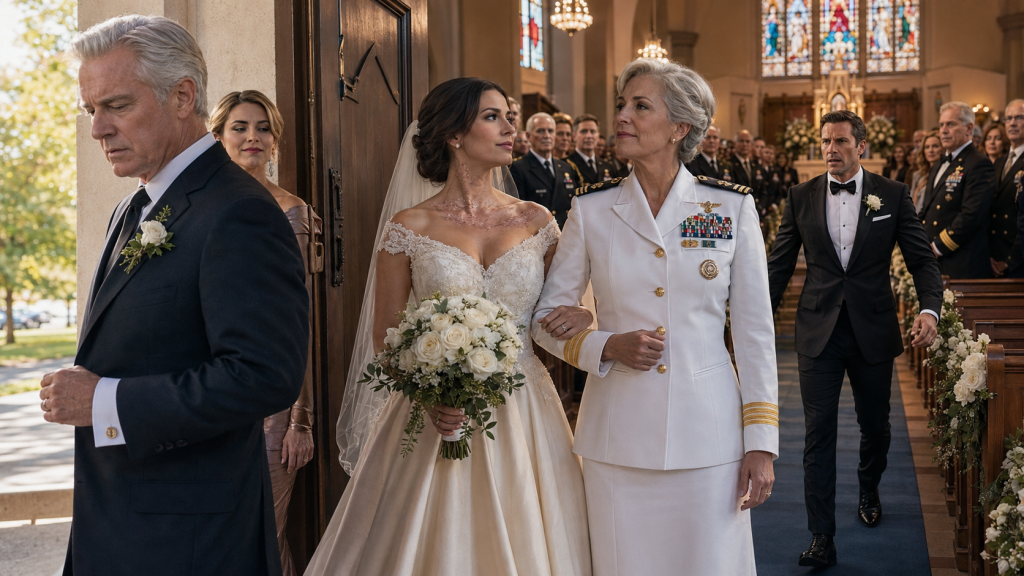
I stood in my wedding dress beneath the stone archway of St. Matthew’s Chapel, one hand holding my bouquet, the other resting lightly against the scarred skin near my collarbone.
The dress was beautiful.
Ivory silk.
Soft sleeves.
A fitted bodice.
A neckline I had chosen on purpose.
I had spent years hiding pieces of myself from the world.
Today, I had decided not to hide.
My father stared at me as if the sight offended him.
He straightened the silver cuff links on his sleeves before glancing toward the rows of politicians, corporate leaders, and decorated naval officers filling the chapel.
“Those wedding photos will be around forever,” he said without emotion. “I won’t spend the rest of my life remembered standing next to… that.”
That.
Not my scars.
Not my proof of survival.
Not the mark of the fire I had walked through and lived.
Just that.
To him, I was no longer Lieutenant Evelyn Vale.
I was not the daughter who had once emptied her savings to rescue his failing business.
I was not the little girl who used to wait by the front window for him to come home from late meetings.
I was not the officer who dragged three sailors through burning steel while smoke swallowed the deck.
In my father’s eyes, I had become nothing more than an embarrassment.
The scars across my skin seemed to tighten beneath his judgment, but I refused to cover them.
I had survived an inferno, months in hospital rooms, surgeries that left me shaking, and rehabilitation sessions where even lifting my arm felt impossible.
If I could endure all of that, I could endure my father’s rejection.
Behind him, my sister Camille wore a satisfied smile.
Her pearl earrings swayed as she leaned closer.
“Dad’s only thinking about the family’s reputation,” she said softly. “You really should have worn a dress with a higher neckline.”
“I’m already wearing my wedding dress,” I answered.
“Then delay the ceremony.”
My fiancé, Daniel Mercer, took an angry step forward, his face pale with disbelief.
Before he could speak, I gently caught his wrist.
“Not now,” I whispered.
His eyes met mine.
Daniel had never once looked at my scars with pity.
Not when he helped me change bandages after surgery.
Not when I woke from nightmares convinced I smelled burning metal.
Not when I cried the first time I tried on a dress and saw how much of my old skin was gone.
He had loved me through the healing, not in spite of it.
That was why I was marrying him.
Richard mistook my composure for surrender.
He leaned closer, lowering his voice so the guests inside would not hear.
“If I refuse to walk with you,” he sneered, “you’ll have to go down that aisle alone. Maybe then everyone will understand what kind of woman comes home from deployment looking like a caution sign.”
For one breath, I saw him clearly.
Not as the powerful CEO of Vale Maritime Systems.
Not as the father whose approval I had chased for most of my life.
Just a small man terrified that my scars would make people ask questions.
And perhaps that was what truly frightened him.
Because my scars came from the explosion aboard the USS Hartwell.
And the Hartwell had been carrying components supplied by my father’s company.
For months, officials called it a tragic mechanical failure.
For months, I stayed silent because the investigation was classified.
For months, I watched Richard give interviews about patriotism while families buried sailors who had trusted the equipment his company sold to the Navy.
But that morning, before my veil was pinned into place, I had received one message from Admiral Helena Cross.
Hold steady today. I am coming.
Before I could answer my father, the chapel doors swung open.
Every guest wearing a military uniform rose to their feet.
The sound moved through the chapel like a wave.
Fabric shifted.
Shoes scraped.
Chairs creaked.
Then silence.
A hush settled beneath the stained-glass windows as four-star Admiral Helena Cross entered in her white dress uniform.
Afternoon light touched the gold on her shoulders and made her appear almost carved from it.
As Chief of Naval Operations, she held the authority Richard Vale had spent years trying to impress.
His company had begged for more contracts.
He had donated to the right committees.
Hosted the right dinners.
Smiled beside the right officers.
He wanted her approval more than he had ever wanted mine.
The color drained from my father’s face.
Admiral Cross walked past him without greeting him.
She stopped beside me.
For one moment, she studied the scars on my neck and shoulder.
Not with disgust.
Not with pity.
With recognition.
Then she turned her eyes toward Richard.
“Your father may see only scars, Lieutenant,” she said, offering me her arm, “but I know exactly what you sacrificed to earn every one of them.”
The silence broke apart.
A single clap came from somewhere near the front.
Then another.
Then the naval officers began applauding.
The sound rolled through the chapel until everyone was on their feet.
Daniel stood at the altar, blinking back tears.
My father remained frozen near the entrance, forgotten by the very audience he had tried so desperately to impress.
Camille’s smile vanished.
I took Admiral Cross’s arm.
Together, we stepped into the aisle.
The chapel had never seemed so long.
Rows of guests turned toward me.
Some were crying.
Some stood in stunned silence.
Others looked at my scars, then at Richard, as if suddenly understanding there was more to the story than a wounded bride and a cruel father.
I kept my chin lifted.
I remembered the heat.
The alarm.
The screams through smoke.
The deck tilting beneath my boots.
I remembered Petty Officer Lewis trapped under twisted railing, trying to tell me to leave him.
I remembered Ensign Marquez coughing so hard she could not speak.
I remembered Sullivan’s hand slipping from mine before I grabbed him again and pulled until my shoulder felt like it was tearing loose.
I had not felt brave.
I had been terrified.
But fear had not stopped me.
When we reached the altar, Daniel took my hand with both of his.
His thumb moved gently across my fingers.
The admiral leaned in and spoke quietly, only loud enough for me to hear.
“The investigation file landed on my desk this morning.”
I kept smiling for the guests.
“Is the case solid?”
She gave a faint nod.
“Solid enough to bring down an entire fleet.”
My breath caught.
Across the chapel, Richard slowly realized Admiral Cross had not attended simply to witness my wedding.
She had come for him.
The ceremony began.
The pastor’s voice carried through the chapel, warm and steady, but I heard only pieces of it.
Love.
Covenant.
Honor.
Truth.
Those words felt different now.
They were no longer decorations.
They were choices.
Daniel’s vows came first.
He unfolded a small paper from his jacket pocket, but after one glance, he let it fall to his side.
“I wrote something,” he said, his voice thick. “But I don’t need it.”
A faint ripple of emotion moved through the room.
Daniel looked at me as if no one else existed.
“Evelyn, I fell in love with you before the accident, but I learned what love truly meant after it. I saw you fight for every step, every breath, every quiet morning when pain tried to keep you in bed. I saw you smile at the families of men and women you saved, even when you were hurting. I saw you carry guilt that was never yours.”
My eyes burned.
He continued.
“You once told me you were afraid the scars had changed how the world would see you. I need you to know something. When I look at you, I see the strongest person I have ever known. I see the woman who came back from fire with her heart still open. I see my home. And I will spend the rest of my life making sure you never have to stand alone again.”
A tear slipped down my cheek.
This time, I did not wipe it away.
Then it was my turn.
I looked at Daniel, but for a moment I felt my father’s stare from the back of the chapel.
For years, I had built my life around earning Richard Vale’s pride.
I joined the Navy partly because he said I was too soft.
I worked harder because he said women in uniform were often symbols, not soldiers.
I saved his business because he said family loyalty mattered.
And still, when I returned changed, he saw damage instead of courage.
So I made my vows to the man who had never asked me to be smaller.
“Daniel,” I said, “before I met you, I thought love had to be earned through perfection. I thought I had to be impressive enough, beautiful enough, useful enough, strong enough. Then you loved me when I was none of those things. You loved me when I was frightened. You loved me when I was angry. You loved me when I did not recognize my own reflection.”
Daniel’s jaw trembled.
“You never asked me to hide the parts of myself that made other people uncomfortable. You taught me that love does not flinch. So today, I promise you my truth, my loyalty, my laughter, my stubbornness, my healing, and every tomorrow I am lucky enough to have. I promise never to mistake silence for peace or comfort for love. And I promise that when storms come, I will stand beside you the way you stood beside me.”
By the time the pastor pronounced us husband and wife, half the chapel was crying.
Daniel kissed me gently.
The applause that followed felt less like celebration and more like release.
For one perfect moment, I let myself be simply a bride.
Not a survivor.
Not a witness.
Not the daughter of a man about to fall.
Just Daniel’s wife.
Then the side doors opened.
Two naval investigators entered in dark suits.
The room shifted instantly.
The applause faded.
Guests turned.
Richard rose too quickly from his seat.
Camille grabbed his sleeve, whispering something urgent, but he shook her off.
“This is a private family event,” he snapped.
Admiral Cross stepped away from the altar and turned toward him.
“No, Mr. Vale. This became federal the moment classified repair reports were altered and faulty parts were approved for active vessels.”
A gasp moved through the chapel.
My bouquet felt suddenly heavy in my hands.
Daniel looked at me, and I knew he understood.
The explosion that nearly killed me had never been an accident.
Richard’s company had supplied the parts.
My father stared at the scars he had mocked minutes earlier, finally seeing them for what they were.
Evidence.
One investigator approached him.
“Richard Allan Vale,” he said, “we need you to come with us.”
Richard’s face hardened.
“You have no idea who you’re speaking to.”
Admiral Cross’s expression did not change.
“I know exactly who I’m speaking to.”
The investigator opened a leather folder.
“We have documentation showing Vale Maritime Systems knowingly substituted lower-grade thermal regulators in multiple naval contracts. We also have internal emails ordering staff to conceal failed stress tests before shipment.”
Richard looked toward the guests, searching for allies.
No one moved.
The politicians who had once laughed at his table looked away.
The executives who had praised his patriotism suddenly found the floor interesting.
Several officers stared at him with cold disgust.
Camille stood slowly.
“This is ridiculous,” she said. “My father built that company from nothing.”
Admiral Cross looked at her.
“And nearly destroyed lives protecting it.”
Camille’s mouth opened, then closed.
Richard pointed at me.
“This is because of her,” he said. “She’s bitter. She was unstable after the accident. Ask anyone. She blamed everyone for what happened.”
The words struck, but they did not knock me down.
Not anymore.
I stepped forward.
The chapel quieted.
“No,” I said. “For months, I blamed myself.”
Richard blinked.
“I kept wondering if I missed something. If I should have seen the warning signs. If I should have reached the others faster. I woke up every night hearing alarms. I kept replaying every second, thinking maybe the fire spread because I failed.”
My voice shook, but I did not stop.
“Then investigators showed me the first report. The regulator failed at a temperature it was supposed to withstand. Then another report disappeared. Then a technician from your company came forward.”
Richard’s face twitched.
I saw it.
So did Admiral Cross.
“He said the failed tests were buried,” I continued. “He said the approved parts were swapped for cheaper ones after inspection. He said the order came from the executive level.”
“That’s a lie,” Richard said.
“No,” I whispered. “The lie was letting grieving families believe their sons and daughters died because machines simply fail.”
The room was completely silent.
Even Camille looked uncertain now.
One of the investigators turned toward her.
“Camille Vale, we also have questions about your role in communications between Vale Maritime Systems and procurement officials.”
Her face went white.
“My role?”
“Your signature appears on several internal approvals.”
“That was ceremonial,” she said quickly. “Dad told me it was routine.”
Richard turned on her.
“Do not say another word.”
But panic had already cracked her polished expression.
“No,” Camille said, backing away from him. “You told me those were revised reports. You said the Navy changed the requirements after delivery. You said it was politics.”
Murmurs spread through the chapel.
Richard’s mask slipped.
“For once in your life, be quiet,” he hissed.
Camille recoiled.
I watched my sister finally understand what I had learned too late.
Richard Vale did not protect family.
He used family as cover.
The investigator stepped closer.
“Mr. Vale, you can answer further questions with counsel present.”
Richard looked past him, directly at me.
His eyes were no longer cold.
They were desperate.
“Evelyn,” he said, softening his voice in the old familiar way. “You don’t understand what’s at stake.”
I almost laughed.
The same man who had called me damaged minutes earlier was now trying to sound like my father.
“I understand exactly what’s at stake,” I said. “The truth.”
His expression twisted.
“That company paid for your schools. Your house. Your mother’s care before she died. Everything you had came from me.”
“No,” I said. “Everything I became came despite you.”
He flinched.
Good.
For years, Richard had taught me that his approval was oxygen.
But the fire had taught me something else.
You can live after losing what you thought you needed.
Daniel moved beside me, his shoulder brushing mine.
Admiral Cross gave the investigators a slight nod.
Richard was escorted toward the side doors.
He did not struggle.
Not physically.
But he kept looking back, waiting for the room to remember who he was.
No one did.
Just before he reached the exit, he stopped.
His eyes moved over my dress, my scars, my face.
For one fleeting second, I thought he might apologize.
Instead, he said, “You have destroyed this family.”
I looked at him calmly.
“No, Dad. I just stopped hiding what you already destroyed.”
The doors closed behind him.
The chapel remained silent for several seconds.
Then Admiral Cross turned toward the guests.
“I apologize for the interruption,” she said. “Lieutenant Mercer deserves her reception.”
Lieutenant Mercer.
My new name.
A small, stunned laugh escaped me.
Daniel heard it and smiled.
The room slowly came back to life, though nothing about the day felt ordinary anymore.
Guests approached cautiously at first.
Then warmly.
Officers I had served with embraced me.
Families of sailors from the Hartwell held my hands.
One woman, Mrs. Lewis, pressed her forehead against mine and cried.
“My son told me you went back for him,” she whispered. “He said he heard your voice through the smoke.”
I remembered Lewis in the hospital, his face pale, his arm in a sling, apologizing for being heavy.
I held his mother tightly.
“He kept talking,” I said. “That helped me find him.”
She pulled back and looked at my scars.
Unlike Richard, she did not look away.
“Then I thank God for every mark that brought you home.”
That was when I finally broke.
Not loudly.
Not dramatically.
Just a quiet collapse into Daniel’s arms, my bouquet crushed between us, my body shaking with everything I had refused to feel.
He held me until I could breathe again.
The reception was held in a glass ballroom overlooking the water.
By then, news had already begun to spread.
Phones buzzed.
Reporters gathered outside the gates.
Vale Maritime Systems’ stock was suspended before dinner.
Several board members resigned before dessert.
Camille disappeared for nearly an hour.
When she returned, her makeup was smudged and her hands trembled.
She found me standing alone on the terrace, watching the sunset burn gold across the harbor.
For a moment, neither of us spoke.
The wind lifted the edge of my veil.
Camille wrapped her arms around herself.
“I didn’t know about the parts,” she said.
I looked at her.
“But you knew about the reports?”
Her silence answered me.
She swallowed.
“I thought he was protecting the company. I thought it was paperwork. Legal positioning. Damage control.”
“People died, Camille.”
Her eyes filled with tears.
“I know that now.”
I wanted to hate her.
Part of me did.
She had smiled when our father rejected me.
She had told me to cover my scars.
She had spent her life standing beside him because power felt safer than kindness.
But now she looked smaller than I had ever seen her.
“You have a choice,” I said.
She blinked.
“What?”
“You can keep protecting him, or you can tell the truth.”
“He’ll never forgive me.”
I looked back toward the ballroom, where Daniel was laughing with my old shipmates, still in his wedding suit, still wearing the expression of a man who could not believe we had survived the day.
“Being forgiven by the wrong person can cost too much,” I said.
Camille wiped her cheek.
“He always said you were difficult.”
A tired smile touched my mouth.
“I was.”
“No,” she whispered. “You were brave. I think he hated that.”
For the first time in years, my sister sounded like the girl who used to sneak into my room during thunderstorms.
Not kind exactly.
But human.
“Tell the investigators everything,” I said. “That’s the only way forward.”
She nodded slowly.
Then she left the terrace.
By morning, she had given a statement.
By the end of the week, three more executives came forward.
By the end of the month, the investigation widened beyond my father’s company.
Faulty parts.
Altered reports.
Bribes.
Silenced engineers.
A chain of greed disguised as national service.
Admiral Cross had been right.
The case was solid enough to bring down an entire fleet.
The trial began eleven months after my wedding.
Reporters filled the courthouse steps.
They called me the scarred bride.
The hero witness.
The daughter who brought down her father.
I hated all of those names.
I was just Evelyn.
A woman who had survived something terrible and refused to let powerful men turn tragedy into accounting.
When I took the stand, Richard sat at the defense table in a dark suit.
He looked older.
Thinner.
Angrier.
But when I walked in, his eyes still went first to my scars.
This time, I did not feel shame.
I wore a navy dress with an open neckline.
Not to provoke him.
Not to make a statement.
Simply because I wanted to.
The prosecutor asked me to describe the day of the explosion.
I spoke carefully.
I did not make it dramatic.
The truth did not need decoration.
I described the alarm.
The heat.
The failed regulator.
The emergency procedures.
The sailors trapped below deck.
The evacuation.
The moment I realized the equipment failure matched a warning I had seen weeks earlier in a maintenance note.
Then the prosecutor asked, “Lieutenant Mercer, did your father ever apologize for what happened aboard the USS Hartwell?”
The courtroom went still.
I looked at Richard.
His jaw tightened.
“No,” I said.
“Did he express concern for the injured sailors?”
“No.”
“Did he express concern for you?”
I paused.
Not because I did not know the answer.
Because even after everything, saying it aloud hurt.
“No.”
The prosecutor nodded.
“What did he say to you on your wedding day?”
Richard’s attorney objected.
The judge allowed the question.
I looked down for one second.
Then I lifted my head.
“He said he would not walk a damaged woman down the aisle.”
A low sound moved through the courtroom.
Richard stared at the table.
For the first time, he seemed to understand that cruelty spoken in private can become evidence in public.
The prosecutor turned gently.
“And what did you understand in that moment?”
I took a breath.
“I understood that he was more ashamed of my scars than of the choices that caused them.”
That sentence followed him through the rest of the trial.
In the end, Richard Vale was convicted on multiple counts of fraud, conspiracy, obstruction, and reckless endangerment tied to defense contracts.
Several others fell with him.
Camille testified in exchange for reduced charges.
Our family name became a headline.
For a while, strangers debated whether I had done the right thing.
Some called me loyal to the country.
Others called me disloyal to blood.
But blood had never saved me.
Truth had.
Daniel and I moved into a small house near the water.
Nothing like the mansions my father admired.
There were no marble floors.
No chandeliers.
No rooms designed to impress people who did not love us.
Just a blue front door, white curtains, and a porch where Daniel drank coffee every morning while I listened to gulls over the harbor.
Some days, my scars ached.
Some nights, the ringing returned.
Healing did not arrive like a parade.
It came quietly.
In small ways.
The first time I wore my hair up in public.
The first time a child pointed at my shoulder and asked what happened, and I answered without flinching.
The first time I looked in the mirror and did not search for the woman I used to be.
One afternoon, nearly two years after the wedding, a letter arrived from federal prison.
Richard’s handwriting was still sharp and controlled.
Daniel saw the envelope in my hand.
“You don’t have to open it,” he said.
“I know.”
I carried it to the porch and sat alone for a long time.
Then I opened it.
There was no real apology inside.
Only careful language.
Regret.
Pressure.
Complicated circumstances.
The burden of leadership.
He wrote that he had made mistakes, but that I had been too harsh.
He wrote that family should not testify against family.
He wrote that he hoped one day I would understand what it meant to carry responsibility.
I read the letter twice.
Then I turned it over and wrote one sentence on the back.
I do understand responsibility; that is why I told the truth.
I did not mail it.
I burned the letter in the small clay fire bowl behind our house and watched the smoke rise into the evening air.
Daniel came outside with two mugs of tea.
He did not ask what the letter said.
He simply sat beside me.
After a while, he reached for my hand.
“Are you okay?” he asked.
I watched the last ash curl inward.
“Yes,” I said.
And I meant it.
Years later, when people asked me about my wedding day, they always expected me to describe the scandal.
The arrest.
The admiral.
The applause.
The father who refused me.
But that was not the part I remembered most.
I remembered Daniel’s hands trembling around mine.
I remembered Admiral Cross offering her arm without hesitation.
I remembered Mrs. Lewis thanking me for the scars I had hated.
I remembered walking down the aisle with every uniformed guest standing, not because I was beautiful, but because I had survived.
For a long time, I thought scars were proof of what had been taken from me.
My smooth skin.
My old reflection.
My father’s approval.
My family’s illusion of love.
But I was wrong.
Scars are not only proof of injury.
They are proof of closure.
Proof that the wound tried to remain open and failed.
Proof that the body chose to mend even after suffering.
Proof that survival can leave a mark and still be beautiful.
On the third anniversary of our wedding, Daniel and I returned to St. Matthew’s Chapel.
There was no crowd this time.
No reporters.
No investigators.
No father waiting at the entrance with shame disguised as pride.
Just us.
The late afternoon light poured through the same stained-glass windows, scattering color across the aisle where I had once stood trembling.
Daniel smiled at me.
“Want to walk it again?”
I looked toward the chapel doors.
For years, I had imagined that walk as the moment my father abandoned me.
But memory can change when you stop handing it to the people who hurt you.
I no longer saw Richard turning away.
I saw Admiral Cross stepping forward.
I saw officers rising.
I saw Daniel waiting.
I saw myself walking, scarred and steady, into a life that belonged to me.
So I took Daniel’s arm.
Together, we walked slowly down the aisle.
This time, there was no applause.
There did not need to be.
At the altar, Daniel kissed my forehead.
The scars along my shoulder caught the colored light.
Gold.
Blue.
Red.
For once, I did not think they looked like damage.
They looked like a map.
A record of every fire I had crossed.
Every truth I had carried.
Every version of myself I had lost and rebuilt.
And when Daniel whispered, “I’m proud of you,” I believed him.
More importantly, I believed myself.
Because my father had been wrong.
I was not a damaged woman.
I was a living one.
And no one who turned away from that deserved the honor of walking beside me.
THE END! THANK YOU FOR READING!