

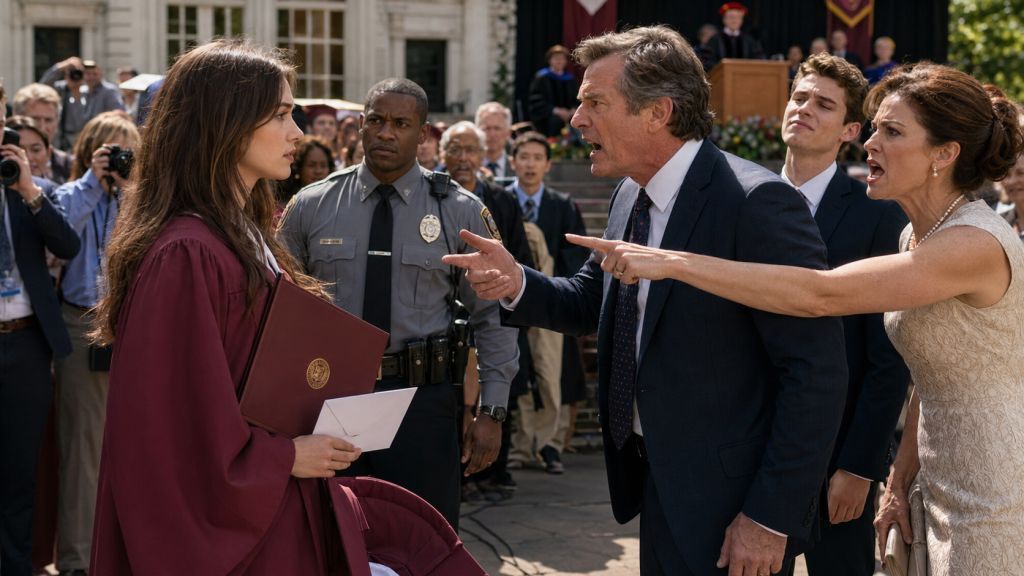
At my own graduation, my father slapped me so hard my cap hit the floor. The sound cracked through the university courtyard like a firework. For one frozen second, nobody moved.
The photographers stopped clicking. The students behind me fell silent. The families holding flowers and balloons turned their heads. My maroon graduation cap spun across the stone path and landed beside my diploma folder.
I stood there in my gown, my cheek burning, my ears ringing, and my entire life standing around me like an audience waiting to see if I would finally break.
My father stood inches away from me, breathing hard, his face red with rage.
“You don’t deserve that degree,” he spat.
My mother rushed up behind him.
Not to stop him.
Not to ask if I was hurt.
She pointed at me as if I were something dirty someone had dragged into the courtyard.
“You’re just a failure in a gown!” she screamed. “Stop embarrassing this family!”
A gasp moved through the crowd.
My best friend, Chloe, grabbed my arm.
“Mia,” she whispered, her voice shaking. “Are you okay?”
I did not answer.
I was looking at my parents.
The same two people who had spent four years telling everyone in our family that I had dropped out.
The same two people who told my aunts, cousins, neighbors, and church friends that I was lazy, unstable, ungrateful, and too weak to finish college.
The same two people who had smiled through every one of my childhood awards, then tore them apart the second we got home because praise made me “arrogant.”
They hated this day because I had proved them wrong.
I had not dropped out.
I had not failed.
I had graduated with honors.
And I had done it without them.
Behind them stood my younger brother, Ethan, in a clean navy suit our parents had bought for him.
He was smiling.
Not a shocked smile.
Not a nervous smile.
A pleased one.
Ethan had always smiled when I was humiliated.
He was the golden child.
The son.
The miracle.
The one my parents paid private tutors for while telling me scholarships were my responsibility.
The one they bought a car for after he failed his driving test twice.
The one they bragged about even after he failed out of community college twice.
When my name had been called that morning with honors, I had seen Ethan’s smile disappear.
That was when my father stormed toward me.
Now his handprint was burning across my face.
A security guard stepped closer.
“Sir,” the guard said firmly, “you need to step back.”
I raised one hand.
“No,” I said quietly. “Let him finish.”
My father blinked.
He had expected tears.
He had expected shame.
He had expected the old Mia, the girl who apologized when other people hurt her.
I bent down slowly, picked up my cap, and brushed dust from the corner of my diploma folder.
My fingers trembled, but my voice did not.
“You’re right,” I said. “Everyone should hear the truth.”
My mother’s face changed.
The rage stayed, but something else moved behind her eyes.
Fear.
“Mia,” she hissed. “Don’t you dare.”
I looked past her toward the stage, where the university president still stood near the microphone.
Then I opened my diploma folder.
Inside, tucked behind the certificate I had earned, was a thick white envelope.
I had carried it all morning.
At first, I had not planned to use it.
Part of me still hoped my parents would simply stay away.
But they came.
Of course they came.
Not to celebrate me.
To stop me from being seen.
I walked straight toward the university president.
The crowd parted without being asked.
My gown brushed against my legs.
My cheek throbbed with every step.
When I reached him, I held out the envelope.
“Sir,” I said clearly, loud enough for the closest rows to hear, “before I leave this campus, I need to report the people who stole my tuition money, forged my loan documents, and tried to make me disappear.”
Behind me, my father shouted, “Mia, shut your mouth!”
The courtyard went completely silent.
The university president looked from my face to the envelope in my hand.
His expression hardened.
“Miss Carter,” he said carefully, “are you making an official statement?”
“Yes, sir,” I said. “I am.”
My mother laughed once, sharp and fake.
“She’s unstable,” she called out. “She has always been dramatic. This is what we’ve dealt with for years.”
I turned around slowly.
“For years,” I repeated. “That part is true.”
The president took the envelope.
Chloe came to stand beside me, still holding the bouquet she had bought with her own money.
Her eyes were wet.
“Mia,” she whispered. “You don’t have to do this in front of everyone.”
“Yes,” I said. “I do.”
Because they had destroyed me in private for too long.
They had lied about me in public.
So the truth deserved witnesses.
My father moved forward again, but the security guard blocked him.
“Don’t touch me,” Dad snapped.
“Then don’t approach her,” the guard replied.
My mother grabbed Dad’s sleeve.
“Richard,” she whispered, but everyone nearby heard her. “Make her stop.”
That was almost funny.
My whole life, my mother had told me no one would believe me.
No one would listen.
No one would care.
But suddenly, everyone was listening.
I faced the crowd.
“My name is Mia Carter,” I said. “Four years ago, I received a full academic scholarship to this university. My parents told everyone I dropped out during my first semester because I couldn’t handle college.”
I opened my phone and tapped the first file.
“The truth is, I never dropped out.”
A murmur spread through the courtyard.
“I worked two campus jobs. I tutored first-year students. I slept in the library more nights than I can count because I was too ashamed to tell anyone I had nowhere stable to stay.”
My mother’s mouth twisted.
“That is not true!”
I looked at her.
“You changed the locks during winter break sophomore year.”
She went still.
“You told me if I wanted to act grown, I could live grown. Then you told Aunt Linda I was staying with friends because I was partying too much.”
My aunt Linda stood near the fountain.
Her hand flew to her chest.
“Mia?” she whispered.
I turned toward her.
“I’m sorry you had to hear it like this,” I said. “But yes.”
My father laughed angrily.
“This is ridiculous. We paid for everything. We supported her while she disrespected us.”
“No,” I said. “You didn’t.”
I reached into my gown pocket and pulled out a folded paper.
“The scholarship covered my tuition. The university sent refund checks for housing support and books. Those checks were mailed to the address I had before I moved to campus.”
My father’s jaw tightened.
“My parents deposited them into an account I couldn’t access.”
“That’s a lie!” Ethan shouted.
I turned to him.
His voice cracked, but his face still wore that spoiled confidence.
“You want to talk about lies, Ethan?” I asked.
His smile finally disappeared.
The university president opened the envelope and looked through the first documents.
A woman from the registrar’s office stepped beside him.
Her eyes widened as she read.
“There are bank copies here,” she said quietly.
My mother lunged forward.
“You have no right to share private family documents!”
I almost smiled.
“Private family documents?” I asked. “You mean the loan applications with my forged signature?”
That sentence changed everything.
The murmurs became louder.
A photographer lifted his camera again.
This time, he did not point it at my graduation gown.
He pointed it at my parents.
My mother’s face drained of color.
My father barked, “Enough!”
“No,” I said. “Not enough. Not anymore.”
I held up my phone.
“For four years, I thought I was drowning because I wasn’t strong enough. I thought maybe they were right. Maybe I really was the problem.”
My throat tightened, but I forced myself to continue.
“Then last year, I was denied an apartment because of debt I didn’t know existed. Student loans. Personal loans. Credit cards. All opened when I was eighteen. All connected to my social security number. All with signatures that looked almost like mine.”
Chloe covered her mouth.
I had told her some of it.
Not all.
Not the worst parts.
I looked at Ethan.
“And somehow, during those same years, Ethan’s tuition was paid, his car was paid, his apartment was paid, and his spending money never ran out.”
Ethan stepped back.
“That has nothing to do with me.”
I tilted my head.
“Then why is your name on one of the transfer receipts?”
The crowd reacted like a wave had moved through it.
My father’s face turned a darker red.
“You little snake,” he said.
The security guard shifted closer.
The president lowered the documents.
“Mr. Carter,” he said, his voice cold, “I strongly suggest you stop speaking to her like that.”
My father looked stunned.
He was not used to other men correcting him.
Especially in public.
Especially when he wore his expensive watch and his polished shoes and his proud father costume.
My mother tried another tactic.
She began to cry.
Not real tears.
Those would come later.
These were her performance tears.
“Mia,” she said softly, reaching toward me. “Sweetheart, you’re confused. We made sacrifices for you. We tried to help you. Maybe we made mistakes, but we are your family.”
That word used to weaken me.
Family.
They had used it like a leash.
Family meant silence.
Family meant forgiveness before accountability.
Family meant I owed them loyalty even while they destroyed me.
But that morning, with my diploma in one hand and the truth in the other, the word finally lost its power.
“No,” I said. “Family doesn’t steal a daughter’s future and call it love.”
My mother’s face hardened instantly.
There she was.
The real her.
I pressed play on the audio file.
My father’s voice came through my phone speaker.
“If Mia exposes us, we ruin her life. Tell people she’s unstable. Tell the school she forged things. I don’t care. She doesn’t get to walk away from this family like she’s better than us.”
The courtyard froze.
Then my mother’s voice followed.
“She won’t do anything. She never does. She’s too afraid of looking ungrateful.”
A shiver ran through me.
Hearing it again hurt.
But hearing it in front of everyone freed something inside me.
My mother covered her mouth.
My father stared at my phone as if it had betrayed him.
Ethan whispered, “Where did you get that?”
I looked at him.
“You sent it to me by accident.”
His face collapsed.
A year ago, Ethan had sent me a voice memo while drunk.
He meant to send it to Mom.
Instead, he sent it to me.
At first, I thought it was a mistake.
Then I listened.
Then I saved it in three places.
Cloud storage.
A flash drive.
An email account no one knew existed.
That was when I stopped surviving and started preparing.
The university president handed the envelope to the registrar.
“Call campus police,” he said.
My father shouted, “You can’t do that!”
“Yes,” the president said. “We can.”
My mother stumbled backward.
“Mia,” she whispered. “Please.”
That was the first time she said please to me that day.
Not when my father hit me.
Not when I stood humiliated in front of hundreds.
Only when consequences came for her.
Aunt Linda pushed through the crowd.
Her face was pale, her eyes full of horror.
“Mia,” she said. “Why didn’t you tell me?”
I looked at her.
“I tried.”
She shook her head.
“When?”
“Thanksgiving, freshman year,” I said. “I told you Mom had taken my scholarship refund. You said I must have misunderstood because my mother would never do that.”
Aunt Linda’s lips parted.
I hated the guilt in her eyes.
Not because she didn’t deserve it.
Because a younger version of me had waited years to see it.
“I’m sorry,” she whispered.
I nodded once.
Not forgiveness.
Not yet.
Just acknowledgment.
Campus police arrived within minutes.
Two officers approached calmly, but the scene was no longer calm.
Phones were out everywhere.
Students had moved closer.
Parents whispered.
Professors looked stunned.
The graduation banners fluttered in the warm spring wind, cheerful and bright above the ruin of my family’s lies.
One officer spoke to me first.
“Miss Carter, do you want to file a report?”
“Yes,” I said.
My father laughed like he still believed this could be controlled.
“She is our daughter. This is a family matter.”
The officer looked at my red cheek.
“Assault in public is not a family matter.”
The word assault made my mother flinch.
Dad’s eyes darted around.
For the first time, he seemed to understand that the courtyard was not his living room.
He could not lower his voice and rewrite reality later.
Everyone had seen.
Everyone had heard.
The officer asked if I wanted medical attention.
I said no.
My cheek hurt, but I had carried worse pain quietly for years.
Still, Chloe squeezed my hand.
“You should let them document it,” she whispered.
She was right.
So I nodded.
A female officer took a photograph of my cheek.
My father looked away.
My mother started crying harder.
Ethan kept muttering that this was insane, that I was ruining everything, that I had no idea what I was doing.
But I knew exactly what I was doing.
That was what terrified them.
For years, they had counted on my confusion.
My fear.
My need for their approval.
They had not planned for a daughter who finally stopped asking to be loved.
The university moved us into an administrative building away from the crowd.
Chloe came with me.
So did the president, the registrar, and campus police.
My parents were told to wait in another room.
They protested.
Dad demanded a lawyer.
Mom demanded privacy.
Ethan demanded to leave.
No one listened.
For the first time in my life, I watched strangers protect me better than my own parents ever had.
In the conference room, I gave my statement.
I explained everything from the beginning.
How my scholarship letter had arrived when I was seventeen, and my father had smiled too tightly when he read the amount.
How my mother said it was “family money” because I was still living under their roof.
How they insisted all university mail go to the house because “young adults lose important documents.”
How the refund checks disappeared.
How I was told there had been a mistake.
How my mother cried whenever I asked questions.
How my father called me greedy.
How I worked in the dining hall before sunrise and cleaned lab rooms after midnight.
How I hid hunger behind black coffee and told people I was too busy to eat.
How I found out about the loans only after a landlord rejected my application.
How the signatures on the documents looked almost like mine, but not quite.
How the emergency contact number listed on one loan application was Ethan’s.
The registrar listened with a grim expression.
The officer took notes.
The university president said very little.
But his silence did not feel dismissive.
It felt furious.
When I finished, my voice was hoarse.
Chloe handed me water.
I took it with both hands.
Outside the conference room, I could hear my mother crying.
For once, the sound did not move me.
After my statement, campus police explained the next steps.
Identity theft.
Forgery.
Financial fraud.
Assault.
The words sounded too large for my family.
For years, my parents had hidden cruelty under ordinary words.
Discipline.
Concern.
Sacrifice.
Respect.
Now the truth had legal names.
And those names had consequences.
By late afternoon, graduation was over.
The courtyard had emptied.
Flowers lay forgotten on benches.
Confetti stuck to the grass.
The stage crew was taking down banners when I stepped outside again.
My parents were gone.
So was Ethan.
For one painful second, I felt the old emptiness.
Even after everything, some small child inside me still looked around for a mother who would come back and say she was sorry.
But no one came.
Chloe stood beside me.
“You did it,” she said.
I looked down at my diploma.
The folder had a faint scuff from where it had hit the ground.
I ran my thumb over it.
“No,” I said softly. “I survived it.”
Two weeks later, my father was arrested at his office.
My mother was questioned the same day.
Ethan tried to disappear to a friend’s apartment in another town, but fraud investigators had already found his transfers.
The story spread faster than I expected.
Someone had posted the courtyard video online.
At first, I was horrified.
My pain had become public.
My worst moment had been watched by strangers.
But then messages started coming in.
Students I barely knew wrote to say they believed me.
Professors sent recommendations and legal resources.
Parents from the ceremony apologized for not stepping in faster.
A woman from my scholarship foundation contacted me personally.
She said they had opened an internal review and would assist with documentation.
Then came messages from relatives.
Aunt Linda wrote every day.
At first, I ignored them.
Then one night, I opened one.
She wrote, “I failed you because believing your mother was easier than protecting you. I am sorry. I know sorry does not fix it. But I want to help if you will let me.”
I stared at that message for a long time.
Then I typed, “I need time.”
She replied, “Take all of it.”
That was the first respectful thing anyone in my family had given me.
Time.
The legal process was slow.
Painfully slow.
There were meetings.
Statements.
Bank records.
Copies of signatures.
Questions that made me feel eighteen again.
Questions that made me angry.
Questions that made me wonder how many systems had ignored obvious signs because my parents looked respectable.
My father denied everything.
Then blamed my mother.
My mother denied everything.
Then blamed my father.
Ethan claimed he knew nothing.
Then investigators found messages where he joked about “Mia money” paying his rent.
That hurt more than I expected.
Not because I thought Ethan was innocent.
But because part of me remembered teaching him how to tie his shoes.
Making him soup when he was sick.
Letting him sleep in my room during thunderstorms.
He had not always hated me.
My parents had taught him that love was a competition.
And he had decided winning mattered more than me.
Three months after graduation, I stood in a courthouse hallway wearing a navy dress Chloe had helped me choose.
My parents sat across from me.
My father looked smaller without an audience.
My mother looked older without control.
Ethan stared at the floor.
No one spoke to me.
That was fine.
I had spent my childhood begging for conversations with people who only wanted obedience.
I was done begging.
Their lawyer tried to argue that everything had been a misunderstanding.
A complicated family financial arrangement.
A mistake.
But mistakes do not forge signatures.
Mistakes do not open accounts.
Mistakes do not threaten daughters into silence.
The evidence was too clear.
The audio recording.
The bank transfers.
The handwriting analysis.
The emails.
The messages.
The loan documents.
The scholarship records.
My father accepted a plea deal first.
My mother followed when she realized he would not protect her.
Ethan avoided jail, but not consequences.
Restitution.
Probation.
A permanent record.
The golden child finally learned that being protected from accountability is not the same as being innocent.
When the judge asked if I wanted to make a statement, I stood.
My mother looked at me for the first time that day.
Her eyes were wet.
For years, I had imagined this moment.
I thought I would rage.
I thought I would scream.
I thought I would list every birthday they ruined, every meal they turned into a trial, every night I cried silently into a pillow because I thought I was impossible to love.
But when I opened my mouth, my voice was calm.
“You told the world I was a failure,” I said. “But I was never failing. I was surviving you.”
My father looked down.
“You stole money from me, but money was not the worst thing you took. You took my safety. You took my name. You took years of my life and filled them with shame that never belonged to me.”
My mother began crying.
This time, I did not stop.
“You taught me that love had to be earned by silence. You taught me that family meant protecting the people who hurt me. You were wrong.”
The courtroom was silent.
“I am not here because I hate you,” I said. “I am here because I finally love myself more than I fear you.”
My voice shook on the last sentence, but I finished.
“I earned my degree. I earned my life. And you do not get to take credit for either.”
When I sat down, Chloe reached for my hand.
I let her hold it.
The judge ordered restitution.
The court recognized the fraud.
My parents were no longer able to hide behind the word family.
Afterward, in the hallway, my mother approached me.
Her lawyer tried to stop her, but she waved him away.
“Mia,” she said.
I turned.
For once, she looked uncertain.
Not soft.
Not harmless.
Just uncertain.
“I’m your mother,” she whispered.
I waited.
There it was again.
The final card she always played.
I looked at the woman who had taught me to doubt my own memory.
The woman who called me dramatic when I was hurting.
The woman who screamed failure at me in a graduation courtyard because my success threatened her lies.
“No,” I said quietly. “You gave birth to me. That is not the same thing.”
Her face crumpled.
Maybe from shame.
Maybe from anger.
Maybe because control had always been easier for her than love.
I did not stay to find out.
I walked out of the courthouse into the sunlight.
Chloe followed.
Aunt Linda was waiting near the steps.
She held a small bouquet of white roses.
Not too many.
Not dramatic.
Just enough.
“I didn’t know if I should come,” she said.
I looked at the flowers.
Then at her.
“I’m glad you did.”
Her eyes filled with tears.
She did not hug me.
She waited.
That mattered.
So I stepped forward first.
The hug was awkward.
Then it was real.
One year later, I returned to the university.
Not as a student.
As a guest speaker.
The scholarship foundation had invited me to speak to first-generation graduates and students who had overcome financial abuse.
At first, I almost said no.
I did not want my story to become my only identity.
I did not want to be remembered only as the girl slapped at graduation.
But then I thought about the version of me who slept in the library.
The version who thought silence was survival.
The version who believed no one would listen.
So I said yes.
I stood on the same stage where the president had handed me my diploma.
The courtyard looked different without chaos.
Flowers bloomed along the walkway.
Students crossed the grass laughing.
Parents took pictures under the arch.
For a moment, I saw my cap hitting the floor again.
I felt the sting.
I heard my mother’s voice.
Failure in a gown.
Then Chloe squeezed my shoulder.
“You okay?”
I smiled.
“Yes,” I said. “I really am.”
When I stepped up to the microphone, the audience quieted.
I looked out at the students in their gowns.
Some looked excited.
Some looked terrified.
Some looked like they were carrying invisible battles under their smiles.
I knew that look.
“My name is Mia Carter,” I began. “And I want to tell you something I wish someone had told me sooner.”
I paused.
“You are not a failure because someone needed you to feel small.”
A few faces changed.
A girl in the second row wiped her eyes.
“Sometimes the people who should celebrate you are the first to resent your growth. Sometimes they call your independence disrespect. Sometimes they call your boundaries betrayal. Sometimes they rewrite your story because the truth makes them look guilty.”
My voice stayed steady.
“But their version of you is not your identity.”
The wind moved gently through the courtyard.
I looked toward the place where my cap had fallen a year before.
“You can pick up what they tried to knock down,” I said. “Your degree. Your name. Your future. Your voice.”
The audience was silent.
Not uncomfortable.
Listening.
“And when the time comes,” I said, “tell the truth. Even if your voice shakes. Even if people stare. Even if the ones who hurt you call it disrespect.”
I smiled.
“Especially then.”
After the speech, a young woman approached me.
She clutched her diploma folder against her chest.
“My parents didn’t come today,” she said softly. “They said college made me selfish.”
I knew that wound.
I knew its shape.
“I’m sorry,” I said.
She looked down.
“I thought I would feel empty.”
“Do you?”
She shook her head slowly.
“No. I think I feel free.”
I smiled.
“Then remember that feeling.”
She nodded, crying now.
I did not tell her everything would be easy.
Freedom is not easy.
Healing is not a straight road.
Some nights, I still woke from dreams where my father was shouting.
Some mornings, I still heard my mother’s voice in my head, turning every mistake into proof that I was worthless.
But the difference was, I no longer believed it.
That was freedom too.
Not the absence of pain.
The refusal to call pain the truth.
That evening, after the ceremony, I walked alone through the courtyard.
The sun was setting behind the old library.
Golden light spilled across the stone path.
I stopped at the exact place where my cap had landed.
For a long moment, I stood there silently.
Then I took my diploma from my bag.
The same folder.
The same scuffed corner.
I had never replaced it.
I liked the mark now.
It reminded me that something could hit the ground and still belong to me.
My phone buzzed.
A message from Chloe.
Dinner in ten? Proud of you, graduate girl.
I laughed softly.
Then another message appeared.
Unknown number.
I opened it.
Mia, it’s Ethan. I know you probably won’t answer. I’m not asking for anything. I just wanted to say I’m sorry. I let them turn me into someone cruel. That’s on me. You didn’t deserve any of it.
I stared at the message for a long time.
The old Mia would have replied immediately.
She would have comforted him.
She would have made his guilt easier.
But I was not old Mia anymore.
I typed only one sentence.
I hope you become better than what they taught you.
Then I put the phone away.
Forgiveness, I had learned, was not a door people could kick open because they finally felt bad.
Sometimes it was a locked room.
Sometimes it was a bridge built slowly.
Sometimes it was never.
And all of those were allowed.
I walked toward the parking lot as the campus lights flickered on.
A group of graduates passed me, laughing, their gowns open over bright dresses and pressed shirts.
One girl’s cap was crooked.
Her mother reached up gently to fix it, then kissed her forehead.
For a second, grief moved through me.
Not jealousy.
Not bitterness.
Just grief for what I never had.
Then the girl looked at me and smiled.
I smiled back.
My story had started with a slap in front of everyone.
But it did not end there.
It ended with my name cleared.
My debt corrected.
My future returned to my own hands.
It ended with a courtroom where lies finally met evidence.
It ended with a stage where my shame became someone else’s courage.
It ended with me walking across the same courtyard that once held my humiliation and feeling nothing but the evening air on my face.
My father had told me I did not deserve that degree.
My mother had called me a failure in a gown.
But they were wrong.
I deserved the degree.
I deserved the truth.
I deserved peace.
And when I finally walked away from them, I did not feel like a daughter losing a family.
I felt like a woman graduating from a life that had tried to bury her.
This time, when the cameras flashed, I smiled.
Not because I was pretending to be strong.
Because I finally was.
THE END! THANK YOU FOR READING!