

I paid my mother-in-law six thousand dollars every month. Not once. Not twice. Every single month for eight years. And the day I finally refused one more demand, she lost control while my husband stood frozen beside her.
I left that house in silence. By morning, the police were at their door. My name is Evelyn Carter, and for eight years, I paid for peace. Six thousand dollars went directly from my business account into my mother-in-law’s account on the first of every month. Margaret Hale called it “family support,” as if she were a struggling widow eating canned soup in a cold kitchen.
But everyone in Maple Ridge, Ohio knew the truth.
That money paid for salon appointments, country club lunches, designer handbags, weekend retreats, charity luncheons, and the kind of lifestyle Margaret loved to show off to women who secretly disliked her.
She never called it help in public.
In public, she called it love.
“My daughter-in-law insists on taking care of me,” she would say, touching my arm with manicured fingers. “Evelyn has always been very generous.”
Generous.
That was the word she used when she wanted to make my exhaustion sound voluntary.
My husband, Daniel, always promised it was temporary.
“Mom just needs help until she gets back on her feet,” he told me during the first year of our marriage.
Margaret had apparently been “getting back on her feet” since 2016.
At the time, I wanted to believe him.
Daniel was charming in those early days. Soft-spoken. Handsome. Careful with compliments. He knew exactly when to touch my shoulder, exactly when to say he was proud of me, exactly when to make me feel like everything I had built meant something to him.
I owned three dental clinics across the state by the time I turned thirty-six.
I had worked for every inch of that life.
My father had been a mail carrier. My mother worked nights at a nursing home. They taught me that money was not power.
Money was responsibility.
So when Daniel told me his widowed mother was struggling, I listened.
When he said she was lonely, I cared.
When he said she had given everything to raise him after his father died, I felt guilty for having so much while she had less.
Six thousand dollars a month sounded outrageous at first.
Then Daniel explained it as temporary.
Just until she reorganized her finances.
Just until the insurance situation settled.
Just until she sold the lake property.
Just until she got back on her feet.
There was always a “just until.”
Eight years later, I realized “just until” was the leash they had tied around my neck.
Daniel worked part-time in real estate, though even that description was generous.
Mostly, he wore expensive shirts, drank expensive coffee, attended networking brunches, and came home with very few sales.
When clients called, he called it pressure.
When I worked twelve-hour days, he called it ambition.
When Margaret needed money, he called it family.
I paid the mortgage.
I paid the insurance.
I paid for Daniel’s car.
I paid Margaret’s allowance.
I paid for family vacations where Margaret complained about the view, the food, the sheets, the weather, and me.
She never treated me like a daughter-in-law.
She treated me like the help who had somehow been allowed to sit at the table.
“Evelyn, dear, you’re so practical,” she would say whenever I wore a simple black dress.
“Evelyn, dear, some women are naturally soft. Others are… efficient.”
“Evelyn, dear, Daniel was raised around elegance. Try not to make him feel like he married a bank manager.”
Daniel would laugh nervously.
Then later, in the car, he would say, “You know how Mom is.”
Yes.
I did know how Margaret was.
And slowly, I began to know how Daniel was too.
He was never cruel in the loud way.
He did not shout often.
He did not throw things.
He did not insult me directly.
He simply stood beside the person who did and called his silence peacekeeping.
For years, I mistook that silence for weakness.
It took me too long to understand that silence can be a choice.
Then came the Friday dinner that changed everything.
Margaret invited us to her house, the same house I had quietly paid to renovate after she complained about unsafe plumbing, old wiring, drafty windows, and a kitchen that made her “look poor.”
The house sat at the end of a curved street lined with old maple trees and expensive mailboxes.
White brick exterior.
Black shutters.
Perfect hedges.
A brass door knocker polished bright enough to reflect your shame back at you.
I had paid for the new roof.
I had paid for the kitchen.
I had paid for the heated marble bathroom floor Margaret bragged about to her bridge group.
And still, every time I walked inside, she looked at me as though I had tracked mud across her life.
That evening, dinner was pleasant at first.
Too pleasant.
Margaret had set the table with her mother’s china and tall candles. Daniel opened a bottle of red wine I recognized because I had bought it for our anniversary and never got to drink it. A roast sat in the center of the table. Soft music played from the living room.
Margaret wore pearls and a pale blue dress.
Daniel seemed nervous.
I should have noticed that first.
He kept touching the stem of his wineglass.
He kept glancing at his mother.
He kept smiling at me in a way that asked for forgiveness before I knew what he had done.
Dinner moved slowly.
Margaret asked about my clinics, though not because she cared. She liked to hear numbers. She liked to know which office was expanding, which dentist I had hired, which neighborhood was profitable.
Information helped her measure what she could ask for next.
Dessert arrived.
Lemon tart.
Margaret cut herself the first slice, then Daniel, then me.
I had barely lifted my fork when she slid a boutique catalog across the table.
The cover showed a woman in sunglasses holding a cream-colored handbag that probably cost more than my first car.
Several pages were folded.
Some items had been circled in red ink.
“I need five thousand by Monday,” Margaret said.
Not asked.
Said.
I looked down at the catalog.
Handbags.
Coats.
Jewelry.
A pair of shoes that looked painful enough to require a medical waiver.
“For what?” I asked.
Margaret smiled as though I were slow.
“My Scottsdale trip. The ladies are shopping.”
Daniel lowered his eyes.
That was when I understood.
He already knew.
This was not a surprise request.
This was a performance they had rehearsed, and I was expected to play my usual part.
The useful wife.
The quiet wallet.
The woman who paid to avoid an argument.
I set down my fork.
“No.”
The room fell silent.
Even the music from the living room seemed suddenly too soft.
Margaret blinked.
Daniel cleared his throat.
“Evie,” he said gently, “don’t make this awkward.”
I looked at him.
“It became awkward when your mother asked me for five thousand dollars for handbags during dessert.”
Margaret’s mouth tightened.
“It’s not for handbags. It’s for the trip.”
“The trip includes handbags.”
“She deserves nice things,” Daniel said.
There it was.
Not “she needs.”
Not “she is struggling.”
She deserves.
A strange calm settled over me.
It started somewhere behind my ribs and spread through my body like cold water.
“No,” I said again. “And the monthly payments stop tonight too.”
Margaret stared at me as if I had slapped her.
For one second, I saw panic flash across her face.
Then the helpless widow disappeared.
What replaced her was cold and furious.
“You think you can embarrass me in my own home?” she asked.
“I think I can stop paying for it.”
Daniel leaned forward.
“Evelyn, this is not the time.”
“When is the time?” I asked. “After another eight years? After another half million dollars? After your mother decides she needs a vacation home?”
Margaret pushed back from the table so hard her chair scraped across the floor.
“You ungrateful little climber.”
I almost laughed.
“Climber?”
“You heard me,” she snapped. “You came into this family with your clinics and your cheap ambition, acting like money makes you better than us.”
“No,” I said quietly. “But apparently my money makes your life better.”
Daniel said my name in warning.
Not hers.
Mine.
That was the moment something in me cracked cleanly.
For eight years, I had swallowed insults because I thought marriage required patience. I had ignored Margaret’s cruelty because I thought grief had made her bitter. I had excused Daniel because I thought he was trapped between his wife and his mother.
But he was not trapped.
He was comfortable.
Margaret’s voice rose.
“I sacrificed everything for my son.”
“And I have paid for that sacrifice every month since our wedding.”
“You owe this family respect.”
“I paid your mortgage for three years after you refinanced behind Daniel’s back.”
Her eyes widened.
Daniel’s face changed.
I had not meant to say that part out loud.
Margaret turned to him.
“You told her?”
Daniel said nothing.
I looked between them.
That silence had a shape.
I knew it instantly.
“What else did you not tell me?” I asked.
Daniel’s jaw tightened.
“Evie, stop.”
But I was already standing.
“What else?”
Margaret grabbed her wineglass.
Her hand shook.
“You want to talk about truth?” she hissed. “Fine. The truth is Daniel should have married someone softer. Someone who understood family. Someone who didn’t count every dollar like a shopkeeper.”
“I counted because you kept taking.”
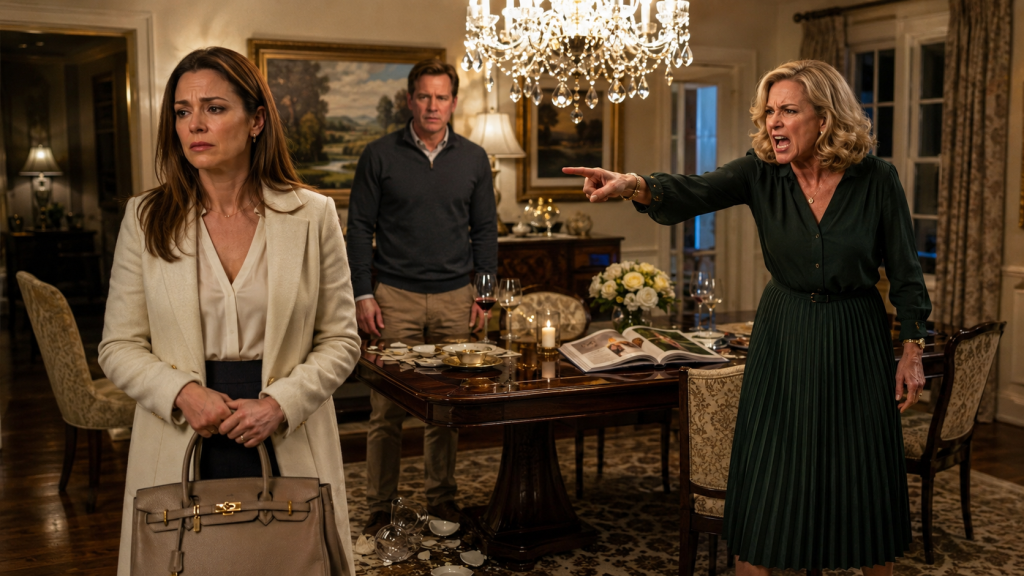
The glass hit the wall before I saw her throw it.
Red wine exploded across the cream wallpaper.
The glass shattered on the floor.
For a second, everyone froze.
Then Margaret pointed at me and screamed.
“You ruin everything! You think because you sign checks, you own us?”
Daniel stood beside the table, his face pale, his hands motionless at his sides.
He did not step forward.
He did not tell her to stop.
He did not ask if I was okay.
He only stared at the broken glass like a child waiting for someone else to clean it.
Margaret swept her arm across the table.
A plate crashed.
Then another.
Silverware clattered onto the hardwood.
The lemon tart slid off its stand and landed cream-side down near my shoes.
Her scream filled the room.
“You owe me! After everything I did for him, you owe me!”
I looked at my husband.
“Daniel.”
He lifted his eyes.
For one foolish second, I waited.
Maybe he would finally move.
Maybe he would finally say, “Mom, enough.”
Maybe he would finally become the man he had pretended to be.
But he only whispered, “Evie, don’t overreact.”
That was it.
Eight years ended in two words.
Don’t overreact.
I picked up my purse from the back of the chair.
I stepped around the broken glass.
Margaret was still breathing hard, still shaking with rage, still looking at me as if I were the thief.
At the front door, Daniel finally found his voice.
“Where are you going?”
I turned and looked at both of them.
“I’m leaving.”
Margaret laughed sharply.
“You’ll be back by morning.”
I looked at Daniel.
He said nothing.
I nodded once.
Not because I agreed.
Because I finally understood.
Then I walked out into the night.
The air outside was cold and clean.
For a moment, I stood under the porch light and breathed as if I had been underwater for years.
My car was parked at the curb.
Inside, my phone showed seventeen missed calls from my office manager, a reminder for a supplier payment, and a text from Daniel sent two minutes earlier.
Don’t do this.
I sat behind the wheel.
My hands were steady.
That surprised me.
I thought the moment I left, I would fall apart.
Instead, I felt strangely awake.
I called my attorney.
Her name was Marissa Grant, and she had handled every business contract for my clinics since my first lease. She answered on the third ring.
“Evelyn?”
“I need you to meet me tonight.”
Silence.
Then her voice sharpened.
“Are you safe?”
“Yes.”
“Where are you?”
“In my car outside Margaret’s house.”
“What happened?”
“I’m done.”
Marissa did not ask what I meant.
Maybe she had been waiting for this longer than I had.
“Come to my office,” she said. “Use the side entrance.”
I drove through Maple Ridge without music.
The town looked peaceful from the road.
Warm kitchen windows.
Porch lights.
Families watching television.
The kind of place where people smiled at church and destroyed each other at dinner.
Marissa’s office was in a renovated brick building downtown. She opened the side door herself, wearing jeans, a black sweater, and the expression of a woman who had already guessed more than I wanted to admit.
Inside, I sat at her conference table and told her everything.
The six thousand a month.
The extra demands.
The renovations.
The credit card access.
The accounts Daniel managed “for convenience.”
The way he had asked me to sign documents quickly because he was “handling the family taxes.”
Marissa listened without interrupting.
But when I said that last part, her pen stopped moving.
“What documents?”
“I don’t know. Daniel said they were related to Margaret’s home refinance and some estate planning.”
“When did you sign them?”
“Different times. Over the years.”
“Did you read them?”
Shame burned through me.
“No.”
Marissa leaned back slowly.
“Evelyn.”
“I trusted my husband.”
“I know,” she said, softer now. “But tomorrow morning, I want full access to every account, every transfer, every signed document, and every property record connected to Margaret Hale or Daniel Hale.”
I nodded.
Then I remembered something.
“There’s an agreement.”
Marissa looked up.
“What agreement?”
“Three years ago, when Margaret needed the bathroom renovation, I refused to call it a gift. Daniel said his mother would be embarrassed, so he drafted something privately. He told me Margaret signed it. It listed the monthly payments as loans against her property.”
“Do you have it?”
“At home. In the safe.”
“Can Daniel access the safe?”
“No.”
“Good.”
That was the first good word I had heard all night.
I did not go home.
Marissa insisted I stay at a hotel under my maiden name.
Before I left her office, we froze what we could freeze, locked Daniel out of the business credit cards, removed his access from clinic operating accounts, and sent notices to my bank.
My marriage did not end with shouting.
It ended with passwords.
It ended with paperwork.
It ended with the quiet click of access being denied.
At 6:12 the next morning, my phone rang.
Daniel.
I let it go to voicemail.
Then Margaret.
Then Daniel again.
Then a number I did not recognize.
At 7:03, Marissa called.
“Evelyn, are you sitting down?”
I sat on the edge of the hotel bed.
“What happened?”
“Police are at Margaret’s house.”
My stomach tightened.
“Because of last night?”
“Because Margaret called them.”
I closed my eyes.
Of course she had.
“What did she say?”
“That you stole from her, threatened her, and tried to force her to sign over her house.”
I opened my eyes.
For a second, I could only stare at the hotel curtains glowing pale gold in the morning sun.
“She said I stole from her?”
“Yes.”
I laughed once.
It sounded nothing like me.
“What do we do?”
“We meet them with records.”
By 8:30, Marissa and I were standing in Margaret’s living room while two police officers reviewed a folder thick enough to silence the house.
Margaret sat on the sofa with a tissue in her hand, performing distress like she had rehearsed it in a mirror.
Daniel stood near the fireplace.
He looked exhausted.
He also looked angry.
Not at his mother.
At me.
The wine stain still marked the wallpaper behind him.
Broken glass had been swept into a corner.
A slice of lemon tart had dried near the baseboard.
Margaret’s voice trembled.
“I only wanted my family to stay together. Evelyn has always controlled Daniel with money.”
I said nothing.
Marissa handed the first officer a stack of bank records.
“These show monthly transfers from Dr. Carter’s business account into Mrs. Hale’s account, totaling five hundred seventy-six thousand dollars over eight years, not including additional direct payments for renovations, utilities, travel, and credit expenses.”
The officer glanced at Margaret.
Margaret’s tissue paused halfway to her face.
“That was support,” she said quickly. “A gift.”
Daniel stepped forward.
“Yes. It was a gift. Evelyn wanted to help.”
Marissa smiled.
Not warmly.
Professionally.
“That’s interesting.”
She opened the final section of the folder and removed a signed agreement.
“This document states that the monthly payments were loans applied against Mrs. Hale’s property, repayable upon sale, transfer, refinance, or written demand.”
Margaret’s face went white.
Daniel stared at the page.
“That’s not—” he began.
Marissa looked at him.
“Your signature is here, Mr. Hale. Your mother’s signature is here. Dr. Carter’s signature is here.”
My throat tightened.
Something about the way she said my signature made my skin go cold.
Marissa turned to the officer.
“Dr. Carter believes her signature may have been copied or obtained under false pretenses on several documents. We are requesting a formal review.”
Daniel’s head snapped toward me.
“Evie.”
I looked at him.
“Did you do it?”
His mouth opened.
Nothing came out.
For once, his silence did not protect him.
The officer turned to Daniel.
“Sir, why did your wife’s signature appear on documents she says she never saw?”
Daniel swallowed.
Margaret stood abruptly.
“This is ridiculous. She is trying to destroy us because I asked for help.”
“No,” I said.
Everyone looked at me.
My voice was quiet.
“I helped. For eight years, I helped. I helped until helping became obedience. I helped until your demands became normal. I helped until my own husband thought watching you scream at me was easier than telling you no.”
Daniel flinched.
Margaret’s eyes hardened.
“You think this makes you powerful?”
“No,” I said. “It makes me finished.”
The police did not arrest them that morning.
Real life is not always dramatic in the way people expect.
There were no handcuffs at breakfast.
No neighbors gasping from their lawns.
No instant justice wrapped in flashing lights.
There were questions.
Documents collected.
Statements taken.
A case number written on a card.
But as Marissa and I left Margaret’s house, I saw something better than handcuffs.
I saw fear.
Margaret stood in the doorway, no longer a helpless widow or a polished society woman.
Just a woman realizing that the person she had used as a wallet had kept receipts.
Daniel followed me down the walkway.
“Evie, wait.”
I stopped beside my car.
He looked smaller in the morning light.
“I didn’t know Mom would call the police.”
“That’s what you want to say?”
He rubbed his forehead.
“She panicked.”
“And you?”
He looked at me.
“I was trying to keep things from getting worse.”
“They got worse because you kept trying to keep them quiet.”
He stepped closer.
“We can fix this.”
“No.”
“You’re upset.”
“I’m awake.”
His face twisted.
“After everything we’ve been through, you’re just going to walk away?”
I looked back at the house.
At the windows I had paid for.
At the roof I had paid for.
At the door I had walked through for years while shrinking myself to fit inside their version of family.
Then I looked at my husband.
“No, Daniel. I’m going to walk away with records.”
The next two weeks were a blur of attorneys, accountants, investigators, and discovery.
That was when the truth grew teeth.
Daniel had not merely allowed Margaret to take money.
He had helped her structure it.
He had told me certain payments were for medical bills that never existed.
He had transferred clinic funds into a personal account during months when I was traveling between offices.
He had used my electronic signature on documents I had never reviewed.
He had quietly opened a line of credit using collateral tied to marital property, then used part of it to cover Margaret’s country club dues when she fell behind.
And Margaret?
Margaret had not been helpless.
She owned investment accounts she had never disclosed.
She owned jewelry stored in a private vault.
She had sold the lake property years earlier and placed the proceeds into an account Daniel helped hide.
All those years, she had cried poverty while wearing my money on her wrist.
The first time Marissa showed me the evidence, I did not cry.
That worried me.
I sat in her office staring at pages of transfers, signatures, emails, and account numbers.
Then I asked the only question that mattered.
“How much?”
Marissa folded her hands.
“With direct payments, fraudulent transfers, unauthorized credit use, and property improvements, we are looking at more than nine hundred thousand dollars.”
The number did not shock me.
What shocked me was how unsurprised I felt.
Some part of me had known.
Not the details.
Not the amount.
But the truth.
I had known in the way a body knows when a room is unsafe.
I had known every time Daniel said, “Don’t make this a big deal.”
I had known every time Margaret smiled after receiving money she claimed embarrassed her.
I had known every time I felt lonely sitting beside my own husband.
Daniel tried every version of apology after that.
First came the soft messages.
I love you.
Please come home.
We need to talk without lawyers.
Then came the practical messages.
Think about the house.
Think about taxes.
Think about what people will say.
Then came the angry ones.
You’re destroying my mother.
You’re making me look like a criminal.
You always cared more about money than family.
That last one almost made me respond.
Almost.
Instead, I forwarded everything to Marissa.
Margaret chose a different strategy.
She went public.
At church, she cried to women near the coffee table.
At the club, she hinted that I had always been controlling.
At a charity luncheon, she reportedly said, “Some women marry into a family but never understand loyalty.”
For three days, Maple Ridge whispered.
Then the subpoenas started.
Suddenly, people became quieter.
The country club received document requests.
The bank received document requests.
The boutique where Margaret had spent tens of thousands received document requests.
The contractor who renovated her kitchen received document requests.
Margaret’s performance collapsed under paperwork.
I filed for divorce on a Tuesday morning.
Daniel was served outside a real estate office where he had not sold a house in four months.
He called me thirteen times.
I answered none.
That evening, he came to my hotel.
I knew he would.
Men like Daniel always return when silence stops working.
He stood in the lobby wearing the navy coat I bought him for Christmas.
His hair was perfect.
His eyes were red.
“Five minutes,” he said.
Against Marissa’s advice, I gave him three.
We sat in the far corner of the lobby near a tall plant and a window overlooking the parking lot.
He looked around like the hotel offended him.
“You’re really staying here?”
“I’m comfortable.”
“This is humiliating.”
“For whom?”
He rubbed his hands together.
“My mother is falling apart.”
“Your mother is facing consequences.”
“She’s old.”
“She’s sixty-two.”
“She’s my mother.”
“And I was your wife.”
That stopped him.
For a moment, I saw the old Daniel.
Or maybe I saw the version I had invented.
He leaned forward.
“I made mistakes.”
“Yes.”
“I should have stood up for you.”
“Yes.”
“I should have handled Mom better.”
“No,” I said. “You should have stopped using me with her.”
His eyes filled.
“I never meant to hurt you.”
“Did you mean to forge my signature?”
His tears disappeared.
There it was.
The truth behind the apology.
He was sorry for the parts that made him look weak.
Not the parts that made him guilty.
“That’s complicated,” he said.
I stood.
“No. It’s actually very simple.”
He grabbed my wrist.
Not hard enough to hurt.
Just hard enough to remind me that he still thought he could stop me.
I looked down at his hand.
Then back at his face.
“Let go.”
He released me immediately.
People in the lobby had turned to look.
Daniel lowered his voice.
“Evelyn, please. Don’t do this.”
I picked up my purse.
“I didn’t do this. I only stopped paying for it.”
The investigation took months.
The divorce took longer.
Margaret sold the house before the court forced the issue, probably because she thought she could control the process.
She could not.
The loan agreement Daniel had hidden from her became enforceable enough to freeze proceeds until the civil claims were resolved.
Her beautiful white brick house, the one she used to call her sanctuary, became evidence.
Daniel fought me on everything.
Then the forensic accountant found the second account.
After that, his attorney became much less confident.
He eventually accepted a settlement that returned a significant portion of what had been taken and removed his claim to my clinics completely.
The criminal side moved more slowly.
It always does.
But charges were filed related to unauthorized signatures and financial misrepresentation.
Margaret was not dragged away in disgrace the way she deserved.
Daniel did not fall to his knees and confess in front of the town.
But justice rarely looks like a movie.
Sometimes justice looks like a bank account restored.
Sometimes it looks like a judge reading documents in silence.
Sometimes it looks like a woman sleeping through the night for the first time in years because no one in the next room is spending her future.
One year after I walked out of Margaret’s house, I returned to Maple Ridge for a very different reason.
My third clinic was expanding.
We had purchased a building downtown, only four blocks from Marissa’s office.
The morning of the ribbon cutting, I wore a cream suit and my mother’s pearl earrings.
My parents came.
My staff came.
Patients came.
Even the mayor came, though I suspected he mostly wanted a photo.
I stood outside the new clinic under a bright blue sky and watched the ribbon flutter in the wind.
For years, I had thought survival meant keeping peace.
I was wrong.
Sometimes survival means breaking the silence everyone else benefits from.
Just before the ceremony began, I saw Daniel across the street.
He stood near a parked car, thinner than before, his hands in his coat pockets.
Margaret was not with him.
For a moment, I thought he might cross over.
He did not.
He only watched.
Marissa noticed him too.
“Do you want me to handle that?”
I shook my head.
“No.”
Daniel and I looked at each other across the street.
Once, I would have wondered what he felt.
Regret.
Anger.
Shame.
Love.
Now I did not need to know.
His feelings were no longer my responsibility.
The mayor handed me the scissors.
My office manager counted down.
Everyone smiled.
And when I cut the ribbon, the crowd applauded.
The sound was clean and bright.
Not like glass breaking.
Not like someone screaming.
Not like a husband whispering, “Don’t overreact,” while your dignity falls around your feet.
It sounded like freedom.
Later that afternoon, after the guests left and the clinic quieted, I sat alone in my new office.
Sunlight poured through the windows.
A framed photograph of my parents rested on the shelf.
My phone buzzed once.
A message from an unknown number.
I knew before opening it.
Daniel.
I’m sorry, Evie. I lost everything.
I stared at the words for a long moment.
Then I typed back.
No, Daniel. You lost access.
And for the first time in eight years, I did not explain myself.
I blocked the number.
Then I set my phone down, opened the clinic door, and walked into the life I had paid for, fought for, and finally kept for myself.
Because I had not destroyed their family.
I had only stopped funding the lie.
And once the money stopped, the truth came knocking.
By morning, it wore a badge.
By the end, it carried a court order.
And by the time I was free, Margaret Hale had learned the lesson she should have known from the beginning.
Peace bought with someone else’s pain is not peace.
It is debt.
And eventually, every debt comes due.
THE END! THANK YOU FOR READING!