

The day I walked into the courthouse wearing jewelry worth nearly two billion dollars to sign my divorce papers, my ex-husband’s entire family was left stunned. But what he did next was even more chilling.
The moment I entered the Monterrey courthouse, every head turned. Not because I was crying. Not because I looked weak. Not because I was begging for my marriage to be saved. Every head turned because the diamonds around my neck caught the sunlight so fiercely that the entire hallway seemed to freeze.
For one perfect second, the courthouse went silent.
The woman Alejandro’s family had always called “the poor wife” walked through those glass doors wearing a fitted black dress, diamond earrings, a platinum bracelet, and a necklace so rare that even strangers stepped aside without knowing why.
My heels clicked against the marble floor.
My back was straight.
My face was calm.
And every member of his family looked at me as if they were seeing me for the first time.
His mother, Doña Carmen, stood near the courtroom entrance in a cream suit, clutching her handbag with both hands.
His sisters, Valeria and Inés, whispered behind her.
Alejandro’s cousins, who had laughed at me for years at family parties, stopped smiling.
And Alejandro…
Alejandro looked like someone had reached into his chest and squeezed his heart.
His eyes dropped from my face to the diamonds on my collarbone.
Then to the bracelet on my wrist.
Then back to my face.
For ten years, he had watched me wear the same faded blouses, the same tired shoes, the same plain wedding band that turned loose after I lost weight from stress.
For ten years, I had stood beside him without asking for attention.
I had built his dream with quiet hands while his family treated me like a shadow.
And now I stood in front of them like a woman made of ice, fire, and everything they never expected me to become.
Alejandro’s lawyer cleared his throat.
My lawyer, Mariana Reyes, leaned closer and whispered, “Walk slowly. Let them understand.”
So I did.
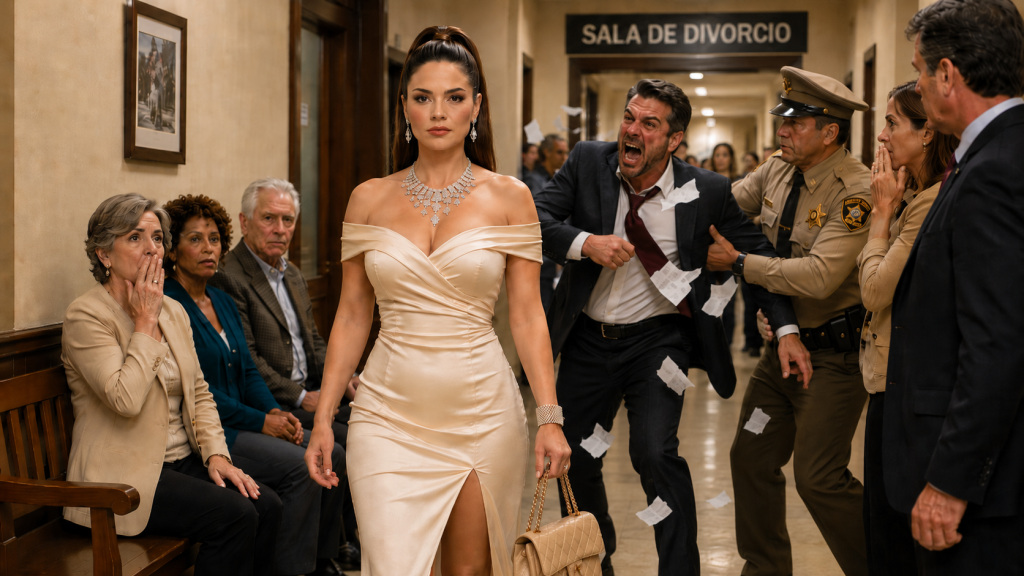
I walked slowly.
Every step felt like an answer.
Every glance felt like justice.
But ten years earlier, I had been just a girl from Guadalupe with nothing to my name.
No diamonds.
No lawyer.
No power.
Just hope.
Alejandro had been twenty-eight then, charming in a rough kind of way, with sun-browned skin, restless eyes, and an old pickup truck that broke down every other week.
He had dreams bigger than his bank account.
He wanted to open a small grocery store.
Then another.
Then a chain.
Then, someday, a business that would make his family proud.
I believed him.
That was my greatest gift and my biggest mistake.
When he proposed, he did it behind a little church after Sunday Mass. He had no ring, only a thin gold band he bought from a pawn shop and polished until it shone.
“I don’t have much now, Isabel,” he said, holding my hands, “but I swear I will build something for us.”
For us.
Those words lived inside me for years.
Our wedding was simple.
Roasted chicken.
Tortillas.
Cheap beer.
Plastic chairs borrowed from neighbors.
My mother cried because she said I looked happy.
His mother barely smiled because she thought her son could do better.
Still, I felt like I owned the world.
I had a husband.
A future.
A dream to build.
The first store was no bigger than a large garage.
We called it Mercado Sol.
There were shelves of canned beans, rice, cooking oil, bread, fruit, and cold drinks. Alejandro handled suppliers during the day, and I handled the register, inventory, payroll, and cleaning.
At night, when he slept, I sat at the back table with a calculator, a notebook, and a cup of coffee gone cold.
I learned every peso.
I learned which products sold fastest.
I learned which drivers were overcharging us.
I learned which employees were honest and which ones smiled too much when the cash drawer opened.
Alejandro called me his lucky charm.
At first, I believed him.
When the second store opened, everyone praised him.
When the third store opened, the newspaper called him “a rising entrepreneur.”
When investors began calling, people said Alejandro had a brilliant mind.
Nobody mentioned the wife who stayed in the warehouse until two in the morning correcting invoices.
Nobody mentioned the woman who skipped meals to make payroll.
Nobody mentioned the woman who sold her mother’s earrings to cover a supplier payment after Alejandro made a risky purchase.
I didn’t mind then.
I told myself that when the business succeeded, we would succeed together.
But money changes people slowly.
So slowly that you blame yourself for noticing.
At first, Alejandro bought a better truck.
Then tailored suits.
Then expensive watches.
Then a house in San Pedro with high walls, polished stone floors, and a swimming pool I never used because I was always too busy.
His mother moved closer to him.
His sisters suddenly visited every weekend.
His cousins asked for jobs.
Everyone enjoyed the wealth.
Everyone praised Alejandro.
And me?
I became the quiet wife in the background.
At parties, his family spoke over me.
At dinners, they asked Alejandro about business deals while I served food.
When I tried to explain the finances, Doña Carmen laughed and said, “Ay, Isabel, numbers are not everything. A man needs vision.”
Vision.
That was what they called his ambition.
My work had no beautiful name.
One night, at a family dinner, Valeria looked at my plain dress and said, “You know, Isabel, now that Alejandro is important, you should try harder.”
The table went quiet.
Alejandro smiled into his wine glass.
He did not defend me.
That was the first small death of my marriage.
There would be many more.
Years passed.
Mercado Sol became SolMart Express.
The stores multiplied across Monterrey and beyond.
Alejandro’s photograph appeared in magazines.
He gave speeches.
He attended charity galas.
He shook hands with politicians.
And I stayed behind, wearing worn-out clothes, sitting in warehouses, checking ledgers, tracking shipments, fixing problems he never even knew existed.
Sometimes he came home after midnight smelling of expensive cologne and hotel soap.
Sometimes he looked at me with impatience, as if I were an old piece of furniture blocking the room.
“You should enjoy life more,” he told me once, adjusting his cuff links in the mirror.
“I’m trying to keep the company stable,” I said.
He sighed.
“Always the company. Always the numbers.”
I wanted to laugh.
The company was the reason we had everything.
The numbers were the reason his mother wore pearls and his sisters drove imported cars.
But he had stopped seeing that.
He had stopped seeing me.
The first time I heard the name Daniela, it was from an employee.
A young cashier lowered her voice while I checked inventory at one of our luxury district stores.
“Señora Isabel,” she said, “I thought you should know. Don Alejandro comes here sometimes with a young woman. She tells people she is part of corporate.”
I looked at her calmly.
“What does she look like?”
The cashier swallowed.
“Beautiful. Maybe twenty-six. Long hair. Very elegant.”
I thanked her.
Then I went home and cooked dinner.
That was the kind of woman I had become.
Quiet outside.
Burning inside.
For weeks, I watched.
I found receipts.
Hotel charges.
Restaurant bills.
Jewelry purchases.
A Chanel bag.
I recognized the bag because Alejandro had once bought it for me after a public award ceremony. He handed it to me in front of photographers and kissed my cheek as if he were a generous husband.
I never used it.
I was afraid to damage it.
Months later, I saw that same bag on another woman’s arm.
It happened outside one of Monterrey’s most luxurious hotels.
I had gone there because the company card showed repeated charges from the lobby restaurant.
I parked across the street and waited.
At 3:17 in the afternoon, Alejandro walked out through the glass doors.
He was laughing.
His arm was wrapped around the waist of a younger woman.
She was beautiful.
Soft.
Perfectly dressed.
And she carried my Chanel bag as if it belonged to her.
I did not scream.
I did not run across the street.
I did not slap him like women do in dramas.
I sat in my car with both hands on the steering wheel and watched my marriage end in silence.
My heart did not break because I was losing him.
It broke because I realized something far worse.
For ten years, the person I had neglected most was myself.
I had been loyal to a man who liked my sacrifice only when it made him richer.
I had been humble for a family that mistook humility for weakness.
I had been invisible for so long that even I had forgotten I had a face.
That night, Alejandro came home late.
He kissed the air beside my cheek.
I smelled her perfume.
I said nothing.
The next morning, I called a lawyer.
Not the lawyer Alejandro used.
Not someone connected to his family.
I called Mariana Reyes, a woman known in Monterrey for destroying arrogant men with quiet paperwork.
When I entered her office, I wore an old gray blouse and carried three boxes of documents.
She looked at the boxes, then at me.
“You brought records?”
“I brought everything,” I said.
And I had.
Invoices.
Transfers.
Payroll reports.
Property purchases.
Contracts.
Personal expenses charged to the company.
Payments to Daniela.
Payments to Alejandro’s mother.
Payments to his sisters disguised as consulting fees.
Mariana opened the first file.
After ten minutes, she stopped smiling.
After one hour, she looked at me differently.
“Isabel,” she said carefully, “do you understand how much of this company is actually tied to your work?”
I folded my hands in my lap.
“No one ever asked.”
She leaned back.
“I am asking.”
That was the beginning of my second life.
For months, I moved like a ghost through my own marriage.
Alejandro thought I was still the tired, obedient wife who would never leave because she had nowhere to go.
He brought Daniela to public events.
He took calls in another room.
He laughed more.
He came home less.
And while he enjoyed the fantasy of replacing me, I built a wall of truth around him.
Mariana discovered something I had almost forgotten.
Alejandro’s father, Don Rafael, had never trusted his son completely.
Rafael had been a quiet man, not affectionate, but observant. Before he died, he had called me to his hospital room.
At the time, Alejandro was in Miami for a business meeting.
Rafael’s hands had been thin and cold when he handed me a sealed envelope.
“Open this when you are forced to choose yourself,” he whispered.
I had put it away in a locked drawer and forgotten it because I was too busy surviving.
When Mariana asked if I had any documents from his father, I remembered.
Inside the envelope was a letter.
And shares.
Real shares.
Rafael had transferred a significant portion of his early investment rights to me before the company exploded in value.
His letter was simple.
Isabel, my son has ambition, but you have discipline. Ambition burns fast. Discipline builds empires. If the day comes when they forget who kept the roof standing, use this. Do not apologize.
I cried when I read it.
Not because of the money.
Because someone had seen me.
Someone had known.
The shares had grown over the years.
With the company’s expansion, investments, real estate, and later valuations, they were worth more than anything Alejandro’s family imagined.
But the jewelry was another story.
Part of Rafael’s private estate had included a collection of rare diamonds and historic pieces inherited through his mother’s family. Alejandro believed those items were locked in a private vault and tied up in estate issues.
They were not.
They had been left to me.
For years, I never touched them.
I told myself such things belonged to women in magazines, not women who counted rice sacks in warehouses.
But when the divorce date was set, Mariana looked at me across her desk and said, “Wear them.”
I shook my head.
“That is too much.”
“No,” she said. “Hiding made them comfortable. Let being seen make them afraid.”
So on the morning of my divorce, I did something I had not done in ten years.
I chose myself first.
A stylist came to my new apartment before sunrise.
The apartment was small compared to the mansion, but peaceful.
No insults.
No perfume that wasn’t mine.
No footsteps that made my stomach tighten.
I wore a fitted black dress.
Elegant.
Quiet.
Powerful.
My hair was styled in soft waves.
My makeup was simple, but sharp enough to make my eyes look steady.
Then Mariana arrived with two security guards and a velvet case.
When she opened it, the room filled with light.
Diamonds.
Platinum.
History.
Proof.
I touched the necklace with trembling fingers.
“I don’t know if I can do this,” I whispered.
Mariana stood behind me in the mirror.
“You already did the hard part. You survived them.”
At the courthouse, Alejandro arrived with his entire family.
Of course he did.
He wanted witnesses.
He wanted me humiliated.
He thought I would come in cheap shoes, red-eyed and broken, signing away the life I helped build while his family watched with satisfaction.
Instead, I walked in wearing the kind of wealth they thought only men controlled.
Doña Carmen’s face drained of color.
Valeria’s mouth fell open.
Inés whispered, “That necklace…”
Alejandro’s jaw tightened.
He stepped toward me before the hearing began.
“Where did you get those?” he hissed.
I looked at him calmly.
“Good morning, Alejandro.”
His eyes narrowed.
“You look ridiculous.”
“No,” I said softly. “I look visible.”
For a moment, he had no answer.
Inside the courtroom, everything felt sharper.
The wooden benches.
The judge’s calm expression.
The cold air.
The faint scent of paper and polished floors.
Alejandro sat with his lawyer, his mother directly behind him like a queen watching a servant being punished.
I sat beside Mariana.
My hands rested in my lap.
The bracelet glittered every time I moved.
The divorce itself should have been simple.
Asset division.
Company stakes.
Properties.
Settlement terms.
Alejandro’s lawyer began with confidence, claiming that I had contributed “domestic support” but had no executive role in SolMart’s expansion.
Domestic support.
I almost smiled.
Mariana stood.
She placed one thick folder on the table.
Then another.
Then another.
Payroll systems under my signature.
Supplier contracts corrected by me.
Emergency loans guaranteed by me.
Expansion reports written from my spreadsheets.
Emails proving Alejandro approved decisions I had already designed.
The judge reviewed them carefully.
Alejandro’s lawyer began to sweat.
Then Mariana presented Rafael’s letter.
The room changed.
Doña Carmen gasped.
Alejandro turned around toward his mother.
“What is that?” he snapped.
Mariana’s voice remained even.
“Proof that Don Rafael Mendoza transferred shares and estate assets to my client legally before his death.”
Alejandro shot to his feet.
“No.”
The judge looked up.
“Sit down, Señor Mendoza.”
But Alejandro did not sit.
His face had gone pale, then red.
His eyes were fixed on the necklace.
Suddenly, I understood.
He did not care that he had lost me.
He did not care that he had betrayed me.
He cared that I had something he believed belonged to him.
“That jewelry is mine,” he said loudly.
A murmur moved through the courtroom.
Mariana stood straighter.
“Your Honor—”
Alejandro pointed at me.
“She stole it from the company. She stole from my family. She planned this.”
His mother began crying behind him.
Valeria whispered, “Alejandro, stop.”
But he did not stop.
He stepped away from his lawyer and shouted, “Do you think you can walk in here wearing my father’s legacy and shame me? You were nothing when I found you. Nothing.”
The words landed in the courtroom like broken glass.
For ten years, those words would have destroyed me.
That day, they did not even make me blink.
The judge ordered him to sit.
His lawyer grabbed his sleeve.
Alejandro pulled away.
Then he did something none of us expected.
He reached inside his jacket.
For one terrifying second, the security guards moved.
But he did not pull out a weapon.
He pulled out a small black device.
A recorder.
He held it up with a strange smile.
“You want truth?” he said. “Then let everyone hear truth.”
His lawyer whispered fiercely, “Do not do this.”
But Alejandro pressed play.
At first, there was static.
Then a woman’s voice.
Daniela.
She was laughing.
Then Alejandro’s voice came through.
“Once the divorce is done, Isabel gets nothing. She does not understand what she signed years ago.”
Daniela asked, “And if she fights?”
Alejandro laughed.
“She won’t. My mother will break her before court. And if that fails, I’ll make her look unstable.”
The courtroom went utterly still.
Alejandro’s smile vanished.
He looked down at the recorder as if it had betrayed him.
The wrong file was playing.
His own voice continued.
“The old documents from my father are a problem, but I can claim she stole them. Who will believe her? She looks like a servant.”
Doña Carmen covered her mouth.
Mariana slowly turned her head toward Alejandro.
I felt my heartbeat in my throat.
The judge’s expression hardened.
Alejandro fumbled with the device.
“Wait. That is not—”
But the recording kept going.
His voice again.
“If she walks away quietly, fine. If not, I will ruin her reputation, freeze her accounts, and have people say she took money from the company.”
Daniela said something too soft to hear.
Then Alejandro replied, cold and clear.
“I built her. I can erase her.”
A silence followed so complete that I could hear someone breathing behind me.
Alejandro finally turned the recorder off.
Nobody moved.
His lawyer looked like he wanted the floor to swallow him.
Mariana spoke first.
“Your Honor, we request that the device be submitted into evidence immediately.”
Alejandro snapped, “It was taken out of context.”
The judge’s voice was ice.
“Señor Mendoza, sit down.”
This time, he sat.
Not because he respected the judge.
Because he knew everyone had heard him.
His family had heard him.
His lawyer had heard him.
I had heard him.
And most importantly, he had heard himself.
For years, Alejandro had hidden cruelty behind charm.
Behind suits.
Behind business awards.
Behind family loyalty.
But in that courtroom, his own voice stripped him bare.
The hearing was suspended briefly while the device was secured.
When we returned, Alejandro looked smaller.
His mother would not meet his eyes.
His sisters sat stiffly, suddenly afraid of being tied too closely to him.
Mariana leaned toward me.
“Do you want a break?”
I shook my head.
“No. I want this finished.”
The judge reviewed the documents.
The shares.
The estate transfer.
The financial records.
The threats captured on Alejandro’s own device.
By the end of the hearing, the divorce was granted.
But it was not just a divorce.
It was a correction.
I retained my shares.
My ownership rights were recognized.
The jewelry was confirmed as legally mine.
Separate investigations were recommended regarding misuse of company funds, hidden payments, and attempted fraud.
Alejandro sat motionless as each sentence was read.
His dream had not collapsed because I destroyed it.
It collapsed because he forgot who helped build it.
When the judge dismissed us, no one spoke at first.
Then benches creaked.
Papers shuffled.
People stood.
I gathered my purse.
Mariana touched my arm.
“You did it.”
I looked across the aisle.
Alejandro stared at me with an expression I had never seen before.
Not love.
Not regret.
Fear.
As I walked toward the door, Doña Carmen stepped into my path.
For a moment, I thought she might insult me one last time.
Instead, she looked at the necklace, then at my face.
“Rafael gave that to you?” she whispered.
“Yes.”
Her eyes filled with something like shame.
“He never told me.”
I held her gaze.
“Maybe because he knew what you would do.”
She stepped back.
I walked past her.
Outside the courtroom, cameras were waiting.
Word had spread.
Maybe someone had recognized the jewelry.
Maybe someone had heard about Alejandro’s outburst.
Maybe fate had decided silence had lasted long enough.
Reporters called my name.
“Señora Mendoza!”
“Isabel!”
“Is it true you own part of SolMart?”
“Is it true your ex-husband accused you of theft?”
I stopped at the courthouse steps.
Alejandro emerged behind me with his family.
He looked furious again, but now his fury had nowhere safe to go.
A reporter pushed forward.
“Do you have anything to say?”
For years, I had said nothing.
For years, I had swallowed humiliation because I thought peace was more important than pride.
But peace without dignity is only a prettier kind of prison.
I looked into the cameras.
“My name is Isabel Herrera,” I said clearly. “For ten years, I helped build a company while being told I was nothing. Today, the court recognized the truth. I am not here for revenge. I am here because women should never have to disappear in order for men to shine.”
The cameras flashed.
Behind me, Alejandro muttered, “You’ll regret this.”
I turned slightly.
Not fully.
Just enough for him to hear me.
“No, Alejandro. Regret is what I already survived.”
Then I walked down the courthouse steps.
My car waited at the curb.
Not a flashy sports car.
Not a symbol of someone else’s approval.
Just a black sedan with tinted windows and two security guards beside it.
Mariana opened the door for me.
Before I got in, I looked once at the city.
Monterrey was bright that afternoon.
The mountains stood in the distance, sharp and silent, like witnesses.
I thought of the girl from Guadalupe who had married a man with an old pickup truck and a dream.
I thought of the woman who stayed awake counting pesos while everyone else slept.
I thought of all the years I spent making myself smaller so Alejandro could feel larger.
And then I touched the necklace at my throat.
For the first time, it did not feel heavy.
It felt like proof.
Proof that I had been seen.
Proof that I had endured.
Proof that the life I built was not erased just because a man tried to take credit for it.
A month later, Alejandro was removed from active leadership pending investigation.
His sisters returned the company cars.
His mother sold the house she could no longer afford to maintain.
Daniela disappeared from social media.
And me?
I walked into the SolMart headquarters wearing a simple white blouse, black trousers, and no diamonds at all.
The employees stood when I entered.
Not because of jewelry.
Not because of scandal.
Because they knew.
They had always known.
The warehouse workers.
The accountants.
The cashiers.
The drivers.
They knew whose hands had steadied the company when ambition almost burned it down.
An older employee named Mateo, who had worked with us since the first little grocery store, stepped forward with tears in his eyes.
“Welcome back, Señora Isabel,” he said.
I smiled.
“Thank you, Mateo.”
Then I walked into the conference room Alejandro had once treated like a throne room.
His portrait still hung on the wall.
I looked at it for a long moment.
Then I turned to the assistant.
“Please take that down.”
She smiled.
“With pleasure.”
By sunset, the portrait was gone.
The company did not collapse without him.
It breathed.
Employees were paid fairly.
Hidden family payments were cut.
Suppliers were renegotiated.
Stores were repaired.
Scholarships were created for workers’ children.
And on the anniversary of our first grocery store opening, I returned to Guadalupe.
The original building was still there, though it had been closed for years.
Dust covered the windows.
The paint was peeling.
The sign was faded.
Mercado Sol.
I stood outside alone for a long time.
Then I unlocked the door.
Inside, everything smelled like wood, dust, and memory.
I could almost see my younger self behind the register, smiling, believing love and labor would be enough.
I wanted to tell her the truth.
That love without respect becomes a cage.
That sacrifice without recognition becomes a wound.
That building someone else’s dream should never require burying your own soul.
But I also wanted to thank her.
Because she had been strong before she knew she was strong.
She had built the foundation.
She had survived the darkness.
She had carried me here.
Six months later, the old grocery store reopened.
Not as a market.
As a community center for women starting small businesses.
On the wall near the entrance, I placed a framed copy of Rafael’s words.
Ambition burns fast. Discipline builds empires.
Underneath, I added one sentence of my own.
And no woman should have to become invisible to prove she is loyal.
People still talk about the day I entered the courthouse wearing diamonds worth more than some nations’ treasures.
They talk about Alejandro’s face.
His family’s shock.
The recording.
The scandal.
But that was not the most important day of my life.
The most important day was quieter.
It was the day I looked in the mirror after seeing Alejandro with Daniela and realized I had abandoned myself.
That was the day everything changed.
The courthouse only showed the world what I had already decided.
I was done being poor in spirit while surrounded by wealth.
I was done being loyal to people who fed on my silence.
I was done shrinking so others could stand taller.
Alejandro once told me he built me.
But he was wrong.
He never built me.
He only underestimated what I was building while he wasn’t looking.
And by the time he finally saw me clearly, I was already walking away.
THE END! THANK YOU FOR READING!