

My eleven-year-old grandson called me in terror after hearing his teenage sister screaming from inside his stepfather’s room. I rushed over, forced my way in, and the moment I entered, everyone froze in shock because what I saw was far worse than a family argument.
When Caleb called me that evening, he was whispering so hard I could hear his breath shaking through the phone. “Grandma,” he said, “please come over. Mia is screaming in Dad’s room.”
I was already reaching for my keys before he finished the sentence.
Caleb never exaggerated.
He was the kind of boy who apologized to chairs when he bumped into them and cried if he accidentally stepped on a bug.
If he sounded terrified, then something was terribly wrong.
“Where is your mother?” I asked, grabbing my coat from the hook by the door.
“At work,” he whispered. “She won’t answer. Please hurry.”
“Where are you now?”
“In the hallway. Upstairs. I don’t know what to do.”
“Go downstairs,” I said firmly. “Go near the front door and stay there until I arrive. Do not open that bedroom door. Do you hear me?”
He sniffed.
“Yes, Grandma.”
“I’m coming.”
I hung up and ran out of my house with my slippers still on.
Maple Hollow was usually quiet at that hour, all porch lights and trimmed lawns and neighbors pretending they never listened through windows.
But that night, the road blurred beneath my headlights.
I drove like the speed limit had stopped existing.
My daughter, Lisa, had married Darren Briggs three years earlier.
He was polite in public.
Helpful at church barbecues.
The kind of man who remembered old ladies’ birthdays and called every woman “ma’am” with just enough charm to sound respectful.
Everyone liked him.
Everyone except me.
There was something about his smile.
It never reached his eyes.
He always looked as though he was performing kindness instead of feeling it.
When Lisa first brought him home, she was still grieving the end of her first marriage.
Caleb was eight then, Mia was twelve, and both children were desperate for peace.
Darren slipped into their lives like a man carrying answers.
He fixed Lisa’s broken porch step.
He cooked pancakes on Saturdays.
He showed up with flowers when she had long shifts at the clinic.
Lisa believed he was steady.
I believed he was patient.
There is a difference.
A steady man builds trust.
A patient man waits until no one is watching.
By the time I reached their house, my hands were trembling so badly I nearly dropped the keys after pulling them from the ignition.
The front door was unlocked.
That scared me more than anything.
Lisa was careful about locks.
Always had been.
I pushed the door open.
“Caleb?”
He stood in the hallway in his dinosaur pajamas, pale as paper, both hands clenched under his chin.
The moment he saw me, he ran into my arms.
“She told him to stop,” he whispered. “Then she screamed.”
My knees nearly gave out.
“Mia?”
He pointed upstairs.
“She’s still in there.”
I kissed the top of his head and pushed him gently behind me.
“Stay here. Do not come upstairs unless I call you.”
His eyes filled with tears.
“Grandma, what if he hurts her?”
I turned around.
“Then he’ll have to go through me first.”
I climbed the stairs fast, one hand gripping the railing, my heart hammering against my ribs.
The house was too quiet.
At the end of the upstairs hallway, Darren and Lisa’s bedroom door was closed.
A strip of yellow light showed beneath it.
Behind the door, I heard Darren’s voice.
Sharp.
Low.
Controlled in a way that made my skin crawl.
Then I heard Mia.
Her voice was choked with panic.
“I already saw it! You can’t lie!”
Darren hissed something I couldn’t make out.
Then Mia cried, “Don’t touch me!”
I slammed my palm against the door.
“Open this door!”
Everything went silent.
For one long second, the entire house seemed to stop breathing.
Then something crashed.
I didn’t wait.
I threw my shoulder into the door once.
Pain shot down my arm.
I did it again.
“Darren! Open this door right now!”
No answer.
Something scraped across the floor inside.
I stepped back, lifted my foot, and kicked near the handle with every bit of fury an old woman’s body could hold.
The door burst open.
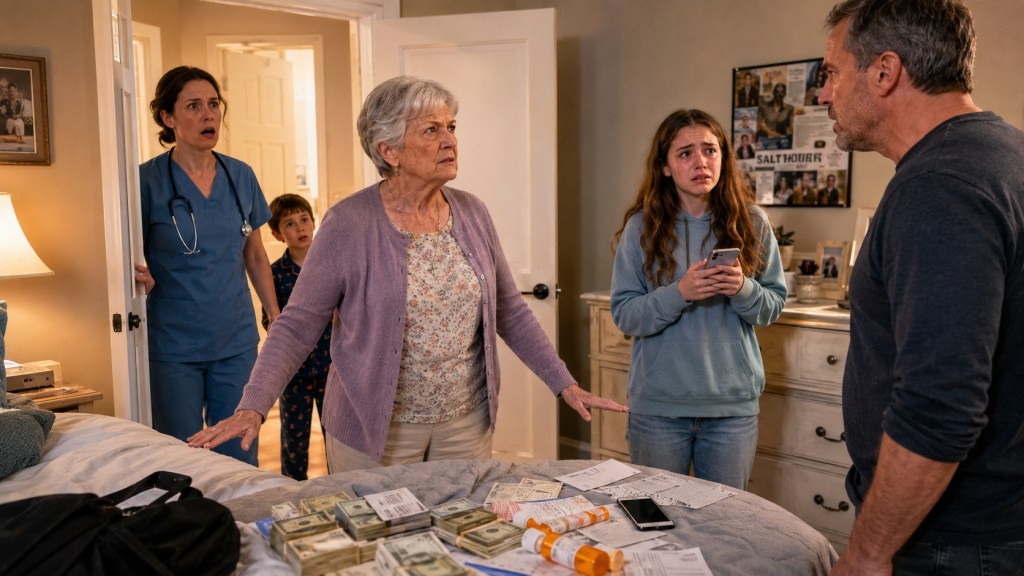
Everyone froze.
Darren stood beside the bed, his face red and stunned.
Mia, fifteen years old, stood near the dresser with tears running down her cheeks, clutching Darren’s phone in both hands.
Her backpack lay open on the floor.
Papers were scattered everywhere.
A small black flash drive had rolled beneath the nightstand.
And on the bed, half-hidden beneath Darren’s jacket, were stacks of cash, fake prescription labels, and a second phone blinking with a message notification.
For a moment, my mind could not put the scene together.
Cash.
Labels.
Phones.
Mia crying.
Darren breathing hard like an animal caught in a trap.
Then Mia looked at me like I had pulled her back from the edge of a cliff.
“He’s not my dad,” she said, her voice trembling. “And he’s been stealing Mom’s patient records from the clinic.”
The words hit the room like thunder.
Darren’s shock disappeared.
His eyes went cold.
“Give me the phone, Mia.”
I stepped between them.
“No,” I said.
His gaze snapped to me.
“You don’t know what’s going on.”
“I know enough.”
“No, you don’t.” He gave me that public smile, but now it was cracked at the edges. “She’s a teenager. She got into things she doesn’t understand.”
Mia shook her head hard.
“I understand everything.”
Darren took one step forward.
I raised my hand.
“Take one more step toward her, and I will scream loud enough for every neighbor on this block to hear.”
He stopped.
For the first time since I had known him, Darren Briggs had no smile ready.
Mia’s hands trembled around the phone.
“I found messages,” she said. “He has pictures of Mom’s clinic files. Patient names, addresses, medications, insurance numbers. He’s been sending them to someone.”
Darren laughed once.
It was ugly and desperate.
“Do you hear yourself? That sounds insane.”
Mia pointed to the bed.
“Then why are there fake prescription labels in your room?”
My stomach turned.
Lisa worked as a nurse at Briar Creek Family Clinic.
She brought paperwork home sometimes, but only sealed files she needed to review under strict privacy rules.
She was careful.
Careful with names.
Careful with charts.
Careful with every detail because she believed people deserved dignity when they were vulnerable.
And now Darren had built something rotten out of that trust.
I bent down slowly and picked up one of the papers near my foot.
It had a patient’s name on it.
A real person.
A real address.
A medication list.
I felt my blood go cold.
“Darren,” I said quietly, “what have you done?”
His jaw tightened.
“Put that down.”
Then we heard footsteps pounding up the stairs.
Lisa appeared in the doorway behind me, still in her scrubs, her hair coming loose from its clip, her face drained of color.
She must have seen Caleb’s missed calls.
She must have driven straight home from the clinic.
For a second, she did not speak.
She only stared.
At Darren.
At Mia’s tears.
At the cash on the bed.
At the papers in my hand.
“What is this?” she whispered.
Darren immediately changed.
His shoulders dropped.
His expression softened.
He became the husband again.
The calm one.
The reasonable one.
“Lisa,” he said, “thank God you’re here. Mia broke into our room and started screaming nonsense. Your mother kicked the door open like a lunatic.”
Lisa did not move.
Her eyes were fixed on the documents.
“Why are those here?”
Darren blinked.
“What?”
“My clinic files,” she said. “Why are they in our bedroom?”
Mia stepped forward, still holding the phone.
“Mom, I can show you. He took pictures of files from your bag. He sent them to someone named Ray. They were talking about labels, cash, and names.”
Darren’s face hardened again.
“Mia, stop lying.”
“She’s not lying,” Caleb said.
We all turned.
He stood in the hallway behind Lisa, small and shaking in his dinosaur pajamas.
“I saw him,” Caleb whispered. “Last week. He was at Mom’s work bag after she went to sleep. I thought he was helping her.”
Darren’s mouth opened, but no sound came out.
Lisa looked at her son.
“Caleb,” she said softly, “are you sure?”
He nodded.
“He told me not to tell because it was a surprise for you.”
Lisa closed her eyes.
I watched the last pieces of denial fall away from her face.
Then she opened them again, and the woman standing in that doorway was not frightened anymore.
She was ice.
“Give me the phone,” she said.
Darren reached toward Mia.
“I said give it to me.”
I stepped closer to him.
“No one is giving you anything.”
Lisa pulled her own phone from her pocket.
Darren noticed and snapped, “Who are you calling?”
“911.”
His face twisted.
“For what? Because your teenage daughter made up a story?”
Lisa looked at the bed.
“At minimum, stolen medical records. Possibly identity theft. Prescription fraud. And whatever else the police find.”
That was when Darren lunged.
Not at Lisa.
Not at Mia.
At the nightstand.
The flash drive.
He dropped to one knee, stretching his arm beneath the furniture.
Mia moved faster.
She kicked the small black flash drive across the floor toward me.
It slid against my slipper.
I bent down, picked it up, and closed my fist around it.
Darren rose slowly.
His face had changed completely.
The mask was gone.
There was nothing charming left.
“You have no idea what you’re doing,” he said.
“No,” I replied. “But the police will.”
Lisa backed into the hallway with her phone pressed to her ear.
“Yes, I need officers at my home. My husband has patient records from my clinic in our bedroom. There is cash. There are labels. My daughter found messages. Please send someone now.”
Darren stared at her as if he could not believe she had chosen the children over him.
That was how men like him thought.
Love was loyalty to their lies.
Marriage was silence.
Family was something they used as a shield.
But Lisa was done being his shield.
The sirens came faster than I expected.
Maybe because Lisa’s voice sounded so calm that the emergency operator knew it was serious.
Maybe because patient records and fake prescription labels were words that moved quickly through the system.
Within minutes, blue and red lights flashed across the upstairs walls.
Caleb began to cry.
Lisa knelt and pulled him close.
“It’s okay,” she whispered. “You did the right thing. You called Grandma. You were brave.”
“I was scared,” he sobbed.
“Brave people are scared,” I said. “They just tell the truth anyway.”
Two officers entered the house first.
Then a detective arrived.
Then another officer asked Darren to step away from the bed.
Darren kept talking.
He talked the way guilty men do when silence becomes dangerous.
He said Mia was troubled.
He said I was controlling.
He said Lisa was exhausted from work and misunderstanding everything.
He said the money belonged to him.
He said the labels were for a side business.
He said the second phone was private.
He said the flash drive was empty.
He said every possible thing except the truth.
The detective listened without expression.
Then she turned to Mia.
“Can you show me what you found?”
Mia looked at Lisa.
Lisa nodded.
With shaking hands, Mia unlocked Darren’s phone.
She had seen his passcode earlier that day, she explained.
She had only gone into the room because she was looking for her missing charger.
Instead, she found her mother’s clinic folder inside Darren’s drawer.
At first, she thought Lisa had left it there.
Then she saw the phone beside it.
The messages were open.
Photos of patient documents.
Names.
Birth dates.
Prescription information.
Insurance cards.
Prices beside each name.
Mia had grabbed the phone and confronted him.
That was when Darren entered the room.
That was when the yelling started.
That was when Caleb heard his sister scream and called me.
The detective’s expression changed as she scrolled.
Not dramatically.
Just enough.
Her mouth tightened.
She showed one of the officers the screen.
Then she asked Lisa, “Are these clinic documents?”
Lisa’s face was white.
“Yes,” she whispered. “Some of them are from locked files. Some were in folders assigned to me. I don’t understand how he—”
She stopped.
Then she looked at Darren.
“My badge.”
Darren said nothing.
Lisa’s voice shook.
“You used my badge.”
The detective looked up.
“Your access badge?”
Lisa nodded slowly.
“I lost it two months ago. Darren said he found it in the laundry and returned it to my purse. But after that, my supervisor asked why I had accessed records during hours I wasn’t working. I thought it was a system error.”
Darren’s eyes flickered.
Just once.
But I saw it.
So did the detective.
“Mr. Briggs,” she said, “turn around and place your hands behind your back.”
Darren exploded.
“This is ridiculous! You’re arresting me because of a child’s story?”
“You’re being detained while we investigate,” she said.
“You can’t do this!”
Lisa stood in the hallway, holding both children.
Darren looked at her.
“Tell them, Lisa. Tell them this is a misunderstanding.”
For one brief moment, I thought she might break.
Not because she still believed him.
Because betrayal can make even truth feel unbearable.
She had shared a bed with this man.
Trusted him with her children.
Let him into her home.
Allowed him near her purse, her keys, her life.
Now that life was split open in front of her.
But Lisa only tightened her arms around Mia and Caleb.
“No,” she said. “I won’t lie for you.”
The officer led Darren down the stairs.
He shouted until the front door closed behind him.
Then the house became silent.
Not peaceful.
Not yet.
Just emptied of the sound of him.
Mia sank onto the hallway floor and burst into tears.
Lisa dropped beside her.
“I’m sorry,” she whispered. “I’m so sorry. I should have listened. I should have seen it.”
Mia clung to her.
“I thought you wouldn’t believe me.”
Those words broke my heart clean in half.
Lisa cried then.
Not loud.
Not dramatically.
Just the quiet, devastated crying of a mother realizing her child had been carrying fear alone.
“I believe you,” Lisa said. “I believe you now. I will believe you every day after this.”
Caleb crawled into their arms too.
I stood over them, gripping the flash drive until the detective gently asked for it.
I handed it over.
She placed it into an evidence bag.
Before leaving, she told Lisa someone from the clinic’s legal department would need to be contacted immediately.
The breach could involve dozens of patients.
Maybe more.
Lisa nodded as though each word was another stone placed on her chest.
After the officers left, we did not sleep.
We sat around the kitchen table until sunrise.
Caleb wore my sweater over his pajamas.
Mia held a mug of tea she never drank.
Lisa made one phone call after another.
Her supervisor.
The clinic director.
The privacy officer.
A lawyer the clinic recommended.
Every call made the situation worse.
Darren had not only stolen patient information.
He had used Lisa’s badge after hours.
He had photographed files.
He had opened records under her name.
For weeks, maybe months, he had made it look like Lisa was the one accessing those patients.
When Lisa ended the last call, she put her phone on the table and covered her face.
“He was setting me up,” she whispered.
I reached across the table and took her hand.
“Yes,” I said. “But he didn’t count on your daughter.”
Mia looked down.
“I only found it because I was looking for my charger.”
“Sometimes,” I said, “truth waits for the smallest door to open.”
By noon, the clinic had placed Lisa on temporary leave while they investigated.
Not punishment, they said.
Procedure.
That word made me furious.
Procedure meant my daughter had to sit at home while the man who betrayed her sat in a holding cell pretending he was innocent.
Procedure meant patients had to be notified.
Procedure meant lawyers.
Questions.
Forms.
Shame.
Even when Lisa had done nothing wrong, Darren had managed to stain her name.
By evening, news had begun to spread.
Not the full truth.
Small-town truth never arrives whole.
It comes in pieces, dressed in gossip.
A neighbor texted asking if everything was okay.
A church friend called and left a message saying she was praying for “both sides.”
Both sides.
I wanted to throw the phone into the sink.
There are not always two sides.
Sometimes there is truth, and there is the person trying to bury it.
The next morning, Darren’s sister, Paula, came to the house.
She knocked like she owned the place.
I opened the door because Lisa was upstairs with the children.
Paula stood on the porch in sunglasses, lips tight, arms crossed.
“My brother wants his clothes,” she said.
“He can ask through his lawyer.”
Her mouth curled.
“You always hated him.”
“I disliked him. He earned the rest.”
“He says Mia is confused.”
I stepped onto the porch and pulled the door partly closed behind me.
“Say my granddaughter’s name carefully.”
Paula blinked.
“What?”
“She is fifteen years old. She protected her mother, her brother, and maybe dozens of strangers whose private information your brother stole. If you came here to call her confused, you can leave.”
Paula’s face flushed.
“You don’t know Darren.”
“No,” I said. “But I know what was on that bed.”
She tried to look past me into the house.
“I just want to talk to Lisa.”
“Lisa is done talking to anyone who excuses him.”
“You’re tearing this family apart.”
I almost laughed.
“Your brother did that when he turned my daughter’s work into a crime scene.”
I shut the door before she could answer.
Behind me, I found Mia standing at the bottom of the stairs.
She had heard everything.
“I’m sorry,” she said.
“For what?”
“For causing trouble.”
I crossed the hallway and took her face gently in my hands.
“Listen to me, sweetheart. You did not cause trouble. You uncovered it.”
Her chin trembled.
“But Mom might lose her job.”
“Your mother might have a hard road because Darren tried to bury his crimes under her name. But that is his fault. Not yours.”
She nodded, but I could see the guilt still sitting on her shoulders.
Children always think they can somehow be responsible for adult darkness.
That is why adults must tell the truth louder.
Over the next week, our lives became a storm.
The police searched the house.
They took Darren’s laptop.
They found a locked storage unit across town.
Inside were boxes of copied documents, prepaid phones, blank prescription pads, and envelopes of cash.
They found more flash drives.
More names.
More proof.
Darren had been working with two other people.
One was a former pharmacy technician.
The other was a man Lisa had never met, someone who bought patient information and used it for fraudulent billing and prescription schemes.
When the detective called Lisa with the update, she sat down slowly at the kitchen table.
Mia stood beside her, holding her breath.
“So it wasn’t just us?” Lisa asked.
“No,” the detective said. “And because your daughter preserved the phone and your mother secured the flash drive, we have a strong starting point.”
For the first time in days, Lisa looked at Mia with something other than grief.
Pride.
Real pride.
“You saved people,” Lisa whispered.
Mia shook her head.
“I was scared.”
“And you still did the right thing.”
Caleb sat beside me, drawing dinosaurs in a notebook.
He looked up and said, “Did I save people too?”
Lisa pulled him into her lap.
“Yes,” she said. “You called Grandma. That saved your sister.”
That night, for the first time since it happened, Caleb slept through the night.
Mia did not.
I found her sitting on the back porch after midnight, wrapped in a blanket, staring at the dark yard.
I sat beside her.
For a while, neither of us spoke.
Then she said, “I keep thinking about his face.”
“Darren’s?”
She nodded.
“When you came in, he looked scared. Then he looked… mean. Like the person he pretended to be disappeared.”
I took a breath.
“That is a hard thing to see.”
“Did you know?” she asked.
“Not this. But I knew something was wrong.”
“Why didn’t anyone else?”
The question was not angry.
That made it worse.
It was tired.
I looked out at the yard.
“Because people like Darren learn how to look good where others are watching.”
Mia wiped her cheek.
“He used to help old women carry groceries after church.”
“I know.”
“He made pancakes shaped like hearts for Mom.”
“I know.”
“He fixed Caleb’s bike.”
“I know.”
“So how can someone do nice things and still be bad?”
I turned toward her.
“Because nice is not the same as good.”
She looked at me.
“Good costs something. Good tells the truth when lying is easier. Good protects people who cannot repay you. Nice can be a costume. Good is what remains when no one is clapping.”
Mia was quiet for a long time.
Then she leaned against my shoulder.
“I don’t want Mom to be sad forever.”
“She won’t be.”
“How do you know?”
“Because she has you and Caleb. And because she is stronger than she feels right now.”
Mia closed her eyes.
“What about me?”
I kissed her hair.
“You are stronger than any of us knew.”
The investigation took months.
Darren’s lies unraveled one by one.
At first, he claimed Mia had misunderstood.
Then he claimed Lisa had given him the files.
Then he claimed he was being forced by criminals.
Then, when the evidence grew too heavy, he tried to make a deal.
By then, the clinic had completed its review.
Lisa had not been careless.
Her badge had been used without her knowledge.
Her access patterns did not match the stolen records.
Security footage showed Darren entering the clinic after hours twice using Lisa’s badge while wearing a baseball cap and keeping his face angled down.
The video was grainy.
But it was enough.
Lisa kept her nursing license.
She kept her job.
But she did not keep the same life.
She filed for divorce the same week Darren was formally charged.
She changed the locks.
Changed the alarm code.
Changed the children’s school pickup list.
Changed every password.
Then she changed something harder.
She stopped apologizing for not seeing it sooner.
That took longer.
Some nights, she still sat at my kitchen table and cried into cold coffee.
“I brought him into their lives,” she would say.
And every time, I told her the same thing.
“You brought love into their lives. He brought lies. Do not confuse the two.”
Mia started therapy.
Caleb did too.
At first, he would not sleep unless every bedroom door was open.
Mia stopped leaving her phone unattended.
Lisa flinched whenever unknown numbers called.
Healing did not come like sunlight all at once.
It came like a match in the dark.
Small.
Fragile.
Enough to see the next step.
Three months after that terrible night, Lisa and the children moved into a smaller house five streets away from me.
It had blue shutters, a fenced backyard, and a kitchen with morning light.
The first Saturday there, Caleb ran through the empty living room with a cardboard sword, declaring himself guardian of the kingdom.
Mia rolled her eyes and told him he was being weird.
Then she smiled.
A real smile.
Lisa saw it and had to turn away before the children noticed her tears.
I noticed.
Of course I did.
Mothers always notice when their daughters are quietly breaking and quietly rebuilding.
That afternoon, we unpacked dishes.
Mia found an old photo album in one of the boxes.
Inside were pictures from before Darren.
Lisa holding Caleb as a baby.
Mia with missing front teeth.
Their father at a school picnic before the divorce, laughing with mustard on his shirt.
Mia traced one photo with her finger.
“I forgot Mom used to laugh like that,” she said.
Lisa came over and looked.
For a second, pain crossed her face.
Then something softer followed.
“I’ll laugh like that again,” she said.
Mia looked up.
“Promise?”
Lisa held out her pinky.
“Promise.”
Caleb ran in and demanded to be included.
So all three of them stood in the kitchen, pinkies linked, surrounded by half-open boxes and sunlight.
I stood by the sink and watched them.
That was when I finally felt it.
Not relief.
Not yet.
But hope.
The kind that does not erase what happened.
The kind that says what happened will not get the last word.
Darren’s trial came the following spring.
Lisa was asked to testify.
So was Mia.
Caleb was not required to take the stand, and for that I thanked God.
The morning of court, Mia wore a navy dress and kept twisting the bracelet on her wrist.
It was one I had given her.
A small silver chain with a tiny heart.
“You don’t have to be fearless,” I told her outside the courtroom.
She swallowed.
“What if my voice shakes?”
“Then let it shake.”
“What if I cry?”
“Then cry.”
“What if he looks at me?”
I took both her hands.
“Then look at the truth instead.”
Inside, Darren looked smaller than I remembered.
Not weak.
Never mistake exposed for harmless.
But smaller.
Without the house, the smile, the church compliments, the husband costume, he was only a man sitting at a defense table while his lies were read aloud.
Mia testified clearly.
Her voice shook only once.
When the prosecutor asked why she took the phone, she looked toward her mother.
“Because I knew something was wrong,” she said. “And I was afraid if I let go of it, he would make the truth disappear.”
Lisa cried silently in the seat beside me.
I held her hand.
When the verdict came weeks later, Darren was found guilty on multiple charges.
Fraud.
Identity theft.
Illegal possession of medical information.
Conspiracy.
There were more words, legal words, heavy words, but I mostly remember Lisa’s breath leaving her body when she heard guilty.
Not happiness.
No one was happy.
A guilty verdict does not give back peaceful nights.
It does not erase a child’s fear.
It does not return the years spent trusting someone who used that trust as a weapon.
But it mattered.
Truth mattered.
Mia mattered.
Caleb mattered.
Lisa mattered.
And for once, the world said so out loud.
After sentencing, Darren turned around before the officers led him away.
His eyes found Lisa.
Then Mia.
Then me.
For half a second, I saw that cold look again.
The one from the bedroom.
But it had no power now.
Not over us.
Not anymore.
I looked back until he turned away first.
That evening, we went home to Lisa’s blue-shuttered house.
No celebration.
No party.
Just soup on the stove, bread warming in the oven, and Caleb setting the table with the serious focus of a boy given an important mission.
Mia came downstairs in sweatpants, her court dress already tossed over a chair.
She looked exhausted.
But lighter.
Lisa pulled her into a hug.
“I’m proud of you,” she whispered.
Mia closed her eyes.
“I was scared the whole time.”
“I know.”
“I still did it.”
Lisa smiled through tears.
“Yes, baby. You still did it.”
Caleb lifted his spoon and announced, “To Mia, detective of the family.”
Mia laughed.
It startled all of us.
Then Lisa laughed.
Then Caleb.
Then me.
It was not the same laughter from the old photo album.
It was newer.
Cracked in places.
But it was real.
Months later, people in Maple Hollow still whispered.
Some whispered that Lisa had been brave.
Some whispered that they always suspected Darren.
That was a lie.
Most of them had admired him.
But I learned not to waste anger on people who only recognized danger after someone else named it for them.
What mattered was inside the blue-shuttered house.
Caleb stopped sleeping with the hallway light on.
Mia joined the school newspaper and wrote an article about digital privacy without mentioning her own family.
Lisa went back to work and became even more careful, even stronger, even more respected.
And every Sunday evening, they came to my house for dinner.
One night, nearly a year after Caleb’s call, Mia helped me wash dishes while Lisa and Caleb played cards in the living room.
The kitchen window was open.
Summer air drifted in.
Mia handed me a plate and said quietly, “Grandma?”
“Yes, sweetheart?”
“Do you ever think about what would have happened if Caleb hadn’t called you?”
I dried the plate slowly.
“Yes,” I said. “Sometimes.”
She looked down.
“Me too.”
I set the towel aside.
“But he did call. And I did come. And you held onto the truth long enough for all of us to see it.”
Her eyes filled, but she smiled.
“I thought you were going to break the whole door down.”
“I nearly did.”
“You were scary.”
“Good.”
She laughed softly.
Then she leaned her head against my shoulder.
For a moment, she was not the brave girl in court.
Not the teenager who uncovered a crime.
Not the child who had stared down a man trying to erase the truth.
She was just my granddaughter.
Fifteen years old.
Still healing.
Still here.
And that was enough.
People always ask how I had the strength to kick open that door.
The truth is, I did not feel strong.
I felt old.
Terrified.
Unprepared.
My shoulder hurt for two weeks afterward.
But love does not ask your age before it moves your body.
Love does not wait until you feel ready.
Love hears a child whisper, “Please hurry,” and it runs.
That night, I thought I was rushing into a family argument.
Instead, I walked into the collapse of a lie.
I saw cash, stolen records, fake labels, and a man who had hidden his crimes behind my daughter’s trust.
But I also saw something else.
I saw a frightened boy brave enough to call for help.
I saw a teenage girl brave enough to hold onto evidence with shaking hands.
I saw my daughter choose truth over denial, even when it broke her heart.
And I learned that sometimes a family is not saved by the person who looks strongest.
Sometimes it is saved by the smallest voice on the phone.
The trembling one.
The one whispering from the hallway.
“Grandma, please come over.”
And thank God, I did.
THE END! THANK YOU FOR READING!