

When my sister-in-law, Vanessa Hart, called my thirteen-year-old daughter Lily into Studio B, I thought she was about to give her a pep talk. The spring showcase was only three days away. Lily had practiced her solo for months, dancing in our garage until her feet blistered and her knees bruised.
Every evening after homework, she pushed aside the bikes, rolled out the old practice mat, and danced beneath the yellow garage light while I counted beats from a folding chair. Vanessa owned Hartline Dance Studio in Columbus, Ohio, and for years she had treated that place like a palace with herself on the throne.
She had framed photos of trophies along the hallway.
She had her name printed in gold letters on the front desk.
She had parents whispering, teachers nodding, and students terrified of disappointing her.
And because she was my husband Mark’s older sister, I had spent years pretending her sharpness was just ambition.
That afternoon, Lily came back out of Studio B ten minutes later with her costume bag pressed against her chest and her face pale.
Her eyes were red, but she was trying not to cry.
“Mom,” she whispered, “Aunt Vanessa said I’m not dancing.”
For a second, I thought I had misunderstood.
I stood up so fast my chair scraped across the lobby floor.
“What?”
Lily looked down at her shoes.
“She said I’m cut from the showcase.”
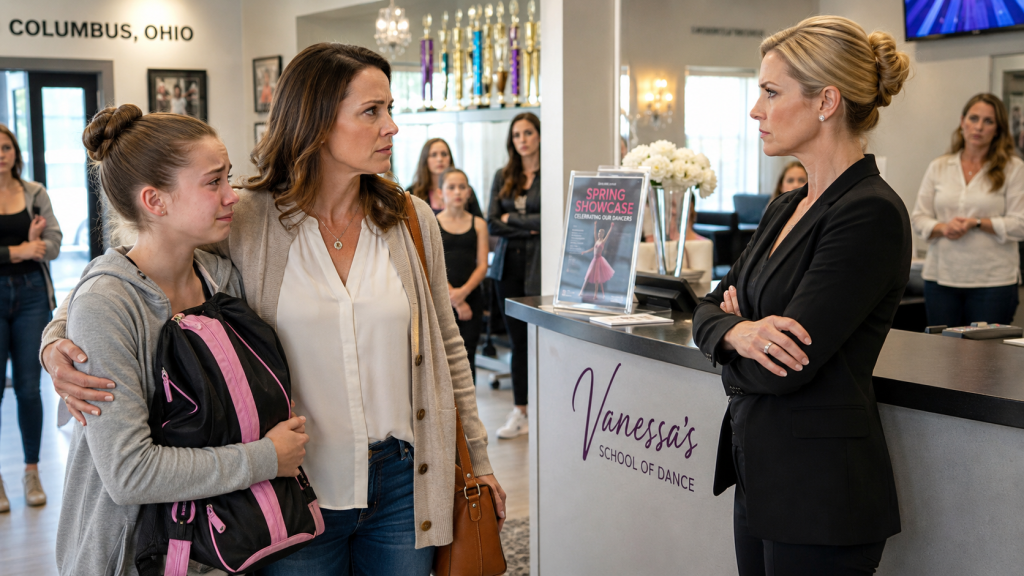
Vanessa walked out behind her, arms folded, wearing that tight smile she used whenever parents complained about fees.
“I made a professional decision,” she said.
“A professional decision?” I repeated. “The showcase is Saturday.”
“She is not ready.”
Lily flinched as if the words had touched her skin.
I stared at Vanessa.
My daughter had been placed in the advanced group by Vanessa herself.
She had earned the solo after auditioning in front of three teachers.
Her music had been cut.
Her costume had been altered.
Her name was already printed in the program.
“You approved her solo,” I said quietly.
Vanessa gave a small sigh, like I was embarrassing myself by asking for fairness.
“I approved it before I saw how she handled pressure.”
“That’s not true.”
“It is true,” Vanessa said.
A few parents in the lobby looked up from their phones.
One mother froze while tying her daughter’s shoe.
Another student stood by the vending machine, pretending not to listen.
Vanessa lowered her voice, but everyone still heard her.
“Lily is stiff. She panics under pressure. And frankly, she’ll ruin my studio’s reputation.”
The words hit harder than a slap.
My husband, Mark, had always told me to ignore Vanessa.
“That’s just Vanessa,” he would say.
Ambitious.
Harsh.
Competitive.
But this was not harsh.
This was cruel.
Lily stared at the floor as tears slipped down her cheeks.
“She worked harder than anyone,” I said.
“Hard work doesn’t matter if the result embarrasses the studio,” Vanessa replied. “I have judges, scouts, and sponsors coming. I cannot risk one weak performance.”
Then she added the part that made the entire lobby go silent.
“Maybe Lily should try something less visible. Like recreational ballet. Or theater tech.”
My daughter’s fingers tightened around the costume bag.
I wanted to shout.
I wanted to say every ugly thing I had swallowed for ten years.
I wanted to remind Vanessa that Lily was a child, not a prop in her studio’s perfect image.
Instead, I took Lily’s hand.
“Come on,” I said.
Vanessa lifted her chin.
“The decision is final.”
I looked at her once.
Not with anger.
With memory.
Because suddenly I remembered every birthday where Vanessa praised another niece more loudly.
Every family dinner where she corrected Lily’s posture at the table.
Every holiday where she asked if Lily had “lost focus again” when my daughter reached for dessert.
Every time she disguised cruelty as expertise.
Then I walked out with my daughter.
The parking lot was bright with afternoon sun, but Lily moved beside me like someone walking through rain.
She didn’t speak until we reached the car.
When I opened the passenger door, she climbed in and placed the costume bag on her lap as carefully as if it were something broken.
On the drive home, she kept her face turned toward the window.
I could see her reflection in the glass.
Small.
Still.
Humiliated.
I wanted to tell her Vanessa was wrong.
I wanted to tell her that one cruel adult did not get to decide her worth.
But I also knew that when a child is hurt, the right words can sound empty.
So I drove in silence and let her cry without making her explain the tears.
At home, Lily went straight to her room.
She closed the door softly.
That hurt me more than if she had slammed it.
For months, our house had been full of music.
Tap counts in the hallway.
Leaps in the kitchen.
Stretching on the living room rug.
Lily practicing turns while brushing her teeth.
That night, there was nothing.
No music.
No tapping feet.
No counting beats under her breath.
No garage door creaking open after dinner.
Mark came home just after seven.
He found me in the kitchen, standing over a pot of untouched pasta.
“What happened?” he asked.
I told him everything.
His face changed slowly.
First confusion.
Then anger.
Then that weary look he always wore when Vanessa was involved.
“I’ll call her,” he said.
“No,” I replied.
He stopped.
“No?”
“She humiliated Lily in front of everyone. A phone call from you won’t fix that.”
“She’s my sister.”
“And Lily is your daughter.”
That silenced him.
He looked toward the hallway, where Lily’s bedroom door remained closed.
“I didn’t mean it like that,” he said quietly.
“I know. But for years we have all let Vanessa behave like being talented gives her permission to be cruel.”
Mark rubbed both hands over his face.
“She’s always been obsessed with winning.”
“She didn’t cut Lily because Lily couldn’t dance,” I said. “She cut her because she didn’t believe Lily made her look good enough.”
Mark did not argue.
Because deep down, he knew.
At midnight, I woke to a faint sound.
Not music.
Not crying.
Something softer.
I walked down the hallway and saw a thin strip of light under Lily’s door.
I knocked once.
“Sweetheart?”
No answer.
I pushed the door open gently.
Lily was sitting on the floor beside her bed, still wearing her sweatshirt and leggings.
Her worn-out jazz shoes were in her lap.
The pink satin had faded around the toes.
The soles were scuffed.
The elastic had been sewn twice because she refused to replace them before the showcase.
She looked up at me.
“I don’t want to quit,” she said.
Those six words broke my heart open.
I sat beside her on the carpet.
“Then don’t.”
Her chin trembled.
“But where would I dance? She took me out.”
I looked at my daughter’s shoes.
Then at her face.
And something in me became calm.
Not peaceful.
Determined.
“The showcase is not the only stage in the world.”
Lily blinked.
“What do you mean?”
I brushed a tear from her cheek.
“I mean tomorrow morning, I’m making a phone call.”
“Please don’t call Aunt Vanessa.”
“I’m not calling Vanessa.”
The next morning, after Lily left for school, I searched through every email Vanessa had ever forwarded about competitions, auditions, and scholarship programs.
Most of them required studio registration.
Some required teacher approval.
But one caught my eye.
The National Young Performers Dance Competition.
Independent entries accepted.
Late registration possible with director approval.
I remembered the name because Lily had dreamed of auditioning the year before, but Vanessa had dismissed it.
“Nationals are not for emotional dancers,” she had said. “They are for polished performers.”
I clicked the link.
My hands were shaking.
Then I called the number.
A woman answered on the third ring.
“National Young Performers Dance Competition, this is Miriam.”
I explained who I was.
I told her my daughter had a prepared solo.
I told her the situation had changed suddenly.
I tried to keep my voice steady, but somewhere in the middle, when I mentioned that Lily had been removed from her studio showcase three days before performing, my throat tightened.
Miriam did not interrupt.
When I finished, she asked for Lily’s name.
“Lily Hart,” I said.
There was a pause.
“Lily Hart from Columbus?”
“Yes.”
“Blue ribbon in her hair in the audition video last fall?”
I sat straighter.
“You remember that?”
“I remember dancers who tell the truth when they move,” Miriam said. “Beautiful control. Why wasn’t she entered through Hartline?”
I looked at the screen in front of me.
At Vanessa’s studio logo.
At the words independent entry.
Then I told her the truth.
Not dramatically.
Not angrily.
Just the facts.
Miriam was quiet for a moment.
Then she said, “Can you send the final music cut and proof of age within the hour?”
“Yes.”
“And does Lily still want to dance?”
I looked toward the garage, where the practice mat was still rolled against the wall.
“More than anything.”
“Then send it.”
By Friday morning, Lily had a late independent entry.
She had no studio jacket.
No team warm-up.
No matching rhinestone bag.
No Vanessa correcting her shoulders backstage.
Just a plain black costume from last year that my mother helped alter overnight.
When Lily came home from school and I told her, she stared at me like I had handed her a key to another life.
“I’m really allowed?”
“You are really allowed.”
Her hands flew to her mouth.
Then she cried again.
But this time, the tears were different.
That evening, she returned to the garage.
The first run-through was rough.
She stopped twice.
Forgot a transition.
Lost balance on her second turn.
Then she sat on the mat with her knees pulled to her chest.
“What if Aunt Vanessa is right?”
I crouched in front of her.
“Then you dance anyway.”
Her eyes searched mine.
“That’s scary.”
“Yes,” I said. “But brave things usually are.”
Mark came into the garage carrying a speaker and a bottle of water.
“I took tomorrow off,” he said.
Lily looked surprised.
“You did?”
He nodded.
“I’m driving you.”
For a second, Lily looked like the little girl she used to be, the one who ran to him after every preschool dance recital with glitter on her cheeks.
Then she stood.
“Play it from the beginning,” she said.
We stayed in that garage until nearly ten.
Mark counted beats.
I fixed the strap on her costume.
Lily danced.
Not perfectly.
But honestly.
And sometimes honesty has a strength perfection never reaches.
The next morning, we arrived at the national competition hall before sunrise.
The building was huge, with glass doors and banners hanging from the ceiling.
Girls in sequined costumes hurried past us with garment bags over their shoulders.
Boys in black dance pants stretched near the wall.
Parents balanced coffee cups, makeup cases, hair spray, and nervous smiles.
Lily stood beside me with her black costume under her coat and her hair in a tight bun.
She looked terrified.
I squeezed her hand.
“You don’t have to beat anyone today,” I said.
She swallowed.
“Then what am I supposed to do?”
“Show them who you are.”
We checked in at the independent registration table.
The volunteer handed Lily a number and a badge.
No studio name was printed under hers.
Just Independent Performer.
Lily touched the badge with her fingertips.
Then we heard a familiar voice.
“Well, this is interesting.”
I turned.
Vanessa stood ten feet away in a burgundy Hartline jacket, surrounded by her team.
Her students wore matching warm-ups.
Their parents stood behind them like an army.
Vanessa’s eyes moved from me to Lily’s badge.
Then to the costume bag in Mark’s hand.
“What is she doing here?” Vanessa asked.
Mark stepped forward.
“She’s competing.”
Vanessa laughed once, but it came out thin.
“Independent?”
“Yes,” I said.
Her expression hardened.
“You have no idea what you’ve done. This level is not a family talent show.”
Lily’s shoulders curled inward.
I felt her shrink beside me.
Vanessa noticed.
Of course she noticed.
She leaned slightly closer.
“Sweetheart, I was trying to spare you.”
Mark’s voice cut through the space between them.
“Enough.”
Vanessa blinked.
He had rarely spoken to her that way.
“She is thirteen,” he said. “You are not going to stand here and make her feel small.”
Vanessa’s mouth opened, then closed.
People were looking again.
Just like in the studio lobby.
Only this time, Lily was not alone.
I turned to my daughter.
“Come on. Let’s warm up.”
Backstage smelled like hairspray, rosin, and nerves.
Lily sat in front of a mirror while I pinned the last loose strands of hair into place.
Her hands were cold.
“I can hear Hartline girls talking,” she whispered.
I could too.
Some of them were curious.
Some sounded sympathetic.
One girl said, “I thought Lily was doing the showcase.”
Another answered, “Miss Vanessa said she wasn’t ready.”
Lily closed her eyes.
I knelt beside her chair.
“Look at me.”
She did.
“Do you remember what you said on your bedroom floor?”
“I don’t want to quit.”
“That is the only sentence that matters today.”
Her lips pressed together.
Then she nodded.
When Lily’s division began, I stood in the audience between Mark and my mother.
Vanessa sat two rows ahead with Hartline parents.
Every few minutes, she checked the program.
I could see the exact moment she found Lily’s name.
Her shoulders stiffened.
She turned slightly, looking back toward us.
I did not look away.
Lily was number eighteen.
The dancers before her were excellent.
Sharp turns.
High leaps.
Perfect smiles.
They sparkled under the lights.
Then the announcer’s voice filled the room.
“Entry number eighteen, Independent Performer, Lily Hart.”
For a moment, the stage was empty.
Then Lily walked into the light.
She looked so small beneath it.
No rhinestones.
No team colors.
No studio name.
Just a girl in black, standing alone with her heart beating loud enough that I imagined everyone could hear it.
The first notes of her music began.
For ten seconds, I thought fear might win.
Her shoulders were tight.
Her face was pale.
Her first step was careful.
Then the music rose.
And something in her changed.
It was not sudden like magic.
It was deeper than that.
It was as if she remembered every night in the garage.
Every blister.
Every correction.
Every time she had fallen and gotten back up.
Every cruel word Vanessa had thrown at her.
Every moment she had almost believed it.
Her arms opened.
Her spine lifted.
She moved.
Not stiffly.
Not timidly.
Not like someone trying to protect a studio’s reputation.
Like someone trying to reclaim her own name.
Her first turn landed clean.
Then the second.
Then the third.
A whisper moved through the audience.
Her leap was not the highest of the day, but it had feeling.
Her floor sequence was raw and controlled at the same time.
Her face told a story without begging for pity.
By the final minute, the room had gone completely silent.
No candy wrappers.
No whispers.
No coughing.
Just music.
Just Lily.
When she reached the final pose, one hand extended toward the light, I realized I had stopped breathing.
Then the applause exploded.
Mark covered his mouth.
My mother began crying openly.
I clapped until my palms hurt.
Lily stood onstage for half a second, stunned by the sound.
Then she bowed.
As she left, I saw Vanessa sitting very still in the second row.
Her face had lost all its color.
Backstage, Lily ran into my arms.
“I did it,” she gasped.
“You did.”
“I messed up one transition.”
“No one saw.”
“I saw.”
“Then you also saw that you kept going.”
She laughed through tears.
That was the first real laugh I had heard from her since Studio B.
Awards were announced that evening.
The competition hall filled again, louder now, buzzing with nervous energy.
Dancers sat with their teams.
Hartline occupied nearly an entire section.
Their jackets formed a burgundy block near the front.
Lily sat between Mark and me.
Her badge still said Independent Performer.
She held it like it was precious.
Vanessa sat across the aisle, arms folded, her expression cool again.
She had recovered enough to pretend nothing mattered.
The announcer began with special recognitions.
Technique awards.
Stage presence.
Choreography.
Costume.
Then came the Junior Solo Division.
Lily leaned into me.
“I’m proud even if I don’t place,” she whispered.
“I know.”
Third place went to a dancer from a large academy in Chicago.
Second place went to one of Hartline’s strongest performers, a girl named Ava who looked shocked and thrilled.
Vanessa stood immediately, clapping loudly, smiling for the parents.
Then the announcer lifted the final card.
“And first place in the Junior Solo Division goes to…”
The screen behind him flashed before he finished speaking.
Lily Hart.
Independent Performer.
For one second, nobody around us moved.
Then my mother screamed.
Mark jumped to his feet.
I grabbed Lily’s shoulders.
“Baby,” I said. “That’s you.”
Lily stared at the screen.
Her mouth opened, but no sound came out.
The announcer repeated it.
“Lily Hart.”
The room applauded.
Not politely.
Loudly.
People turned to see the independent girl in the plain black costume.
Lily stood on shaking legs.
As she walked toward the stage, she passed Vanessa.
Vanessa stared at the screen like it had betrayed her.
Her lips were slightly parted.
Her hands had stopped clapping.
And for the first time since I had known her, Vanessa Hart had no correction ready.
Lily climbed the steps and accepted the trophy.
It looked almost too big in her hands.
Then the announcer smiled.
“Please remain onstage, Lily. We also have a special award.”
Lily froze.
I did too.
The announcer opened another envelope.
“The award for Best Emotional Performance goes to Lily Hart.”
Another wave of applause filled the room.
Lily pressed one hand to her chest.
Then came the final blow Vanessa never saw coming.
“The National Scholarship Finalist selected from the Junior Division is also Lily Hart.”
Mark whispered, “Oh my God.”
I looked at Vanessa.
She was still staring.
Not angry now.
Not smug.
Just stunned.
Her carefully built story had collapsed in front of everyone.
The girl she called stiff had moved judges to silence.
The child she removed to protect her studio’s reputation had won without her studio’s name attached.
When Lily came offstage, she ran straight to us.
The trophy bumped against my arm as she hugged me.
“Mom,” she whispered, crying and smiling at the same time, “I didn’t ruin anything.”
I held her tightly.
“No,” I said. “You didn’t.”
Vanessa approached a few minutes later.
The Hartline parents watched from a distance.
So did her students.
Her smile was strained.
“Lily,” she said, “congratulations.”
Lily looked at her aunt.
“Thank you.”
Vanessa cleared her throat.
“I always knew you had potential. Perhaps this experience taught you how to handle pressure.”
Mark stiffened beside me.
I almost laughed.
Even now, Vanessa wanted to take credit.
Even now, she wanted to twist the story until she was the teacher and Lily was the student who should be grateful.
But Lily surprised us all.
She stood a little straighter.
“No,” she said softly. “It taught me that I can dance without people who don’t believe in me.”
Vanessa’s face tightened.
A few parents nearby went silent.
I felt Mark’s hand find mine.
Vanessa looked at me then.
There was accusation in her eyes.
As if I had embarrassed her.
As if my daughter’s success was an attack.
“You should have told me you entered her,” she said.
I kept my voice calm.
“Why?”
“She was trained at Hartline.”
“She was discouraged at Hartline.”
Vanessa’s jaw clenched.
“That is unfair.”
“What you did in that lobby was unfair.”
Her eyes flicked toward the parents watching.
“This is not the place.”
“No,” I said. “Studio B was not the place either.”
For once, Vanessa had nothing to say.
Lily touched my arm.
“Mom, can we go home?”
I looked at her, still holding the trophy, still wearing the plain black costume that had become the most beautiful thing I had ever seen.
“Yes,” I said. “Let’s go home.”
We left through the glass doors into the cool evening.
The sun had already set, and the parking lot lights shone across the pavement.
Lily walked between Mark and me, her trophy held against her chest.
My mother followed behind, still wiping her eyes and muttering that she had known all along.
At the car, Lily stopped.
“Can we still do the showcase?”
I looked at her carefully.
“Do you want to?”
She thought about it.
Then she shook her head.
“No. I don’t want to dance for Aunt Vanessa anymore.”
Mark put an arm around her shoulders.
“You don’t have to.”
The next morning, Vanessa called before breakfast.
I let it ring.
Then Mark’s phone rang.
He looked at the screen and sighed.
I expected him to step outside.
To smooth things over.
To protect family peace the way he always had.
Instead, he answered on speaker.
“Vanessa.”
Her voice came through sharp and controlled.
“We need to discuss Lily’s future.”
Mark looked at our daughter, who was eating cereal at the counter with her trophy beside the fruit bowl.
“No,” he said.
Vanessa paused.
“No?”
“Lily is no longer dancing at Hartline.”
“You are making an emotional decision.”
“No,” Mark said. “We should have made it years ago.”
Lily looked down at her bowl, but I saw the small smile touch her mouth.
Vanessa’s voice hardened.
“You know this makes me look terrible.”
Mark’s expression changed.
There it was.
The truth.
Not Lily’s pain.
Not the public humiliation.
Not the damage done to a thirteen-year-old child.
Only Vanessa’s image.
“You did that yourself,” he said.
Then he hung up.
For a long moment, our kitchen was quiet.
Then Lily whispered, “Dad?”
He looked at her.
“I’m sorry I didn’t stop her sooner.”
Lily’s eyes filled again.
But this time, she did not look broken.
She looked seen.
Two weeks later, Lily started at a new studio across town.
It was smaller than Hartline.
No gold letters.
No walls crowded with trophies.
No lobby full of parents afraid to speak.
The owner, Miss Claire, watched Lily dance once and said, “You have a gift, but more importantly, you have something to say.”
Lily looked at me when she heard that.
Because that was what Vanessa had never understood.
Dance was not only about reputation.
It was not only about pointed toes, clean turns, and polished smiles.
It was about truth moving through a body brave enough to tell it.
That spring, Hartline’s showcase went on without Lily.
We did not attend.
I heard from another parent that Vanessa gave a speech about excellence, standards, and protecting the integrity of performance.
I heard the applause was polite.
I also heard three students left Hartline by summer.
One of them was Ava, the girl who had won second place at nationals.
Her mother told me quietly in the grocery store, “After seeing Lily, my daughter realized fear is not the same as discipline.”
I never repeated that to Vanessa.
I did not need to.
Lily’s trophy remained on the shelf in our living room.
Not because winning mattered most.
But because of what it represented.
A door slammed in her face.
A stage found anyway.
A cruel sentence answered without cruelty.
Sometimes, when I pass the garage at night, I still hear music.
Lily still practices there.
The old mat is worn thin now.
The concrete floor is still too hard.
The lighting is still terrible.
But she dances with her whole heart.
And every time she turns, every time she leaps, every time she lands and keeps going, I remember Vanessa standing in that lobby, saying my daughter would ruin her studio’s reputation.
She was wrong.
Lily did not ruin anything.
She revealed it.
THE END! THANK YOU FOR READING!