

The day I found out I was finally pregnant after years of trying, I planned to surprise my husband. Instead, he went pale. And then he said the words that changed everything. “Before this baby is born, there’s something you need to know.”
My husband, Bruce, and I had been married for nine years. For most of that time, we dreamed of becoming parents. In the beginning, we believed it would happen naturally. We were young enough to be hopeful, foolish enough to think love could solve anything, and innocent enough to believe that wanting something with your whole heart meant life would eventually hand it to you.
Every month, I counted days.
Every month, I noticed every small change in my body.
Every month, I wondered if this was it.
And every month, my hope broke quietly behind the bathroom door.
At first, Bruce comforted me through all of it.
He would hold me on the bathroom floor when the test came back negative.
He would kiss my forehead and say, “Next month, sweetheart.”
He would remind me that we were a team.
And I believed him.
Then came the doctors.
The tests.
The blood work.
The uncomfortable appointments.
The whispered questions.
The money we pretended not to worry about.
The strange feeling of sitting beside other couples in waiting rooms, all of us trying not to look too desperate.
Some doctors were kind.
Some were cold.
Some spoke in numbers, percentages, and possibilities, as if our pain could be folded neatly into a chart.
Eventually, after years of trying, hoping, crying, and starting over, we stopped chasing every new option.
Not because we stopped wanting a child.
Not because we stopped imagining tiny socks in the laundry or a car seat in the back seat.
But because we could no longer live from one heartbreak to the next.
There are only so many times a person can pray over a plastic test before something inside them begins to shut down.
So we made a decision.
We would build a happy life anyway.
We would travel when we could.
We would celebrate anniversaries without mentioning what was missing.
We would decorate the spare bedroom as an office instead of a nursery.
We would smile politely when relatives asked when we were “finally going to start a family.”
And we would pretend that the question did not feel like a knife.
Over time, pretending became easier.
At least, I thought it did.
Then one ordinary morning, everything changed.
I woke up with a strange pain low in my stomach.
It was not terrible.
Just different.
A dull pulling sensation that made me pause as I sat up in bed.
Bruce was already in the shower, humming softly like he always did.
I pressed a hand to my stomach and waited for the discomfort to pass.
It did, mostly.
I told myself it was nothing.
Too much coffee.
Stress.
Maybe something I ate.
But on my way to work, while sitting in traffic behind a school bus filled with laughing children, one dangerous thought crossed my mind.
What if?
I gripped the steering wheel tighter.
No.
I had not allowed myself that thought in years.
Hope had become something I treated carefully, like glass.
I did not touch it unless I had to.
Still, after work, I found myself pulling into the parking lot of a pharmacy.
I sat in the car for nearly ten minutes, staring through the windshield at the bright automatic doors.
My heart was beating too fast.
“This is ridiculous,” I whispered to myself.
But I went inside anyway.
I bought one pregnancy test.
Then, embarrassed by my own fear, I bought gum and hand lotion too, as if the cashier cared what I was buying.
When I got home, Bruce was still at work.
The house was quiet.
I set my purse down, walked straight to the bathroom, and took the test before I could talk myself out of it.
I left it on the counter and turned away.
I washed my hands.
I folded a towel that did not need folding.
I looked at my reflection and almost laughed at myself.
Then I looked down.
Two pink lines.
Clear.
Dark.
Impossible.
My body went still.
For several seconds, I could not move.
I picked up the test with trembling fingers and stared at it until my eyes burned.
“No,” I whispered.
Not because I did not want it.
Because I wanted it so badly that believing it felt dangerous.
I grabbed my keys and drove back to the pharmacy.
This time, I bought two more tests.
Then I took both.
Both were positive.
By the third test, I was sitting on the bathroom floor, one hand over my mouth, tears sliding down my face.
I called my doctor the next morning and begged for a blood test.
The nurse must have heard something in my voice, because she squeezed me in that afternoon.
When the results came back, I was sitting in my car outside the clinic.
The doctor called personally.
“Congratulations, Anna,” she said gently. “You’re pregnant.”
I closed my eyes.
For a moment, I heard nothing except my own heartbeat.
“How?” I asked, because it was the only word I could manage.
“Sometimes,” she said, “life surprises us.”
Life surprises us.
I cried so hard after that call that a woman walking past my car knocked on the window to ask if I was all right.
I nodded, laughing through tears.
“I’m okay,” I told her.
But I was not okay.
I was floating.
I was terrified.
I was happy in a way that almost hurt.
All day, I thought about Bruce.
I imagined his face.
The way his eyes would widen.
The way he would laugh in disbelief.
The way he would pull me into his arms and spin me around like he used to when we were younger.
I decided I had to tell him properly.
After everything we had been through, this could not be a casual announcement between dishes and laundry.
So I cooked his favorite dinner.
Roasted chicken with rosemary.
Mashed potatoes.
Green beans with garlic.
I picked up a small chocolate cake from the bakery we visited every year on our anniversary.
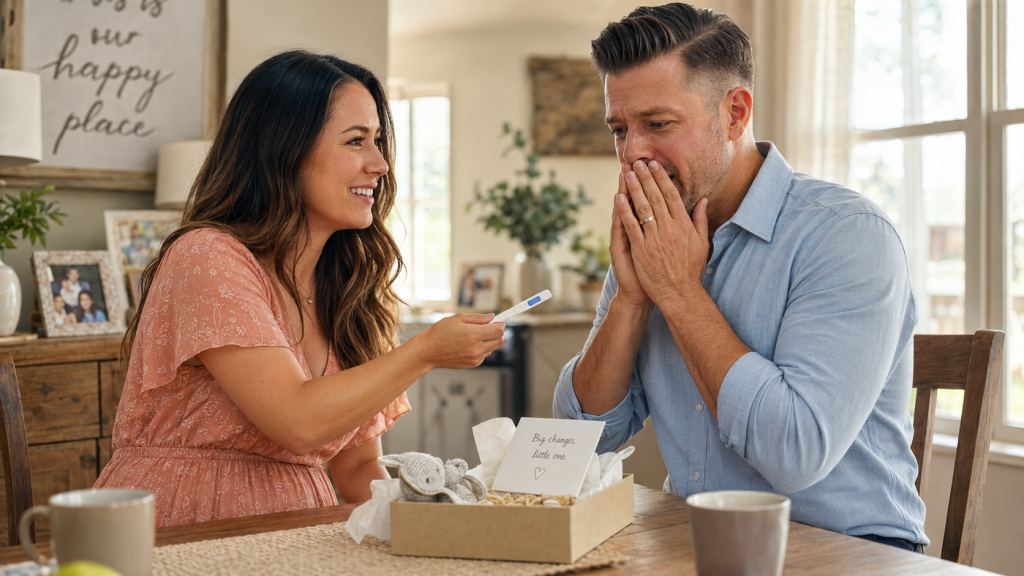
Then I placed one of the positive pregnancy tests inside a small white gift box and tied it with blue ribbon.
Not because I knew the baby was a boy.
Just because blue was Bruce’s favorite color.
I set the table with candles.
I even wore the green dress he once told me made my eyes look bright.
The whole time, I could barely stand still.
Every sound outside made me jump.
When his car finally pulled into the driveway, I pressed my hands to my stomach and whispered, “Your daddy’s home.”
The words made me cry again.
Bruce came through the front door looking tired.
He loosened his tie and smiled when he saw the table.
“What’s all this?” he asked.
“Can’t a wife make dinner for her husband?”
He narrowed his eyes playfully.
“Not with candles and cake unless I forgot something important.”
“You didn’t forget anything.”
He came closer and kissed me.
“Then what’s the occasion?”
I handed him the box.
“Open it.”
He laughed softly.
“Now I’m nervous.”
“You should be.”
But my voice trembled.
He noticed.
His smile softened.
“Anna?”
“Just open it.”
He untied the ribbon carefully, the way he always opened gifts, like he did not want to damage even the wrapping.
Then he lifted the lid.
At first, he did not understand.
He stared at the pregnancy test in silence.
Then his face changed.
The smile disappeared.
His skin went pale.
His fingers tightened around the box.
I waited for joy.
For laughter.
For tears.
For anything.
But he only looked at me as if I had just handed him something terrible.
“Bruce?” I whispered.
He swallowed.
His eyes lifted to mine.
And then he said it.
“Before this baby is born, there’s something you need to know.”
The room became painfully quiet.
The candles flickered between us.
“What do you mean?” I asked.
Bruce lowered himself into the chair like his legs had given out.
He set the box on the table.
Then he put both hands over his face.
I had seen my husband upset before.
I had seen him angry, exhausted, disappointed, even grieving.
But I had never seen him look afraid of me.
“Bruce,” I said again, sharper this time. “What do you mean?”
He dragged his hands down his face.
His eyes were wet.
“I should have told you years ago.”
My stomach turned cold.
“Told me what?”
He looked at the pregnancy test again and shook his head.
“When I was twenty-three, before I met you, I had an accident.”
I blinked.
“What accident?”
“A car accident. Bad one. I was in the hospital for almost two weeks.”
I remembered the scar on his lower abdomen.
He had always said it came from surgery after an accident.
But he never spoke about it in detail.
I never pushed.
“The doctors told me there was damage,” he continued. “They said it was unlikely I’d ever be able to have children.”
The words landed slowly.
At first, I did not understand them.
Then I understood too well.
I sat down across from him.
“You knew?”
He flinched.
“Anna—”
“You knew there was a chance you couldn’t have children?”
He nodded.
My hands began to shake.
“All those appointments,” I whispered. “All those tests. All those nights I cried because I thought my body was failing us.”
His face crumpled.
“I’m sorry.”
“You let me believe it might be me.”
“I didn’t know how to say it.”
I stared at him.
“You didn’t know how to say it?”
“I was ashamed.”
“So you lied?”
“I never meant to hurt you.”
“But you did.”
My voice cracked on the last word.
Bruce reached for my hand, but I pulled away.
For nine years, we had stood together in doctor’s offices.
For nine years, I had answered questions about my body.
For nine years, I had taken tests, swallowed pills, tracked cycles, and blamed myself in quiet ways I never admitted aloud.
And he had known.
Maybe not for certain.
But he had known enough to tell me.
“You should have told me before we got married,” I said.
“I know.”
“You should have told me before I spent years wondering what was wrong with me.”
“I know.”
“You should have told the doctors.”
His silence answered before his mouth did.
My eyes widened.
“You didn’t?”
He looked down.
“Not the whole truth.”
I stood up so fast the chair scraped against the floor.
“Oh my God.”
“Anna, please.”
“No. Don’t please me right now.”
I pressed a hand to my stomach.
Suddenly, the baby I had celebrated only moments earlier felt surrounded by fear.
“What are you thinking?” I asked.
He looked confused.
“What?”
“You went pale when you saw the test. So what are you thinking?”
“Anna—”
“Say it.”
His lips parted, but no words came.
My heart broke in a new place.
“You think the baby isn’t yours.”
“No.”
“You do.”
“No,” he said louder, standing. “No, that is not what I think.”
“Then why did you look at me like that?”
“Because I thought I had ruined everything before it even began.”
I laughed once, bitterly.
“You thought you ruined everything? I just found out my husband kept the biggest secret of our marriage from me.”
“I was afraid you would leave.”
I stared at him.
“What?”
“When we first started dating, I knew how much you loved children. I saw you with your nieces, with babies at church, with kids at the park. You had this light around you.” He swallowed hard. “I thought if I told you, you’d choose someone else. Someone who could give you what you wanted.”
My anger faltered, but only for a second.
“So you made the choice for me.”
He closed his eyes.
“Yes.”
That hurt more than the lie itself.
Because it was true.
He had stolen my choice and called it protection.
I left the dinner untouched.
The cake sat in the middle of the table, perfect and ridiculous.
Bruce slept on the couch that night.
I did not sleep at all.
I lay in bed with one hand on my stomach and the other gripping the blanket, trying to separate joy from pain.
I was pregnant.
That was still true.
A tiny life was growing inside me after all the years I had stopped believing.
But Bruce’s confession had cracked the foundation under our happiness.
By morning, my eyes were swollen.
Bruce was sitting at the kitchen table when I came downstairs.
He had not changed clothes.
He looked like he had aged overnight.
“I made an appointment,” he said quietly.
“With who?”
“A fertility specialist. The best one I could find. They can see us tomorrow morning.”
I crossed my arms.
“Why?”
“Because you deserve answers.”
“I deserved answers nine years ago.”
He nodded.
“You did.”
His voice was so quiet that some of my anger had nowhere to land.
“I’m not asking you to forgive me today,” he said. “I’m asking you to let me face this with you now.”
I looked away.
Part of me wanted to refuse.
Part of me wanted to punish him.
Part of me wanted to pack a bag and go to my sister’s house.
But another part of me, the part that had loved him through almost a decade of ordinary mornings and difficult nights, wanted the truth.
So the next morning, we went together.
The specialist was a calm woman named Dr. Patel.
She had silver glasses, kind eyes, and the rare ability to speak honestly without making it feel cruel.
Bruce brought every medical record he could find.
Old hospital papers.
Surgery notes.
Test results from years ago.
He had kept them hidden in a locked box in the garage.
Watching him place them on the doctor’s desk made my chest ache.
Dr. Patel reviewed everything carefully.
Then she ordered new tests for Bruce and confirmed my pregnancy with another blood test and ultrasound scheduling.
When she returned to the room, she looked at Bruce first.
“Your old diagnosis was serious,” she said. “But it was never absolute.”
Bruce frowned.
“What does that mean?”
“It means the doctors told you conception was unlikely, not impossible.”
He stared at her.
“But they said—”
“They gave you a prognosis based on the damage at the time. But the human body can change. Healing can happen in ways we don’t always predict.”
I held my breath.
Dr. Patel turned to me.
“And based on your current pregnancy timeline, nothing here suggests anything unusual.”
Bruce’s eyes filled with tears.
“So the baby could be mine?”
Dr. Patel gave a gentle smile.
“Medically, yes. Absolutely.”
He covered his mouth.
For a moment, he did not make a sound.
Then his shoulders started shaking.
I had seen Bruce cry before, but never like that.
This was not quiet sadness.
This was nine years of fear breaking open all at once.
I watched him fall apart beside me, and my own tears came too.
Not because everything was fixed.
It was not.
But because the baby was real.
The miracle was real.
And Bruce had been carrying a fear so heavy that it had twisted him into secrecy.
On the drive home, neither of us spoke for a long time.
Rain tapped lightly against the windshield.
Finally, Bruce said, “I understand if you can’t forgive me.”
I looked out the window.
“I don’t know what I can do yet.”
He nodded.
“I’ll wait.”
“That’s not enough.”
“I know.”
I turned to him.
“No more secrets. Not one. Not even something you think will hurt me.”
His hands tightened on the steering wheel.
“I promise.”
“And we go to counseling.”
“Yes.”
“And you don’t get to rush me into being okay because I’m pregnant.”
His jaw trembled.
“I won’t.”
I nodded, though my heart still felt bruised.
In the weeks that followed, happiness and pain lived side by side in our house.
Some mornings, Bruce would bring me ginger tea and crackers because nausea hit before sunrise.
Some evenings, I would find him standing in the doorway of the spare room, staring at the empty space where a crib might go.
He bought pregnancy books.
Too many of them.
He highlighted paragraphs and wrote questions in the margins.
He came to every appointment.
At the first ultrasound, when the tiny heartbeat filled the room, he broke down again.
The sound was fast and strong.
Like a little horse running toward us.
I cried too, but for a different reason.
Because joy had returned.
Not fully.
Not simply.
But enough.
Still, trust does not grow back overnight.
At counseling, I said things I had kept buried for years.
I told Bruce how many times I had hated my own body.
How many times I had smiled at baby showers and cried in the car afterward.
How many times I had secretly wondered if he would have been happier with someone else.
He cried through most of it.
“I thought I was the broken one,” he said one night. “And instead of telling you, I let you believe you might be.”
“Yes,” I said.
He lowered his head.
“I don’t know how to forgive myself for that.”
“That’s not my job to fix.”
“I know.”
But little by little, he changed.
Not in dramatic ways.
In quiet ones.
He stopped hiding behind jokes.
He answered hard questions even when they made him uncomfortable.
He told me about the accident in detail.
About waking up in the hospital.
About the doctor telling him that fatherhood might never happen.
About the way he had built an entire identity around being damaged before he ever met me.
And I listened.
Not because his pain erased mine.
But because marriage, real marriage, is not the absence of wounds.
It is deciding whether two wounded people can still tell the truth.
When I was four months pregnant, we painted the spare room.
For years, that room had been my office.
A practical room.
A safe room.
A room that did not ask questions.
Now it smelled like fresh paint and possibility.
Bruce wanted yellow.
I wanted soft green.
We chose both.
He stood on a ladder, painting near the ceiling, while I sat in a chair giving unnecessary instructions.
“You missed a spot.”
He looked down at me.
“You’ve said that six times.”
“And I was right six times.”
For the first time in weeks, he laughed without sadness behind it.
The sound filled the room, and something inside me loosened.
Later, he came down from the ladder and knelt in front of me.
He placed both hands gently on my stomach.
“Hi, little one,” he whispered. “It’s your dad.”
The word dad caught in his throat.
I covered his hands with mine.
For a moment, there was no secret between us.
Only the three of us, sitting in a half-painted room, surrounded by colors we chose together.
At six months, we found out we were having a girl.
Bruce cried again, which had become so common that the ultrasound technician handed him tissues before saying anything.
“A daughter,” he whispered.
On the way home, he was quiet.
I worried at first.
Then he said, “I don’t want fear to be the first thing I give her.”
I looked at him.
“Then don’t.”
“I want to be honest with her. Always.”
“You can start by being honest with yourself.”
He nodded.
That night, he called his father.
I did not hear the whole conversation, only pieces from the hallway.
“I should have told Anna.”
“I was scared.”
“No, Dad, it wasn’t her fault.”
“I know that now.”
Later, he came to bed with red eyes and lay beside me carefully, as if I were made of glass.
“My father told me men keep pain to themselves,” he said. “He said that’s what strength is.”
I turned toward him.
“And what do you think?”
He looked at my stomach.
“I think keeping pain to myself almost cost me my family.”
I reached for his hand.
It was not forgiveness.
Not completely.
But it was something.
A bridge, maybe.
By the eighth month, my feet were swollen, my back hurt, and Bruce had turned into a nervous guard dog.
He packed the hospital bag three times.
He installed the car seat, removed it, watched another video, and installed it again.
He taped a list of emergency numbers to the fridge.
He asked Dr. Patel so many questions that she finally smiled and said, “Bruce, breathe.”
He tried.
He really did.
Then, one night, I woke up to cramps.
At first, I thought it was the usual discomfort.
Then my water broke.
Bruce panicked so badly he put on two different shoes.
“Bruce,” I said, gripping the doorframe, “focus.”
“I am focused.”
“You’re wearing one sneaker and one dress shoe.”
He looked down.
“Oh.”
Despite the pain, I laughed.
And somehow that laugh carried us to the hospital.
Labor was long.
Longer than I expected.
Harder than anything I had ever done.
There were moments when I thought I could not keep going.
Bruce stayed beside me the entire time.
He held my hand.
He wiped my forehead.
He whispered, “You’re doing it, Anna. You’re doing it.”
At one point, when the pain became unbearable, I looked at him and said, “I hate you.”
He nodded seriously.
“That’s fair.”
The nurse laughed.
Hours later, just before dawn, our daughter came into the world.
She arrived screaming.
Tiny.
Pink.
Furious.
Perfect.
The doctor placed her on my chest, and the entire world narrowed to the warmth of her small body against mine.
Bruce stood beside the bed, frozen.
His mouth trembled.
His eyes were wide.
“Bruce,” I whispered.
He looked at me.
Then at her.
“This is Lily,” I said.
We had chosen the name two weeks earlier.
Lily Grace.
He reached out with one shaking finger and touched her tiny hand.
She wrapped her fingers around him.
And Bruce broke.
He sank into the chair beside the bed and sobbed like a man who had been forgiven by life itself.
“I’m sorry,” he whispered, though I did not know if he was speaking to me, to himself, or to the baby.
I watched him cry.
Then I looked at our daughter.
Her eyes were closed.
Her cheek rested against my skin.
For years, I had imagined motherhood as a door that would never open for me.
Now she was here, breathing softly against my chest.
A miracle.
Not clean.
Not simple.
Not born from a perfect love story.
But real.
Two days later, when we brought Lily home, the house looked different.
The same walls.
The same furniture.
The same kitchen where Bruce had confessed his secret.
But everything had changed.
The white gift box still sat on a shelf in our bedroom.
Inside it was the pregnancy test that had started the storm.
For a while, I had wanted to throw it away.
Now I kept it.
Not as a symbol of perfect happiness.
But as proof that one moment can hold more than one truth.
It had been the happiest day of my life.
It had also been the day my heart broke.
And somehow, both truths had led us here.
Months passed.
Sleep became rare.
Laundry became endless.
Our conversations became whispers over a crib at three in the morning.
Bruce changed diapers with the seriousness of a surgeon.
He sang terribly.
Lily loved it anyway.
Sometimes, I would wake to find him standing by her crib, one hand resting on the rail, watching her sleep.
One night, I found him there crying quietly.
I stepped beside him.
“What is it?”
He wiped his face.
“I almost let fear steal this from me.”
I looked down at Lily.
“But it didn’t.”
He turned to me.
“Do you forgive me?”
I was quiet for a long moment.
Forgiveness is not a switch.
It is not one beautiful sentence spoken at the perfect time.
It is a road.
Some days smooth.
Some days full of stones.
Finally, I said, “I’m getting there.”
He nodded, accepting that answer like it was more than he deserved.
Then he whispered, “I’ll keep walking with you until you do.”
And he did.
Years later, when Lily was old enough to ask questions about the small white box in our room, Bruce and I sat her between us on the bed.
We did not tell her everything.
Not yet.
But we told her she was wanted.
We told her she was prayed for.
We told her she arrived after a long season of waiting.
She touched the ribbon on the box and smiled.
“So I was a surprise?”
Bruce looked at me.
I looked at him.
Then he kissed the top of her head.
“The best surprise,” he said.
And this time, when he smiled, there was no fear in his face.
Only gratitude.
Only love.
Only the quiet understanding that some miracles do not arrive to make life perfect.
They arrive to bring the truth into the light.
And sometimes, if two people are brave enough to face what the light reveals, love can grow again.
Not the same as before.
But stronger.
Deeper.
Honest.
The day I found out I was pregnant, I thought I was giving my husband a gift.
I did not know I was also opening the door to a secret he had carried for years.
I did not know joy and heartbreak could sit at the same dinner table.
I did not know a tiny pink line could change a marriage, expose a lie, and still lead us toward healing.
But now, whenever I see Bruce holding our daughter, whenever I hear Lily call him Daddy, whenever I remember the man who went pale because he was terrified of losing me, I understand something I did not understand then.
Love is not proven by never being afraid.
Love is proven by what you do after fear tells you to hide.
Bruce hid for too long.
But in the end, he chose the truth.
And the truth gave us back more than we thought we had lost.
It gave us our daughter.
It gave us our family.
And it gave us a second chance.
One we never stopped being grateful for.
THE END.
THE END! THANK YOU FOR READING